module JEEP COMPASS 2023 Owners Manual
[x] Cancel search | Manufacturer: JEEP, Model Year: 2023, Model line: COMPASS, Model: JEEP COMPASS 2023Pages: 344, PDF Size: 18.8 MB
Page 164 of 344
162STARTING AND OPERATING
Flowing Water
If the water is swift flowing and rising (as in storm
run-off) avoid crossing until the water level recedes
and/or the flow rate is reduced. If you must cross
flowing-water, avoid depths in excess of 9 inches
(22 cm). The flowing water can erode the
streambed causing your vehicle to sink into deeper
water. Determine exit point(s) that are downstream
of your entry point to allow for drifting.
Standing Water
Avoid driving in standing water deeper than
16 inches (40.5 cm), and reduce speed
appropriately to minimize wave effects. Maximum
speed in 16 inches (40.5 cm) of water is less than
5 mph (8 km/h).
(Trailhawk only): Avoid driving in standing water
deeper than 19 inches (48 cm), and reduce speed
appropriately to minimize wave effects. Maximum
speed in 19 inches (48 cm) of water is less than
5 mph (8 km/h).
Maintenance
After driving through deep water, inspect your
vehicle fluids and lubricants (engine, transmission,
Power Transfer Unit, and Rear Drive Module) to
ensure they have not been contaminated.
Contaminated fluids and lubricants (milky, foamy
in appearance) should be flushed/changed as
soon as possible to prevent component damage.
Driving In Snow, Mud And Sand
In heavy snow, when pulling a load, or for
additional control at slower speeds, shift the
transmission to a low gear and shift the 4WD
system to the appropriate terrain mode, using
4WD LOW if necessary Úpage 112. Do not shift to
a lower gear than necessary to maintain headway.
Over-revving the engine can spin the wheels and
traction will be lost.
Avoid abrupt downshifts on icy or slippery roads
because engine braking may cause skidding and
loss of control.
Hill Climbing
NOTE:Before attempting to climb a hill, determine the
conditions at the crest and/or on the other side.
Before climbing a steep hill, shift the transmission
to a lower gear and shift the 4WD System to 4WD
LOW. Use FIRST gear and 4WD LOW for very steep
hills.
NOTE:Brakes should be applied at increased slippage,
but before coming to a stop to avoid digging into
the loose surface and rendering the operator of the
vehicle stuck/immobile. If you stall or begin to lose headway
while climbing
a steep hill, allow your vehicle to come to a stop
and immediately apply the brakes. Once stopped,
shift to REVERSE. Back slowly down the hill
allowing the compression braking of the engine to
help regulate your speed. If the brakes are
required to control vehicle speed, apply them
lightly and avoid locking or skidding the tires.
NOTE:Remember, never drive diagonally across a hill -
drive straight up or down.
If the wheels start to slip as you approach the crest
of a hill, ease off the accelerator and maintain
headway by turning the front wheels slowly left and
right. This may provide a fresh “bite” into the
surface and may provide traction to complete the
climb.
WARNING!
If the engine stalls or you lose headway or
cannot make it to the top of a steep hill or grade,
never attempt to turn around. To do so may
result in tipping and rolling the vehicle. Always
back straight down a hill in REVERSE gear
carefully. Never back down a hill in NEUTRAL
using only the brake.
22_MP_OM_EN_USC_t.book Page 162
Page 190 of 344
188SAFETY
Light does not come on when the ignition is placed
in the ON/RUN mode, have the light repaired as
soon as possible.
ELECTRONIC BRAKE CONTROL (EBC)
S
YSTEM
Your vehicle is equipped with an advanced
Electronic Brake Control (EBC) system. This system
includes Anti-Lock Brake System (ABS), Brake Assist
System (BAS), Electronic Brake Force Distribution
(EBD), Electronic Roll Mitigation (ERM), Electronic
Stability Control (ESC), Hill Start Assist (HSA), and
Traction Control System (TCS). These systems work
together to enhance both vehicle stability and
control in various driving conditions.
Your vehicle may also be equipped with Dynamic
Steering Torque (DST), Hill Descent Control (HDC),
Rain Brake Support (RBS), Ready Alert Braking
(RAB), and Trailer Sway Control (TSC).
Brake Assist System (BAS)
The BAS is designed to optimize the vehicle’s
braking capability during emergency braking
maneuvers. The system detects an emergency
braking situation by sensing the rate and amount
of brake application and then applies optimum
pressure to the brakes. This can help reduce
braking distances. The BAS complements the
Anti-Lock Brake System (ABS). Applying the brakes
very quickly results in the best BAS assistance. To receive the benefit of the system, you must
apply continuous braking pressure during the
stopping sequence (do not “pump” the brakes). Do
not reduce brake pedal pressure unless braking is
no longer desired. Once the brake pedal is
released, the BAS is deactivated.
Brake System Warning Light
The red Brake System Warning Light will turn on
when the ignition is placed in the ON/RUN mode
and may stay on for as long as four seconds.
If the Brake System Warning Light remains on or
comes on while driving, it indicates that the brake
system is not functioning properly and that
immediate service is required. If the Brake System
Warning Light does not come on when the ignition
is placed in the ON/RUN mode, have the light
repaired as soon as possible.
Dynamic Steering Torque (DST)
DST is a feature of the Electronic Stability Control
(ESC) and Electric Power Steering (EPS) modules
that provides torque at the steering wheel for
certain driving conditions in which the ESC module
is detecting vehicle instability. The torque that the
steering wheel receives is only meant to help the
driver realize optimal steering behavior in order to
reach/maintain vehicle stability. The only
notification the driver receives that the feature is
active is the torque applied to the steering wheel.
NOTE:The DST feature is only meant to help the driver
realize the correct course of action through small
torques on the steering wheel, which means the
effectiveness of the DST feature is highly
dependent on the driver’s sensitivity and overall
reaction to the applied torque. It is very important
to realize that this feature will not steer the vehicle,
meaning the driver is still responsible for steering
the vehicle.
Electronic Brake Force Distribution (EBD)
EBD manages the distribution of the braking
torque between the front and rear axles by limiting
braking pressure to the rear axle. This is done to
prevent overslip of the rear wheels to avoid vehicle
instability, and to prevent the rear axle from
entering ABS before the front axle.
WARNING!
The Brake Assist System (BAS) cannot prevent the
natural laws of physics from acting on the vehicle,
nor can it increase the traction afforded by
prevailing road conditions. BAS cannot prevent
collisions, including those resulting from excessive
speed in turns, driving on very slippery surfaces, or
hydroplaning. The capabilities of a BAS-equipped
vehicle must never be exploited in a reckless or
dangerous manner, which could jeopardize the
user's safety or the safety of others.
22_MP_OM_EN_USC_t.book Page 188
Page 204 of 344
202SAFETY
(Continued)
be on. In this situation, the Tire Pressure
Monitoring System Warning Light will turn off only
after the tires are inflated to the vehicle’s
recommended cold placard pressure value
Ú
page 328.
NOTE:When filling warm tires, the tire pressure may need
to be increased up to an additional 4 psi (28 kPa)
above the recommended cold placard pressure in
order to turn the Tire Pressure Monitoring System
Warning Light off.
NOTE:
The TPMS is not intended to replace normal tire
care and maintenance, or to provide warning of
a tire failure or condition.
The TPMS should not be used as a tire pressure
gauge while adjusting your tire pressure.
Driving on a significantly underinflated tire
causes the tire to overheat and can lead to tire
failure. Underinflation also reduces fuel effi -
ciency and tire tread life, and may affect the
vehicle’s handling and stopping ability.
The TPMS is not a substitute for proper tire
maintenance, and it is the driver’s responsibility
to maintain correct tire pressure using an accu -
rate tire pressure gauge, even if underinflation
has not reached the level to trigger illumination
of the Tire Pressure Monitoring System Warning
Light.
Seasonal temperature changes will affect tire
pressure, and the TPMS will monitor the actual
tire pressure in the tire.
Premium System
The Tire Pressure Monitoring System (TPMS) uses
wireless technology with wheel rim mounted
electronic sensors to monitor tire pressure levels.
Sensors, mounted to each wheel as part of the
valve stem, transmit tire pressure readings to the
receiver module.
NOTE:It is particularly important for you to check the tire
pressure in all of the tires on your vehicle monthly
and to maintain the proper pressure.
The TPMS consists of the following components:
Receiver module
Four Tire Pressure Monitoring System sensors
Various Tire Pressure Monitoring System
messages, which will display in the instrument
cluster display
Tire Pressure Monitoring System Warning Light
CAUTION!
The TPMS has been optimized for the original
equipment tires and wheels. TPMS pressures
and warning have been established for the tire
size equipped on your vehicle. Undesirable
system operation or sensor damage may
result when using replacement equipment
that is not of the same size, type, and/or style.
The TPMS sensor is not designed for use on
aftermarket wheels and may contribute to a
poor overall system performance or sensor
damage. Customers are encouraged to use
OEM wheels to ensure proper TPMS feature
operation.
Using aftermarket tire sealants may cause the
Tire Pressure Monitoring System (TPMS)
sensor to become inoperable. After using an
aftermarket tire sealant it is recommended
that you take your vehicle to an authorized
dealer to have your sensor function checked.
After inspecting or adjusting the tire pressure
always reinstall the valve stem cap. This will
prevent moisture and dirt from entering the
valve stem, which could damage the TPMS
sensor.
CAUTION!
22_MP_OM_EN_USC_t.book Page 202
Page 218 of 344
216SAFETY
Occupant Classification System (OCS) —
Front Passenger Seat
The Occupant Classification System (OCS) is part of
a Federally regulated safety system for this vehicle.
It is designed to provide Passenger Advanced Front
Air Bag output appropriate to the occupant’s seated
weight, as determined by the OCS.
The Occupant Classification System (OCS) consists
of the following:
Occupant Restraint Controller (ORC)
Occupant Classification Module (OCM) and
Sensor located in the front passenger seat
Air Bag Warning Light
Occupant Classification Module (OCM) And Sensor
The Occupant Classification Module (OCM) is
located underneath the front passenger seat. The
Sensor is located beneath the passenger seat
cushion foam. Any weight on the seat will be
sensed by the Sensor. The OCM uses input from
the Sensor to determine the front passenger’s
most probable classification. The OCM
communicates this information to the ORC. The
ORC may reduce the inflation rate of the Passenger
Advanced Front Air Bag deployment based on
occupant classification. In order for the OCS to
operate as designed, it is important for the front
passenger to be seated properly and properly
wearing the seat belt. The OCS will NOT prevent deployment of the
Passenger Advanced Front Air Bag. The OCS may
reduce the inflation rate of the Passenger
Advanced Front Air Bag if the OCS estimates that:
The front passenger seat is unoccupied or has
very light objects on it; or
The front passenger seat is occupied by a small
passenger, including a child; or
The front passenger seat is occupied by a
rear-facing child restraint; or
The front passenger is not properly seated or his
or her weight is taken off of the seat for a period
of time.
* It is possible for a child to be classified as an
adult, allowing a full-power Passenger Advanced
Front Air Bag deployment. Never allow children to
ride in the front passenger seat and never install a
child restraint system, including a rear-facing child
restraint, in the front passenger seat.
The OCS determines the front passenger’s most
probable classification. The OCS estimates the
seated weight on the front passenger seat and
where that weight is located. The OCS
communicates the classification status to the ORC.
Front Passenger Seat
Occupant Status Front Passenger
Air Bag Output
Rear-facing child
restraint Reduced-power
deployment
Child, including a child
in a forward-facing
child restraint or
booster seat* Reduced-power
deployment OR
Full-power deployment
Properly seated adult Full-power deployment
OR reduced-power
deployment
Unoccupied seat Reduced-power
deployment
WARNING!
Never place a rear-facing child restraint in
front of an air bag. A deploying passenger
front air bag can cause death or serious injury
to a child 12 years or younger, including a
child in a rear-facing child restraint.
Never install a rear-facing child restraint in the
front seat of a vehicle. Only use a rear-facing
child restraint in the rear seat. If the vehicle
does not have a rear seat, do not transport a
rear-facing child restraint in that vehicle.
Children 12 years or younger should always
ride buckled up in the rear seat of a vehicle
with a rear seat.
22_MP_OM_EN_USC_t.book Page 216
Page 248 of 344
246IN CASE OF EMERGENCY
SOS Call System Limitations
Vehicles sold in Mexico DO NOT have SOS Call
system capabilities.
SOS or other emergency line operators in Mexico
may not answer or respond to SOS system calls. If the SOS Call system detects a malfunction, any
of the following may occur at the time the
malfunction is detected, and at the beginning of
each ignition cycle:
The Rearview Mirror light located next to the
SOS button will continuously illuminate red.
The Device Screen will display the following
message “Vehicle device requires service.
Please contact an authorized dealer.”
An In-Vehicle Audio message will state “Vehicle
device requires service. Please contact an
authorized dealer.”
Even if the SOS Call system is fully functional,
factors beyond FCA US LLC’s control may prevent
or stop the SOS Call system operation. These
include, but are not limited to, the following
factors:
The ignition is in the OFF position
The vehicle’s electrical systems are not intact
The SOS Call system software and/or hardware
are damaged during a crash
The vehicle battery loses power or becomes
disconnected during a vehicle crash
LTE (voice/data) or 4G (data) network and/or
Global Positioning Satellite signals are unavail
-
able or obstructed
Equipment malfunction at the SOS operator
facility
Operator error by the SOS operator
LTE (voice/data) or 4G (data) network conges -
tion
Weather
Buildings, structures, geographic terrain, or
tunnels
The SOS Call system is embedded into the
vehicle’s electrical system. Do not add after -
market electrical equipment to the vehicle’s
electrical system. This may prevent your
vehicle from sending a signal to initiate an
emergency call. To avoid interference that can
cause the SOS Call system to fail, never add
aftermarket equipment (e.g., two-way mobile
radio, CB radio, data recorder, etc.) to your
vehicle’s electrical system or modify the
antennas on your vehicle. IF YOUR VEHICLE
LOSES BATTERY POWER FOR ANY REASON
(INCLUDING DURING OR AFTER AN ACCI -
DENT), THE UCONNECT FEATURES, APPS AND
SERVICES, AMONG OTHERS, WILL NOT
OPERATE.
Modifications to any part of the SOS Call
system could cause the air bag system to fail
when you need it. You could be injured if the
air bag system is not there to help protect you.
WARNING!
WARNING!
Ignoring the Rearview Mirror light could mean
you will not have SOS Call services. If the Rear -
view Mirror light is illuminated, have an autho -
rized dealer service the SOS Call system
immediately.
The Occupant Restraint Control module turns
on the air bag Warning Light on the instrument
panel if a malfunction in any part of the
system is detected. If the Air Bag Warning
Light is illuminated, have an authorized dealer
service the Occupant Restraint Control system
immediately.
22_MP_OM_EN_USC_t.book Page 246
Page 287 of 344
SERVICING AND MAINTENANCE285
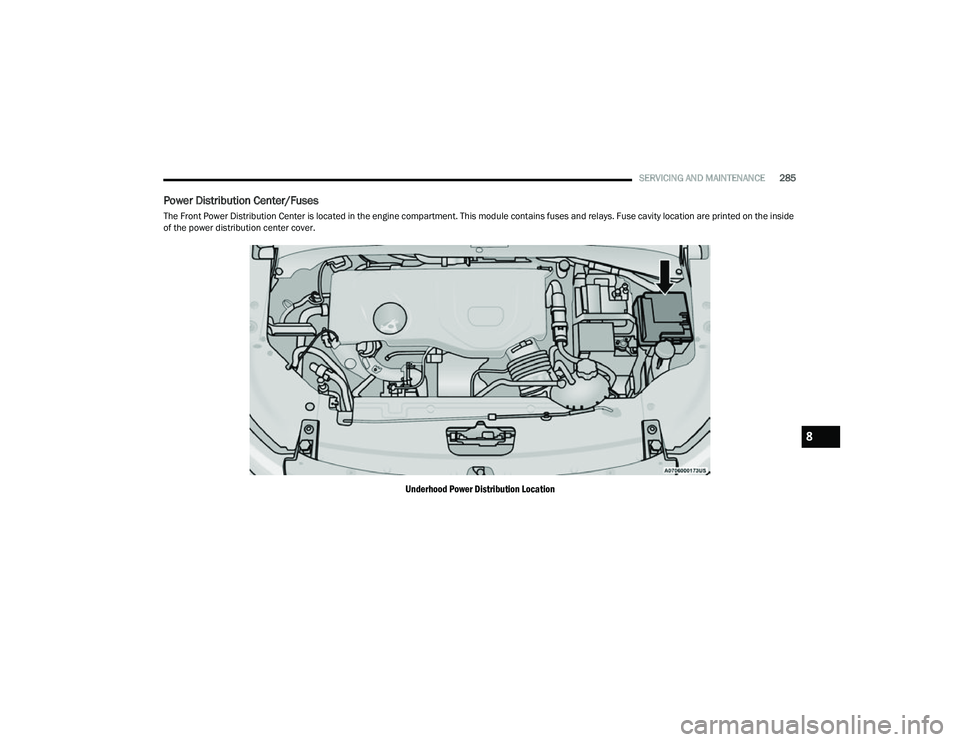
Power Distribution Center/Fuses
The Front Power Distribution Center is located in the engine compartment. This module contains fuses and relays. Fuse cavity location are printed on the inside
of the power distribution center cover.
Underhood Power Distribution Location
8
22_MP_OM_EN_USC_t.book Page 285
Page 288 of 344
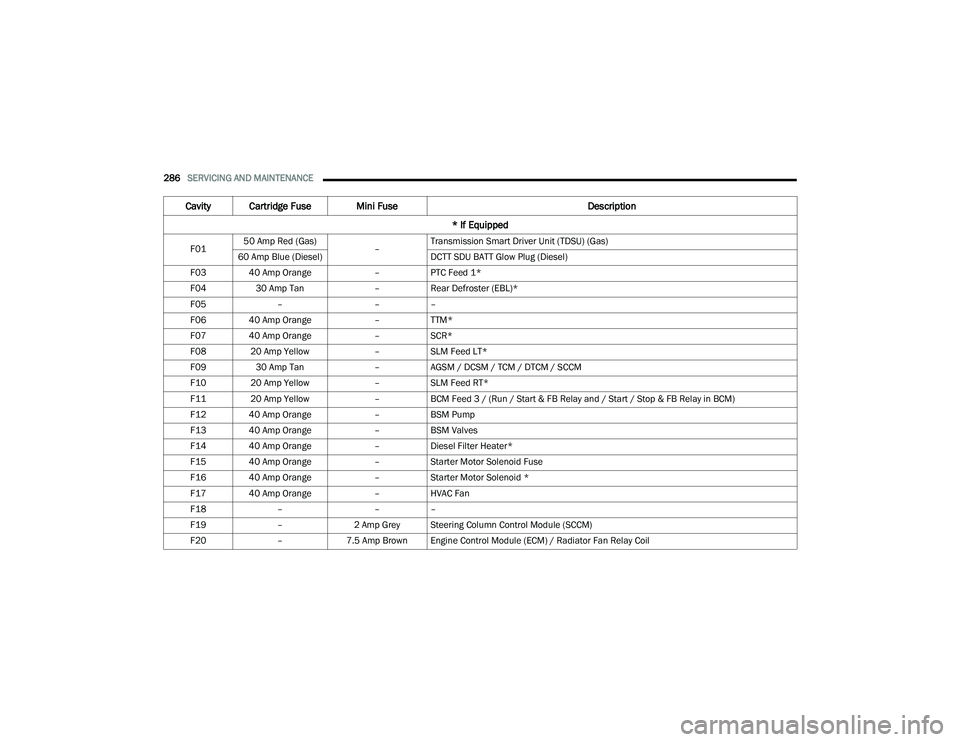
286SERVICING AND MAINTENANCE
Cavity Cartridge Fuse Mini Fuse Description
* If Equipped
F01 50 Amp Red (Gas)
–Transmission Smart Driver Unit (TDSU) (Gas)
60 Amp Blue (Diesel) DCTT SDU BATT Glow Plug (Diesel)
F03 40 Amp Orange –PTC Feed 1*
F04 30 Amp Tan –Rear Defroster (EBL)*
F05 – ––
F06 40 Amp Orange –TTM*
F07 40 Amp Orange –SCR*
F08 20 Amp Yellow –SLM Feed LT*
F09 30 Amp Tan –AGSM / DCSM / TCM / DTCM / SCCM
F10 20 Amp Yellow –SLM Feed RT*
F11 20 Amp Yellow –BCM Feed 3 / (Run / Start & FB Relay and / Start / Stop & FB Relay in BCM)
F12 40 Amp Orange –BSM Pump
F13 40 Amp Orange –BSM Valves
F14 40 Amp Orange –Diesel Filter Heater*
F15 40 Amp Orange –Starter Motor Solenoid Fuse
F16 40 Amp Orange –Starter Motor Solenoid *
F17 40 Amp Orange –HVAC Fan
F18 – ––
F19 –2 Amp Grey Steering Column Control Module (SCCM)
F20 –7.5 Amp Brown Engine Control Module (ECM) / Radiator Fan Relay Coil
22_MP_OM_EN_USC_t.book Page 286
Page 289 of 344
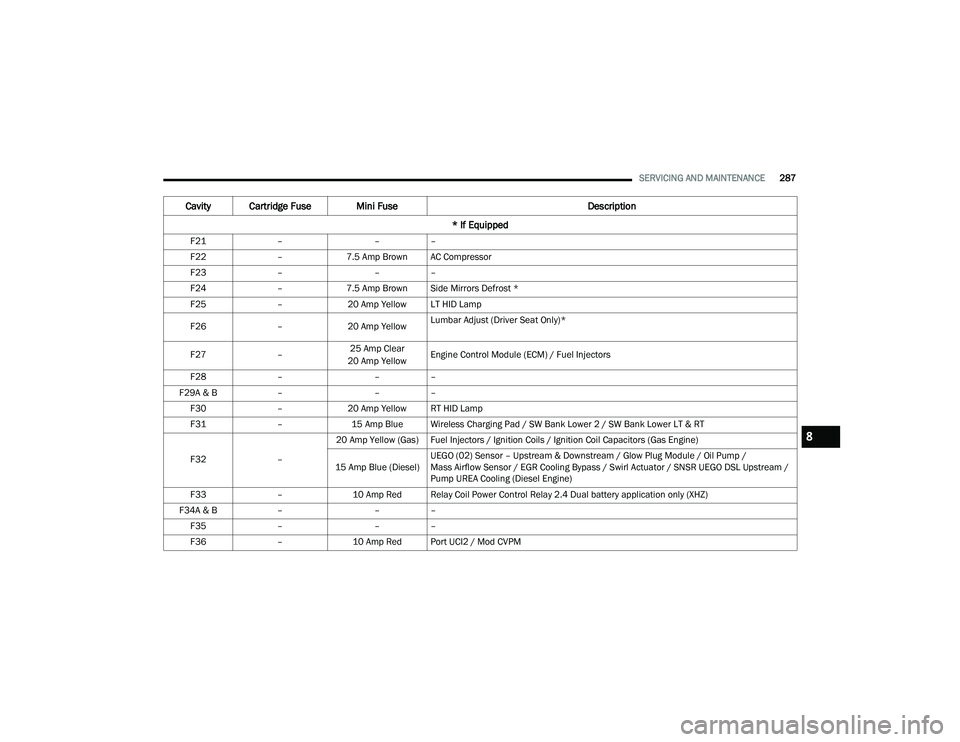
SERVICING AND MAINTENANCE287
F21 – ––
F22 –7.5 Amp Brown AC Compressor
F23 – ––
F24 –7.5 Amp Brown Side Mirrors Defrost *
F25 –20 Amp Yellow LT HID Lamp
F26 –20 Amp Yellow Lumbar Adjust (Driver Seat Only)*
F27 –25 Amp Clear
20 Amp Yellow Engine Control Module (ECM) / Fuel Injectors
F28 – ––
F29A & B –––
F30 –20 Amp Yellow RT HID Lamp
F31 –15 Amp Blue Wireless Charging Pad / SW Bank Lower 2 / SW Bank Lower LT & RT
F32 –20 Amp Yellow (Gas) Fuel Injectors / Ignition Coils / Ignition Coil Capacitors (Gas Engine)
15 Amp Blue (Diesel) UEGO (02) Sensor – Upstream & Downstream / Glow Plug Module / Oil Pump /
Mass Airflow Sensor / EGR Cooling Bypass / Swirl Actuator / SNSR UEGO DSL Upstream /
Pump UREA Cooling (Diesel Engine)
F33 –10 Amp Red Relay Coil Power Control Relay 2.4 Dual battery application only (XHZ)
F34A & B –––
F35 – ––
F36 –10 Amp Red Port UCI2 / Mod CVPM
Cavity Cartridge Fuse Mini Fuse Description
* If Equipped
8
22_MP_OM_EN_USC_t.book Page 287
Page 290 of 344
288SERVICING AND MAINTENANCE
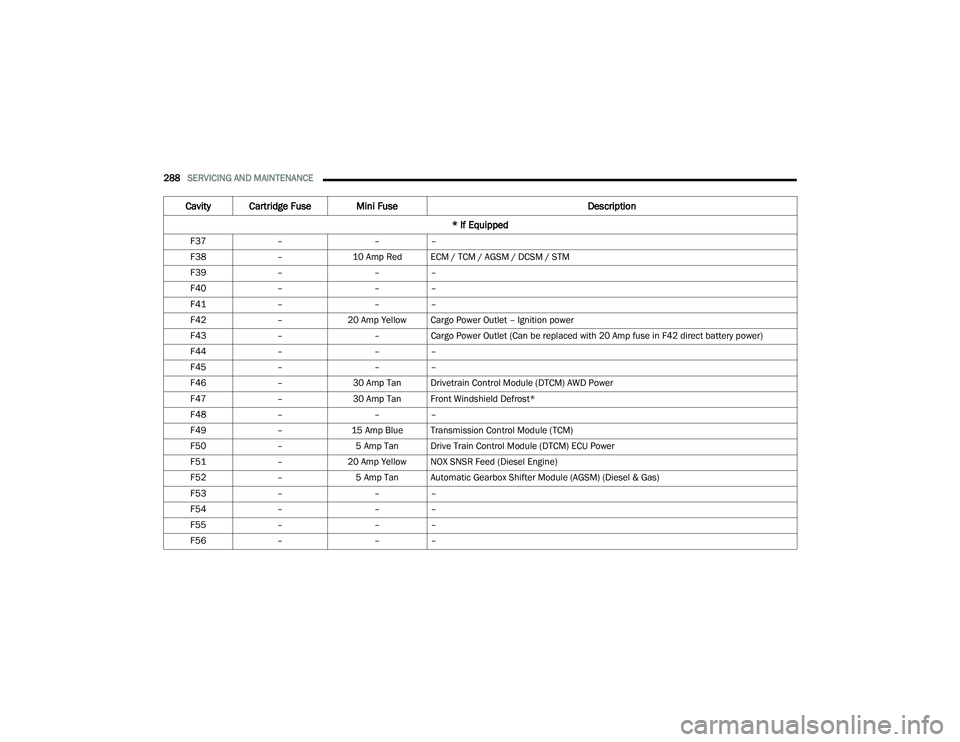
F37 – ––
F38 –10 Amp Red ECM / TCM / AGSM / DCSM / STM
F39 – ––
F40 – ––
F41 – ––
F42 –20 Amp Yellow Cargo Power Outlet – Ignition power
F43 – –Cargo Power Outlet (Can be replaced with 20 Amp fuse in F42 direct battery power)
F44 – ––
F45 – ––
F46 –30 Amp Tan Drivetrain Control Module (DTCM) AWD Power
F47 –30 Amp Tan Front Windshield Defrost*
F48 – ––
F49 –15 Amp Blue Transmission Control Module (TCM)
F50 –5 Amp Tan Drive Train Control Module (DTCM) ECU Power
F51 –20 Amp Yellow NOX SNSR Feed (Diesel Engine)
F52 –5 Amp Tan Automatic Gearbox Shifter Module (AGSM) (Diesel & Gas)
F53 – ––
F54 – ––
F55 – ––
F56 – ––
Cavity Cartridge Fuse Mini Fuse Description
* If Equipped
22_MP_OM_EN_USC_t.book Page 288
Page 291 of 344
SERVICING AND MAINTENANCE289
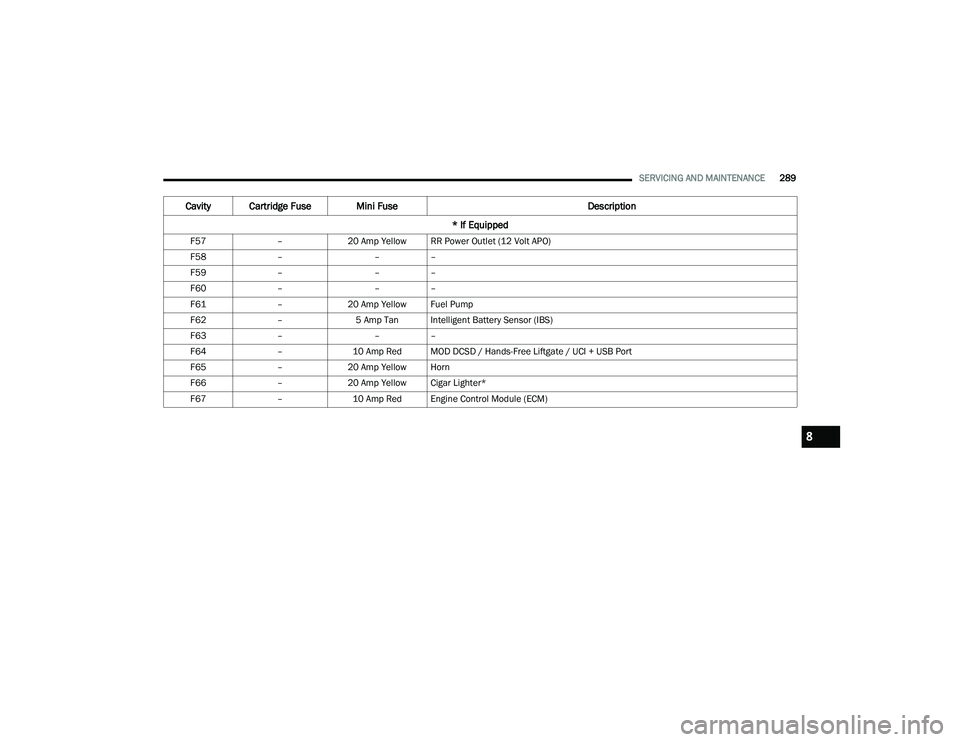
F57 –20 Amp Yellow RR Power Outlet (12 Volt APO)
F58 – ––
F59 – ––
F60 – ––
F61 –20 Amp Yellow Fuel Pump
F62 –5 Amp Tan Intelligent Battery Sensor (IBS)
F63 – ––
F64 –10 Amp Red MOD DCSD / Hands-Free Liftgate / UCI + USB Port
F65 –20 Amp Yellow Horn
F66 –20 Amp Yellow Cigar Lighter*
F67 –10 Amp Red Engine Control Module (ECM)
Cavity Cartridge Fuse Mini Fuse Description
* If Equipped
8
22_MP_OM_EN_USC_t.book Page 289