lock JEEP COMPASS TRAILHAWK 2018 Owner's Manual
[x] Cancel search | Manufacturer: JEEP, Model Year: 2018, Model line: COMPASS TRAILHAWK, Model: JEEP COMPASS TRAILHAWK 2018Pages: 554, PDF Size: 5.29 MB
Page 220 of 554
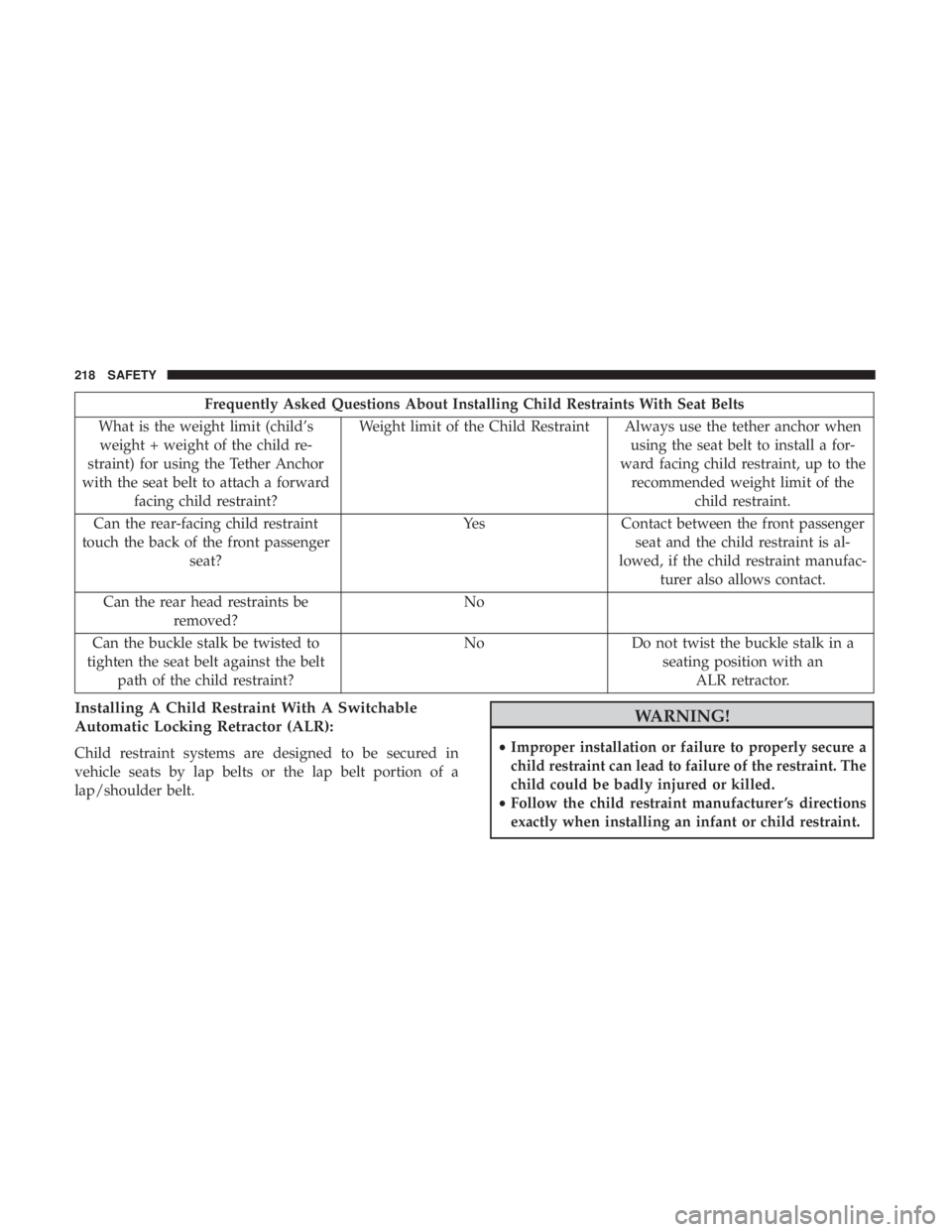
Frequently Asked Questions About Installing Child Restraints With Seat Belts
What is the weight limit (child’s weight + weight of the child re-
straint) for using the Tether Anchor
with the seat belt to attach a forward facing child restraint? Weight limit of the Child Restraint Always use the tether anchor when
using the seat belt to install a for-
ward facing child restraint, up to the recommended weight limit of the child restraint.
Can the rear-facing child restraint
touch the back of the front passenger seat? Yes Contact between the front passenger
seat and the child restraint is al-
lowed, if the child restraint manufac- turer also allows contact.
Can the rear head restraints be removed? No
Can the buckle stalk be twisted to
tighten the seat belt against the belt path of the child restraint? No
Do not twist the buckle stalk in a
seating position with an ALR retractor.
Installing A Child Restraint With A Switchable
Automatic Locking Retractor (ALR):
Child restraint systems are designed to be secured in
vehicle seats by lap belts or the lap belt portion of a
lap/shoulder belt.
Page 227 of 554
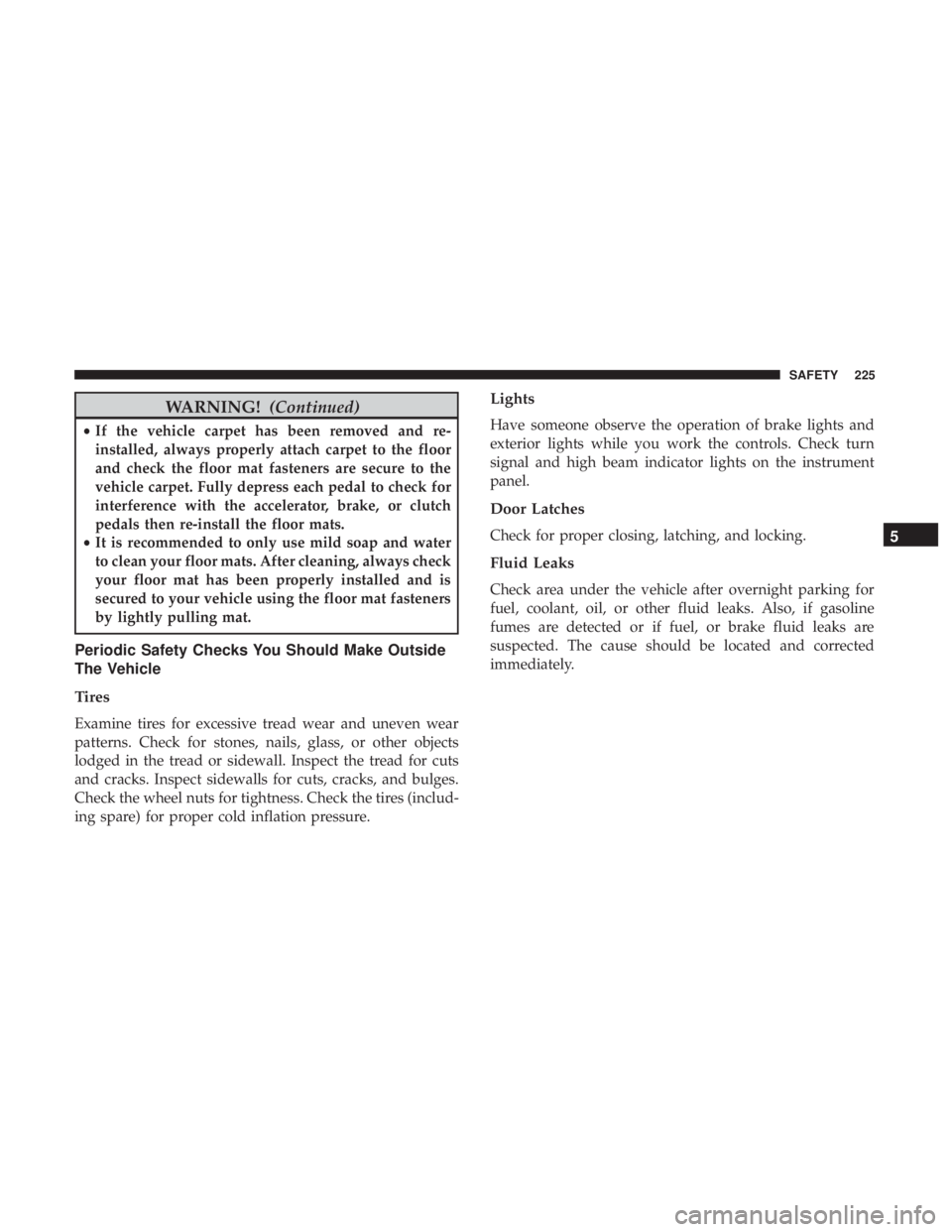
WARNING!(Continued)
•If the vehicle carpet has been removed and re-
installed, always properly attach carpet to the floor
and check the floor mat fasteners are secure to the
vehicle carpet. Fully depress each pedal to check for
interference with the accelerator, brake, or clutch
pedals then re-install the floor mats.
• It is recommended to only use mild soap and water
to clean your floor mats. After cleaning, always check
your floor mat has been properly installed and is
secured to your vehicle using the floor mat fasteners
by lightly pulling mat.
Periodic Safety Checks You Should Make Outside
The Vehicle
Tires
Examine tires for excessive tread wear and uneven wear
patterns. Check for stones, nails, glass, or other objects
lodged in the tread or sidewall. Inspect the tread for cuts
and cracks. Inspect sidewalls for cuts, cracks, and bulges.
Check the wheel nuts for tightness. Check the tires (includ-
ing spare) for proper cold inflation pressure.
Lights
Have someone observe the operation of brake lights and
exterior lights while you work the controls. Check turn
signal and high beam indicator lights on the instrument
panel.
Door Latches
Check for proper closing, latching, and locking.
Fluid Leaks
Check area under the vehicle after overnight parking for
fuel, coolant, oil, or other fluid leaks. Also, if gasoline
fumes are detected or if fuel, or brake fluid leaks are
suspected. The cause should be located and corrected
immediately.
5
SAFETY 225
Page 237 of 554
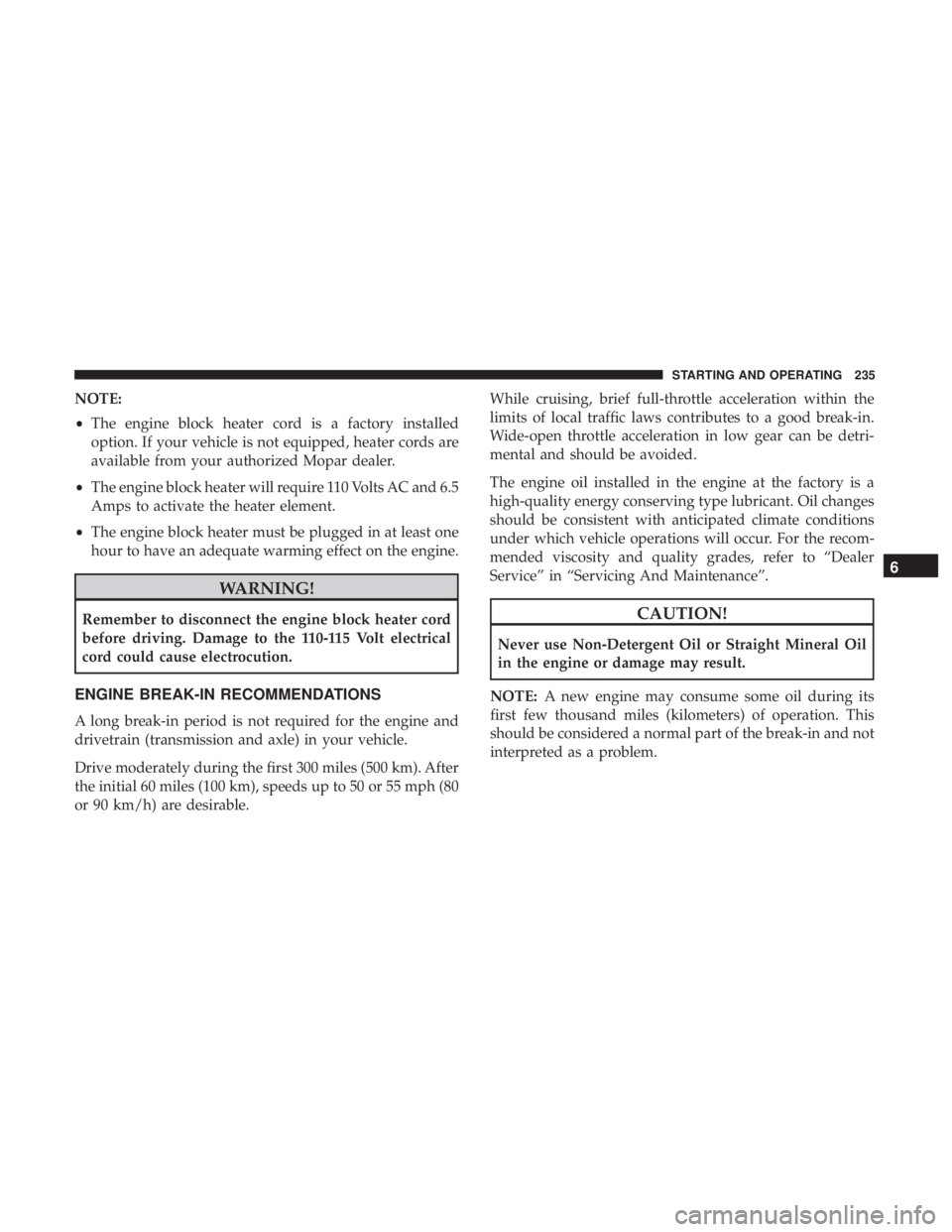
NOTE:
•The engine block heater cord is a factory installed
option. If your vehicle is not equipped, heater cords are
available from your authorized Mopar dealer.
• The engine block heater will require 110 Volts AC and 6.5
Amps to activate the heater element.
• The engine block heater must be plugged in at least one
hour to have an adequate warming effect on the engine.
Page 239 of 554
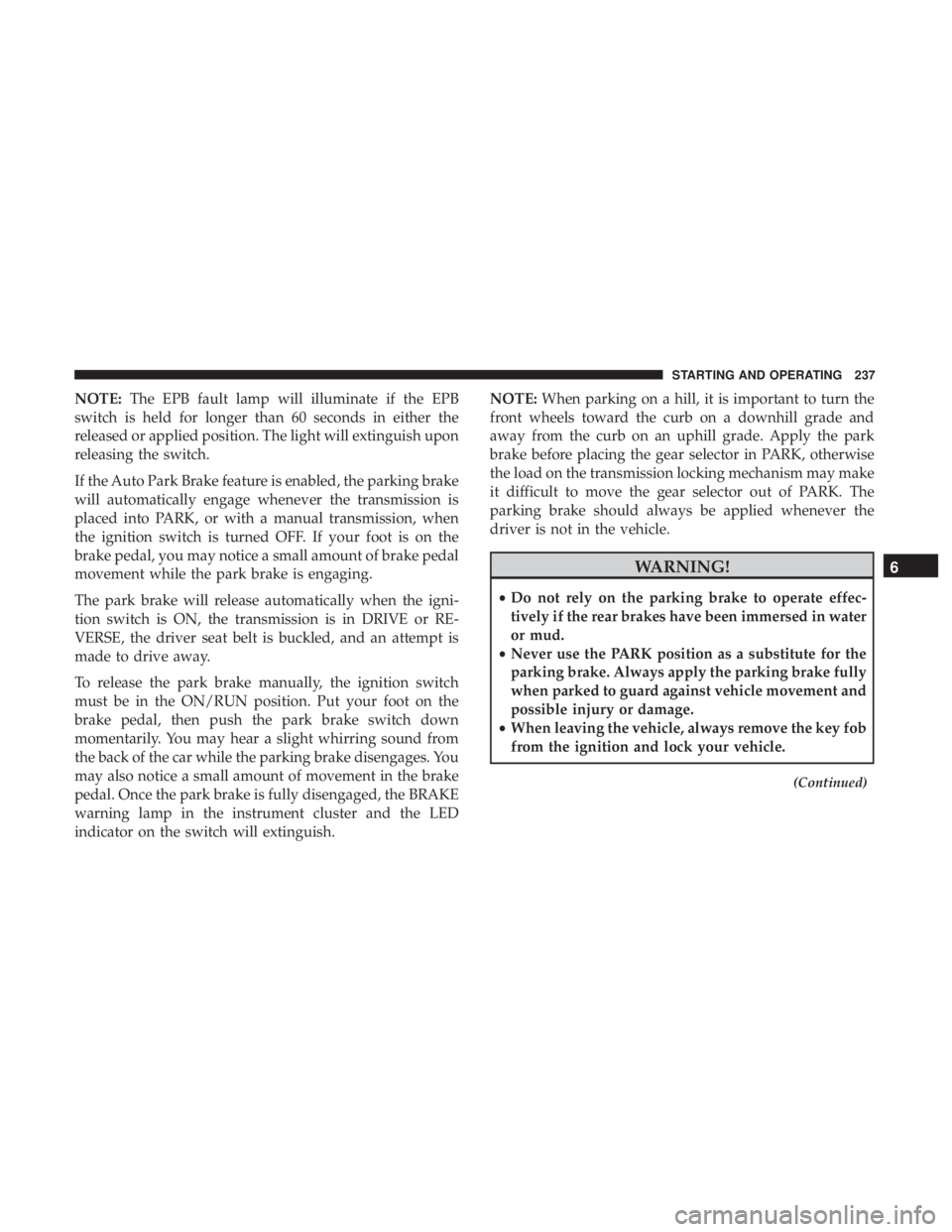
NOTE:The EPB fault lamp will illuminate if the EPB
switch is held for longer than 60 seconds in either the
released or applied position. The light will extinguish upon
releasing the switch.
If the Auto Park Brake feature is enabled, the parking brake
will automatically engage whenever the transmission is
placed into PARK, or with a manual transmission, when
the ignition switch is turned OFF. If your foot is on the
brake pedal, you may notice a small amount of brake pedal
movement while the park brake is engaging.
The park brake will release automatically when the igni-
tion switch is ON, the transmission is in DRIVE or RE-
VERSE, the driver seat belt is buckled, and an attempt is
made to drive away.
To release the park brake manually, the ignition switch
must be in the ON/RUN position. Put your foot on the
brake pedal, then push the park brake switch down
momentarily. You may hear a slight whirring sound from
the back of the car while the parking brake disengages. You
may also notice a small amount of movement in the brake
pedal. Once the park brake is fully disengaged, the BRAKE
warning lamp in the instrument cluster and the LED
indicator on the switch will extinguish. NOTE:
When parking on a hill, it is important to turn the
front wheels toward the curb on a downhill grade and
away from the curb on an uphill grade. Apply the park
brake before placing the gear selector in PARK, otherwise
the load on the transmission locking mechanism may make
it difficult to move the gear selector out of PARK. The
parking brake should always be applied whenever the
driver is not in the vehicle.
Page 240 of 554
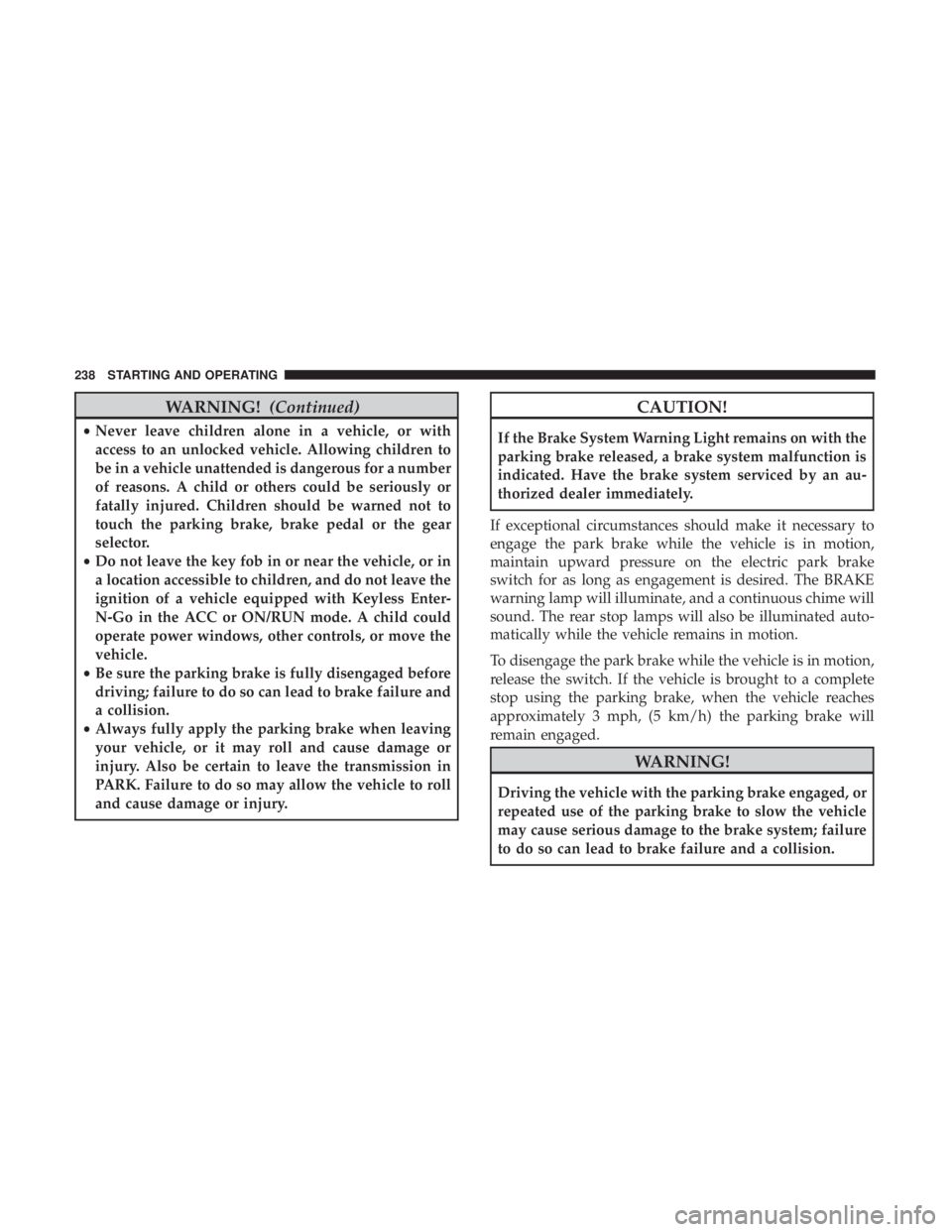
WARNING!(Continued)
•Never leave children alone in a vehicle, or with
access to an unlocked vehicle. Allowing children to
be in a vehicle unattended is dangerous for a number
of reasons. A child or others could be seriously or
fatally injured. Children should be warned not to
touch the parking brake, brake pedal or the gear
selector.
• Do not leave the key fob in or near the vehicle, or in
a location accessible to children, and do not leave the
ignition of a vehicle equipped with Keyless Enter-
N-Go in the ACC or ON/RUN mode. A child could
operate power windows, other controls, or move the
vehicle.
• Be sure the parking brake is fully disengaged before
driving; failure to do so can lead to brake failure and
a collision.
• Always fully apply the parking brake when leaving
your vehicle, or it may roll and cause damage or
injury. Also be certain to leave the transmission in
PARK. Failure to do so may allow the vehicle to roll
and cause damage or injury.
Page 247 of 554
CAUTION!
If you skip a gear while downshifting or downshift at
too high of a vehicle speed, these conditions may cause
the engine to overspeed if too low of a gear is selected
and the clutch pedal is released. Damage to the clutch
and the transmission can result from skipping a gear
while downshifting or downshifting at too high of a
vehicle speed even if the clutch pedal is held pressed
(i.e., not released).
Parking
When parking and leaving the vehicle, proceed as follows:
•Engage a gear (first gear if facing uphill or reverse if
facing downhill) and leave the wheels turned.
• Stop the engine and engage the park brake.
• Always remove the key fob.
• Block the wheels with a wedge or a stone if the vehicle
is parked on a steep slope.
NOTE: NEVER leave the car with the gearbox in neutral
(or, if equipped with automatic transmission, before plac-
ing the gear lever in PARK).
Page 248 of 554
WARNING!(Continued)
•It is dangerous to shift out of PARK or NEUTRAL if
the engine speed is higher than idle speed. If your
foot is not firmly pressing the brake pedal, the
vehicle could accelerate quickly forward or in re-
verse. You could lose control of the vehicle and hit
someone or something. Only shift into gear when the
engine is idling normally and your foot is firmly
pressing the brake pedal.
• The vehicle may not engage a newly selected gear
when shifting between PARK, REVERSE, or DRIVE
if the vehicle is moving while shifting.
•
Unintended movement of a vehicle could injure those
in or near the vehicle. As with all vehicles, you should
never exit a vehicle while the engine is running. Before
exiting a vehicle, always come to a complete stop, then
apply the park brake, shift the transmission into PARK,
and turn the ignition OFF. When the ignition is in the
OFF mode, the transmission is locked in PARK, secur-
ing the vehicle against unwanted movement.
• When leaving the vehicle, always make sure the
ignition is in the OFF mode, remove the key fob from
the vehicle, and lock the vehicle.
(Continued)
Page 251 of 554
NOTE:After selecting any gear range, wait a moment to
allow the selected gear to engage before accelerating. This
is especially important when the engine is cold.
PARK (P)
This range supplements the parking brake by locking the
transmission. The engine can be started in this range.
Never attempt to use PARK while the vehicle is in motion.
Apply the parking brake when exiting the vehicle in this
range.
When parking on a level surface, you may shift the
transmission into PARK first, and then apply the parking
brake.
When parking on a hill, apply the parking brake before
shifting the transmission to PARK, otherwise the load on
the transmission locking mechanism may make it difficult
to move the gear selector out of PARK. As an added
precaution, turn the front wheels toward the curb on a
downhill grade and away from the curb on an uphill grade.
When exiting the vehicle, always:
1. Apply the parking brake.
2. Shift the transmission into PARK.
3. Turn the ignition OFF. 4. Remove the key fob from the vehicle.
NOTE:
Block the wheels with a wedge or a stone if the
vehicle is parked on a steep slope.
Page 252 of 554
WARNING!(Continued)
•The vehicle may not engage a newly selected gear
when shifting between PARK, REVERSE, or DRIVE
if the vehicle is moving while shifting.
• Unintended movement of a vehicle could injure
those in or near the vehicle. As with all vehicles, you
should never exit a vehicle while the engine is
running. Before exiting a vehicle, always come to a
complete stop, then apply the park brake, shift the
transmission into PARK, and turn the ignition OFF.
When the ignition is in the OFF mode, the transmis-
sion is locked in PARK, securing the vehicle against
unwanted movement.
• When leaving the vehicle, always make sure the
ignition is in the OFF mode, remove the key fob from
the vehicle, and lock the vehicle.
• Never leave children alone in a vehicle, or with
access to an unlocked vehicle. Allowing children to
be in a vehicle unattended is dangerous for a number
of reasons. A child or others could be seriously or
fatally injured. Children should be warned not to
touch the park brake, brake pedal or the transmis-
sion gear selector.
(Continued)
Page 320 of 554
If you stall or begin to lose headwaywhile climbing a
steep hill, allow your vehicle to come to a stop and
immediately apply the brakes. Once stopped, shift to
REVERSE. Back slowly down the hill allowing the com-
pression braking of the engine to help regulate your speed.
If the brakes are required to control vehicle speed, apply
them lightly and avoid locking or skidding the tires.