clutch JEEP DJ 1953 Repair Manual
[x] Cancel search | Manufacturer: JEEP, Model Year: 1953, Model line: DJ, Model: JEEP DJ 1953Pages: 376, PDF Size: 19.96 MB
Page 271 of 376
'Jeep'
UNIVERSAL SERIES SERVICE
MANUAL
K
the
bottom.
Remove
rear
bearing
cone
and roller
assembly from the shaft by striking the end of the
shaft lightly against a
wooden
block,
j.
Remove the set screw in sliding gear shift fork.
Remove shift rod.
See the following paragraphs for disassembly of
the front and
rear
bearing caps.
K-4.
Front
Bearing Cap Disassembly
•
Refer to Fig. K-1, K-2.
The
front bearing cap is a separate assembly which
may
be removed for service. Should difficulty be
experienced in this section of the transfer case,
follow
the
sequence
below
for removal and dis assembly.
a.
Remove the output shaft yoke as outlined in
Par. K-3.
Remove the
poppet
balls and
move
the
front wheel drive shift rod forward as outlined in
Par.
K-3f.
b.
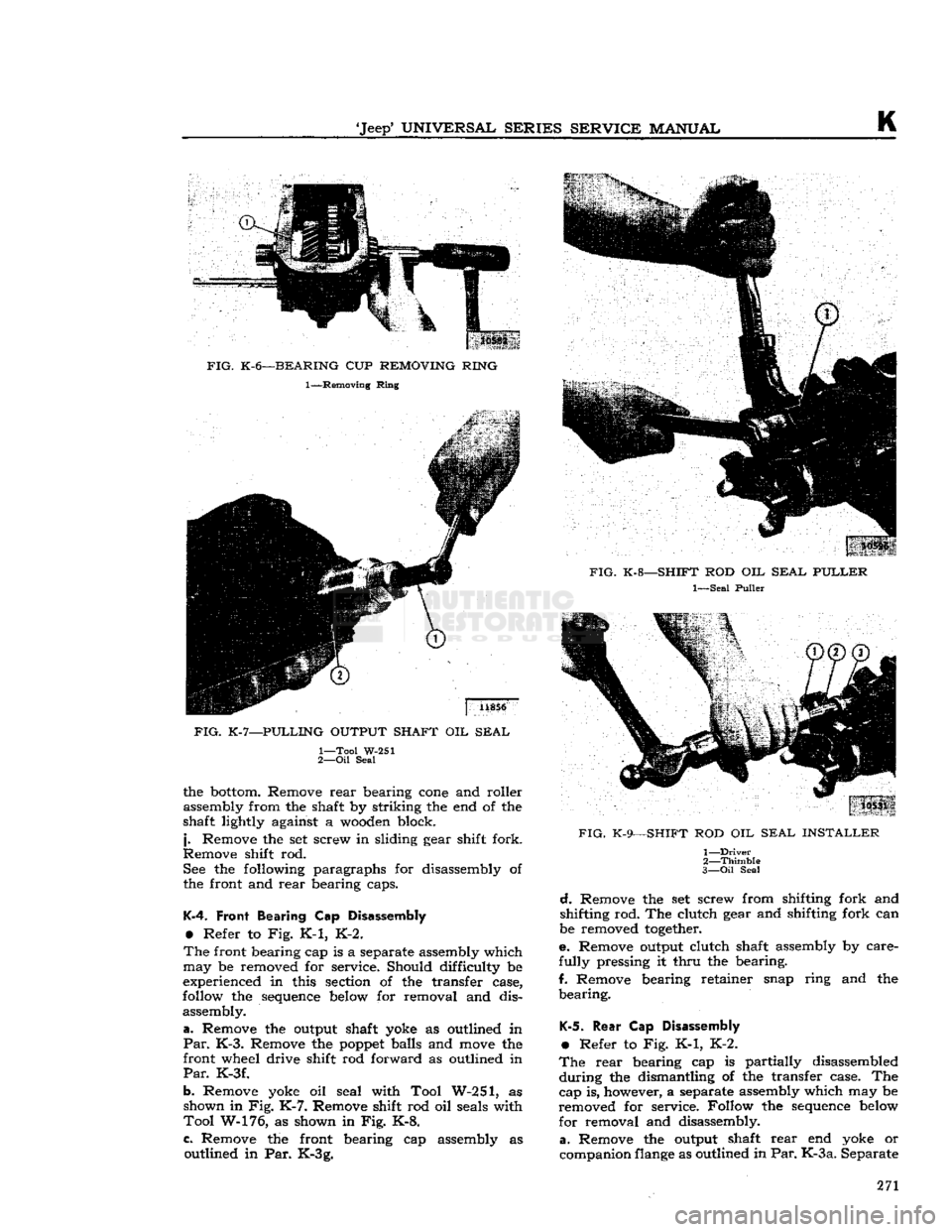
Remove yoke oil seal with Tool W-251, as shown in Fig.
K-7.
Remove shift rod oil seals with
Tool
W-176, as shown in Fig. K-8.
c.
Remove the front bearing cap assembly as outlined in Par. K-3g.
FIG.
K-9—SHIFT
ROD OIL
SEAL INSTALLER
1—
Driver
2—
Thimble
3— Oil
Seal
d.
Remove the set screw from shifting fork and
shifting rod. The clutch gear and shifting fork can
be removed
together.
e. Remove output clutch shaft assembly by care
fully
pressing it
thru
the bearing.
f. Remove bearing retainer snap ring and the
bearing.
K-5.
Rear
Cap Disassembly
•
Refer to Fig. K-1, K-2.
The
rear
bearing cap is partially disassembled
during
the dismantling of the transfer case. The
cap is, however, a separate assembly which may be
removed for service. Follow the
sequence
below
for removal and disassembly,
a.
Remove the output shaft
rear
end yoke or
companion
flange
as outlined in
Par. K-3 a.
Separate 271
Page 273 of 376
![JEEP DJ 1953 Repair Manual
Jeep*
UNIVERSAL
SERIES
SERVICE
MANUAL
K
ment, the shaft should have .004" to .008"
[0,102
a
0,203
mm.] end play. Adjustment is made by
selective
shim installation
between
the cap an](/img/16/57041/w960_57041-272.png "JEEP DJ 1953 Repair Manual
Jeep*
UNIVERSAL
SERIES
SERVICE
MANUAL
K
ment, the shaft should have .004\" to .008\"
[0,102
a
0,203
mm.] end play. Adjustment is made by
selective
shim installation
between
the cap an")
'Jeep*
UNIVERSAL
SERIES
SERVICE
MANUAL
K
ment, the shaft should have .004" to .008"
[0,102
a
0,203
mm.] end play. Adjustment is made by
selective
shim installation
between
the cap and the
case. Shims .003", .010" and .031" [0,076,
0,254,
0,787
mm.] in thickness are available for this ad
justment. Do not install the rear cap oil seal until
the bearings are correctly adjusted. Both the front
and
rear oil seals may be installed with oil seal
driver
Tool W-143, shown in Fig. K-12.
When
installing the end yokes on the output shafts,
inspect for the presence of
felt
seals in each oil
seal guard. (The oil seal guard is a part of each
yoke assembly.) Felt seals should be installed in the oil seal guards if
they
are not present. When
installing the shift
rail
oil seals in the front bear
ing cap, it is necessary to protect the seals against
damage when passing over the shift
rail
notches.
Protect them with the thimble, and install them with the driver, Tool W-130, shown in Fig. K-9.
K-7.
Transfer Case Installation
The
installation of the assembly in the vehicle is
the reverse of the removal operation covered in
Par.
K-2.
If
the transmission was removed from the vehicle,
lubricate the pilot bearing and also lubricate the
transmission and transfer case as outlined in the
"Lubrication
Section". Be sure that the clutch pedal has %"
[19,05
mm.] free travel as outlined
in
the
"Clutch
Section".
K-8.
Transfer Case Linkage Adjustment
Adjust
the link to provide
xh"
[12,7 mm.] clear
ance
between
the floor pan and the shift lever
bend when operating in four wheel drive low
position. Refer to Fig. K-4.
K-3.
TRENSFER
CESE
SERVICE
DIAGNOSIS
SYMPTOMS PROBABLE REMEDY
Slips
Out of
Gear (High-Low)
Shifting
Lock
Spring Weak Replace Spring
Bearing
Broken or Worn Replace
Shifting
Fork
Bent Replace
Slips
Out of
Front Wheel Drive
Shifting
Lock
Spring Weak. Replace
Bearing
Worn or Broken Replace
End
Play in Shaft. . . ..... Adjust Shifting
Fork
Bent.. Replace
Hard Shifting
Lack
of
Lubricant
Drain
and
Refill
Shift
Lever
Stuck on Shaft Remove, Clean and Lubricate
Shifting
Lock
Ball
Scored Replace
Ball
Shifting
Fork
Bent Replace
Fork
Low
Tire
Pressure Inflate
Grease Leak
at
Front
or
Rear Drive
Grease
Leak
at Covers. Install New Gaskets
Grease
Leak
between
Transmission and Transfer Cases Install New Gaskets
Grease
Leak
at Output Shaft Install New Oil Seal
K-10.
TRANSFER
CESE
SPECIFICATIONS
Transfer
Case:
All
Models
Spicer
18
On
Floor
Gear
Ratio: 1.00 to 1
2.46 to 1 273
Page 302 of 376
N
REAR
AXLE a.
Place the transmission in neutral.
b.
Raise one wheel off the floor and place a block
in
front and at the
rear
of the
opposite
wheel.
c.
Apply a torque wrench to the axle shaft nut of
the elevated wheel.
d.
Turn
wheel with torque wrench. Disregard
breakaway
torque and observe torque required to
continuously
turn
wheel smoothly. Torque should
read
40 lb-ft [5,53 kg-m.] or more.
N-23. Powr-Lok
Differential Disassembly
/
and Reassembly
Refer
to
Figs.
N-38 and N-39.
The
procedure for overhauling disc type
Powr-Lok
differentials is as follows:
a.
Remove axle shafts following procedure de
scribed
in Par. N-2.
b.
Remove housing cover and gasket.
c.
Remove the
Powr-Lok
differential from the axle.
Do not remove the ring gear or bearing
cone
and
rollers
unless replacement is to be made.
Mark
the hearing cups so they may later be reassembled
with
the same bearing cones.
Mark
the differential
case halves for correct alignment at reassembly.
Each
pinion mate cross shaft should also be marked
so that each pin cam surface
will
match with the
same
V-ramp
in the case when reassembled.
d.
Separate the case halves. e. Remove the disc and plate
sets.
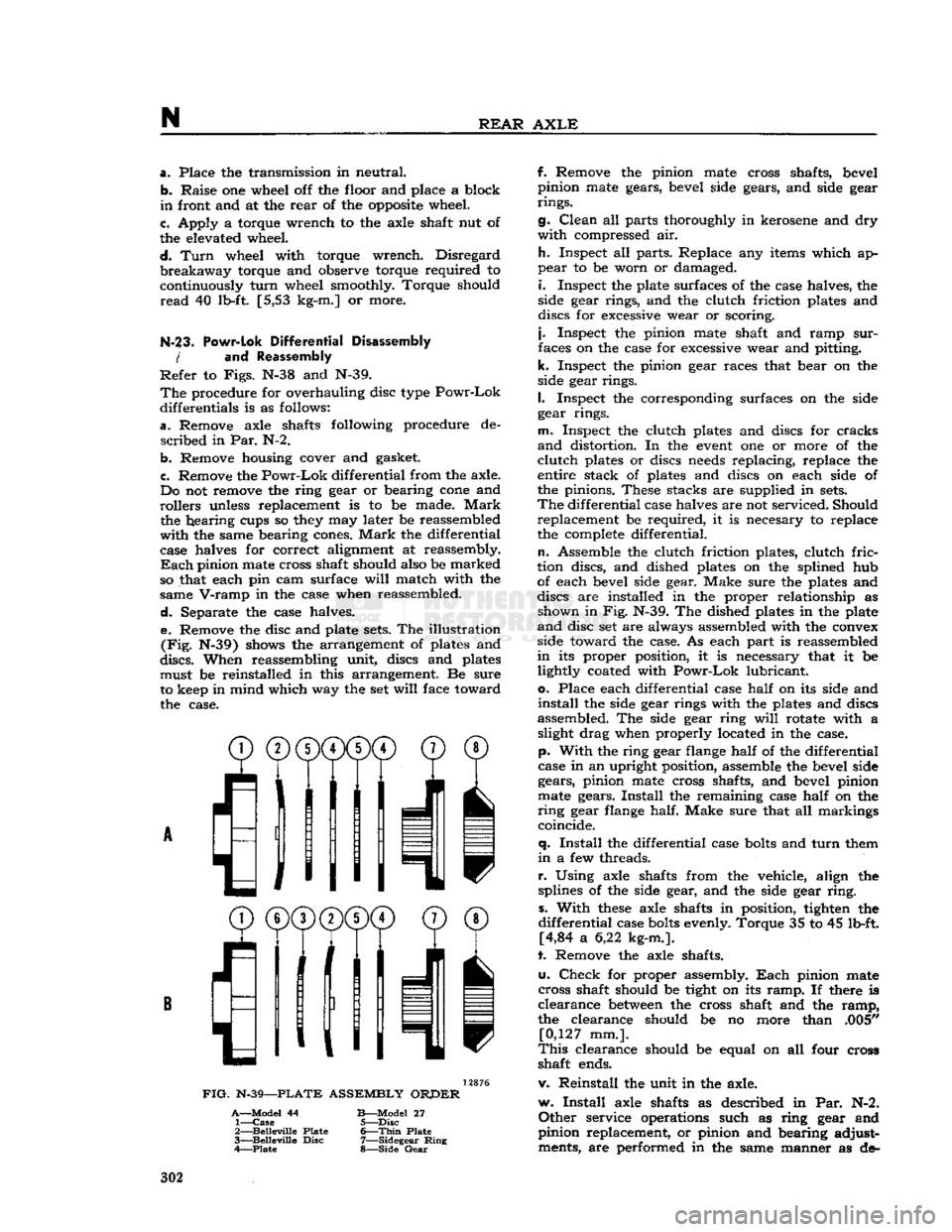
The illustration
(Fig.
N-39) shows the arrangement of plates and
discs.
When reassembling unit, discs and plates must be reinstalled in this arrangement. Be sure
to keep in mind which way the set
will
face toward the case.
^®(j)(j)CD©
® /'Ml
I
11
11 v
FIG.
N-39—PLATE
ASSEMBLY
ORPER
A—Model
44
B—Model
27 1—
Case
5—Disc
2—
Belleville
Plate
6—Thin
Plate
3—
Belleville
Disc
7—Sidegear
Ring
4—Plate
8—Side
Gear
f. Remove the pinion mate cross shafts, bevel
pinion mate gears, bevel side gears, and side gear
rings.
g.
Clean
all parts thoroughly in kerosene and dry
with
compressed air.
h.
Inspect all parts. Replace any items which ap
pear
to be worn or damaged.
i.
Inspect the plate surfaces of the case halves, the
side gear rings, and the clutch friction plates and
discs for excessive wear or scoring.
j.
Inspect the pinion mate shaft and ramp
sur
faces on the case for excessive wear and pitting,
k.
Inspect the pinion gear races that bear on the
side gear rings.
I.
Inspect the corresponding surfaces on the side
gear rings.
m.
Inspect the clutch plates and discs for cracks
and
distortion. In the
event
one or more of the
clutch
plates or discs
needs
replacing, replace the
entire stack of plates and discs on each side of
the pinions. These stacks are supplied in
sets.
The
differential case halves are not serviced. Should replacement be required, it is necesary to replace
the complete differential.
n.
Assemble the clutch friction plates, clutch
fric
tion discs, and dished plates on the splined hub of each bevel side gear. Make sure the plates and
discs are installed in the proper relationship as shown in Fig. N-39. The dished plates in the plate
and
disc set are always assembled with the convex
side toward the case. As each part is reassembled
in
its proper position, it is necessary that it be lightly coated with
Powr-Lok
lubricant,
o.
Place each differential case
half
on its side and
install
the side gear rings with the plates and discs
assembled. The side gear ring
will
rotate with a slight drag when properly located in the case,
p.
With
the ring gear flange
half
of the differential
case in an upright position, assemble the bevel side gears, pinion mate cross shafts, and bevel pinion
mate gears.
Install
the remaining case
half
on the
ring
gear flange half. Make sure that all markings
coincide.
q.
Install
the differential case
bolts
and
turn
them
in
a few threads.
r.
Using axle shafts from the vehicle, align the
splines of the side gear, and the side gear
ring,
s.
With
these
axle shafts in position, tighten the
differential
case
bolts
evenly. Torque 35 to 45 lb-ft. [4,84 a 6,22 kg-m.].
t. Remove the axle shafts.
u.
Check
for proper assembly.
Each
pinion mate
cross shaft should be tight on its
ramp.
If there is
clearance
between
the cross shaft and the
ramp,
the clearance should be no more than .005" [0,127 mm.].
This
clearance should be equal on all four cross
shaft ends.
v. Reinstall the unit in the axle.
w.
Install
axle shafts as described in Par. N-2.
Other
service operations such as ring gear and
pinion replacement, or pinion and bearing adjust ments, are performed in the same manner as de- 302
Page 303 of 376
'Jeep*
UNIVERSAL
SERIES SERVICE
MANUAL
N
scribed
in
Pars.
N-ll through N-l9 for standard
axles, with the exception of the following torque
recommendations. Torque the differential case
bearing
cap screws 70 to 90 lb-ft. [9,7 a 12,4 kg-m.]
and
the cover screws 15 to 25 lb-ft. [2,1 a 3,4
kg-m.].
The ring gear screws on axles with Powr-
Lok
differentials should be torqued as follows:
Model
30 and 44 axles 35 to 55 lb-ft. [4,84 a 7,60 kg-m.].
N-24. TRAC-LOK DIFFERENTIAL
As
optional equipment
Trac-Lok
Model 44 differen
tial
is available on all Jeep Universal vehicles equipped with semi-float flanged axle shafts.
A
conventional differential transmits all of the
ring
gear torque through the differential gears to the axle shafts. Torque is at all
times
equal on the axle shafts, and if one wheel slips, the other wheel
can
only put out as much torque as the slipping
wheel.
The
Trac-Lok
differential is similar,
except
that
part
of the torque from the ring gear is trans mitted through clutch packs
between
the side gears
and
differential case. The multiple disc clutches
with
radial
grooves
on the plates and concentric
grooves
on the discs are
engaged
by a preload
from
Belleville springs, plus separating forces from
the side gears as torque is applied through the
ring
gear.
The
Trac-Lok
construction permits differential action when required for turning corners and transmits equal torque to both
wheels
when driving
straight
ahead. However, when one wheel tries to spin due to leaving the ground, a patch of ice,
etc., the clutch packs automatically provide more
torque to the wheel which is not trying to spin.
It
can be
seen
then that the
Trac-Lok
differential
resists wheel spin on bumpy roads and provides
more pulling power when one wheel tries to slip.
In
many cases of differences in traction, pulling
power
will
be automatically provided until both
wheels
start to slip.
In
diagnosis of vehicle operators' complaints, it
is important to recognize two things:
a.
If, with unequal traction, both
wheels
slip, the
Trac-Lok
has
done
all it can possibly do.
b.
In extreme cases of differences in traction, the
wheel with least traction may spin after the
Trac-
Lok
has transferred as much torque as possible
to the non-slipping wheel.
N-25.
Lubrication
The
Trac-Lok
differential requires a special
lubri
cant
and ordinary multipurpose gear lubricants
MUST
NOT be used. Use only 'Jeep* Differential
Oil,
Part
No. 94557.
Trac-Lok
differential may be cleaned only by disassembling the unit and wiping with clean rags. Do not flush the
Trac-Lok
unit.
Note:
The
Trac-Lok
differential is serviced at the
same time intervals as the standard differential.
N-26.
Trouble
Symptoms
If
noises
or roughness, such as chatter, are present
in
turning corners, the probable cause is incorrect
or
contaminated lubricant.
Before any differential is removed and disassem
bled for chatter complaints, the correctness of
lubri
cant
can and should be determined.
A
complete
lubricant
drain,
and
refill
with specified
Limited
Slip Differential lubricant
will
usually
correct
chatter.
The
following procedure is recommended to ensure
complete
removal of old lubricant.
a.
Warm
the lubricant by vehicle road operation,
or
5 minutes of operation in gear at 30 mph with
both
wheels
off the ground on a hoist.
Caution:
Never place the transmission in gear with
the
engine
running when only one wheel of a
Limited
Slip Differential equipped vehicle is raised.
The
vehicle might drive itself off the
jack
and produce damage or
injury.
b.
Drain
lubricant while
warm.
Remove
drain
plug
or
cover to
drain
completely. If cover is removed,
it
may be necessary to replace gasket at this time.
c.
Refill
axle with specified
Limited
Slip Differen
tial
lubricant.
d.
Operate the vehicle for approximately ten miles
[16,09
km.], making at least ten figure 8 turns
to flush the old lubricant out of the clutch packs.
e.
Repeat
steps
b, c, and d, making sure to replace
the cover gasket if required in
step
c.
f. It is possible that slight chatter, requiring ad
ditional
vehicle operation, may remain after
step
e. If chatter persists after 100 miles
[160,9
km.]
of vehicle operation, or remains severe after
step
e above, disassembly and repair
will
be necessary.
N-27.
Unit
Inoperative
Proper
performance and capabilities of
Limited
Slip
Differentials are
often
misunderstood. No
precise
methods
of measuring
Limited
Slip Dif
ferential
performance are generally available in the field. A functioning unit can be determined by
relatively
simple vehicle operational
tests,
as
follows:
a.
Place one wheel on
good
dry pavement, and the
other on ice, mud, grease, etc.
b.
Gradually
increase
engine
rpm to obtain maxi
mum
traction
prior
to "break-a-way." The ability
to
move
the vehicle
effectively
will
demonstrate
proper
performance.
c.
If extremely slick surfaces, such as ice or grease,
are
used
some
question may exist as to proper per
formance at
step
b. In
these
extreme cases a prop
erly
performing
Limited
Slip Differential
will
pro
vide greater "pulling" power by lightly applying
the parking brake.
N-23.
Trac-Lok
Differential Disassembly
and
Reassembly
It
is recommended that the
complete
axle assembly
be removed from the vehicle, when it
becomes
necessary to remove the
Trac-Lok
from the hous
ing.
Refer to Par. N-3 and N-12 for removal of axle shafts and differential case from axle housing. 303
Page 306 of 376
N
REAR
AXLE
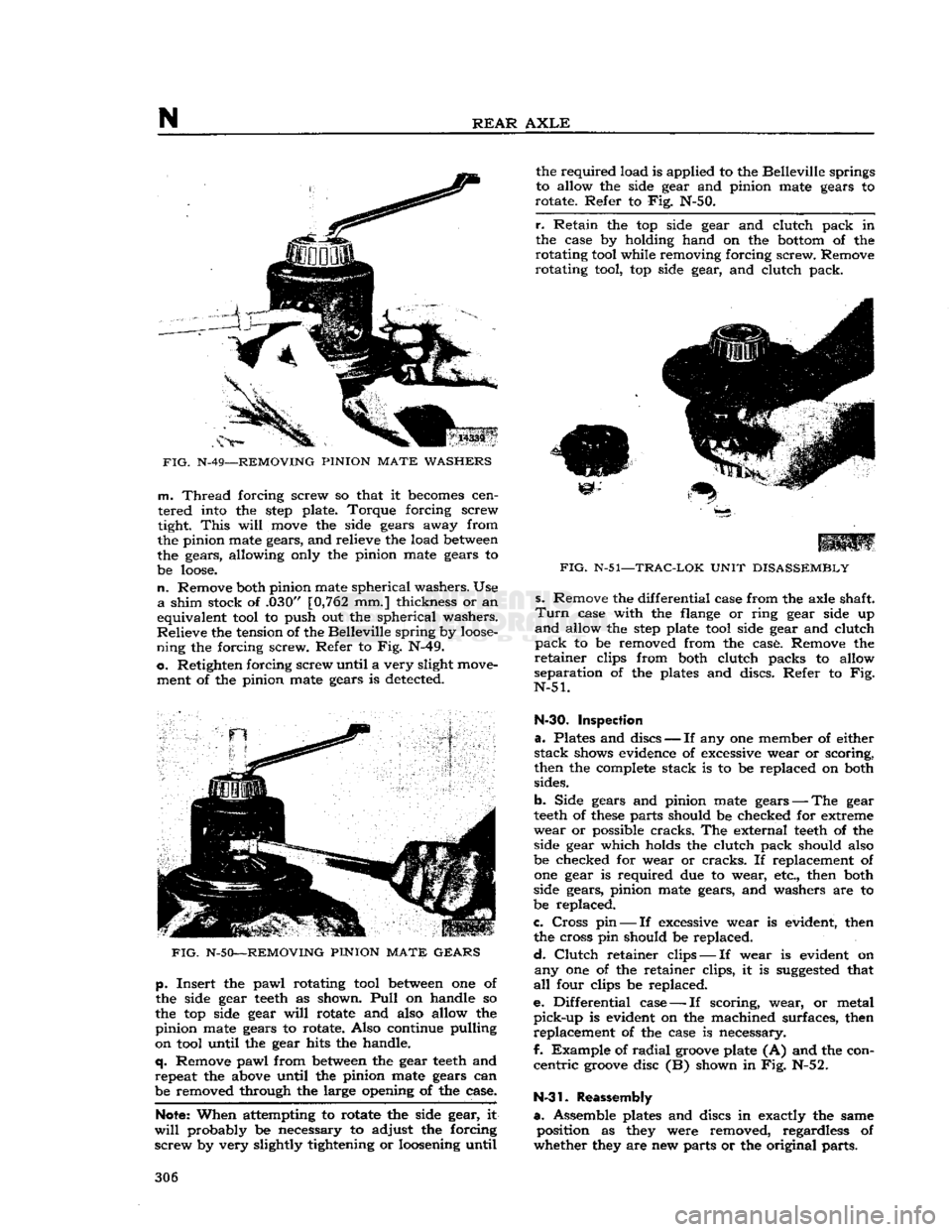
FIG.
N-49—REMOVING
PINION
MATE
WASHERS
m.
Thread
forcing screw so that it becomes cen
tered into the
step
plate. Torque forcing screw
tight.
This
will
move the side gears away from
the pinion mate gears, and relieve the load between
the gears, allowing only the pinion mate gears to
be
loose.
n.
Remove both pinion mate spherical washers. Use
a
shim stock of .030" [0,762 mm.] thickness or an
equivalent tool to push out the spherical washers.
Relieve
the tension of the Belleville spring by
loose
ning
the forcing screw. Refer to Fig. N-49.
o.
Retighten forcing screw until a very slight move ment of the pinion mate gears is detected.
FIG.
N-50—-REMOVING
PINION
MATE
GEARS
p.
Insert the pawl rotating tool between one of
the side gear
teeth
as shown.
Pull
on handle so
the top side gear
will
rotate and also allow the
pinion mate gears to rotate. Also continue pulling
on tool until the gear hits the handle,
q.
Remove pawl from between the gear
teeth
and
repeat the above until the pinion mate gears can
be removed through the large opening of the case.
Note:
When attempting to rotate the side gear, it
will
probably be necessary to adjust the forcing
screw
by very slightly tightening or loosening until the required load is applied to the Belleville springs
to allow the side gear and pinion mate gears to
rotate. Refer to Fig. N-50.
r.
Retain the top side gear and clutch pack in
the case by holding hand on the bottom of the
rotating tool while removing forcing screw. Remove
rotating tool, top side gear, and clutch pack.
FIG.
N-51—-TRAC-LOK
UNIT
DISASSEMBLY
s. Remove the differential case from the axle shaft.
Turn
case with the flange or ring gear side up
and
allow the
step
plate tool side gear and clutch
pack
to be removed from the case. Remove the
retainer
clips from both clutch packs to allow
separation of the plates and discs. Refer to Fig.
N-51.
N-30.
Inspection
a.
Plates and discs —
If
any one member of either
stack
shows evidence of excessive wear or scoring,
then the complete stack is to be replaced on both
sides.
b.
Side gears and pinion mate gears —
The
gear
teeth
of
these
parts should be checked for extreme
wear
or possible
cracks.
The external
teeth
of the side gear which holds the clutch pack should also
be checked for wear or
cracks.
If replacement of one gear is required due to wear, etc., then both
side gears, pinion mate gears, and washers are to
be replaced.
c.
Cross
pin
— If excessive wear is evident, then
the cross pin should be replaced.
d.
Clutch
retainer clips — If wear is evident on
any
one of the retainer clips, it is
suggested
that
all
four clips be replaced.
e. Differential case — If scoring, wear, or metal
pick-up
is evident on the machined surfaces, then replacement of the case is necessary.
I.
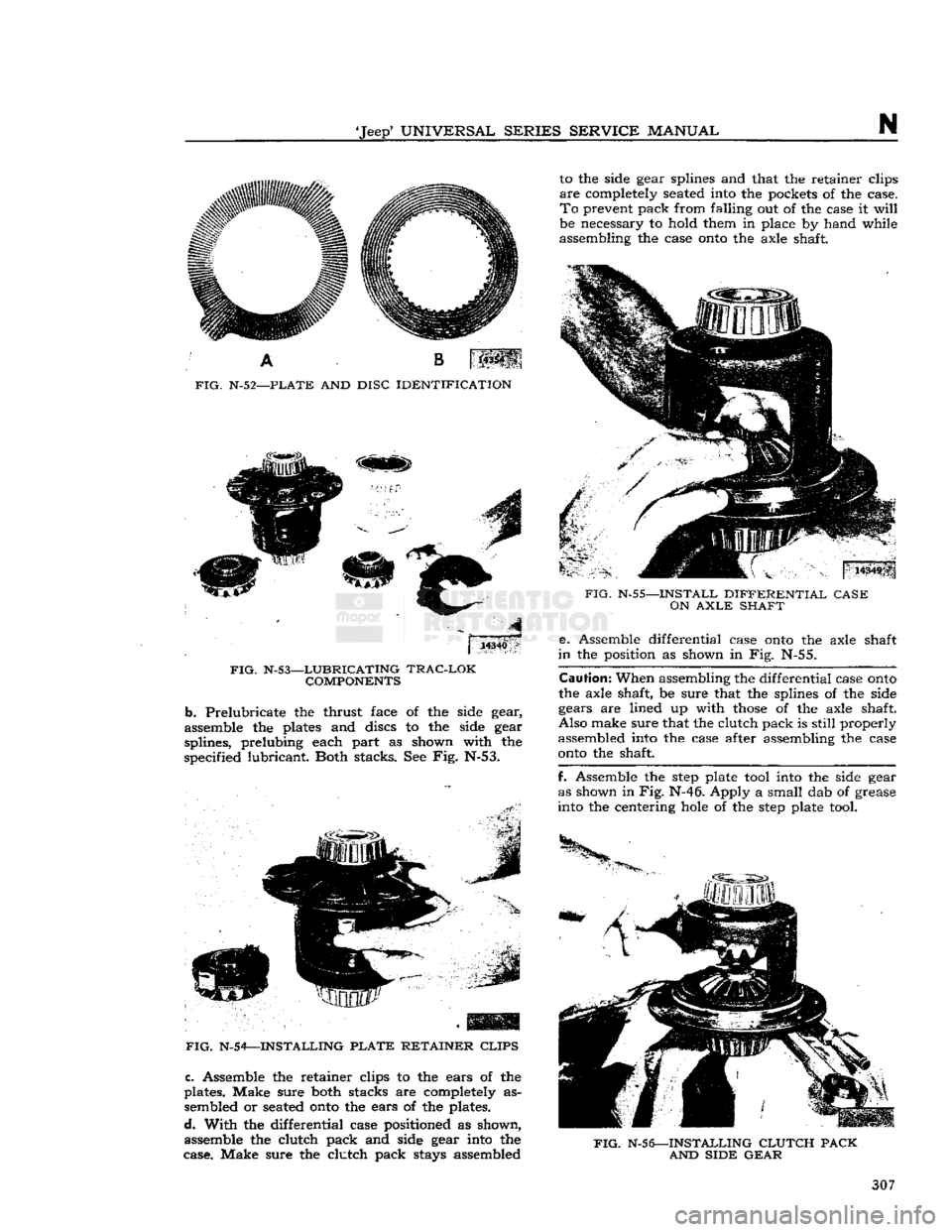
Example of
radial
groove plate (A) and the con
centric
groove disc (B) shown in Fig. N-52.
N-31.
Reassembly
a.
Assemble plates and discs in exactly the same position as they were removed, regardless of
whether they are new parts or the original parts. 306
Page 307 of 376
'Jeep'
UNIVERSAL
SERIES
SERVICE
MANUAL
N
FIG.
N-52—PLATE
AND
DISC
IDENTIFICATION
I 14340
FIG.
N-S3—LUBRICATING
TRAC-LOK
COMPONENTS
b.
Prelubricate the thrust face of the side
gear,
assemble
the plates and discs to the side
gear
splines, prelubing each part as shown
with
the
specified
lubricant.
Both
stacks. See Fig. N-53.
FIG.
N-54—INSTALLING
PLATE
RETAINER
CLIPS
c. Assemble the retainer clips to the
ears
of the
plates. Make
sure
both
stacks
are completely as sembled or
seated
onto the
ears
of the plates.
d.
With
the
differential
case
positioned as shown,
assemble
the
clutch
pack and side
gear
into
the
case.
Make
sure
the
clutch
pack
stays
assembled
to
the side
gear
splines and that the retainer clips
are completely
seated
into
the pockets of the
case.
To
prevent pack
from
falling
out of the
case
it
will
be
necessary
to
hold
them in place by hand
while
assembling the
case
onto the axle shaft.
FIG.
N-55—INSTALL
DIFFERENTIAL
CASE
ON
AXLE
SHAFT
e. Assemble
differential
case
onto the axle shaft
in
the position as shown in Fig. N-55.
Caution:
When assembling the
differential
case
onto
the axle shaft, be
sure
that the splines of the side
gears
are
lined
up
with
those
of the axle shaft.
Also
make
sure
that the
clutch
pack is
still
properly
assembled
into
the
case
after assembling the
case
onto the shaft.
f. Assemble the
step
plate
tool
into
the side
gear
as shown in Fig. N-4 6.
Apply
a small dab of
grease
into
the centering hole of the
step
plate
tool.
FIG.
N-56—INSTALLING
CLUTCH
PACK
AND
SIDE
GEAR
307
Page 308 of 376
N
REAR
AXLE
FIG.
N-57—POSITIONING GEAR ROTATING TOOL
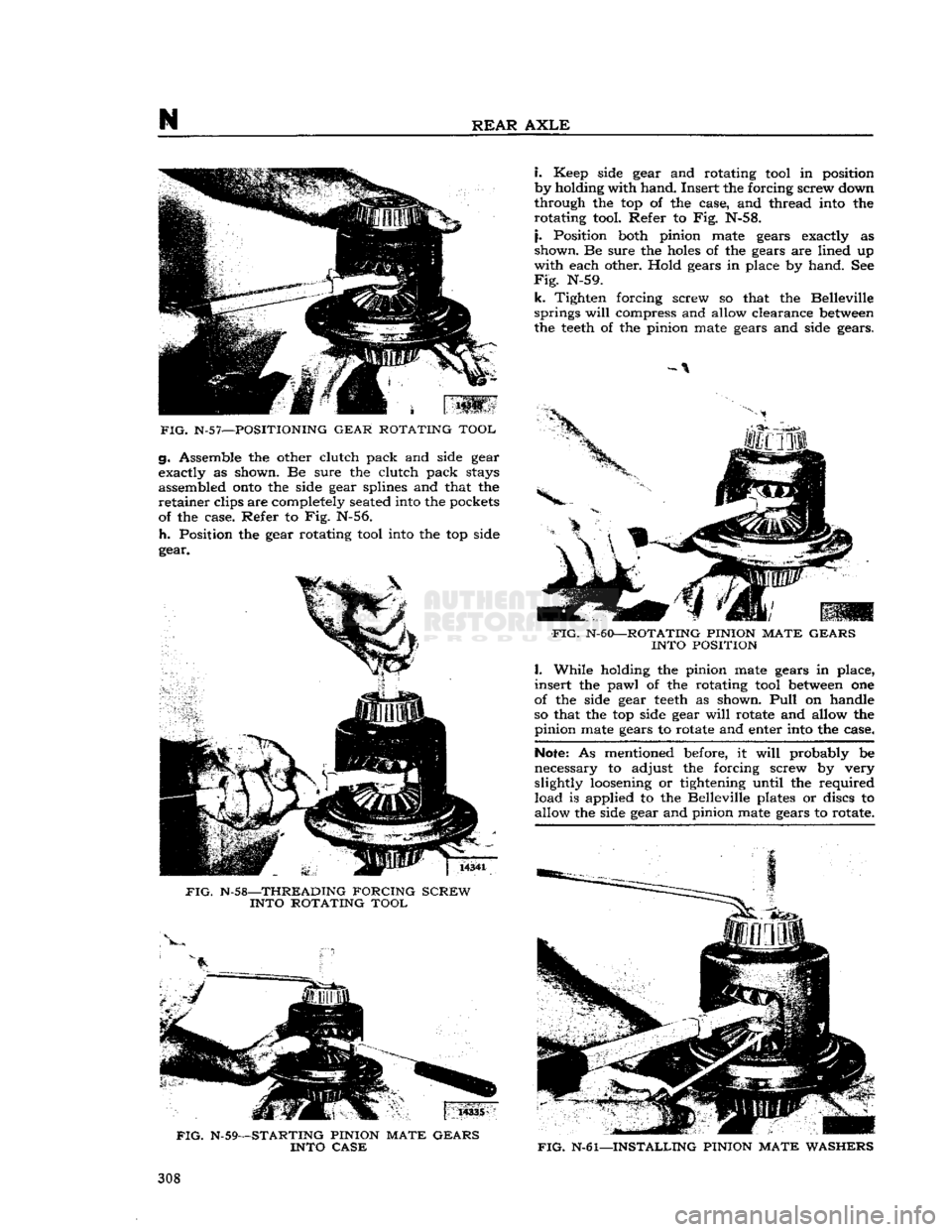
g. Assemble the other clutch pack and side gear
exactly as shown. Be sure the clutch pack stays
assembled
onto
the side gear splines and that the
retainer
clips are completely seated into the pockets
of the case. Refer to Fig. N-56.
h.
Position the gear rotating tool into the top side
gear.
FIG.
N-58—THREADING FORCING SCREW
INTO ROTATING TOOL
FIG.
N-59—STARTING PINION MATE GEARS INTO CASE
i.
Keep side gear and rotating tool in position
by holding with hand. Insert the forcing screw down
through the top of the case, and thread into the
rotating tool. Refer to Fig. N-58.
j.
Position both pinion mate gears exactly as
shown. Be sure the holes of the gears are lined up
with
each other. Hold gears in place by hand. See
Fig.
N-59.
k.
Tighten forcing screw so that the Belleville
springs
will
compress and allow clearance between
the
teeth
of the pinion mate gears and side gears.
FIG.
N-60—ROTATING PINION MATE GEARS
INTO POSITION
I.
While holding the pinion mate gears in place,
insert
the pawl of the rotating tool between one
of the side gear
teeth
as shown.
Pull
on handle
so that the top side gear
will
rotate and allow the pinion mate gears to rotate and enter into the case.
Note:
As mentioned before, it
will
probably be
necessary to adjust the forcing screw by very
slightly loosening or tightening until the required load is applied to the Belleville plates or discs to allow the side gear and pinion mate gears to rotate.
FIG.
N-61—INSTALLING PINION MATE WASHERS
308
Page 327 of 376
'Jeep'
UNIVERSAL
SERIES SERVICE
MANUAL
P
lengthening of the brake master cylinder eye bolt.
This
is
done
so the primary cup
will
clear the by
pass port when the piston is in the off position,
otherwise the compensating action of the master
cylinder
for expansion and contraction of the fluid
in
the system, due to temperature changes,
will
be destroyed and cause the brakes to drag.
Note:
Some older 'Jeep' vehicles may
develop
side
movement
of the clutch and brake pedals resulting
from wear of the pedals, shafts, and bushings. One
way to
compensate
for this wear is to install a pedal
slack
adjuster kit,
Part
No.
921936.
FIG.
P-6—HAND
BRAKE
ADJUSTMENT
P-10.
Hand Brake
On
Model DJ-5 and DJ-6 vehicles the rear brake
shoes
are operated through cables and conduits to
form the hand or parking brake. A brake cable
equalizer and adjusting rod, Fig. P-6, is located directly back of the frame center cross member.
P-11.
Parking Brake Adjustment
•
Model DJ-5, DJ-6.
The
foot
brakes must be satisfactorily adjusted be
fore attempting adjustment of the hand brake.
To
adjust the hand brake raise both rear
wheels
free of the floor.
Pull
up three
notches
on the hand
brake
lever and tighten the adjustment until the
rear
brakes drag slightly. Release the hand brake
lever and check the rear
wheels
for drag. The
wheels
must turn freely with the lever released.
P-12.
Transmission Brake Adjustment
The
transmission brake is located on the propeller
shaft at the rear of the transfer case, see Fig. P-4.
The
brake is operated by a cable connection from
the brake handle mounted on the instrument panel.
To
adjust the transmission brake, the following
sequence
should be followed:
Make
sure that the brake handle on the instrument
panel is fully released. Give due attention to the
cable and operating linkage to see that
they
do
not bind. If necessary free up the cable and
lubri
cate it. Rotate the brake drum until one pair of the
three
sets
of
holes
are over the
shoe
adjusting screw
wheels
in the brake. Use the
edge
of the
holes
in
the brake drum as a fulcrum for suitable adjusting
tool
or a screwdriver, rotate each notched adjusting
screw by moving the handle of the
tool
away from
the center of the drive shaft until the
shoes
are
snug in the drum.
Back
off seven
notches
on the
adjusting screw
wheels
to secure proper running clearance
between
the
shoes
and the drum. Refer
to Fig. P-8.
P-13.
Relining Transmission Brake
Note:
The condition of the brake lining on the
transmission brake can be visually checked through
the adjusting
holes
in the brake drum.
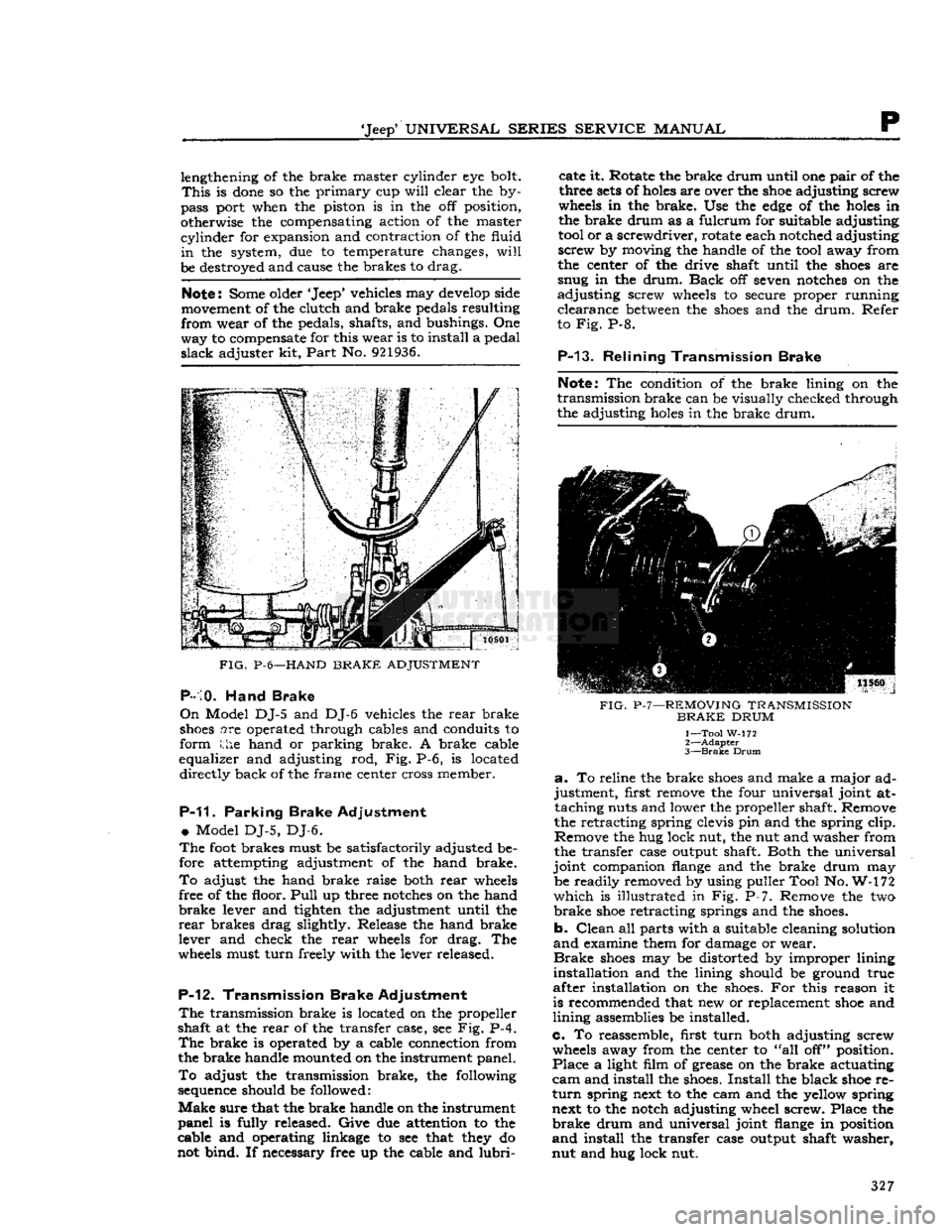
FIG.
P-7—REMOVING
TRANSMISSION
BRAKE
DRUM
1— Tool W-172
2—
Adapter
3—
Brake
Drum
a.
To reline the brake
shoes
and make a major ad
justment, first remove the four universal joint at taching nuts and lower the propeller shaft. Remove
the retracting spring clevis pin and the spring clip.
Remove the hug lock nut, the nut and washer from
the transfer case output shaft. Both the universal
joint companion
flange
and the brake drum may be readily removed by using puller Tool No. W-172
which
is illustrated in Fig. P-7. Remove the two
brake
shoe
retracting springs and the
shoes.
b. Clean all parts with a suitable cleaning solution
and
examine them for damage or wear.
Brake
shoes
may be distorted by improper lining
installation and the lining should be ground true
after installation on the
shoes.
For this reason it
is recommended that new or replacement
shoe
and
lining assemblies be installed.
c. To reassemble, first turn both adjusting screw
wheels
away from the center to "all off" position.
Place a light film of grease on the brake actuating
cam
and install the
shoes.
Install the black
shoe
re
turn
spring next to the cam and the yellow spring next to the notch adjusting wheel screw. Place the
brake
drum and universal joint
flange
in position
and
install the transfer case output shaft washer,
nut and hug lock nut. 327
Page 351 of 376
'Jeep'
UNIVERSAL
SERIES
SERVICE
MANUAL
T
BODY
Contents
SUBJECT
PAR.
Brake
and
Clutch
Pedal Pads T-7
Canvas
Tops T-5
Care
of
Fabric
Tops. : T-6
Front
Seat Adjustment. . . T-8
Passenger Seat Safety
Catch
. .T-9
Windshield
T-2, T-3
Windshield
Glass and Weatherstrip T-4
T-1.
GENERAL
The
body
is of
all
steel construction with mountings
that provide a secure attachment to the frame.
All
major panels are of No. 18
gauge
steel. All
open
edges
of the panels are turned under, reinforced
and
flanged to provide strength. These panels are reinforced with
"U"
sections
and welded. All com
ponent
panels are seamed and welded
together.
The
body
is insulated from the frame with insulator shims placed
between
the
body
and frame and
held in position by the
body
bolts.
The
instruments and controls, mounted on the
instrument panel are within clear view and easy
to reach.
Note:
A new floor pan cover plate has
been
released on late CJ-5 and CJ-6 models, that is
identified by a stamped oval-shaped bubble or
relief, located to the right of the accelerator treadle.
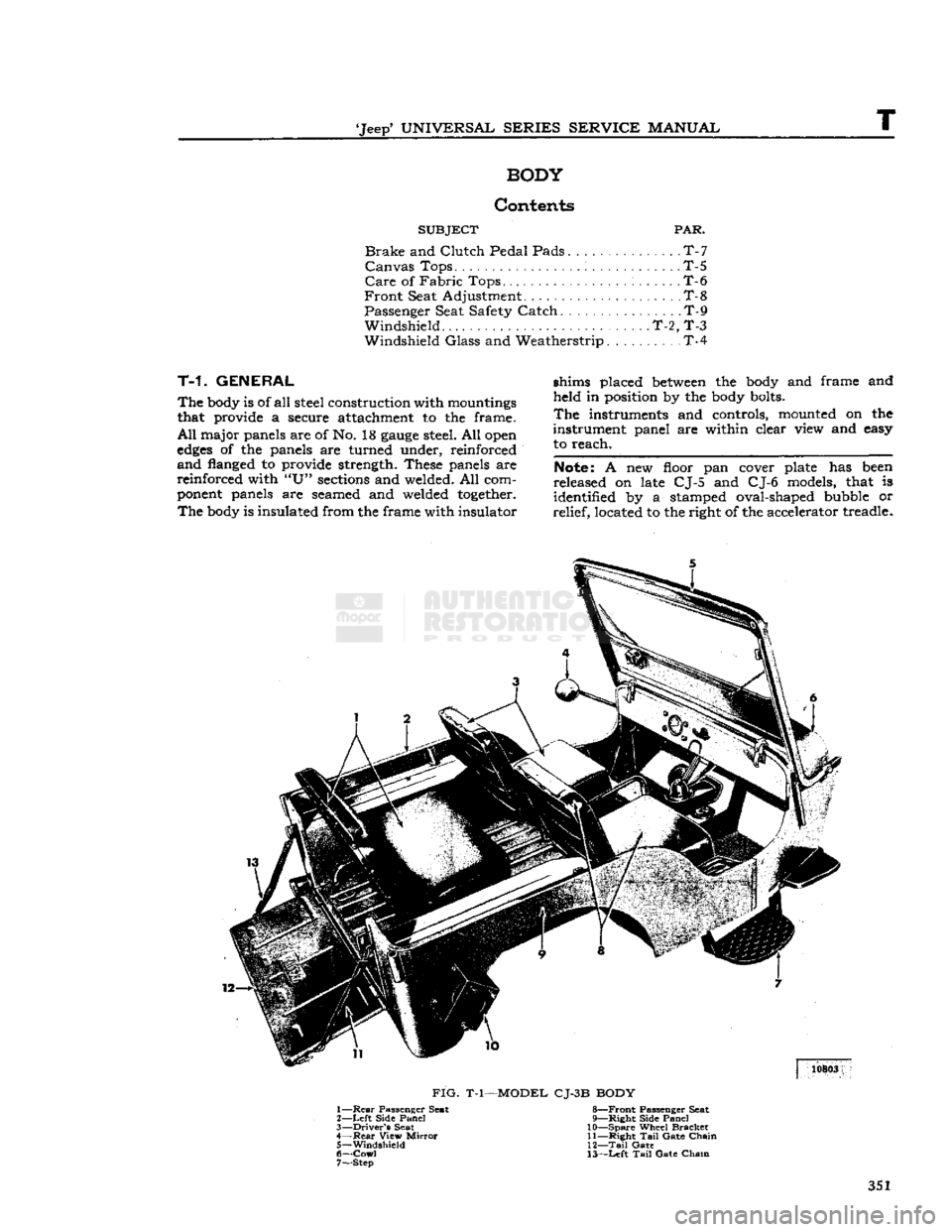
FIG.
T-l—MODEL CJ-3B BODY
1—
Rear
Passenger Seat 8—Front Passenger Seat
2—
Left
Side
Panel
9—Right Side
Panel
3—
Driver's
Seat 10—Spare Wheel
Bracket
4—
Rear
View
Mirror
11—Right
Tail
Gate
Chain
5—
Windshield
12—Tail
Gate
6—
Cowl
13—Left
Tail
Gate
Chain
7— Step
351
Page 354 of 376
T
BODY
from the windshield wiper vacuum fitting. On
late
models
disconnect electrical wires from wiper
motor. Unlatch the two windshield clamps on each
side
of the windshield.
Fold
the windshield forward
until
the
slot
in the windshield
hinges
aligns with the flat
side
of the pin in the
body
hinges.
Slip wind
shield off the pins and remove from
body.
T-4.
Windshield Glass
The
windshield
glass
is mounted in a rubber
weatherstrip which in turn
mounts
in the frame. A
rubber
locking strip, which
holds
the
glass
firmly in
the frame, is inserted in a moulded
groove
around
the rear
face
of the weatherstrip as shown in Fig.
T-2.
To remove the
glass
it is necessary to first
remove the locking strip which may be pried out
with a screwdriver or similar
tool.
Installation is,
obvious.
T-5.
Canvas Tops
Canvas
tops
are available in
Half
Tops and
Full
Tops.
Installation instructions are provided with
each canvas top kit for each model vehicle.
FIG.
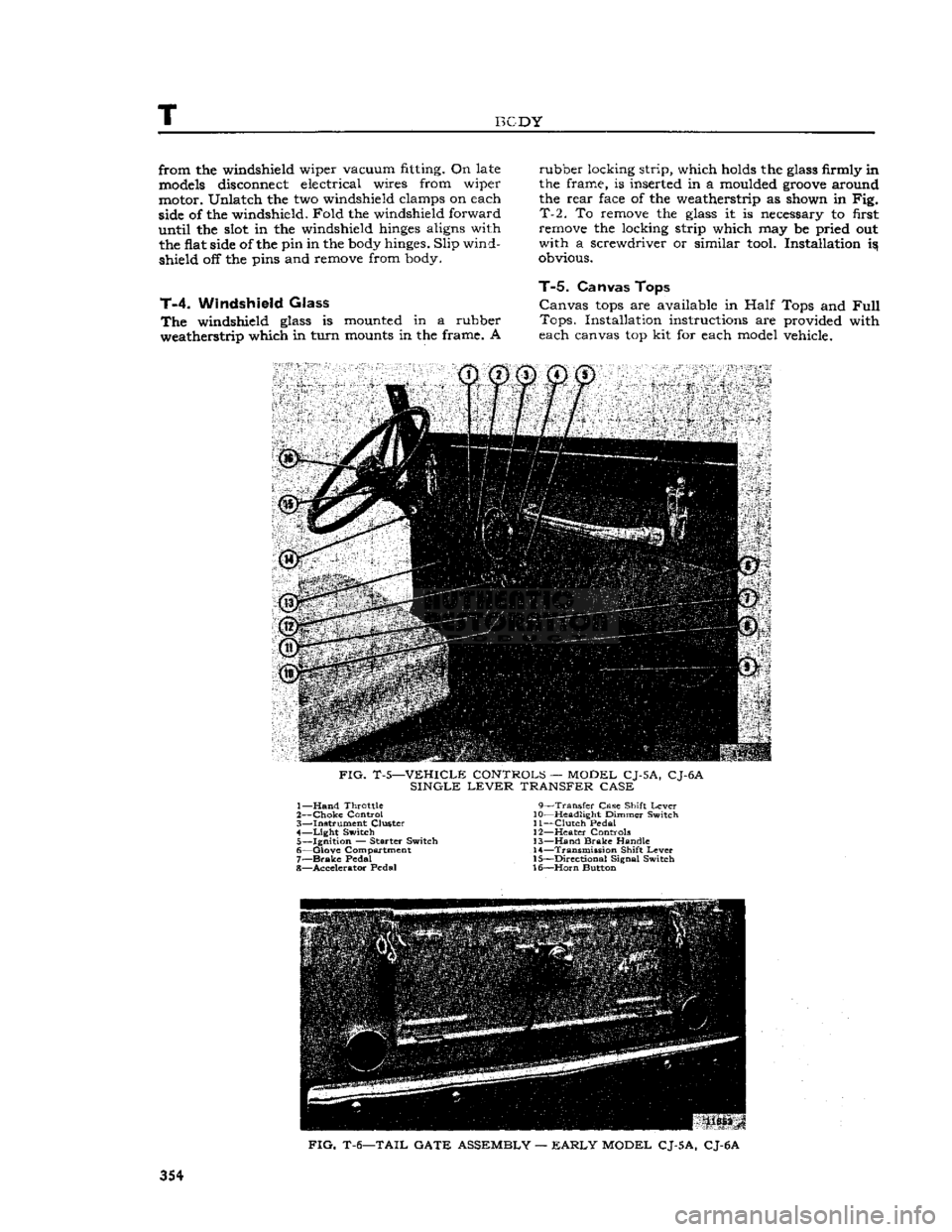
T-5—VEHICLE CONTROLS — MODEL CJ-5A, CJ-6A
SINGLE
LEVER
TRANSFER CASE 1—
Hand
Throttle 9—Transfer Case Shift
Lever
2—
Choke
Control 10—Headlight Dimmer Switch
3— Instrument Cluster 11—Clutch Pedal 4—
Light
Switch 12—Heater Controls 5— Ignition — Starter Switch 13—Hand
Brake
Handle
6— Glove Compartment 14—Transmission Shift
Lever
7—
Brake
Pedal 15—Directional Signal Switch
8— Accelerator Pedal 16—Horn Button
FIG.
T-6—TAIL GATE ASSEMBLY —
EARLY
MODEL CJ-5A, CJ-6A
354