belt JEEP GLADIATOR 2023 User Guide
[x] Cancel search | Manufacturer: JEEP, Model Year: 2023, Model line: GLADIATOR, Model: JEEP GLADIATOR 2023Pages: 448, PDF Size: 17.37 MB
Page 47 of 448
GETTING TO KNOW YOUR VEHICLE45
NOTE:
Be sure that the front seats are fully upright and
positioned forward. This will allow the rear seat
to fold down easily.
The center head restraints must be in the lowest
position to avoid contact with the center console
when folding the seat.
Folding The Rear Seats
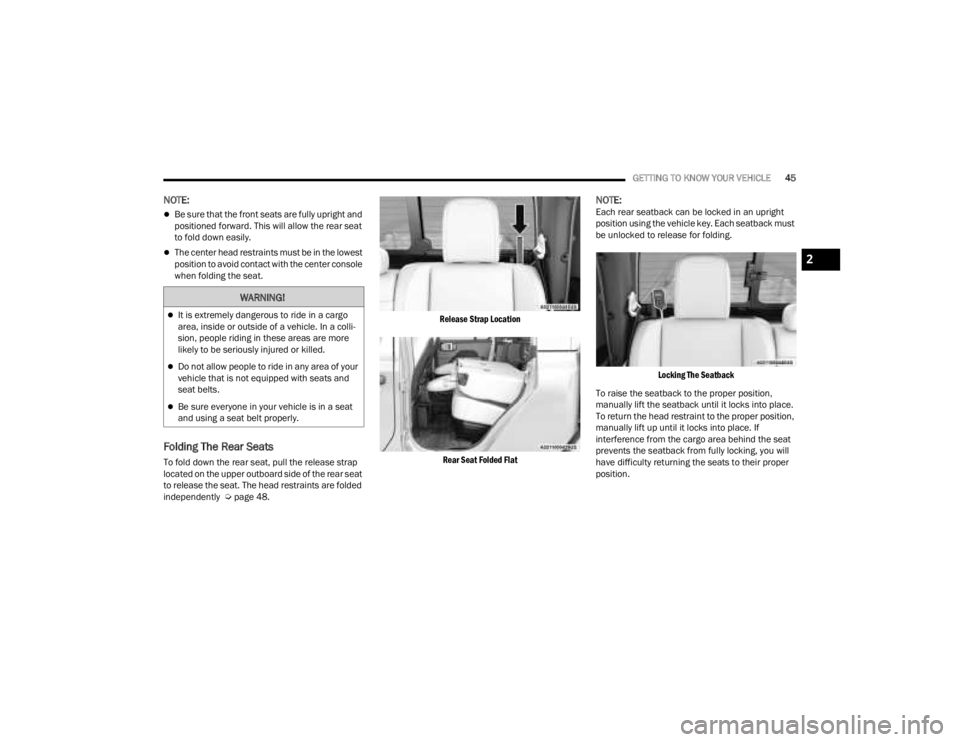
To fold down the rear seat, pull the release strap
located on the upper outboard side of the rear seat
to release the seat. The head restraints are folded
independently Úpage 48.
Release Strap Location
Rear Seat Folded Flat
NOTE:Each rear seatback can be locked in an upright
position using the vehicle key. Each seatback must
be unlocked to release for folding.
Locking The Seatback
To raise the seatback to the proper position,
manually lift the seatback until it locks into place.
To return the head restraint to the proper position,
manually lift up until it locks into place. If
interference from the cargo area behind the seat
prevents the seatback from fully locking, you will
have difficulty returning the seats to their proper
position.
WARNING!
It is extremely dangerous to ride in a cargo
area, inside or outside of a vehicle. In a colli -
sion, people riding in these areas are more
likely to be seriously injured or killed.
Do not allow people to ride in any area of your
vehicle that is not equipped with seats and
seat belts.
Be sure everyone in your vehicle is in a seat
and using a seat belt properly.
2
23_JT_OM_EN_USC_t.book Page 45
Page 48 of 448
46GETTING TO KNOW YOUR VEHICLE
NOTE:
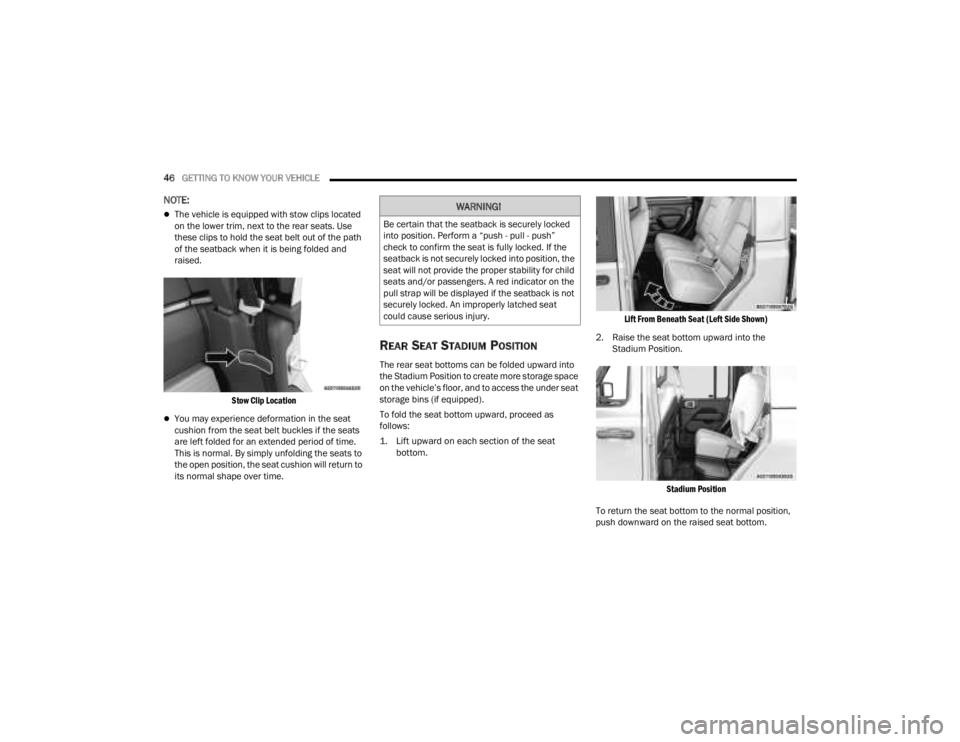
The vehicle is equipped with stow clips located
on the lower trim, next to the rear seats. Use
these clips to hold the seat belt out of the path
of the seatback when it is being folded and
raised.
Stow Clip Location
You may experience deformation in the seat
cushion from the seat belt buckles if the seats
are left folded for an extended period of time.
This is normal. By simply unfolding the seats to
the open position, the seat cushion will return to
its normal shape over time.
REAR SEAT STADIUM POSITION
The rear seat bottoms can be folded upward into
the Stadium Position to create more storage space
on the vehicle’s floor, and to access the under seat
storage bins (if equipped).
To fold the seat bottom upward, proceed as
follows:
1. Lift upward on each section of the seat bottom.
Lift From Beneath Seat (Left Side Shown)
2. Raise the seat bottom upward into the Stadium Position.
Stadium Position
To return the seat bottom to the normal position,
push downward on the raised seat bottom.
WARNING!
Be certain that the seatback is securely locked
into position. Perform a “push - pull - push”
check to confirm the seat is fully locked. If the
seatback is not securely locked into position, the
seat will not provide the proper stability for child
seats and/or passengers. A red indicator on the
pull strap will be displayed if the seatback is not
securely locked. An improperly latched seat
could cause serious injury.
23_JT_OM_EN_USC_t.book Page 46
Page 85 of 448
GETTING TO KNOW YOUR VEHICLE83
(Continued)
LOWERING THE SOFT TOP
Use this QR code to access your
digital experience. If the temperature is below 72°F (24°C) and/or
the top has been folded down for a period of time,
the top will appear to have shrunk when you raise
it, making it difficult to put up. This is caused by a
natural contraction of the vinyl or acrylic materials
of the fabric top.
Place the vehicle in a warm area. Pull steadily on
the top fabric. The vinyl will stretch back to its
original size and the top can then be installed. If
the temperature is 41°F (5°C) or below, do not
attempt to put the top down or roll the rear or side
curtains.
WARNING!
Do not drive the vehicle with the rear window
up/removed unless the quarter windows are
also removed. Dangerous exhaust gases
could enter the vehicle causing harm to the
driver and passengers.
The fabric quarter windows and fabric top are
designed only for protection against the
elements. Do not rely on them to contain occu -
pants within the vehicle or to protect against
injury during an accident. Remember, always
wear seat belts.
Make sure hands and fingers are clear of all
pinch points when installing and removing the
soft top. The lift assist mechanism and side
bows may cause serious injury if fingers or
hands get caught in between.
CAUTION!
The soft top is not designed to carry any
additional loads such as roof racks, spare tires,
building, hunting or camping supplies, and/or
luggage, etc. Also, it was not designed as a
structural member of the vehicle and, thus,
cannot properly carry any additional loads other
than environmental (rain, snow, etc.).
CAUTION!
Do not run a fabric top through an automatic
car wash. Window scratches and wax buildup
may result.
Do not lower the top when the temperature is
below 41°F (5°C). Damage to the top may
result.
Do not move your vehicle until the top has been
either fully attached to the windshield frame, or
fully lowered.
Follow the proper steps for cleaning and caring
for your vehicle’s fabric top
Ú
page 413.
Do not use any tools (screwdrivers, etc.) to pry
or force any of the clamps, clips, or retainers
securing the soft top. Do not force or pry the soft
top framework when opening or closing.
Damage to the top may result.
Failure to follow these cautions may cause interior
water damage, stains, or mildew on the top
material:
It is recommended that the top be free of water
prior to opening it. Operating the top, opening a
door or lowering a window while the top is wet
may allow water to drip into the vehicle's interior.
Careless handling and storage of the soft top
may damage the seals, causing water to leak
into the vehicle's interior.
The soft top must be positioned properly to
ensure sealing. Improper installation can cause
water to leak into the vehicle's interior.
CAUTION!
2
23_JT_OM_EN_USC_t.book Page 83
Page 94 of 448
92GETTING TO KNOW YOUR VEHICLE
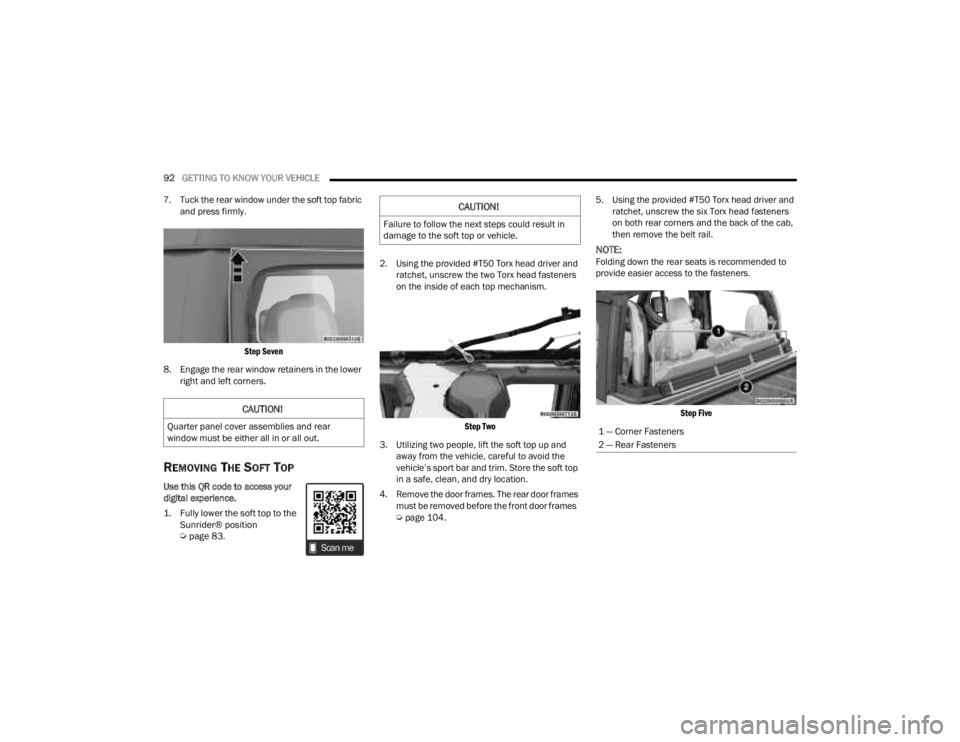
7. Tuck the rear window under the soft top fabric and press firmly.
Step Seven
8. Engage the rear window retainers in the lower right and left corners.
REMOVING THE SOFT TOP
Use this QR code to access your
digital experience.
1. Fully lower the soft top to the Sunrider® position
Ú
page 83.
2. Using the provided #T50 Torx head driver and
ratchet, unscrew the two Torx head fasteners
on the inside of each top mechanism.
Step Two
3. Utilizing two people, lift the soft top up and away from the vehicle, careful to avoid the
vehicle’s sport bar and trim. Store the soft top
in a safe, clean, and dry location.
4. Remove the door frames. The rear door frames must be removed before the front door frames
Úpage 104. 5. Using the provided #T50 Torx head driver and
ratchet, unscrew the six Torx head fasteners
on both rear corners and the back of the cab,
then remove the belt rail.
NOTE:Folding down the rear seats is recommended to
provide easier access to the fasteners.
Step Five
CAUTION!
Quarter panel cover assemblies and rear
window must be either all in or all out.
CAUTION!
Failure to follow the next steps could result in
damage to the soft top or vehicle.
1 — Corner Fasteners
2 — Rear Fasteners
23_JT_OM_EN_USC_t.book Page 92
Page 95 of 448
GETTING TO KNOW YOUR VEHICLE93
INSTALLING THE SOFT TOP
NOTE:If installing the soft top immediately after removing
the hard top, ensure the wire harness is stored
properly, and not tucked under the belt rail
Úpage 98.
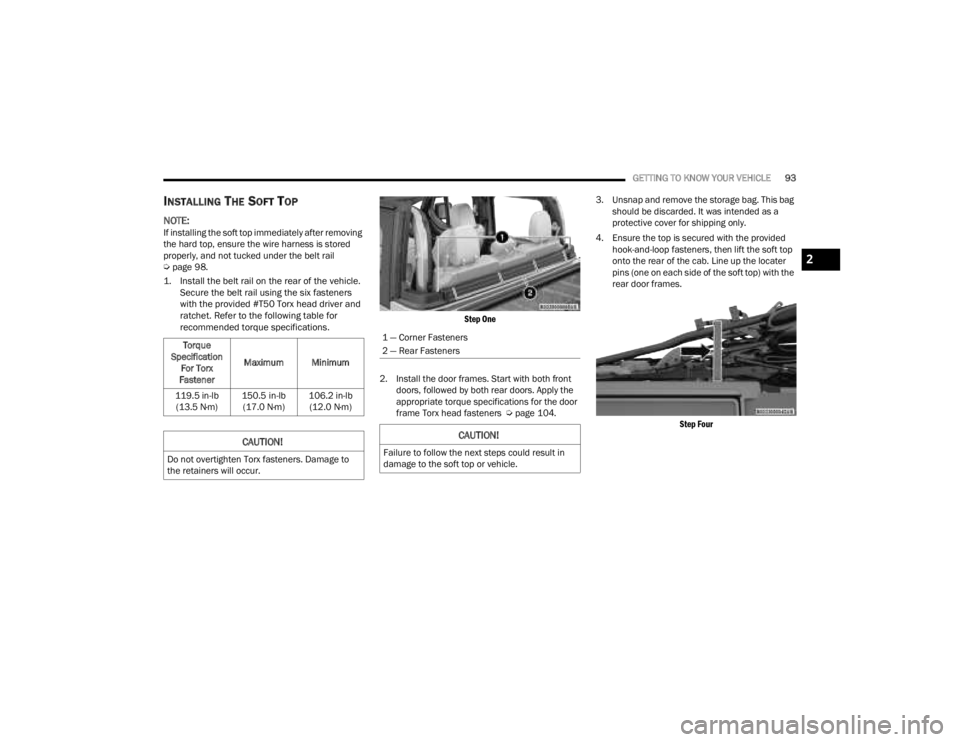
1. Install the belt rail on the rear of the vehicle. Secure the belt rail using the six fasteners
with the provided #T50 Torx head driver and
ratchet. Refer to the following table for
recommended torque specifications.
Step One
2. Install the door frames. Start with both front doors, followed by both rear doors. Apply the
appropriate torque specifications for the door
frame Torx head fasteners Ú page 104.3. Unsnap and remove the storage bag. This bag
should be discarded. It was intended as a
protective cover for shipping only.
4. Ensure the top is secured with the provided hook-and-loop fasteners, then lift the soft top
onto the rear of the cab. Line up the locater
pins (one on each side of the soft top) with the
rear door frames.
Step Four
Torque
Specification For Torx
Fastener Maximum Minimum
119.5 in-lb (13.5 N·m) 150.5 in-lb
(17.0 N·m) 106.2 in-lb
(12.0 N·m)
CAUTION!
Do not overtighten Torx fasteners. Damage to
the retainers will occur.
1 — Corner Fasteners
2 — Rear Fasteners
CAUTION!
Failure to follow the next steps could result in
damage to the soft top or vehicle.
2
23_JT_OM_EN_USC_t.book Page 93
Page 107 of 448
GETTING TO KNOW YOUR VEHICLE105
DOOR FRAME INSTALLATION
1. Install the front door frame first.
2. Ensure the windshield is in the “up” position.
Carefully place the front door frame in the
rubber seal at the top of the windshield, and
line up the holes for the Torx head fasteners
(two for each door).
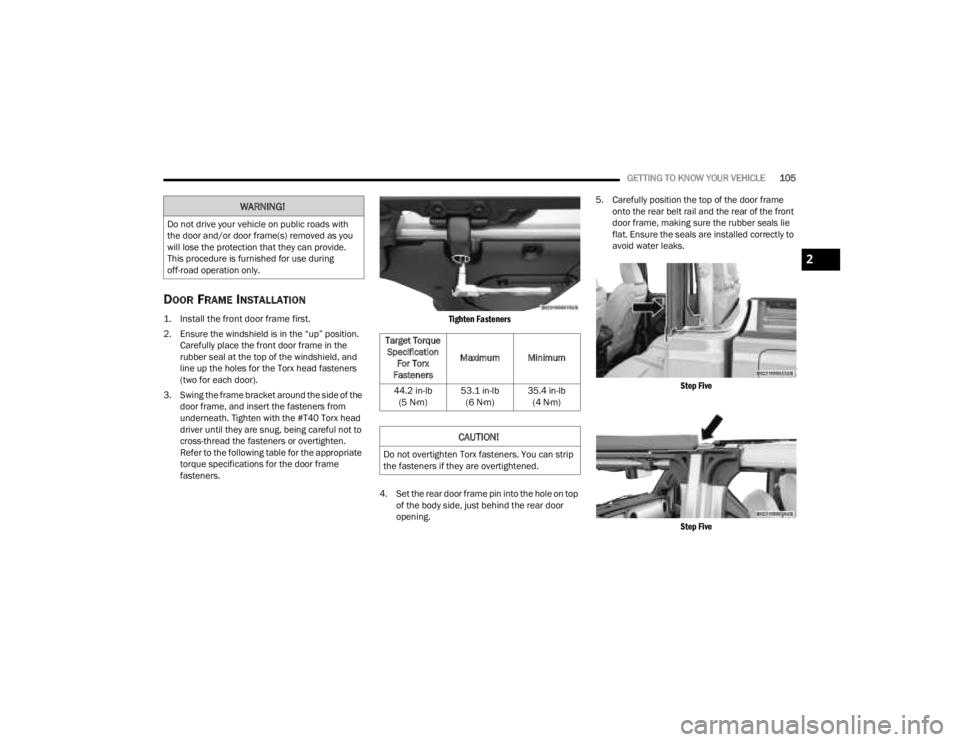
3. Swing the frame bracket around the side of the door frame, and insert the fasteners from
underneath. Tighten with the #T40 Torx head
driver until they are snug, being careful not to
cross-thread the fasteners or overtighten.
Refer to the following table for the appropriate
torque specifications for the door frame
fasteners.
Tighten Fasteners
4. Set the rear door frame pin into the hole on top of the body side, just behind the rear door
opening. 5. Carefully position the top of the door frame
onto the rear belt rail and the rear of the front
door frame, making sure the rubber seals lie
flat. Ensure the seals are installed correctly to
avoid water leaks.
Step Five
Step Five
WARNING!
Do not drive your vehicle on public roads with
the door and/or door frame(s) removed as you
will lose the protection that they can provide.
This procedure is furnished for use during
off-road operation only.
Target Torque Specification For Torx
Fasteners Maximum Minimum
44.2 in-lb (5 N·m) 53.1 in-lb
(6 N·m) 35.4 in-lb
(4 N·m)
CAUTION!
Do not overtighten Torx fasteners. You can strip
the fasteners if they are overtightened.
2
23_JT_OM_EN_USC_t.book Page 105
Page 108 of 448

106GETTING TO KNOW YOUR VEHICLE
(Continued)
6. Insert the fasteners from underneath. Tighten
with the #T40 Torx head driver until they are
snug, being careful not to cross-thread the
fasteners or overtighten. Refer to the previous
table for the appropriate torque specifications
for the door frame fasteners.
FOLDING WINDSHIELD
The fold-down windshield on your vehicle is a
structural element that can provide protection in
some accidents. The windshield also provides
protection against weather, road debris and
intrusion of small branches and other objects.
Do not drive your vehicle on-road with the
windshield down, as you lose the protection this
structural element provides.
If required for certain off-road uses, the windshield
can be folded down. However, the protection
afforded by the windshield is then lost. If you fold
down the windshield, drive slowly and cautiously. It
is recommended that the speed of the vehicle be
limited to 10 mph (16 km/h), with low range
operation preferred if you are driving off-road with
the windshield folded down. Raise the windshield as soon as the task that
required its removal is completed and before you
return to on-road driving. Both you and your
passengers should wear seat belts at all times,
on-road and off-road, regardless of whether the
windshield is raised or folded down.
LOWERING THE WINDSHIELD
1. Before completing the following steps:
If your vehicle is equipped with a soft top,
the top
MUST be lowered Ú page 83, and
the door frames must be removed
Ú page 104 prior to lowering the wind -
shield.
If your vehicle is equipped with a hard top,
the Freedom Panels MUST be removed
prior to lowering the windshield Úpage 95.
WARNING!
Carefully follow these warnings to help protect
against personal injury:
Do not drive your vehicle on-road with the
windshield down.
Do not drive your vehicle unless the wind -
shield is securely fastened, either up or down.
Eye protection, such as goggles, should be
worn at all times when the windshield is down.
Be sure that you carefully follow the instruc -
tions for raising the windshield. Make sure
that the folding windshield, windshield wipers,
side bars, and all associated hardware and
fasteners are correctly and tightly assembled
before driving your vehicle. Failure to follow
these instructions may prevent your vehicle
from providing you and your passengers’
protection in some accidents.
If you remove the doors, store them outside
the vehicle. In the event of an accident, a
loose door may cause personal injury.
CAUTION!
Failure to follow this step will cause damage to
the vehicle’s header seal.
WARNING!
23_JT_OM_EN_USC_t.book Page 106
Page 136 of 448
134GETTING TO KNOW YOUR INSTRUMENT PANEL
Oil Pressure Warning Light
This warning light will illuminate, and a
chime will sound, to indicate low engine
oil pressure. If the light and chime turn on
while driving, safely stop the vehicle and
turn off the engine as soon as possible. After the
vehicle is safely stopped, restart the engine and
monitor the Oil Pressure Warning Light. If the Oil
Pressure Warning Light is still illuminated, turn the
engine OFF and contact an authorized dealer for
further assistance. Do not operate the vehicle until
the cause is corrected. If the light is no longer
illuminated, the engine can be operated but it is
recommended to take the vehicle to an authorized
dealer as soon as possible.
Do not operate the vehicle until the cause is
corrected. This light does not indicate how much oil
is in the engine. The engine oil level must be
checked under the hood.
Oil Temperature Warning Light
This warning light will illuminate to
indicate the engine oil temperature is
high. If the light turns on while driving,
stop the vehicle and shut off the engine
as soon as possible. Wait for oil temperature to
return to normal levels.
Seat Belt Reminder Warning Light
This warning light indicates when the
driver or passenger seat belt is
unbuckled. When the ignition is first
placed in the ON/RUN or ACC/ON/RUN
position and if the driver’s seat belt is unbuckled,
a chime will sound and the light will turn on. When
driving, if the driver or front passenger seat belt
remains unbuckled, the Seat Belt Reminder Light
will flash or remain on continuously and a chime
will sound Ú page 299.
Rear Seat Belt Reminder Indicator Light —
If Equipped With A Base Instrument
Cluster
This light indicates when a rear seat belt
is unbuckled in the second row. When
the ignition is first placed in the ON/RUN
or ACC/ON/RUN position, and if a seat
belt in the second row is unbuckled, a light
corresponding to the specific seat will turn on in
the upper right portion of the instrument cluster
display, momentarily replacing the configurable
corner information. If a second row seat belt that
was buckled at the start of the trip is unbuckled,
the Rear Seat Belt Reminder Light will change from
the buckled to the unbuckled symbol, and a chime
will sound Ú page 299.
Transmission Temperature Warning
Light — If Equipped
This warning light will illuminate to warn of
a high transmission fluid temperature.
This may occur with strenuous usage such
as trailer towing. If this light turns on, stop
the vehicle and run the engine at idle or slightly
faster, with the transmission in PARK (P) or NEUTRAL
(N), until the light turns off. Once the light turns off,
you may continue to drive normally. If Manual
transmission equipped, this warning will illuminate
to warn of high clutch temperature. This may occur
with driver misuse of clutch pedal or resting foot on
the clutch pedal or partially engaging the clutch for
longer duration. If the light turns on, it will be with an
additional CLUTCH HOT message. Stop the vehicle
safely and run the engine at idle with transmission
gear in NEUTRAL (N) until the light turns off. Once the
light turns off, follow the message displayed in the
instrument cluster.
23_JT_OM_EN_USC_t.book Page 134
Page 142 of 448
140GETTING TO KNOW YOUR INSTRUMENT PANEL
Front Fog Indicator Light — If Equipped
This indicator light will illuminate when
the front fog lights are on Úpage 56.
Parking/Headlights On Indicator Light
This indicator light will illuminate when
the parking lights or headlights are
turned on.
Stop/Start Active Indicator Light —
If Equipped
This indicator light will illuminate when
the Stop/Start function is in “Autostop”
mode.
Turn Signal Indicator Lights
When the left or right turn signal is
activated, the turn signal indicator will
flash independently and the
corresponding exterior turn signal lamps
will flash. Turn signals can be activated when the
multifunction lever is moved down (left) or up
(right).
NOTE:
A continuous chime will sound if the vehicle is
driven more than 1 mile (1.6 km) with either
turn signal on.
Check for an inoperative outside light bulb if
either indicator flashes at a rapid rate.
Rear Seat Belt Fastened Indicator Light —
If Equipped With A Premium Instrument
Cluster
This light indicates when a rear seat belt
has been buckled in the second row. A
telltale will display in the upper right
corner of the instrument cluster display
to correspond to the specific seating position once
the seat belt has been buckled Ú page 299.
WHITE INDICATOR LIGHTS
Adaptive Cruise Control (ACC) Ready
Indicator Light — If Equipped With a
Premium Instrument Cluster
This light will turn on when the vehicle
equipped with Adaptive Cruise Control
(ACC) has been turned on, but not set.
Adaptive Cruise Control (ACC) Ready
Indicator Light — If Equipped With a Base
Instrument Cluster
This light will turn on when the vehicle
equipped with ACC has been turned on,
but not set.
Adaptive Cruise Control (ACC) Set Indicator
Light — If Equipped With a Base Instrument
Cluster
This light will turn on when the vehicle
equipped with ACC has been turned on,
but not set.
Two Wheel Drive High Indicator Light —
If Equipped With A Premium Instrument
Cluster
This light alerts the driver that the vehicle
is in the two wheel drive high mode.
Rear Seat Belt Fastened Indicator Light —
If Equipped With A Base Instrument
Cluster
This light indicates when a rear seat belt
has been buckled in the second row. A
telltale will display in the upper right
corner of the instrument cluster display
to correspond to the specific seating position once
the seat belt has been buckled.
23_JT_OM_EN_USC_t.book Page 140
Page 143 of 448
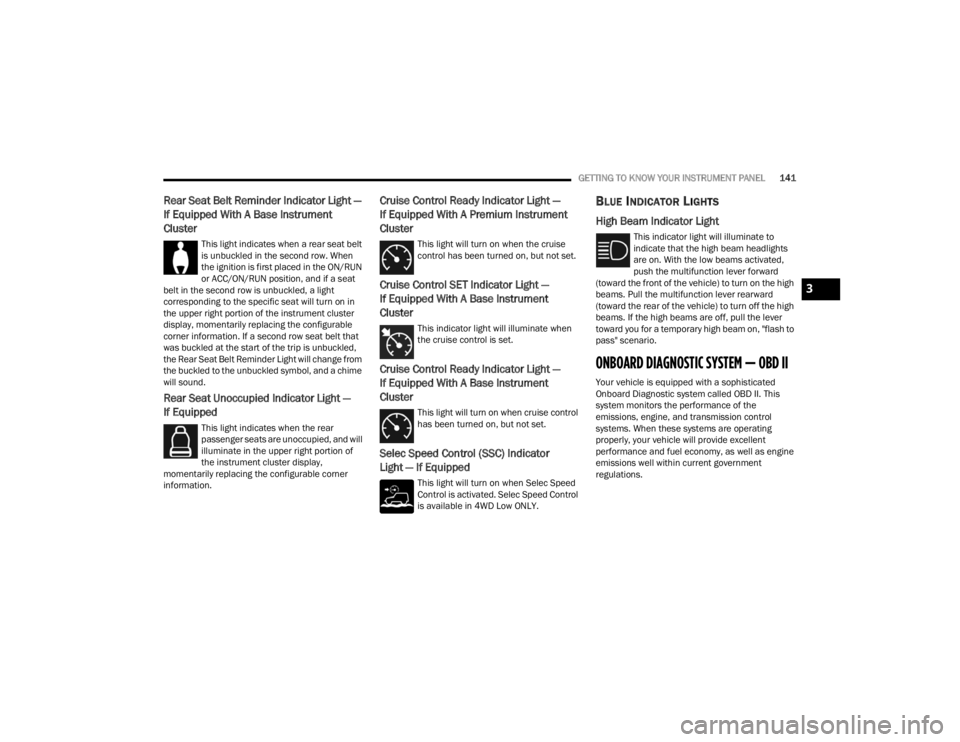
GETTING TO KNOW YOUR INSTRUMENT PANEL141
Rear Seat Belt Reminder Indicator Light —
If Equipped With A Base Instrument
Cluster
This light indicates when a rear seat belt
is unbuckled in the second row. When
the ignition is first placed in the ON/RUN
or ACC/ON/RUN position, and if a seat
belt in the second row is unbuckled, a light
corresponding to the specific seat will turn on in
the upper right portion of the instrument cluster
display, momentarily replacing the configurable
corner information. If a second row seat belt that
was buckled at the start of the trip is unbuckled,
the Rear Seat Belt Reminder Light will change from
the buckled to the unbuckled symbol, and a chime
will sound.
Rear Seat Unoccupied Indicator Light —
If Equipped
This light indicates when the rear
passenger seats are unoccupied, and will
illuminate in the upper right portion of
the instrument cluster display,
momentarily replacing the configurable corner
information.
Cruise Control Ready Indicator Light —
If Equipped With A Premium Instrument
Cluster
This light will turn on when the cruise
control has been turned on, but not set.
Cruise Control SET Indicator Light —
If Equipped With A Base Instrument
Cluster
This indicator light will illuminate when
the cruise control is set.
Cruise Control Ready Indicator Light —
If Equipped With A Base Instrument
Cluster
This light will turn on when cruise control
has been turned on, but not set.
Selec Speed Control (SSC) Indicator
Light — If Equipped
This light will turn on when Selec Speed
Control is activated. Selec Speed Control
is available in 4WD Low ONLY.
BLUE INDICATOR LIGHTS
High Beam Indicator Light
This indicator light will illuminate to
indicate that the high beam headlights
are on. With the low beams activated,
push the multifunction lever forward
(toward the front of the vehicle) to turn on the high
beams. Pull the multifunction lever rearward
(toward the rear of the vehicle) to turn off the high
beams. If the high beams are off, pull the lever
toward you for a temporary high beam on, "flash to
pass" scenario.
ONBOARD DIAGNOSTIC SYSTEM — OBD II
Your vehicle is equipped with a sophisticated
Onboard Diagnostic system called OBD II. This
system monitors the performance of the
emissions, engine, and transmission control
systems. When these systems are operating
properly, your vehicle will provide excellent
performance and fuel economy, as well as engine
emissions well within current government
regulations.
3
23_JT_OM_EN_USC_t.book Page 141