battery JEEP GRAND CHEROKEE 2008 WK / 3.G SRT Owner's Manual
[x] Cancel search | Manufacturer: JEEP, Model Year: 2008, Model line: GRAND CHEROKEE, Model: JEEP GRAND CHEROKEE 2008 WK / 3.GPages: 405, PDF Size: 2.93 MB
Page 303 of 405
WARNING!
Any procedure other than above could result in:
1. Personal injury caused by electrolyte squirting out
the battery vent;
2. Personal injury or property damage due to battery
explosion;
3. Damage to charging system of booster vehicle or
of immobilized vehicle.
WARNING!
²You should not try to start your vehicle by pushing
or towing.
²Do not connect the cable to the negative post of the
discharge battery. The resulting electrical spark
could cause the battery to explode.
²During cold weather when temperatures are be-
low freezing point, electrolyte in a discharged
battery may freeze. Do not attempt jump starting
because the battery could rupture or explode. The
battery temperature must be brought up above
freezing point before attempting jump start.
302 WHAT TO DO IN EMERGENCIES
Page 304 of 405
MAINTAINING YOUR VEHICLE
CONTENTS
mEngine Compartment ± 6.1L...............306
mOnboard Diagnostic System Ð OBD II........307
NLoose Fuel Filler Cap Message............308
mEmissions Inspection And Maintenance
Programs............................308
mReplacement Parts......................310
mDealer Service.........................310
mMaintenance Procedures..................311
NEngine Oil..........................311NEngine Oil Filter......................315
NDrive Belts Ð Check Condition And
Tensioner...........................315
NSpark Plugs.........................316
NEngine Air Cleaner Filter................316
NFuel Filter..........................317
NCatalytic Converter....................317
NMaintenance-Free Battery................318
NAir Conditioner Maintenance.............319
7
Page 310 of 405
For states which have an I/M (Inspection and
Maintenance) requirement, this check verifies the
following: the MIL (Malfunction Indicator Lamp)
is functioning and is not on when the engine is running,
and that the OBD (On Board Diagnostic) system is ready
for testing.
Normally, the OBD system will be ready. The OBD
system maynotbe ready if your vehicle was recently
serviced, if you recently had a dead battery, or a battery
replacement. If the OBD system should be determined
not ready for the I/M test, your vehicle may fail the test.
Your vehicle has a simple ignition key actuated test
which you can use prior to going to the test station. To
check if your vehicle's OBD system is ready, you must do
the following:
1. Insert your ignition key into the ignition switch.2. Turn the ignition to the ON position, but do not crank
or start the engine.
3. If you crank or start the engine, you will have to start
this test over.
4. As soon as you turn your key to the ON position, you
will see your MIL symbol come on as part of a normal
bulb check.
5. Approximately 15 seconds later, one of two things will
happen:
a. The MIL will flash for about 10 seconds and then
return to being fully illuminated until you turn off the
ignition key or start the engine. This means that your
vehicle's OBD system isnot readyand you shouldnot
proceed to the I/M station.
MAINTAINING YOUR VEHICLE 309
7
Page 311 of 405
b. The MIL will not flash at all and will remain fully
illuminated until you turn off the ignition key or start
the engine. This means that your vehicle's OBD system
isreadyand you can proceed to the I/M station.
If your OBD system isnot ready,you should see your
authorized dealer or repair facility. If your vehicle was
recently serviced or had a battery failure or replacement,
you may need to do nothing more than drive your
vehicle as you normally would in order for your OBD
system to update. A recheck with the above test routine
may then indicate that the system is now ready.
Regardless of whether your vehicle's OBD system is
ready or not ready, if the MIL symbol is illuminated
during normal vehicle operation, you should have your
vehicle serviced before going to the I/M station. The I/M
station can fail your vehicle because the MIL symbol is on
with the engine running.REPLACEMENT PARTS
Use of genuine Mopartparts for normal/scheduled
maintenance and repairs is highly recommended to in-
sure the designed performance. Damage or failures
caused by the use of non-Mopartparts for maintenance
and repairs will not be covered by the manufacturer's
warranty.
DEALER SERVICE
Your dealer has the qualified service personnel, special
tools and equipment to perform all service operations in
an expert manner. Service Manuals are available which
include detailed service information for your vehicle.
Refer to these manuals before attempting any procedure
yourself.
NOTE:Intentional tampering with emissions control
systems can result in civil penalties being assessed
against you.
310 MAINTAINING YOUR VEHICLE
Page 317 of 405
At the mileage indicated on the appropriate ªMainte-
nance Schedule,º all belts and tensioner should be
checked for condition. Improper belt tension can cause
belt slippage and failure.
Belts should be inspected for evidence of cuts, cracks,
glazing, or frayed cords and replaced if there is indication
of damage which could result in belt failure. Low gen-
erator belt tension can cause battery failure.
Also check belt routing to make sure there is no interfer-
ence between the belts and other engine components.
Spark Plugs
Spark plugs must fire properly to assure engine perfor-
mance and emission control. New spark plugs should be
installed at the specified mileage. The entire set should be
replaced if there is any malfunction due to a faulty spark
plug. Refer to ªFluids, Lubricants, and Genuine Partsº in
this section for spark plug information.
Engine Air Cleaner Filter
Under normal driving conditions, replace the air filter at
the intervals shown on ªMaintenance Schedule A.º If,
however, you drive the vehicle frequently under dusty or
severe conditions, the filter element should be inspected
periodically and replaced if necessary at the intervals
shown on ªMaintenance Schedule B.º
WARNING!
The air cleaner can provide a measure of protection
in the case of engine backfire. Do not remove the air
cleaner unless such removal is necessary for repair or
maintenance. Make sure that no one is near the
engine compartment before starting the vehicle with
the air cleaner removed. Failure to do so can result in
serious personal injury.
316 MAINTAINING YOUR VEHICLE
Page 319 of 405
WARNING!
A hot exhaust system can start a fire if you park over
materials that can burn. Such materials might be
grass or leaves coming into contact with your exhaust
system. Do not park or operate your vehicle in areas
where your exhaust system can contact anything that
can burn.
In unusual situations involving grossly malfunctioning
engine operation, a scorching odor may indicate severe
and abnormal catalyst overheating. If this occurs, the
vehicle should be stopped, the engine shut off and the
vehicle allowed to cool. Thereafter, service, including a
tune-up to manufacturer's specifications, should be ob-
tained immediately.To minimize the possibility of catalyst damage:²Do not shut off the engine or interrupt the ignition
when the transmission is in gear and the vehicle is in
motion.
²Do not try to start engine by pushing or towing the
vehicle.
²Do not idle the engine with any spark plug wires
disconnected or removed, such as when diagnostic
testing, or for prolonged periods during very rough
idling or malfunctioning operating conditions.
Maintenance-Free Battery
Your vehicle is equipped with a maintenance-free battery.
You will never have to add water, nor is periodic main-
tenance required.
318 MAINTAINING YOUR VEHICLE
Page 320 of 405
CAUTION!
It is essential when replacing the cables on the
battery that the positive cable is attached to the
positive post and the negative cable is attached to the
negative post. Battery posts are marked (+) positive
and negative (-) and identified on the battery case.
Also, if a ªfast chargerº is used while battery is in the
vehicle, disconnect both vehicle battery cables before
connecting the charger to battery. Do not use a ªfast
chargerº to provide starting voltage.
Air Conditioner Maintenance
For best possible performance, your air conditioner
should be checked and serviced by an Authorized Dealer
at the start of each warm season. This service shouldinclude cleaning of the condenser fins and a performance
test. Drive belt tension should also be checked at this
time.
WARNING!
²Use only refrigerants and compressor lubricants
approved by the manufacturer for your air condi-
tioning system. Some unapproved refrigerants are
flammable and can explode, injuring you. Other
unapproved refrigerants or lubricants can cause
the system to fail, requiring costly repairs. Refer
to Section 3 of the Warranty Information Book for
further warranty information.
²The air conditioning system contains refrigerant
under high pressure. To avoid risk of personal
injury or damage to the system, adding refrigerant
or any repair requiring lines to be disconnected
should be done by an experienced repairman.
MAINTAINING YOUR VEHICLE 319
7
Page 346 of 405
Cav-
ityCartridge
FuseMini Fuse Description
18 20 Amp
YellowFront Control Module
(FCM) Batt #1
19 20 Amp
YellowLt Trailer-Tow Stop/
Turn
20 20 Amp
YellowFront Control Module
(FCM) Batt #3
21 20 Amp
YellowRt Trailer-Tow Stop/
Turn
22 30 Amp
PinkFinal Drive Control
Module (FDCM)
MOD
23 50 Amp
RedRadiator Fan
27 15 Amp
BlueIgnition Off Draw
(IOD) #1
28 20 Amp
YellowIgnition Off Draw
(IOD) #2Cav-
ityCartridge
FuseMini Fuse Description
29 10 Amp
RedOccupant Restraint
Controller (ORC) R/S
30 10 Amp
RedOccupant Restraint
Controller (ORC) R/O
VEHICLE STORAGE
If you are leaving your vehicle dormant for more than 21
days you may want to take steps to protect your battery.
You may:
²Remove fuse #27 in the Intelligent Power Module
labeled Ignition-Off Draw (IOD#1).
²Or, disconnect the negative cable from the battery.
MAINTAINING YOUR VEHICLE 345
7
Page 359 of 405
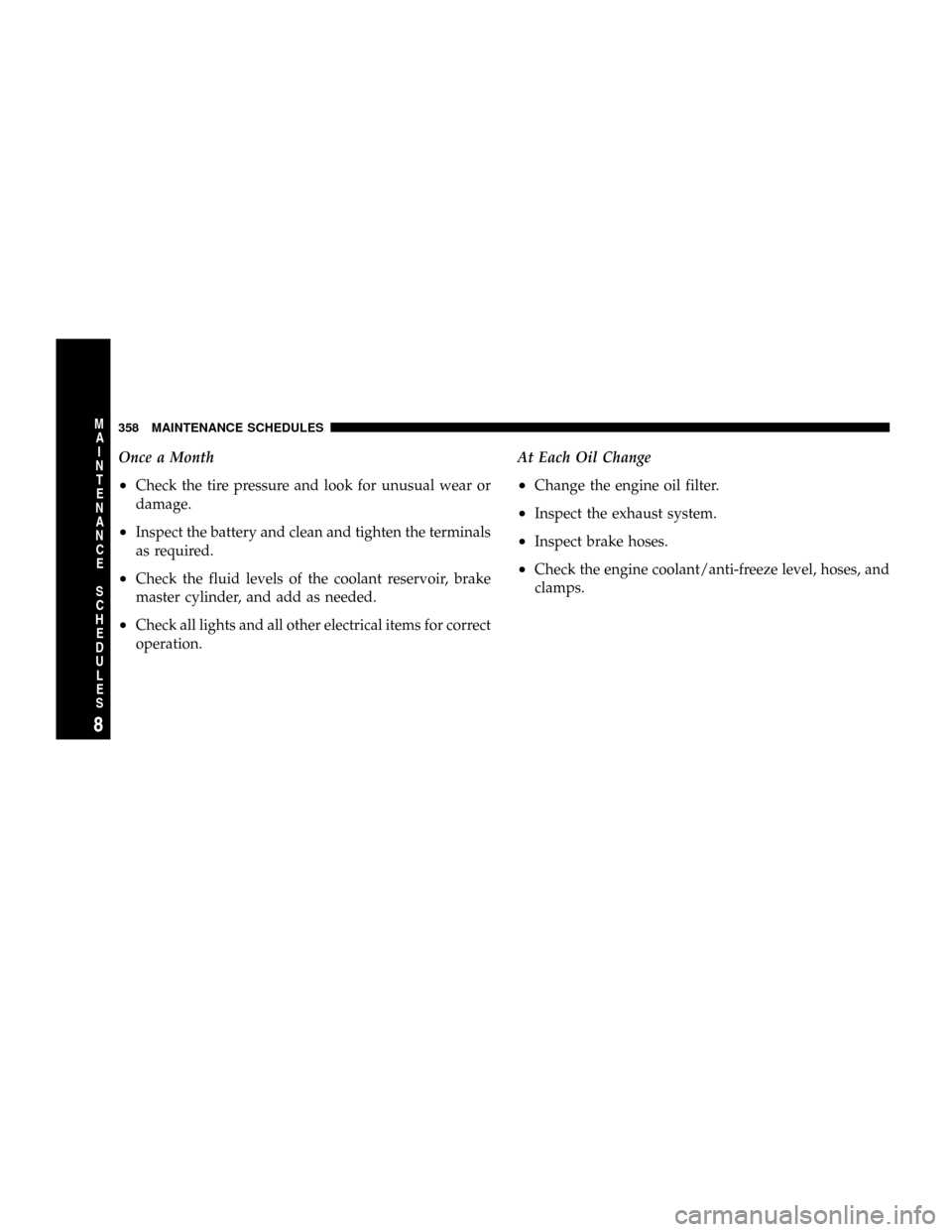
Once a Month
²Check the tire pressure and look for unusual wear or
damage.
²Inspect the battery and clean and tighten the terminals
as required.
²Check the fluid levels of the coolant reservoir, brake
master cylinder, and add as needed.
²Check all lights and all other electrical items for correct
operation.At Each Oil Change
²Change the engine oil filter.
²Inspect the exhaust system.
²Inspect brake hoses.
²Check the engine coolant/anti-freeze level, hoses, and
clamps.
358 MAINTENANCE SCHEDULES
8
M
A
I
N
T
E
N
A
N
C
E
S
C
H
E
D
U
L
E
S
Page 388 of 405
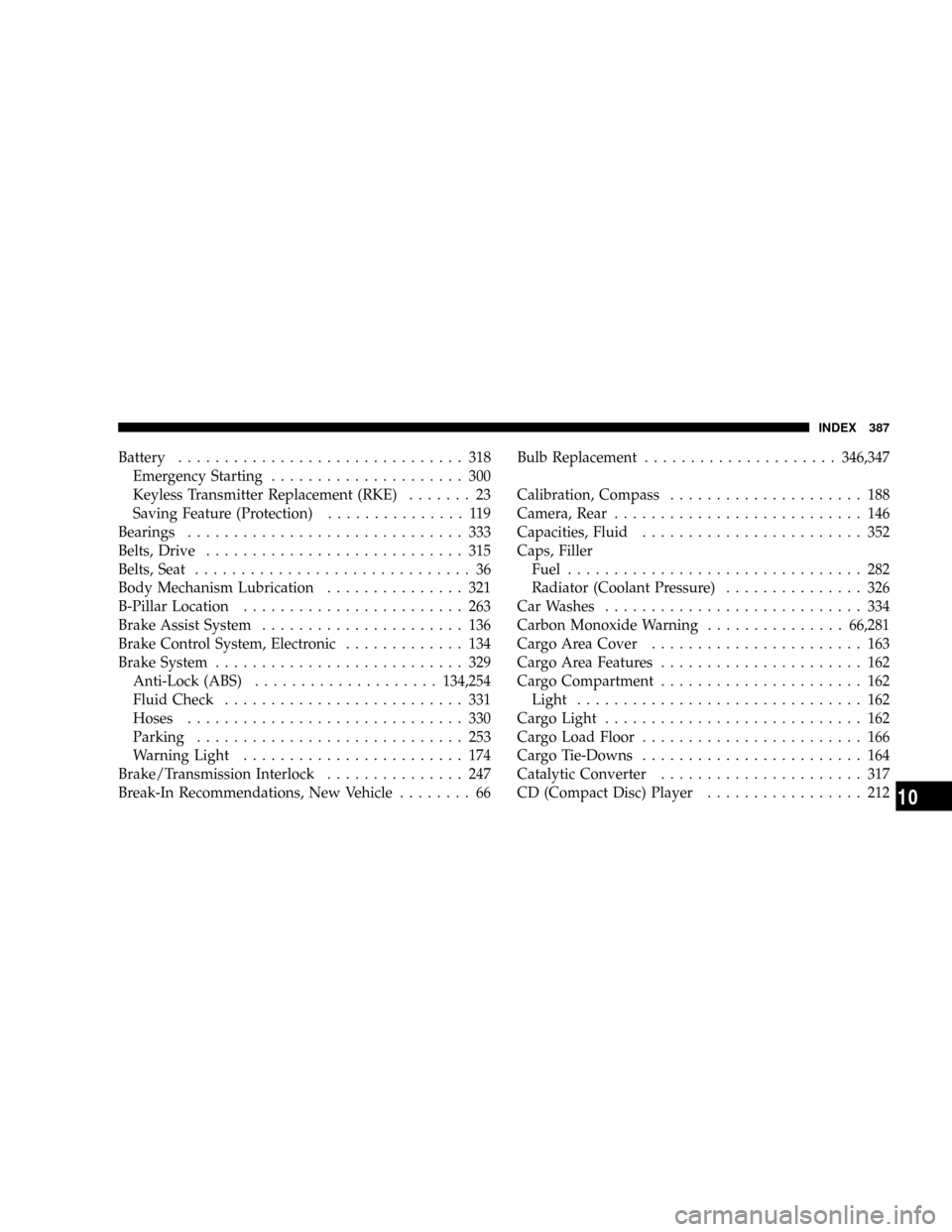
Battery............................... 318
Emergency Starting..................... 300
Keyless Transmitter Replacement (RKE)....... 23
Saving Feature (Protection)............... 119
Bearings.............................. 333
Belts, Drive............................ 315
Belts, Seat.............................. 36
Body Mechanism Lubrication............... 321
B-Pillar Location........................ 263
Brake Assist System...................... 136
Brake Control System, Electronic............. 134
Brake System........................... 329
Anti-Lock (ABS)....................134,254
Fluid Check.......................... 331
Hoses.............................. 330
Parking............................. 253
Warning Light........................ 174
Brake/Transmission Interlock............... 247
Break-In Recommendations, New Vehicle........ 66Bulb Replacement.....................346,347
Calibration, Compass..................... 188
Camera, Rear........................... 146
Capacities, Fluid........................ 352
Caps, Filler
Fuel................................ 282
Radiator (Coolant Pressure)............... 326
Car Washes............................ 334
Carbon Monoxide Warning...............66,281
Cargo Area Cover....................... 163
Cargo Area Features...................... 162
Cargo Compartment...................... 162
Light............................... 162
Cargo Light............................ 162
Cargo Load Floor........................ 166
Cargo Tie-Downs........................ 164
Catalytic Converter...................... 317
CD (Compact Disc) Player................. 212
INDEX 387
10