coolant temperature JEEP GRAND CHEROKEE 2008 WK / 3.G SRT Owners Manual
[x] Cancel search | Manufacturer: JEEP, Model Year: 2008, Model line: GRAND CHEROKEE, Model: JEEP GRAND CHEROKEE 2008 WK / 3.GPages: 405, PDF Size: 2.93 MB
Page 179 of 405
of reasons, including the installation of replacement or
alternate tires or wheels on the vehicle that prevent the
TPMS from functioning properly. Always check the
TPMS malfunction telltale after replacing one or more
tires or wheels on your vehicle to ensure that the replace-
ment or alternate tires and wheels allow the TPMS to
continue to function properly.CAUTION!
The TPMS has been optimized for the original
equipment tires and wheels. TPMS pressures and
warning have been established for the tire size
equipped on your vehicle. Undesirable system opera-
tion or sensor damage may result when using re-
placement equipment that is not of the same size,
type, and/or style. After-market wheels can cause
sensor damage. Do not use aftermarket tire sealants
or balance beads if your vehicle is equipped with a
TPMS, as damage to the sensors may result.
13. Temperature Gauge
The temperature gauge shows engine coolant tempera-
ture. Any reading within the normal range indicates that
the engine cooling system is operating satisfactorily.
178 UNDERSTANDING YOUR INSTRUMENT PANEL
Page 180 of 405
The gauge pointer will likely indicate a higher tempera-
ture when driving in hot weather, up mountain grades,
or when towing a trailer. It should not be allowed to
exceed the upper limits of the normal operating range.
CAUTION!
Driving with a hot engine cooling system could
damage your vehicle. If temperature gauge reads
high, pull over and stop the vehicle. Idle the vehicle
with the air conditioner turned off until the pointer
drops back into the normal range. If the pointer
remains high, and you hear continuous chimes, turn
the engine off immediately, and call for service.
WARNING!
A hot engine cooling system is dangerous. You or
others could be badly burned by steam or boiling
coolant. If you decide to look under the hood your-
self, refer to Section 7 of this manual. Follow the
warnings under ªCooling System Pressure Cap.º
14. Electronic Vehicle Information Center Display
When the appropriate conditions exist, this display
shows the Electronic Vehicle Information Center (EVIC)
messages. Refer to ªElectronic Vehicle Information Cen-
terº later in this section.
UNDERSTANDING YOUR INSTRUMENT PANEL 179
4
Page 237 of 405
Operating Tips
Window Fogging
Windows will fog on the inside when the humidity inside
the vehicle is high. This often occurs in mild or cool
temperatures when it's rainy or humid. In most cases
turning on the Air-conditioning (pressing the snowflake
button) will clear the fog. Adjust the temperature control,
air direction and blower speed to maintain comfort.
As the temperature gets colder it may be necessary to
direct air onto the windshield. Adjust the temperature
control and blower speed to maintain comfort. Higher
blower speeds will reduce fogging. Interior fogging on
the windshield can be quickly removed by selecting the
defrost mode.
Regular cleaning of the inside of the windows with a
non-filming cleaning solution (vinegar and water works
very well) will help prevent contaminates (cigarettesmoke, perfumes, etc.) from sticking to the windows.
Contaminates increase the rate of window fogging.Summer Operation
Air conditioned vehicles must be protected with a high
quality antifreeze coolant during summer to provide
proper corrosion protection and to raise the boiling point
of the coolant for protection against overheating. A 50 %
concentration is recommended. Refer to Recommended
Fluids and Genuine Parts for the proper coolant type.
When using the air conditioner in extremely heavy traffic
in hot weather especially when towing a trailer, addi-
tional engine cooling may be required. If this situation is
encountered, operate the transmission in a lower gear to
increase engine RPM, coolant flow and fan speed. When
stopped in heavy traffic, it may be necessary to shift into
N (Neutral) and depress the accelerator slightly for fast
idle operation to increase coolant flow and fan speed.
236 UNDERSTANDING YOUR INSTRUMENT PANEL
Page 325 of 405
Cooling System
WARNING!
²When working near the radiator cooling fan, dis-
connect the fan motor lead or turn the ignition
switch to the OFF position. The fan is temperature
controlled and can start at any time the ignition
switch is in the ON position.
²You or others can be badly burned by hot coolant
or steam from your radiator. If you see or hear
steam coming from under the hood, don't open the
hood until the radiator has had time to cool. Never
try to open a cooling system pressure cap when the
radiator is hot.
Coolant Checks
Check engine coolant (antifreeze) protection every 12
months (before the onset of freezing weather, where
applicable). If coolant is dirty or rusty in appearance, the
system should be drained, flushed and refilled with fresh
coolant. Check the front of the A/C condenser for any
accumulation of bugs, leaves, etc. If dirty, clean by gently
spraying water from a garden hose vertically down the
face of the condenser.
Check the coolant recovery bottle tubing for brittle rub-
ber, cracking, tears, cuts and tightness of the connection
at the bottle and radiator. Inspect the entire system for
leaks.
With the engine at normal operating temperature (but
not running), check the cooling system pressure cap for
proper vacuum sealing by draining a small amount of
coolant from the radiator drain cock. If the cap is sealing
properly, the engine coolant (antifreeze) will begin to
324 MAINTAINING YOUR VEHICLE
Page 327 of 405
Adding Coolant
Your vehicle has been built with an improved engine
coolant that allows extended maintenance intervals. This
coolant can be used up to 5 Years or 100,000 miles (160
000 km) before replacement. To prevent reducing this
extended maintenance period, it is important that you
use the same coolant throughout the life of your vehicle.
Please review these recommendations for using Hybrid
Organic Additive Technology (HOAT) coolant.
When adding coolant:
²The manufacturer recommends using Mopart
Antifreeze/ Coolant 5 Year/100,000 Mile Formula
HOAT (Hybrid Organic Additive Technology)
²Mix a minimum solution of 50% HOAT engine coolant
and distilled water. Use higher concentrations (not to
exceed 70%) if temperatures below234ÉF (237ÉC ) are
anticipated.
²Use only high purity water such as distilled or deion-
ized water when mixing the water/engine coolant
solution. The use of lower quality water will reduce
the amount of corrosion protection in the engine
cooling system.
Please note that it is the owner's responsibility to main-
tain the proper level of protection against freezing ac-
cording to the temperatures occurring in the area where
the vehicle is operated.
NOTE:Mixing coolant types will decrease the life of the
engine coolant and will require more frequent coolant
changes.
Cooling System Pressure Cap
The cap must be fully tightened to prevent loss of
coolant, and to insure that coolant will return to the
radiator from the coolant recovery bottle.
326 MAINTAINING YOUR VEHICLE
Page 329 of 405
service attendant of this. As long as the engine operating
temperature is satisfactory, the coolant bottle need only
be checked once a month.
When additional coolant is needed to maintain the
proper level, it should be added to the coolant bottle. Do
not overfill.
Points To Remember
NOTE:When the vehicle is stopped after a few miles (a
few kilometers) of operation, you may observe vapor
coming from the front of the engine compartment. This is
normally a result of moisture from rain, snow, or high
humidity accumulating on the radiator and being vapor-
ized when the thermostat opens, allowing hot coolant to
enter the radiator.
If an examination of your engine compartment shows no
evidence of radiator or hose leaks, the vehicle may be
safely driven. The vapor will soon dissipate.
²Do not overfill the coolant recovery bottle.
²Check coolant freeze point in the radiator and in the
coolant recovery bottle. If antifreeze needs to be
added, contents of coolant recovery bottle must also be
protected against freezing.
²If frequent coolant additions are required, or if the
level in the coolant recovery bottle does not drop when
the engine cools, the cooling system should be pres-
sure tested for leaks.
²Maintain coolant concentration at 50% HOAT engine
coolant (minimum) and distilled water for proper
corrosion protection of your engine which contains
aluminum components.
²Make sure that the radiator and coolant recovery
bottle overflow hoses are not kinked or obstructed.
328 MAINTAINING YOUR VEHICLE
Page 360 of 405
Schedule ªBº
Follow this schedule if you usually operate your vehicle
under one or more of the following conditions.
²Day or night temperatures are below 32ÉF (0ÉC)
²Stop and go driving
²Excessive engine idling
²Driving in dusty conditions
²Short trips of less than 10 miles (16.2 km)
²More than 50% of your driving is at sustained high
speeds during hot weather, above 90ÉF (32ÉC)
²Trailer towing
NOTE:IfANYof these apply to you, change your
engine oil every 3,000 miles (5 000 km) or 3 months,
whichever comes first, and follow the maintenance rec-
ommendations in ªMaintenance Schedule B.º
NOTE:IfANYof these apply to you then flush and
replace your engine coolant every 102,000 miles (170 000
km) or 60 months, whichever comes first, and follow
ªSchedule Bº of the ªMaintenance Schedulesº section of
this manual.
SCHEDULE ªBº 359
8
M
A
I
N
T
E
N
A
N
C
E
S
C
H
E
D
U
L
E
S
Page 387 of 405
ABS (Anti-Lock Brake System)............175,254
Adding Engine Coolant (Antifreeze).......... 326
Adding Fuel........................... 282
Adding Washer Fluid..................... 168
Additives, Fuel......................... 280
Adjustable Pedals....................... 130
Air Conditioner Maintenance............... 319
Air Conditioning, Operating Tips............ 236
Air Conditioning Refrigerant............... 320
Air Pressure, Tires....................... 269
Airbag................................ 45
Airbag Deployment....................... 51
Airbag Light.......................53,67,175
Airbag Maintenance....................... 53
Alarm, Panic............................ 22
Alarm (Security Alarm).................18,176
Alarm System (Security Alarm)............... 18
Alignment and Balance................... 274
Alterations/Modifications, Vehicle............. 8Antenna, Satellite Radio................... 222
Antifreeze (Engine Coolant)..............325,352
Disposal............................ 327
Anti-Lock Brake System (ABS)............134,254
Anti-Lock Warning Light.................. 175
Anti-Theft System.....................18,176
Appearance Care........................ 333
Audio Systems (Radio).................... 212
Auto Down Power Windows................ 29
Automatic Dimming Mirror................. 74
Automatic Door Locks..................... 27
Automatic Headlights.................... 120
Automatic Temperature Control (ATC)......... 229
Automatic Transmission................247,333
Fluid Level Check...................... 333
Autostick............................. 250
Auxiliary Electrical Outlet (Power Outlet)...... 158
Auxiliary Power Outlet................... 158
386 INDEX
Page 391 of 405
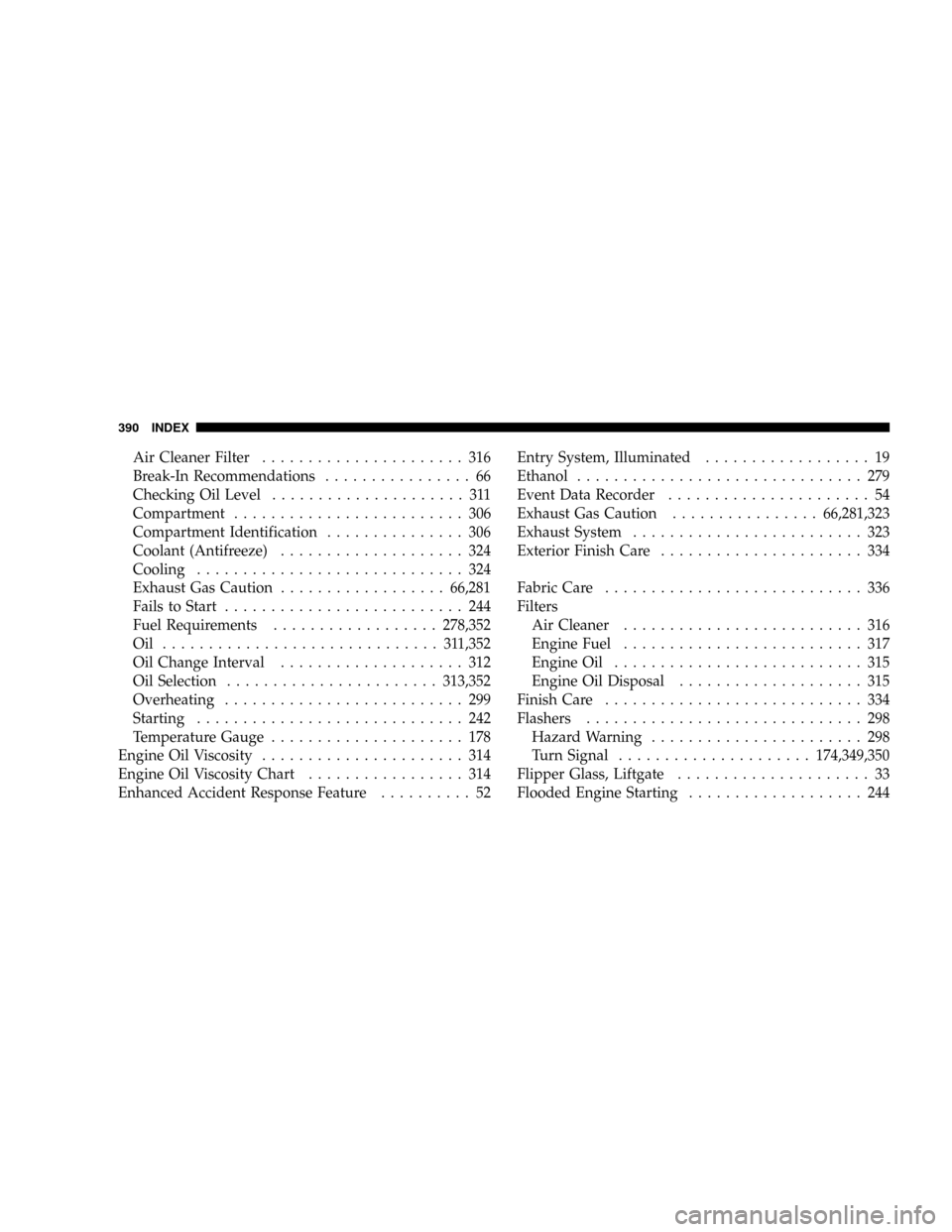
Air Cleaner Filter...................... 316
Break-In Recommendations................ 66
Checking Oil Level..................... 311
Compartment......................... 306
Compartment Identification............... 306
Coolant (Antifreeze).................... 324
Cooling............................. 324
Exhaust Gas Caution..................66,281
Fails to Start.......................... 244
Fuel Requirements..................278,352
Oil .............................. 311,352
Oil Change Interval.................... 312
Oil Selection.......................313,352
Overheating.......................... 299
Starting............................. 242
Temperature Gauge..................... 178
Engine Oil Viscosity...................... 314
Engine Oil Viscosity Chart................. 314
Enhanced Accident Response Feature.......... 52Entry System, Illuminated.................. 19
Ethanol............................... 279
Event Data Recorder...................... 54
Exhaust Gas Caution................66,281,323
Exhaust System......................... 323
Exterior Finish Care...................... 334
Fabric Care............................ 336
Filters
Air Cleaner.......................... 316
Engine Fuel.......................... 317
Engine Oil........................... 315
Engine Oil Disposal.................... 315
Finish Care............................ 334
Flashers.............................. 298
Hazard Warning....................... 298
Turn Signal.....................174,349,350
Flipper Glass, Liftgate..................... 33
Flooded Engine Starting................... 244
390 INDEX
Page 392 of 405
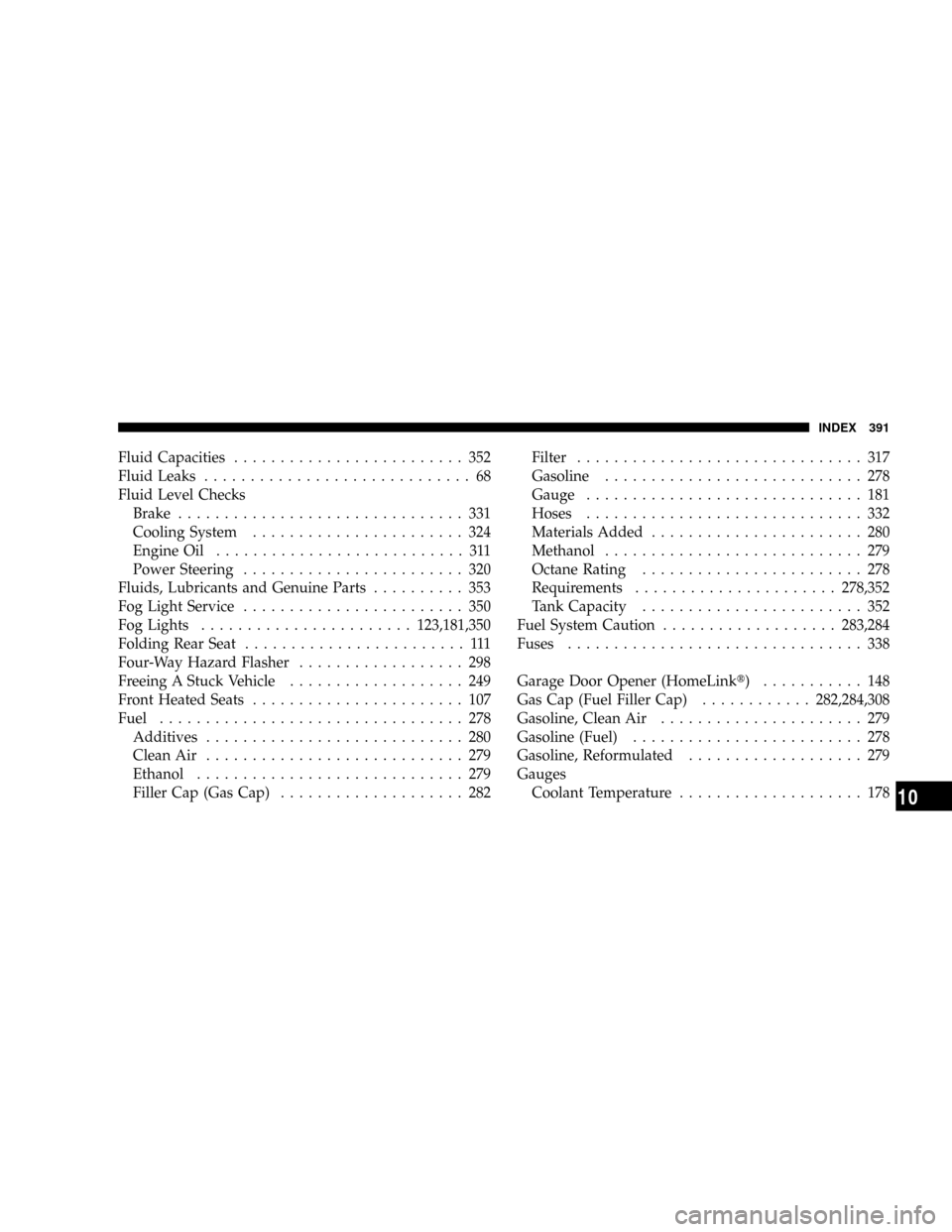
Fluid Capacities......................... 352
Fluid Leaks............................. 68
Fluid Level Checks
Brake............................... 331
Cooling System....................... 324
Engine Oil........................... 311
Power Steering........................ 320
Fluids, Lubricants and Genuine Parts.......... 353
Fog Light Service........................ 350
Fog Lights.......................123,181,350
Folding Rear Seat........................ 111
Four-Way Hazard Flasher.................. 298
Freeing A Stuck Vehicle................... 249
Front Heated Seats....................... 107
Fuel................................. 278
Additives............................ 280
Clean Air............................ 279
Ethanol............................. 279
Filler Cap (Gas Cap).................... 282Filter............................... 317
Gasoline............................ 278
Gauge.............................. 181
Hoses.............................. 332
Materials Added....................... 280
Methanol............................ 279
Octane Rating........................ 278
Requirements......................278,352
Tank Capacity........................ 352
Fuel System Caution...................283,284
Fuses................................ 338
Garage Door Opener (HomeLinkt) ........... 148
Gas Cap (Fuel Filler Cap)............282,284,308
Gasoline, Clean Air...................... 279
Gasoline (Fuel)......................... 278
Gasoline, Reformulated................... 279
Gauges
Coolant Temperature.................... 178
INDEX 391
10