oil temperature JEEP GRAND CHEROKEE 2009 WK / 3.G Owners Manual
[x] Cancel search | Manufacturer: JEEP, Model Year: 2009, Model line: GRAND CHEROKEE, Model: JEEP GRAND CHEROKEE 2009 WK / 3.GPages: 521, PDF Size: 17.85 MB
Page 273 of 521
captured interior air to condense on windows and ham-
per visibility. For this reason, the system will not allow
“Recirculation” mode to be selected while in the defrost
or defrost/floor modes. Attempting to use Recirculation
while in these modes will cause the LED in the button to
blink and then turn off.
Operating Tips
Window Fogging
Windows will fog on the inside when the humidity inside
the vehicle is high. This often occurs in mild or cool
temperatures when it’s rainy or humid. In most cases,
turning the air conditioning (pressing the snowflake
button) on will clear the fog. Adjust the temperature
control, air direction, and blower speed to maintain
comfort.
As the temperature gets colder, it may be necessary to
direct air onto the windshield. Adjust the temperaturecontrol and blower speed to maintain comfort. Higher
blower speeds will reduce fogging. Interior fogging on
the windshield can be quickly removed by selecting the
defrost mode.
Regular cleaning of the inside of the windows with a
non-filming cleaning solution (vinegar and water works
very well) will help prevent contaminates (cigarette
smoke, perfumes, etc.) from sticking to the windows.
Contaminates increase the rate of window fogging.
Summer Operation
Air conditioned vehicles must be protected with a high
quality antifreeze coolant, during the summer, to provide
proper corrosion protection and to raise the boiling point
of the coolant for protection against overheating. A 50 %
concentration is recommended. Refer to Fluids, Lubri-
cants, and Genuine Parts in Section 7 for the proper
coolant type.
UNDERSTANDING YOUR INSTRUMENT PANEL 271
4
Page 284 of 521
release it as soon as the starter engages. The starter motor
will disengage automatically in 10 seconds. Once this
occurs, release the accelerator pedal, turn the ignition
switch to the LOCK position, wait 10 to 15 seconds, then
repeat the normal starting procedure.
CAUTION!
To prevent damage to the starter, wait 10 to 15 sec-
onds before trying again.
After Starting
The idle speed is controlled automatically and it will
decrease as the engine warms up.
Normal Starting — Diesel Engines
Observe the following when the engine is operating.
•All message center lights are off.
•Malfunction Indicator Light (MIL) is off.
•Low Oil Pressure Light is off.
Cold Weather Precautions
Operation in ambient temperature below 32°F (0°C) may
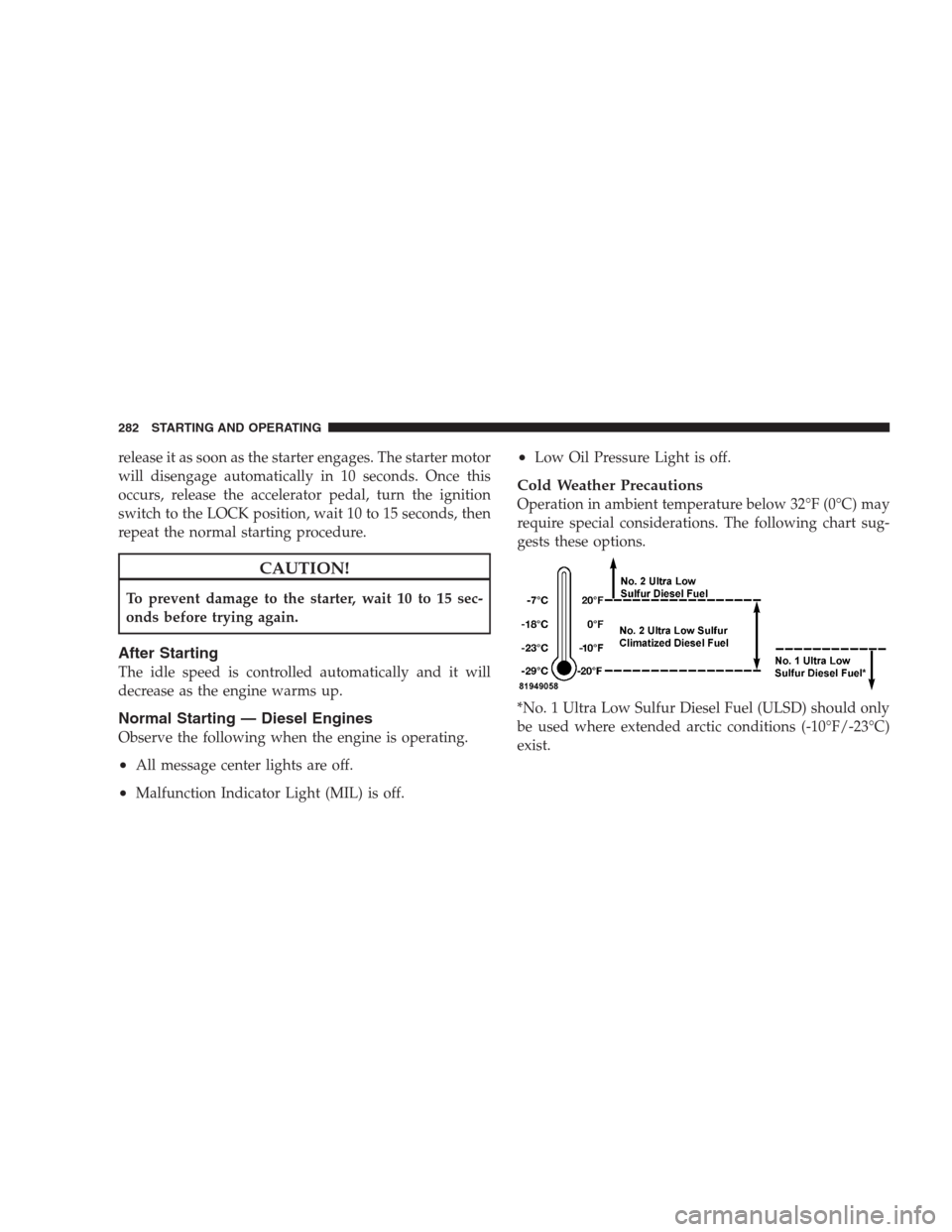
require special considerations. The following chart sug-
gests these options.
*No. 1 Ultra Low Sulfur Diesel Fuel (ULSD) should only
be used where extended arctic conditions (-10°F/-23°C)
exist.
282 STARTING AND OPERATING
Page 286 of 521
depending on engine temperature. When the “Wait To
Start” goes out, the engine is ready to start.
4. Tip Start Feature
Do notpress the accelerator. Use the Fob with Integrated
Key (FOBIK) to briefly turn the ignition switch to the
START position and then release it. The starter motor will
continue to run, and it will automatically disengage
when the engine is running. If the engine fails to start, the
starter will disengage automatically in 20 seconds. The
starter can be disengaged by turning the ignition key to
the OFF position, if required.
5. After the engine starts, allow it to idle for approxi-
mately 30 seconds before driving. This allows oil to
circulate and lubricate the turbocharger.
Avoid prolonged idling in ambient temperatures below
0°F (-18°C). Long periods of idling may be harmful to
your engine because combustion chamber temperatures
can drop so low that the fuel may not burn completely.Incomplete combustion allows carbon and varnish to
form on piston rings and injector nozzles. Also, the
unburned fuel can enter the crankcase, diluting the oil
and causing rapid wear to the engine.
Engine Warm-Up
Avoid full throttle operation when the engine is cold.
When starting a cold engine, bring the engine up to
operating speed slowly to allow the oil pressure to
stabilize as the engine warms up.
NOTE:High-speed, no-load running of a cold engine
can result in excessive white smoke and poor engine
performance. No-load engine speeds should be kept
under 1,200 RPM during the warm-up period, especially
in cold ambient temperature conditions.
If temperatures are below 32°F (0°C), operate the engine
at moderate speeds for five minutes before full loads are
applied.
284 STARTING AND OPERATING
Page 287 of 521
Engine Idling - In Cold Weather
Avoid prolonged idling in ambient temperatures below
0°F (-18°C). Long periods of idling may be harmful to
your engine because combustion chamber temperatures
can drop so low that the fuel may not burn completely.
Incomplete combustion allows carbon and varnish to
form on piston rings and injector nozzles. Also, the
unburned fuel can enter the crankcase, diluting the oil
and causing rapid wear to the engine.
Stopping The Engine
Before turning off your turbo diesel engine, always allow
the engine to return to normal idle speed and run for
several seconds. This assures proper lubrication of the
turbocharger. This is particularly necessary after any
period of hard driving.
Idle the engine a few minutes before routine shutdown.
After full load operation, idle the engine three to five
minutes before shutting it down. This idle period willallow the lubricating oil and coolant to carry excess heat
away from the combustion chamber, bearings, internal
components, and turbocharger. This is especially impor-
tant for turbocharged, charge air cooled engines.
ENGINE BLOCK HEATER — IF EQUIPPED
The engine block heater warms the engine, and permits
quicker starts in cold weather. Connect the heater cord to
a ground-fault interrupter protected 110-115 Volt AC
electrical outlet with a grounded, three-wire extension
cord.
Use the heater when temperatures below 0°F (-18°C) are
expected to last for several days.
The block heater must be plugged in at least one hour to
have an adequate warming effect on the coolant.
The engine block heater cord is located:
•3.7L/4.7L Engine — coiled and strapped to the engine
oil dipstick tube.
STARTING AND OPERATING 285
5
Page 365 of 521
For best results, a refueling pattern that avoids alternat-
ing between E-85 and unleaded gasoline is recom-
mended.
When you do switch fuel types it is recommended that:
•you do not add less than 5 gal (19 L) when refueling
•you drive the vehicle immediately after refueling for at
least 5 mi (8 km)
Observing these precautions will avoid possible hard
starting and/or significant deterioration in drivability
during warm up.
NOTE:Use seasonally adjusted E-85 fuel (ASTM
D5798). With non-seasonally adjusted E-85 fuel, you may
experience hard starting and rough idle following start
up even if the above recommendations are followed,
especially when the ambient temperature is below 32°F
(0°C).
Selection Of Engine Oil For Flexible Fuel Vehicles
(E-85) and Gasoline Vehicles
Whether operating the vehicle on an E-85 ethanol fuel or
unleaded gasoline, the engine oil requirements are the
same. Refer to “Maintenance Procedures” in Section 7 of
this manual for the proper quality and viscosity engine
oil.
Starting
The characteristics of E-85 fuel make it unsuitable for use
when ambient temperatures fall below 0°F (-18°C). In the
range of 0° to 32°F (-18° to 0°C), you may experience an
increase in the time it takes for your engine to start, and
a deterioration in drivability (sags and/or hesitations)
until the engine is fully warmed up.
Cruising Range
Because E-85 fuel contains less energy per gallon/liter
than gasoline, you will experience an increase in fuel
STARTING AND OPERATING 363
5
Page 418 of 521
Engine Oil Viscosity (3.7L/4.7L/5.7L Engines)
SAE 5W-20 engine oil is recommended for all operating
temperatures. This engine oil improves low temperature
starting and vehicle fuel economy.
The engine oil filler cap also shows the recommended
engine oil viscosity for your vehicle. For information on
engine oil filler cap location, refer to “Engine Compart-
ment” in this section.
Lubricants, which do not have both the engine oil certi-
fication mark and the correct SAE viscosity grade num-
ber, should not be used.
Engine Oil Viscosity (3.0L Diesel Engine)
CAUTION!
Your vehicle is equipped with an advanced technol-
ogy Diesel Engine and an emission device designed
to limit Diesel Particulate Emissions from being
released into the atmosphere. The durability of your
engine and life expectancy of this diesel particulate
filter emission device is highly dependent on the use
of the correct engine oil.
SAE 5W-30 Synthetic Low Ash engine oil is recom-
mended for all operating temperatures. This engine oil
improves low temperature starting and vehicle fuel
economy.
416 MAINTAINING YOUR VEHICLE
Page 423 of 521
Windshield Wiper Blades
Clean the rubber edges of the wiper blades and the
windshield periodically with a sponge or soft cloth and a
mild nonabrasive cleaner to remove accumulations of salt
or road film.
Operation of the wipers on dry glass for long periods
may cause deterioration of the wiper blades. Always use
washer fluid when using the wipers to remove salt or dirt
from a dry windshield.
Avoid using the wiper blades to wipe frost or ice from the
windshield. Keep the blade rubber out of contact with
petroleum products such as engine oil, gasoline, etc.
Adding Washer Fluid
On vehicles equipped with a Electronic Vehicle Informa-
tion Center (EVIC), the low washer fluid level will be
indicated. When the sensor detects a low fluid level, the
windshield will light on the vehicle graphic outline and
the “WASHER FLUID LOW” message will be displayed.The fluid reservoir for the windshield washers and the
rear window washer is shared. The fluid reservoir is
located in the engine compartment, be sure to check the
fluid level at regular intervals. Fill the reservoir with
windshield washer solvent only (not radiator antifreeze).
When refilling the washer fluid reservoir, take some
washer fluid and apply it to a cloth or towel and wipe
clean the wiper blades, this will help blade performance.
To prevent freeze-up of your windshield washer system
in cold weather, select a solution or mixture that meets or
exceeds the temperature range of your climate. This
rating information can be found on most washer fluid
containers.
MAINTAINING YOUR VEHICLE 421
7
Page 437 of 521
2. The vehicle must be on level ground.
3. Fully apply the parking brake, and press the brake
pedal.
4. Place the shift lever momentarily in each gear position
ending with the lever in PARK.
5. Remove the dipstick, wipe it clean and reinsert it until
seated.
6. Remove the dipstick again, and note the fluid level on
both sides. The fluid level should be between the “HOT”
(upper) reference holes on the dipstick at normal operat-
ing temperature. The fluid level is only valid if there is a
solid coating of oil on both sides of the dipstick. If the
fluid is low, add as required into the dipstick tube.Do
not overfill.After adding any quantity of oil through the
oil fill tube, wait a minimum of two minutes for the oil to
fully drain into the transmission before rechecking the
fluid level.NOTE:If it is necessary to check the transmissionbelow
the operating temperature, the fluid level should be
between the two “COLD” (lower) holes on the dipstick
with the fluid at approximately 70°F (21°C) (room tem-
perature). If the fluid level is correctly established at
room temperature, it should be between the “HOT”
(upper) reference holes when the transmission reaches
180°F (82°C). Remember it is best to check the level at the
normal operating temperature.
CAUTION!
Be aware that if the fluid temperature is below 50°F
(10°C) it may not register on the dipstick. Do not add
fluid until the temperature is elevated enough to
produce an accurate reading.
7. Check for leaks. Release parking brake.
MAINTAINING YOUR VEHICLE 435
7
Page 505 of 521
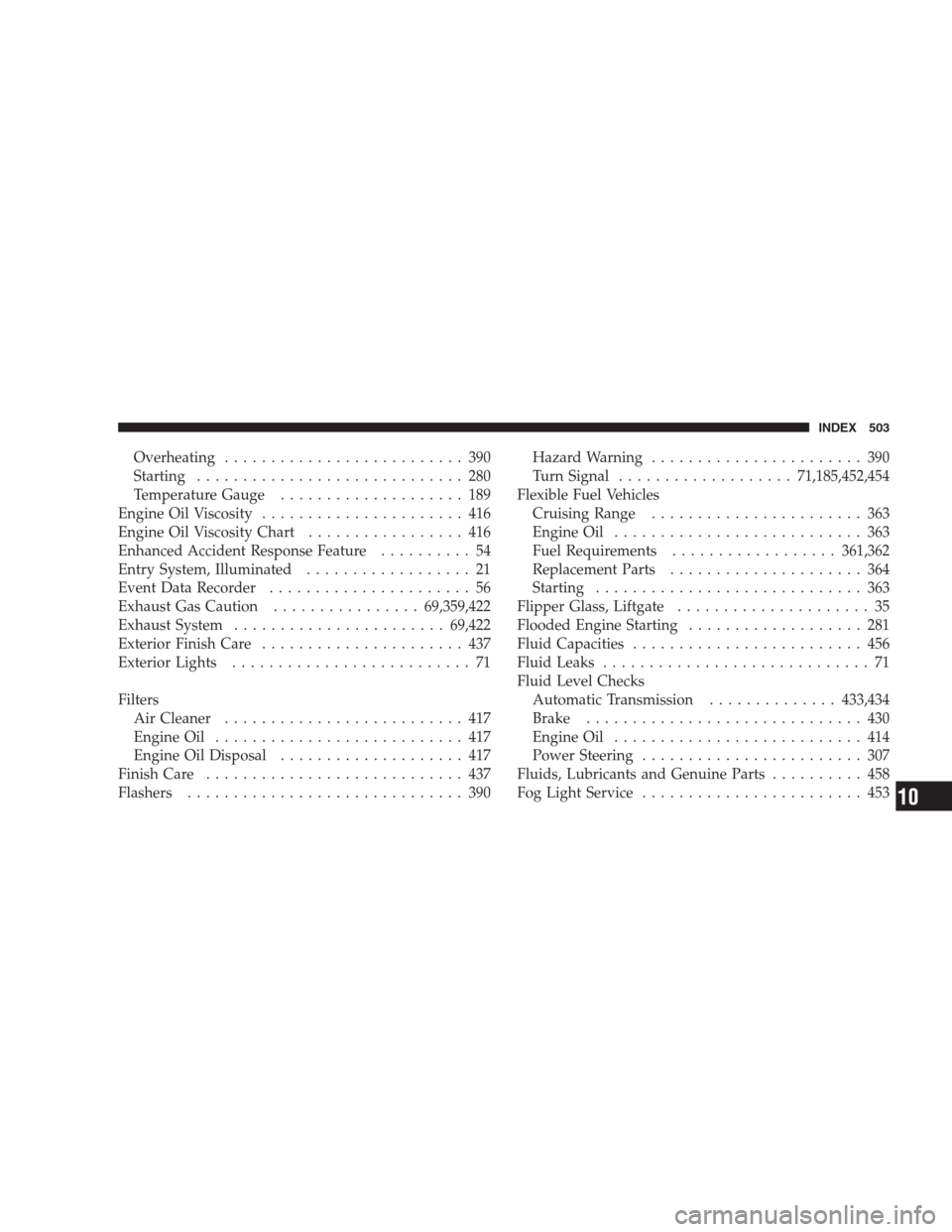
Overheating.......................... 390
Starting............................. 280
Temperature Gauge.................... 189
Engine Oil Viscosity...................... 416
Engine Oil Viscosity Chart................. 416
Enhanced Accident Response Feature.......... 54
Entry System, Illuminated.................. 21
Event Data Recorder...................... 56
Exhaust Gas Caution................69,359,422
Exhaust System.......................69,422
Exterior Finish Care...................... 437
Exterior Lights.......................... 71
Filters
Air Cleaner.......................... 417
Engine Oil........................... 417
Engine Oil Disposal.................... 417
Finish Care............................ 437
Flashers.............................. 390Hazard Warning....................... 390
Turn Signal...................71,185,452,454
Flexible Fuel Vehicles
Cruising Range....................... 363
Engine Oil........................... 363
Fuel Requirements..................361,362
Replacement Parts..................... 364
Starting............................. 363
Flipper Glass, Liftgate..................... 35
Flooded Engine Starting................... 281
Fluid Capacities......................... 456
Fluid Leaks............................. 71
Fluid Level Checks
Automatic Transmission..............433,434
Brake.............................. 430
Engine Oil........................... 414
Power Steering........................ 307
Fluids, Lubricants and Genuine Parts.......... 458
Fog Light Service........................ 453
INDEX 503
10
Page 516 of 521
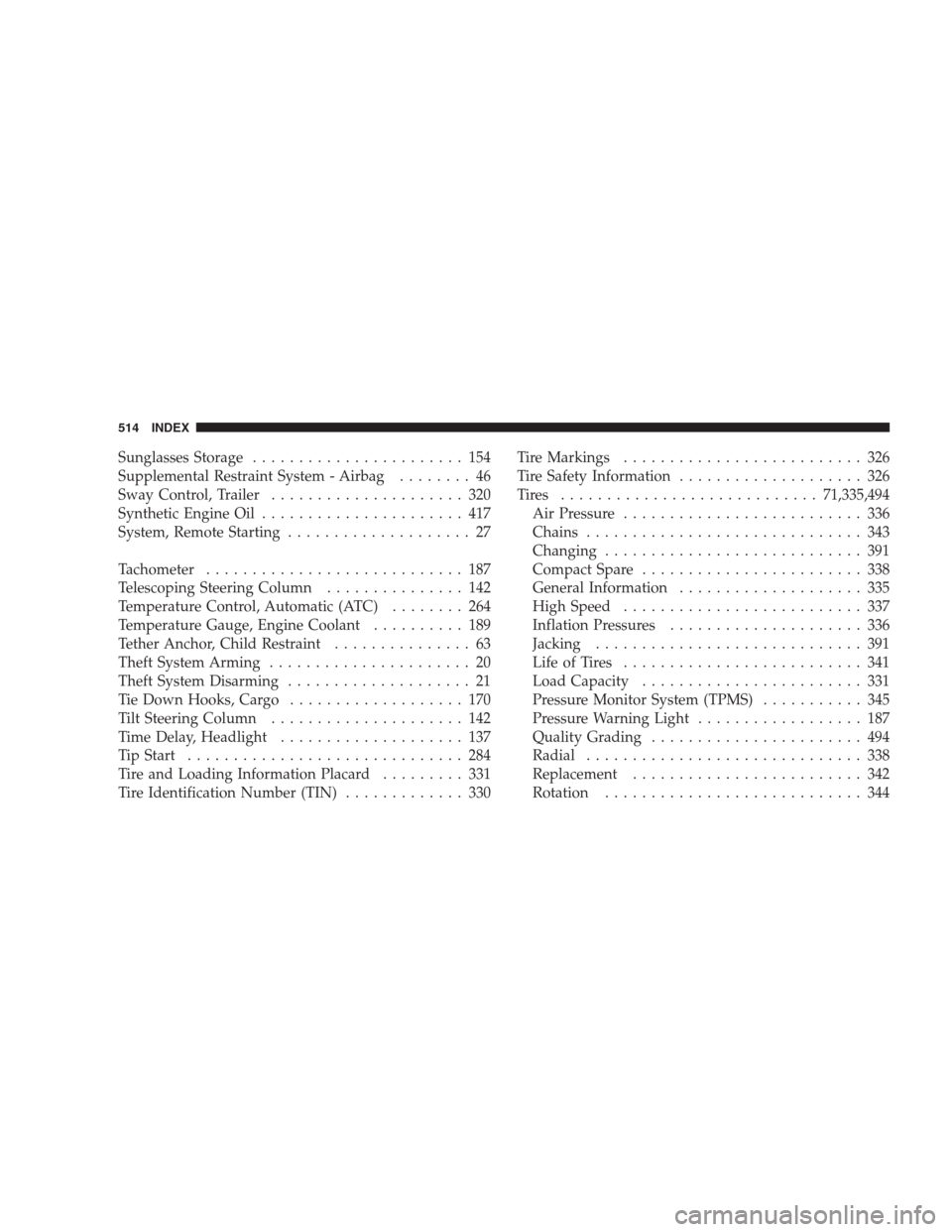
Sunglasses Storage....................... 154
Supplemental Restraint System - Airbag........ 46
Sway Control, Trailer..................... 320
Synthetic Engine Oil...................... 417
System, Remote Starting.................... 27
Tachometer............................ 187
Telescoping Steering Column............... 142
Temperature Control, Automatic (ATC)........ 264
Temperature Gauge, Engine Coolant.......... 189
Tether Anchor, Child Restraint............... 63
Theft System Arming...................... 20
Theft System Disarming.................... 21
Tie Down Hooks, Cargo................... 170
Tilt Steering Column..................... 142
Time Delay, Headlight.................... 137
Tip Start.............................. 284
Tire and Loading Information Placard......... 331
Tire Identification Number (TIN)............. 330Tire Markings.......................... 326
Tire Safety Information.................... 326
Tires ............................71,335,494
Air Pressure.......................... 336
Chains.............................. 343
Changing............................ 391
Compact Spare........................ 338
General Information.................... 335
High Speed.......................... 337
Inflation Pressures..................... 336
Jacking............................. 391
Life of Tires.......................... 341
Load Capacity........................ 331
Pressure Monitor System (TPMS)........... 345
Pressure Warning Light.................. 187
Quality Grading....................... 494
Radial.............................. 338
Replacement......................... 342
Rotation............................ 344
514 INDEX