instrument panel JEEP GRAND CHEROKEE 2010 WK / 3.G Owners Manual
[x] Cancel search | Manufacturer: JEEP, Model Year: 2010, Model line: GRAND CHEROKEE, Model: JEEP GRAND CHEROKEE 2010 WK / 3.GPages: 466, PDF Size: 8.11 MB
Page 2 of 466
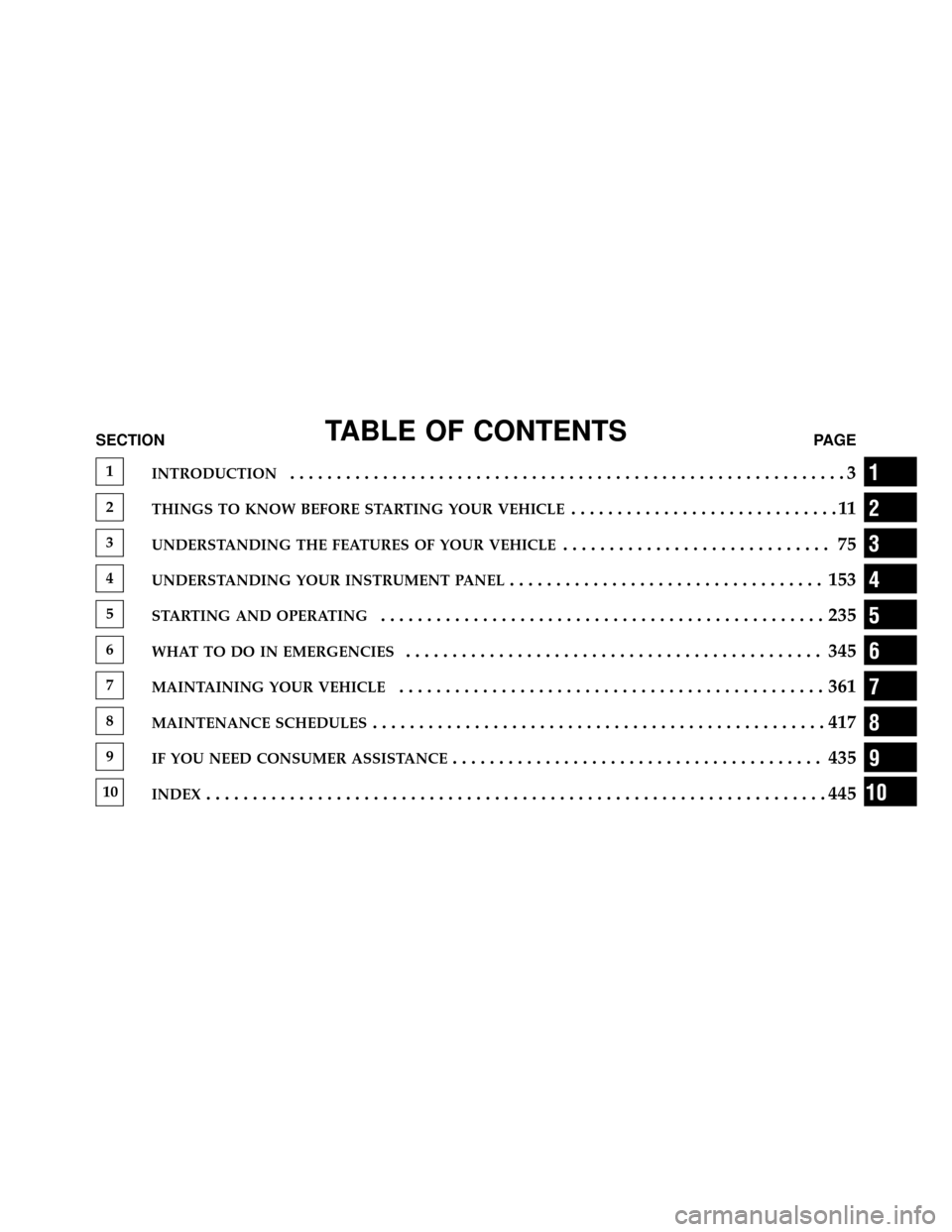
TABLE OF CONTENTSSECTIONPAGE
1INTRODUCTION............................................................3
2THINGS TO KNOW BEFORE STARTING YOUR VEHICLE.............................11
3UNDERSTANDING THE FEATURES OF YOUR VEHICLE............................. 75
4UNDERSTANDING YOUR INSTRUMENT PANEL.................................. 153
5STARTING AND OPERATING................................................235
6WHAT TO DO IN EMERGENCIES............................................. 345
7MAINTAINING YOUR VEHICLE..............................................361
8MAINTENANCE SCHEDULES.................................................417
9IF YOU NEED CONSUMER ASSISTANCE........................................ 435
10INDEX...................................................................445
1
2
3
4
5
6
7
8
9
10
Page 9 of 466
WARNINGS AND CAUTIONS
This Owner’s Manual containsWARNINGSagainst op-
erating procedures that could result in an accident or
bodily injury. It also contains CAUTIONSagainst proce-
dures that could result in damage to your vehicle. If you
do not read this entire manual, you may miss important
information. Observe all Warnings and Cautions.
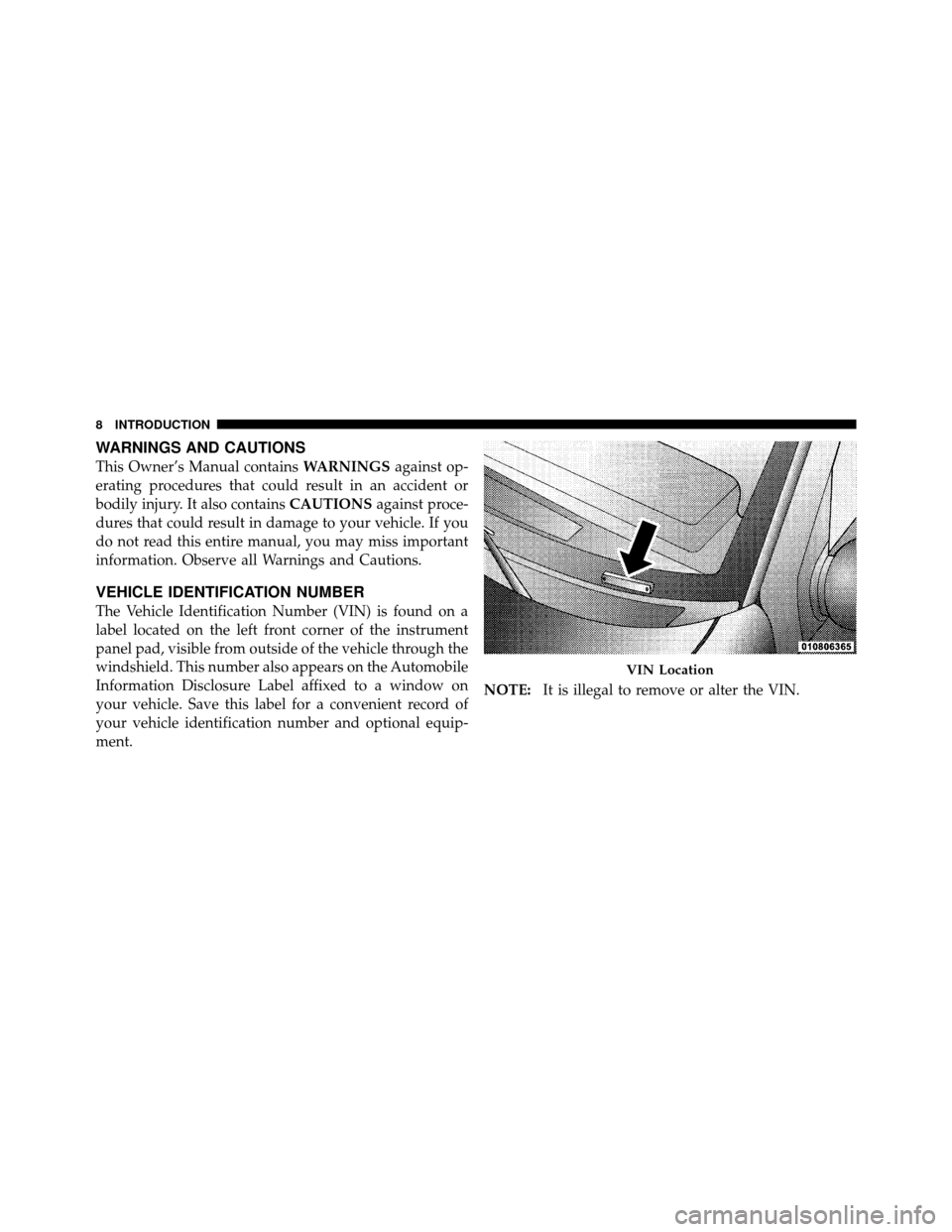
VEHICLE IDENTIFICATION NUMBER
The Vehicle Identification Number (VIN) is found on a
label located on the left front corner of the instrument
panel pad, visible from outside of the vehicle through the
windshield. This number also appears on the Automobile
Information Disclosure Label affixed to a window on
your vehicle. Save this label for a convenient record of
your vehicle identification number and optional equip-
ment. NOTE:
It is illegal to remove or alter the VIN.
VIN Location
8 INTRODUCTION
Page 22 of 466
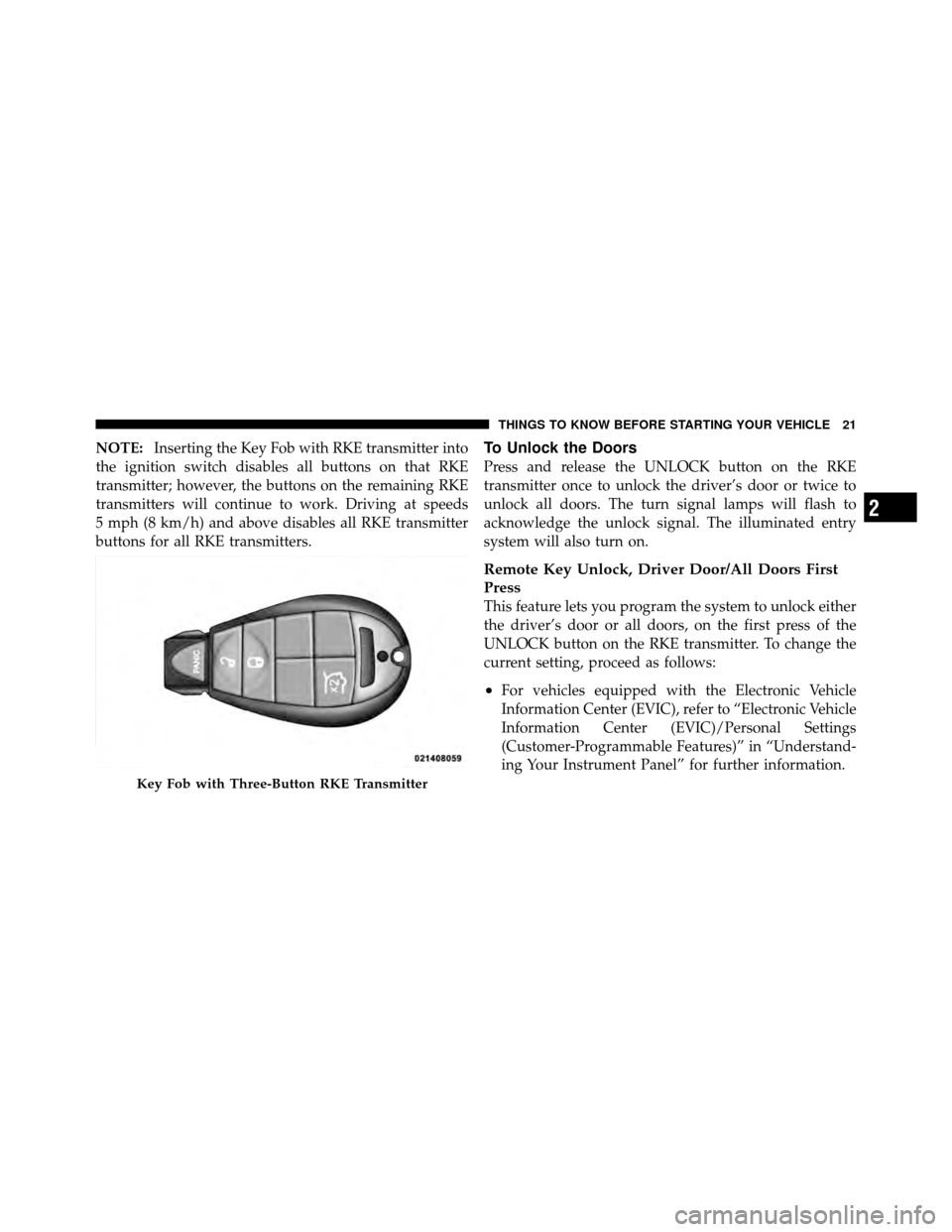
NOTE:Inserting the Key Fob with RKE transmitter into
the ignition switch disables all buttons on that RKE
transmitter; however, the buttons on the remaining RKE
transmitters will continue to work. Driving at speeds
5 mph (8 km/h) and above disables all RKE transmitter
buttons for all RKE transmitters.To Unlock the Doors
Press and release the UNLOCK button on the RKE
transmitter once to unlock the driver’s door or twice to
unlock all doors. The turn signal lamps will flash to
acknowledge the unlock signal. The illuminated entry
system will also turn on.
Remote Key Unlock, Driver Door/All Doors First
Press
This feature lets you program the system to unlock either
the driver’s door or all doors, on the first press of the
UNLOCK button on the RKE transmitter. To change the
current setting, proceed as follows:
•For vehicles equipped with the Electronic Vehicle
Information Center (EVIC), refer to “Electronic Vehicle
Information Center (EVIC)/Personal Settings
(Customer-Programmable Features)” in “Understand-
ing Your Instrument Panel” for further information.
Key Fob with Three-Button RKE Transmitter
2
THINGS TO KNOW BEFORE STARTING YOUR VEHICLE 21
Page 23 of 466
Flash Lamps with Remote Key Lock
This feature will cause the turn signal lamps to flash
when the doors are locked or unlocked with the RKE
transmitter. This feature can be turned on or off. To
change the current setting, proceed as follows:
•For vehicles equipped with the Electronic Vehicle
Information Center (EVIC), refer to “Electronic Vehicle
Information Center (EVIC)/Personal Settings
(Customer-Programmable Features)” in “Understand-
ing Your Instrument Panel” for further information.
Turn Headlights On with Remote Key Unlock
This feature activates the headlights for up to 90 seconds
when the doors are unlocked with the RKE transmitter.
The time for this feature is programmable on vehicles
equipped with the Electronic Vehicle Information Center
(EVIC). Refer to “Electronic Vehicle Information Center(EVIC)/Personal Settings (Customer-Programmable Fea-
tures)” in “Understanding Your Instrument Panel” for
further information.
To Lock the Doors
Press and release the LOCK button on the RKE transmit-
ter to lock all doors. The turn signal lamps will flash and
the horn will chirp to acknowledge the signal.
Sound Horn with Remote Key Lock
This feature will cause the horn to chirp when the doors
are locked with the RKE transmitter. This feature can be
turned on or off. To change the current setting, proceed as
follows:
•For vehicles equipped with the Electronic Vehicle
Information Center (EVIC), refer to “Electronic Vehicle
Information Center (EVIC)/Personal Settings
(Customer-Programmable Features)” in “Understand-
ing Your Instrument Panel” for further information.
22 THINGS TO KNOW BEFORE STARTING YOUR VEHICLE
Page 30 of 466
If you press the door lock switch while the Key Fob is in
the ignition switch and the driver’s door is open, the
doors will not lock.
The rear doors cannot be opened from inside the vehicle
until you pull up the lock plungers.
Automatic Unlock On Exit Feature — If Equipped
If Auto Unlock is enabled, this feature will unlock all the
doors when the driver’s door is opened if the vehicle is
stopped and in PARK or NEUTRAL. Refer to “Electronic
Vehicle Information Center (EVIC)/Personal Settings
(Customer-Programmable Features)” in “Understanding
Your Instrument Panel” for further information.
Automatic Door Locks
If this feature is selected, your door locks will lock
automatically when the vehicle speed is above 15 mph
(24 km/h) and all doors are closed. It will reset whenever
a door is opened.This feature is selectable and can be turned on or off.
Refer to “Electronic Vehicle Information Center (EVIC)/
Personal Settings (Customer-Programmable Features)” in
“Understanding Your Instrument Panel” for further
information.
Child Protection Door Lock
The rear doors of your vehicle are equipped with Child
Protection Door Locks. If you push up on the lever on the
open edge of the door it cannot be opened from the inside
of the vehicle. Push the lever down to disengage the
Child Protection Door Locks.
WARNING!
Avoid trapping anyone in the vehicle in a collision.
Remember that the rear doors can only be opened
from the outside when the Child Protection Door
Locks are engaged.
2
THINGS TO KNOW BEFORE STARTING YOUR VEHICLE 29
Page 47 of 466
Supplemental Restraint Systems (SRS) —
Airbags
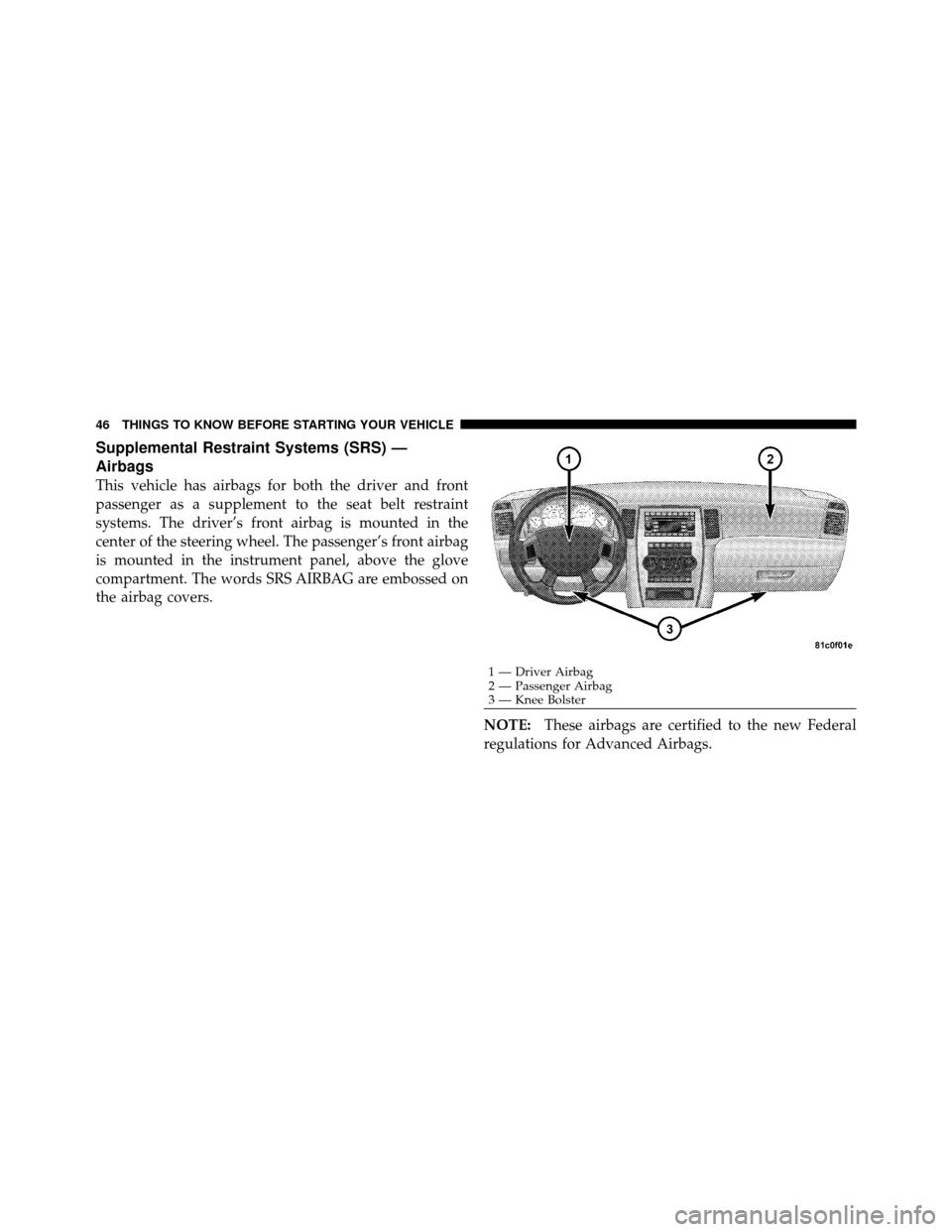
This vehicle has airbags for both the driver and front
passenger as a supplement to the seat belt restraint
systems. The driver’s front airbag is mounted in the
center of the steering wheel. The passenger’s front airbag
is mounted in the instrument panel, above the glove
compartment. The words SRS AIRBAG are embossed on
the airbag covers.NOTE:These airbags are certified to the new Federal
regulations for Advanced Airbags.
1 — Driver Airbag
2 — Passenger Airbag
3 — Knee Bolster
46 THINGS TO KNOW BEFORE STARTING YOUR VEHICLE
Page 48 of 466
The Advanced Front Airbags have a multistage inflator
design. This allows the airbag to have different rates of
inflation based on the severity and type of collision.
This vehicle may also be equipped with Supplemental
Side Airbag Inflatable Curtains (SABIC) to protect the
driver, front, and rear passengers sitting next to a win-
dow. If the vehicle is equipped with SABIC airbags, they
are located above the side windows and their covers are
also labeled: SRS AIRBAG.
NOTE:Airbag covers may not be obvious in the interior
trim; but they will open during airbag deployment.Airbag System Components
The airbag system consists of the following:
•Occupant Restraint Controller (ORC)
•Airbag Warning Light
•Driver Front Airbag
•Front Passenger Airbag
•Front and Side Impact Sensors
•Steering Wheel and Column
•Instrument Panel
•Knee Impact Bolster
•Front Seat Belt Pretensioners — if equipped
•Supplemental Side Airbag Inflatable Curtains (SABIC)
— if equipped
2
THINGS TO KNOW BEFORE STARTING YOUR VEHICLE 47
Page 49 of 466
Advanced Front Airbag Features
The Advanced Front Airbag system has multistage driver
and front passenger airbags. This system provides output
appropriate to the severity and type of collision as
determined by the Occupant Restraint Controller (ORC),
which may receive information from the impact sensors
at the front of the car.
The first stage inflator is triggered immediately during an
impact that requires airbag deployment. The timing of
the second stage determines whether the output force is
low, medium, or high. If a low output is sufficient to meet
the need, the remaining gas in the inflator is expended.WARNING!
•No objects should be placed over or near the
airbag on the instrument panel, because any such
objects could cause harm if the vehicle is in a crash
severe enough to cause the airbag to inflate.
•Do not put anything on or around the airbag
covers or attempt to open them manually. You may
damage the airbags and you could be injured
because the airbags may no longer be functional.
The protective covers for the airbag cushions are
designed to open only when the airbags are inflat-
ing.
•Do not drill, cut or tamper with the knee bolster in
any way.
•Do not mount any accessories to the knee bolster
such as alarm lights, stereos, citizen band radios,
etc.
48 THINGS TO KNOW BEFORE STARTING YOUR VEHICLE
Page 53 of 466
WARNING!
•Relying on the airbags alone could lead to more
severe injuries in a collision. The airbags work
with your seat belt to restrain you properly. In
some collisions, the airbags won’t deploy at all.
Always wear your seat belts even though you have
airbags.
•Being too close to the steering wheel or instrument
panel during front airbag deployment could cause
serious injury, including death. Airbags need
room to inflate. Sit back, comfortably extending
your arms to reach the steering wheel or instru-
ment panel.
•Side airbags also need room to inflate. Do not lean
against the door. Sit upright in the center of the
seat.
Airbag Deployment Sensors and Controls
Occupant Restraint Controller (ORC)
TheORC is part of a Federally regulated safety system
required for this vehicle.
The ORC determines if deployment of the front and/or
side airbags in a frontal or side collision is required.
Based on the impact sensors signals, a central electronic
ORC deploys the Advanced Front Airbags, SABIC air-
bags — if equipped, and front seat belt pretensioners —
if equipped, as required, depending on severity and type
of impact.
Advanced Front Airbags are designed to provide addi-
tional protection by supplementing the seat belts in
certain frontal collisions depending on the severity and
type of collision. Advanced Front Airbags are not ex-
pected to reduce the risk of injury in rear, side, or rollover
collisions.
52 THINGS TO KNOW BEFORE STARTING YOUR VEHICLE
Page 54 of 466
The Advanced Front Airbags will not deploy in all frontal
collisions, including some that may produce substantial
vehicle damage — for example, some pole collisions,
truck underrides, and angle offset collisions. On the other
hand, depending on the type and location of impact,
Advanced Front Airbags may deploy in crashes with
little vehicle front-end damage but that produce a severe
initial deceleration.
The side airbags will not deploy in all side collisions. Side
airbag deployment will depend on the severity and type
of collision.
Because airbag sensors measure vehicle deceleration over
time, vehicle speed and damage by themselves are not
good indicators of whether or not an airbag should have
deployed.
Seat belts are necessary for your protection in all colli-
sions, and also are needed to help keep you in position,
away from an inflating airbag.The ORC monitors the readiness of the electronic parts of
the system whenever the ignition switch is in the START
or ON position. If the key is in the LOCK position, in the
ACC position, or not in the ignition, the airbags are not
on and will not inflate.
The ORC contains a backup power supply system that
may deploy the airbags even if the battery loses power or
it becomes disconnected prior to deployment.
Also, the ORC turns on the Airbag Warning
Light in the instrument panel for approxi-
mately six to eight seconds for a self-check
when the ignition is first turned on. After the
self-check, the Airbag Warning Light will turn off. If the
ORC detects a malfunction in any part of the system, it
turns on the Airbag Warning Light, either momentarily
or continuously. A single chime will sound if the light
comes on again after initial startup.
2
THINGS TO KNOW BEFORE STARTING YOUR VEHICLE 53