ECU JEEP GRAND CHEROKEE 2023 Workshop Manual
[x] Cancel search | Manufacturer: JEEP, Model Year: 2023, Model line: GRAND CHEROKEE, Model: JEEP GRAND CHEROKEE 2023Pages: 424, PDF Size: 15.48 MB
Page 304 of 424
302SAFETY
(Continued)
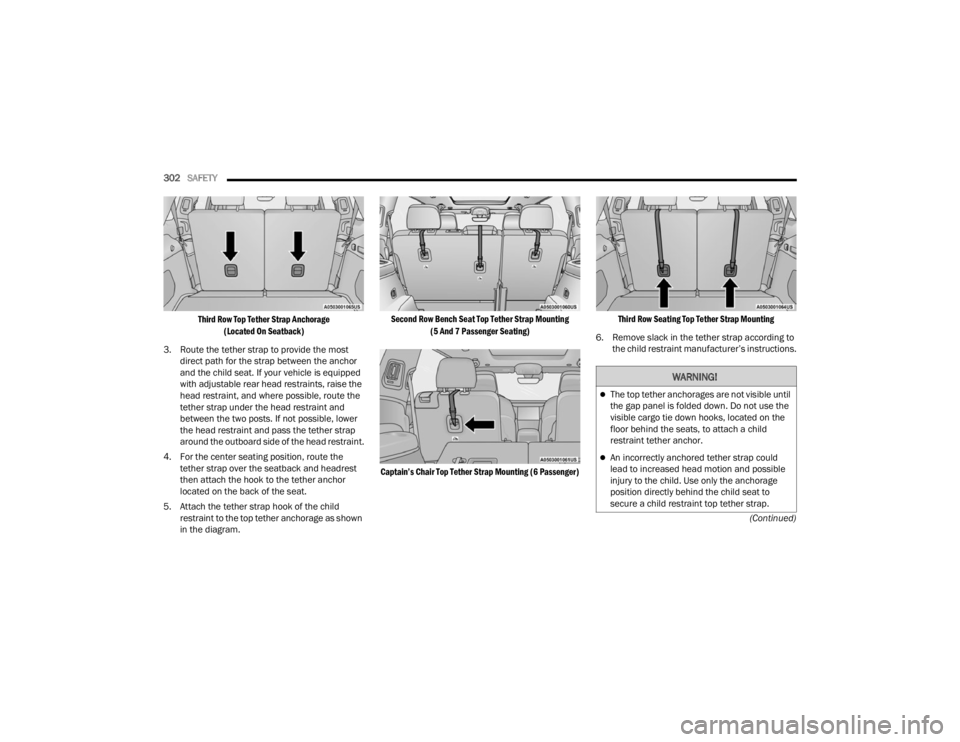
Third Row Top Tether Strap Anchorage
(Located On Seatback)
3. Route the tether strap to provide the most direct path for the strap between the anchor
and the child seat. If your vehicle is equipped
with adjustable rear head restraints, raise the
head restraint, and where possible, route the
tether strap under the head restraint and
between the two posts. If not possible, lower
the head restraint and pass the tether strap
around the outboard side of the head restraint.
4. For the center seating position, route the tether strap over the seatback and headrest
then attach the hook to the tether anchor
located on the back of the seat.
5. Attach the tether strap hook of the child restraint to the top tether anchorage as shown
in the diagram.
Second Row Bench Seat Top Tether Strap Mounting
(5 And 7 Passenger Seating)
Captain’s Chair Top Tether Strap Mounting (6 Passenger) Third Row Seating Top Tether Strap Mounting
6. Remove slack in the tether strap according to the child restraint manufacturer’s instructions.
WARNING!
The top tether anchorages are not visible until
the gap panel is folded down. Do not use the
visible cargo tie down hooks, located on the
floor behind the seats, to attach a child
restraint tether anchor.
An incorrectly anchored tether strap could
lead to increased head motion and possible
injury to the child. Use only the anchorage
position directly behind the child seat to
secure a child restraint top tether strap.
23_WL_OM_EN_USC_t.book Page 302
Page 305 of 424

SAFETY303
SAFETY TIPS
TRANSPORTING PASSENGERS
NEVER TRANSPORT PASSENGERS IN THE CARGO
AREA.
TRANSPORTING PETS
Air Bags deploying in the front seat could harm
your pet. An unrestrained pet will be thrown about
and possibly injured, or injure a passenger during
panic braking or in a collision.
Pets should be restrained in the rear seat (if
equipped) in pet harnesses or pet carriers that are
secured by seat belts.
CONNECTED VEHICLES
Privacy of any wireless and wired communications
cannot be assured. Third parties may unlawfully
intercept information and private communications
without your consent. For further information, refer
to “Data Collection & Privacy” in your Uconnect
Owner’s Manual Supplement or “Onboard
Diagnostic System (OBD II) Cybersecurity”
Úpage 117.
SAFETY CHECKS YOU SHOULD MAKE
I
NSIDE THE VEHICLE
Seat Belts
Inspect the seat belt system periodically, checking
for cuts, frays, and loose parts. Damaged parts
must be replaced immediately. Do not
disassemble or modify the system.
If your vehicle is involved in a collision, or if you
have questions regarding the seat belt or retractor
conditions, take your vehicle to an authorized FCA
dealer or authorized FCA Certified Collision Care
Program facility for inspection.
Air Bag Warning Light
The Air Bag Warning Light will turn on for
four to eight seconds as a bulb check
when the ignition switch is first placed in
the ON/RUN position. If the light is either
not on during starting, stays on, or turns on while
driving, have the system inspected at an
authorized dealer as soon as possible. After the
bulb check, this light will illuminate with a single
chime when a fault with the Air Bag System has
been detected. It will stay on until the fault is
removed. If the light comes on intermittently or
remains on while driving, have an authorized
dealer service the vehicle immediately
Ú page 269.
If your vehicle is equipped with a split rear
seat, make sure the tether strap does not slip
into the opening between the seatbacks as
you remove slack in the strap.
WARNING!
Do not leave children or animals inside parked
vehicles in hot weather. Interior heat buildup
may cause serious injury or death.
It is extremely dangerous to ride in a cargo
area, inside or outside of a vehicle. In a colli -
sion, people riding in these areas are more
likely to be seriously injured or killed.
Do not allow people to ride in any area of your
vehicle that is not equipped with seats and
seat belts.
Be sure everyone in your vehicle is in a seat
and using a seat belt properly.
WARNING!
WARNING!
It is not possible to know or to predict all of the
possible outcomes if your vehicle’s systems are
breached. It may be possible that vehicle
systems, including safety related systems, could
be impaired or a loss of vehicle control could
occur that may result in an accident involving
serious injury or death.
6
23_WL_OM_EN_USC_t.book Page 303
Page 306 of 424
304SAFETY
(Continued)
(Continued)
(Continued)
Defroster
Check operation by selecting the defrost mode and
place the blower control on high speed. You should
be able to feel the air directed against the
windshield. See an authorized dealer for service if
your defroster is inoperable.
Floor Mat Safety Information
Always use floor mats designed to fit your vehicle.
Only use a floor mat that does not interfere with the
operation of the accelerator, brake or clutch
pedals. Only use a floor mat that is securely
attached using the floor mat fasteners so it cannot
slip out of position and interfere with the
accelerator, brake or clutch pedals or impair safe
operation of your vehicle in other ways.
WARNING!
An improperly attached, damaged, folded, or
stacked floor mat, or damaged floor mat
fasteners may cause your floor mat to interfere
with the accelerator, brake, or clutch pedals and
cause a loss of vehicle control. To prevent
SERIOUS INJURY or DEATH:
ALWAYS securely attach your floor
mat using the floor mat fasteners. DO
NOT install your floor mat upside down
or turn your floor mat over. Lightly pull
to confirm mat is secured using the floor mat
fasteners on a regular basis.
ALWAYS REMOVE THE EXISTING
FLOOR MAT FROM THE VEHICLE
before installing any other floor mat.
NEVER install or stack an additional
floor mat on top of an existing floor mat.
ONLY install floor mats designed to fit your
vehicle. NEVER install a floor mat that cannot
be properly attached and secured to your
vehicle. If a floor mat needs to be replaced,
only use a FCA approved floor mat for the
specific make, model, and year of your
vehicle.
WARNING!
ONLY use the driver’s side floor mat on the
driver’s side floor area. To check for interfer -
ence, with the vehicle properly parked with the
engine off, fully depress the accelerator, the
brake, and the clutch pedal (if present) to
check for interference. If your floor mat inter -
feres with the operation of any pedal, or is not
secure to the floor, remove the floor mat from
the vehicle and place the floor mat in your
trunk.
ONLY use the passenger’s side floor mat on
the passenger’s side floor area.
ALWAYS make sure objects cannot fall or slide
into the driver’s side floor area when the
vehicle is moving. Objects can become
trapped under accelerator, brake, or clutch
pedals and could cause a loss of vehicle
control.
WARNING!
23_WL_OM_EN_USC_t.book Page 304
Page 307 of 424

SAFETY305
PERIODIC SAFETY CHECKS YOU SHOULD
M
AKE OUTSIDE THE VEHICLE
Tires
Examine tires for excessive tread wear and uneven
wear patterns. Check for stones, nails, glass, or
other objects lodged in the tread or sidewall.
Inspect the tread for cuts and cracks. Inspect
sidewalls for cuts, cracks, and bulges. Check the
lug nut/bolt torque for tightness. Check the tires
(including spare) for proper cold inflation pressure.
Lights
Have someone observe the operation of brake
lights and exterior lights while you work the
controls. Check turn signal and high beam
indicator lights on the instrument panel.
Door Latches
Check for proper closing, latching, and locking.
Fluid Leaks
Check area under the vehicle after overnight
parking for fuel, coolant, oil, or other fluid leaks.
Also, if gasoline fumes are detected or if fuel or
brake fluid leaks are suspected, the cause should
be located and corrected immediately.
EXHAUST GAS
NEVER place any objects under the floor mat
(e.g., towels, keys, etc.). These objects could
change the position of the floor mat and may
cause interference with the accelerator,
brake, or clutch pedals.
If the vehicle carpet has been removed and
re-installed, always properly attach carpet to
the floor and check the floor mat fasteners are
secure to the vehicle carpet. Fully depress
each pedal to check for interference with the
accelerator, brake, or clutch pedals then
re-install the floor mats.
It is recommended to only use mild soap and
water to clean your floor mats. After cleaning,
always check your floor mat has been properly
installed and is secured to your vehicle using
the floor mat fasteners by lightly pulling mat.
WARNING!
WARNING!
Exhaust gases can injure or kill. They contain
carbon monoxide (CO), which is colorless and
odorless. Breathing it can make you
unconscious and can eventually poison you. To
avoid breathing (CO), follow these safety tips:
Do not run the engine in a closed garage or in
confined areas any longer than needed to
move your vehicle in or out of the area.
If you are required to drive with the trunk/lift -
gate/rear doors open, make sure that all
windows are closed and the climate control
BLOWER switch is set at high speed. DO NOT
use the recirculation mode.
If it is necessary to sit in a parked vehicle with
the engine running, adjust your heating or
cooling controls to force outside air into the
vehicle. Set the blower at high speed.
6
23_WL_OM_EN_USC_t.book Page 305
Page 316 of 424
314IN CASE OF EMERGENCY
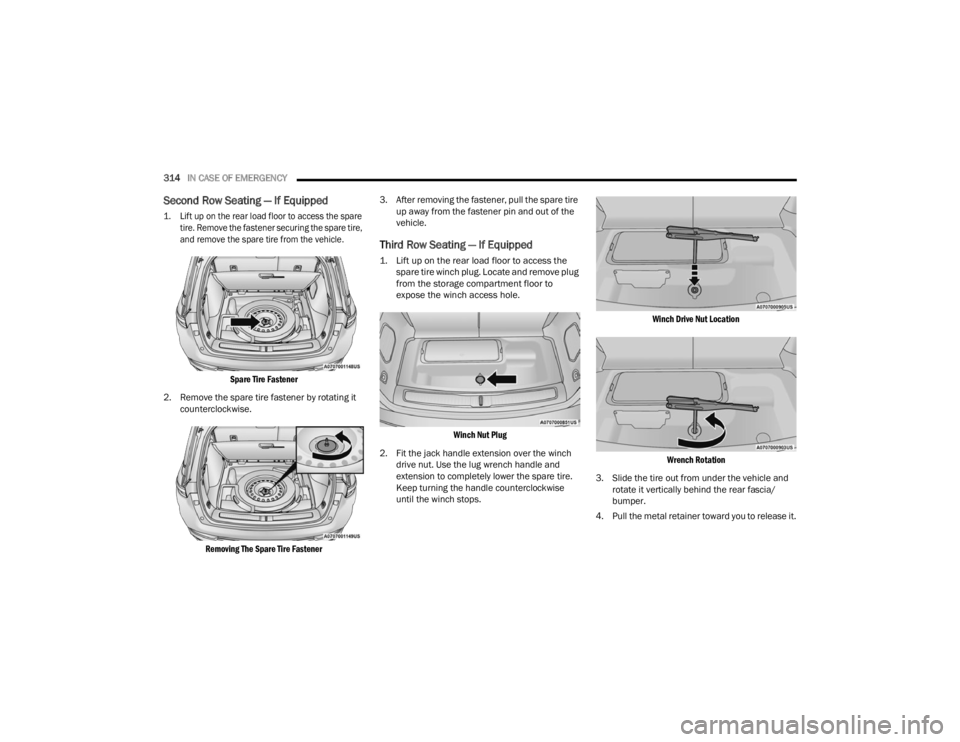
Second Row Seating — If Equipped
1. Lift up on the rear load floor to access the spare
tire. Remove the fastener securing the spare tire,
and remove the spare tire from the vehicle.
Spare Tire Fastener
2. Remove the spare tire fastener by rotating it counterclockwise.
Removing The Spare Tire Fastener
3. After removing the fastener, pull the spare tire
up away from the fastener pin and out of the
vehicle.
Third Row Seating — If Equipped
1. Lift up on the rear load floor to access the spare tire winch plug. Locate and remove plug
from the storage compartment floor to
expose the winch access hole.
Winch Nut Plug
2. Fit the jack handle extension over the winch drive nut. Use the lug wrench handle and
extension to completely lower the spare tire.
Keep turning the handle counterclockwise
until the winch stops.
Winch Drive Nut Location
Wrench Rotation
3. Slide the tire out from under the vehicle and rotate it vertically behind the rear fascia/
bumper.
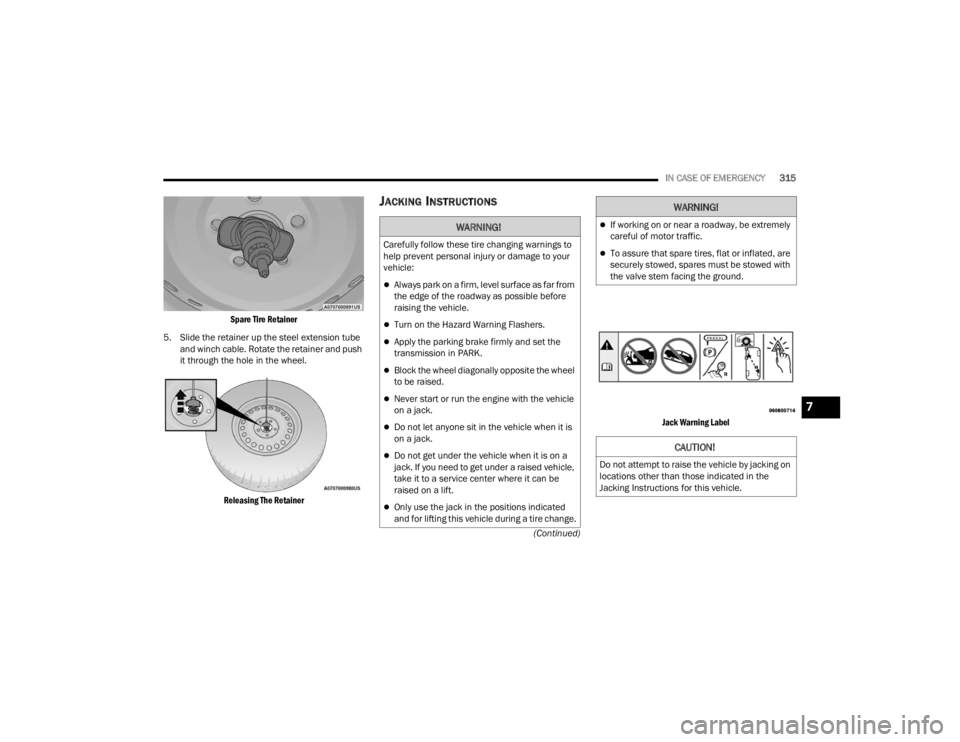
4. Pull the metal retainer toward you to release it.
23_WL_OM_EN_USC_t.book Page 314
Page 317 of 424
IN CASE OF EMERGENCY315
(Continued)
Spare Tire Retainer
5. Slide the retainer up the steel extension tube and winch cable. Rotate the retainer and push
it through the hole in the wheel.
Releasing The Retainer
JACKING INSTRUCTIONS
Jack Warning Label
WARNING!
Carefully follow these tire changing warnings to
help prevent personal injury or damage to your
vehicle:
Always park on a firm, level surface as far from
the edge of the roadway as possible before
raising the vehicle.
Turn on the Hazard Warning Flashers.
Apply the parking brake firmly and set the
transmission in PARK.
Block the wheel diagonally opposite the wheel
to be raised.
Never start or run the engine with the vehicle
on a jack.
Do not let anyone sit in the vehicle when it is
on a jack.
Do not get under the vehicle when it is on a
jack. If you need to get under a raised vehicle,
take it to a service center where it can be
raised on a lift.
Only use the jack in the positions indicated
and for lifting this vehicle during a tire change.
If working on or near a roadway, be extremely
careful of motor traffic.
To assure that spare tires, flat or inflated, are
securely stowed, spares must be stowed with
the valve stem facing the ground.
CAUTION!
Do not attempt to raise the vehicle by jacking on
locations other than those indicated in the
Jacking Instructions for this vehicle.
WARNING!
7
23_WL_OM_EN_USC_t.book Page 315
Page 320 of 424
318IN CASE OF EMERGENCY
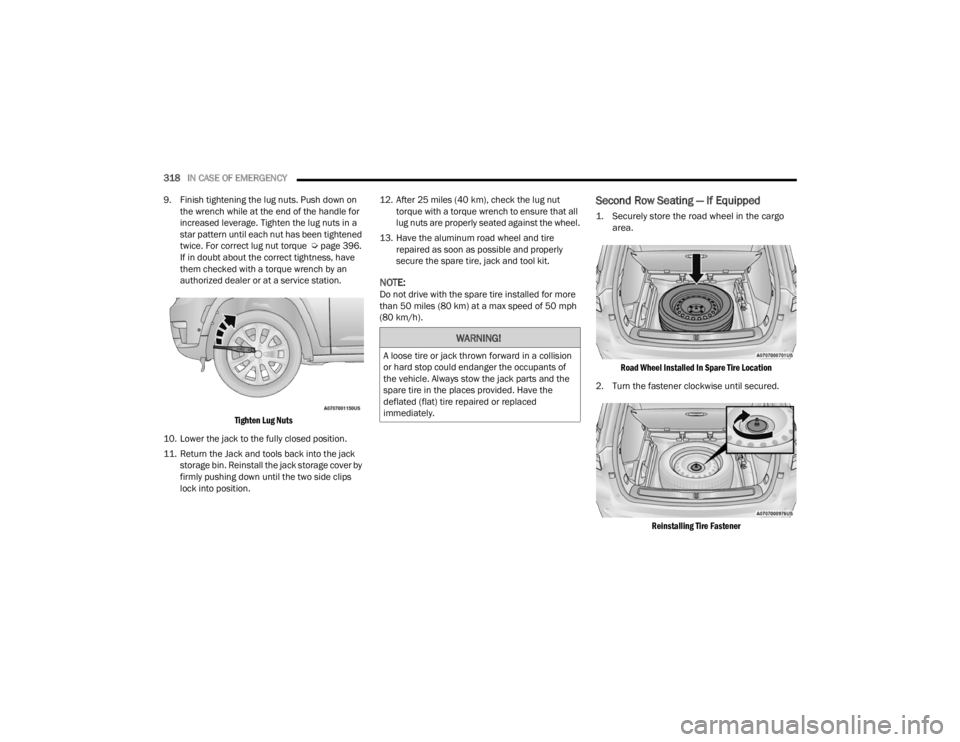
9. Finish tightening the lug nuts. Push down on the wrench while at the end of the handle for
increased leverage. Tighten the lug nuts in a
star pattern until each nut has been tightened
twice. For correct lug nut torque Úpage 396.
If in doubt about the correct tightness, have
them checked with a torque wrench by an
authorized dealer or at a service station.
Tighten Lug Nuts
10. Lower the jack to the fully closed position.
11. Return the Jack and tools back into the jack storage bin. Reinstall the jack storage cover by
firmly pushing down until the two side clips
lock into position. 12. After 25 miles (40 km), check the lug nut
torque with a torque wrench to ensure that all
lug nuts are properly seated against the wheel.
13. Have the aluminum road wheel and tire repaired as soon as possible and properly
secure the spare tire, jack and tool kit.
NOTE:Do not drive with the spare tire installed for more
than 50 miles (80 km) at a max speed of 50 mph
(80 km/h).
Second Row Seating — If Equipped
1. Securely store the road wheel in the cargo area.
Road Wheel Installed In Spare Tire Location
2. Turn the fastener clockwise until secured.
Reinstalling Tire Fastener
WARNING!
A loose tire or jack thrown forward in a collision
or hard stop could endanger the occupants of
the vehicle. Always stow the jack parts and the
spare tire in the places provided. Have the
deflated (flat) tire repaired or replaced
immediately.
23_WL_OM_EN_USC_t.book Page 318
Page 325 of 424
IN CASE OF EMERGENCY323
In the event it is observed that the temperature
gauge is moving towards or close to the HOT (H)
position, you can reduce the potential for
overheating by taking the appropriate action.
On the highways — slow down.
In city traffic — while stopped, place the trans -
mission in NEUTRAL (N), but do not increase the
engine idle speed while preventing vehicle
motion with the brakes.
If your Air Conditioner (A/C) is on, turn it off. The
A/C system adds heat to the engine cooling
system and turning the A/C off can help remove
this heat.
You can also turn the temperature control to
maximum heat, the mode control to floor and
the blower control to high. This allows the heater
core to act as a supplement to the radiator and
aids in removing heat from the engine cooling
system.
MANUAL PARK RELEASE
To move the vehicle in cases where the
transmission will not shift out of PARK (P) (such as
a depleted battery), a Manual Park Release is
available.
To activate the Manual Park Release, see the
following steps:
1. Apply firm pressure to the brake pedal while seated in the driver’s seat.
2. Apply the Electric Park Brake (EPB), if possible.
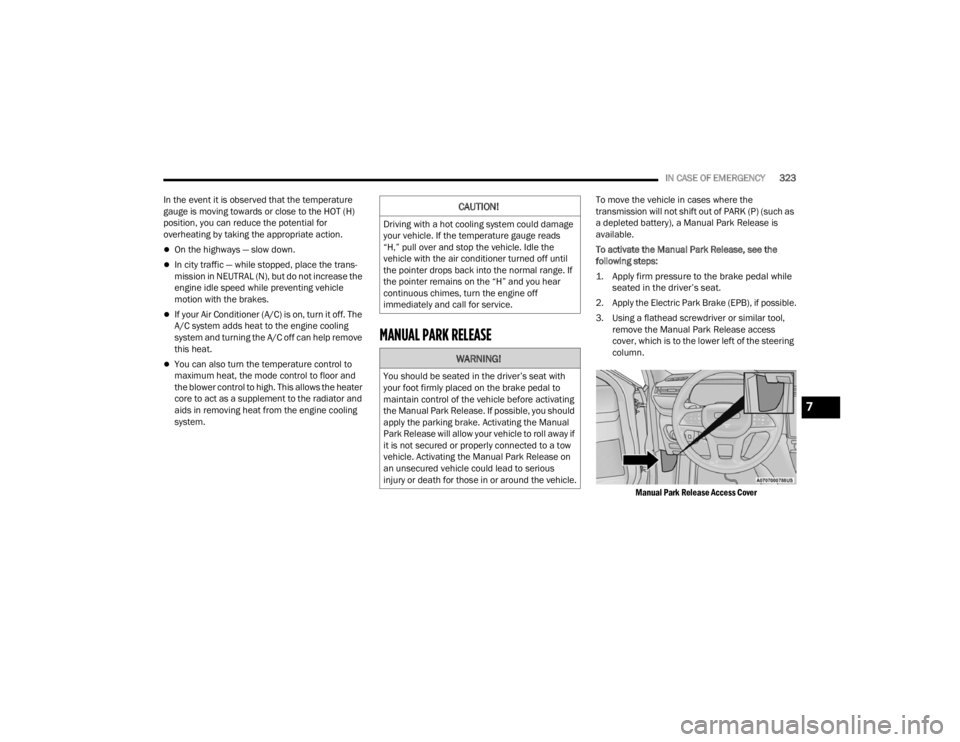
3. Using a flathead screwdriver or similar tool, remove the Manual Park Release access
cover, which is to the lower left of the steering
column.
Manual Park Release Access Cover
CAUTION!
Driving with a hot cooling system could damage
your vehicle. If the temperature gauge reads
“H,” pull over and stop the vehicle. Idle the
vehicle with the air conditioner turned off until
the pointer drops back into the normal range. If
the pointer remains on the “H” and you hear
continuous chimes, turn the engine off
immediately and call for service.
WARNING!
You should be seated in the driver’s seat with
your foot firmly placed on the brake pedal to
maintain control of the vehicle before activating
the Manual Park Release. If possible, you should
apply the parking brake. Activating the Manual
Park Release will allow your vehicle to roll away if
it is not secured or properly connected to a tow
vehicle. Activating the Manual Park Release on
an unsecured vehicle could lead to serious
injury or death for those in or around the vehicle.
7
23_WL_OM_EN_USC_t.book Page 323
Page 326 of 424
324IN CASE OF EMERGENCY
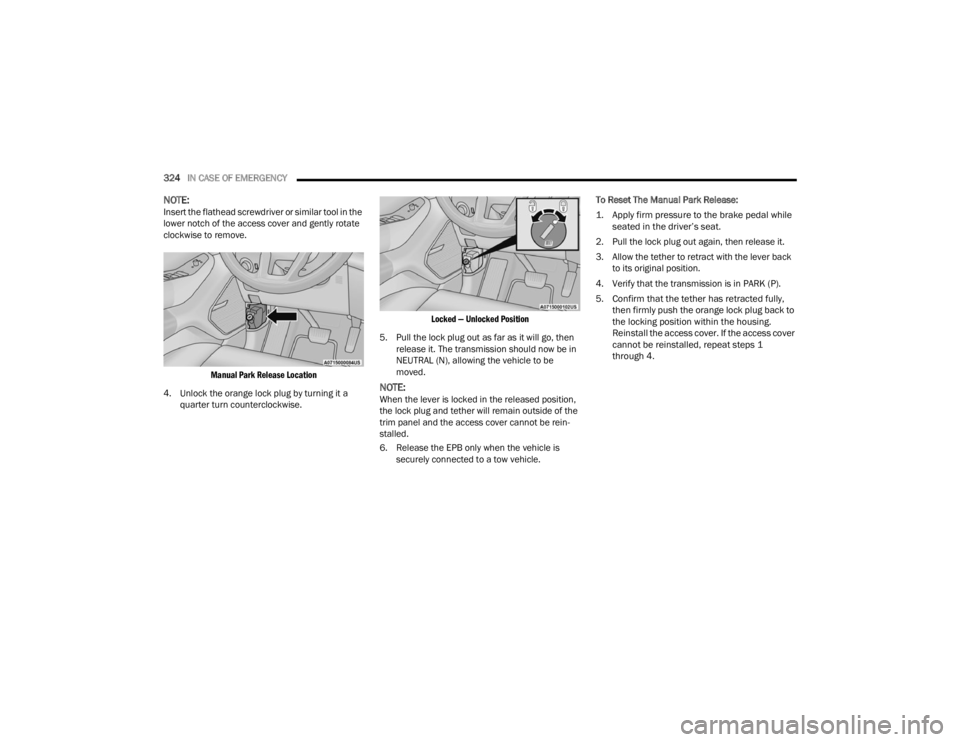
NOTE:Insert the flathead screwdriver or similar tool in the
lower notch of the access cover and gently rotate
clockwise to remove.
Manual Park Release Location
4. Unlock the orange lock plug by turning it a quarter turn counterclockwise.
Locked — Unlocked Position
5. Pull the lock plug out as far as it will go, then release it. The transmission should now be in
NEUTRAL (N), allowing the vehicle to be
moved.
NOTE:When the lever is locked in the released position,
the lock plug and tether will remain outside of the
trim panel and the access cover cannot be rein -
stalled.
6. Release the EPB only when the vehicle is securely connected to a tow vehicle. To Reset The Manual Park Release:
1. Apply firm pressure to the brake pedal while
seated in the driver’s seat.
2. Pull the lock plug out again, then release it.
3. Allow the tether to retract with the lever back to its original position.
4. Verify that the transmission is in PARK (P).
5. Confirm that the tether has retracted fully, then firmly push the orange lock plug back to
the locking position within the housing.
Reinstall the access cover. If the access cover
cannot be reinstalled, repeat steps 1
through 4.
23_WL_OM_EN_USC_t.book Page 324
Page 329 of 424

IN CASE OF EMERGENCY327
NOTE:
You must ensure that the Auto Park Brake
Úpage 123 feature is disabled before towing
this vehicle to avoid inadvertent Electric Park
Brake engagement. The Auto Park Brake
feature is enabled or disabled via the customer
programmable features in the Uconnect
Settings.
Vehicles with a discharged battery, or total elec -
trical failure when the Electric Park Brake (EPB)
is engaged, will need a wheel dolly or jack to
raise the rear wheels off the ground when
moving the vehicle onto a flatbed.
The Safehold feature will engage the Electric
Park Brake whenever the driver's door is
opened (if the battery is connected, ignition is
ON, transmission is not in PARK, and brake
pedal is released). If you are towing this vehicle
with the ignition in the ON/RUN mode, you must
manually disable the Electric Park Brake each
time the driver's door is opened by pressing the
brake pedal and then releasing the EPB. If you must use the accessories (wipers,
defrosters, etc.) while being towed, the ignition
must be in the ON/RUN mode.
If the vehicle's battery is discharged, instructions
on shifting the automatic transmission out of PARK
(P) in order to move the vehicle Ú
page 323.
REAR-WHEEL DRIVE MODELS
FCA US LLC recommends towing your vehicle with
all four wheels OFF the ground using a flatbed.
If flatbed equipment is not available, and the
transmission is operable, the vehicle may be towed
(with rear wheels off the ground) under the
following conditions:
The transmission must be in NEUTRAL (N). For
instructions on shifting the transmission to
NEUTRAL (N) when the engine is off
Ú page 323.
The towing speed must not exceed 30 mph
(48 km/h).
The towing distance must not exceed 30 miles
(48 km).
CAUTION!
Do not use sling type equipment when towing.
Vehicle damage may occur.
When securing the vehicle to a flat bed truck,
do not attach to front or rear suspension
components. If vehicle is equipped with
Quadra-lift air suspension, secure vehicle only
with tire/wheel straps (no suspension compo -
nents or body) to prevent air suspension from
adjusting during towing against securement
straps and causing damage. Damage to your
vehicle may result from improper towing.
CAUTION!
Towing faster than 30 mph (48 km/h) or
farther than 30 miles (48 km) with rear
wheels on the ground can cause severe trans -
mission damage. Damage from improper
towing is not covered under the New Vehicle
Limited Warranty.
7
23_WL_OM_EN_USC_t.book Page 327