4WD JEEP GRAND CHEROKEE LIMITED 2018 Owners Manual
[x] Cancel search | Manufacturer: JEEP, Model Year: 2018, Model line: GRAND CHEROKEE LIMITED, Model: JEEP GRAND CHEROKEE LIMITED 2018Pages: 630, PDF Size: 5.95 MB
Page 191 of 630
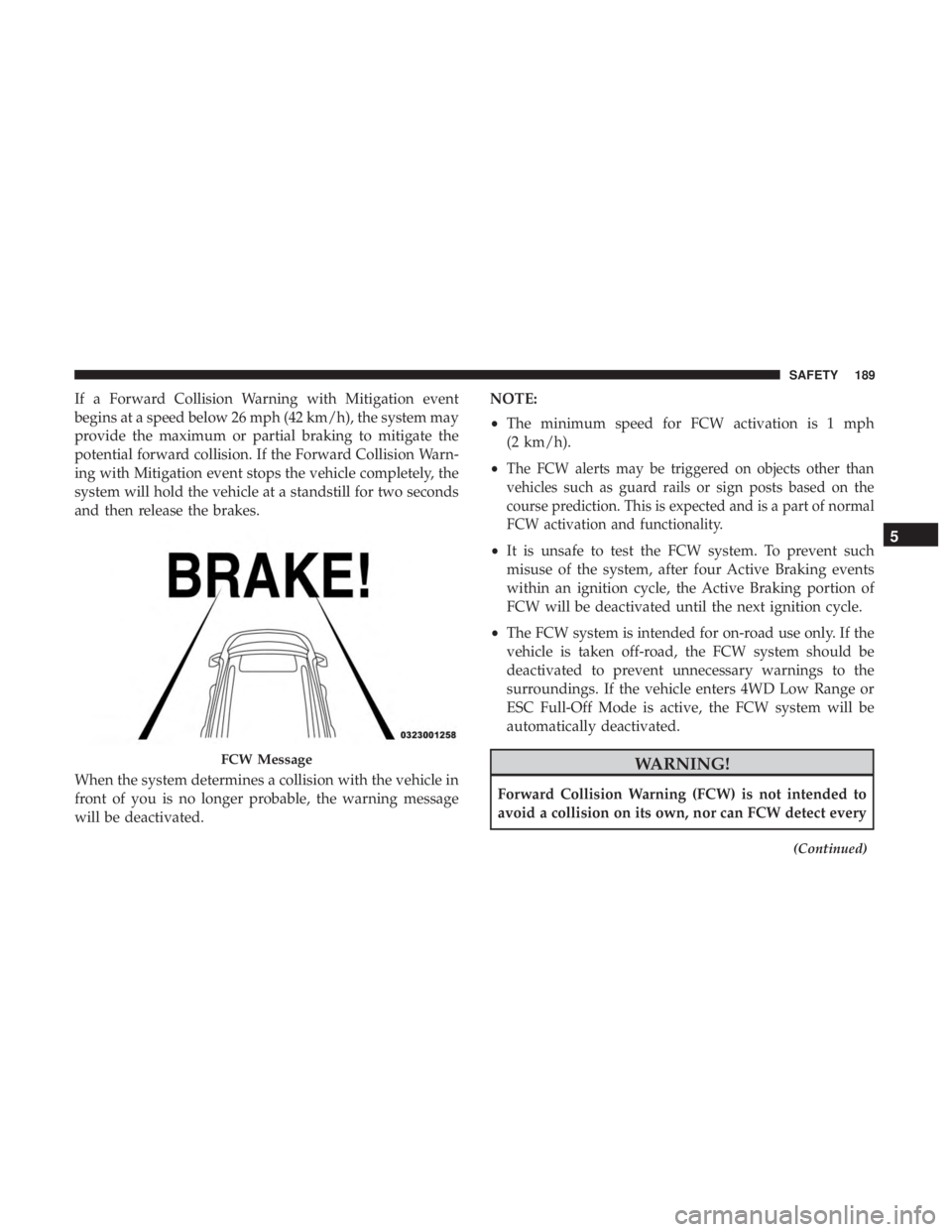
If a Forward Collision Warning with Mitigation event
begins at a speed below 26 mph (42 km/h), the system may
provide the maximum or partial braking to mitigate the
potential forward collision. If the Forward Collision Warn-
ing with Mitigation event stops the vehicle completely, the
system will hold the vehicle at a standstill for two seconds
and then release the brakes.
When the system determines a collision with the vehicle in
front of you is no longer probable, the warning message
will be deactivated.NOTE:
•
The minimum speed for FCW activation is 1 mph
(2 km/h).
•
The FCW alerts may be triggered on objects other than
vehicles such as guard rails or sign posts based on the
course prediction. This is expected and is a part of normal
FCW activation and functionality.
• It is unsafe to test the FCW system. To prevent such
misuse of the system, after four Active Braking events
within an ignition cycle, the Active Braking portion of
FCW will be deactivated until the next ignition cycle.
• The FCW system is intended for on-road use only. If the
vehicle is taken off-road, the FCW system should be
deactivated to prevent unnecessary warnings to the
surroundings. If the vehicle enters 4WD Low Range or
ESC Full-Off Mode is active, the FCW system will be
automatically deactivated.
Page 273 of 630
WARNING!
You or others could be injured or killed if you leave the
vehicle unattended with the transfer case in the NEU-
TRAL position without first fully engaging the park-
ing brake. The transfer case NEUTRAL position disen-
gages both the front and rear drive shafts from the
powertrain and will allow the vehicle to roll, even if
the transmission is in PARK. The parking brake
should always be applied when the driver is not in the
vehicle.
Shift Positions
For additional information on the appropriate use of each
4WD system mode position, see the information below:
4WD AUTO
This range is used on surfaces such as ice, snow, gravel,
sand, and dry hard pavement.
NOTE:Refer to “Selec-Terrain — If Equipped” further on
in this section for further information on the various
positions and their intended usages.
NEUTRAL
This range disengages the driveline from the powertrain.
It is to be used for flat towing behind another vehicle. Refer
to “Recreational Towing” in “Starting And Operating” for
further information.
Page 275 of 630
•Shifting into or out of 4WD LOW is possible with the
vehicle completely stopped; however, difficulty may
occur due to the mating clutch teeth not being properly
aligned. Several attempts may be required for clutch
teeth alignment and shift completion to occur. The
preferred method is with the vehicle rolling 0 to 3 mph
(0 to 5 km/h). If the vehicle is moving faster than 3 mph
(5 km/h), the transfer case will not allow the shift.
Shifting Into NEUTRAL (N)
Page 387 of 630
The Selec-Terrain switch will automatically change the
vehicle to the optimized height based on the Selec-Terrain
switch position. The vehicle height can be changed from
the default height for each Selec-Terrain mode by normal
use of the air suspension switches. Refer to “Four Wheel
Drive Operation” in “Starting And Operating” for further
information.
When To Use 4WD LOW Range — If Equipped
When off-road driving, shift to 4WD LOW for additional
traction. This range should be limited to extreme situations
such as deep snow, mud, or sand where additional low
speed pulling power is needed. Vehicle speeds in excess of
25 mph (40 km/h) should be avoided when in 4WD LOW
range.