The JEEP LIBERTY 2002 KJ / 1.G Owners Manual
[x] Cancel search | Manufacturer: JEEP, Model Year: 2002, Model line: LIBERTY, Model: JEEP LIBERTY 2002 KJ / 1.GPages: 1803, PDF Size: 62.3 MB
Page 106 of 1803
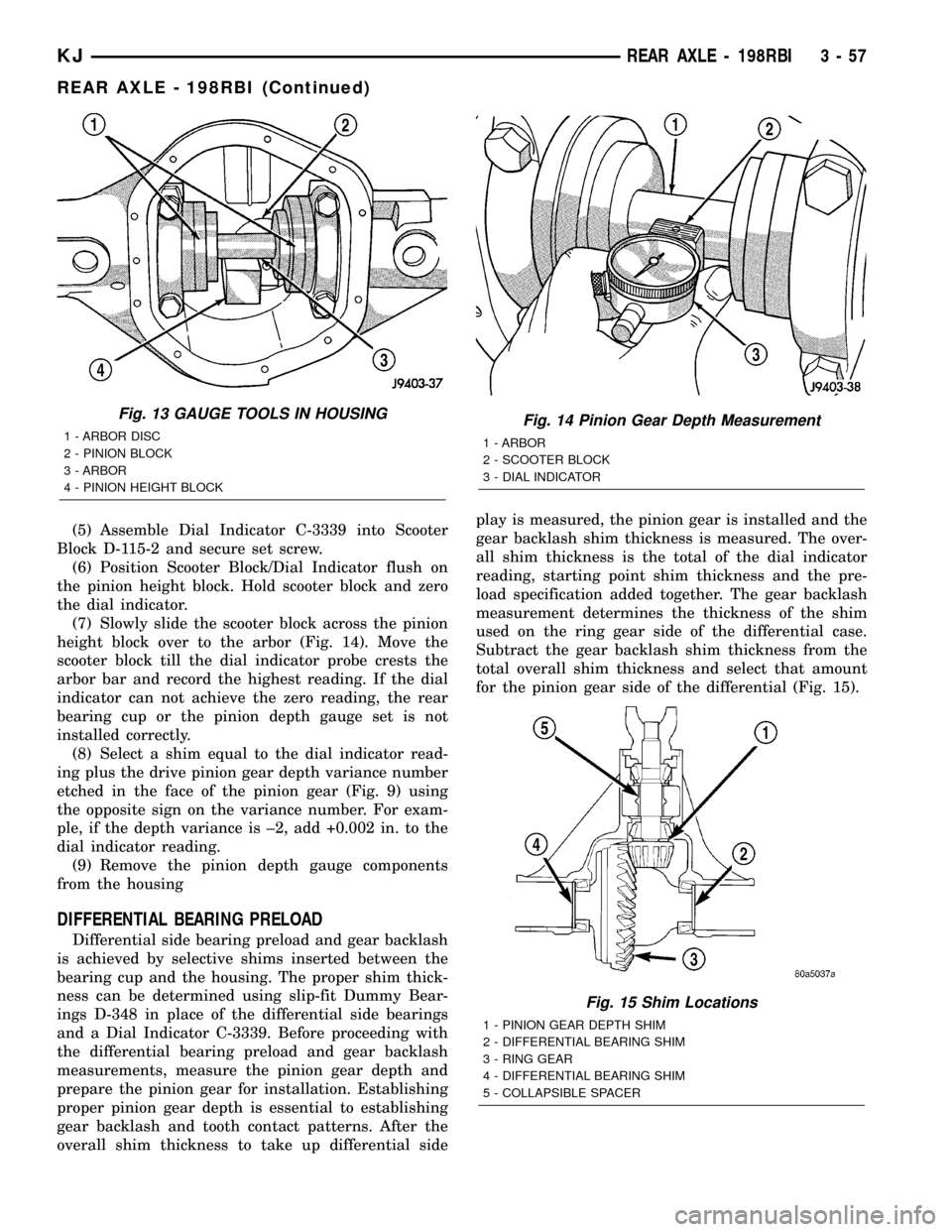
(5) Assemble Dial Indicator C-3339 into Scooter
Block D-115-2 and secure set screw.
(6) Position Scooter Block/Dial Indicator flush on
the pinion height block. Hold scooter block and zero
the dial indicator.
(7) Slowly slide the scooter block across the pinion
height block over to the arbor (Fig. 14). Move the
scooter block till the dial indicator probe crests the
arbor bar and record the highest reading. If the dial
indicator can not achieve the zero reading, the rear
bearing cup or the pinion depth gauge set is not
installed correctly.
(8) Select a shim equal to the dial indicator read-
ing plus the drive pinion gear depth variance number
etched in the face of the pinion gear (Fig. 9) using
the opposite sign on the variance number. For exam-
ple, if the depth variance is ±2, add +0.002 in. to the
dial indicator reading.
(9) Remove the pinion depth gauge components
from the housing
DIFFERENTIAL BEARING PRELOAD
Differential side bearing preload and gear backlash
is achieved by selective shims inserted between the
bearing cup and the housing. The proper shim thick-
ness can be determined using slip-fit Dummy Bear-
ings D-348 in place of the differential side bearings
and a Dial Indicator C-3339. Before proceeding with
the differential bearing preload and gear backlash
measurements, measure the pinion gear depth and
prepare the pinion gear for installation. Establishing
proper pinion gear depth is essential to establishing
gear backlash and tooth contact patterns. After the
overall shim thickness to take up differential sideplay is measured, the pinion gear is installed and the
gear backlash shim thickness is measured. The over-
all shim thickness is the total of the dial indicator
reading, starting point shim thickness and the pre-
load specification added together. The gear backlash
measurement determines the thickness of the shim
used on the ring gear side of the differential case.
Subtract the gear backlash shim thickness from the
total overall shim thickness and select that amount
for the pinion gear side of the differential (Fig. 15).
Fig. 13 GAUGE TOOLS IN HOUSING
1 - ARBOR DISC
2 - PINION BLOCK
3 - ARBOR
4 - PINION HEIGHT BLOCKFig. 14 Pinion Gear Depth Measurement
1 - ARBOR
2 - SCOOTER BLOCK
3 - DIAL INDICATOR
Fig. 15 Shim Locations
1 - PINION GEAR DEPTH SHIM
2 - DIFFERENTIAL BEARING SHIM
3 - RING GEAR
4 - DIFFERENTIAL BEARING SHIM
5 - COLLAPSIBLE SPACER
KJREAR AXLE - 198RBI 3 - 57
REAR AXLE - 198RBI (Continued)
Page 107 of 1803
PRELOAD SHIM SELECTION
NOTE: It is difficult to salvage the differential side
bearings during the removal procedure. Install
replacement bearings if necessary.
(1) Remove side bearings from differential case.
(2) Install ring gear, if necessary, on differential
case and tighten bolts to specification.
(3) Install Dummy Bearings D-348 on differential
case.
(4) Install differential case in the housing.
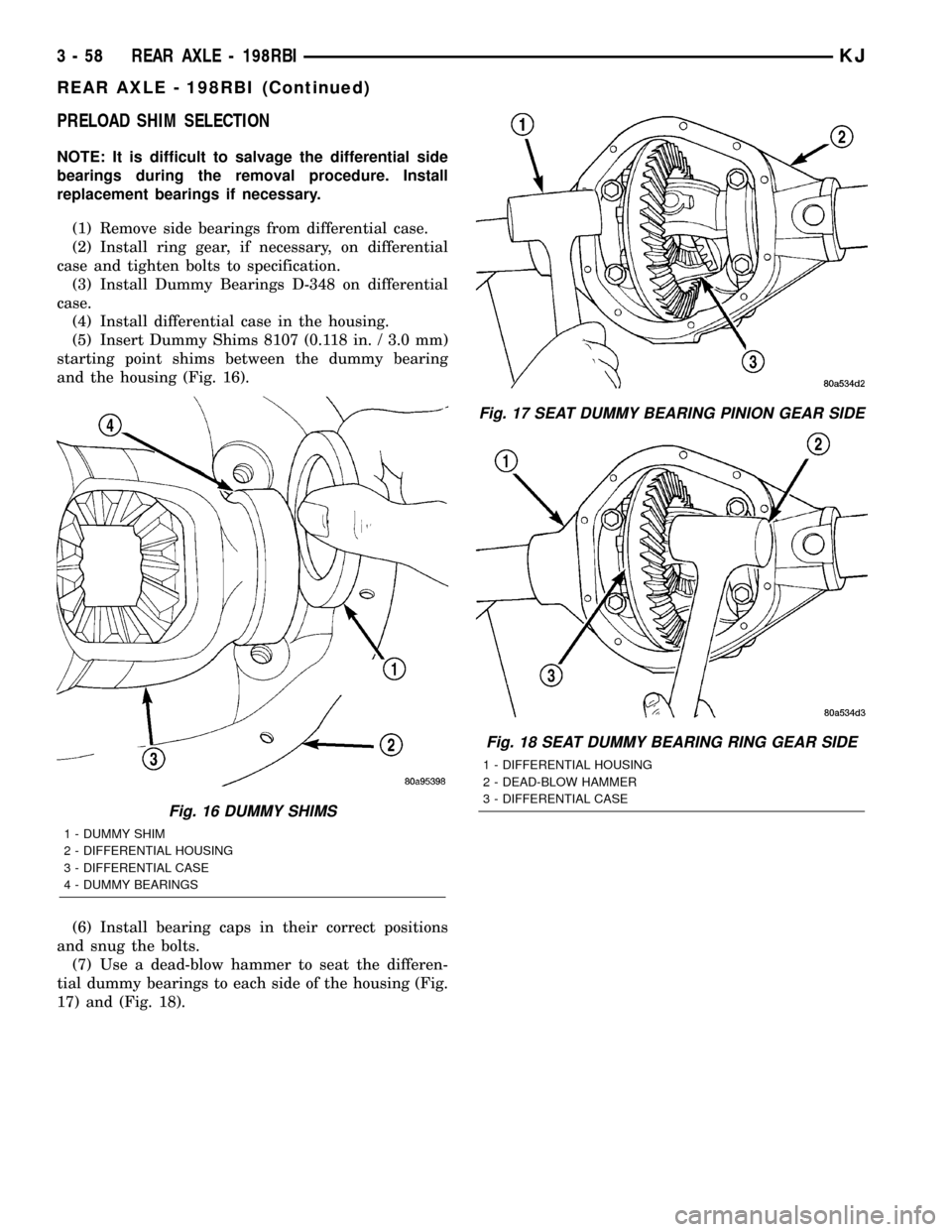
(5) Insert Dummy Shims 8107 (0.118 in. / 3.0 mm)
starting point shims between the dummy bearing
and the housing (Fig. 16).
(6) Install bearing caps in their correct positions
and snug the bolts.
(7) Use a dead-blow hammer to seat the differen-
tial dummy bearings to each side of the housing (Fig.
17) and (Fig. 18).
Fig. 16 DUMMY SHIMS
1 - DUMMY SHIM
2 - DIFFERENTIAL HOUSING
3 - DIFFERENTIAL CASE
4 - DUMMY BEARINGS
Fig. 17 SEAT DUMMY BEARING PINION GEAR SIDE
Fig. 18 SEAT DUMMY BEARING RING GEAR SIDE
1 - DIFFERENTIAL HOUSING
2 - DEAD-BLOW HAMMER
3 - DIFFERENTIAL CASE
3 - 58 REAR AXLE - 198RBIKJ
REAR AXLE - 198RBI (Continued)
Page 108 of 1803
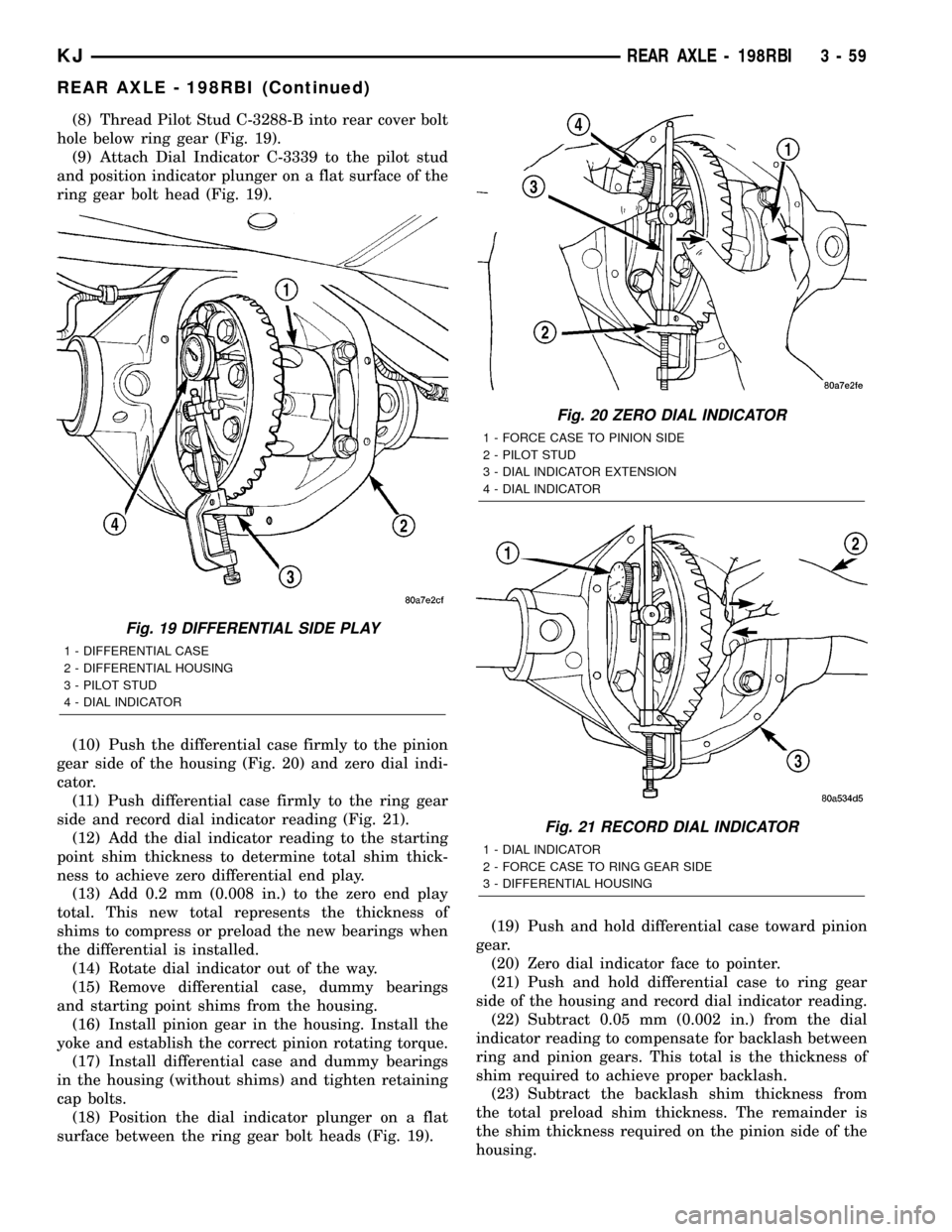
(8) Thread Pilot Stud C-3288-B into rear cover bolt
hole below ring gear (Fig. 19).
(9) Attach Dial Indicator C-3339 to the pilot stud
and position indicator plunger on a flat surface of the
ring gear bolt head (Fig. 19).
(10) Push the differential case firmly to the pinion
gear side of the housing (Fig. 20) and zero dial indi-
cator.
(11) Push differential case firmly to the ring gear
side and record dial indicator reading (Fig. 21).
(12) Add the dial indicator reading to the starting
point shim thickness to determine total shim thick-
ness to achieve zero differential end play.
(13) Add 0.2 mm (0.008 in.) to the zero end play
total. This new total represents the thickness of
shims to compress or preload the new bearings when
the differential is installed.
(14) Rotate dial indicator out of the way.
(15) Remove differential case, dummy bearings
and starting point shims from the housing.
(16) Install pinion gear in the housing. Install the
yoke and establish the correct pinion rotating torque.
(17) Install differential case and dummy bearings
in the housing (without shims) and tighten retaining
cap bolts.
(18) Position the dial indicator plunger on a flat
surface between the ring gear bolt heads (Fig. 19).(19) Push and hold differential case toward pinion
gear.
(20) Zero dial indicator face to pointer.
(21) Push and hold differential case to ring gear
side of the housing and record dial indicator reading.
(22) Subtract 0.05 mm (0.002 in.) from the dial
indicator reading to compensate for backlash between
ring and pinion gears. This total is the thickness of
shim required to achieve proper backlash.
(23) Subtract the backlash shim thickness from
the total preload shim thickness. The remainder is
the shim thickness required on the pinion side of the
housing.
Fig. 19 DIFFERENTIAL SIDE PLAY
1 - DIFFERENTIAL CASE
2 - DIFFERENTIAL HOUSING
3 - PILOT STUD
4 - DIAL INDICATOR
Fig. 20 ZERO DIAL INDICATOR
1 - FORCE CASE TO PINION SIDE
2 - PILOT STUD
3 - DIAL INDICATOR EXTENSION
4 - DIAL INDICATOR
Fig. 21 RECORD DIAL INDICATOR
1 - DIAL INDICATOR
2 - FORCE CASE TO RING GEAR SIDE
3 - DIFFERENTIAL HOUSING
KJREAR AXLE - 198RBI 3 - 59
REAR AXLE - 198RBI (Continued)
Page 109 of 1803
(24) Rotate dial indicator out of the way on pilot
stud.
(25) Remove differential case and dummy bearings
from the housing.
(26) Install new side bearing cones and cups on
differential case.
(27) Install spreader W-129-B and some compo-
nents of Adapter Set 6987 on differential housing and
spread axle opening enough to receive differential
case.
(28) Place side bearing shims into the housing
against the axle tubes.
(29) Install differential case in the housing.
(30) Rotate the differential case several times to
seat the side bearings.
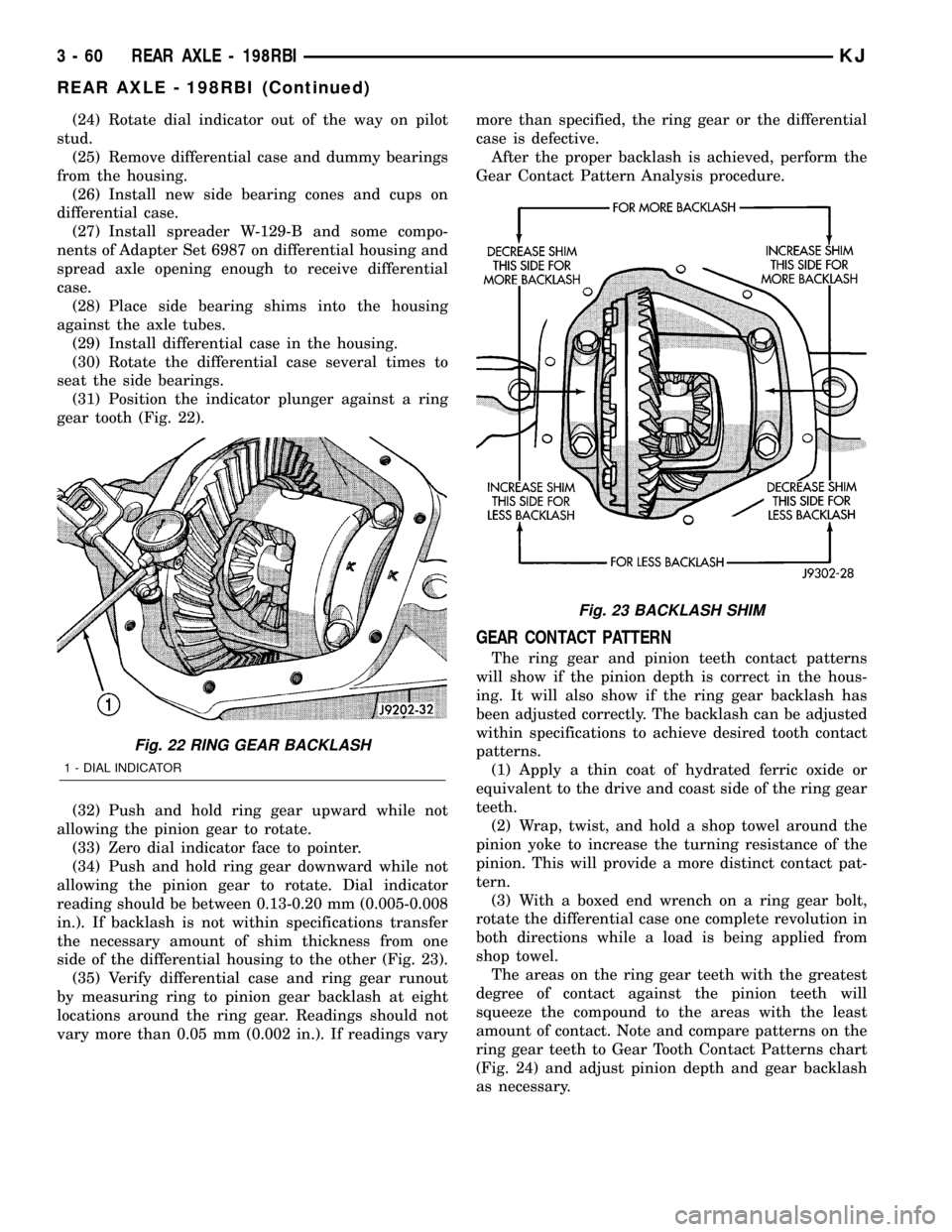
(31) Position the indicator plunger against a ring
gear tooth (Fig. 22).
(32) Push and hold ring gear upward while not
allowing the pinion gear to rotate.
(33) Zero dial indicator face to pointer.
(34) Push and hold ring gear downward while not
allowing the pinion gear to rotate. Dial indicator
reading should be between 0.13-0.20 mm (0.005-0.008
in.). If backlash is not within specifications transfer
the necessary amount of shim thickness from one
side of the differential housing to the other (Fig. 23).
(35) Verify differential case and ring gear runout
by measuring ring to pinion gear backlash at eight
locations around the ring gear. Readings should not
vary more than 0.05 mm (0.002 in.). If readings varymore than specified, the ring gear or the differential
case is defective.
After the proper backlash is achieved, perform the
Gear Contact Pattern Analysis procedure.
GEAR CONTACT PATTERN
The ring gear and pinion teeth contact patterns
will show if the pinion depth is correct in the hous-
ing. It will also show if the ring gear backlash has
been adjusted correctly. The backlash can be adjusted
within specifications to achieve desired tooth contact
patterns.
(1) Apply a thin coat of hydrated ferric oxide or
equivalent to the drive and coast side of the ring gear
teeth.
(2) Wrap, twist, and hold a shop towel around the
pinion yoke to increase the turning resistance of the
pinion. This will provide a more distinct contact pat-
tern.
(3) With a boxed end wrench on a ring gear bolt,
rotate the differential case one complete revolution in
both directions while a load is being applied from
shop towel.
The areas on the ring gear teeth with the greatest
degree of contact against the pinion teeth will
squeeze the compound to the areas with the least
amount of contact. Note and compare patterns on the
ring gear teeth to Gear Tooth Contact Patterns chart
(Fig. 24) and adjust pinion depth and gear backlash
as necessary.
Fig. 22 RING GEAR BACKLASH
1 - DIAL INDICATOR
Fig. 23 BACKLASH SHIM
3 - 60 REAR AXLE - 198RBIKJ
REAR AXLE - 198RBI (Continued)
Page 111 of 1803
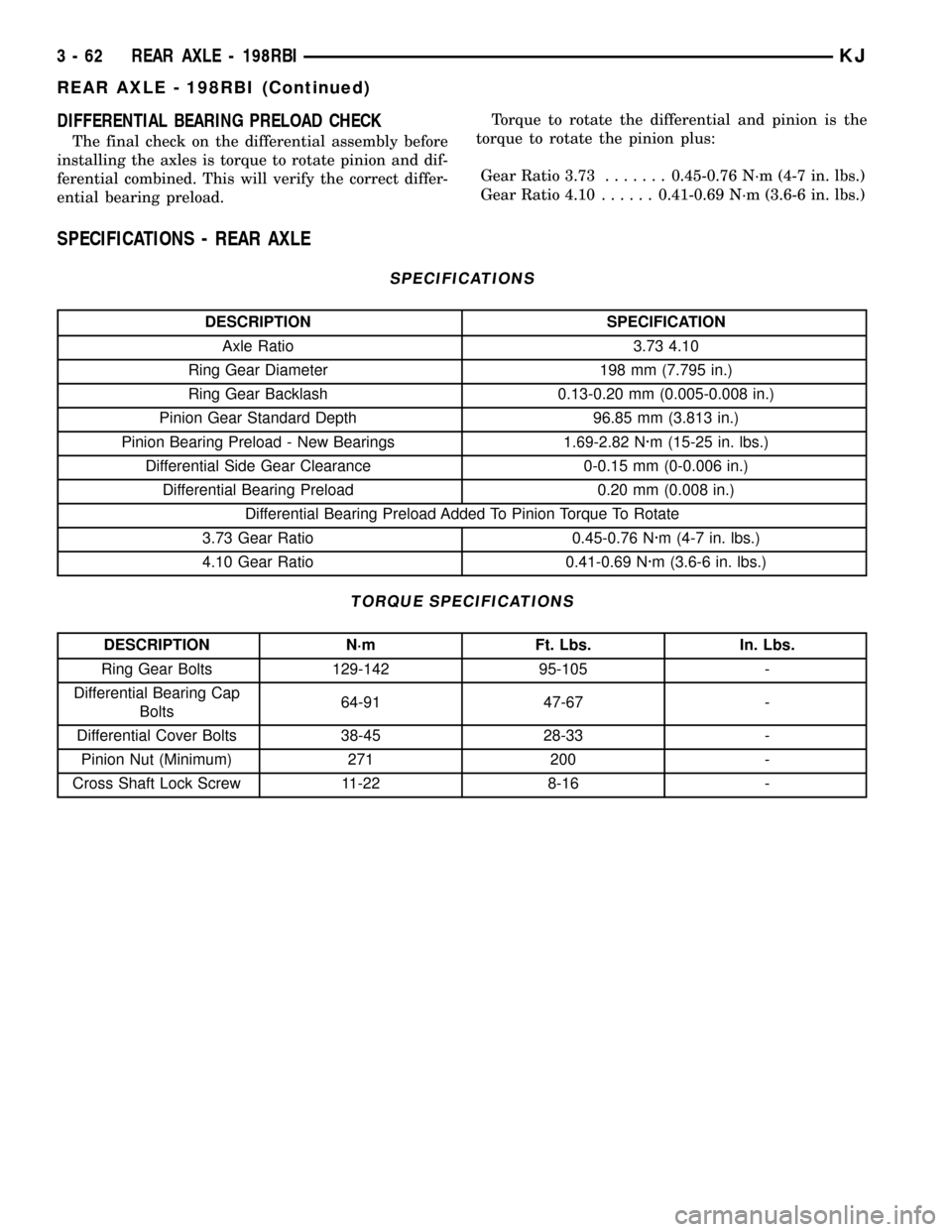
DIFFERENTIAL BEARING PRELOAD CHECK
The final check on the differential assembly before
installing the axles is torque to rotate pinion and dif-
ferential combined. This will verify the correct differ-
ential bearing preload.Torque to rotate the differential and pinion is the
torque to rotate the pinion plus:
Gear Ratio 3.73.......0.45-0.76 N´m (4-7 in. lbs.)
Gear Ratio 4.10......0.41-0.69 N´m (3.6-6 in. lbs.)
SPECIFICATIONS - REAR AXLE
SPECIFICATIONS
DESCRIPTION SPECIFICATION
Axle Ratio 3.73 4.10
Ring Gear Diameter 198 mm (7.795 in.)
Ring Gear Backlash 0.13-0.20 mm (0.005-0.008 in.)
Pinion Gear Standard Depth 96.85 mm (3.813 in.)
Pinion Bearing Preload - New Bearings 1.69-2.82 N´m (15-25 in. lbs.)
Differential Side Gear Clearance 0-0.15 mm (0-0.006 in.)
Differential Bearing Preload 0.20 mm (0.008 in.)
Differential Bearing Preload Added To Pinion Torque To Rotate
3.73 Gear Ratio 0.45-0.76 N´m (4-7 in. lbs.)
4.10 Gear Ratio 0.41-0.69 N´m (3.6-6 in. lbs.)
TORQUE SPECIFICATIONS
DESCRIPTION N´m Ft. Lbs. In. Lbs.
Ring Gear Bolts 129-142 95-105 -
Differential Bearing Cap
Bolts64-91 47-67 -
Differential Cover Bolts 38-45 28-33 -
Pinion Nut (Minimum) 271 200 -
Cross Shaft Lock Screw 11-22 8-16 -
3 - 62 REAR AXLE - 198RBIKJ
REAR AXLE - 198RBI (Continued)
Page 114 of 1803
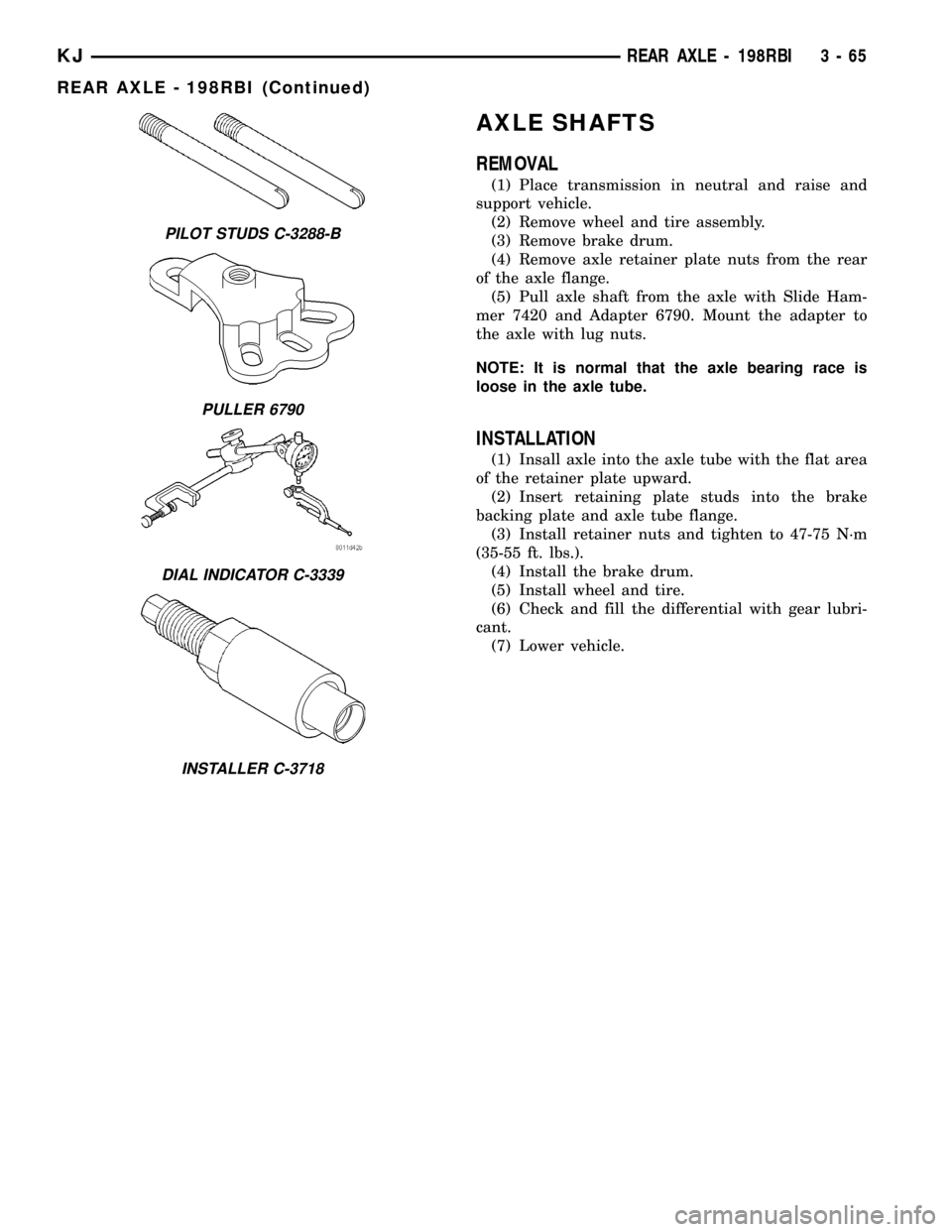
AXLE SHAFTS
REMOVAL
(1) Place transmission in neutral and raise and
support vehicle.
(2) Remove wheel and tire assembly.
(3) Remove brake drum.
(4) Remove axle retainer plate nuts from the rear
of the axle flange.
(5) Pull axle shaft from the axle with Slide Ham-
mer 7420 and Adapter 6790. Mount the adapter to
the axle with lug nuts.
NOTE: It is normal that the axle bearing race is
loose in the axle tube.
INSTALLATION
(1) Insall axle into the axle tube with the flat area
of the retainer plate upward.
(2) Insert retaining plate studs into the brake
backing plate and axle tube flange.
(3) Install retainer nuts and tighten to 47-75 N´m
(35-55 ft. lbs.).
(4) Install the brake drum.
(5) Install wheel and tire.
(6) Check and fill the differential with gear lubri-
cant.
(7) Lower vehicle.
PILOT STUDS C-3288-B
PULLER 6790
DIAL INDICATOR C-3339
INSTALLER C-3718
KJREAR AXLE - 198RBI 3 - 65
REAR AXLE - 198RBI (Continued)
Page 115 of 1803
AXLE BEARING/SEAL
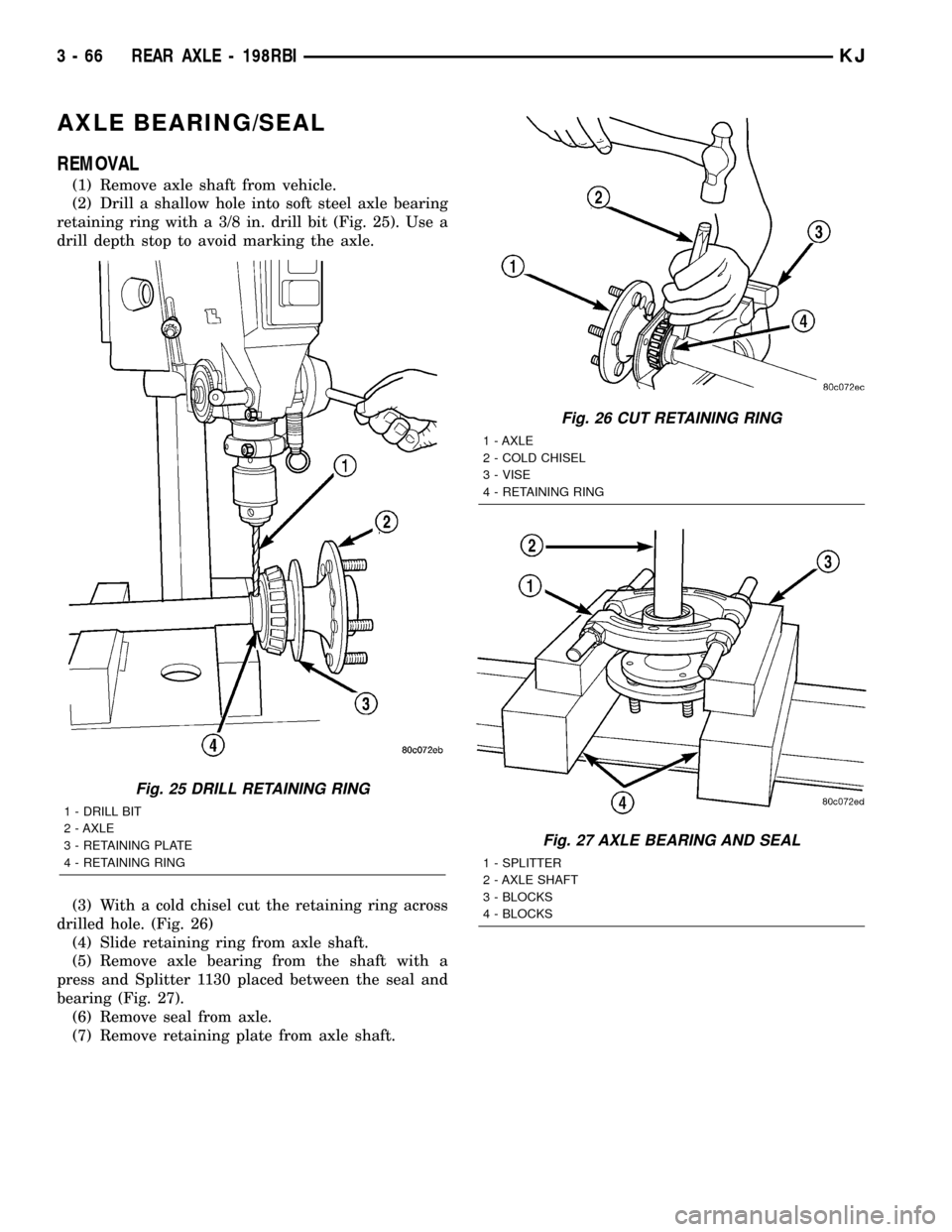
REMOVAL
(1) Remove axle shaft from vehicle.
(2) Drill a shallow hole into soft steel axle bearing
retaining ring with a 3/8 in. drill bit (Fig. 25). Use a
drill depth stop to avoid marking the axle.
(3) With a cold chisel cut the retaining ring across
drilled hole. (Fig. 26)
(4) Slide retaining ring from axle shaft.
(5) Remove axle bearing from the shaft with a
press and Splitter 1130 placed between the seal and
bearing (Fig. 27).
(6) Remove seal from axle.
(7) Remove retaining plate from axle shaft.
Fig. 25 DRILL RETAINING RING
1 - DRILL BIT
2 - AXLE
3 - RETAINING PLATE
4 - RETAINING RING
Fig. 26 CUT RETAINING RING
1 - AXLE
2 - COLD CHISEL
3 - VISE
4 - RETAINING RING
Fig. 27 AXLE BEARING AND SEAL
1 - SPLITTER
2 - AXLE SHAFT
3 - BLOCKS
4 - BLOCKS
3 - 66 REAR AXLE - 198RBIKJ
Page 116 of 1803
INSTALLATION
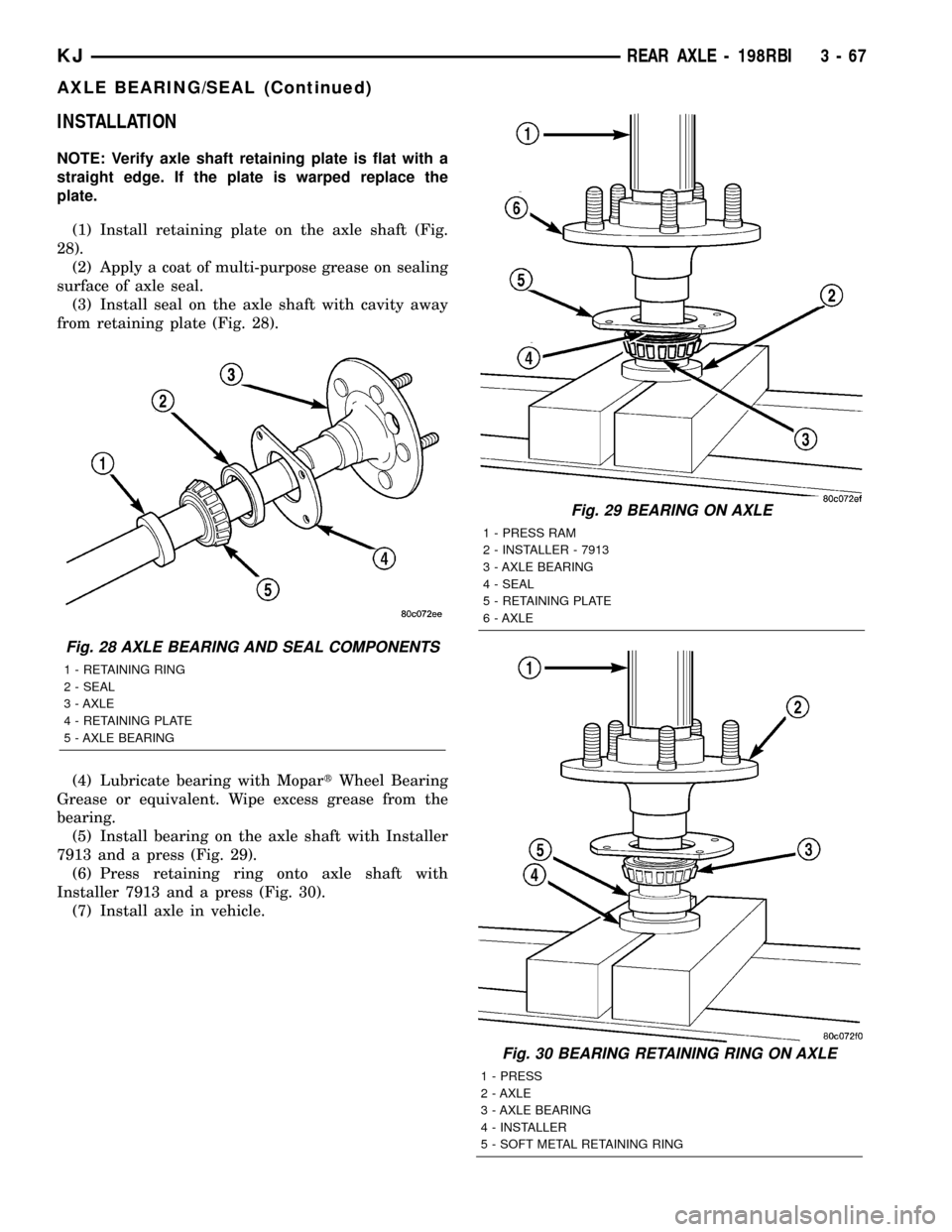
NOTE: Verify axle shaft retaining plate is flat with a
straight edge. If the plate is warped replace the
plate.
(1) Install retaining plate on the axle shaft (Fig.
28).
(2) Apply a coat of multi-purpose grease on sealing
surface of axle seal.
(3) Install seal on the axle shaft with cavity away
from retaining plate (Fig. 28).
(4) Lubricate bearing with MopartWheel Bearing
Grease or equivalent. Wipe excess grease from the
bearing.
(5) Install bearing on the axle shaft with Installer
7913 and a press (Fig. 29).
(6) Press retaining ring onto axle shaft with
Installer 7913 and a press (Fig. 30).
(7) Install axle in vehicle.
Fig. 29 BEARING ON AXLE
1 - PRESS RAM
2 - INSTALLER - 7913
3 - AXLE BEARING
4 - SEAL
5 - RETAINING PLATE
6 - AXLE
Fig. 30 BEARING RETAINING RING ON AXLE
1 - PRESS
2 - AXLE
3 - AXLE BEARING
4 - INSTALLER
5 - SOFT METAL RETAINING RING
Fig. 28 AXLE BEARING AND SEAL COMPONENTS
1 - RETAINING RING
2 - SEAL
3 - AXLE
4 - RETAINING PLATE
5 - AXLE BEARING
KJREAR AXLE - 198RBI 3 - 67
AXLE BEARING/SEAL (Continued)
Page 117 of 1803
PINION SEAL
REMOVAL
(1) Raise and support the vehicle.
(2) Remove wheel and tire assemblies.
(3) Remove rear brake rotors drums.
(4) Mark propeller shaft and pinion yoke for
installation reference.
(5) Remove the propeller shaft from the yoke.
(6) Rotate pinion gear three or four times and ver-
ify that pinion rotates smoothly.
(7) Measure and record torque to rotate the pinion
gear with an inch pound dial-type torque wrench.
(8) With a short piece of pipe and Spanner Wrench
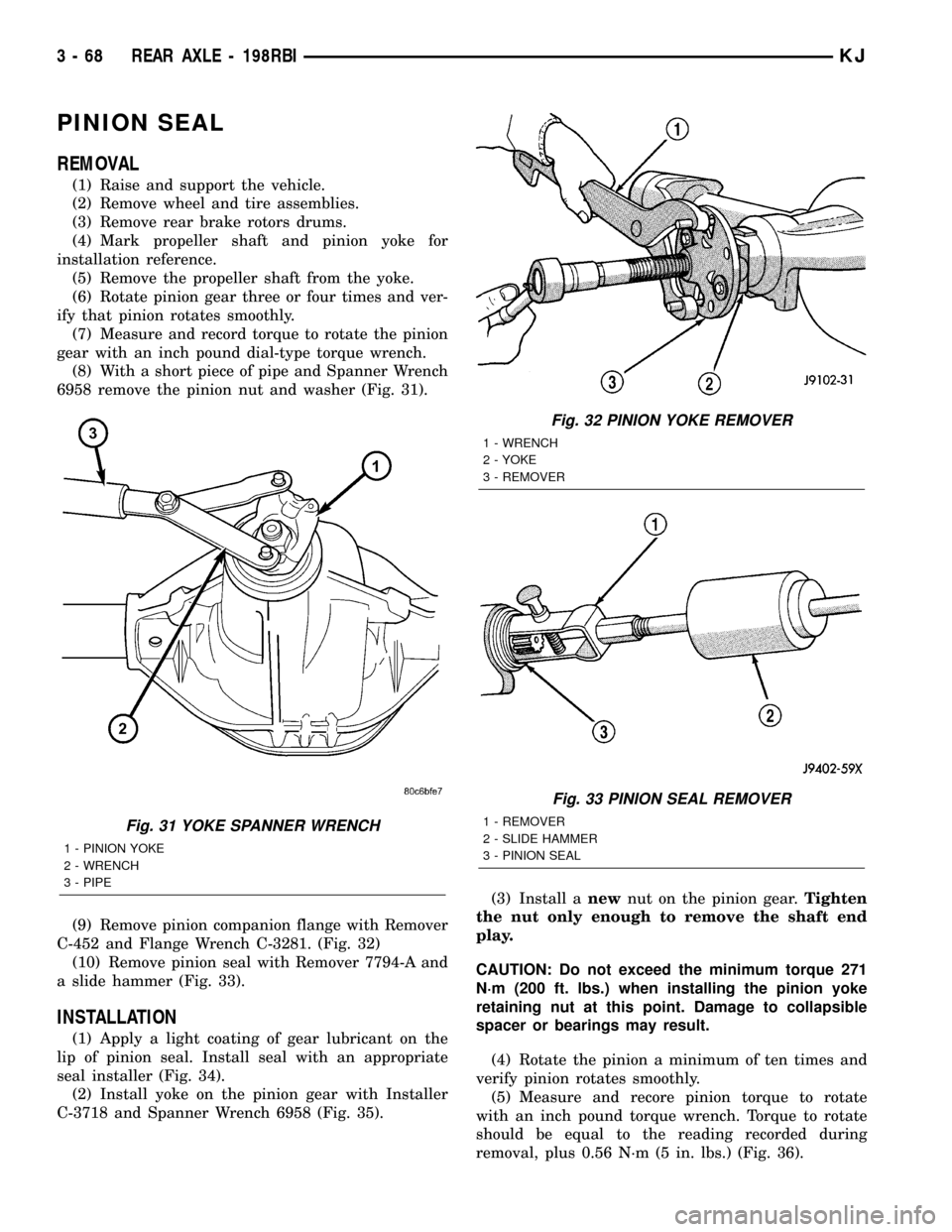
6958 remove the pinion nut and washer (Fig. 31).
(9) Remove pinion companion flange with Remover
C-452 and Flange Wrench C-3281. (Fig. 32)
(10) Remove pinion seal with Remover 7794-A and
a slide hammer (Fig. 33).
INSTALLATION
(1) Apply a light coating of gear lubricant on the
lip of pinion seal. Install seal with an appropriate
seal installer (Fig. 34).
(2) Install yoke on the pinion gear with Installer
C-3718 and Spanner Wrench 6958 (Fig. 35).(3) Install anewnut on the pinion gear.Tighten
the nut only enough to remove the shaft end
play.
CAUTION: Do not exceed the minimum torque 271
N´m (200 ft. lbs.) when installing the pinion yoke
retaining nut at this point. Damage to collapsible
spacer or bearings may result.
(4) Rotate the pinion a minimum of ten times and
verify pinion rotates smoothly.
(5) Measure and recore pinion torque to rotate
with an inch pound torque wrench. Torque to rotate
should be equal to the reading recorded during
removal, plus 0.56 N´m (5 in. lbs.) (Fig. 36).
Fig. 31 YOKE SPANNER WRENCH
1 - PINION YOKE
2 - WRENCH
3 - PIPE
Fig. 32 PINION YOKE REMOVER
1 - WRENCH
2 - YOKE
3 - REMOVER
Fig. 33 PINION SEAL REMOVER
1 - REMOVER
2 - SLIDE HAMMER
3 - PINION SEAL
3 - 68 REAR AXLE - 198RBIKJ
Page 118 of 1803
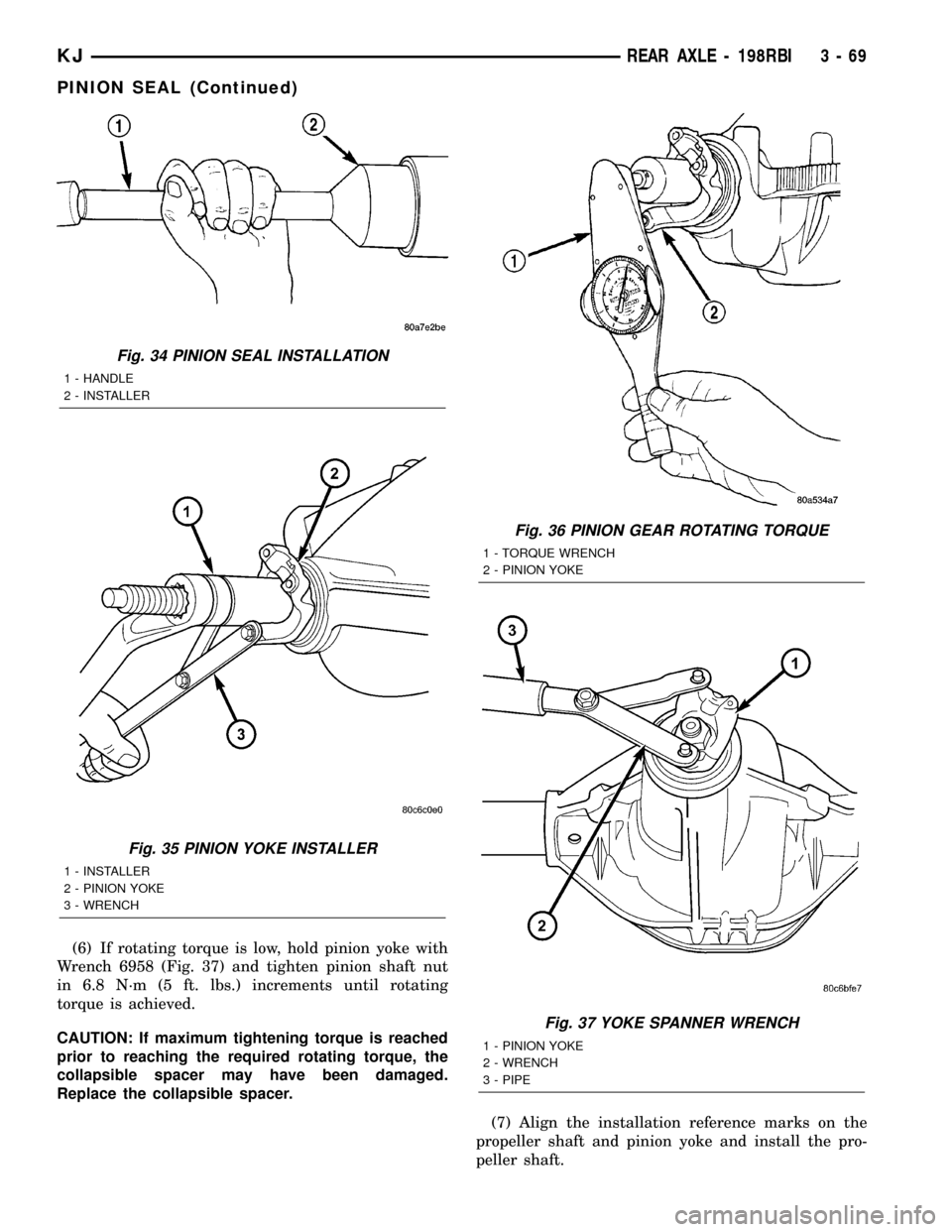
(6) If rotating torque is low, hold pinion yoke with
Wrench 6958 (Fig. 37) and tighten pinion shaft nut
in 6.8 N´m (5 ft. lbs.) increments until rotating
torque is achieved.
CAUTION: If maximum tightening torque is reached
prior to reaching the required rotating torque, the
collapsible spacer may have been damaged.
Replace the collapsible spacer.
(7) Align the installation reference marks on the
propeller shaft and pinion yoke and install the pro-
peller shaft.
Fig. 34 PINION SEAL INSTALLATION
1 - HANDLE
2 - INSTALLER
Fig. 35 PINION YOKE INSTALLER
1 - INSTALLER
2 - PINION YOKE
3 - WRENCH
Fig. 36 PINION GEAR ROTATING TORQUE
1 - TORQUE WRENCH
2 - PINION YOKE
Fig. 37 YOKE SPANNER WRENCH
1 - PINION YOKE
2 - WRENCH
3 - PIPE
KJREAR AXLE - 198RBI 3 - 69
PINION SEAL (Continued)