Body JEEP LIBERTY 2002 KJ / 1.G Workshop Manual
[x] Cancel search | Manufacturer: JEEP, Model Year: 2002, Model line: LIBERTY, Model: JEEP LIBERTY 2002 KJ / 1.GPages: 1803, PDF Size: 62.3 MB
Page 465 of 1803

REMOVAL
WARNING: ON VEHICLES EQUIPPED WITH AIR-
BAGS, DISABLE THE SUPPLEMENTAL RESTRAINT
SYSTEM BEFORE ATTEMPTING ANY STEERING
WHEEL, STEERING COLUMN, DRIVER AIRBAG,
PASSENGER AIRBAG, SEAT BELT TENSIONER,
FRONT IMPACT SENSORS, SIDE CURTAIN AIRBAG,
OR INSTRUMENT PANEL COMPONENT DIAGNOSIS
OR SERVICE. DISCONNECT AND ISOLATE THE
BATTERY NEGATIVE (GROUND) CABLE, THEN
WAIT TWO MINUTES FOR THE SYSTEM CAPACI-
TOR TO DISCHARGE BEFORE PERFORMING FUR-
THER DIAGNOSIS OR SERVICE. THIS IS THE ONLY
SURE WAY TO DISABLE THE SUPPLEMENTAL
RESTRAINT SYSTEM. FAILURE TO TAKE THE
PROPER PRECAUTIONS COULD RESULT IN ACCI-
DENTAL AIRBAG DEPLOYMENT AND POSSIBLE
PERSONAL INJURY.
(1) Disconnect and isolate the battery negative
cable.
(2) Remove the steering column opening cover
from the instrument panel. (Refer to 23 - BODY/IN-
STRUMENT PANEL/STEERING COLUMN OPEN-
ING COVER - REMOVAL).
(3) Remove the front fog lamp relay by grasping it
firmly and pulling it straight out from the receptacle
in the Junction Block (JB) (Fig. 13).
INSTALLATION
WARNING: ON VEHICLES EQUIPPED WITH AIR-
BAGS, DISABLE THE SUPPLEMENTAL RESTRAINT
SYSTEM BEFORE ATTEMPTING ANY STEERING
WHEEL, STEERING COLUMN, DRIVER AIRBAG,
PASSENGER AIRBAG, SEAT BELT TENSIONER,
FRONT IMPACT SENSORS, SIDE CURTAIN AIRBAG,
OR INSTRUMENT PANEL COMPONENT DIAGNOSIS
OR SERVICE. DISCONNECT AND ISOLATE THE
BATTERY NEGATIVE (GROUND) CABLE, THEN
WAIT TWO MINUTES FOR THE SYSTEM CAPACI-
TOR TO DISCHARGE BEFORE PERFORMING FUR-
THER DIAGNOSIS OR SERVICE. THIS IS THE ONLY
SURE WAY TO DISABLE THE SUPPLEMENTAL
RESTRAINT SYSTEM. FAILURE TO TAKE THE
PROPER PRECAUTIONS COULD RESULT IN ACCI-
DENTAL AIRBAG DEPLOYMENT AND POSSIBLE
PERSONAL INJURY.(1) Position the front fog lamp relay to the proper
receptacle in the Junction Block (JB) (Fig. 13).
(2) Align the front fog lamp relay terminals with
the terminal cavities in the JB receptacle.
(3) Push firmly and evenly on the top of the front
fog lamp relay until the terminals are fully seated in
the terminal cavities in the JB receptacle.
(4) Reinstall the steering column opening cover
onto the instrument panel. (Refer to 23 - BODY/IN-
STRUMENT PANEL/STEERING COLUMN OPEN-
ING COVER - INSTALLATION).
(5) Reconnect the battery negative cable.
Fig. 13 Junction Block - Inboard Side (LHD Shown -
Rotate 180É for RHD)
1 - PASSENGER DOOR UNLOCK RELAY
2 - JB C3 CONNECTOR RECEPTACLE
3 - LOW BEAM RELAY
4 - CIRCUIT BREAKER #1
5 - CIRCUIT BREAKER #2
6 - CIRCUIT BREAKER #3
7 - DOOR LOCK RELAY
8 - DEFOGGER RELAY
9-SPARE
10 - FRONT FOG LAMP RELAY
11 - HORN RELAY
12 - SPARE
13 - SPARE
14 - REAR FOG LAMP RELAY
15 - PARK LAMP RELAY
16 - DRIVER DOOR UNLOCK RELAY
17 - JB C1 CONNECTOR RECEPTACLE
18 - JB C2 CONNECTOR RECEPTACLE
8L - 24 LAMPS/LIGHTING - EXTERIORKJ
FRONT FOG LAMP RELAY (Continued)
Page 470 of 1803

HAZARD SWITCH
DESCRIPTION
The hazard switch is integral to the hazard switch
module, which is secured near the center of instrument
panel just above the radio (Fig. 21). Only the hazard
switch button is visible through a dedicated, round, bev-
eled opening on the outer surface of the instrument
panel between the two center panel outlets of the heater
and air conditioning system. A red, stencil-like Interna-
tional Control and Display Symbol icon for ªHazard
Warningº identifies the hazard switch button. On the
opposite end of the black, molded plastic hazard switch
module housing from the switch button is an integral
connector receptacle and a stamped steel mounting
bracket with two latch feature tabs that extend down-
ward, while a short dowel-like alignment pin is integral
to each side of the housing just below the switch button.
The switch module is connected to the vehicle electrical
system through a dedicated take out and connector of
the instrument panel wire harness. Within the hazard
switch module housing is the hazard switch circuitry
and an electronic circuit board with the integral combi-
nation flasher circuitry. The electronic combination
flasher circuitry performs both the hazard flasher and
turn signal flasher functions.
The hazard switch module cannot be adjusted or
repaired and, if faulty or damaged, the unit must be
replaced.
OPERATION
The hazard switch button is slightly recessed in the
instrument panel when the switch is in the Off position,
and latches at a position that is flush with the outer
surface of the instrument panel when in the On posi-tion. The hazard switch module produces an audible
clicking sound that emulates the sound of a conven-
tional flasher whenever the turn signals or the hazard
warning system are activated. The hazard switch mod-
ule receives battery current on a fused B(+) circuit from
a fuse in the Junction Block (JB) at all times for oper-
ation of the hazard warning, and on a fused ignition
switch output (run) circuit from another fuse in the JB
whenever the ignition switch is in the On position for
operation of the turn signals. The module receives a
path to ground through a splice block located in the
instrument panel wire harness with an eyelet terminal
connector that is secured by a nut to a ground stud on
the driver side instrument panel end bracket near the
JB. Inputs to and outputs from the hazard switch mod-
ule include:
²Panel Lamps Dimmer Input- A non-service-
able incandescent bulb soldered onto the hazard
switch module circuit board provides illumination of
the switch button when the exterior lighting is
turned On through an input received on the fused
panel lamps dimmer switch signal circuit. However,
this bulb flashes on and off at full intensity whenever
the hazard switch button is in the On position,
regardless of the status of the exterior lighting.
²Hazard Switch Input- The combination
flasher circuitry of the hazard switch module receives
an internal ground input from the hazard switch to
request hazard flasher operation.
²Multi-Function Switch Input- The combina-
tion flasher circuitry of the hazard switch module
receives separate ground inputs from the turn signal
switch circuitry of the multi-function switch on right
and left turn switch sense circuits to request right or
left turn signal flasher operation.
²Body Control Module Input- The Body Con-
trol Module (BCM) can request hazard flasher opera-
tion by providing a ground path to the combination
flasher circuitry of the hazard switch module through
a hazard lamp control circuit.
²Turn Signal Output- The combination flasher
circuitry within the hazard switch module responds
to the flasher request inputs by energizing and
de-energizing two miniature relays on the module
circuit board. These relays control the switch output
through the right and left turn signal circuits. One
relay controls the right lamps, while the other con-
trols the left.
Because of active electronic elements within the
hazard switch module, it cannot be tested with con-
ventional automotive electrical test equipment. If the
hazard switch module is believed to be faulty, replace
the switch with a known good unit to confirm system
operation.
Fig. 21 Hazard Switch
1 - HAZARD SWITCH BUTTON
2 - SCREW (1)
3 - MOUNTING BRACKET TABS
KJLAMPS/LIGHTING - EXTERIOR 8L - 29
Page 474 of 1803

(3) Pinch the two hooked ends of the wire head-
lamp bulb retainer clip together and engage them
into the slots in the flange of the reflector (Fig. 26).
(4) Position the center opening of the boot seal
over the base of the headlamp bulb and pull it down-
ward until the seal is fully engaged over the bulb
base (Fig. 25).
(5) Position the outer circumference of the boot
seal over the flange on the back of the headlamp unit
housing and pull it downward until the seal is fully
engaged over the flange.
(6) Reinstall the headlamp unit onto the grille
opening reinforcement. (Refer to 8 - ELECTRICAL/
LAMPS/LIGHTING - EXTERIOR/HEADLAMP UNIT
- INSTALLATION).
(7) Reconnect the battery negative cable.
(8) Confirm proper headlamp unit alignment.
(Refer to 8 - ELECTRICAL/LAMPS/LIGHTING -
EXTERIOR/HEADLAMP UNIT - ADJUSTMENTS).
HEADLAMP HIGH BEAM
RELAY
DESCRIPTION
The headlamp high beam relay is located in the
Junction Block (JB) on the driver side outboard end
of the instrument panel in the passenger compart-
ment of the vehicle. The headlamp high beam relay
is omitted from vehicles manufactured for sale in
Canada, which have a Daytime Running Lamp (DRL)
solid state relay installed in the JB that also per-forms the function of the headlamp high beam relay.
The headlamp high beam relay is a conventional
International Standards Organization (ISO) micro
relay (Fig. 28). Relays conforming to the ISO specifi-
cations have common physical dimensions, current
capacities, terminal patterns, and terminal functions.
The relay is contained within a small, rectangular,
molded plastic housing and is connected to all of the
required inputs and outputs by five integral male
spade-type terminals that extend from the bottom of
the relay base.
The headlamp high beam relay cannot be adjusted
or repaired and, if faulty or damaged, the unit must
be replaced.
OPERATION
The headlamp high beam relay is an electrome-
chanical switch that uses a low current input from
the Body Control Module (BCM) to control a high
current output to the headlamp high beam filaments.
The movable common feed contact point is held
against the fixed normally closed contact point by
spring pressure. When the relay coil is energized, an
electromagnetic field is produced by the coil wind-
ings. This electromagnetic field draws the movable
relay contact point away from the fixed normally
closed contact point, and holds it against the fixed
normally open contact point. When the relay coil is
de-energized, spring pressure returns the movable
contact point back against the fixed normally closed
contact point. A resistor is connected in parallel with
the relay coil in the relay, and helps to dissipate volt-
age spikes and electromagnetic interference that can
be generated as the electromagnetic field of the relay
coil collapses.
The headlamp high beam relay terminals are con-
nected to the vehicle electrical system through a con-
nector receptacle in the Junction Block (JB). The
inputs and outputs of the headlamp high beam relay
include:
²Common Feed Terminal- The common feed
terminal (30) receives battery current at all times
from a fuse in the Power Distribution Center (PDC)
through a fused B(+) circuit.
²Coil Ground Terminal- The coil ground termi-
nal (85) receives battery current at all times from a
fuse in the PDC through a fused B(+) circuit.
²Coil Battery Terminal- The coil battery ter-
minal (86) is connected to a control output of the
Body Control Module (BCM) and to the momentary
optical horn (flash-to-pass) output of the multi-func-
tion switch through a high beam relay control circuit.
The BCM and/or the multi-function switch controls
headlamp high beam operation by controlling a
ground path through this circuit.
Fig. 28 ISO Micro Relay
30 - COMMON FEED
85 - COIL GROUND
86 - COIL BATTERY
87 - NORMALLY OPEN
87A - NORMALLY CLOSED
KJLAMPS/LIGHTING - EXTERIOR 8L - 33
HEADLAMP BULB (Continued)
Page 475 of 1803

²Normally Open Terminal- The normally open
terminal (87) is connected to the headlamp high
beam filaments through the high beam relay output
circuit and provides battery current to the headlamp
high beams whenever the relay is energized.
²Normally Closed Terminal- The normally
closed terminal (87A) is not connected in this appli-
cation.
The headlamp high beam relay can be diagnosed
using conventional diagnostic tools and methods.
DIAGNOSIS AND TESTING - HEADLAMP HIGH
BEAM RELAY
The headlamp high beam relay (Fig. 29) is located
in the Junction Block (JB) on the driver side out-
board end of the instrument panel. Refer to the
appropriate wiring information. The wiring informa-
tion includes wiring diagrams, proper wire and con-
nector repair procedures, details of wire harness
routing and retention, connector pin-out information
and location views for the various wire harness con-
nectors, splices and grounds.
WARNING: ON VEHICLES EQUIPPED WITH AIR-
BAGS, DISABLE THE SUPPLEMENTAL RESTRAINT
SYSTEM BEFORE ATTEMPTING ANY STEERING
WHEEL, STEERING COLUMN, DRIVER AIRBAG,
PASSENGER AIRBAG, SEAT BELT TENSIONER,
FRONT IMPACT SENSORS, SIDE CURTAIN AIRBAG,
OR INSTRUMENT PANEL COMPONENT DIAGNOSIS
OR SERVICE. DISCONNECT AND ISOLATE THE
BATTERY NEGATIVE (GROUND) CABLE, THEN
WAIT TWO MINUTES FOR THE SYSTEM CAPACI-
TOR TO DISCHARGE BEFORE PERFORMING FUR-
THER DIAGNOSIS OR SERVICE. THIS IS THE ONLY
SURE WAY TO DISABLE THE SUPPLEMENTAL
RESTRAINT SYSTEM. FAILURE TO TAKE THE
PROPER PRECAUTIONS COULD RESULT IN ACCI-
DENTAL AIRBAG DEPLOYMENT AND POSSIBLE
PERSONAL INJURY.
(1) Remove the headlamp high beam relay from
the JB. (Refer to 8 - ELECTRICAL/LAMPS/LIGHT-
ING - EXTERIOR/HEADLAMP HIGH BEAM RELAY
- REMOVAL).
(2) A relay in the de-energized position should
have continuity between terminals 87A and 30, and
no continuity between terminals 87 and 30. If OK, go
to Step 3. If not OK, replace the faulty relay.
(3) Resistance between terminals 85 and 86 (elec-
tromagnet) should be 75 8 ohms. If OK, go to Step
4. If not OK, replace the faulty relay.
(4) Connect a battery to terminals 85 and 86.
There should now be continuity between terminals
30 and 87, and no continuity between terminals 87A
and 30. If OK, reinstall the relay and use a DRBIIItscan tool to perform further testing. Refer to the
appropriate diagnostic information.
REMOVAL
WARNING: ON VEHICLES EQUIPPED WITH AIR-
BAGS, DISABLE THE SUPPLEMENTAL RESTRAINT
SYSTEM BEFORE ATTEMPTING ANY STEERING
WHEEL, STEERING COLUMN, DRIVER AIRBAG,
PASSENGER AIRBAG, SEAT BELT TENSIONER,
FRONT IMPACT SENSORS, SIDE CURTAIN AIRBAG,
OR INSTRUMENT PANEL COMPONENT DIAGNOSIS
OR SERVICE. DISCONNECT AND ISOLATE THE
BATTERY NEGATIVE (GROUND) CABLE, THEN
WAIT TWO MINUTES FOR THE SYSTEM CAPACI-
TOR TO DISCHARGE BEFORE PERFORMING FUR-
THER DIAGNOSIS OR SERVICE. THIS IS THE ONLY
SURE WAY TO DISABLE THE SUPPLEMENTAL
RESTRAINT SYSTEM. FAILURE TO TAKE THE
PROPER PRECAUTIONS COULD RESULT IN ACCI-
DENTAL AIRBAG DEPLOYMENT AND POSSIBLE
PERSONAL INJURY.
(1) Disconnect and isolate the battery negative
cable.
(2) Remove the end cap from the driver side out-
board end of the instrument panel. (Refer to 23 -
BODY/INSTRUMENT PANEL/INSTRUMENT
PANEL END CAP - REMOVAL).
(3) Remove the headlamp high beam relay by
grasping it firmly and pulling it straight out from the
receptacle in the Junction Block (JB) (Fig. 30).
Fig. 29 ISO Micro Relay
30 - COMMON FEED
85 - COIL GROUND
86 - COIL BATTERY
87 - NORMALLY OPEN
87A - NORMALLY CLOSED
8L - 34 LAMPS/LIGHTING - EXTERIORKJ
HEADLAMP HIGH BEAM RELAY (Continued)
Page 476 of 1803

INSTALLATION
WARNING: ON VEHICLES EQUIPPED WITH AIR-
BAGS, DISABLE THE SUPPLEMENTAL RESTRAINT
SYSTEM BEFORE ATTEMPTING ANY STEERING
WHEEL, STEERING COLUMN, DRIVER AIRBAG,
PASSENGER AIRBAG, SEAT BELT TENSIONER,
FRONT IMPACT SENSORS, SIDE CURTAIN AIRBAG,
OR INSTRUMENT PANEL COMPONENT DIAGNOSIS
OR SERVICE. DISCONNECT AND ISOLATE THE
BATTERY NEGATIVE (GROUND) CABLE, THEN
WAIT TWO MINUTES FOR THE SYSTEM CAPACI-
TOR TO DISCHARGE BEFORE PERFORMING FUR-
THER DIAGNOSIS OR SERVICE. THIS IS THE ONLY
SURE WAY TO DISABLE THE SUPPLEMENTAL
RESTRAINT SYSTEM. FAILURE TO TAKE THE
PROPER PRECAUTIONS COULD RESULT IN ACCI-
DENTAL AIRBAG DEPLOYMENT AND POSSIBLE
PERSONAL INJURY.
(1) Position the headlamp high beam relay to the
proper receptacle in the Junction Block (JB) (Fig. 30).
(2) Align the headlamp high beam relay terminals
with the terminal cavities in the JB receptacle.
(3) Push firmly and evenly on the top of the head-
lamp high beam relay until the terminals are fully
seated in the terminal cavities in the JB receptacle.
(4) Reinstall the end cap onto the driver side out-
board end of the instrument panel. (Refer to 23 -
BODY/INSTRUMENT PANEL/INSTRUMENT
PANEL END CAP - INSTALLATION).
(5) Reconnect the battery negative cable.
HEADLAMP LEVELING MOTOR
DESCRIPTION
The headlamp leveling motor is located on the rear
inboard side of each headlamp unit on models
equipped with the headlamp leveling system, which
is available only in certain markets where required
(Fig. 31). The motor is encased within a molded plas-
tic housing and is secured by an integral wedge-type
mounting boss on its forward surface to a flanged
receptacle on the back of the headlamp unit housing.
A rubber seal around the circumference of the
mounting boss is compressed and seals the motor to
the headlamp unit when the boss is properly
installed in the flanged receptacle. The outside of the
motor housing features an integral molded connector
receptacle on its rearward surface, a hex-headed
adjusting screw extends from the top of the housing,
and a plastic pushrod with a ball formation on its
free end extends from the center of the mounting
boss at the front. Within the motor housing is a
12-volt Direct Current (DC) servo motor, an elec-
tronic controller board that includes the motor logic
circuits, and an integral screw-drive transmission.
The headlamp leveling motor is connected to the
vehicle electrical system through a dedicated take
out and connector of the front fascia wire harness.
The headlamp leveling motor cannot be repaired
and, if faulty or damaged, the unit must be replaced.
Fig. 30 Junction Block - Outboard Side (RHD Shown
- Rotate 180É for LHD)
1 - JB/BCM CONNECTOR
2 - HIGH BEAM RELAY
3 - DRL RELAY
Fig. 31 Headlamp Unit - With Leveling
1 - LEVELING MOTOR (IF EQUIPPED)
2 - BOOT SEAL
3 - ADJUSTING SCREW
4 - LOCATOR TAB
5 - HOUSING
6 - FRONT POSITION LAMP SOCKET & BULB
7 - HEADLAMP BULB
8 - MOUNTING TAB (2)
KJLAMPS/LIGHTING - EXTERIOR 8L - 35
HEADLAMP HIGH BEAM RELAY (Continued)
Page 479 of 1803
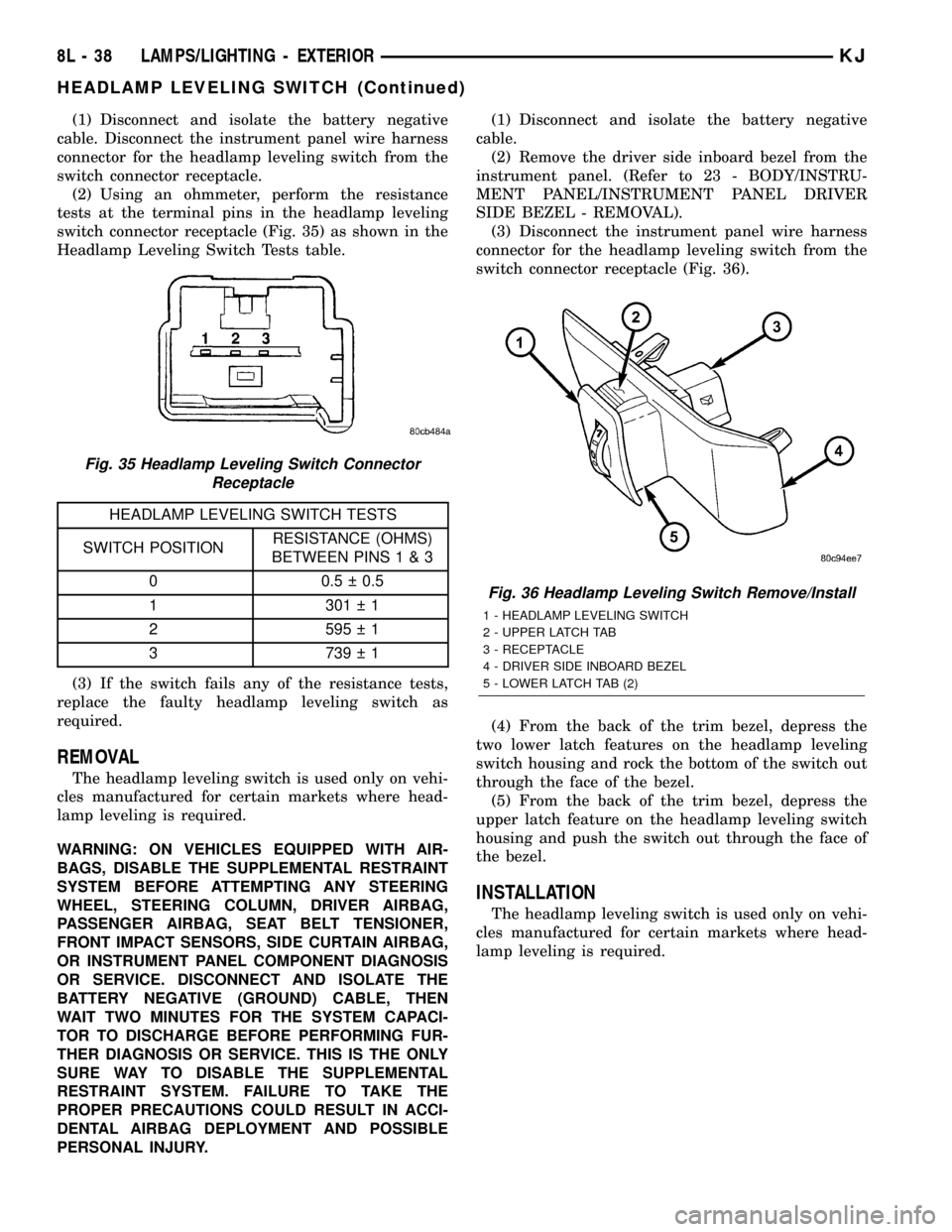
(1) Disconnect and isolate the battery negative
cable. Disconnect the instrument panel wire harness
connector for the headlamp leveling switch from the
switch connector receptacle.
(2) Using an ohmmeter, perform the resistance
tests at the terminal pins in the headlamp leveling
switch connector receptacle (Fig. 35) as shown in the
Headlamp Leveling Switch Tests table.
HEADLAMP LEVELING SWITCH TESTS
SWITCH POSITIONRESISTANCE (OHMS)
BETWEEN PINS1&3
0 0.5 0.5
1 301 1
2 595 1
3 739 1
(3) If the switch fails any of the resistance tests,
replace the faulty headlamp leveling switch as
required.
REMOVAL
The headlamp leveling switch is used only on vehi-
cles manufactured for certain markets where head-
lamp leveling is required.
WARNING: ON VEHICLES EQUIPPED WITH AIR-
BAGS, DISABLE THE SUPPLEMENTAL RESTRAINT
SYSTEM BEFORE ATTEMPTING ANY STEERING
WHEEL, STEERING COLUMN, DRIVER AIRBAG,
PASSENGER AIRBAG, SEAT BELT TENSIONER,
FRONT IMPACT SENSORS, SIDE CURTAIN AIRBAG,
OR INSTRUMENT PANEL COMPONENT DIAGNOSIS
OR SERVICE. DISCONNECT AND ISOLATE THE
BATTERY NEGATIVE (GROUND) CABLE, THEN
WAIT TWO MINUTES FOR THE SYSTEM CAPACI-
TOR TO DISCHARGE BEFORE PERFORMING FUR-
THER DIAGNOSIS OR SERVICE. THIS IS THE ONLY
SURE WAY TO DISABLE THE SUPPLEMENTAL
RESTRAINT SYSTEM. FAILURE TO TAKE THE
PROPER PRECAUTIONS COULD RESULT IN ACCI-
DENTAL AIRBAG DEPLOYMENT AND POSSIBLE
PERSONAL INJURY.(1) Disconnect and isolate the battery negative
cable.
(2) Remove the driver side inboard bezel from the
instrument panel. (Refer to 23 - BODY/INSTRU-
MENT PANEL/INSTRUMENT PANEL DRIVER
SIDE BEZEL - REMOVAL).
(3) Disconnect the instrument panel wire harness
connector for the headlamp leveling switch from the
switch connector receptacle (Fig. 36).
(4) From the back of the trim bezel, depress the
two lower latch features on the headlamp leveling
switch housing and rock the bottom of the switch out
through the face of the bezel.
(5) From the back of the trim bezel, depress the
upper latch feature on the headlamp leveling switch
housing and push the switch out through the face of
the bezel.
INSTALLATION
The headlamp leveling switch is used only on vehi-
cles manufactured for certain markets where head-
lamp leveling is required.
Fig. 35 Headlamp Leveling Switch Connector
Receptacle
Fig. 36 Headlamp Leveling Switch Remove/Install
1 - HEADLAMP LEVELING SWITCH
2 - UPPER LATCH TAB
3 - RECEPTACLE
4 - DRIVER SIDE INBOARD BEZEL
5 - LOWER LATCH TAB (2)
8L - 38 LAMPS/LIGHTING - EXTERIORKJ
HEADLAMP LEVELING SWITCH (Continued)
Page 480 of 1803

WARNING: ON VEHICLES EQUIPPED WITH AIR-
BAGS, DISABLE THE SUPPLEMENTAL RESTRAINT
SYSTEM BEFORE ATTEMPTING ANY STEERING
WHEEL, STEERING COLUMN, DRIVER AIRBAG,
PASSENGER AIRBAG, SEAT BELT TENSIONER,
FRONT IMPACT SENSORS, SIDE CURTAIN AIRBAG,
OR INSTRUMENT PANEL COMPONENT DIAGNOSIS
OR SERVICE. DISCONNECT AND ISOLATE THE
BATTERY NEGATIVE (GROUND) CABLE, THEN
WAIT TWO MINUTES FOR THE SYSTEM CAPACI-
TOR TO DISCHARGE BEFORE PERFORMING FUR-
THER DIAGNOSIS OR SERVICE. THIS IS THE ONLY
SURE WAY TO DISABLE THE SUPPLEMENTAL
RESTRAINT SYSTEM. FAILURE TO TAKE THE
PROPER PRECAUTIONS COULD RESULT IN ACCI-
DENTAL AIRBAG DEPLOYMENT AND POSSIBLE
PERSONAL INJURY.
(1) From the face of the driver side inboard bezel,
align the headlamp leveling switch housing to the
mounting hole in the bezel (Fig. 36).
(2) Push the headlamp leveling switch into the
mounting hole until it is fully seated and the upper
latch and two lower latch features on the switch
housing are engaged on the back of the bezel.
(3) Position the switch and bezel unit to the
instrument panel.
(4) Reconnect the instrument panel wire harness
connector for the headlamp leveling switch to the
switch connector receptacle.
(5) Reinstall the driver side inboard bezel onto the
instrument panel. (Refer to 23 - BODY/INSTRU-
MENT PANEL/INSTRUMENT PANEL DRIVER
SIDE BEZEL - INSTALLATION).
(6) Reconnect the battery negative cable.
HEADLAMP LOW BEAM RELAY
DESCRIPTION
The headlamp low beam relay is located in the
Junction Block (JB) below the driver side outboard
end of the instrument panel in the passenger com-
partment of the vehicle. The headlamp low beam
relay is a conventional International Standards
Organization (ISO) micro relay (Fig. 37). Relays con-
forming to the ISO specifications have common phys-
ical dimensions, current capacities, terminal
patterns, and terminal functions. The relay is con-
tained within a small, rectangular, molded plastic
housing and is connected to all of the required inputs
and outputs by five integral male spade-type termi-
nals that extend from the bottom of the relay base.
The headlamp low beam relay cannot be adjusted
or repaired and, if faulty or damaged, the unit must
be replaced.
OPERATION
The headlamp low beam relay is an electromechan-
ical switch that uses a low current input from the
Body Control Module (BCM) to control a high current
output to the headlamp low beam filaments. The
movable common feed contact point is held against
the fixed normally closed contact point by spring
pressure. When the relay coil is energized, an electro-
magnetic field is produced by the coil windings. This
electromagnetic field draws the movable relay con-
tact point away from the fixed normally closed con-
tact point, and holds it against the fixed normally
open contact point. When the relay coil is de-ener-
gized, spring pressure returns the movable contact
point back against the fixed normally closed contact
point. A resistor is connected in parallel with the
relay coil in the relay, and helps to dissipate voltage
spikes and electromagnetic interference that can be
generated as the electromagnetic field of the relay
coil collapses.
The headlamp low beam relay terminals are con-
nected to the vehicle electrical system through a con-
nector receptacle in the Junction Block (JB). The
inputs and outputs of the headlamp low beam relay
include:
²Common Feed Terminal- The common feed
terminal (30) receives battery current at all times
from a fuse in the Power Distribution Center (PDC)
through a fused B(+) circuit.
²Coil Ground Terminal- The coil ground termi-
nal (85) receives battery current at all times from a
fuse in the PDC through a fused B(+) circuit.
Fig. 37 ISO Micro Relay
30 - COMMON FEED
85 - COIL GROUND
86 - COIL BATTERY
87 - NORMALLY OPEN
87A - NORMALLY CLOSED
KJLAMPS/LIGHTING - EXTERIOR 8L - 39
HEADLAMP LEVELING SWITCH (Continued)
Page 481 of 1803

²Coil Battery Terminal- The coil battery ter-
minal (86) is connected to a control output of the
Body Control Module (BCM) through a low beam
relay control circuit. The BCM controls headlamp low
beam operation by controlling a ground path through
this circuit.
²Normally Open Terminal- The normally open
terminal (87) is connected to the headlamp low beam
filaments through the low beam relay output circuit
and provides battery current to the headlamp low
beams whenever the relay is energized.
²Normally Closed Terminal- The normally
closed terminal (87A) is not connected in this appli-
cation.
The headlamp low beam relay can be diagnosed
using conventional diagnostic tools and methods.
DIAGNOSIS AND TESTING - HEADLAMP LOW
BEAM RELAY
The headlamp low beam relay (Fig. 38) is located
in the Junction Block (JB) under the driver side out-
board end of the instrument panel. Refer to the
appropriate wiring information. The wiring informa-
tion includes wiring diagrams, proper wire and con-
nector repair procedures, details of wire harness
routing and retention, connector pin-out information
and location views for the various wire harness con-
nectors, splices and grounds.
WARNING: ON VEHICLES EQUIPPED WITH AIR-
BAGS, DISABLE THE SUPPLEMENTAL RESTRAINT
SYSTEM BEFORE ATTEMPTING ANY STEERING
WHEEL, STEERING COLUMN, DRIVER AIRBAG,
PASSENGER AIRBAG, SEAT BELT TENSIONER,
FRONT IMPACT SENSORS, SIDE CURTAIN AIRBAG,
OR INSTRUMENT PANEL COMPONENT DIAGNOSIS
OR SERVICE. DISCONNECT AND ISOLATE THE
BATTERY NEGATIVE (GROUND) CABLE, THEN
WAIT TWO MINUTES FOR THE SYSTEM CAPACI-
TOR TO DISCHARGE BEFORE PERFORMING FUR-
THER DIAGNOSIS OR SERVICE. THIS IS THE ONLY
SURE WAY TO DISABLE THE SUPPLEMENTAL
RESTRAINT SYSTEM. FAILURE TO TAKE THE
PROPER PRECAUTIONS COULD RESULT IN ACCI-
DENTAL AIRBAG DEPLOYMENT AND POSSIBLE
PERSONAL INJURY.
(1) Remove the headlamp low beam relay from the
JB. (Refer to 8 - ELECTRICAL/LAMPS/LIGHTING -
EXTERIOR/HEADLAMP LOW BEAM RELAY -
REMOVAL).
(2) A relay in the de-energized position should
have continuity between terminals 87A and 30, and
no continuity between terminals 87 and 30. If OK, go
to Step 3. If not OK, replace the faulty relay.(3) Resistance between terminals 85 and 86 (elec-
tromagnet) should be 75 8 ohms. If OK, go to Step
4. If not OK, replace the faulty relay.
(4) Connect a battery to terminals 85 and 86.
There should now be continuity between terminals
30 and 87, and no continuity between terminals 87A
and 30. If OK, reinstall the relay and use a DRBIIIt
scan tool to perform further testing. Refer to the
appropriate diagnostic information.
REMOVAL
WARNING: ON VEHICLES EQUIPPED WITH AIR-
BAGS, DISABLE THE SUPPLEMENTAL RESTRAINT
SYSTEM BEFORE ATTEMPTING ANY STEERING
WHEEL, STEERING COLUMN, DRIVER AIRBAG,
PASSENGER AIRBAG, SEAT BELT TENSIONER,
FRONT IMPACT SENSORS, SIDE CURTAIN AIRBAG,
OR INSTRUMENT PANEL COMPONENT DIAGNOSIS
OR SERVICE. DISCONNECT AND ISOLATE THE
BATTERY NEGATIVE (GROUND) CABLE, THEN
WAIT TWO MINUTES FOR THE SYSTEM CAPACI-
TOR TO DISCHARGE BEFORE PERFORMING FUR-
THER DIAGNOSIS OR SERVICE. THIS IS THE ONLY
SURE WAY TO DISABLE THE SUPPLEMENTAL
RESTRAINT SYSTEM. FAILURE TO TAKE THE
PROPER PRECAUTIONS COULD RESULT IN ACCI-
DENTAL AIRBAG DEPLOYMENT AND POSSIBLE
PERSONAL INJURY.
(1) Disconnect and isolate the battery negative
cable.
Fig. 38 ISO Micro Relay
30 - COMMON FEED
85 - COIL GROUND
86 - COIL BATTERY
87 - NORMALLY OPEN
87A - NORMALLY CLOSED
8L - 40 LAMPS/LIGHTING - EXTERIORKJ
HEADLAMP LOW BEAM RELAY (Continued)
Page 482 of 1803

(2) Remove the steering column opening cover
from the instrument panel. (Refer to 23 - BODY/IN-
STRUMENT PANEL/STEERING COLUMN OPEN-
ING COVER - REMOVAL).
(3) Remove the headlamp low beam relay by
grasping it firmly and pulling it straight out from the
receptacle in the Junction Block (JB) (Fig. 39).
INSTALLATION
WARNING: ON VEHICLES EQUIPPED WITH AIR-
BAGS, DISABLE THE SUPPLEMENTAL RESTRAINT
SYSTEM BEFORE ATTEMPTING ANY STEERING
WHEEL, STEERING COLUMN, DRIVER AIRBAG,
PASSENGER AIRBAG, SEAT BELT TENSIONER,
FRONT IMPACT SENSORS, SIDE CURTAIN AIRBAG,
OR INSTRUMENT PANEL COMPONENT DIAGNOSIS
OR SERVICE. DISCONNECT AND ISOLATE THE
BATTERY NEGATIVE (GROUND) CABLE, THEN
WAIT TWO MINUTES FOR THE SYSTEM CAPACI-
TOR TO DISCHARGE BEFORE PERFORMING FUR-THER DIAGNOSIS OR SERVICE. THIS IS THE ONLY
SURE WAY TO DISABLE THE SUPPLEMENTAL
RESTRAINT SYSTEM. FAILURE TO TAKE THE
PROPER PRECAUTIONS COULD RESULT IN ACCI-
DENTAL AIRBAG DEPLOYMENT AND POSSIBLE
PERSONAL INJURY.
(1) Position the headlamp low beam relay to the
proper receptacle in the Junction Block (JB) (Fig. 39).
(2) Align the headlamp low beam relay terminals
with the terminal cavities in the JB receptacle.
(3) Push firmly and evenly on the top of the head-
lamp low beam relay until the terminals are fully
seated in the terminal cavities in the JB receptacle.
(4) Reinstall the steering column opening cover
onto the instrument panel. (Refer to 23 - BODY/IN-
STRUMENT PANEL/STEERING COLUMN OPEN-
ING COVER - INSTALLATION).
(5) Reconnect the battery negative cable.
HEADLAMP UNIT
REMOVAL
(1) Disconnect and isolate the battery negative
cable.
(2) Remove the grille panel from the grille opening
reinforcement. (Refer to 23 - BODY/EXTERIOR/
GRILLE - REMOVAL).
(3) Remove the two screws that secure the mount-
ing tabs on the inboard side of the headlamp unit
housing to the grille opening reinforcement (Fig. 40).
(4) Pull the inboard side of the headlamp unit
away from the grille opening reinforcement farFig. 39 Junction Block - Inboard Side (LHD Shown -
Rotate 180É for RHD)
1 - PASSENGER DOOR UNLOCK RELAY
2 - JB C3 CONNECTOR RECEPTACLE
3 - LOW BEAM RELAY
4 - CIRCUIT BREAKER #1
5 - CIRCUIT BREAKER #2
6 - CIRCUIT BREAKER #3
7 - DOOR LOCK RELAY
8 - DEFOGGER RELAY
9-SPARE
10 - FRONT FOG LAMP RELAY
11 - HORN RELAY
12 - SPARE
13 - SPARE
14 - REAR FOG LAMP RELAY
15 - PARK LAMP RELAY
16 - DRIVER DOOR UNLOCK RELAY
17 - JB C1 CONNECTOR RECEPTACLE
18 - JB C2 CONNECTOR RECEPTACLE
Fig. 40 Headlamp Unit Remove/Install
1 - FENDER PANEL
2 - HEADLAMP UNIT
3 - MOUNTING TAB (2)
4 - MOUNTING PANEL
5 - LOCATOR TAB
KJLAMPS/LIGHTING - EXTERIOR 8L - 41
HEADLAMP LOW BEAM RELAY (Continued)
Page 483 of 1803

enough to disengage the locator tab on the outboard
side of the unit (Fig. 41) or (Fig. 42) from the engage-
ment slot in the outboard edge of the reinforcement.
(5) Pull the headlamp unit away from the grille
opening reinforcement far enough to disconnect the
wire harness connectors from the headlamp bulbsocket (North America), the headlamp bulb base
(Rest-Of-World), the front position lamp socket (if
equipped), and the headlamp leveling motor (if
equipped).
(6) Remove the headlamp unit from the grille
opening reinforcement.
INSTALLATION
(1) Position the headlamp unit to the grille open-
ing reinforcement.
(2) Reconnect the wire harness connectors to the
headlamp bulb socket (North America), the headlamp
bulb base (Rest-Of-World), the front position lamp
socket (if equipped), and the headlamp leveling motor
(if equipped) (Fig. 41) or (Fig. 42).
(3) Engage the locator tab on the outboard side of
the headlamp unit into the engagement slot in the
outboard edge of the grille opening reinforcement.
(4) Align the two mounting tabs on the inboard
side of the headlamp unit housing to the mounting
holes in the grille opening reinforcement (Fig. 40).
(5) Install and tighten the two screws that secure
the mounting tabs on the inboard side of the head-
lamp unit housing to the grille opening reinforce-
ment. Tighten the screws to 3 N´m (30 in. lbs.).
(6) Reinstall the grille panel onto the grille open-
ing reinforcement. (Refer to 23 - BODY/EXTERIOR/
GRILLE - INSTALLATION).
(7) Reconnect the battery negative cable.
(8) Confirm proper headlamp unit alignment.
(Refer to 8 - ELECTRICAL/LAMPS/LIGHTING -
EXTERIOR/HEADLAMP UNIT - ADJUSTMENTS).
ADJUSTMENTS
ADJUSTMENT - HEADLAMP UNIT
VEHICLE PREPARATION FOR HEADLAMP ALIGNMENT
(1) Verify headlamp dimmer (multi-function)
switch and high beam indicator operation.
(2) If the vehicle is equipped with headlamp level-
ing, be certain that the headlamp leveling switch is
in the ª0º position.
(3) Repair or replace any faulty or damaged com-
ponents that could hinder proper lamp alignment.
(4) Verify proper tire inflation.
(5) Clean headlamp lenses.
(6) Verify that cargo area is not heavily loaded.
(7) The fuel tank should be Full. Add 2.94 kilo-
grams (6.5 pounds) of weight over the fuel tank for
each estimated gallon of missing fuel.
HEADLAMP ALIGNMENT SCREEN PREPARATION
Prepare an alignment screen as illustrated.
(1) Position the vehicle on a level surface perpen-
dicular to a flat wall 7.62 meters (25 feet) away from
Fig. 41 Headlamp Unit - North America
1 - MOUNTING TAB (2)
2 - ADJUSTING SCREW
3 - LOCK RING
4 - HOUSING
5 - LOCATOR TAB
6 - SOCKET & BULB
Fig. 42 Headlamp Unit - Rest-Of-World
1 - LEVELING MOTOR (IF EQUIPPED)
2 - BOOT SEAL
3 - ADJUSTING SCREW
4 - LOCATOR TAB
5 - HOUSING
6 - FRONT POSITION LAMP SOCKET & BULB
7 - HEADLAMP BULB
8 - MOUNTING TAB (2)
8L - 42 LAMPS/LIGHTING - EXTERIORKJ
HEADLAMP UNIT (Continued)