cable JEEP LIBERTY 2002 KJ / 1.G Workshop Manual
[x] Cancel search | Manufacturer: JEEP, Model Year: 2002, Model line: LIBERTY, Model: JEEP LIBERTY 2002 KJ / 1.GPages: 1803, PDF Size: 62.3 MB
Page 388 of 1803

IGNITION CONTROL
TABLE OF CONTENTS
page page
IGNITION CONTROL
DESCRIPTION..........................1
OPERATION............................1
SPECIFICATIONS
SPECIFICATIONS - IGNITION TIMING.......2
ENGINE FIRING ORDER - 2.4L 4-CYLINDER . 2
ENGINE FIRING ORDER - 3.7L V-6.........2
IGNITION COIL RESISTANCE - 2.4L........2
IGNITION COIL RESISTANCE - 3.7L V-6.....3
SPARK PLUGS........................3
SPARK PLUG CABLE RESISTANCE - 2.4L . . . 3
TORQUE - IGNITION SYSTEM............3
AUTO SHUT DOWN RELAY
DESCRIPTION - PCM OUTPUT.............4
OPERATION
OPERATION - ASD SENSE - PCM INPUT....4
OPERATION - PCM OUTPUT.............4
DIAGNOSIS AND TESTING - ASD AND FUEL
PUMP RELAYS........................4
REMOVAL.............................5
INSTALLATION..........................5
CAMSHAFT POSITION SENSOR
DESCRIPTION
DESCRIPTION - 2.4L....................5
DESCRIPTION-3.7L.....................6
OPERATION
OPERATION - 2.4L.....................6OPERATION - 3.7L.....................6
REMOVAL.............................7
INSTALLATION..........................8
IGNITION COIL
DESCRIPTION..........................9
OPERATION............................9
REMOVAL.............................10
INSTALLATION.........................10
KNOCK SENSOR
DESCRIPTION.........................11
OPERATION...........................11
REMOVAL.............................12
INSTALLATION.........................12
SPARK PLUG
DESCRIPTION.........................12
OPERATION...........................12
DIAGNOSIS AND TESTING - SPARK PLUG
CONDITIONS.........................13
REMOVAL.............................15
CLEANING SPARK PLUGS................15
INSTALLATION.........................15
IGNITION COIL CAPACITOR
DESCRIPTION.........................16
OPERATION...........................16
REMOVAL.............................16
INSTALLATION.........................16
IGNITION CONTROL
DESCRIPTION
The ignition system consists of:
²Spark Plugs
²Ignition Coil(s)
²Powertrain Control Module (PCM)
²Crankshaft Position Sensor
²2 Knock Sensors (3.7L only)
²Camshaft Position Sensor
²The MAP, TPS, IAC and ECT also have an effect
on the control of the ignition system.
OPERATION
2.4L
A common ignition coil divided into 2 halves is
used. Secondary, high-tension spark plug cables are
also used. One half of the coil fires two spark plugs
simultaneously (one plug is the cylinder under com-pression, and the other plug is the cylinder on the
exhaust stroke). Coil half number one fires cylinders
1 and 4. Coil half number two fires cylinders 2 and 3.
The PCM determines which of the coils to charge and
fire at the correct time.
The Auto Shutdown (ASD) relay provides battery
voltage to the ignition coil. The PCM provides a
ground contact (circuit) for energizing the coil. When
the PCM breaks the contact, the energy in the coil
primary transfers to the secondary causing a spark.
The PCM will de-energize the ASD relay if it does
not receive inputs from either the crankshaft or cam-
shaft position sensors.
A distributor is not used with the 2.4L engine.
3.7L
The 3.7L V6 engine uses a separate ignition coil for
each cylinder. The one-piece coil bolts directly to the
cylinder head. Rubber boots seal the secondary ter-
minal ends of the coils to the top of all 6 spark plugs.
A separate electrical connector is used for each coil.
KJIGNITION CONTROL 8I - 1
Page 389 of 1803

Because of coil design, spark plug cables (second-
ary cables) are not used. A distributor is not used
with the 3.7L engine.
Two knock sensors (one for each cylinder bank) are
used to help control spark knock.
The Auto Shutdown (ASD) relay provides battery
voltage to each ignition coil. The Powertrain Control
Module (PCM) provides a ground contact (circuit) for
energizing each coil. When the PCM breaks the con-
tact, the energy in the coil primary transfers to the
secondary causing a spark. The PCM will de-energize
the ASD relay if it does not receive inputs from
either the crankshaft or camshaft position sensors.
SPECIFICATIONS
SPECIFICATIONS - IGNITION TIMING
Ignition timing is not adjustable on any
engine.
ENGINE FIRING ORDER - 2.4L 4-CYLINDER1-3-4-2
ENGINE FIRING ORDER - 3.7L V-61-6-5-4-3-2
IGNITION COIL RESISTANCE - 2.4L
Engine Coil ManufacturePrimary Resistance at
21ÉC-27ÉC (70ÉF-80ÉF)Secondary Resistance at
21ÉC-27ÉC (70ÉF-80ÉF)
2.4L Toyodenso or Diamond 0.51 to 0.61 Ohms 11,500 to 13,500 Ohms
Fig. 1 IGNITION COIL - 2.4L
8I - 2 IGNITION CONTROLKJ
IGNITION CONTROL (Continued)
Page 390 of 1803
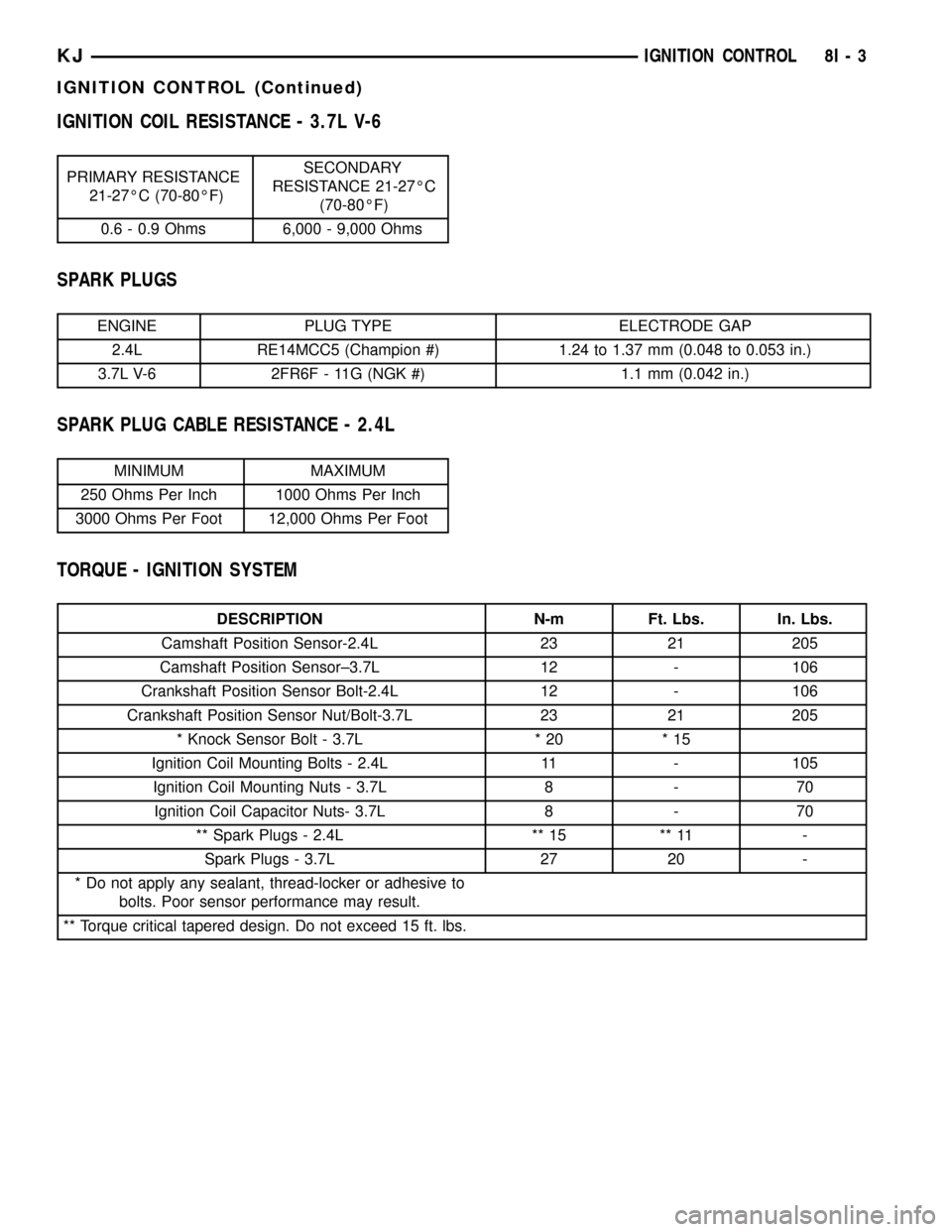
IGNITION COIL RESISTANCE - 3.7L V-6
PRIMARY RESISTANCE
21-27ÉC (70-80ÉF)SECONDARY
RESISTANCE 21-27ÉC
(70-80ÉF)
0.6 - 0.9 Ohms 6,000 - 9,000 Ohms
SPARK PLUGS
ENGINE PLUG TYPE ELECTRODE GAP
2.4L RE14MCC5 (Champion #) 1.24 to 1.37 mm (0.048 to 0.053 in.)
3.7L V-6 2FR6F - 11G (NGK #) 1.1 mm (0.042 in.)
SPARK PLUG CABLE RESISTANCE - 2.4L
MINIMUM MAXIMUM
250 Ohms Per Inch 1000 Ohms Per Inch
3000 Ohms Per Foot 12,000 Ohms Per Foot
TORQUE - IGNITION SYSTEM
DESCRIPTION N-m Ft. Lbs. In. Lbs.
Camshaft Position Sensor-2.4L 23 21 205
Camshaft Position Sensor±3.7L 12 - 106
Crankshaft Position Sensor Bolt-2.4L 12 - 106
Crankshaft Position Sensor Nut/Bolt-3.7L 23 21 205
* Knock Sensor Bolt - 3.7L * 20 * 15
Ignition Coil Mounting Bolts - 2.4L 11 - 105
Ignition Coil Mounting Nuts - 3.7L 8 - 70
Ignition Coil Capacitor Nuts- 3.7L 8 - 70
** Spark Plugs - 2.4L ** 15 ** 11 -
Spark Plugs - 3.7L 27 20 -
* Do not apply any sealant, thread-locker or adhesive to
bolts. Poor sensor performance may result.
** Torque critical tapered design. Do not exceed 15 ft. lbs.
KJIGNITION CONTROL 8I - 3
IGNITION CONTROL (Continued)
Page 397 of 1803

cylinders 1 and 4, and coil number two fires cylinders
2 and 3.
The Auto Shutdown (ASD) relay provides battery
voltage to the ignition coil. The PCM provides a
ground contact (circuit) for energizing the coil(s). The
PCM will de-energize the ASD relay if it does not
receive the crankshaft position sensor and camshaft
position sensor inputs.
Base ignition timing is not adjustable.By con-
trolling the coil ground circuit, the PCM is able to set
the base timing and adjust the ignition timing
advance. This is done to meet changing engine oper-
ating conditions.
The ignition coil is not oil filled. The windings are
embedded in an epoxy compound. This provides heat
and vibration resistance that allows the ignition coil
to be mounted on the engine.
Spark plug cables (secondary wires or cables) are
used with the 2.4L engine.
3.7L
Battery voltage is supplied to the 6 ignition coils
from the ASD relay. The Powertrain Control Module
(PCM) opens and closes each ignition coil ground cir-
cuit at a determined time for ignition coil operation.
Base ignition timing is not adjustable.By con-
trolling the coil ground circuit, the PCM is able to set
the base timing and adjust the ignition timing
advance. This is done to meet changing engine oper-
ating conditions.
The ignition coil is not oil filled. The windings are
embedded in an epoxy compound. This provides heat
and vibration resistance that allows the ignition coil
to be mounted on the engine.
Because of coil design, spark plug cables (second-
ary cables) are not used with the 3.7L engine.
REMOVAL
2.4L
(1) Disconnect electrical connector at rear of coil.
(2) Remove all secondary cables from coil.
(3) Remove 4 coil mounting bolts (Fig. 17).
(4) Remove coil from vehicle.
3.7L
An individual ignition coil is used for each spark
plug (Fig. 19). The coil fits into machined holes in the
cylinder head. A mounting stud/nut secures each coil
to the top of the intake manifold (Fig. 18). The bot-
tom of the coil is equipped with a rubber boot to seal
the spark plug to the coil. Inside each rubber boot is
a spring. The spring is used for a mechanical contact
between the coil and the top of the spark plug. These
rubber boots and springs are a permanent part of the
coil and are not serviced separately. An o-ring (Fig.19) is used to seal the coil at the opening into the cyl-
inder head.
(1) Depending on which coil is being removed, the
throttle body air intake tube or intake box may need
to be removed to gain access to coil.
(2) Disconnect electrical connector from coil by
pushing downward on release lock on top of connec-
tor and pull connector from coil.
(3) Clean area at base of coil with compressed air
before removal.
(4) Remove coil mounting nut from mounting stud
(Fig. 18).
(5) Carefully pull up coil from cylinder head open-
ing with a slight twisting action.
(6) Remove coil from vehicle.
INSTALLATION
2.4L
(1) Position coil to engine.
(2) Install 4 mounting bolts. Refer to torque speci-
fications.
(3) Install secondary cables.
(4) Install electrical connector at rear of coil.
(5) Install air cleaner tube and housing.
3.7L
(1) Using compressed air, blow out any dirt or con-
taminants from around top of spark plug.
(2) Check condition of coil o-ring and replace as
necessary. To aid in coil installation, apply silicone to
coil o-ring.
Fig. 17 IGNITION COIL - 2.4L
1 - IGNITION COIL
2 - MOUNTING BOLTS (4)
8I - 10 IGNITION CONTROLKJ
IGNITION COIL (Continued)
Page 400 of 1803

gle plug displaying an abnormal condition indicates
that a problem exists in the corresponding cylinder.
Replace spark plugs at the intervals recommended in
the Lubrication and Maintenance section.
Spark plugs that have low mileage may be cleaned
and reused if not otherwise defective, carbon or oil
fouled. Also refer to Spark Plug Conditions.
CAUTION: Never use a motorized wire wheel brush
to clean the spark plugs. Metallic deposits will
remain on the spark plug insulator and will cause
plug misfire.
DIAGNOSIS AND TESTING - SPARK PLUG
CONDITIONS
NORMAL OPERATING
The few deposits present on the spark plug will
probably be light tan or slightly gray in color. This is
evident with most grades of commercial gasoline
(Fig. 21). There will not be evidence of electrode
burning. Gap growth will not average more than
approximately 0.025 mm (.001 in) per 3200 km (2000
miles) of operation. Spark plugs that have normal
wear can usually be cleaned, have the electrodes
filed, have the gap set and then be installed.
Some fuel refiners in several areas of the United
States have introduced a manganese additive (MMT)
for unleaded fuel. During combustion, fuel with MMT
causes the entire tip of the spark plug to be coated
with a rust colored deposit. This rust color can be
misdiagnosed as being caused by coolant in the com-bustion chamber. Spark plug performance may be
affected by MMT deposits.
COLD FOULING/CARBON FOULING
Cold fouling is sometimes referred to as carbon
fouling. The deposits that cause cold fouling are basi-
cally carbon (Fig. 21). A dry, black deposit on one or
two plugs in a set may be caused by sticking valves
or defective spark plug cables. Cold (carbon) fouling
of the entire set of spark plugs may be caused by a
clogged air cleaner element or repeated short operat-
ing times (short trips).
WET FOULING OR GAS FOULING
A spark plug coated with excessive wet fuel or oil
is wet fouled. In older engines, worn piston rings,
leaking valve guide seals or excessive cylinder wear
can cause wet fouling. In new or recently overhauled
engines, wet fouling may occur before break-in (nor-
mal oil control) is achieved. This condition can usu-
ally be resolved by cleaning and reinstalling the
fouled plugs.
OIL OR ASH ENCRUSTED
If one or more spark plugs are oil or oil ash
encrusted (Fig. 22), evaluate engine condition for the
cause of oil entry into that particular combustion
chamber.
ELECTRODE GAP BRIDGING
Electrode gap bridging may be traced to loose
deposits in the combustion chamber. These deposits
accumulate on the spark plugs during continuous
stop-and-go driving. When the engine is suddenly
Fig. 21 Normal Operation and Cold (Carbon) Fouling
1 - NORMAL
2 - DRY BLACK DEPOSITS
3 - COLD (CARBON) FOULING
Fig. 22 Oil or Ash Encrusted
KJIGNITION CONTROL 8I - 13
SPARK PLUG (Continued)
Page 402 of 1803

REMOVAL
2.4L
If spark plug for #2 or #3 cylinder is being
removed, throttle body must be removed. Refer to
Throttle Body Removal.
(1) Remove air cleaner tube and housing.
(2) Twist secondary cable at cylinder head to break
loose at spark plug. Remove cable from plug.
(3) Prior to removing spark plug, spray com-
pressed air into cylinder head opening. This will help
prevent foreign material from entering combustion
chamber.
(4) Remove spark plug from cylinder head using a
quality socket with a rubber or foam insert.
(5) Inspect spark plug condition. Refer to Spark
Plug Conditions.
3.7L
Each individual spark plug is located under each
ignition coil. Each individual ignition coil must be
removed to gain access to each spark plug. Refer to
Ignition Coil Removal/Installation.
(1) Prior to removing ignition coil, spray com-
pressed air around coil base at cylinder head.
(2) Prior to removing spark plug, spray com-
pressed air into cylinder head opening. This will help
prevent foreign material from entering combustion
chamber.
(3) Remove spark plug from cylinder head using a
quality socket with a rubber or foam insert. Also
check condition of ignition coil o-ring and replace as
necessary.
(4) Inspect spark plug condition. Refer to Spark
Plug Conditions.
CLEANING SPARK PLUGS
The plugs may be cleaned using commercially
available spark plug cleaning equipment. After clean-
ing, file the center electrode flat with a small point
file or jewelers file before adjusting gap.
CAUTION: Never use a motorized wire wheel brush
to clean the spark plugs. Metallic deposits will
remain on the spark plug insulator and will cause
plug misfire.
INSTALLATION
2.4L
CAUTION: Spark plug tightening on the 2.4L is
torque critical. The plugs are equipped with tapered
seats. Do not exceed 15 ft. lbs. torque.
Special care should be taken when installing spark
plugs into the cylinder head spark plug wells. Be
sure the plugs do not drop into the plug wells as elec-
trodes can be damaged.
Always tighten spark plugs to the specified torque.
Over tightening can cause distortion resulting in a
change in the spark plug gap or a cracked porcelain
insulator.
(1) Start the spark plug into the cylinder head by
hand to avoid cross threading.
(2) Tighten spark plugs. Refer to torque specifica-
tions.
(3) Install throttle body. Refer to Throttle Body
Installation.
(4) Install air cleaner tube and housing.
3.7L
Special care should be taken when installing spark
plugs into the cylinder head spark plug wells. Be
Fig. 26 Preignition Damage
1 - GROUND ELECTRODE STARTING TO DISSOLVE
2 - CENTER ELECTRODE DISSOLVED
Fig. 27 Spark Plug Overheating
1 - BLISTERED WHITE OR GRAY COLORED INSULATOR
KJIGNITION CONTROL 8I - 15
SPARK PLUG (Continued)
Page 410 of 1803

fused panel lamps dimmer switch signal circuit. The
cluster illumination lamps are grounded at all times.
In addition, the control ring on the left (lighting)
control stalk of the multi-function switch has a
Parade Mode position to provide a parade mode. The
BCM monitors the request for this mode from the
multi-function switch, then sends an electronic dim-
ming level message to the EMIC over the PCI data
bus to illuminate all VFDs in the vehicle at full
intensity for easier visibility when driving in daylight
with the exterior lighting turned On.
The hard wired cluster illumination lamp circuits
may be diagnosed using conventional diagnostic
methods. However, proper testing of the PWM output
of the EMIC and the electronic dimming level mes-
sages sent by the BCM over the PCI data bus
requires the use of a DRBIIItscan tool. Refer to the
appropriate diagnostic information.
CHIME WARNING SERVICE The EMIC is pro-
grammed to provide chime service when certain indi-
cators are illuminated. When the programmed
conditions are met, the EMIC generates an electronic
chime tone through its integral chime tone generator.
In addition, the EMIC is programmed to provide
chime service for other electronic modules in the
vehicle when it receives the proper electronic chime
request messages over the PCI data bus. Upon
receiving the proper chime request message, the
EMIC activates the integral chime tone generator to
provide the audible chime tone to the vehicle opera-
tor. (Refer to 8 - ELECTRICAL/CHIME/BUZZER -
OPERATION). Proper testing of the EMIC and the
PCI data bus chime request message functions
requires the use of a DRBIIItscan tool. Refer to the
appropriate diagnostic information.
DIAGNOSIS AND TESTING - INSTRUMENT
CLUSTER
If all of the instrument cluster gauges and/or indi-
cators are inoperative, refer to PRELIMINARY
DIAGNOSIS . If an individual gauge or Programma-
ble Communications Interface (PCI) data bus mes-
sage-controlled indicator is inoperative, refer to
ACTUATOR TEST . If an individual hard wired indi-
cator is inoperative, refer to the diagnosis and testing
information for that specific indicator. If the instru-
ment cluster chime service is inoperative, refer to
CHIME SERVICE DIAGNOSIS . If the instrument
cluster illumination lighting is inoperative, refer to
CLUSTER ILLUMINATION DIAGNOSIS . Refer to
the appropriate wiring information. The wiring infor-
mation includes wiring diagrams, proper wire and
connector repair procedures, details of wire harness
routing and retention, connector pin-out information
and location views for the various wire harness con-
nectors, splices and grounds.NOTE: Certain indicators in this instrument cluster
are automatically configured. This feature allows
those indicators to be activated for compatibility
with certain optional equipment. If the problem
being diagnosed involves illumination of the ABS
indicator, the airbag indicator, or the SKIS indicator
when the vehicle does not have this equipment, a
DRBIIITscan tool must be used to disable the erro-
neous indicator(s). Refer to the appropriate diag-
nostic information.
PRELIMINARY DIAGNOSIS
WARNING: ON VEHICLES EQUIPPED WITH AIR-
BAGS, DISABLE THE SUPPLEMENTAL RESTRAINT
SYSTEM BEFORE ATTEMPTING ANY STEERING
WHEEL, STEERING COLUMN, DRIVER AIRBAG,
PASSENGER AIRBAG, SEAT BELT TENSIONER,
FRONT IMPACT SENSORS, SIDE CURTAIN AIRBAG,
OR INSTRUMENT PANEL COMPONENT DIAGNOSIS
OR SERVICE. DISCONNECT AND ISOLATE THE
BATTERY NEGATIVE (GROUND) CABLE, THEN
WAIT TWO MINUTES FOR THE SYSTEM CAPACI-
TOR TO DISCHARGE BEFORE PERFORMING FUR-
THER DIAGNOSIS OR SERVICE. THIS IS THE ONLY
SURE WAY TO DISABLE THE SUPPLEMENTAL
RESTRAINT SYSTEM. FAILURE TO TAKE THE
PROPER PRECAUTIONS COULD RESULT IN ACCI-
DENTAL AIRBAG DEPLOYMENT AND POSSIBLE
PERSONAL INJURY.
(1) Check the fused B(+) fuse (Fuse 34 - 15
ampere) in the Junction Block (JB). If OK, go to Step
2. If not OK, repair the shorted circuit or component
as required and replace the faulty fuse.
(2) Check for battery voltage at the fused B(+) fuse
(Fuse 34 - 15 ampere) in the JB. If OK, go to Step 3.
If not OK, repair the open fused B(+) circuit between
the JB and the Power Distribution Center (PDC) as
required.
(3) Disconnect and isolate the battery negative
cable. Remove the instrument cluster. Reconnect the
battery negative cable. Check for battery voltage at
the fused B(+) circuit cavity of the instrument panel
wire harness connector for the instrument cluster. If
OK, go to Step 4. If not OK, repair the open fused
B(+) circuit between the instrument cluster and the
JB as required.
(4) Check the fused ignition switch output (run-
start) fuse (Fuse 13 - 10 ampere) in the JB. If OK, go
to Step 5. If not OK, repair the shorted circuit or
component as required and replace the faulty fuse.
(5) Turn the ignition switch to the On position.
Check for battery voltage at the fused ignition switch
output (run-start) fuse (Fuse 13 - 10 ampere) in the
JB. If OK, go to Step 6. If not OK, repair the open
KJINSTRUMENT CLUSTER 8J - 7
INSTRUMENT CLUSTER (Continued)
Page 411 of 1803

fused ignition switch output (run-start) circuit
between the JB and the ignition switch as required.
(6) With the ignition switch still in the On posi-
tion, check for battery voltage at the fused ignition
switch output (run-start) circuit cavity of the instru-
ment panel wire harness connector for the instru-
ment cluster. If OK, go to Step 7. If not OK, repair
the open fused ignition switch output circuit (run-
start) between the instrument cluster and the JB as
required.
(7) Turn the ignition switch to the Off position.
Disconnect and isolate the battery negative cable.
Check for continuity between the ground circuit cav-
ity of the instrument panel wire harness connector
for the instrument cluster and a good ground. There
should be continuity. If OK, refer to ACTUATOR
TEST . If not OK, repair the open ground circuit
between the instrument cluster and ground (G202) as
required.
ACTUATOR TEST
WARNING: ON VEHICLES EQUIPPED WITH AIR-
BAGS, DISABLE THE SUPPLEMENTAL RESTRAINT
SYSTEM BEFORE ATTEMPTING ANY STEERING
WHEEL, STEERING COLUMN, DRIVER AIRBAG,
PASSENGER AIRBAG, SEAT BELT TENSIONER,
FRONT IMPACT SENSORS, SIDE CURTAIN AIRBAG,
OR INSTRUMENT PANEL COMPONENT DIAGNOSIS
OR SERVICE. DISCONNECT AND ISOLATE THE
BATTERY NEGATIVE (GROUND) CABLE, THEN
WAIT TWO MINUTES FOR THE SYSTEM CAPACI-
TOR TO DISCHARGE BEFORE PERFORMING FUR-
THER DIAGNOSIS OR SERVICE. THIS IS THE ONLY
SURE WAY TO DISABLE THE SUPPLEMENTAL
RESTRAINT SYSTEM. FAILURE TO TAKE THE
PROPER PRECAUTIONS COULD RESULT IN ACCI-
DENTAL AIRBAG DEPLOYMENT AND POSSIBLE
PERSONAL INJURY.
The instrument cluster actuator test will put the
instrument cluster into its self-diagnostic mode. In
this mode the instrument cluster can perform a self-
diagnostic test that will confirm that the instrument
cluster circuitry, the gauges, the PCI data bus mes-
sage controlled indicator lamps, and the chime tone
generator are capable of operating as designed. Dur-
ing the actuator test the instrument cluster circuitry
will sound the chime tone generator, position each of
the gauge needles at various specified calibration
points, illuminate each of the segments in the Vacu-um-Fluorescent Display (VFD), and turn all of the
PCI data bus message-controlled indicators on and
off again.
Successful completion of the actuator test will con-
firm that the instrument cluster is operational. How-
ever, there may still be a problem with the PCI data
bus, the Powertrain Control Module (PCM), the Air-
bag Control Module (ACM), the Sentry Key Immobi-
lizer Module (SKIM), or the inputs to one of these
electronic control modules. Use a DRBIIItscan tool
to diagnose these components. Refer to the appropri-
ate diagnostic information.
(1) Begin the test with the ignition switch in the
Off position.
(2) Depress the odometer/trip odometer switch but-
ton.
(3) While still holding the odometer/trip odometer
switch button depressed, turn the ignition switch to
the On position, but do not start the engine.
(4) Release the odometer/trip odometer switch but-
ton.
(5) The instrument cluster will automatically
begin the actuator test sequence, as follows:
(a) The cluster will turn on, then off again each
of the PCI data bus message controlled indicators
to confirm the functionality of the indicator and
the cluster control circuitry:
(b) The cluster will sweep the needles for each of
the gauges to several calibration points in sequence
to confirm the functionality of the gauge and the
cluster control circuitry:
(c) The cluster will sequentially step the odome-
ter/trip odometer VFD display from all ones
( 111111 )through all nines (999999) to confirm the
functionality of all VFD segments and their control
circuitry, then display the software version number.
(d) The cluster will generate five (5) chime tones
to confirm the functionality of the chime tone gen-
erator and the chime control circuitry.
(6) The actuator test is now completed. The instru-
ment cluster will automatically exit the self-diagnos-
tic mode and return to normal operation at the
completion of the test, if the ignition switch is turned
to the Off position during the test, or if an engine
rpm message indicating that the engine is running is
received from the PCM over the PCI data bus during
the test.
(7) Go back to Step 1 to repeat the test, if
required.
8J - 8 INSTRUMENT CLUSTERKJ
INSTRUMENT CLUSTER (Continued)
Page 412 of 1803

CHIME SERVICE DIAGNOSIS
The most reliable, efficient, and accurate means to
diagnose the Chime Service function of the instru-
ment cluster requires the use of a DRBIIItscan tool.
Refer to the appropriate diagnostic information.
CLUSTER ILLUMINATION DIAGNOSIS
If the problem being diagnosed is a single inopera-
tive illumination lamp, be certain that the bulb and
bulb holder unit are properly installed in the instru-
ment cluster electronic circuit board. If no installa-
tion problems are found replace the faulty bulb and
bulb holder unit. If all of the cluster illumination
lamps are inoperative, the most reliable, efficient,
and accurate means to diagnose the cluster illumina-
tion function of the instrument cluster requires the
use of a DRBIIItscan tool. Refer to the appropriate
diagnostic information.
REMOVAL
WARNING: ON VEHICLES EQUIPPED WITH AIR-
BAGS, DISABLE THE SUPPLEMENTAL RESTRAINT
SYSTEM BEFORE ATTEMPTING ANY STEERING
WHEEL, STEERING COLUMN, DRIVER AIRBAG,
PASSENGER AIRBAG, SEAT BELT TENSIONER,
FRONT IMPACT SENSORS, SIDE CURTAIN AIRBAG,
OR INSTRUMENT PANEL COMPONENT DIAGNOSIS
OR SERVICE. DISCONNECT AND ISOLATE THE
BATTERY NEGATIVE (GROUND) CABLE, THEN
WAIT TWO MINUTES FOR THE SYSTEM CAPACI-
TOR TO DISCHARGE BEFORE PERFORMING FUR-
THER DIAGNOSIS OR SERVICE. THIS IS THE ONLY
SURE WAY TO DISABLE THE SUPPLEMENTAL
RESTRAINT SYSTEM. FAILURE TO TAKE THE
PROPER PRECAUTIONS COULD RESULT IN ACCI-
DENTAL AIRBAG DEPLOYMENT AND POSSIBLE
PERSONAL INJURY.
(1) Disconnect and isolate the battery negative
cable.
(2) Remove the cluster bezel from the instrument
panel. (Refer to 23 - BODY/INSTRUMENT PANEL/
CLUSTER BEZEL - REMOVAL).
(3) Remove the four screws that secure the instru-
ment cluster to the instrument panel (Fig. 3).
(4) Pull the instrument cluster rearward far
enough to access and disconnect the instrument
panel wire harness connector for the cluster from the
cluster connector receptacle.
(5) Remove the instrument cluster from the instru-
ment panel.DISASSEMBLY
Some of the components for the instrument cluster
used in this vehicle are serviced individually. The
serviced components include the incandescent instru-
ment cluster illumination lamp bulbs (including the
integral bulb holders), and the cluster lens, hood and
mask unit. Following are the procedures for disas-
sembling these components from the instrument clus-
ter unit.
WARNING: ON VEHICLES EQUIPPED WITH AIR-
BAGS, DISABLE THE SUPPLEMENTAL RESTRAINT
SYSTEM BEFORE ATTEMPTING ANY STEERING
WHEEL, STEERING COLUMN, DRIVER AIRBAG,
PASSENGER AIRBAG, SEAT BELT TENSIONER,
FRONT IMPACT SENSORS, SIDE CURTAIN AIRBAG,
OR INSTRUMENT PANEL COMPONENT DIAGNOSIS
OR SERVICE. DISCONNECT AND ISOLATE THE
BATTERY NEGATIVE (GROUND) CABLE, THEN
WAIT TWO MINUTES FOR THE SYSTEM CAPACI-
TOR TO DISCHARGE BEFORE PERFORMING FUR-
THER DIAGNOSIS OR SERVICE. THIS IS THE ONLY
SURE WAY TO DISABLE THE SUPPLEMENTAL
RESTRAINT SYSTEM. FAILURE TO TAKE THE
PROPER PRECAUTIONS COULD RESULT IN ACCI-
DENTAL AIRBAG DEPLOYMENT AND POSSIBLE
PERSONAL INJURY.
Fig. 3 Instrument Cluster Remove/Install
1 - INSTRUMENT CLUSTER
2 - SCREW (4)
KJINSTRUMENT CLUSTER 8J - 9
INSTRUMENT CLUSTER (Continued)
Page 413 of 1803

CLUSTER BULB
This procedure applies to each of the incandescent
cluster illumination lamp and bulb holder units.
(1) Disconnect and isolate the battery negative
cable.
(2) Remove the instrument cluster from the instru-
ment panel. (Refer to 8 - ELECTRICAL/INSTRU-
MENT CLUSTER - REMOVAL).
(3) Turn the bulb holder counterclockwise about
sixty degrees on the cluster electronic circuit board
(Fig. 4).
(4) Pull the bulb and bulb holder unit straight
back to remove it from the bulb mounting hole in the
cluster electronic circuit board.
CLUSTER LENS, HOOD, AND MASK
(1) Disconnect and isolate the battery negative
cable.
(2) Remove the instrument cluster from the instru-
ment panel. (Refer to 8 - ELECTRICAL/INSTRU-
MENT CLUSTER - REMOVAL).
(3) From the back of the instrument cluster,
remove the six screws that secure the rear cover and
the lens, hood, and mask unit to the cluster housing
(Fig. 5).
(4) Remove the lens, hood, and mask unit from the
face of the instrument cluster.
ASSEMBLY
WARNING: ON VEHICLES EQUIPPED WITH AIR-
BAGS, DISABLE THE SUPPLEMENTAL RESTRAINT
SYSTEM BEFORE ATTEMPTING ANY STEERING
WHEEL, STEERING COLUMN, DRIVER AIRBAG,
PASSENGER AIRBAG, SEAT BELT TENSIONER,
FRONT IMPACT SENSORS, SIDE CURTAIN AIRBAG,
OR INSTRUMENT PANEL COMPONENT DIAGNOSIS
OR SERVICE. DISCONNECT AND ISOLATE THE
BATTERY NEGATIVE (GROUND) CABLE, THEN
WAIT TWO MINUTES FOR THE SYSTEM CAPACI-
TOR TO DISCHARGE BEFORE PERFORMING FUR-
THER DIAGNOSIS OR SERVICE. THIS IS THE ONLY
SURE WAY TO DISABLE THE SUPPLEMENTAL
RESTRAINT SYSTEM. FAILURE TO TAKE THE
PROPER PRECAUTIONS COULD RESULT IN ACCI-
DENTAL AIRBAG DEPLOYMENT AND POSSIBLE
PERSONAL INJURY.
CLUSTER BULB
This procedure applies to each of the incandescent
cluster illumination lamp and bulb holder units.
CAUTION: Always use the correct bulb size and
type for replacement. An incorrect bulb size or type
may overheat and cause damage to the instrument
cluster, the electronic circuit board and/or the
gauges.
(1) Insert the bulb and bulb holder unit straight
into the correct bulb mounting hole in the cluster
electronic circuit board (Fig. 4).
Fig. 4 Cluster Bulb Remove/Install
1 - INSTRUMENT CLUSTER
2 - BULB & HOLDER (9)
Fig. 5 Instrument Cluster Components
1 - REAR COVER
2 - CLUSTER HOUSING
3 - LENS, HOOD & MASK
4 - SCREW (6)
8J - 10 INSTRUMENT CLUSTERKJ
INSTRUMENT CLUSTER (Continued)