Heat JEEP LIBERTY 2002 KJ / 1.G Workshop Manual
[x] Cancel search | Manufacturer: JEEP, Model Year: 2002, Model line: LIBERTY, Model: JEEP LIBERTY 2002 KJ / 1.GPages: 1803, PDF Size: 62.3 MB
Page 617 of 1803

POWER SEATS
TABLE OF CONTENTS
page page
POWER SEATS
DESCRIPTION.........................14
OPERATION...........................15
DIAGNOSIS AND TESTING - POWER SEATS . . 15
SEAT TRACK
DESCRIPTION.........................15
OPERATION...........................15
DIAGNOSIS AND TESTING - SEAT TRACK....16
REMOVAL.............................16
INSTALLATION.........................16
LEFT POWER SEAT SWITCH
DESCRIPTION.........................16OPERATION...........................17
DIAGNOSIS AND TESTING - LEFT POWER
SEAT SWITCH........................17
REMOVAL.............................18
INSTALLATION.........................18
RIGHT POWER SEAT SWITCH
DESCRIPTION.........................19
OPERATION...........................19
DIAGNOSIS AND TESTING - RIGHT POWER
SEAT SWITCH........................19
REMOVAL.............................20
INSTALLATION.........................20
POWER SEATS
DESCRIPTION
Individually controlled, electrically powered front
seats are available as factory-installed equipment on
this model. Vehicles with this option can be visually
identified by the two separate power seat switches,
mounted on each of the front seat cushion side
shields (Fig. 1). The power seat system option allows
the front seating positions to be electrically adjustedfor optimum vehicle control and comfort. The power
seat cushion can be adjusted forward, rearward, front
up, front down, rear up, or rear down. The power
seat system for this vehicle includes the following
major components, which are described in further
detail later in this section:
²Power Seat Switches- Two power seat
switches are used per vehicle, one for the driver and
one for the front seat passenger. Refer to the left and
right power seat switch information later in this sec-
tion.
²Power Seat Tracks- Two power seat tracks
are used per vehicle, one for the driver and one for
the front seat passenger seats. Refer to the power
seat track information later in this section.
²Circuit Breaker- An automatic resetting cir-
cuit breaker (# 1) is located in the Junction Block
and is used to protect the power seat system from
current overload.
Hard wired circuitry connects the power seat sys-
tem components to each other through the electrical
system of the vehicle. These hard wired circuits are
integral to several wire harnesses, which are routed
throughout the vehicle and retained by many differ-
ent methods. These circuits may be connected to each
other, to the vehicle electrical system and to the
power seat system components through the use of a
combination of soldered splices, splice block connec-
tors and many different types of wire harness termi-
nal connectors and insulators. Refer to theWiring
section of this manual for more information. The wir-
ing information includes wiring diagrams, proper
wire and connector repair procedures, further details
on wire harness routing and retention, as well as
pin-out and location views for the various wire har-
ness connectors, splices and grounds.
Fig. 1 KJ Heated/Power Seat
8N - 14 POWER SEATSKJ
Page 619 of 1803
DIAGNOSIS AND TESTING - SEAT TRACK
(1) Remove the power seat switch from the seat
(Refer to 8 - ELECTRICAL/POWER SEATS/DRIVER
SEAT SWITCH - REMOVAL).
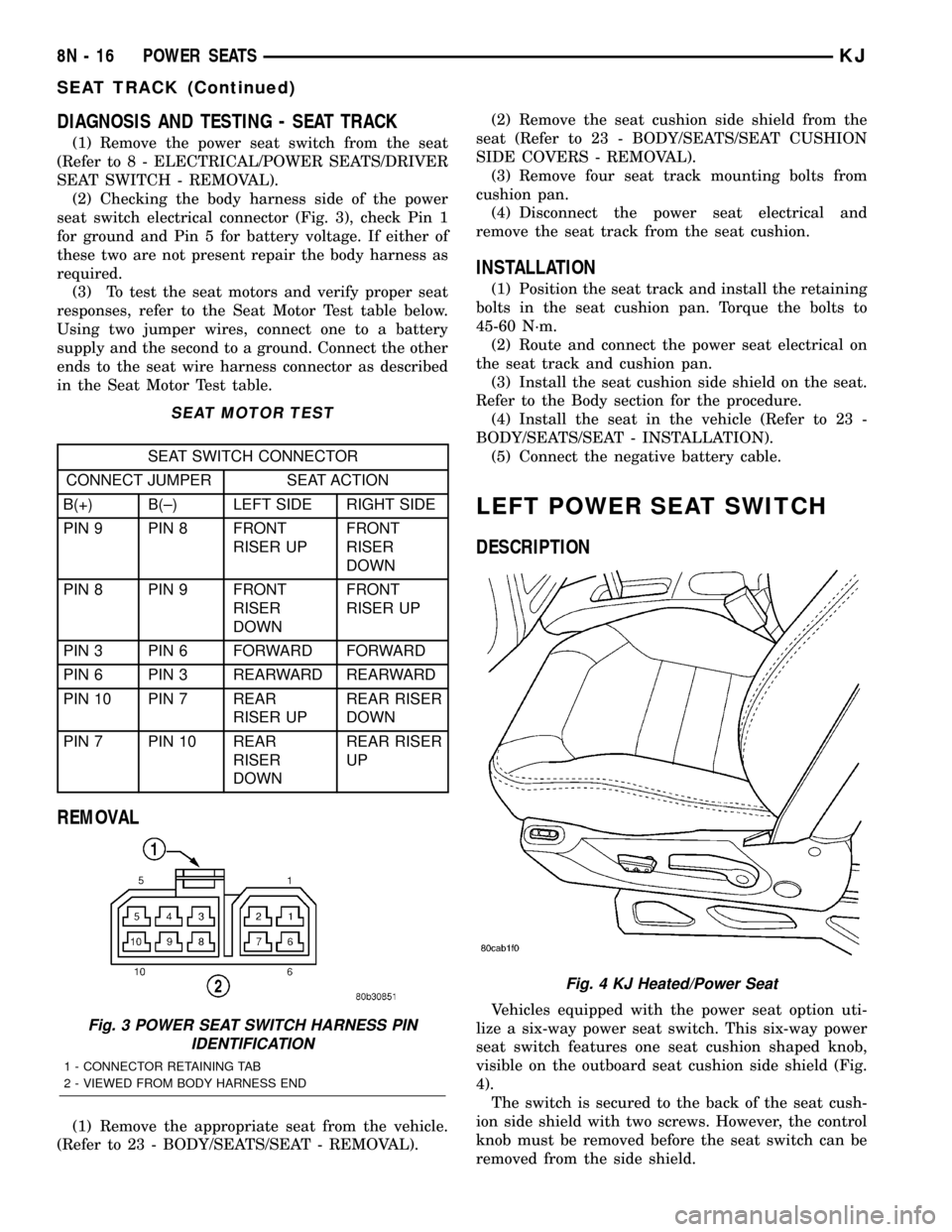
(2) Checking the body harness side of the power
seat switch electrical connector (Fig. 3), check Pin 1
for ground and Pin 5 for battery voltage. If either of
these two are not present repair the body harness as
required.
(3) To test the seat motors and verify proper seat
responses, refer to the Seat Motor Test table below.
Using two jumper wires, connect one to a battery
supply and the second to a ground. Connect the other
ends to the seat wire harness connector as described
in the Seat Motor Test table.
SEAT MOTOR TEST
SEAT SWITCH CONNECTOR
CONNECT JUMPER SEAT ACTION
B(+) B(±) LEFT SIDE RIGHT SIDE
PIN 9 PIN 8 FRONT
RISER UPFRONT
RISER
DOWN
PIN 8 PIN 9 FRONT
RISER
DOWNFRONT
RISER UP
PIN 3 PIN 6 FORWARD FORWARD
PIN 6 PIN 3 REARWARD REARWARD
PIN 10 PIN 7 REAR
RISER UPREAR RISER
DOWN
PIN 7 PIN 10 REAR
RISER
DOWNREAR RISER
UP
REMOVAL
(1) Remove the appropriate seat from the vehicle.
(Refer to 23 - BODY/SEATS/SEAT - REMOVAL).(2) Remove the seat cushion side shield from the
seat (Refer to 23 - BODY/SEATS/SEAT CUSHION
SIDE COVERS - REMOVAL).
(3) Remove four seat track mounting bolts from
cushion pan.
(4) Disconnect the power seat electrical and
remove the seat track from the seat cushion.
INSTALLATION
(1) Position the seat track and install the retaining
bolts in the seat cushion pan. Torque the bolts to
45-60 N´m.
(2) Route and connect the power seat electrical on
the seat track and cushion pan.
(3) Install the seat cushion side shield on the seat.
Refer to the Body section for the procedure.
(4) Install the seat in the vehicle (Refer to 23 -
BODY/SEATS/SEAT - INSTALLATION).
(5) Connect the negative battery cable.
LEFT POWER SEAT SWITCH
DESCRIPTION
Vehicles equipped with the power seat option uti-
lize a six-way power seat switch. This six-way power
seat switch features one seat cushion shaped knob,
visible on the outboard seat cushion side shield (Fig.
4).
The switch is secured to the back of the seat cush-
ion side shield with two screws. However, the control
knob must be removed before the seat switch can be
removed from the side shield.
Fig. 3 POWER SEAT SWITCH HARNESS PIN
IDENTIFICATION
1 - CONNECTOR RETAINING TAB
2 - VIEWED FROM BODY HARNESS END
Fig. 4 KJ Heated/Power Seat
8N - 16 POWER SEATSKJ
SEAT TRACK (Continued)
Page 633 of 1803

WARNING: THE FASTENERS, SCREWS, AND
BOLTS ORIGINALLY USED FOR THE RESTRAINT
SYSTEM COMPONENTS HAVE SPECIAL COATINGS
AND ARE SPECIFICALLY DESIGNED FOR THE
RESTRAINT SYSTEM. THEY MUST NEVER BE
REPLACED WITH ANY SUBSTITUTES. ANY TIME A
NEW FASTENER IS NEEDED, REPLACE IT WITH
THE CORRECT FASTENERS PROVIDED IN THE
SERVICE PACKAGE OR SPECIFIED IN THE
DAIMLERCHRYSLER MOPAR PARTS CATALOG.
WARNING: WHEN A STEERING COLUMN HAS AN
AIRBAG UNIT ATTACHED, NEVER PLACE THE COL-
UMN ON THE FLOOR OR ANY OTHER SURFACE
WITH THE STEERING WHEEL OR AIRBAG UNIT
FACE DOWN.
DIAGNOSIS AND TESTING - SUPPLEMENTAL
RESTRAINT SYSTEM
Proper diagnosis and testing of the supplemental
restraint system components, the PCI data bus, the
data bus message inputs to and outputs from the
ElectroMechanical Instrument Cluster (EMIC), the
Airbag Control Module (ACM), or the Side Impact
Airbag Control Module (SIACM) as well as the
retrieval or erasure of a Diagnostic Trouble Code
(DTC) from the ACM or SIACM requires the use of a
DRBIIItscan tool. Refer to the appropriate diagnos-
tic information.
WARNING: ON VEHICLES EQUIPPED WITH AIR-
BAGS, DISABLE THE SUPPLEMENTAL RESTRAINT
SYSTEM BEFORE ATTEMPTING ANY STEERING
WHEEL, STEERING COLUMN, DRIVER AIRBAG,
PASSENGER AIRBAG, SEAT BELT TENSIONER,
FRONT IMPACT SENSORS, SIDE CURTAIN AIRBAG,
OR INSTRUMENT PANEL COMPONENT DIAGNOSIS
OR SERVICE. DISCONNECT AND ISOLATE THE
BATTERY NEGATIVE (GROUND) CABLE, THEN
WAIT TWO MINUTES FOR THE SYSTEM CAPACI-
TOR TO DISCHARGE BEFORE PERFORMING FUR-
THER DIAGNOSIS OR SERVICE. THIS IS THE ONLY
SURE WAY TO DISABLE THE SUPPLEMENTAL
RESTRAINT SYSTEM. FAILURE TO TAKE THE
PROPER PRECAUTIONS COULD RESULT IN ACCI-
DENTAL AIRBAG DEPLOYMENT AND POSSIBLE
PERSONAL INJURY.
STANDARD PROCEDURE
STANDARD PROCEDURE - HANDLING
NON-DEPLOYED SUPPLEMENTAL RESTRAINTS
At no time should any source of electricity be per-
mitted near the inflator on the back of a non-de-
ployed airbag or seat belt tensioner. When carrying a
non-deployed airbag, the trim cover or airbag cushion
side of the unit should be pointed away from the
body to minimize injury in the event of an accidental
deployment. If the airbag unit is placed on a bench or
any other surface, the trim cover or airbag cushion
side of the unit should be face up to minimize move-
ment in the event of an accidental deployment. When
handling a non-deployed seat belt tensioner, take
proper care to keep fingers out from under the
retractor cover and away from the seat belt webbing
where it exits from the retractor cover. In addition,
the supplemental restraint system should be dis-
armed whenever any steering wheel, steering col-
umn, seat belt tensioner, driver airbag, passenger
airbag, front impact sensor, side curtain airbag, or
instrument panel components require diagnosis or
service. Failure to observe this warning could result
in accidental airbag deployment and possible per-
sonal injury.
All damaged, faulty or non-deployed airbags and
seat belt tensioners which are replaced on vehicles
are to be handled and disposed of properly. If an air-
bag or seat belt tensioner unit is faulty or damaged
and non-deployed, refer to the Hazardous Substance
Control System for proper disposal. Dispose of all
non-deployed and deployed airbags and seat belt ten-
sioners in a manner consistent with state, provincial,
local and federal regulations.
SUPPLEMENTAL RESTRAINT STORAGE
Airbags and seat belt tensioners must be stored in
their original, special container until they are used
for service. Also, they must be stored in a clean, dry
environment; away from sources of extreme heat,
sparks, and high electrical energy. Always place or
store any airbag on a surface with its trim cover or
airbag cushion side facing up, to minimize movement
in case of an accidental deployment.
STANDARD PROCEDURE - SERVICE AFTER A
SUPPLEMENTAL RESTRAINT DEPLOYMENT
Any vehicle which is to be returned to use follow-
ing a supplemental restraint deployment, must have
the deployed restraints replaced. In addition, if the
driver airbag has been deployed, the clockspring
must be replaced. If the passenger airbag is
deployed, the passenger airbag door and both passen-
ger airbag mounting brackets must be replaced. If a
side curtain airbag has been deployed, the complete
8O - 6 RESTRAINTSKJ
RESTRAINTS (Continued)
Page 635 of 1803

Ifnone of the Driver or Passenger Squib 1 or 2
open are active codes, the status of the airbag squibs
is unknown. In this case the airbag should be han-
dled and disposed of as if the squibs were both live.
CLEANUP PROCEDURE
Following a supplemental restraint deployment,
the vehicle interior will contain a powdery residue.
This residue consists primarily of harmless particu-
late by-products of the small pyrotechnic charge that
initiates the propellant used to deploy a supplemen-
tal restraint. However, this residue may also contain
traces of sodium hydroxide powder, a chemical
by-product of the propellant material that is used to
generate the inert gas that inflates the airbag. Since
sodium hydroxide powder can irritate the skin, eyes,
nose, or throat, be sure to wear safety glasses, rubber
gloves, and a long-sleeved shirt during cleanup (Fig.
3).
WARNING: IF YOU EXPERIENCE SKIN IRRITATION
DURING CLEANUP, RUN COOL WATER OVER THE
AFFECTED AREA. ALSO, IF YOU EXPERIENCE IRRITA-
TION OF THE NOSE OR THROAT, EXIT THE VEHICLE
FOR FRESH AIR UNTIL THE IRRITATION CEASES. IF
IRRITATION CONTINUES, SEE A PHYSICIAN.
(1) Begin the cleanup by using a vacuum cleaner
to remove any residual powder from the vehicle inte-
rior. Clean from outside the vehicle and work your
way inside, so that you avoid kneeling or sitting on a
non-cleaned area.
(2) Be certain to vacuum the heater and air condi-
tioning outlets as well (Fig. 4). Run the heater and
air conditioner blower on the lowest speed setting
and vacuum any powder expelled from the outlets.
CAUTION: Deployed front airbags having two initiators
(squibs) in the airbag inflator may or may not have livepyrotechnic material within the inflator. Do not dispose
of these airbags unless you are sure of complete
deployment. Refer to AIRBAG SQUIB STATUS . Refer
to the Hazardous Substance Control System for
proper disposal procedures. Dispose of all non-de-
ployed and deployed airbags in a manner consistent
with state, provincial, local, and federal regulations.
(3) Next, remove the deployed supplemental
restraints from the vehicle. Refer to the appropriate
service removal procedures.
(4) You may need to vacuum the interior of the
vehicle a second time to recover all of the powder.
STANDARD PROCEDURE - VERIFICATION TEST
The following procedure should be performed using
a DRBIIItscan tool to verify proper supplemental
restraint system operation following the service or
replacement of any supplemental restraint system
component.
WARNING: ON VEHICLES EQUIPPED WITH AIR-
BAGS, DISABLE THE SUPPLEMENTAL RESTRAINT
SYSTEM BEFORE ATTEMPTING ANY STEERING
WHEEL, STEERING COLUMN, DRIVER AIRBAG,
PASSENGER AIRBAG, SEAT BELT TENSIONER,
FRONT IMPACT SENSORS, SIDE CURTAIN AIRBAG,
OR INSTRUMENT PANEL COMPONENT DIAGNOSIS
OR SERVICE. DISCONNECT AND ISOLATE THE
BATTERY NEGATIVE (GROUND) CABLE, THEN
WAIT TWO MINUTES FOR THE SYSTEM CAPACI-
TOR TO DISCHARGE BEFORE PERFORMING FUR-
THER DIAGNOSIS OR SERVICE. THIS IS THE ONLY
SURE WAY TO DISABLE THE SUPPLEMENTAL
RESTRAINT SYSTEM. FAILURE TO TAKE THE
PROPER PRECAUTIONS COULD RESULT IN ACCI-
DENTAL AIRBAG DEPLOYMENT AND POSSIBLE
PERSONAL INJURY.
Fig. 3 Wear Safety Glasses and Rubber Gloves -
Typical
Fig. 4 Vacuum Heater and A/C Outlets - Typical
8O - 8 RESTRAINTSKJ
RESTRAINTS (Continued)
Page 637 of 1803

The ACM housing also has an integral ground lug
with a tapped hole that protrudes from the lower left
rear corner of the unit. This lug provides a case
ground to the ACM when a ground screw is installed
through the left side of the mounting bracket. Two
molded plastic electrical connector receptacles exit
the right side of the ACM housing. The smaller of the
two receptacles contains twelve terminal pins, while
the larger one contains twenty-three. These terminal
pins connect the ACM to the vehicle electrical system
through two dedicated take outs and connectors of
the instrument panel wire harness.
A molded rubber protective cover is installed
loosely over the ACM to protect the unit from con-
densation or coolant leaking from a damaged or
faulty heater-air conditioner unit housing. An inte-
gral flange on the left side of the cover is secured to
the floor panel transmission tunnel with a short
piece of double-faced tape as an assembly aid during
the manufacturing process, but this tape does not
require replacement following service removal.
The impact sensor and safing sensor internal to
the ACM are calibrated for the specific vehicle, and
are only serviced as a unit with the ACM. The ACM
cannot be repaired or adjusted and, if damaged or
faulty, it must be replaced. The ACM cover is avail-
able for separate service replacement.
OPERATION
The microprocessor in the Airbag Control Module
(ACM) contains the front supplemental restraint sys-
tem logic circuits and controls all of the front supple-
mental restraint system components. The ACM uses
On-Board Diagnostics (OBD) and can communicate
with other electronic modules in the vehicle as well
as with the DRBIIItscan tool using the Programma-
ble Communications Interface (PCI) data bus net-
work. This method of communication is used for
control of the airbag indicator in the ElectroMechani-
cal Instrument Cluster (EMIC) and for supplemental
restraint system diagnosis and testing through the
16-way data link connector located on the driver side
lower edge of the instrument panel. (Refer to 8 -
ELECTRICAL/INSTRUMENT CLUSTER/AIRBAG
INDICATOR - OPERATION).
The ACM microprocessor continuously monitors all
of the front supplemental restraint system electrical
circuits to determine the system readiness. If the
ACM detects a monitored system fault, it sets an
active and stored Diagnostic Trouble Code (DTC) and
sends electronic messages to the EMIC over the PCI
data bus to turn on the airbag indicator. An active
fault only remains for the duration of the fault or in
some cases the duration of the current ignition
switch cycle, while a stored fault causes a DTC to be
stored in memory by the ACM. For some DTCs, if afault does not recur for a number of ignition cycles,
the ACM will automatically erase the stored DTC.
For other internal faults, the stored DTC is latched
forever.
On models equipped with optional side curtain air-
bags, the ACM communicates with both the left and
right Side Impact Airbag Control Modules (SIACM)
over the PCI data bus. The SIACM notifies the ACM
when it has detected a monitored system fault and
stored a DTC in memory for its respective side cur-
tain airbag system, and the ACM sets a DTC and
controls the airbag indicator operation accordingly.
The ACM also monitors a Hall effect-type seat belt
switch located in the buckle of each front seat belt to
determine whether the seatbelts are buckled, and
provides an input to the EMIC over the PCI data bus
to control the seatbelt indicator operation based upon
the status of the driver side front seat belt switch.
The ACM receives battery current through two cir-
cuits; a fused ignition switch output (run) circuit
through a fuse in the Junction Block (JB), and a
fused ignition switch output (run-start) circuit
through a second fuse in the JB. The ACM has a case
ground through a lug on the bottom of the ACM
housing that is secured with a ground screw to the
left side of the ACM mounting bracket. The ACM
also receives a power ground through a ground cir-
cuit and take out of the instrument panel wire har-
ness. This take out has a single eyelet terminal
connector that is secured by a second ground screw
to the left side of the ACM mounting bracket. These
connections allow the ACM to be operational when-
ever the ignition switch is in the Start or On posi-
tions. The ACM also contains an energy-storage
capacitor. When the ignition switch is in the Start or
On positions, this capacitor is continually being
charged with enough electrical energy to deploy the
airbags for up to one second following a battery dis-
connect or failure. The purpose of the capacitor is to
provide backup supplemental restraint system pro-
tection in case there is a loss of battery current sup-
ply to the ACM during an impact.
Two sensors are contained within the ACM, an
electronic impact sensor and a safing sensor. The
ACM also monitors inputs from two remote front
impact sensors located on the back of the right and
left vertical members of the radiator support near
the front of the vehicle. The electronic impact sensors
are accelerometers that sense the rate of vehicle
deceleration, which provides verification of the direc-
tion and severity of an impact. The safing sensor is
an electromechanical sensor within the ACM that
provides an additional logic input to the ACM micro-
processor. The safing sensor is a normally open
switch that is used to verify the need for an airbag
deployment by detecting impact energy of a lesser
8O - 10 RESTRAINTSKJ
AIRBAG CONTROL MODULE (Continued)
Page 640 of 1803

NOTE: The integral flange on the left side of the
ACM cover is secured to the floor panel transmis-
sion tunnel with a short piece of double-faced tape
as an assembly aid during the manufacturing pro-
cess, but this tape does not require replacement
following service removal.
(7) Reinstall the center console onto the top of the
floor panel transmission tunnel. (Refer to 23 - BODY/
INTERIOR/FLOOR CONSOLE - INSTALLATION).
(8) Do not reconnect the battery negative cable at
this time. The airbag system verification test proce-
dure should be performed following service of any
supplemental restraint system component. (Refer to
8 - ELECTRICAL/RESTRAINTS - STANDARD PRO-
CEDURE - VERIFICATION TEST).
CHILD TETHER ANCHOR
DESCRIPTION
All vehicles are equipped with three, fixed-position,
child seat tether anchors (Fig. 9). Two anchors are
integral to the back of the right rear seat back panel,
and one is integral to the left rear seat back panel.
The child seat tether anchors cannot be adjusted or
repaired and, if faulty or damaged, they must be
replaced as a unit with the rear seat back panel.
OPERATION
See the owner's manual in the vehicle glove box for
more information on the proper use of the factory-in-
stalled child seat tether anchors.
CLOCKSPRING
DESCRIPTION
The clockspring assembly is secured with two inte-
gral plastic latches onto the upper steering column
housing near the top of the steering column behind
the steering wheel (Fig. 10). The clockspring consists
of a flat, round molded plastic case with a stubby tail
that hangs below the steering column and contains
two connector receptacles that face toward the
instrument panel (Fig. 11). Within the plastic hous-
ing is a spool-like molded plastic rotor with a large
exposed hub and several plastic rollers. The upper
surface of the rotor hub has a large center hole, a
release button, a clear plastic inspection window, two
short pigtail wires with connectors, and a connector
receptacle that faces toward the steering wheel. Two
versions of the clockspring are used on this model,
one is a seven circuit unit for vehicles not equipped
with optional remote radio switches on the steering
wheel and can be visually identified by the use of yel-
low heat-shrink tubing on the pigtail wires, while the
other is a nine circuit unit for vehicles with remote
radio switches and can be visually identified by the
use of black heat-shrink tubing on the pigtail wires.
A rubber bumper block is located on each side of
the tower formation that contains the connector
receptacle and pigtail wires on the upper surface of
the rotor hub. The lower surface of the rotor hub has
Fig. 9 Child Tether Anchors
1 - REAR SEAT BACK (LEFT)
2 - REAR SEAT BACK (RIGHT)
3 - CHILD TETHER ANCHOR (3)
Fig. 10 Clockspring
1 - PIGTAIL WIRE (2)
2 - UPPER CONNECTOR RECEPTACLE
3 - BUMPER (2)
4 - BRACKET (2)
5 - LABEL
6 - SHIELD
7 - CASE
8 - WINDOW
9 - ROTOR
KJRESTRAINTS 8O - 13
AIRBAG CONTROL MODULE (Continued)
Page 645 of 1803

The resistive membrane-type horn switch is
secured with heat stakes to the inside surface of the
driver airbag trim cover, between the trim cover and
the folded airbag cushion. The horn switch ground
pigtail wire has a female spade terminal connector
that receives a path to ground through a male spade
terminal that is integral to the driver airbag housing
stamping and is located near the upper right corner
on the back of the housing (Fig. 15). The horn switch
feed pigtail wire has a white, molded plastic insula-
tor that is secured by an integral retainer to a
mounting hole located near the lower left corner on
the back of the housing, and is connected to the vehi-
cle electrical system through a take out and connec-
tor of the steering wheel wire harness.
The airbag used in this model is a multistage, Next
Generation-type that complies with revised federal
airbag standards to deploy with less force than those
used in some prior models. A 67 centimeter (26.5
inch) diameter, radial deploying fabric cushion with
tethers is used. The airbag inflator is a dual-initiator,
non-azide, pyrotechnic-type unit with four mounting
studs and is secured to the stamped metal airbag
housing using four hex nuts with washers. Two
keyed and color-coded connector receptacles on the
driver airbag inflator connect the two inflator initia-
tors to the vehicle electrical system through two yel-
low-jacketed, two-wire pigtail harnesses of the
clockspring. The driver airbag and horn switch unit
cannot be repaired, and must be replaced if deployed
or in any way damaged.OPERATION
The multistage driver airbag is deployed by electri-
cal signals generated by the Airbag Control Module
(ACM) through the driver airbag squib 1 and squib 2
circuits to the two initiators in the airbag inflator. By
using two initiators, the airbag can be deployed at
multiple levels of force. The force level is controlled
by the ACM to suit the monitored impact conditions
by providing one of three delay intervals between the
electrical signals provided to the two initiators. The
longer the delay between these signals, the less force-
fully the airbag will deploy. When the ACM sends the
proper electrical signals to each initiator, the electri-
cal energy generates enough heat to initiate a small
pyrotechnic charge which, in turn ignites chemical
pellets within the inflator. Once ignited, these chem-
ical pellets burn rapidly and produce a large quantity
of nitrogen gas. The inflator is sealed to the back of
the airbag housing and a diffuser in the inflator
directs all of the nitrogen gas into the airbag cush-
ion, causing the cushion to inflate. As the cushion
inflates, the driver airbag trim cover will split at pre-
determined breakout lines, then fold back out of the
way along with the horn switch unit. Following an
airbag deployment, the airbag cushion quickly
deflates by venting the nitrogen gas towards the
instrument panel through vent holes within the fab-
ric used to construct the back (steering wheel side)
panel of the airbag cushion.
Some of the chemicals used to create the nitrogen
gas may be considered hazardous while in their solid
state before they are burned, but they are securely
sealed within the airbag inflator. Typically, both ini-
tiators are used and all potentially hazardous chem-
icals are burned during an airbag deployment event.
However, it is possible for only one initiator to be
used during a deployment due to an airbag system
fault; therefore, it is necessary to always confirm
that both initiators have been used in order to avoid
the improper disposal of potentially live pyrotechnic
or hazardous materials. (Refer to 8 - ELECTRICAL/
RESTRAINTS - STANDARD PROCEDURE - SER-
VICE AFTER A SUPPLEMENTAL RESTRAINT
DEPLOYMENT). The nitrogen gas that is produced
when the chemicals are burned is harmless. How-
ever, a small amount of residue from the burned
chemicals may cause some temporary discomfort if it
contacts the skin, eyes, or breathing passages. If skin
or eye irritation is noted, rinse the affected area with
plenty of cool, clean water. If breathing passages are
irritated, move to another area where there is plenty
of clean, fresh air to breath. If the irritation is not
alleviated by these actions, contact a physician.
Fig. 15 Driver Airbag Housing
1 - HOUSING
2 - HORN SWITCH GROUND WIRE
3 - HORN SWITCH FEED WIRE
4 - INFLATOR
5 - TRIM COVER
8O - 18 RESTRAINTSKJ
DRIVER AIRBAG (Continued)
Page 654 of 1803

PASSENGER AIRBAG
DESCRIPTION
The rearward facing surface of the injection
molded, thermoplastic passenger airbag door is the
most visible part of the passenger airbag (Fig. 23).
The passenger airbag door is located above the glove
box opening in front of the front seat passenger seat-
ing position on the instrument panel. The integral
upper mounting flange is secured with five screws
and the lower mounting flange with six screws to the
instrument panel structural support. The passenger
airbag door includes an integral air conditioning
panel outlet housing and an integral side window
demister outlet. An integral stamped metal bracket
that reinforces the upper airbag door mounting
flange is secured to the back of the door unit with
heat stakes. The upper airbag door fasteners and
mounting flange are concealed beneath the instru-
ment panel top cover, while the lower fasteners and
mounting flange are concealed beneath a bezel on the
instrument panel above the glove box opening.
Located behind the passenger airbag door within
the instrument panel is the passenger airbag unit
(Fig. 24). The passenger airbag unit used in this
model is a multistage, Next Generation-type that
complies with revised federal airbag standards to
deploy with less force than those used in some prior
models. The passenger airbag unit consists of a
molded, glass-filled nylon plastic housing, a molded
plastic inner airbag cushion cover, the airbag cush-
ion, and the airbag inflator. The airbag housing con-tains the airbag inflator, while the inner cover
contains the folded airbag cushion. The inner cover
completely encloses the airbag cushion and is perma-
nently retained to the housing. The passenger airbag
unit is secured by two screws on each side to two
stamped metal mounting brackets that are fastened
with screws to the instrument panel structural sup-
port. The airbag cushion is constructed of a coated
nylon fabric. The airbag inflator is a dual-initiator,
hybrid-type unit that is secured to and sealed within
the airbag housing. A short four-wire pigtail harness
with a keyed, yellow connector insulator connects the
two inflator initiators to the vehicle electrical system
through a dedicated take out and connector of the
instrument panel wire harness.
The passenger airbag cannot be repaired, and must
be replaced if deployed, faulty, or in any way dam-
aged. The passenger airbag door and the passenger
airbag mounting brackets are available for separate
service replacement.
OPERATION
The multistage passenger airbag is deployed by
electrical signals generated by the Airbag Control
Module (ACM) through the passenger airbag squib 1
and squib 2 circuits to the two initiators in the air-
bag inflator. By using two initiators, the airbag can
be deployed at multiple levels of force. The force level
is controlled by the ACM to suit the monitored
impact conditions by providing one of three delay
intervals between the electrical signals provided to
the two initiators. The longer the delay between
these signals, the less forcefully the airbag will
deploy.
Fig. 23 Passenger Airbag Door
1 - PASSENGER AIRBAG DOOR
2 - DEMISTER OUTLET
3 - PANEL OUTLET
4 - BEZEL
5 - GLOVE BOX
Fig. 24 Passenger Airbag Unit
1 - PIGTAIL WIRE CONNECTOR
2 - RETAINER
3 - HOUSING
4 - INNER COVER
KJRESTRAINTS 8O - 27
Page 663 of 1803

in parallel with the IC where the two pigtail wire
leads connect to the IC pins.
The seat belt switch cannot be adjusted or repaired
and, if faulty or damaged, the entire seat belt buckle-
half unit must be replaced.
OPERATION
The seat belt switches are designed to provide a
status signal to the seat belt switch sense inputs of
the Airbag Control Module (ACM) indicating whether
the front seat belts are fastened. The ACM uses the
seat belt switch inputs as a factor in determining
what level of force with which it should deploy the
multistage driver and passenger airbags. In addition,
the ACM sends electronic messages to the ElectroMe-
chanical Instrument Cluster (EMIC) to control the
seat belt indicator based upon the status of the
driver side front seat belt switch. A spring-loaded
plastic slide with a small, enclosed permanent mag-
net is integral to the buckle latch mechanism. When
a seat belt tip-half is inserted and latched into the
seat belt buckle, the slide is pushed downward and
into close proximity of the Hall Effect Integrated Cir-
cuit (IC) chip within the buckle, which induces a cur-
rent within the chip. The chip provides this induced
current as an output to the ACM, which monitors the
current to determine the status of the front seat
belts. When the seat belt is unbuckled, the spring-
loaded slide and permanent magnet move upward
and away from the IC, causing the output current
from the seat belt switch to be reduced.
The seat belt switch receives a supply current from
the ACM, and the ACM senses the status of the front
seat belts through its pigtail wire connection to the
seat wire harness. The ACM also monitors the condi-
tion of the seat belt switch circuits through circuit
resistance created by the diagnostic resistor. The
ACM will illuminate the airbag indicator in the
EMIC and store a Diagnostic Trouble Code (DTC) for
any fault that is detected in either seat belt switch
circuit. For proper diagnosis of the seat belt switches,
a DRBIIItscan tool is required. Refer to the appro-
priate diagnostic information.
SEAT BELT TENSIONER
DESCRIPTION
A driver side seat belt tensioner supplements the
driver airbag system for all versions of this model
(Fig. 34). The seat belt tensioner is integral to the
driver side front seat belt and retractor unit, which is
secured to the B-pillar on the left side of the vehicle.
The retractor is concealed beneath the molded plastic
B-pillar trim. The seat belt tensioner consists prima-
rily of a molded plastic tensioner housing, a tubularmetal piston housing, a piston, a short rack gear, a
set of pinion gears, a pyrotechnically activated gas
generator, and a short pigtail wire. All of these com-
ponents are located on one side of the retractor spool
on the outside of the retractor housing. The seat belt
tensioner is controlled by the Airbag Control Module
(ACM) and is connected to the vehicle electrical sys-
tem through a dedicated take out of the body wire
harness by a keyed and latching molded plastic con-
nector insulator to ensure a secure connection.
The seat belt tensioner cannot be repaired and, if
faulty or damaged, the entire driver side front seat
belt and retractor unit must be replaced. The seat
belt tensioner is not intended for reuse and must be
replaced following a deployment. A locked retractor
that will not allow the seat belt webbing to be
retracted or extracted is a sure indication that the
seat belt tensioner has been deployed and requires
replacement. (Refer to 8 - ELECTRICAL/RE-
STRAINTS/FRONT SEAT BELT & RETRACTOR -
REMOVAL).
OPERATION
The seat belt tensioner is deployed by a signal gen-
erated by the Airbag Control Module (ACM) through
the driver seat belt tensioner line 1 and line 2 (or
squib) circuits. When the ACM sends the proper elec-
trical signal to the tensioner, the electrical energy
generates enough heat to initiate a small pyrotechnic
gas generator. The gas generator is installed in one
end of the tubular metal piston housing, which con-
tains a piston and a small rack gear. As the gas
expands, it pushes the piston and the rack gear
Fig. 34 Seat Belt Tensioner
1 - RETRACTOR
2 - TENSIONER HOUSING
3 - PISTON HOUSING
4 - PIGTAIL WIRE
5 - GAS GENERATOR
8O - 36 RESTRAINTSKJ
SEAT BELT SWITCH (Continued)
Page 666 of 1803

screws. A two-wire pigtail harness is routed forward
from the airbag inflator through a trough along the
top of the plastic airbag channel on the roof rail and
down the B-pillar, where it is retained by three rout-
ing clips. The pigtail harness is connected to a take
out and connector of the body wire harness on the
B-pillar, which connects to the respective right or left
Side Impact Airbag Control Module (SIACM) on the
sill panel at the base of the B-pillar.
The side curtain airbag unit cannot be adjusted or
repaired and must be replaced if deployed, faulty, or
in any way damaged. Once a side curtain airbag has
been deployed, the complete airbag unit, the head-
liner, the upper A, B, and C-pillar trim, and all other
visibly damaged components must be replaced.
OPERATION
Each side curtain airbag is deployed individually by
an electrical signal generated by the left or right Side
Impact Airbag Control Module (SIACM) to which it is
connected through left or right curtain airbag line 1 and
line 2 (or squib) circuits. The hybrid-type inflatorassembly for each airbag contains a small canister of
highly compressed helium gas. When the SIACM sends
the proper electrical signal to the airbag inflator, the
electrical energy creates enough heat to ignite chemical
pellets within the inflator. Once ignited, these chemicals
burn rapidly and produce the pressure necessary to rup-
ture a containment disk in the helium gas canister. The
inflator and helium gas canister are sealed and con-
nected to a tubular manifold so that all of the released
gas is directed into the folded curtain airbag cushion,
causing the cushion to inflate.
As the airbag cushion inflates it will drop down
from the roof rail between the edge of the headliner
and the side glass/body pillars to form a curtain-like
cushion to protect the vehicle occupants during a side
impact collision. The front tether keeps the front por-
tion of the bag taut, thus ensuring that the bag will
deploy in the proper position. Following the airbag
deployment, the airbag cushion quickly deflates by
venting the helium gas through the loose weave of
the cushion fabric, and the deflated cushion hangs
down loosely from the roof rail.
Fig. 37 Side Curtain Airbag
1 - INFLATOR
2 - MANIFOLD
3 - CHANNEL
4 - TETHER5 - PIGTAIL WIRE RETAINER (3)
6 - PUSH-IN FASTENER (4)
7 - BRACKET (3)
KJRESTRAINTS 8O - 39
SIDE CURTAIN AIRBAG (Continued)