ad blue JEEP LIBERTY 2002 KJ / 1.G User Guide
[x] Cancel search | Manufacturer: JEEP, Model Year: 2002, Model line: LIBERTY, Model: JEEP LIBERTY 2002 KJ / 1.GPages: 1803, PDF Size: 62.3 MB
Page 436 of 1803

sends the proper vehicle speed messages to the
instrument cluster. For further diagnosis of the
speedometer or the instrument cluster circuitry that
controls the gauge, (Refer to 8 - ELECTRICAL/IN-
STRUMENT CLUSTER - DIAGNOSIS AND TEST-
ING). For proper diagnosis of the BCM, the PCM, the
PCI data bus, or the electronic message inputs to the
instrument cluster that control the speedometer, a
DRBIIItscan tool is required. Refer to the appropri-
ate diagnostic information.
TACHOMETER
DESCRIPTION
A tachometer is standard equipment on all instru-
ment clusters. The tachometer is located to the left of
the speedometer in the instrument cluster. The
tachometer consists of a movable gauge needle or
pointer controlled by the instrument cluster circuitry,
and a fixed 255 degree scale on the gauge dial face
that reads left-to-right from 0 to 7 for gasoline
engines, or from 0 to 5 for diesel engines. The text
ªRPM X 1000º imprinted on the cluster overlay
directly below the hub of the tachometer needle iden-
tifies that each number on the tachometer scale is to
be multiplied by 1000 rpm. The gasoline engine
tachometer has a red zone beginning at 5800 RPM,
while the red zone for the diesel engine tachometer
begins at 4300 RPM. The tachometer graphics are
dark blue and red against a beige field, making them
clearly visible within the instrument cluster in day-
light. When illuminated from behind by the panel
lamps dimmer controlled cluster illumination lighting
with the exterior lamps turned On, the dark blue
graphics appear blue and the red graphics appear
red. The orange gauge needle is internally illumi-
nated. Gauge illumination is provided by replaceable
incandescent bulb and bulb holder units located on
the instrument cluster electronic circuit board. The
tachometer is serviced as a unit with the instrument
cluster.
OPERATION
The tachometer gives an indication to the vehicle
operator of the engine speed. This gauge is controlled
by the instrument cluster electronic circuit board
based upon cluster programming and electronic mes-
sages received by the cluster from the Powertrain
Control Module (PCM) over the Programmable Com-
munications Interface (PCI) data bus. The tachome-
ter is an air core magnetic unit that receives battery
current on the instrument cluster electronic circuit
board through the fused ignition switch output (run-
start) circuit whenever the ignition switch is in the
On or Start positions. The cluster is programmed tomove the gauge needle back to the low end of the
scale after the ignition switch is turned to the Off
position. The instrument cluster circuitry controls
the gauge needle position and provides the following
features:
²Engine Speed Message- Each time the cluster
receives an engine speed message from the PCM it
will calculate the correct engine speed reading and
position the gauge needle at that speed position on
the gauge scale. The cluster will receive a new
engine speed message and reposition the gauge
pointer accordingly about every 86 milliseconds. The
gauge needle will continue to be positioned at the
actual engine speed position on the gauge scale until
the ignition switch is turned to the Off position.
²Communication Error- If the cluster fails to
receive an engine speed message, it will hold the
gauge needle at the last indication for about six sec-
onds, or until the ignition switch is turned to the Off
position, whichever occurs first. If a new engine
speed message is not received after about six sec-
onds, the gauge needle will return to the far left
(low) end of the scale.
²Actuator Test- Each time the cluster is put
through the actuator test, the gauge needle will be
swept to several calibration points on the gauge scale
in sequence in order to confirm the functionality of
the gauge and the cluster control circuitry.
The PCM continually monitors the crankshaft posi-
tion sensor to determine the engine speed, then
sends the proper engine speed messages to the
instrument cluster. For further diagnosis of the
tachometer or the instrument cluster circuitry that
controls the gauge, (Refer to 8 - ELECTRICAL/IN-
STRUMENT CLUSTER - DIAGNOSIS AND TEST-
ING). For proper diagnosis of the crankshaft position
sensor, the PCM, the PCI data bus, or the electronic
message inputs to the instrument cluster that control
the tachometer, a DRBIIItscan tool is required.
Refer to the appropriate diagnostic information.
TRANS TEMP INDICATOR
DESCRIPTION
A transmission over-temperature indicator is stan-
dard equipment on all instrument clusters, but is
only functional on vehicles equipped with an optional
automatic transmission. The transmission over-tem-
perature indicator is located near the lower edge of
the instrument cluster, between the tachometer and
the speedometer. The transmission over-temperature
indicator consists of a stencil-like cutout of the words
ªTRANS TEMPº in the opaque layer of the instru-
ment cluster overlay. The dark outer layer of the
overlay prevents the indicator from being clearly vis-
KJINSTRUMENT CLUSTER 8J - 33
SPEEDOMETER (Continued)
Page 438 of 1803

The turn signal indicators are connected in parallel
with the other turn signal circuits. This arrangement
allows the turn signal indicators to remain func-
tional, regardless of the condition of the other cir-
cuits in the turn signal and hazard warning systems.
The combination flasher outputs of the hazard switch
to the instrument cluster turn signal indicator inputs
can be diagnosed using conventional diagnostic tools
and methods. (Refer to 8 - ELECTRICAL/LAMPS/
LIGHTING - EXTERIOR/HAZARD SWITCH -
DESCRIPTION) for more information on the combi-
nation flasher and hazard switch operation.
WAIT-TO-START INDICATOR
DESCRIPTION
A wait-to-start indicator is only found in the
instrument clusters of vehicles equipped with an
optional diesel engine. The wait-to-start indicator is
located above the fuel gauge and to the left of the
tachometer in the instrument cluster. The wait-to-
start indicator consists of a stencil-like cutout of the
International Control and Display Symbol icon for
ªDiesel Preheatº in the opaque layer of the instru-
ment cluster overlay. The dark outer layer of the
overlay prevents the indicator from being clearly vis-
ible when it is not illuminated. An amber Light
Emitting Diode (LED) behind the cutout in the
opaque layer of the overlay causes the icon to appear
in amber through the translucent outer layer of the
overlay when it is illuminated from behind by the
LED, which is soldered onto the instrument cluster
electronic circuit board. The wait-to-start indicator is
serviced as a unit with the instrument cluster.
OPERATION
The wait-to-start indicator gives an indication to
the vehicle operator when the diesel engine glow
plugs are energized in their pre-heat operating mode.
This indicator is controlled by a transistor on the
instrument cluster electronic circuit board based
upon the cluster programming and electronic mes-
sages received by the cluster from the Powertrain
Control Module (PCM) over the Programmable Com-
munications Interface (PCI) data bus. The wait-to-
start indicator Light Emitting Diode (LED) is
completely controlled by the instrument cluster logic
circuit, and that logic will only allow this indicator to
operate when the instrument cluster receives a bat-
tery current input on the fused ignition switch out-
put (run-start) circuit. Therefore, the LED will
always be off when the ignition switch is in any posi-
tion except On or Start. The LED only illuminates
when it is provided a path to ground by the instru-
ment cluster transistor. The instrument cluster willturn on the wait-to-start indicator for the following
reasons:
²Wait-To-Start Lamp-On Message- Each time
the cluster receives a wait-to-start lamp-on message
from the PCM indicating the glow plugs are heating
and the driver must wait to start the engine, the
wait-to-start indicator will be illuminated. The indi-
cator remains illuminated until the cluster receives a
wait-to-start lamp-off message, or until the ignition
switch is turned to the Off position, whichever occurs
first.
²Actuator Test- Each time the cluster is put
through the actuator test, the wait-to-start indicator
will be turned on, then off again during the bulb
check portion of the test to confirm the functionality
of the LED and the cluster control circuitry.
The PCM continually monitors the ambient tem-
perature and the glow plug pre-heater circuits to
determine how long the glow plugs must be heated in
the pre-heat operating mode. The PCM then sends
the proper wait-to-start lamp-on and lamp-off mes-
sages to the instrument cluster. For further diagnosis
of the wait-to-start indicator or the instrument clus-
ter circuitry that controls the indicator, (Refer to 8 -
ELECTRICAL/INSTRUMENT CLUSTER - DIAGNO-
SIS AND TESTING). For proper diagnosis of the
glow plug pre-heater control circuits, the PCM, the
PCI data bus, or the electronic message inputs to the
instrument cluster that control the wait-to-start indi-
cator, a DRBIIItscan tool is required. Refer to the
appropriate diagnostic information.
WASHER FLUID INDICATOR
DESCRIPTION
A washer fluid indicator is standard equipment on
all instrument clusters. The washer fluid indicator
consists of the text ªlowashº, which appears in place
of the odometer/trip odometer information in the Vac-
uum-Fluorescent Display (VFD) of the instrument
cluster. The VFD is part of the cluster electronic cir-
cuit board, and is visible through a cutout located
near the lower edge of the speedometer dial face in
the instrument cluster. The dark outer layer of the
overlay prevents the VFD from being clearly visible
when it is not illuminated. The text message
ªlowashº appears in the same blue-green color and at
the same lighting level as the odometer/trip odometer
information through the translucent outer layer of
the overlay when it is illuminated by the instrument
cluster electronic circuit board. The washer fluid
indicator is serviced as a unit with the instrument
cluster.
KJINSTRUMENT CLUSTER 8J - 35
TURN SIGNAL INDICATOR (Continued)
Page 642 of 1803

designed to rotate the same number of turns (about
five complete rotations) as the steering wheel can be
turned from stop to stop. Centering the clockspring
indexes the clockspring tape to other steering compo-
nents so that it can operate within its designed
travel limits. The rotor of a centered clockspring can
be rotated two and one-half turns in either direction
from the centered position, without damaging the
clockspring tape.
However, if the clockspring is removed for service
or if the steering column is disconnected from the
steering gear, the clockspring tape can change posi-
tion relative to the other steering components. The
clockspring must then be re-centered following com-
pletion of such service or the clockspring tape may be
damaged. Service replacement clocksprings are
shipped pre-centered, with the release button
engaged (raised) and a molded plastic shield installed
over the release button. This release button should
not be disengaged and the shield should not be
removed until the clockspring has been installed on
the steering column. If the release button is disen-
gaged before the clockspring is installed on a steering
column, the clockspring centering procedure must be
performed.
WARNING: ON VEHICLES EQUIPPED WITH AIR-
BAGS, DISABLE THE SUPPLEMENTAL RESTRAINT
SYSTEM BEFORE ATTEMPTING ANY STEERING
WHEEL, STEERING COLUMN, DRIVER AIRBAG,
PASSENGER AIRBAG, SEAT BELT TENSIONER,
FRONT IMPACT SENSORS, SIDE CURTAIN AIRBAG,
OR INSTRUMENT PANEL COMPONENT DIAGNOSIS
OR SERVICE. DISCONNECT AND ISOLATE THE
BATTERY NEGATIVE (GROUND) CABLE, THEN
WAIT TWO MINUTES FOR THE SYSTEM CAPACI-
TOR TO DISCHARGE BEFORE PERFORMING FUR-
THER DIAGNOSIS OR SERVICE. THIS IS THE ONLY
SURE WAY TO DISABLE THE SUPPLEMENTAL
RESTRAINT SYSTEM. FAILURE TO TAKE THE
PROPER PRECAUTIONS COULD RESULT IN ACCI-
DENTAL AIRBAG DEPLOYMENT AND POSSIBLE
PERSONAL INJURY.
NOTE: Before starting this procedure, be certain to
turn the steering wheel until the front wheels are in
the straight-ahead position.
(1) Place the front wheels in the straight-ahead
position.
(2) Remove the clockspring from the steering col-
umn. (Refer to 8 - ELECTRICAL/RESTRAINTS/
CLOCKSPRING - REMOVAL).
(3) Depress the release button (Fig. 12).(4) Keeping the release button depressed, rotate
the clockspring rotor clockwise to the end of its
travel.Do not apply excessive torque.
(5) From the end of the clockwise travel, rotate the
rotor about two and one-half turns counterclockwise,
then release the release button. The clockspring
tower formation with the pigtail wires for the driver
airbag and the connector receptacle for the steering
wheel wire harness should end up at the top, the
blue roller should be visible through the inspection
window, and the printed arrow on the label of the
clockspring rotor should be aligned with the arrow
molded into the clockspring case. The clockspring is
now centered.
(6) The front wheels should still be in the straight-
ahead position. Reinstall the clockspring onto the
steering column. (Refer to 8 - ELECTRICAL/RE-
STRAINTS/CLOCKSPRING - INSTALLATION).
REMOVAL
The clockspring cannot be repaired. It must be
replaced if faulty or damaged, or if the driver airbag
has been deployed.
Fig. 12 Clockspring Centering
1 - ROTOR LABEL
2 - RELEASE BUTTON
3 - ALIGNMENT ARROWS
4 - INSPECTION WINDOW
KJRESTRAINTS 8O - 15
CLOCKSPRING (Continued)
Page 752 of 1803
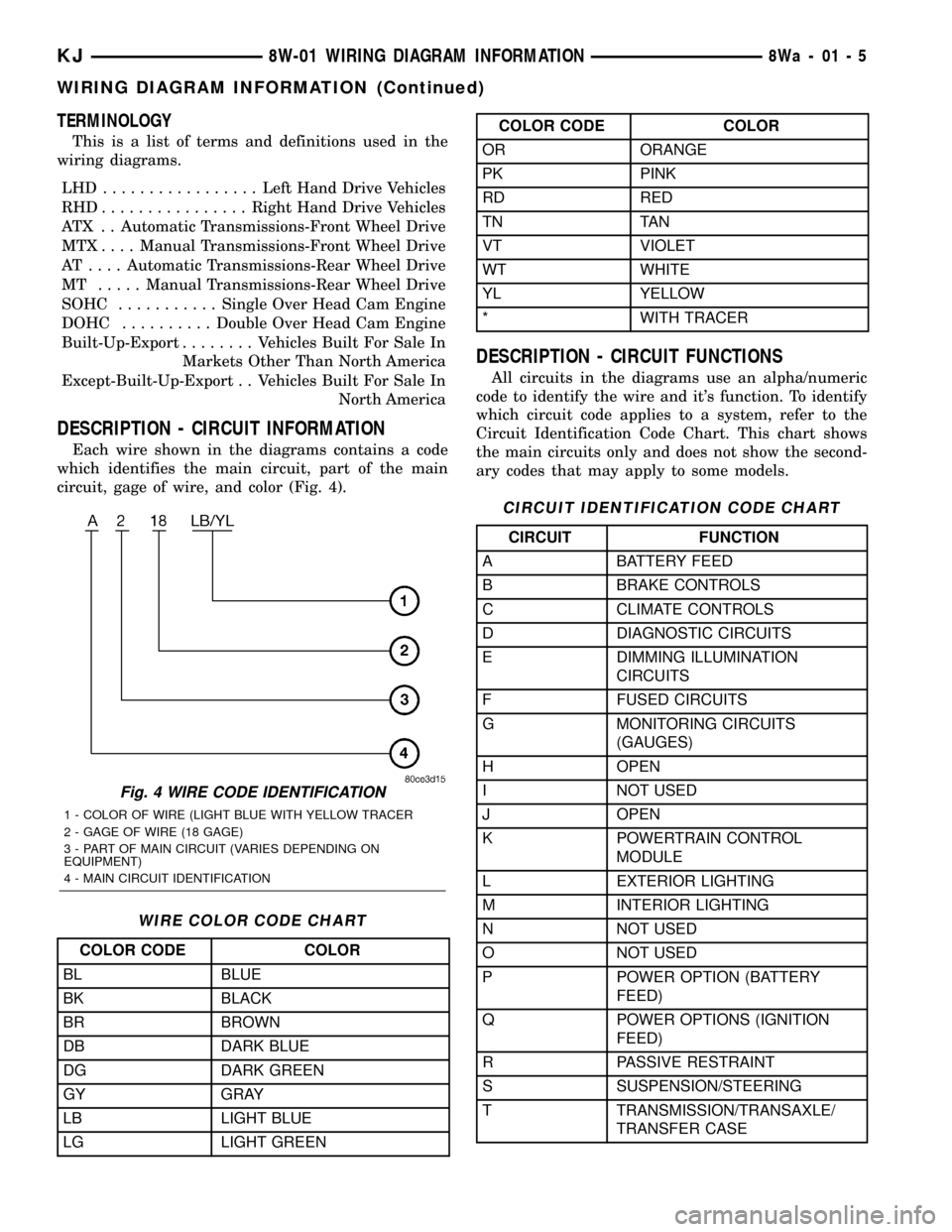
TERMINOLOGY
This is a list of terms and definitions used in the
wiring diagrams.
LHD .................Left Hand Drive Vehicles
RHD................Right Hand Drive Vehicles
ATX . . Automatic Transmissions-Front Wheel Drive
MTX....Manual Transmissions-Front Wheel Drive
AT ....Automatic Transmissions-Rear Wheel Drive
MT .....Manual Transmissions-Rear Wheel Drive
SOHC...........Single Over Head Cam Engine
DOHC..........Double Over Head Cam Engine
Built-Up-Export........ Vehicles Built For Sale In
Markets Other Than North America
Except-Built-Up-Export . . Vehicles Built For Sale In
North America
DESCRIPTION - CIRCUIT INFORMATION
Each wire shown in the diagrams contains a code
which identifies the main circuit, part of the main
circuit, gage of wire, and color (Fig. 4).
WIRE COLOR CODE CHART
COLOR CODE COLOR
BL BLUE
BK BLACK
BR BROWN
DB DARK BLUE
DG DARK GREEN
GY GRAY
LB LIGHT BLUE
LG LIGHT GREEN
COLOR CODE COLOR
OR ORANGE
PK PINK
RD RED
TN TAN
VT VIOLET
WT WHITE
YL YELLOW
* WITH TRACER
DESCRIPTION - CIRCUIT FUNCTIONS
All circuits in the diagrams use an alpha/numeric
code to identify the wire and it's function. To identify
which circuit code applies to a system, refer to the
Circuit Identification Code Chart. This chart shows
the main circuits only and does not show the second-
ary codes that may apply to some models.
CIRCUIT IDENTIFICATION CODE CHART
CIRCUIT FUNCTION
A BATTERY FEED
B BRAKE CONTROLS
C CLIMATE CONTROLS
D DIAGNOSTIC CIRCUITS
E DIMMING ILLUMINATION
CIRCUITS
F FUSED CIRCUITS
G MONITORING CIRCUITS
(GAUGES)
H OPEN
I NOT USED
J OPEN
K POWERTRAIN CONTROL
MODULE
L EXTERIOR LIGHTING
M INTERIOR LIGHTING
N NOT USED
O NOT USED
P POWER OPTION (BATTERY
FEED)
Q POWER OPTIONS (IGNITION
FEED)
R PASSIVE RESTRAINT
S SUSPENSION/STEERING
T TRANSMISSION/TRANSAXLE/
TRANSFER CASE
Fig. 4 WIRE CODE IDENTIFICATION
1 - COLOR OF WIRE (LIGHT BLUE WITH YELLOW TRACER
2 - GAGE OF WIRE (18 GAGE)
3 - PART OF MAIN CIRCUIT (VARIES DEPENDING ON
EQUIPMENT)
4 - MAIN CIRCUIT IDENTIFICATION
KJ8W-01 WIRING DIAGRAM INFORMATION8Wa-01-5
WIRING DIAGRAM INFORMATION (Continued)
Page 1092 of 1803
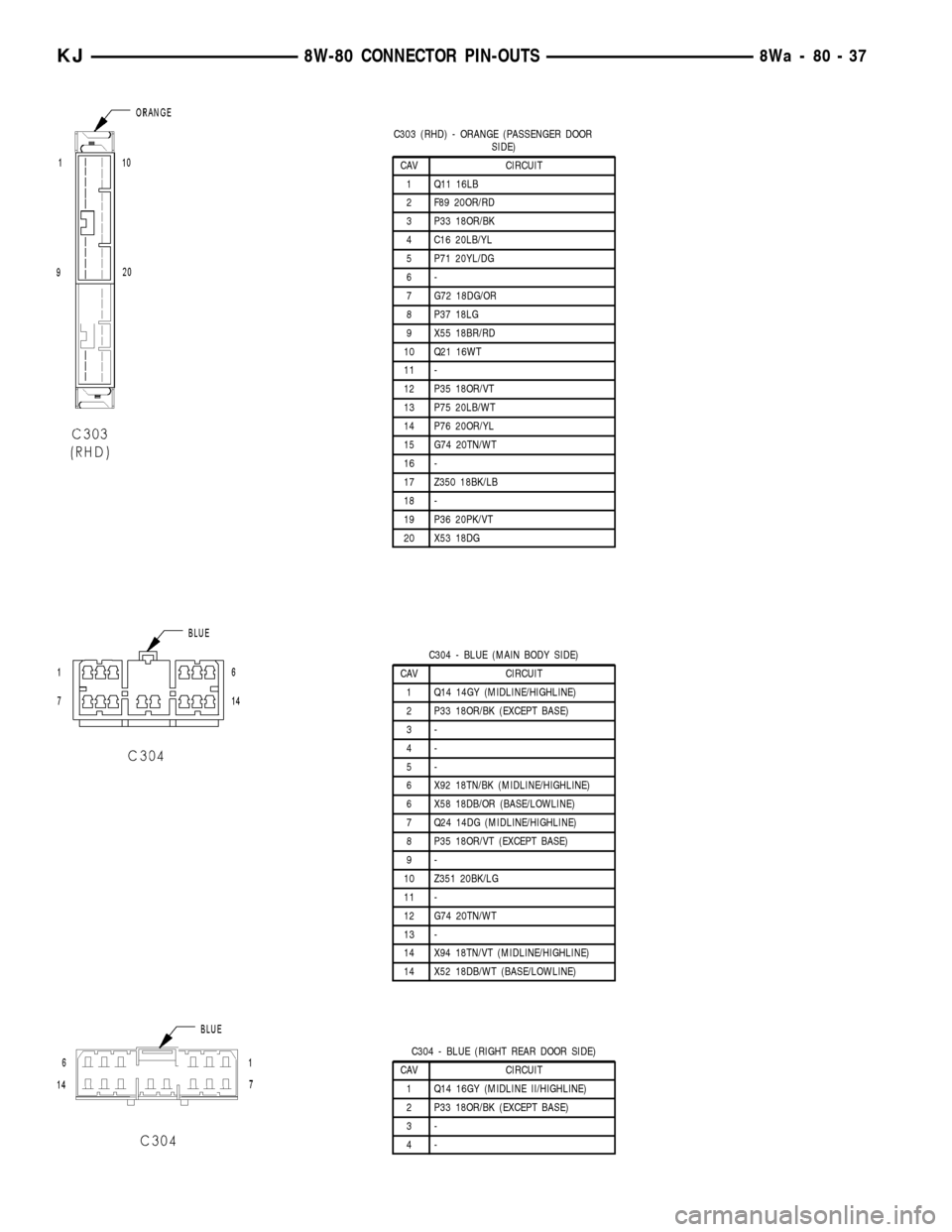
C303 (RHD) - ORANGE (PASSENGER DOOR
SIDE)
CAV CIRCUIT
1 Q11 16LB
2 F89 20OR/RD
3 P33 18OR/BK
4 C16 20LB/YL
5 P71 20YL/DG
6-
7 G72 18DG/OR
8 P37 18LG
9 X55 18BR/RD
10 Q21 16WT
11 -
12 P35 18OR/VT
13 P75 20LB/WT
14 P76 20OR/YL
15 G74 20TN/WT
16 -
17 Z350 18BK/LB
18 -
19 P36 20PK/VT
20 X53 18DG
C304 - BLUE (MAIN BODY SIDE)
CAV CIRCUIT
1 Q14 14GY (MIDLINE/HIGHLINE)
2 P33 18OR/BK (EXCEPT BASE)
3-
4-
5-
6 X92 18TN/BK (MIDLINE/HIGHLINE)
6 X58 18DB/OR (BASE/LOWLINE)
7 Q24 14DG (MIDLINE/HIGHLINE)
8 P35 18OR/VT (EXCEPT BASE)
9-
10 Z351 20BK/LG
11 -
12 G74 20TN/WT
13 -
14 X94 18TN/VT (MIDLINE/HIGHLINE)
14 X52 18DB/WT (BASE/LOWLINE)
C304 - BLUE (RIGHT REAR DOOR SIDE)
CAV CIRCUIT
1 Q14 16GY (MIDLINE II/HIGHLINE)
2 P33 18OR/BK (EXCEPT BASE)
3-
4-
KJ8W-80 CONNECTOR PIN-OUTS8Wa-80-37
Page 1093 of 1803
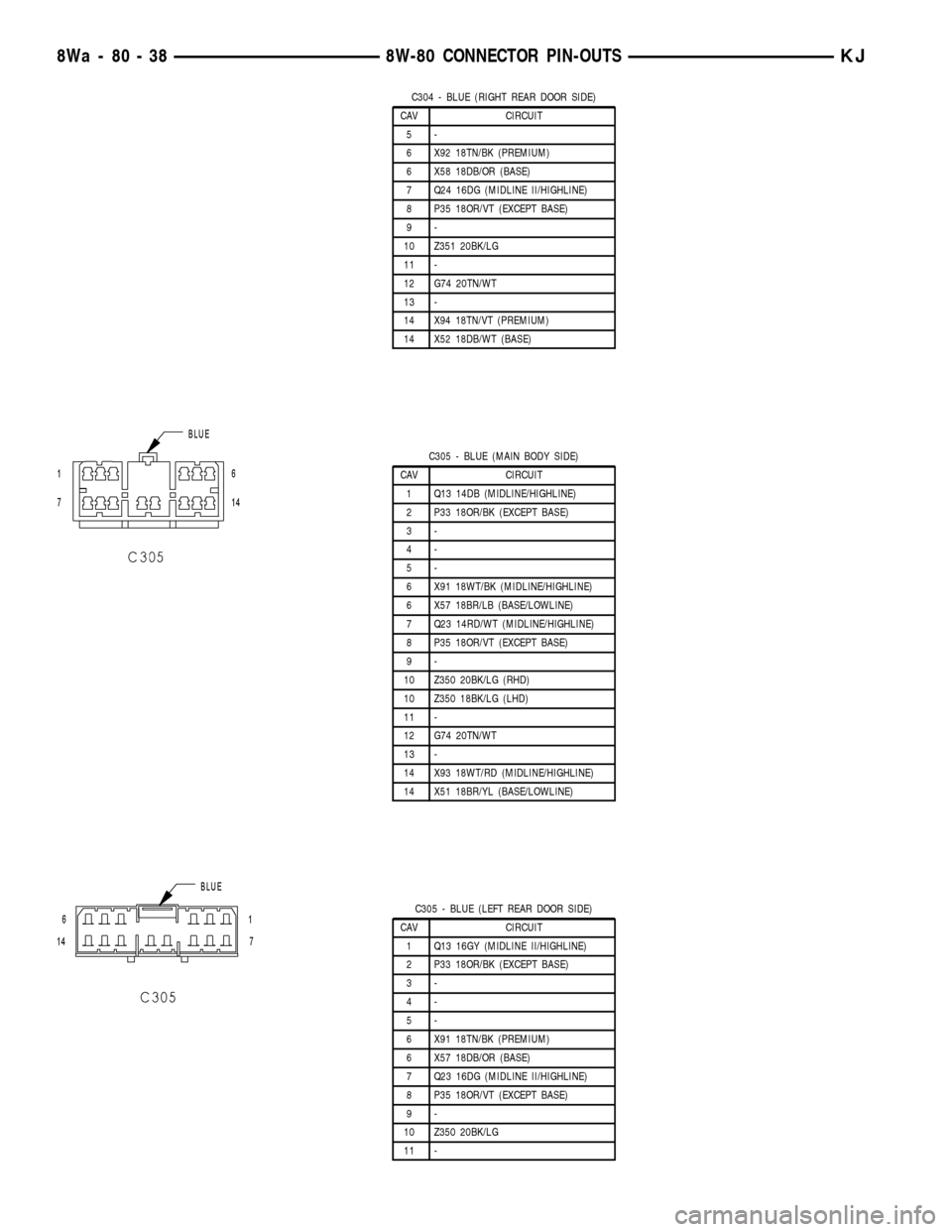
C304 - BLUE (RIGHT REAR DOOR SIDE)
CAV CIRCUIT
5-
6 X92 18TN/BK (PREMIUM)
6 X58 18DB/OR (BASE)
7 Q24 16DG (MIDLINE II/HIGHLINE)
8 P35 18OR/VT (EXCEPT BASE)
9-
10 Z351 20BK/LG
11 -
12 G74 20TN/WT
13 -
14 X94 18TN/VT (PREMIUM)
14 X52 18DB/WT (BASE)
C305 - BLUE (MAIN BODY SIDE)
CAV CIRCUIT
1 Q13 14DB (MIDLINE/HIGHLINE)
2 P33 18OR/BK (EXCEPT BASE)
3-
4-
5-
6 X91 18WT/BK (MIDLINE/HIGHLINE)
6 X57 18BR/LB (BASE/LOWLINE)
7 Q23 14RD/WT (MIDLINE/HIGHLINE)
8 P35 18OR/VT (EXCEPT BASE)
9-
10 Z350 20BK/LG (RHD)
10 Z350 18BK/LG (LHD)
11 -
12 G74 20TN/WT
13 -
14 X93 18WT/RD (MIDLINE/HIGHLINE)
14 X51 18BR/YL (BASE/LOWLINE)
C305 - BLUE (LEFT REAR DOOR SIDE)
CAV CIRCUIT
1 Q13 16GY (MIDLINE II/HIGHLINE)
2 P33 18OR/BK (EXCEPT BASE)
3-
4-
5-
6 X91 18TN/BK (PREMIUM)
6 X57 18DB/OR (BASE)
7 Q23 16DG (MIDLINE II/HIGHLINE)
8 P35 18OR/VT (EXCEPT BASE)
9-
10 Z350 20BK/LG
11 -
8Wa - 80 - 38 8W-80 CONNECTOR PIN-OUTSKJ
Page 1094 of 1803
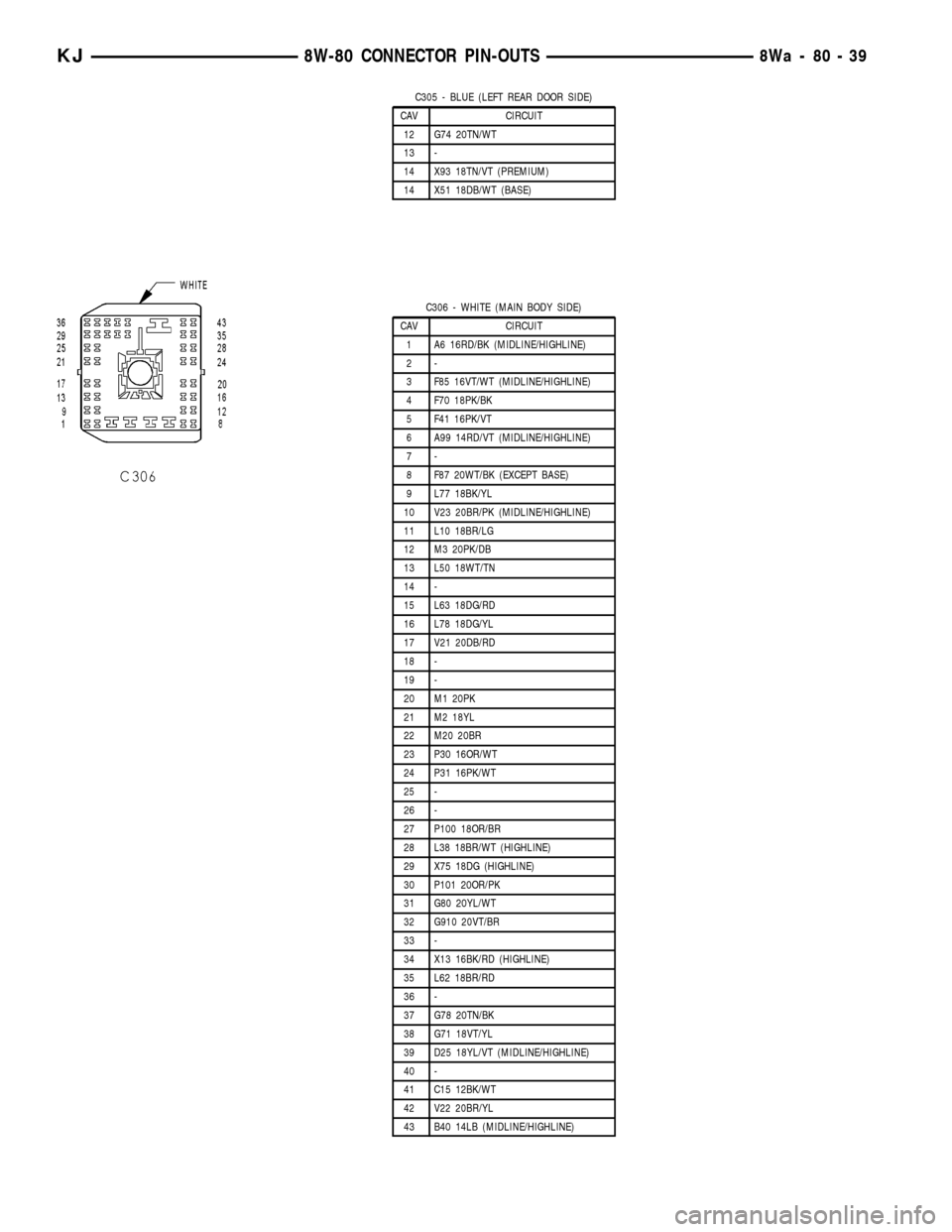
C305 - BLUE (LEFT REAR DOOR SIDE)
CAV CIRCUIT
12 G74 20TN/WT
13 -
14 X93 18TN/VT (PREMIUM)
14 X51 18DB/WT (BASE)
C306 - WHITE (MAIN BODY SIDE)
CAV CIRCUIT
1 A6 16RD/BK (MIDLINE/HIGHLINE)
2-
3 F85 16VT/WT (MIDLINE/HIGHLINE)
4 F70 18PK/BK
5 F41 16PK/VT
6 A99 14RD/VT (MIDLINE/HIGHLINE)
7-
8 F87 20WT/BK (EXCEPT BASE)
9 L77 18BK/YL
10 V23 20BR/PK (MIDLINE/HIGHLINE)
11 L10 18BR/LG
12 M3 20PK/DB
13 L50 18WT/TN
14 -
15 L63 18DG/RD
16 L78 18DG/YL
17 V21 20DB/RD
18 -
19 -
20 M1 20PK
21 M2 18YL
22 M20 20BR
23 P30 16OR/WT
24 P31 16PK/WT
25 -
26 -
27 P100 18OR/BR
28 L38 18BR/WT (HIGHLINE)
29 X75 18DG (HIGHLINE)
30 P101 20OR/PK
31 G80 20YL/WT
32 G910 20VT/BR
33 -
34 X13 16BK/RD (HIGHLINE)
35 L62 18BR/RD
36 -
37 G78 20TN/BK
38 G71 18VT/YL
39 D25 18YL/VT (MIDLINE/HIGHLINE)
40 -
41 C15 12BK/WT
42 V22 20BR/YL
43 B40 14LB (MIDLINE/HIGHLINE)
KJ8W-80 CONNECTOR PIN-OUTS8Wa-80-39
Page 1097 of 1803
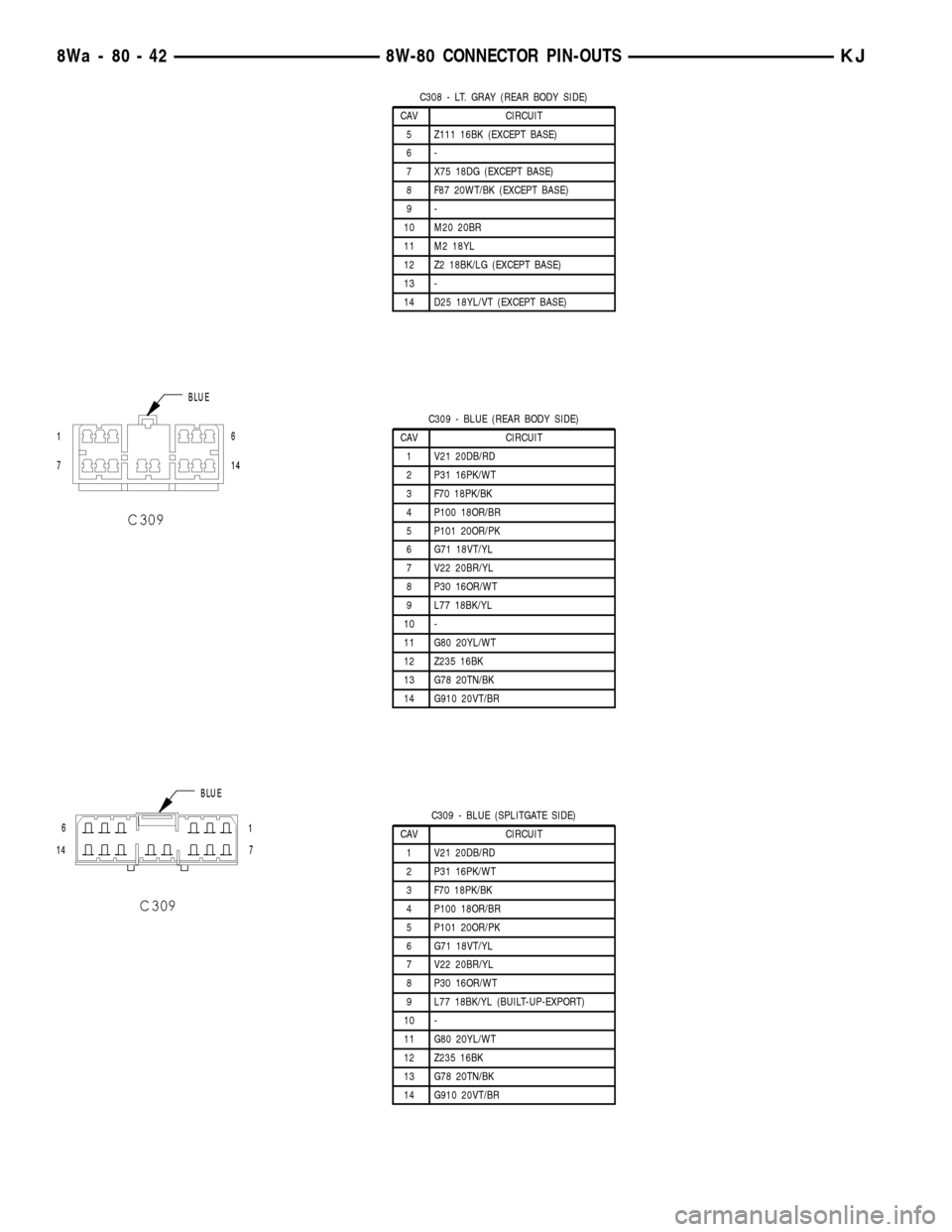
C308 - LT. GRAY (REAR BODY SIDE)
CAV CIRCUIT
5 Z111 16BK (EXCEPT BASE)
6-
7 X75 18DG (EXCEPT BASE)
8 F87 20WT/BK (EXCEPT BASE)
9-
10 M20 20BR
11 M2 18YL
12 Z2 18BK/LG (EXCEPT BASE)
13 -
14 D25 18YL/VT (EXCEPT BASE)
C309 - BLUE (REAR BODY SIDE)
CAV CIRCUIT
1 V21 20DB/RD
2 P31 16PK/WT
3 F70 18PK/BK
4 P100 18OR/BR
5 P101 20OR/PK
6 G71 18VT/YL
7 V22 20BR/YL
8 P30 16OR/WT
9 L77 18BK/YL
10 -
11 G80 20YL/WT
12 Z235 16BK
13 G78 20TN/BK
14 G910 20VT/BR
C309 - BLUE (SPLITGATE SIDE)
CAV CIRCUIT
1 V21 20DB/RD
2 P31 16PK/WT
3 F70 18PK/BK
4 P100 18OR/BR
5 P101 20OR/PK
6 G71 18VT/YL
7 V22 20BR/YL
8 P30 16OR/WT
9 L77 18BK/YL (BUILT-UP-EXPORT)
10 -
11 G80 20YL/WT
12 Z235 16BK
13 G78 20TN/BK
14 G910 20VT/BR
8Wa - 80 - 42 8W-80 CONNECTOR PIN-OUTSKJ
Page 1123 of 1803
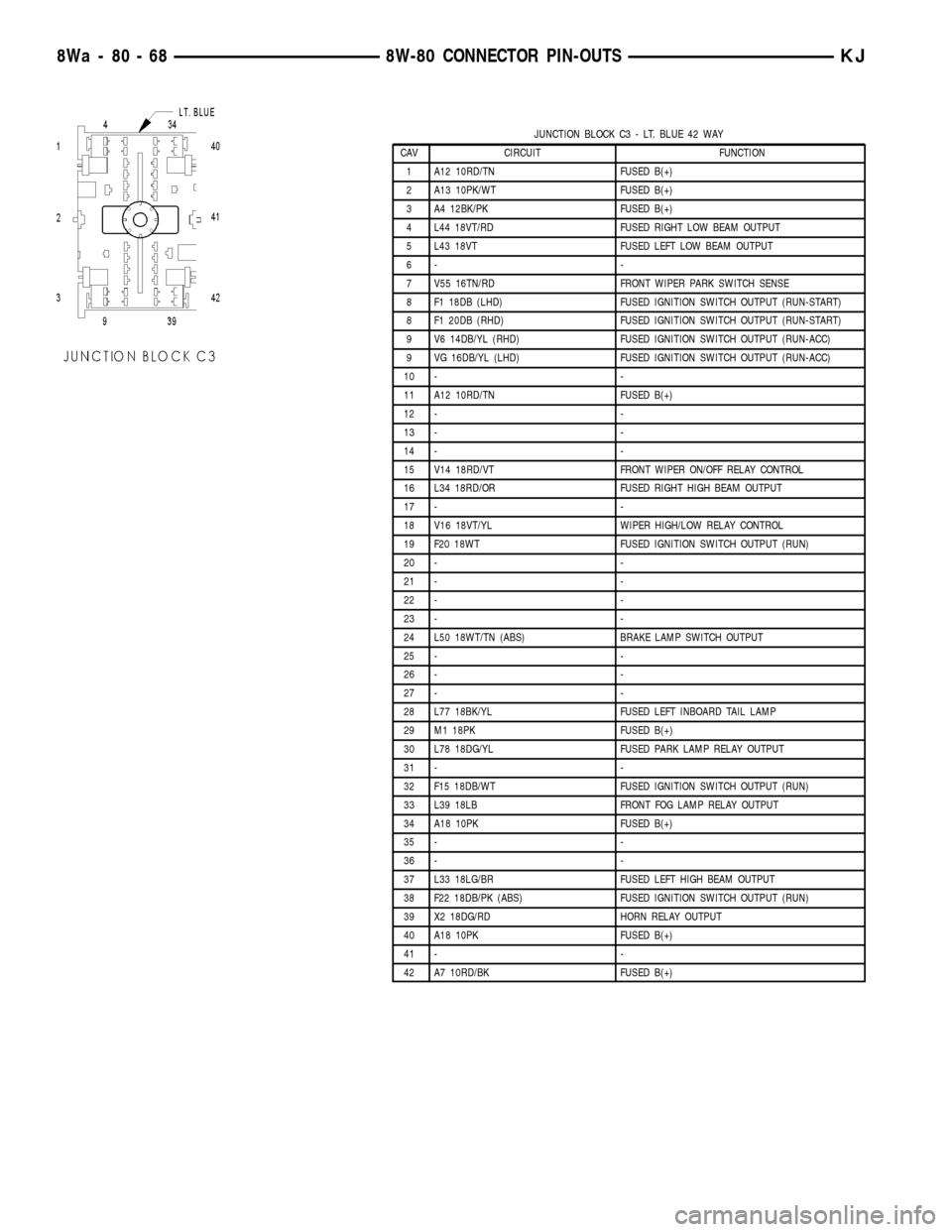
JUNCTION BLOCK C3 - LT. BLUE 42 WAY
CAV CIRCUIT FUNCTION
1 A12 10RD/TN FUSED B(+)
2 A13 10PK/WT FUSED B(+)
3 A4 12BK/PK FUSED B(+)
4 L44 18VT/RD FUSED RIGHT LOW BEAM OUTPUT
5 L43 18VT FUSED LEFT LOW BEAM OUTPUT
6- -
7 V55 16TN/RD FRONT WIPER PARK SWITCH SENSE
8 F1 18DB (LHD) FUSED IGNITION SWITCH OUTPUT (RUN-START)
8 F1 20DB (RHD) FUSED IGNITION SWITCH OUTPUT (RUN-START)
9 V6 14DB/YL (RHD) FUSED IGNITION SWITCH OUTPUT (RUN-ACC)
9 VG 16DB/YL (LHD) FUSED IGNITION SWITCH OUTPUT (RUN-ACC)
10 - -
11 A12 10RD/TN FUSED B(+)
12 - -
13 - -
14 - -
15 V14 18RD/VT FRONT WIPER ON/OFF RELAY CONTROL
16 L34 18RD/OR FUSED RIGHT HIGH BEAM OUTPUT
17 - -
18 V16 18VT/YL WIPER HIGH/LOW RELAY CONTROL
19 F20 18WT FUSED IGNITION SWITCH OUTPUT (RUN)
20 - -
21 - -
22 - -
23 - -
24 L50 18WT/TN (ABS) BRAKE LAMP SWITCH OUTPUT
25 - -
26 - -
27 - -
28 L77 18BK/YL FUSED LEFT INBOARD TAIL LAMP
29 M1 18PK FUSED B(+)
30 L78 18DG/YL FUSED PARK LAMP RELAY OUTPUT
31 - -
32 F15 18DB/WT FUSED IGNITION SWITCH OUTPUT (RUN)
33 L39 18LB FRONT FOG LAMP RELAY OUTPUT
34 A18 10PK FUSED B(+)
35 - -
36 - -
37 L33 18LG/BR FUSED LEFT HIGH BEAM OUTPUT
38 F22 18DB/PK (ABS) FUSED IGNITION SWITCH OUTPUT (RUN)
39 X2 18DG/RD HORN RELAY OUTPUT
40 A18 10PK FUSED B(+)
41 - -
42 A7 10RD/BK FUSED B(+)
8Wa - 80 - 68 8W-80 CONNECTOR PIN-OUTSKJ
Page 1127 of 1803
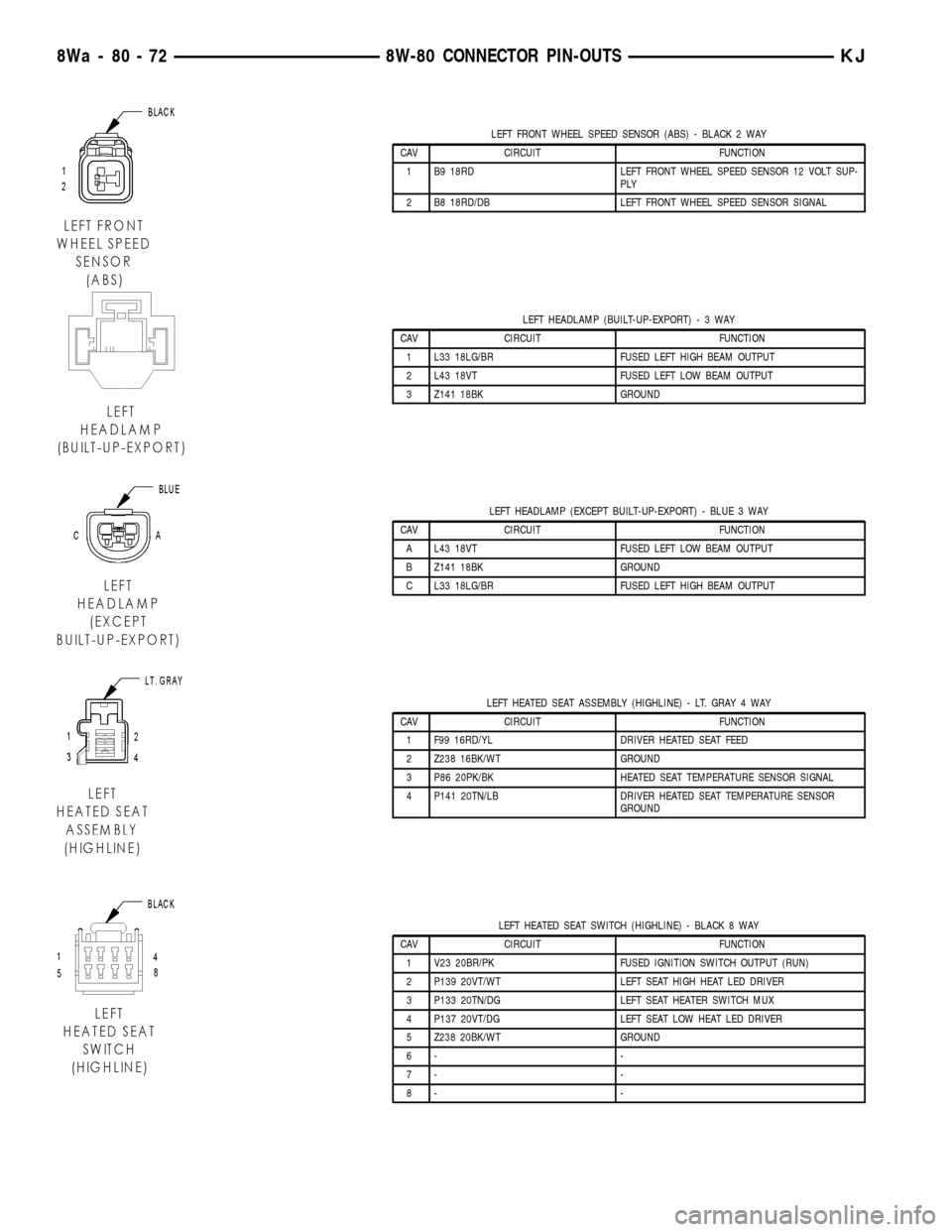
LEFT FRONT WHEEL SPEED SENSOR (ABS) - BLACK 2 WAY
CAV CIRCUIT FUNCTION
1 B9 18RD LEFT FRONT WHEEL SPEED SENSOR 12 VOLT SUP-
PLY
2 B8 18RD/DB LEFT FRONT WHEEL SPEED SENSOR SIGNAL
LEFT HEADLAMP (BUILT-UP-EXPORT)-3WAY
CAV CIRCUIT FUNCTION
1 L33 18LG/BR FUSED LEFT HIGH BEAM OUTPUT
2 L43 18VT FUSED LEFT LOW BEAM OUTPUT
3 Z141 18BK GROUND
LEFT HEADLAMP (EXCEPT BUILT-UP-EXPORT) - BLUE 3 WAY
CAV CIRCUIT FUNCTION
A L43 18VT FUSED LEFT LOW BEAM OUTPUT
B Z141 18BK GROUND
C L33 18LG/BR FUSED LEFT HIGH BEAM OUTPUT
LEFT HEATED SEAT ASSEMBLY (HIGHLINE) - LT. GRAY 4 WAY
CAV CIRCUIT FUNCTION
1 F99 16RD/YL DRIVER HEATED SEAT FEED
2 Z238 16BK/WT GROUND
3 P86 20PK/BK HEATED SEAT TEMPERATURE SENSOR SIGNAL
4 P141 20TN/LB DRIVER HEATED SEAT TEMPERATURE SENSOR
GROUND
LEFT HEATED SEAT SWITCH (HIGHLINE) - BLACK 8 WAY
CAV CIRCUIT FUNCTION
1 V23 20BR/PK FUSED IGNITION SWITCH OUTPUT (RUN)
2 P139 20VT/WT LEFT SEAT HIGH HEAT LED DRIVER
3 P133 20TN/DG LEFT SEAT HEATER SWITCH MUX
4 P137 20VT/DG LEFT SEAT LOW HEAT LED DRIVER
5 Z238 20BK/WT GROUND
6- -
7- -
8- -
8Wa - 80 - 72 8W-80 CONNECTOR PIN-OUTSKJ