fuel type JEEP LIBERTY 2002 KJ / 1.G User Guide
[x] Cancel search | Manufacturer: JEEP, Model Year: 2002, Model line: LIBERTY, Model: JEEP LIBERTY 2002 KJ / 1.GPages: 1803, PDF Size: 62.3 MB
Page 1310 of 1803
(8) Install the starter.
(9) Connect the crankshaft position sensor.
(10) Install the engine block heater power cable, if
equipped.
CAUTION: The structural cover requires a specific
torque sequence. Failure to follow this sequence
may cause severe damage to the cover.
(11) Install the structural cover.
(12) Install the exhaust pipe.
(13) Connect the oxygen sensors.
(14) Lower vehicle.
(15) Connect the knock sensors.
(16) Connect the engine to body ground straps.
(17) Install the power brake booster vacuum hose.
(18) Install the breather hoses.
(19) Install the PCV hose.
(20) Install the fuel rail.
(21) Install the coil over plugs.
(22) Reconnect the engine wiring harness at the
following points:
²Intake air temperature (IAT) sensor
²Fuel Injectors
²Throttle Position (TPS) Switch
²Idle Air Control (IAC) Motor
²Engine Oil Pressure Switch
²Engine Coolant Temperature (ECT) Sensor
²Manifold Absolute Pressure MAP) Sensor
²Camshaft Position (CMP) Sensor
²Coil Over Plugs
²Crankshaft Position Sensor
(23) Connect lower radiator hose.
(24) Connect upper radiator hose.
(25) Connect throttle and speed control cables.
(26) Install the heater hose assembly.
(27) Install coolant recovery bottle.
(28) Install the power steering pump.
(29) Install the generator.
(30) Install the A/C compressor.
(31) Install the drive belt.
(32) Install the fan shroud with the electric fan
assembly.
(33) Install the radiator core support bracket.
(34) Install the air cleaner assembly.
(35) Refill the engine cooling system.
(36) Install the hood.
(37) Check and fill engine oil.
(38) Connect the battery negative cable.
(39) Start the engine and check for leaks.SPECIFICATIONS
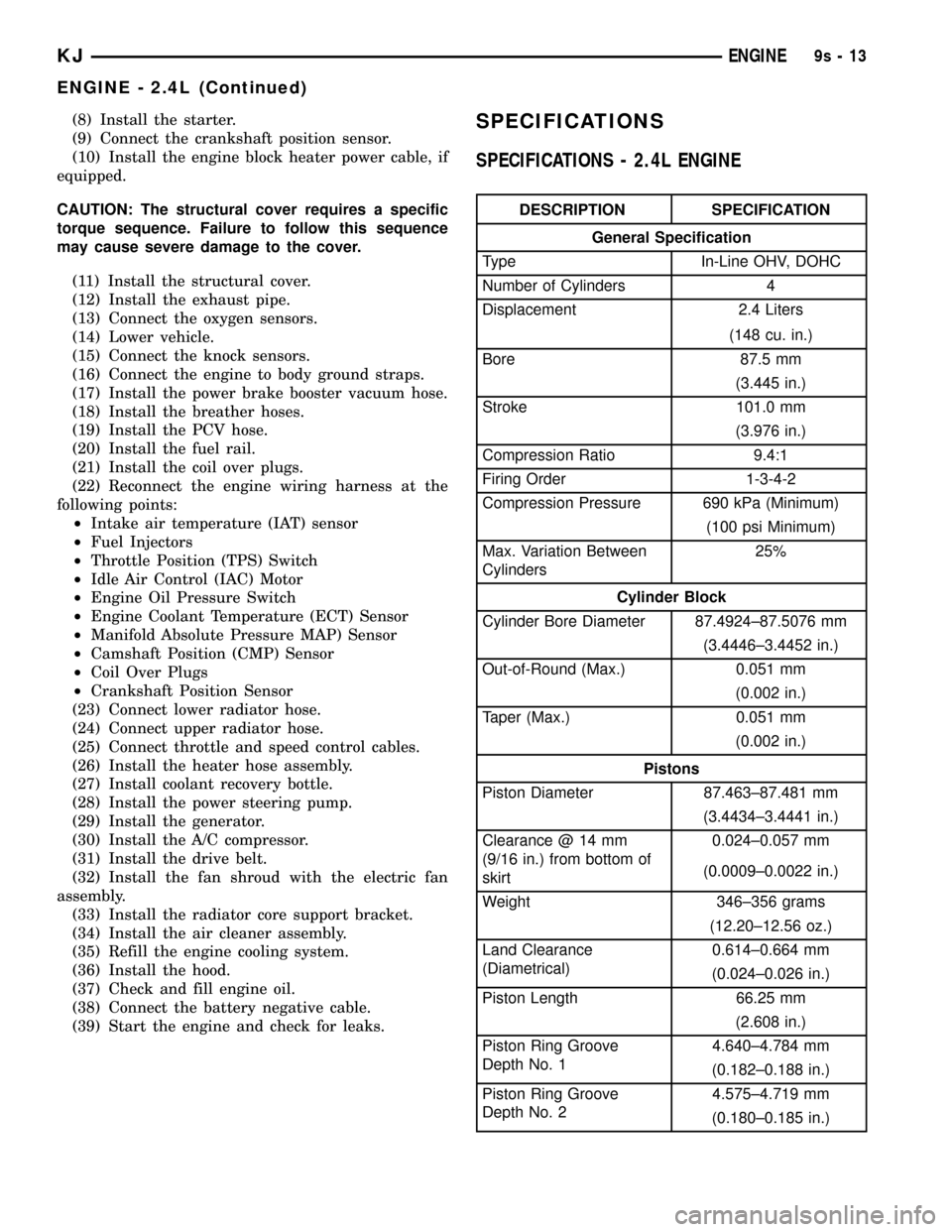
SPECIFICATIONS - 2.4L ENGINE
DESCRIPTION SPECIFICATION
General Specification
Type In-Line OHV, DOHC
Number of Cylinders 4
Displacement 2.4 Liters
(148 cu. in.)
Bore 87.5 mm
(3.445 in.)
Stroke 101.0 mm
(3.976 in.)
Compression Ratio 9.4:1
Firing Order 1-3-4-2
Compression Pressure 690 kPa (Minimum)
(100 psi Minimum)
Max. Variation Between
Cylinders25%
Cylinder Block
Cylinder Bore Diameter 87.4924±87.5076 mm
(3.4446±3.4452 in.)
Out-of-Round (Max.) 0.051 mm
(0.002 in.)
Taper (Max.) 0.051 mm
(0.002 in.)
Pistons
Piston Diameter 87.463±87.481 mm
(3.4434±3.4441 in.)
Clearance @ 14 mm
(9/16 in.) from bottom of
skirt0.024±0.057 mm
(0.0009±0.0022 in.)
Weight 346±356 grams
(12.20±12.56 oz.)
Land Clearance
(Diametrical)0.614±0.664 mm
(0.024±0.026 in.)
Piston Length 66.25 mm
(2.608 in.)
Piston Ring Groove
Depth No. 14.640±4.784 mm
(0.182±0.188 in.)
Piston Ring Groove
Depth No. 24.575±4.719 mm
(0.180±0.185 in.)
KJENGINE9s-13
ENGINE - 2.4L (Continued)
Page 1344 of 1803

(6) Install oil pressure switch and connector. (Refer
to 9 - ENGINE/LUBRICATION/OIL PRESSURE
SENSOR/SWITCH - INSTALLATION)
OIL
STANDARD PROCEDURE
ENGINE OIL LEVEL CHECK
The best time to check engine oil level is after it
has sat overnight, or if the engine has been running,
allow the engine to be shut off for at least 5 minutes
before checking oil level.
Checking the oil while the vehicle is on level
ground will improve the accuracy of the oil level
reading. Remove dipstick and observe oil level. Add
oil only when the level is at or below the ADD mark
(Fig. 78).
STANDARD PROCEDURE - ENGINE OIL AND
FILTER CHANGE
Change engine oil at mileage and time intervals
described in the Maintenance Schedule. (Refer to
LUBRICATION & MAINTENANCE/MAINTE-
NANCE SCHEDULES - DESCRIPTION)
WARNING: NEW OR USED ENGINE OIL CAN BE
IRRITATING TO THE SKIN. AVOID PROLONGED OR
REPEATED SKIN CONTACT WITH ENGINE OIL.
CONTAMINANTS IN USED ENGINE OIL, CAUSED BY
INTERNAL COMBUSTION, CAN BE HAZARDOUS TO
YOUR HEALTH. THOROUGHLY WASH EXPOSED
SKIN WITH SOAP AND WATER. DO NOT WASH
SKIN WITH GASOLINE, DIESEL FUEL, THINNER, OR
SOLVENTS, HEALTH PROBLEMS CAN RESULT. DO
NOT POLLUTE, DISPOSE OF USED ENGINE OIL
PROPERLY. CONTACT YOUR DEALER OR GOVERN-
MENT AGENCY FOR LOCATION OF COLLECTION
CENTER IN YOUR AREA.
Run engine until achieving normal operating tem-
perature.
(1) Position the vehicle on a level surface and turn
engine off.(2) Hoist and support vehicle on safety stands.
Refer to Hoisting and Jacking Recommendations.
(Refer to LUBRICATION & MAINTENANCE/HOIST-
ING - STANDARD PROCEDURE)
(3) Remove oil fill cap.
(4) Place a suitable drain pan under crankcase
drain.
(5) Remove drain plug from crankcase and allow
oil to drain into pan. Inspect drain plug threads for
stretching or other damage. Replace drain plug and
gasket if damaged.
(6) Remove oil filter. (Refer to 9 - ENGINE/LUBRI-
CATION/OIL FILTER - REMOVAL)
(7) Install and tighten drain plug in crankcase.
(8) Install new oil filter. (Refer to 9 - ENGINE/LU-
BRICATION/OIL FILTER - INSTALLATION)
(9) Lower vehicle and fill crankcase with specified
type and amount of engine oil. (Refer to LUBRICA-
TION & MAINTENANCE/FLUID TYPES -
DESCRIPTION)
(10) Install oil fill cap.
(11) Start engine and inspect for leaks.
(12) Stop engine and inspect oil level.
NOTE: Care should be exercised when disposing
used engine oil after it has been drained from a
vehicle engine. Refer to the WARNING listed above.
OIL FILTER
DESCRIPTION
The engine oil filter is a high quality full-flow, dis-
posable type. Replace the oil filter with a Mopartor
the equivalent.
REMOVAL
(1) Raise vehicle on hoist.
(2) Position an oil collecting container under oil fil-
ter location.
CAUTION: When servicing the oil filter avoid
deforming the filter can by installing the remove/in-
stall tool band strap against the can to base lock
seam. The lock seam joining the can to the base is
reinforced by the base plate.
(3) Using a suitable filter wrench, turn oil filter
counterclockwise to remove (Fig. 79).
INSTALLATION
(1) Clean and check filter mounting surface. The
surface must be smooth, flat and free of debris or
pieces of gasket.
(2) Lubricate new oil filter gasket with clean
engine oil.
Fig. 78 Oil Level
1 - ENGINE OIL LEVEL DIPSTICK
KJENGINE9s-47
LUBRICATION (Continued)
Page 1392 of 1803

INSTALLATION
(1) Connect necessary wiring into electrical con-
nectors. Connect 4±wire connector to upper section of
pump module.
(2) Position sending unit to pump module. Slide
and snap into place.
(3) Install lower section of fuel pump module.
Refer to Fuel Pump Module Removal/Installation.
FUEL LINES
DESCRIPTION
Also refer to Quick-Connect Fittings.
WARNING: THE FUEL SYSTEM MAY BE UNDER A
CONSTANT PRESSURE (EVEN WITH THE ENGINE
OFF). BEFORE SERVICING ANY FUEL SYSTEM
HOSES, FITTINGS, LINES, OR MOST COMPO-
NENTS, FUEL SYSTEM PRESSURE MUST BE
RELEASED. REFER TO THE FUEL SYSTEM PRES-
SURE RELEASE PROCEDURE.
The lines/tubes/hoses used on fuel injected vehicles
are of a special construction. This is due to the
higher fuel pressures and the possibility of contami-nated fuel in this system. If it is necessary to replace
these lines/tubes/hoses, only those marked EFM/EFI
may be used.
If equipped:The hose clamps used to secure rub-
ber hoses on fuel injected vehicles are of a special
rolled edge construction. This construction is used to
prevent the edge of the clamp from cutting into the
hose. Only these rolled edge type clamps may be
used in this system. All other types of clamps may
cut into the hoses and cause high-pressure fuel leaks.
Use new original equipment type hose clamps.
QUICK CONNECT FITTING
DESCRIPTION
Different types of quick-connect fittings are used to
attach various fuel system components, lines and
tubes. These are: a single-tab type, a two-tab type or
a plastic retainer ring type. Some are equipped with
safety latch clips. Some may require the use of a spe-
cial tool for disconnection and removal. Refer to
Quick-Connect Fittings Removal/Installation for more
information.
CAUTION: The interior components (o-rings, clips)
of quick-connect fittings are not serviced sepa-
rately, but new plastic spacers are available for
some types. If service parts are not available, do
not attempt to repair the damaged fitting or fuel line
(tube). If repair is necessary, replace the complete
fuel line (tube) assembly.
STANDARD PROCEDURE - QUICK-CONNECT
FITTINGS
Also refer to Fuel Tubes/Lines/Hoses and Clamps.
Different types of quick-connect fittings are used to
attach various fuel system components, lines and
tubes. These are: a single-tab type, a two-tab type or
a plastic retainer ring type. Safety latch clips are
used on certain components/lines. Certain fittings
may require use of a special tool for disconnection.
DISCONNECTING
WARNING: THE FUEL SYSTEM IS UNDER A CON-
STANT PRESSURE (EVEN WITH ENGINE OFF).
BEFORE SERVICING ANY FUEL SYSTEM HOSE,
FITTING OR LINE, FUEL SYSTEM PRESSURE MUST
BE RELEASED. REFER TO FUEL SYSTEM PRES-
SURE RELEASE PROCEDURE.
Fig. 9 FUEL PRESSURE REGULATOR/SENDING
UNIT ELECTRICAL CONNECTOR
1 - UPPER SECTION OF PUMP MODULE
2 - QUICK-CONNECT FITTINGS
3 - FUEL PRESSURE REGULATOR
4 - 4-WIRE ELECTRICAL CONNECTOR
5 - FUEL TANK CHECK (CONTROL) VALVE
14 - 10 FUEL DELIVERYKJ
FUEL LEVEL SENDING UNIT / SENSOR (Continued)
Page 1393 of 1803

CAUTION: The interior components (o-rings, spac-
ers) of some types of quick-connect fitting are not
serviced separately. If service parts are not avail-
able, do not attempt to repair a damaged fitting or
fuel line. If repair is necessary, replace complete
fuel line assembly.
(1) Perform fuel pressure release procedure. Refer
to Fuel Pressure Release Procedure.
(2) Disconnect negative battery cable from battery.
(3) Clean fitting of any foreign material before dis-
assembly.
(4)2±Button Type Fitting:This type of fitting is
equipped with a push-button located on each side of
quick-connect fitting (Fig. 10). Press on both buttons
simultaneously for removal.
(5)Single-Tab Type Fitting:This type of fitting
is equipped with a single pull tab (Fig. 11). The tab is
removable. After tab is removed, quick-connect fitting
can be separated from fuel system component.
(a) Press release tab on side of fitting to release
pull tab (Fig. 12).If release tab is not pressed
prior to releasing pull tab, pull tab will be
damaged.
(b) While pressing release tab on side of fitting,
use screwdriver to pry up pull tab (Fig. 12).
(c) Raise pull tab until it separates from quick-
connect fitting (Fig. 13).
(6)Two-Tab Type Fitting:This type of fitting is
equipped with tabs located on both sides of fitting
(Fig. 14). The tabs are supplied for disconnecting
quick-connect fitting from component being serviced.(a) To disconnect quick-connect fitting, squeeze
plastic retainer tabs (Fig. 14) against sides of
quick-connect fitting with your fingers. Tool use is
not required for removal and may damage plastic
retainer.
(b) Pull fitting from fuel system component
being serviced.
(c) The plastic retainer will remain on compo-
nent being serviced after fitting is disconnected.
The o-rings and spacer will remain in quick-con-
nect fitting connector body.
Fig. 10 2-BUTTON TYPE FITTING
1 - QUICK-CONNECT FITTING
2 - PUSH-BUTTONS (2)
Fig. 11 SINGLE-TAB TYPE FITTING
1 - PULL TAB
2 - QUICK-CONNECT FITTING
3 - PRESS HERE TO REMOVE PULL TAB
4 - INSERTED TUBE END
Fig. 12 DISCONNECTING SINGLE-TAB TYPE
FITTING
1 - PULL TAB
2 - SCREWDRIVER
3 - QUICK-CONNECT FITTING
KJFUEL DELIVERY 14 - 11
QUICK CONNECT FITTING (Continued)
Page 1394 of 1803

(7)Plastic Retainer Ring Type Fitting:This
type of fitting can be identified by the use of a full-
round plastic retainer ring (Fig. 15) usually black in
color.
(a) To release fuel system component from quick-
connect fitting, firmly push fitting towards compo-
nent being serviced while firmly pushing plastic
retainer ring into fitting (Fig. 15). With plastic ring
depressed, pull fitting from component.The plas-
tic retainer ring must be pressed squarely
into fitting body. If this retainer is cocked
during removal, it may be difficult to discon-
nect fitting. Use an open-end wrench on
shoulder of plastic retainer ring to aid in dis-
connection.
Fig. 13 REMOVING PULL TAB
1 - FUEL TUBE OR FUEL SYSTEM COMPONENT
2 - PULL TAB
3 - QUICK-CONNECT FITTING
4 - FUEL TUBE STOP
Fig. 14 TYPICAL 2±TAB TYPE FITTING
1 - TAB(S)
2 - QUICK-CONNECT FITTING
Fig. 15 PLASTIC RETAINER RING TYPE FITTING
1 - FUEL TUBE
2 - QUICK CONNECT FITTING
3 - PUSH
4 - PLASTIC RETAINER
5 - PUSH
6 - PUSH
7 - PUSH
8 - PUSH
Fig. 16 LATCH CLIP-TYPE 1
1 - TETHER STRAP
2 - FUEL LINE
3 - SCREWDRIVER
4 - LATCH CLIP
5 - FUEL RAIL
14 - 12 FUEL DELIVERYKJ
QUICK CONNECT FITTING (Continued)
Page 1395 of 1803

(b) After disconnection, plastic retainer ring will
remain with quick-connect fitting connector body.
(c) Inspect fitting connector body, plastic retainer
ring and fuel system component for damage.
Replace as necessary.
(8)Latch Clips:Depending on vehicle model and
engine, 2 different types of safety latch clips are used
(Fig. 16) or (Fig. 17). Type-1 is tethered to fuel line
and type-2 is not. A special tool will be necessary todisconnect fuel line after latch clip is removed. The
latch clip may be used on certain fuel line/fuel rail
connection, or to join fuel lines together.
(a) Type 1: Pry up on latch clip with a screw-
driver (Fig. 16).
(b) Type 2: Separate and unlatch 2 small arms
on end of clip (Fig. 17) and swing away from fuel
line.
(c) Slide latch clip toward fuel rail while lifting
with screwdriver.
(d) Insert special fuel line removal tool (Snap-On
number FIH 9055-1 or equivalent) into fuel line
(Fig. 18). Use tool to release locking fingers in end
of line.
(e) With special tool still inserted, pull fuel line
from fuel rail.
(f) After disconnection, locking fingers will
remain within quick-connect fitting at end of fuel
line.
(9) Disconnect quick-connect fitting from fuel sys-
tem component being serviced.
CONNECTING
(1) Inspect quick-connect fitting body and fuel sys-
tem component for damage. Replace as necessary.
(2) Prior to connecting quick-connect fitting to
component being serviced, check condition of fitting
and component. Clean parts with a lint-free cloth.
Lubricate with clean engine oil.
(3) Insert quick-connect fitting into fuel tube or
fuel system component until built-on stop on fuel
tube or component rests against back of fitting.
(4) Continue pushing until a click is felt.
(5) Single-tab type fitting: Push new tab down
until it locks into place in quick-connect fitting.
(6) Verify a locked condition by firmly pulling on
fuel tube and fitting (15-30 lbs.).
(7) Latch Clip Equipped: Install latch clip (snaps
into position).If latch clip will not fit, this indi-
cates fuel line is not properly installed to fuel
rail (or other fuel line). Recheck fuel line con-
nection.
(8) Connect negative cable to battery.
(9) Start engine and check for leaks.
FUEL PRESSURE REGULATOR
DESCRIPTION
The fuel pressure regulator is located on the bot-
tom of the upper section of the fuel pump module.
The fuel filteris not combinedinto the pressure
regulator on this model.
Fig. 17 LATCH CLIP-TYPE 2
1 - LATCH CLIP
Fig. 18 FUEL LINE DISCONNECTION USING
SPECIAL TOOL
1 - SPECIAL FUEL LINE TOOL
2 - FUEL LINE
3 - FUEL RAIL
KJFUEL DELIVERY 14 - 13
QUICK CONNECT FITTING (Continued)
Page 1399 of 1803
WARNING: BEFORE PROCEEDING TO NEXT STEP,
NOTE THE FUEL PUMP WILL BE ACTIVATED AND
SYSTEM PRESSURE WILL BE PRESENT. THIS WILL
OCCUR AFTER CONNECTING TEST LEADS FROM
LCS ADAPTER INTO FUEL PUMP RELAY CAVITIES.
THE FUEL PUMP WILL OPERATE EVEN WITH IGNI-
TION KEY IN OFF POSITION. BEFORE ATTACHING
TEST LEADS, BE SURE ALL FUEL LINES AND
FUEL SYSTEM COMPONENTS ARE CONNECTED.
CAUTION: To prevent possible damage to the vehi-
cle electrical system and LCS adapter, the test
leads must be connected into relay cavities exactly
as shown in following steps.
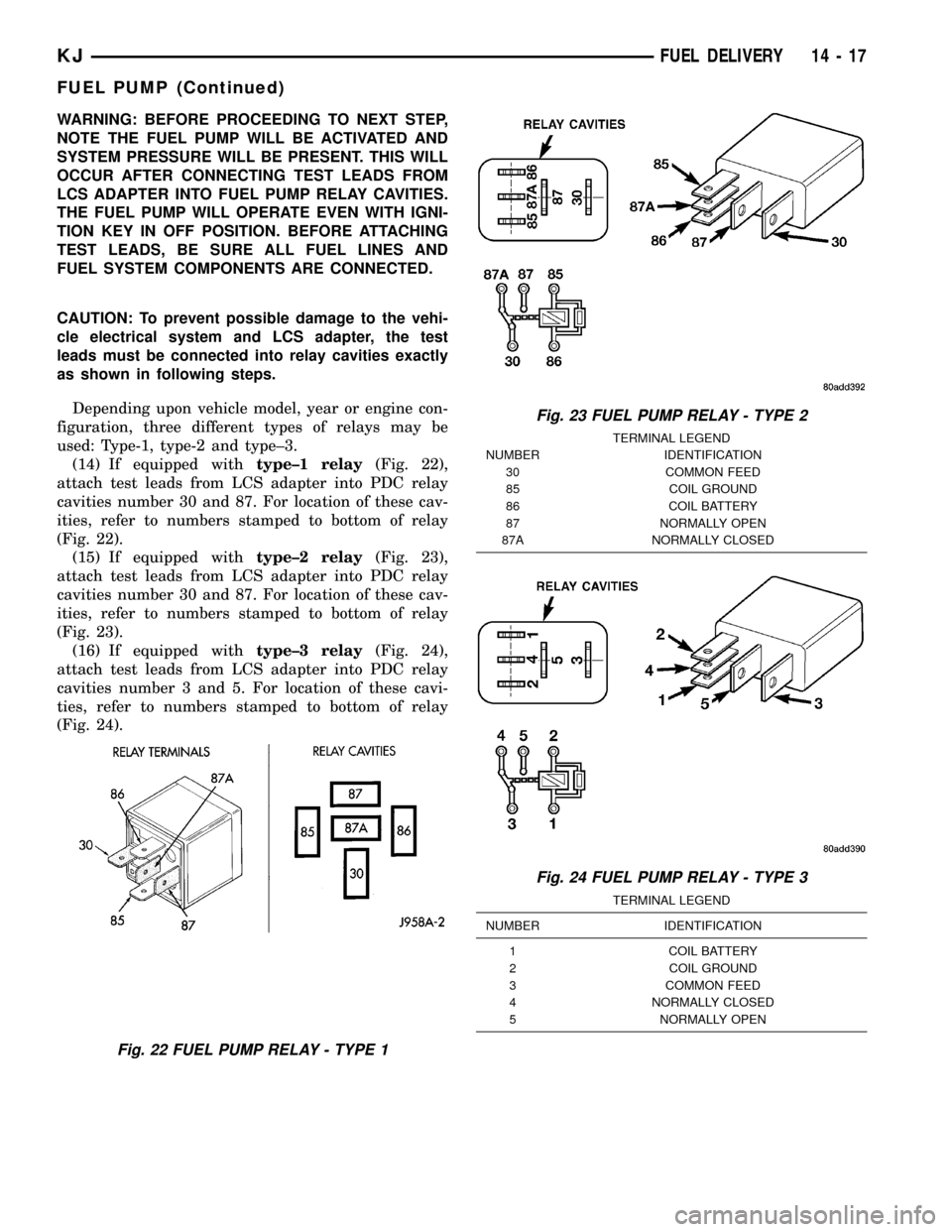
Depending upon vehicle model, year or engine con-
figuration, three different types of relays may be
used: Type-1, type-2 and type±3.
(14) If equipped withtype±1 relay(Fig. 22),
attach test leads from LCS adapter into PDC relay
cavities number 30 and 87. For location of these cav-
ities, refer to numbers stamped to bottom of relay
(Fig. 22).
(15) If equipped withtype±2 relay(Fig. 23),
attach test leads from LCS adapter into PDC relay
cavities number 30 and 87. For location of these cav-
ities, refer to numbers stamped to bottom of relay
(Fig. 23).
(16) If equipped withtype±3 relay(Fig. 24),
attach test leads from LCS adapter into PDC relay
cavities number 3 and 5. For location of these cavi-
ties, refer to numbers stamped to bottom of relay
(Fig. 24).
Fig. 22 FUEL PUMP RELAY - TYPE 1
Fig. 23 FUEL PUMP RELAY - TYPE 2
TERMINAL LEGEND
NUMBER IDENTIFICATION
30 COMMON FEED
85 COIL GROUND
86 COIL BATTERY
87 NORMALLY OPEN
87A NORMALLY CLOSED
Fig. 24 FUEL PUMP RELAY - TYPE 3
TERMINAL LEGEND
NUMBER IDENTIFICATION
1 COIL BATTERY
2 COIL GROUND
3 COMMON FEED
4 NORMALLY CLOSED
5 NORMALLY OPEN
KJFUEL DELIVERY 14 - 17
FUEL PUMP (Continued)
Page 1423 of 1803

ronment that they operate in, that keep them from
being interchangeable.
Maintaining correct sensor temperature at all
times allows the system to enter into closed loop
operation sooner. Also, it allows the system to remain
in closed loop operation during periods of extended
idle.
In Closed Loop operation, the PCM monitors cer-
tain O2 sensor input(s) along with other inputs, and
adjusts the injector pulse width accordingly. During
Open Loop operation, the PCM ignores the O2 sensor
input. The PCM adjusts injector pulse width based
on preprogrammed (fixed) values and inputs from
other sensors.
Upstream Sensor - 2.4L Engine:The upstream
sensor (1/1) provides an input voltage to the PCM.
The input tells the PCM the oxygen content of the
exhaust gas. The PCM uses this information to fine
tune fuel delivery to maintain the correct oxygen con-
tent at the downstream oxygen sensor. The PCM will
change the air/fuel ratio until the upstream sensor
inputs a voltage that the PCM has determined will
make the downstream sensor output (oxygen content)
correct.
The upstream oxygen sensor also provides an input
to determine catalytic convertor efficiency.
Downstream Sensor - 2.4L Engine:The down-
stream oxygen sensor (1/2) is also used to determine
the correct air-fuel ratio. As the oxygen content
changes at the downstream sensor, the PCM calcu-
lates how much air-fuel ratio change is required. The
PCM then looks at the upstream oxygen sensor volt-
age and changes fuel delivery until the upstream
sensor voltage changes enough to correct the down-
stream sensor voltage (oxygen content).
The downstream oxygen sensor also provides an
input to determine catalytic convertor efficiency.
Upstream Sensors - 3.7L Engine:Two upstream
sensors are used (1/1 and 2/1). The 1/1 sensor is the
first sensor to receive exhaust gases from the #1 cyl-
inder. They provide an input voltage to the PCM. The
input tells the PCM the oxygen content of the
exhaust gas. The PCM uses this information to fine
tune fuel delivery to maintain the correct oxygen con-
tent at the downstream oxygen sensors. The PCM
will change the air/fuel ratio until the upstream sen-
sors input a voltage that the PCM has determined
will make the downstream sensors output (oxygen
content) correct.
The upstream oxygen sensors also provide an input
to determine mini-catalyst efficiency. Main catalytic
convertor efficiency is not calculated with this pack-
age.
Downstream Sensors - 3.7L Engine:Two down-
stream sensors are used (1/2 and 2/2). The down-
stream sensors are used to determine the correct air-fuel ratio. As the oxygen content changes at the
downstream sensor, the PCM calculates how much
air-fuel ratio change is required. The PCM then looks
at the upstream oxygen sensor voltage, and changes
fuel delivery until the upstream sensor voltage
changes enough to correct the downstream sensor
voltage (oxygen content).
The downstream oxygen sensors also provide an
input to determine mini-catalyst efficiency. Main cat-
alytic convertor efficiency is not calculated with this
package.
Engines equipped with either a downstream sen-
sor(s), or a post-catalytic sensor, will monitor cata-
lytic convertor efficiency. If efficiency is below
emission standards, the Malfunction Indicator Lamp
(MIL) will be illuminated and a Diagnostic Trouble
Code (DTC) will be set. Refer to Monitored Systems
in Emission Control Systems for additional informa-
tion.
REMOVAL
CAUTION: Never apply any type of grease to the
oxygen sensor electrical connector, or attempt any
soldering of the sensor wiring harness.
Refer to (Fig. 20), (Fig. 21) or (Fig. 22) for O2S
(oxygen sensor) location.
Fig. 20 OXYGEN SENSORS - 2.4L
1 - ELECTRICAL CONNECTORS
2 - UPSTREAM SENSOR (1/1)
3 - ELECTRICAL CONNECTORS
4 - DOWNSTREAM SENSOR (1/2)
KJFUEL INJECTION 14 - 41
OXYGEN SENSOR (Continued)
Page 1725 of 1803

Normal vehicle miles or engine misfire can cause a
catalyst to decay. This can increase vehicle emissions
and deteriorate engine performance, driveability and
fuel economy.
The catalyst monitor uses dual oxygen sensors
(O2S's) to monitor the efficiency of the converter. The
dual O2S's sensor strategy is based on the fact that
as a catalyst deteriorates, its oxygen storage capacity
and its efficiency are both reduced. By monitoring
the oxygen storage capacity of a catalyst, its effi-
ciency can be indirectly calculated. The upstream
O2S is used to detect the amount of oxygen in the
exhaust gas before the gas enters the catalytic con-
verter. The PCM calculates the A/F mixture from the
output of the O2S. A low voltage indicates high oxy-
gen content (lean mixture). A high voltage indicates a
low content of oxygen (rich mixture).
When the upstream O2S detects a lean condition,
there is an abundance of oxygen in the exhaust gas.
A functioning converter would store this oxygen so it
can use it for the oxidation of HC and CO. As the
converter absorbs the oxygen, there will be a lack of
oxygen downstream of the converter. The output of
the downstream O2S will indicate limited activity in
this condition.
As the converter loses the ability to store oxygen,
the condition can be detected from the behavior of
the downstream O2S. When the efficiency drops, no
chemical reaction takes place. This means the con-
centration of oxygen will be the same downstream as
upstream. The output voltage of the downstream
O2S copies the voltage of the upstream sensor. The
only difference is a time lag (seen by the PCM)
between the switching of the O2S's.
To monitor the system, the number of lean-to-rich
switches of upstream and downstream O2S's is
counted. The ratio of downstream switches to
upstream switches is used to determine whether the
catalyst is operating properly. An effective catalyst
will have fewer downstream switches than it has
upstream switches i.e., a ratio closer to zero. For a
totally ineffective catalyst, this ratio will be one-to-
one, indicating that no oxidation occurs in the device.
The system must be monitored so that when cata-
lyst efficiency deteriorates and exhaust emissions
increase to over the legal limit, the MIL will be illu-
minated.
DESCRIPTION - TRIP DEFINITION
The term ªTripº has different meanings depending
on what the circumstances are. If the MIL (Malfunc-
tion Indicator Lamp) is OFF, a Trip is defined as
when the Oxygen Sensor Monitor and the Catalyst
Monitor have been completed in the same drive cycle.
When any Emission DTC is set, the MIL on the
dash is turned ON. When the MIL is ON, it takes 3good trips to turn the MIL OFF. In this case, it
depends on what type of DTC is set to know what a
ªTripº is.
For the Fuel Monitor or Mis-Fire Monitor (contin-
uous monitor), the vehicle must be operated in the
ªSimilar Condition Windowº for a specified amount of
time to be considered a Good Trip.
If a Non-Contiuous OBDII Monitor fails twice in a
row and turns ON the MIL, re-running that monitor
which previously failed, on the next start-up and
passing the monitor, is considered to be a Good Trip.
These will include the following:
²Oxygen Sensor
²Catalyst Monitor
²Purge Flow Monitor
²Leak Detection Pump Monitor (if equipped)
²EGR Monitor (if equipped)
²Oxygen Sensor Heater Monitor
If any other Emission DTC is set (not an OBDII
Monitor), a Good Trip is considered to be when the
Oxygen Sensor Monitor and Catalyst Monitor have
been completed; or 2 Minutes of engine run time if
the Oxygen Sensor Monitor or Catalyst Monitor have
been stopped from running.
It can take up to 2 Failures in a row to turn on the
MIL. After the MIL is ON, it takes 3 Good Trips to
turn the MIL OFF. After the MIL is OFF, the PCM
will self-erase the DTC after 40 Warm-up cycles. A
Warm-up cycle is counted when the ECT (Engine
Coolant Temperature Sensor) has crossed 160ÉF and
has risen by at least 40ÉF since the engine has been
started.
DESCRIPTION - COMPONENT MONITORS
There are several components that will affect vehi-
cle emissions if they malfunction. If one of these com-
ponents malfunctions the Malfunction Indicator
Lamp (MIL) will illuminate.
Some of the component monitors are checking for
proper operation of the part. Electrically operated
components now have input (rationality) and output
(functionality) checks. Previously, a component like
the Throttle Position sensor (TPS) was checked by
the PCM for an open or shorted circuit. If one of
these conditions occurred, a DTC was set. Now there
is a check to ensure that the component is working.
This is done by watching for a TPS indication of a
greater or lesser throttle opening than MAP and
engine rpm indicate. In the case of the TPS, if engine
vacuum is high and engine rpm is 1600 or greater
and the TPS indicates a large throttle opening, a
DTC will be set. The same applies to low vacuum if
the TPS indicates a small throttle opening.
All open/short circuit checks or any component that
has an associated limp in will set a fault after 1 trip
with the malfunction present. Components without
KJEMISSIONS CONTROL 25 - 19
EMISSIONS CONTROL (Continued)
Page 1749 of 1803

FLUID DRAIN AND FILL - STANDARD
PROCEDURE.................21-208,21-246
FLUID FILL/CHECK LOCATIONS -
DESCRIPTION.........................0-4
FLUID INDICATOR - DESCRIPTION,
WASHER...........................8J-35
FLUID INDICATOR - DIAGNOSIS AND
TESTING, WASHER...................8J-36
FLUID INDICATOR - OPERATION,
WASHER...........................8J-36
FLUID LEAK - DIAGNOSIS AND TESTING,
CONVERTER HOUSING................21-80
FLUID LEVEL - DIAGNOSIS AND
TESTING, EFFECTS OF INCORRECT......21-125
FLUID LEVEL - STANDARD
PROCEDURES, MASTER CYLINDER.......5-26
FLUID LEVEL CHECK - STANDARD
PROCEDURE.......................21-126
FLUID LEVEL SWITCH - DESCRIPTION,
WASHER...........................8R-17
FLUID LEVEL SWITCH - INSTALLATION,
WASHER...........................8R-18
FLUID LEVEL SWITCH - OPERATION,
WASHER...........................8R-17
FLUID LEVEL SWITCH - REMOVAL,
WASHER...........................8R-17
FLUID RESERVOIR - INSTALLATION.......5-26
FLUID RESERVOIR - REMOVAL..........5-26
FLUID, SPECIFICATIONS - BRAKE.........5-27
FLUID TYPES - DESCRIPTION.............0-1
FLUSH - SPECIFICATIONS, GAP........23-116
FLUSHING - STANDARD PROCEDURE,
COOLING SYSTEM - REVERSE...........7-12
FLYWHEEL - DESCRIPTION...............6-7
FLYWHEEL - DIAGNOSIS AND TESTING.....6-8
FLYWHEEL - OPERATION................6-7
FOG LAMP BULB - INSTALLATION,
FRONT.............................8L-22
FOG LAMP BULB - REMOVAL, FRONT....8L-21
FOG LAMP INDICATOR - DESCRIPTION,
FRONT.............................8J-19
FOG LAMP INDICATOR - DESCRIPTION,
REAR..............................8J-27
FOG LAMP INDICATOR - OPERATION,
FRONT.............................8J-19
FOG LAMP INDICATOR - OPERATION,
REAR..............................8J-27
FOG LAMP RELAY - DESCRIPTION,
FRONT.............................8L-22
FOG LAMP RELAY - DESCRIPTION, REAR . 8L-56
FOG LAMP RELAY - DIAGNOSIS AND
TESTING, FRONT.....................8L-23
FOG LAMP RELAY - DIAGNOSIS AND
TESTING, REAR......................8L-57
FOG LAMP RELAY - INSTALLATION,
FRONT.............................8L-24
FOG LAMP RELAY - INSTALLATION,
REAR..............................8L-58
FOG LAMP RELAY - OPERATION, FRONT . . 8L-22
FOG LAMP RELAY - OPERATION, REAR . . . 8L-57
FOG LAMP RELAY - REMOVAL, FRONT . . . 8L-24
FOG LAMP RELAY - REMOVAL, REAR....8L-58
FOG LAMP UNIT - ADJUSTMENT, FRONT . . 8L-25
FOG LAMP UNIT - INSTALLATION,
FRONT.............................8L-25
FOG LAMP UNIT - REMOVAL, FRONT.....8L-25
FOLDING REAR SEAT BACK LATCH /
LOCK - INSTALLATION
...............23-170
FOLDING REAR SEAT BACK LATCH /
LOCK - REMOVAL
...................23-170
FOUR LOW MODE INDICATOR -
DESCRIPTION
.......................8J-29
FOUR LOW MODE INDICATOR -
OPERATION
.........................8J-30
FRAME - REAR - INSTALLATION, SEAT
BACK
.............................23-171
FRAME - REAR - REMOVAL, SEAT BACK
. 23-171
FRAME DIMENSIONS - SPECIFICATIONS
. . . 13-3
FRONT - DESCRIPTION
..................2-7
FRONT - INSTALLATION, CRANKSHAFT
OIL SEAL
............................9-47
FRONT - INSTALLATION, PROPELLER
SHAFT
...............................3-6
FRONT - INSTALLATION, SEAT
.........23-165
FRONT - INSTALLATION, SEAT BACK
....23-166
FRONT - INSTALLATION, SEAT BACK
COVER
............................23-167FRONT - INSTALLATION, SEAT BACK
CUSHION..........................23-167
FRONT - INSTALLATION, SEAT BACK
RECLINER.........................23-166
FRONT - INSTALLATION, SEAT CUSHION . 23-167
FRONT - INSTALLATION, SEAT CUSHION
COVER............................23-167
FRONT - REMOVAL, CRANKSHAFT OIL
SEAL...............................9-46
FRONT - REMOVAL, PROPELLER SHAFT....3-6
FRONT - REMOVAL, SEAT.............23-165
FRONT - REMOVAL, SEAT BACK........23-166
FRONT - REMOVAL, SEAT BACK COVER . . 23-166
FRONT - REMOVAL, SEAT BACK
CUSHION..........................23-167
FRONT - REMOVAL, SEAT BACK
RECLINER.........................23-166
FRONT - REMOVAL, SEAT CUSHION.....23-167
FRONT - REMOVAL, SEAT CUSHION
COVER............................23-167
FRONT - WARNING.....................2-7
FRONT AXLE - 186FIA - ADJUSTMENTS....3-25
FRONT AXLE - 186FIA - DESCRIPTION.....3-19
FRONT AXLE - 186FIA - INSTALLATION....3-24
FRONT AXLE - 186FIA - OPERATION......3-19
FRONT AXLE - 186FIA - REMOVAL........3-24
FRONT AXLE - SPECIFICATIONS..........3-33
FRONT AXLE, SPECIAL TOOLS...........3-34
FRONT BRAKE HOSE - INSTALLATION.......5-10
FRONT BRAKE PADS - INSTALLATION.....5-11
FRONT BRAKE PADS - REMOVAL.........5-11
FRONT CHECK VALVE - DESCRIPTION.....8R-8
FRONT CHECK VALVE - INSTALLATION....8R-9
FRONT CHECK VALVE - OPERATION.......8R-9
FRONT CHECK VALVE - REMOVAL........8R-9
FRONT DOOR OUTER BELT MOLDING -
INSTALLATION......................23-186
FRONT DOOR OUTER BELT MOLDING -
REMOVAL.........................23-186
FRONT FASCIA - INSTALLATION..........13-2
FRONT FASCIA - REMOVAL..............13-1
FRONT FENDER - INSTALLATION.......23-141
FRONT FENDER - REMOVAL...........23-141
FRONT FOG LAMP BULB -
INSTALLATION.......................8L-22
FRONT FOG LAMP BULB - REMOVAL.....8L-21
FRONT FOG LAMP INDICATOR -
DESCRIPTION.......................8J-19
FRONT FOG LAMP INDICATOR -
OPERATION.........................8J-19
FRONT FOG LAMP RELAY -
DESCRIPTION.......................8L-22
FRONT FOG LAMP RELAY - DIAGNOSIS
AND TESTING.......................8L-23
FRONT FOG LAMP RELAY -
INSTALLATION.......................8L-24
FRONT FOG LAMP RELAY - OPERATION . . 8L-22
FRONT FOG LAMP RELAY - REMOVAL....8L-24
FRONT FOG LAMP UNIT - ADJUSTMENT . . 8L-25
FRONT FOG LAMP UNIT - INSTALLATION . . 8L-25
FRONT FOG LAMP UNIT - REMOVAL.....8L-25
FRONT HOSE - REMOVAL................5-9
FRONT IMPACT SENSOR - DESCRIPTION . 8O-21
FRONT IMPACT SENSOR -
INSTALLATION......................8O-22
FRONT IMPACT SENSOR - OPERATION . . . 8O-21
FRONT IMPACT SENSOR - REMOVAL....8O-22
FRONT LAMP BULB - INSTALLATION.....8L-27
FRONT LAMP BULB - REMOVAL.........8L-26
FRONT LAMP UNIT - INSTALLATION.....8L-28
FRONT LAMP UNIT - REMOVAL.........8L-27
FRONT MOUNT - INSTALLATION..........9-57
FRONT MOUNT - REMOVAL.............9-56
FRONT OUTPUT SHAFT SEAL -
INSTALLATION................21-208,21-246
FRONT OUTPUT SHAFT SEAL -
REMOVAL...................21-208,21-246
FRONT POSITION LAMP BULB -
INSTALLATION.......................8L-28
FRONT POSITION LAMP BULB -
REMOVAL
..........................8L-28
FRONT SEAL - INSTALLATION, OIL
PUMP
............................21-152
FRONT SEAL - REMOVAL, OIL PUMP
....21-152
FRONT SEAT BELT & RETRACTOR -
INSTALLATION
......................8O-24
FRONT SEAT BELT & RETRACTOR -
REMOVAL
..........................8O-23FRONT SEAT BELT BUCKLE -
INSTALLATION......................8O-26
FRONT SEAT BELT BUCKLE - REMOVAL . . 8O-25
FRONT SKID PLATE - INSTALLATION......13-6
FRONT SKID PLATE - REMOVAL..........13-6
FRONT SUSPENSION, SPECIAL TOOLS.....2-8
FRONT TOW HOOK - INSTALLATION......13-8
FRONT TOW HOOK - REMOVAL..........13-8
FRONT WASHER HOSES/TUBES -
DESCRIPTION.......................8R-10
FRONT WASHER HOSES/TUBES -
OPERATION.........................8R-10
FRONT WASHER NOZZLE -
DESCRIPTION.......................8R-11
FRONT WASHER NOZZLE -
INSTALLATION......................8R-11
FRONT WASHER NOZZLE - OPERATION . . . 8R-11
FRONT WASHER NOZZLE - REMOVAL....8R-11
FRONT WHEEL OPENING FLARE
MOLDINGS - INSTALLATION...........23-145
FRONT WHEEL OPENING FLARE
MOLDINGS - REMOVAL..............23-145
FRONT WHEEL SPEED SENSOR -
INSTALLATION........................5-34
FRONT WHEEL SPEED SENSOR -
REMOVAL...........................5-34
FRONT WHEELHOUSE SPLASH SHIELD -
INSTALLATION......................23-143
FRONT WHEELHOUSE SPLASH SHIELD -
REMOVAL.........................23-143
FRONT WIPER & WASHER SYSTEM -
CLEANING...........................8R-7
FRONT WIPER & WASHER SYSTEM -
DIAGNOSIS AND TESTING..............8R-6
FRONT WIPER & WASHER SYSTEM -
INSPECTION.........................8R-7
FRONT WIPER ARM - DESCRIPTION.....8R-12
FRONT WIPER ARM - INSTALLATION.....8R-13
FRONT WIPER ARM - OPERATION.......8R-12
FRONT WIPER ARM - REMOVAL........8R-12
FRONT WIPER BLADE - DESCRIPTION....8R-13
FRONT WIPER BLADE - INSTALLATION . . . 8R-14
FRONT WIPER BLADE - OPERATION.....8R-14
FRONT WIPER BLADE - REMOVAL.......8R-14
FRONT WIPER MODULE - DESCRIPTION . . 8R-15
FRONT WIPER MODULE - INSTALLATION . 8R-16
FRONT WIPER MODULE - OPERATION....8R-15
FRONT WIPER MODULE - REMOVAL.....8R-16
FRONT WIPERS/WASHERS -
DESCRIPTION........................8R-2
FRONT WIPERS/WASHERS - OPERATION . . 8R-4
FRONT WIPER/WASHER SWITCH -
DESCRIPTION.......................8R-16
FRONT WIPER/WASHER SWITCH -
OPERATION.........................8R-16
FUEL DELIVERY - DESCRIPTION..........14-2
FUEL DELIVERY - OPERATION...........14-3
FUEL FILL DOOR/HOUSING -
INSTALLATION......................23-141
FUEL FILL DOOR/HOUSING - REMOVAL . . 23-141
FUEL FILLER CAP - DESCRIPTION.......25-27
FUEL FILLER CAP - OPERATION.........25-27
FUEL FILTER - DESCRIPTION............14-7
FUEL FILTER - INSTALLATION............14-8
FUEL FILTER - REMOVAL...............14-7
FUEL GAUGE - DESCRIPTION...........8J-19
FUEL GAUGE - OPERATION.............8J-20
FUEL INDICATOR - DESCRIPTION, LOW
. . . 8J-22
FUEL INDICATOR - OPERATION, LOW
.....8J-22
FUEL INJECTION - DESCRIPTION
........14-29
FUEL INJECTOR - DESCRIPTION
.........14-33
FUEL INJECTOR - DIAGNOSIS AND
TESTING
...........................14-33
FUEL INJECTOR - OPERATION
..........14-33
FUEL LEVEL SENDING UNIT -
DIAGNOSIS AND TESTING
..............14-9
FUEL LEVEL SENDING UNIT / SENSOR -
DESCRIPTION
........................14-9
FUEL LEVEL SENDING UNIT / SENSOR -
INSTALLATION
.......................14-10
FUEL LEVEL SENDING UNIT / SENSOR -
OPERATION
..........................14-9
FUEL LEVEL SENDING UNIT / SENSOR -
REMOVAL
...........................14-9
FUEL LINES - DESCRIPTION
............14-10
FUEL PRESSURE LEAK DOWN TEST -
DIAGNOSIS AND TESTING
..............14-3
10 INDEXKJ
Description Group-Page Description Group-Page Description Group-Page