tire type JEEP LIBERTY 2002 KJ / 1.G User Guide
[x] Cancel search | Manufacturer: JEEP, Model Year: 2002, Model line: LIBERTY, Model: JEEP LIBERTY 2002 KJ / 1.GPages: 1803, PDF Size: 62.3 MB
Page 198 of 1803

ELECTRICAL
DESCRIPTION
Three wheel speed sensors are used. The front sen-
sors are mounted to the steering knuckles. The rear
sensor is mounted at the top of the rear axle differ-
ential carrier. Tone wheels are mounted to the out-
board ends of the front axle shafts. The gear type
tone wheel serves as the trigger mechanism for each
sensor.
OPERATION
The sensors convert wheel speed into a small digi-
tal signal. The CAB sends 12 volts to the sensors.
The sensor has an internal magneto resistance
bridge that alters the voltage and amperage of the
signal circuit. This voltage and amperage is changed
by magnetic induction when the toothed tone wheel
passes the wheel speed sensor. This digital signal is
sent to the CAB. The CAB measures the voltage and
amperage of the digital signal for each wheel.
FRONT WHEEL SPEED
SENSOR
REMOVAL
(1) Disconnect the front wheel speed sensor wire
connector that is located on the inboard side of the
respective wheel house.
(2) Raise and support the vehicle.
(3) Remove the tire and wheel assembly.
(4) Remove the caliper adapter. (Refer to 5 -
BRAKES/HYDRAULIC/MECHANICAL/DISC
BRAKE CALIPER ADAPTER - REMOVAL).
CAUTION: Never allow the disc brake caliper to
hang from the brake hose. Damage to the brake
hose with result. Provide a suitable support to hang
the caliper securely.
(5) Remove the disc brake rotor. (Refer to 5 -
BRAKES/HYDRAULIC/MECHANICAL/ROTORS -
REMOVAL).
(6) Remove the wheel speed sensor mounting bolt
to the hub (Fig. 1).
(7) Remove the wheel speed sensor wire from the
hub/bearing (Fig. 1).
(8) Remove the wheel speed sensor wire hold down
from the knuckle (Fig. 1).
(9) Remove the wheel speed sensor wire thru the
wheel well.
(10) Remove the wheel speed sensor from the vehi-
cle.
INSTALLATION
(1) Install the wheel speed sensor to the vehicle.
(2) Install the wheel speed sensor wire thru the
wheel well.
(3) Install the wheel speed sensor wire to the hub/
bearing.
(4) Install the wheel speed sensor wire hold down
to the knuckle.
(5) Install the wheel speed sensor mounting bolt to
the hub. Tighten the mounting bolt to 14 N´m (10
ft.lbs.).
(6) Install the disc brake rotor (Refer to 5 -
BRAKES/HYDRAULIC/MECHANICAL/ROTORS -
INSTALLATION).
(7) Install the disc brake caliper adapter. (Refer to
5 - BRAKES/HYDRAULIC/MECHANICAL/DISC
BRAKE CALIPER ADAPTER - INSTALLATION).
(8) Install the tire and wheel assembly (Refer to 22
- TIRES/WHEELS/WHEELS - STANDARD PROCE-
DURE).
(9) Reconnect the front wheel speed sensor wire
connector to the inboard side of the wheel house
being worked on.
Fig. 1 FRONT WHEEL SPEED SENSOR
1 - WHEEL SPEED SENSOR WIRE
2 - WHEEL SPEED SENSOR
3 - ROTOR
4 - WHEEL SPEED SENSOR WIRE HOLD DOWN
5 - 34 BRAKES - ABSKJ
Page 304 of 1803

flip-up glass ajar switch, the hood ajar switch (in
required markets only), and the Remote Keyless
Entry (RKE) module to control the features of the
optional Vehicle Theft Security System (VTSS).
Hard wired circuitry connects the BCM to the elec-
trical system of the vehicle. These hard wired circuits
are integral to several wire harnesses, which are
routed throughout the vehicle and retained by many
different methods. These circuits may be connected to
each other, to the vehicle electrical system and to the
BCM through the use of a combination of soldered
splices, splice block connectors, and many different
types of wire harness terminal connectors and insu-
lators. Refer to the appropriate wiring information.
The wiring information includes wiring diagrams,
proper wire and connector repair procedures, further
details on wire harness routing and retention, as well
as pin-out and location views for the various wire
harness connectors, splices and grounds.
Many of the electronic features in the vehicle con-
trolled or supported by the BCM are programmable
using a customer programming procedure or the
DRBIIItscan tool. In addition, the BCM software is
Flash compatible, which means it can be repro-
grammed using Flash reprogramming procedures.
However, if any of the BCM hardware components is
damaged or faulty, the entire BCM unit must be
replaced.
OPERATION
The microprocessor-based Body Control Module
(BCM) monitors many hard wired switch and sensor
inputs as well as those resources it shares with other
electronic modules in the vehicle through its commu-
nication over the Programmable Communications
Interface (PCI) data bus network. The internal pro-
gramming and all of these inputs allow the BCM
microprocessor to determine the tasks it needs to
perform and their priorities, as well as both the stan-
dard and optional features that it should provide.
The BCM programming then performs those tasks
and provides those features through both PCI data
bus communication with other electronic modules
and through hard wired outputs through a number of
driver circuits, relays, and actuators. These outputs
allow the BCM the ability to control numerous acces-
sory systems in the vehicle.
The BCM operates on battery current received
through a fuse in the Junction Block (JB) on a non-
switched fused B(+) circuit, through another fuse in
the JB on a fused ignition switch output (run-start)
circuit, and through a third fuse in the JB on a fused
ignition switch output (run-acc) circuit. This arrange-
ment allows the BCM to provide some features
regardless of the ignition switch position, while other
features will operate only with the ignition switch inthe On, Start, and/or Accessory positions. All of the
battery current circuits are connected to the BCM
through the JB/BCM connector. The BCM receives
ground through five separate circuits. Three of these
circuits are connected to the BCM through a connec-
tor and take out of the instrument panel wire har-
ness on three separate ground circuits, while the
other two circuits are connected to the BCM through
the JB/BCM connector. All of these circuits are
grounded through a splice block located in the instru-
ment panel wire harness with an eyelet terminal con-
nector that is secured by a nut to a ground stud on
the driver side instrument panel end bracket near
the JB.
The BCM monitors its own internal circuitry as
well as many of its input and output circuits, and
will store a Diagnostic Trouble Code (DTC) in elec-
tronic memory for any failure it detects. These DTCs
can be retrieved and diagnosed using a DRBIIItscan
tool. Refer to the appropriate diagnostic information.
HARD WIRED INPUTS The hard wired inputs to
the BCM include the following:
²A/C on/off control
²Ambient temperature sensor signal
²Body control module flash enable
²Door lock switch mux
²Driver door ajar switch sense
²Flip-up glass ajar switch sense
²Flip-up glass release switch sense
²Fog lamp switch sense
²Front wiper park switch sense
²Front wiper switch mux
²Front washer pump driver
²Fused B(+)
²Fused ignition switch output (run-acc)
²Fused ignition switch output (run-start)
²Headlamp switch mux
²High beam switch sense
²Hood ajar switch sense - premium with
VTSS - in markets where required only
²Key-in ignition switch sense
²Left cylinder lock switch sense - premium
with VTSS only - omitted in some markets as
required
²Panel lamps dimmer switch mux
²Passenger doors ajar switch sense (input
from three ajar switches connected in parallel)
²Radio control mux - premium with remote
radio switches only
²Rear courtesy lamp control
²Rear window defogger control
²Rear wiper intermittent driver
²Rear wiper on driver
²Right cylinder lock switch sense - premium
with VTSS only - omitted in some markets as
required
KJELECTRONIC CONTROL MODULES 8E - 5
BODY CONTROL MODULE (Continued)
Page 348 of 1803

GENERATOR
DESCRIPTION
The generator is belt-driven by the engine using a
serpentine type drive belt. It is serviced only as a
complete assembly. If the generator fails for any rea-
son, the entire assembly must be replaced.
OPERATION
As the energized rotor begins to rotate within the
generator, the spinning magnetic field induces a cur-
rent into the windings of the stator coil. Once the
generator begins producing sufficient current, it also
provides the current needed to energize the rotor.
The stator winding connections deliver the induced
AC current to 3 positive and 3 negative diodes for
rectification. From the diodes, rectified DC current is
delivered to the vehicle electrical system through the
generator battery terminal.
Although the generators appear the same exter-
nally, different generators with different output rat-
ings are used on this vehicle. Be certain that the
replacement generator has the same output rating
and part number as the original unit. Refer to Spec-
ifications and see Generator Ratings for amperage
ratings and part numbers.
Noise emitting from the generator may be caused
by: worn, loose or defective bearings; a loose or defec-
tive drive pulley; incorrect, worn, damaged or misad-
justed fan drive belt; loose mounting bolts; a
misaligned drive pulley or a defective stator or diode.
REMOVAL
Gasoline Powered Engines
CAUTION: DISCONNECT NEGATIVE CABLE FROM
BATTERY BEFORE REMOVING BATTERY OUTPUT
WIRE FROM GENERATOR. FAILURE TO DO SO
CAN RESULT IN INJURY.
(1) Disconnect and isolate negative battery cable
at battery.
CAUTION: Never force a belt over a pulley rim
using a screwdriver. The synthetic fiber of the belt
can be damaged.CAUTION: When installing a serpentine accessory
drive belt, the belt MUST be routed correctly. The
water pump will be rotating in the wrong direction if
the belt is installed incorrectly, causing the engine
to overheat. Refer to belt routing label in engine
compartment, or refer to Belt Schematics in Cooling
System.
(2) Remove generator drive belt. Refer to 7, Cool-
ing System for procedures.
(3) Unsnap plastic protective cover (Fig. 2) from
B+ mounting stud.
(4) Remove B+ terminal mounting nut (Fig. 2) at
top of generator.
(5) Disconnect field wire electrical connector at
rear of generator (Fig. 2) by pushing on connector
tab.
(6) 2.4L Engine: Remove 2 generator mounting
bolts (Fig. 3).
(7) 3.7L Engine: Remove 1 vertical generator
mounting bolt and 2 horizontal mounting bolts (Fig.
4).
(8) Remove generator from vehicle.
Fig. 2 GENERATOR ELECTRICAL CONNECTORS -
TYPICAL
1 - PROTECTIVE CAP
2-B+NUT
3 - B+ TERMINAL
4 - FIELD ELECTRICAL CONNECTOR
KJCHARGING SYSTEM 8F - 25
Page 371 of 1803

DIAGNOSIS AND TESTING - REAR WINDOW
DEFOGGER SYSTEM
For circuit descriptions and diagrams, (Refer to
Appropriate Wiring Information). The operation of
the electrically heated rear window defogger system
can be confirmed in one of the following manners:
²Turn the ignition switch to the run position.
²Set the defogger switch in the run position. The
rear window defogger operation can be checked by
feeling the rear window or outside rear view mirror
glass. A distinct difference in temperature between
the grid lines and the adjacent clear glass or the mir-
ror glass can be detected within three to four min-
utes of operation.
²Using a 12-volt DC voltmeter, contact the rear
glass heating grid terminal B (right side) with the
negative lead, and terminal A (left side) with the pos-
itive lead (Fig. 1). The voltmeter should read battery
voltage.
The above checks will confirm system operation.
Illumination of the defogger switch indicator lamp
means that there is electrical current available at the
output of the defogger relay, but does not confirmthat the electrical current is reaching the rear glass
heating grid lines.
If the defogger system does not operate, the prob-
lem should be isolated in the following manner:
(1) Confirm that the ignition switch is in the run
position.
(2) Ensure that the rear glass heating grid feed
and ground wires are connected to the glass. Confirm
that the ground wire has continuity to ground.
(3) Check the fuses in the Power Distribution Cen-
ter (PDC) and in the junction block. The fuses must
be tight in their receptacles and all electrical connec-
tions must be secure.
When the above steps have been completed and the
rear glass or outside rear view mirror heating grid is
still inoperative, one or more of the following is
faulty:
²Defogger switch
²Defogger relay
²HVAC control head circuitry
²Rear window grid lines (all grid lines would
have to be broken or one of the feed wires discon-
nected for the entire system to be inoperative)
²Outside rear view mirror heating grid.
If setting the defogger switch to the On position
produces a severe voltmeter deflection, check for a
short circuit between the defogger relay output and
the rear glass or outside rear view mirror heating
grids.
STANDARD PROCEDURE - REAR GLASS
HEATING GRID REPAIR
Repair of the rear glass heating grid lines, bus
bars, terminals or pigtail wires can be accomplished
using a Mopar Rear Window Defogger Repair Kit
(Part Number 4267922) or equivalent.
WARNING: MATERIALS CONTAINED IN THE REPAIR
KIT MAY CAUSE SKIN OR EYE IRRITATION. THE
KIT CONTAINS EPOXY RESIN AND AMINE TYPE
HARDENER, WHICH ARE HARMFUL IF SWAL-
LOWED. AVOID CONTACT WITH THE SKIN AND
EYES. FOR SKIN CONTACT, WASH THE AFFECTED
AREAS WITH SOAP AND WATER. FOR CONTACT
WITH THE EYES, FLUSH WITH PLENTY OF WATER.
DO NOT TAKE INTERNALLY. IF TAKEN INTER-
NALLY, INDUCE VOMITING AND CALL A PHYSICIAN
IMMEDIATELY. USE WITH ADEQUATE VENTILA-
TION. DO NOT USE NEAR FIRE OR FLAME. CON-
TAINS FLAMMABLE SOLVENTS. KEEP OUT OF THE
REACH OF CHILDREN.
(1) Mask the repair area so that the conductive
epoxy can be applied neatly. Extend the epoxy appli-
cation onto the grid line or the bus bar on each side
of the break (Fig. 2).
Fig. 1 REAR WINDOW DEFOGGER
1 - DEFOGGER BACKGLASS
2 - HEATED GLASS CONNECTOR9A9
3 - HINDGE MOUNTING SCREWS (2)
4 - HINDGE (LEFT SIDE)
5 - HINDGE MOUNTING SCREWS (2)
6 - HINDGE (RIGHT SIDE)
7 - HEATED GLASS CONNECTOR9B9
8 - BACKGLASS DEFOGGER GRID
8G - 4 WINDOW DEFOGGERKJ
WINDOW DEFOGGER (Continued)
Page 375 of 1803

REAR WINDOW DEFOGGER
SWITCH
DESCRIPTION
The rear window defogger switch is installed in the
instrument panel HVAC contol head assembly. The
momentary-type switch provides a hard-wired ground
signal to the HVAC control head each time it is
depressed. The instrument cluster rear window
defogger timer and logic circuitry responds by ener-
gizing or de-energizing the rear window defogger
relay.
OPERATION
Energizing the rear window defogger relay pro-
vides electrical current to the rear window defogger
grid and, if the vehicle is so equipped, the outside
rear view mirror heating grids. An amber indicator
lamp in the defogger switch, which lights to indicate
when the defogger system is turned On, is also pow-
ered by the defogger relay output.
The defogger switch illumination lamp and indica-
tor lamp bulbs are serviceable. The defogger switch
cannot be repaired and, if faulty or damaged the
entire HVAC control head assembly must be
replaced.
DIAGNOSIS AND TESTING
DIAGNOSIS AND TESTING - REAR WINDOW
DEFOGGER SWITCH
For circuit descriptions and diagrams, (Refer to
Appropriate Wiring Information).
WARNING: ON VEHICLES EQUIPPED WITH AIR-
BAGS, DISABLE THE AIRBAG SYSTEM BEFORE
ATTEMPTING ANY STEERING WHEEL, STEERING
COLUMN, OR INSTRUMENT PANEL COMPONENT
DIAGNOSIS OR SERVICE. DISCONNECT AND ISO-
LATE THE BATTERY NEGATIVE (GROUND) CABLE,
THEN WAIT TWO MINUTES FOR THE AIRBAG SYS-
TEM CAPACITOR TO DISCHARGE BEFORE PER-
FORMING FURTHER DIAGNOSIS OR SERVICE. THIS
IS THE ONLY SURE WAY TO DISABLE THE AIRBAG
SYSTEM. FAILURE TO TAKE THE PROPER PRE-
CAUTIONS COULD RESULT IN AN ACCIDENTAL
AIRBAG DEPLOYMENT AND POSSIBLE PERSONAL
INJURY.
(1) Disconnect and isolate the battery negative
cable. Remove the HVAC control head assembly from
the instrument panel and unplug the defogger switch
wire harness connector-B.
(2) Check for continuity between the ground cir-
cuit cavity of the defogger switch wire harness con-nector and a good ground. There should be
continuity. If OK, go to Step 3. If not OK, repair the
open circuit as required.
(3) Check for continuity between the ground cir-
cuit terminal and the rear window defogger switch
sense circuit terminal on the back of the defogger
switch housing (Fig. 5). There should be momentary
continuity as the defogger switch button is depressed,
and then no continuity. If OK, (Refer to 8 - ELEC-
TRICAL/HEATED GLASS/REAR WINDOW DEFOG-
GER SWITCH - DIAGNOSIS AND TESTING -
INSTRUMENT CLUSTER REAR WINDOW DEFOG-
GER FUNCTION) If not OK, replace the faulty
switch (Fig. 5).
(4) Check switch position continuity between:
CONTACT PINS
1 - OFF LAMPS A-1 - A-7
2 - ON MOMENTARY B-6 - B-8
3 - ILLUMINATION LAMP A-7 - A-1
4 - INDICATOR LAMP B-12 - B-7
Fig. 5 A/C HEATER CONTROL HEAD (Rear View)
1 - A/C HEATER CONTROL HEAD
2 - A/C HEATER CONTROL HEAD LIGHT
3 - REAR WINDOW DEFOGGER SWITCH AND TEMPERATURE
BLEND DOOR- CONNECTOR B (12 PIN)
4 - A/C HEATER CONTROL HEAD LIGHT
5 - MODE SELECT CONTROL
6 - BLOWER SPEED CONTROL- CONNECTOR A (7 PIN)
7 - MOUNTING SCREWS (4)
8G - 8 WINDOW DEFOGGERKJ
Page 378 of 1803
The heated seat module monitors inputs from the
heated seat sensors and the heated seat switches. In
response to these inputs the heated seat module uses
its internal programming to control outputs to the
heated seat elements in both front seats and to con-
trol the heated seat LED indicator lamps located in
both of the heated seat switches. The heated seat
module is also programmed to provide self-diagnostic
capability. When the module detects certain failures
within the heated seat system, it will provide a
visual indication of the failure by flashing the indica-
tor lamps in the affected heated seat switch. The
heated seat module will automatically turn off the
heated seat elements if it detects a short or open in
the heated seat element circuit or a heated seat sen-
sor value that is out of range.
DIAGNOSIS AND TESTING - HEATED SEAT
SYSTEM
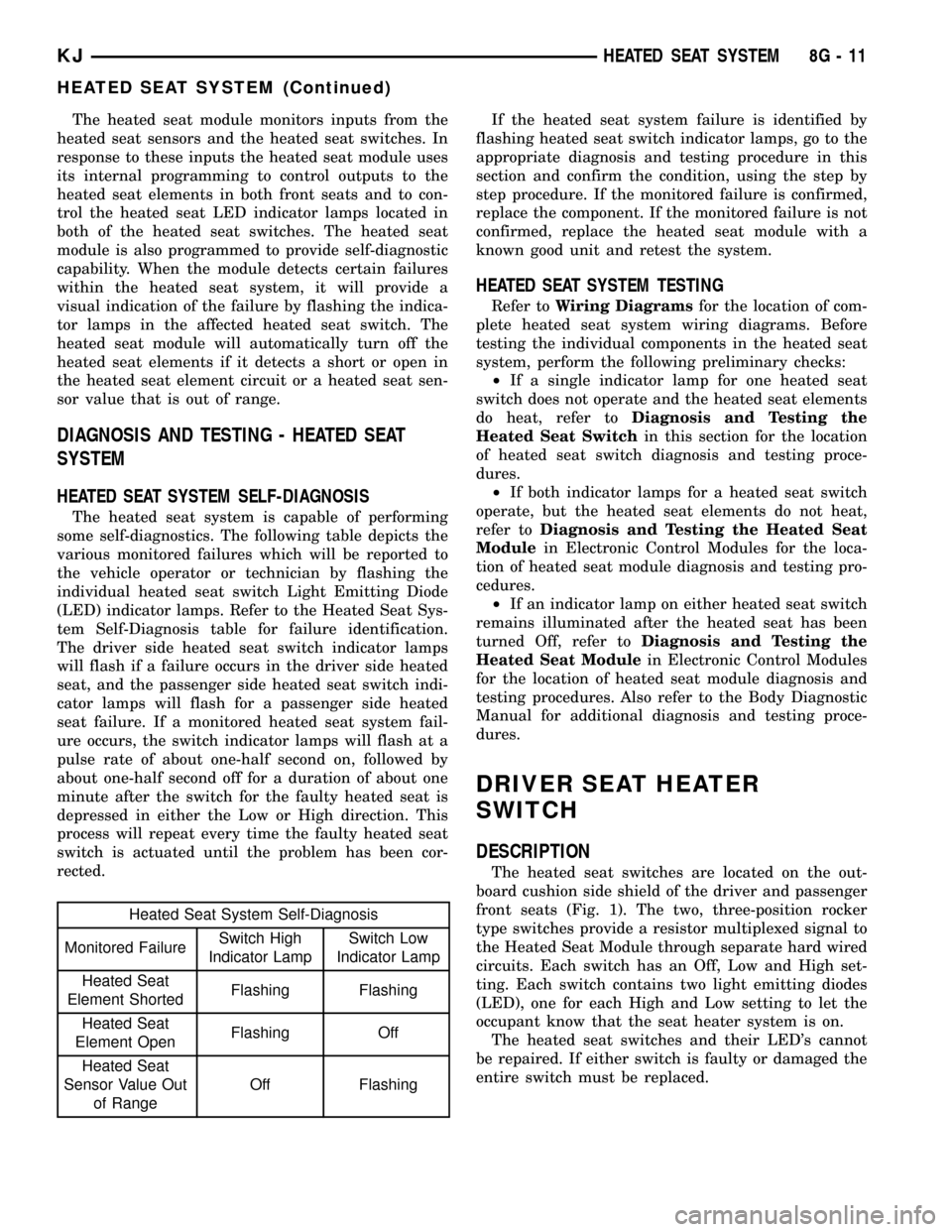
HEATED SEAT SYSTEM SELF-DIAGNOSIS
The heated seat system is capable of performing
some self-diagnostics. The following table depicts the
various monitored failures which will be reported to
the vehicle operator or technician by flashing the
individual heated seat switch Light Emitting Diode
(LED) indicator lamps. Refer to the Heated Seat Sys-
tem Self-Diagnosis table for failure identification.
The driver side heated seat switch indicator lamps
will flash if a failure occurs in the driver side heated
seat, and the passenger side heated seat switch indi-
cator lamps will flash for a passenger side heated
seat failure. If a monitored heated seat system fail-
ure occurs, the switch indicator lamps will flash at a
pulse rate of about one-half second on, followed by
about one-half second off for a duration of about one
minute after the switch for the faulty heated seat is
depressed in either the Low or High direction. This
process will repeat every time the faulty heated seat
switch is actuated until the problem has been cor-
rected.
Heated Seat System Self-Diagnosis
Monitored FailureSwitch High
Indicator LampSwitch Low
Indicator Lamp
Heated Seat
Element ShortedFlashing Flashing
Heated Seat
Element OpenFlashing Off
Heated Seat
Sensor Value Out
of RangeOff FlashingIf the heated seat system failure is identified by
flashing heated seat switch indicator lamps, go to the
appropriate diagnosis and testing procedure in this
section and confirm the condition, using the step by
step procedure. If the monitored failure is confirmed,
replace the component. If the monitored failure is not
confirmed, replace the heated seat module with a
known good unit and retest the system.
HEATED SEAT SYSTEM TESTING
Refer toWiring Diagramsfor the location of com-
plete heated seat system wiring diagrams. Before
testing the individual components in the heated seat
system, perform the following preliminary checks:
²If a single indicator lamp for one heated seat
switch does not operate and the heated seat elements
do heat, refer toDiagnosis and Testing the
Heated Seat Switchin this section for the location
of heated seat switch diagnosis and testing proce-
dures.
²If both indicator lamps for a heated seat switch
operate, but the heated seat elements do not heat,
refer toDiagnosis and Testing the Heated Seat
Modulein Electronic Control Modules for the loca-
tion of heated seat module diagnosis and testing pro-
cedures.
²If an indicator lamp on either heated seat switch
remains illuminated after the heated seat has been
turned Off, refer toDiagnosis and Testing the
Heated Seat Modulein Electronic Control Modules
for the location of heated seat module diagnosis and
testing procedures. Also refer to the Body Diagnostic
Manual for additional diagnosis and testing proce-
dures.
DRIVER SEAT HEATER
SWITCH
DESCRIPTION
The heated seat switches are located on the out-
board cushion side shield of the driver and passenger
front seats (Fig. 1). The two, three-position rocker
type switches provide a resistor multiplexed signal to
the Heated Seat Module through separate hard wired
circuits. Each switch has an Off, Low and High set-
ting. Each switch contains two light emitting diodes
(LED), one for each High and Low setting to let the
occupant know that the seat heater system is on.
The heated seat switches and their LED's cannot
be repaired. If either switch is faulty or damaged the
entire switch must be replaced.
KJHEATED SEAT SYSTEM 8G - 11
HEATED SEAT SYSTEM (Continued)
Page 381 of 1803

HEATED SEAT SENSOR
DIAGNOSIS AND TESTING - HEATED SEAT
SENSOR
For complete circuit diagrams, refer toWIRING.
NOTE: ANY RESISTANCE VALUES (OHMSV) GIVEN
IN THE FOLLOWING TEXT ARE SUPPLIED USING
THE AUTOMATIC RANGE GENERATED BY A
FLUKETAUTOMOTIVE METER. IF ANOTHER TYPE
OF MEASURING DEVICE IS USED THE VALUES
GENERATED MAY NOT BE THE SAME AS THE
RESULTS SHOWN HERE, OR MAY HAVE TO BE
CONVERTED TO THE RANGE USED HERE.
(1) Disconnect the heated seat wire harness con-
nector from under the seat. Using an ohmmeter,
check the resistance between the heated seat sensor
input circuit cavity and the heated seat sensor feed
circuit cavity in the heated seat wire harness connec-
tor. The heated seat sensor resistance should be
between 1 kilohm and 100 kilohms. If OK, go to Step
2. If not OK, replace the faulty seat heating element
assembly.
(2) Test the seat wire harness between the heated
seat module connector and the heated seat wire har-
ness connector for a shorted or open circuit. If OK,
refer toDiagnosis and Testing the Heated Seat
Modulein Electronic Control Modules, for the
proper heated seat module diagnosis and testing pro-
cedures. If not OK, repair the shorted or open heated
seat wire harness as required.
PASSENGER SEAT HEATER
SWITCH
DESCRIPTION
The heated seat switches are located on the out-
board cushion side shield of the driver and passenger
front seats (Fig. 3). The two, three-position rocker
type switches provide a resistor multiplexed signal to
the Heated Seat Module through separate hard wired
circuits. Each switch has an Off, Low and High set-
ting. Each switch contains two light emitting diodes
(LED), one for each High and Low setting to let the
occupant know that the seat heater system is on.
The heated seat switches and their LED's cannot
be repaired. If either switch is faulty or damaged the
entire switch must be replaced.
OPERATION
There are three positions that can be selected with
each of the heated seat switches: Off, Low, and High.
When the front of the switch rocker is fullydepressed, the High position is selected and the high
position LED indicator illuminates. When the rear of
the switch rocker is fully depressed, the Low position
is selected and the low position LED indicator illumi-
nates. When the switch rocker is depressed a second
time in either direction, Off is selected and both LED
indicators are extinguished.
Both switches provide separate resistor multi-
plexed hard wire inputs to the Heated Seat Module
to indicate the selected switch position. The heated
seat module monitors the switch inputs and responds
to the heated seat switch status messages by control-
ling the output to the seat heater elements of the
selected seat. The Low heat position set point is
about 36É C (97É F), and the High heat position set
point is about 41É C (105É F).
DIAGNOSIS AND TESTING - HEATED SEAT
SWITCH
If a heated seat fails to heat and one or both of the
indicator lamps on a heated seat switch flash, refer
toHeated Seat System Diagnosis and Testingin
this section for flashing LED failure identification.
Refer toWiring Diagramsfor complete heated seat
system wiring diagrams.
(1) If the problem being diagnosed involves a
heated seat switch indicator lamp that remains illu-
minated after the heated seat has been turned Off,
refer toDiagnosis and Testing the Heated Seat
Modulein the Electronic Control Modules section for
heated seat module diagnosis and testing procedures.
If not, go to Step 2
Fig. 3 KJ POWER / HEATED SEAT
8G - 14 HEATED SEAT SYSTEMKJ
Page 406 of 1803

perform its many functions. The EMIC module incor-
porates a blue-green digital Vacuum Fluorescent Dis-
play (VFD) for displaying odometer and trip
odometer information, as well as several warning
messages and certain diagnostic information. In addi-
tion to instrumentation and indicators, the EMIC has
the hardware and software needed to provide the fol-
lowing features:
²Chime Warning Service- A chime tone gener-
ator on the EMIC electronic circuit board provides
audible alerts to the vehicle operator and eliminates
the need for a separate chime module. (Refer to 8 -
ELECTRICAL/CHIME WARNING SYSTEM -
DESCRIPTION).
²Panel Lamps Dimming Service- The EMIC
provides a hard wired 12-volt Pulse-Width Modulated
(PWM) output that synchronizes the dimming level
of the radio display, gear selector indicator, heater-air
conditioner control, and all other dimmable lighting
on the panel lamps dimmer circuit with that of the
cluster illumination lamps and VFD.
The EMIC houses four analog gauges and has pro-
visions for up to twenty-four indicators (Fig. 2). The
EMIC includes the following analog gauges:
²Coolant Temperature Gauge
²Fuel Gauge
²Speedometer
²Tachometer
Some of the EMIC indicators are automatically
configured when the EMIC is connected to the vehi-
cle electrical system for compatibility with certain
optional equipment or equipment required for regula-
tory purposes in certain markets. While each EMIC
may have provisions for indicators to support every
available option, the configurable indicators will not
be functional in a vehicle that does not have the
equipment that an indicator supports. The EMIC
includes provisions for the following indicators (Fig.
2):
²Airbag Indicator (with Airbag System only)
²Antilock Brake System (ABS) Indicator
(with ABS only)
²Brake Indicator
²Charging Indicator
²Coolant Low Indicator (with Diesel Engine
only)
²Cruise Indicator (with Speed Control Sys-
tem only)
²Four-Wheel Drive Full Time Indicator (with
Selec-Trac Transfer Case only)
²Four-Wheel Drive Low Mode Indicator
²Four-Wheel Drive Part Time Indicator
²Front Fog Lamp Indicator (with Front Fog
Lamps only)
²High Beam Indicator
²Low Fuel Indicator²Low Oil Pressure Indicator
²Malfunction Indicator Lamp (MIL)
²Overdrive-Off Indicator (with Automatic
Transmission only)
²Rear Fog Lamp Indicator (with Rear Fog
Lamps only)
²Seatbelt Indicator
²Security Indicator (with Vehicle Theft
Security System only)
²Sentry Key Immobilizer System (SKIS)
Indicator (with SKIS only)
²Transmission Overtemp Indicator (with
Automatic Transmission only)
²Turn Signal (Right and Left) Indicators
²Wait-To-Start Indicator (with Diesel Engine
only)
²Water-In-Fuel Indicator (with Diesel Engine
only)
Each indicator in the EMIC is illuminated by a
dedicated Light Emitting Diode (LED) that is sol-
dered onto the EMIC electronic circuit board. The
LEDs are not available for service replacement and,
if damaged or faulty, the entire EMIC must be
replaced. Cluster illumination is accomplished by
dimmable incandescent back lighting, which illumi-
nates the gauges for visibility when the exterior
lighting is turned on. Each of the incandescent bulbs
is secured by an integral bulb holder to the electronic
circuit board from the back of the cluster housing.
The incandescent bulb/bulb holder units are available
for service replacement.
Hard wired circuitry connects the EMIC to the
electrical system of the vehicle. These hard wired cir-
cuits are integral to several wire harnesses, which
are routed throughout the vehicle and retained by
many different methods. These circuits may be con-
nected to each other, to the vehicle electrical system
and to the EMIC through the use of a combination of
soldered splices, splice block connectors, and many
different types of wire harness terminal connectors
and insulators. Refer to the appropriate wiring infor-
mation. The wiring information includes wiring dia-
grams, proper wire and connector repair procedures,
further details on wire harness routing and reten-
tion, as well as pin-out and location views for the
various wire harness connectors, splices and grounds.
The EMIC modules for this model are serviced only
as complete units. The EMIC module cannot be
adjusted or repaired. If a gauge, an LED indicator,
the VFD, the electronic circuit board, the circuit
board hardware, the cluster overlay, or the EMIC
housing are damaged or faulty, the entire EMIC mod-
ule must be replaced. The cluster lens, hood and
mask unit and the individual incandescent lamp
bulbs with holders are available for service replace-
ment.
KJINSTRUMENT CLUSTER 8J - 3
INSTRUMENT CLUSTER (Continued)
Page 445 of 1803

front of the vehicle. In certain markets where
required, a headlamp leveling actuator motor is
included on each headlamp.
²Park Lamps- The park lamps include the front
park lamps and front side marker lamps that are
integral to the front lamp units mounted at each end
of the bumper fascia at the front of the vehicle, as
well as the rear park lamps and rear side marker
lamps that are integral to the rear lamp units
mounted to the back of the quarter panel on each
side of the tailgate at the rear of the vehicle. The
park lamps include a license plate lamp or lamps,
depending upon the requirements of the market for
which the vehicle is manufactured. Vehicles with a
license plate tub located near the left end of the rear
bumper fascia have a single lamp, while vehicles
with a license plate module located on the spare tire
carrier have two license plate lamps. In certain mar-
kets where required, a front position lamp that is
integral to each headlamp unit is illuminated instead
of the front park lamps and front side marker lamps
in the park lamps circuit; and, a rectangular, red
reflector is located on the rear bumper fascia just
inboard and below each rear lamp unit.
²Rear Fog Lamps- Rear fog lamps are avail-
able only in certain markets where they are required
equipment. The rear fog lamps are integral to the
rear lamp units mounted to the back of the quarter
panel on each side of the tailgate at the rear of the
vehicle.
²Turn Signal Lamps- The turn signal lamps
include the front turn signal and front side marker
lamps that are integral to the front lamp units
mounted at each end of the bumper fascia at the
front of the vehicle, as well as rear turn signal lamps
that are integral to the rear lamp units mounted to
the back of the quarter panel on each side of the tail-
gate at the rear of the vehicle. In certain markets
where required, a repeater lamp unit mounted to
each front fender just behind the front wheel opening
is illuminated instead of the front side marker lamp
in each turn signal lamp circuit.
Other components of the exterior lighting system
for this model include:
²Combination Flasher- An electronic combina-
tion flasher is integral to the hazard warning switch
in the center of the instrument panel.
²Backup Lamp Switch- Vehicles equipped with
a manual transmission have a plunger-type backup
lamp switch located on the transmission housing. ATransmission Range Sensor (TRS) integral to the
solenoid pack on the valve body of the optional elec-
tronic automatic transmission performs the backup
lamp switch function on models that are so equipped.
²Brake Lamp Switch- A plunger-type brake
lamp switch is located on the steering column sup-
port bracket under the instrument panel and actu-
ated by the brake pedal arm.
²Body Control Module- The Body Control
Module (BCM) is located on the Junction Block (JB)
under the driver side outboard end of the instrument
panel. (Refer to 8 - ELECTRICAL/ELECTRONIC
CONTROL MODULES/BODY CONTROL MODULE
- DESCRIPTION).
²Daytime Running Lamp Relay- Vehicles
manufactured for sale in Canada use a solid state
Daytime Running Lamps (DRL) relay installed in the
Junction Block (JB) instead of the conventional high
beam relay.
²Front Fog Lamp Relay- Vehicles equipped
with the optional front fog lamps have a front fog
lamp relay located in the Junction Block (JB).
²Hazard Switch- The hazard switch is located
near the center of the instrument panel and includes
the integral electronic combination flasher circuitry
for the hazard warning system and the turn signal
system.
²Headlamp Leveling Motor- A headlamp lev-
eling actuator motor is located on the back of each
headlamp housing of vehicles manufactured for cer-
tain markets where this equipment is required.
²Headlamp Leveling Switch- A thumbwheel
actuated headlamp leveling switch is mounted in the
driver side inboard instrument panel trim bezel of
vehicles manufactured for certain markets where this
equipment is required.
²High Beam Relay- A high beam relay is
located in the Junction Block (JB) of all vehicles
except those that are manufactured for sale in Can-
ada. Canadian vehicles have a solid state Daytime
Running Lamps (DRL) relay in the JB instead of the
high beam relay.
²Low Beam Relay- A low beam relay is located
in the Junction Block (JB) of all vehicles.
²Multi-Function Switch- The multi-function
switch is located on the top of the steering column,
just below the steering wheel. The multi-function
switch includes a left (lighting) control stalk and a
right (wiper) control stalk. The left control stalk is
dedicated to providing almost all of the driver con-
1 - HEADLAMP UNIT (2)
2 - REPEATER LAMP UNIT (2)
3 - FRONT POSITION LAMP (2)
4 - FRONT LAMP UNIT (2)
5 - FRONT FOG LAMP (2)6 - CENTER HIGH MOUNTED STOP LAMP UNIT
7 - REAR LAMP UNIT
8 - LICENSE PLATE LAMP UNIT
8L - 4 LAMPS/LIGHTING - EXTERIORKJ
LAMPS/LIGHTING - EXTERIOR (Continued)
Page 456 of 1803
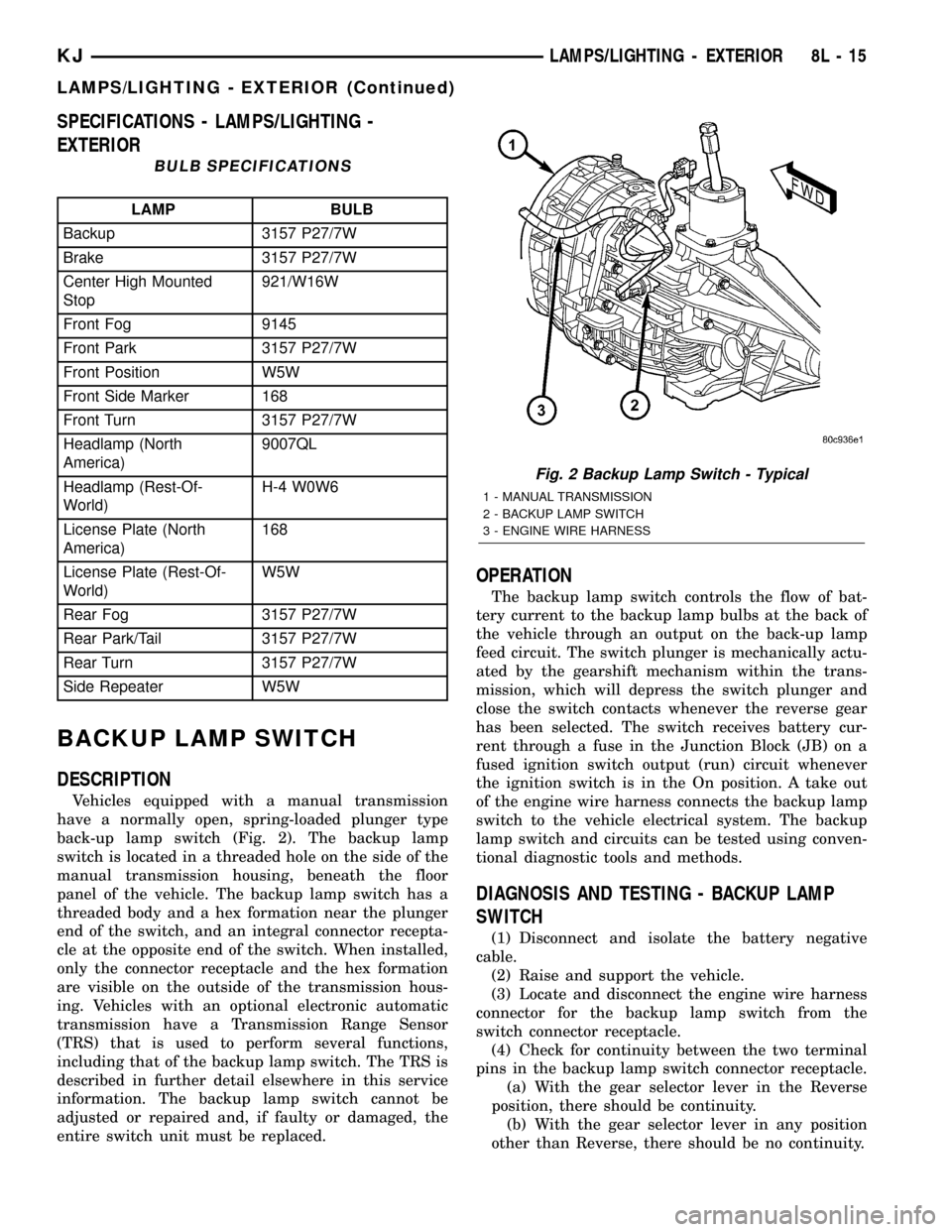
SPECIFICATIONS - LAMPS/LIGHTING -
EXTERIOR
BULB SPECIFICATIONS
LAMP BULB
Backup 3157 P27/7W
Brake 3157 P27/7W
Center High Mounted
Stop921/W16W
Front Fog 9145
Front Park 3157 P27/7W
Front Position W5W
Front Side Marker 168
Front Turn 3157 P27/7W
Headlamp (North
America)9007QL
Headlamp (Rest-Of-
World)H-4 W0W6
License Plate (North
America)168
License Plate (Rest-Of-
World)W5W
Rear Fog 3157 P27/7W
Rear Park/Tail 3157 P27/7W
Rear Turn 3157 P27/7W
Side Repeater W5W
BACKUP LAMP SWITCH
DESCRIPTION
Vehicles equipped with a manual transmission
have a normally open, spring-loaded plunger type
back-up lamp switch (Fig. 2). The backup lamp
switch is located in a threaded hole on the side of the
manual transmission housing, beneath the floor
panel of the vehicle. The backup lamp switch has a
threaded body and a hex formation near the plunger
end of the switch, and an integral connector recepta-
cle at the opposite end of the switch. When installed,
only the connector receptacle and the hex formation
are visible on the outside of the transmission hous-
ing. Vehicles with an optional electronic automatic
transmission have a Transmission Range Sensor
(TRS) that is used to perform several functions,
including that of the backup lamp switch. The TRS is
described in further detail elsewhere in this service
information. The backup lamp switch cannot be
adjusted or repaired and, if faulty or damaged, the
entire switch unit must be replaced.
OPERATION
The backup lamp switch controls the flow of bat-
tery current to the backup lamp bulbs at the back of
the vehicle through an output on the back-up lamp
feed circuit. The switch plunger is mechanically actu-
ated by the gearshift mechanism within the trans-
mission, which will depress the switch plunger and
close the switch contacts whenever the reverse gear
has been selected. The switch receives battery cur-
rent through a fuse in the Junction Block (JB) on a
fused ignition switch output (run) circuit whenever
the ignition switch is in the On position. A take out
of the engine wire harness connects the backup lamp
switch to the vehicle electrical system. The backup
lamp switch and circuits can be tested using conven-
tional diagnostic tools and methods.
DIAGNOSIS AND TESTING - BACKUP LAMP
SWITCH
(1) Disconnect and isolate the battery negative
cable.
(2) Raise and support the vehicle.
(3) Locate and disconnect the engine wire harness
connector for the backup lamp switch from the
switch connector receptacle.
(4) Check for continuity between the two terminal
pins in the backup lamp switch connector receptacle.
(a) With the gear selector lever in the Reverse
position, there should be continuity.
(b) With the gear selector lever in any position
other than Reverse, there should be no continuity.
Fig. 2 Backup Lamp Switch - Typical
1 - MANUAL TRANSMISSION
2 - BACKUP LAMP SWITCH
3 - ENGINE WIRE HARNESS
KJLAMPS/LIGHTING - EXTERIOR 8L - 15
LAMPS/LIGHTING - EXTERIOR (Continued)