Turn JEEP LIBERTY 2002 KJ / 1.G Workshop Manual
[x] Cancel search | Manufacturer: JEEP, Model Year: 2002, Model line: LIBERTY, Model: JEEP LIBERTY 2002 KJ / 1.GPages: 1803, PDF Size: 62.3 MB
Page 645 of 1803

The resistive membrane-type horn switch is
secured with heat stakes to the inside surface of the
driver airbag trim cover, between the trim cover and
the folded airbag cushion. The horn switch ground
pigtail wire has a female spade terminal connector
that receives a path to ground through a male spade
terminal that is integral to the driver airbag housing
stamping and is located near the upper right corner
on the back of the housing (Fig. 15). The horn switch
feed pigtail wire has a white, molded plastic insula-
tor that is secured by an integral retainer to a
mounting hole located near the lower left corner on
the back of the housing, and is connected to the vehi-
cle electrical system through a take out and connec-
tor of the steering wheel wire harness.
The airbag used in this model is a multistage, Next
Generation-type that complies with revised federal
airbag standards to deploy with less force than those
used in some prior models. A 67 centimeter (26.5
inch) diameter, radial deploying fabric cushion with
tethers is used. The airbag inflator is a dual-initiator,
non-azide, pyrotechnic-type unit with four mounting
studs and is secured to the stamped metal airbag
housing using four hex nuts with washers. Two
keyed and color-coded connector receptacles on the
driver airbag inflator connect the two inflator initia-
tors to the vehicle electrical system through two yel-
low-jacketed, two-wire pigtail harnesses of the
clockspring. The driver airbag and horn switch unit
cannot be repaired, and must be replaced if deployed
or in any way damaged.OPERATION
The multistage driver airbag is deployed by electri-
cal signals generated by the Airbag Control Module
(ACM) through the driver airbag squib 1 and squib 2
circuits to the two initiators in the airbag inflator. By
using two initiators, the airbag can be deployed at
multiple levels of force. The force level is controlled
by the ACM to suit the monitored impact conditions
by providing one of three delay intervals between the
electrical signals provided to the two initiators. The
longer the delay between these signals, the less force-
fully the airbag will deploy. When the ACM sends the
proper electrical signals to each initiator, the electri-
cal energy generates enough heat to initiate a small
pyrotechnic charge which, in turn ignites chemical
pellets within the inflator. Once ignited, these chem-
ical pellets burn rapidly and produce a large quantity
of nitrogen gas. The inflator is sealed to the back of
the airbag housing and a diffuser in the inflator
directs all of the nitrogen gas into the airbag cush-
ion, causing the cushion to inflate. As the cushion
inflates, the driver airbag trim cover will split at pre-
determined breakout lines, then fold back out of the
way along with the horn switch unit. Following an
airbag deployment, the airbag cushion quickly
deflates by venting the nitrogen gas towards the
instrument panel through vent holes within the fab-
ric used to construct the back (steering wheel side)
panel of the airbag cushion.
Some of the chemicals used to create the nitrogen
gas may be considered hazardous while in their solid
state before they are burned, but they are securely
sealed within the airbag inflator. Typically, both ini-
tiators are used and all potentially hazardous chem-
icals are burned during an airbag deployment event.
However, it is possible for only one initiator to be
used during a deployment due to an airbag system
fault; therefore, it is necessary to always confirm
that both initiators have been used in order to avoid
the improper disposal of potentially live pyrotechnic
or hazardous materials. (Refer to 8 - ELECTRICAL/
RESTRAINTS - STANDARD PROCEDURE - SER-
VICE AFTER A SUPPLEMENTAL RESTRAINT
DEPLOYMENT). The nitrogen gas that is produced
when the chemicals are burned is harmless. How-
ever, a small amount of residue from the burned
chemicals may cause some temporary discomfort if it
contacts the skin, eyes, or breathing passages. If skin
or eye irritation is noted, rinse the affected area with
plenty of cool, clean water. If breathing passages are
irritated, move to another area where there is plenty
of clean, fresh air to breath. If the irritation is not
alleviated by these actions, contact a physician.
Fig. 15 Driver Airbag Housing
1 - HOUSING
2 - HORN SWITCH GROUND WIRE
3 - HORN SWITCH FEED WIRE
4 - INFLATOR
5 - TRIM COVER
8O - 18 RESTRAINTSKJ
DRIVER AIRBAG (Continued)
Page 651 of 1803

(4) Remove the screw that secures the lower
anchor to the bracket on the outboard side of the
front seat cushion frame.
(5) Unsnap and lift the trim cover to access the
nut that secures the front seat belt turning loop to
the height adjuster on the upper B-pillar (Fig. 20).
(6) Remove the nut that secures the seat belt turn-
ing loop to the height adjuster stud on the upper
B-pillar.
(7) Remove the seat belt turning loop from the
height adjuster stud.
(8) Remove the upper and lower trim from the
inside of the B-pillar. (Refer to 23 - BODY/INTERI-
OR/B-PILLAR UPPER TRIM - REMOVAL) and
(Refer to 23 - BODY/INTERIOR/B-PILLAR LOWER
TRIM - REMOVAL).
(9) On the driver side only, disconnect the seat belt
tensioner pigtail wire connector from the body wire
harness connector.
(10) Remove the screw that secures the lower
retractor bracket to the lower B-pillar.
(11) Disengage the engagement tab on the upper
retractor bracket/seat belt web guide from the
engagement slot in the lower B-pillar.
(12) Remove the front seat belt and retractor from
the B-pillar as a unit.INSTALLATION
WARNING: ON VEHICLES EQUIPPED WITH AIR-
BAGS, DISABLE THE SUPPLEMENTAL RESTRAINT
SYSTEM BEFORE ATTEMPTING ANY STEERING
WHEEL, STEERING COLUMN, DRIVER AIRBAG,
PASSENGER AIRBAG, SEAT BELT TENSIONER,
FRONT IMPACT SENSORS, SIDE CURTAIN AIRBAG,
OR INSTRUMENT PANEL COMPONENT DIAGNOSIS
OR SERVICE. DISCONNECT AND ISOLATE THE
BATTERY NEGATIVE (GROUND) CABLE, THEN
WAIT TWO MINUTES FOR THE SYSTEM CAPACI-
TOR TO DISCHARGE BEFORE PERFORMING FUR-
THER DIAGNOSIS OR SERVICE. THIS IS THE ONLY
SURE WAY TO DISABLE THE SUPPLEMENTAL
RESTRAINT SYSTEM. FAILURE TO TAKE THE
PROPER PRECAUTIONS COULD RESULT IN ACCI-
DENTAL AIRBAG DEPLOYMENT AND POSSIBLE
PERSONAL INJURY.
WARNING: DURING AND FOLLOWING ANY SEAT
BELT SERVICE, CAREFULLY INSPECT ALL SEAT
BELTS, BUCKLES, MOUNTING HARDWARE, AND
RETRACTORS FOR PROPER INSTALLATION,
OPERATION, OR DAMAGE. REPLACE ANY BELT
THAT IS CUT, FRAYED, OR TORN. STRAIGHTEN
ANY BELT THAT IS TWISTED. TIGHTEN ANY
LOOSE FASTENERS. REPLACE ANY BELT THAT
HAS A DAMAGED OR INOPERATIVE BUCKLE OR
RETRACTOR. REPLACE ANY BELT THAT HAS A
BENT OR DAMAGED LATCH PLATE OR ANCHOR
PLATE. NEVER ATTEMPT TO REPAIR A SEAT BELT
COMPONENT. ALWAYS REPLACE DAMAGED OR
FAULTY SEAT BELT COMPONENTS WITH THE COR-
RECT, NEW AND UNUSED REPLACEMENT PARTS
LISTED IN THE MOPAR PARTS CATALOG.
(1) Position the front seat belt and retractor to the
B-pillar as a unit (Fig. 20). Be certain to engage the
engagement tab on the upper retractor bracket/seat
belt web guide into the engagement slot in the lower
B-pillar.
(2) Install and tighten the screw that secures the
lower retractor bracket to the lower B-pillar. Tighten
the screw to 43 N´m (32 ft. lbs.).
(3) On the driver side only, reconnect the seat belt
tensioner pigtail wire connector to the body wire har-
ness connector.
(4) Reinstall the upper and lower trim onto the
inside of the B-pillar. (Refer to 23 - BODY/INTERI-
OR/B-PILLAR UPPER TRIM - INSTALLATION) and
(Refer to 23 - BODY/INTERIOR/B-PILLAR LOWER
TRIM - INSTALLATION).
(5) Position the seat belt turning loop onto the
height adjuster stud on the upper B-pillar.
Fig. 20 Front Seat Belt Retractor Remove/Install
1 - ADJUSTER
2 - B-PILLAR
3 - RETRACTOR
4 - B-PILLAR TRIM
5 - CONNECTOR (DRIVER SIDE ONLY)
6 - LOWER ANCHOR
7 - NUT
8 - TURNING LOOP
9 - COVER
8O - 24 RESTRAINTSKJ
FRONT SEAT BELT & RETRACTOR (Continued)
Page 652 of 1803

(6) Install and tighten the nut that secures the
seat belt turning loop to the height adjuster stud.
Tighten the nut to 34 N´m (25 ft. lbs.).
(7) Fold and snap the trim cover back into place to
conceal the nut that secures the front seat belt turn-
ing loop to the height adjuster on the upper B-pillar.
(8) Position the front seat belt lower anchor to the
bracket on the outboard side of the front seat cushion
frame (Fig. 19).
(9) Install and tighten the screw that secures the
lower anchor to the bracket on the outboard side of
the front seat cushion frame. Tighten the screw to 43
N´m (32 ft. lbs.).
(10) Align the plug that covers the front seat belt
lower anchor screw with the hole near the rear of the
outboard seat side shield. Using hand pressure, press
firmly and evenly on the plug until it snaps into
place.
(11) Do not reconnect the battery negative cable at
this time. The airbag system verification test proce-
dure should be performed following service of any
supplemental restraint system component. (Refer to
8 - ELECTRICAL/RESTRAINTS - STANDARD PRO-
CEDURE - VERIFICATION TEST).
FRONT SEAT BELT BUCKLE
REMOVAL
WARNING: ON VEHICLES EQUIPPED WITH AIR-
BAGS, DISABLE THE SUPPLEMENTAL RESTRAINT
SYSTEM BEFORE ATTEMPTING ANY STEERING
WHEEL, STEERING COLUMN, DRIVER AIRBAG,
PASSENGER AIRBAG, SEAT BELT TENSIONER,
FRONT IMPACT SENSORS, SIDE CURTAIN AIRBAG,
OR INSTRUMENT PANEL COMPONENT DIAGNOSIS
OR SERVICE. DISCONNECT AND ISOLATE THE
BATTERY NEGATIVE (GROUND) CABLE, THEN
WAIT TWO MINUTES FOR THE SYSTEM CAPACI-
TOR TO DISCHARGE BEFORE PERFORMING FUR-
THER DIAGNOSIS OR SERVICE. THIS IS THE ONLY
SURE WAY TO DISABLE THE SUPPLEMENTAL
RESTRAINT SYSTEM. FAILURE TO TAKE THE
PROPER PRECAUTIONS COULD RESULT IN ACCI-
DENTAL AIRBAG DEPLOYMENT AND POSSIBLE
PERSONAL INJURY.WARNING: DURING AND FOLLOWING ANY SEAT
BELT SERVICE, CAREFULLY INSPECT ALL SEAT
BELTS, BUCKLES, MOUNTING HARDWARE, AND
RETRACTORS FOR PROPER INSTALLATION,
OPERATION, OR DAMAGE. REPLACE ANY BELT
THAT IS CUT, FRAYED, OR TORN. STRAIGHTEN
ANY BELT THAT IS TWISTED. TIGHTEN ANY
LOOSE FASTENERS. REPLACE ANY BELT THAT
HAS A DAMAGED OR INOPERATIVE BUCKLE OR
RETRACTOR. REPLACE ANY BELT THAT HAS A
BENT OR DAMAGED LATCH PLATE OR ANCHOR
PLATE. NEVER ATTEMPT TO REPAIR A SEAT BELT
COMPONENT. ALWAYS REPLACE DAMAGED OR
FAULTY SEAT BELT COMPONENTS WITH THE COR-
RECT, NEW AND UNUSED REPLACEMENT PARTS
LISTED IN THE MOPAR PARTS CATALOG.
(1) Disconnect and isolate the battery negative
cable. Wait two minutes for the system capacitor to
discharge before further service.
(2) Remove the front seat and seat track from the
floor panel as a unit. (Refer to 23 - BODY/SEATS/
SEAT - FRONT - REMOVAL).
(3) Disconnect the seat belt switch pigtail wire
connector from the seat wire harness connector on
the seat cushion frame bracket located under the
rear edge of the seat cushion near the inboard side of
the seat (Fig. 21).
Fig. 21 Seat Belt Switch Connector
1 - PIGTAIL WIRE
2 - SEAT WIRE HARNESS
3 - SEAT CUSHION FRAME BRACKET
4 - BODY WIRE HARNESS
5 - INBOARD SEAT TRACK
KJRESTRAINTS 8O - 25
FRONT SEAT BELT & RETRACTOR (Continued)
Page 660 of 1803

(11) Remove the screw that secures the retractor
to the rear seat back panel (Fig. 30).
(12) Remove the rear center seat belt and retractor
unit from the seat back panel.
INSTALLATION
WARNING: DURING AND FOLLOWING ANY SEAT
BELT SERVICE, CAREFULLY INSPECT ALL SEAT
BELTS, BUCKLES, MOUNTING HARDWARE, AND
RETRACTORS FOR PROPER INSTALLATION,
OPERATION, OR DAMAGE. REPLACE ANY BELT
THAT IS CUT, FRAYED, OR TORN. STRAIGHTEN
ANY BELT THAT IS TWISTED. TIGHTEN ANY
LOOSE FASTENERS. REPLACE ANY BELT THAT
HAS A DAMAGED OR INOPERATIVE BUCKLE OR
RETRACTOR. REPLACE ANY BELT THAT HAS A
BENT OR DAMAGED LATCH PLATE OR ANCHOR
PLATE. NEVER ATTEMPT TO REPAIR A SEAT BELT
COMPONENT. ALWAYS REPLACE DAMAGED OR
FAULTY SEAT BELT COMPONENTS WITH THE COR-
RECT, NEW AND UNUSED REPLACEMENT PARTS
LISTED IN THE MOPAR PARTS CATALOG.
(1) Position the rear center seat belt and retractor
unit onto the seat back panel.
(2) Install and tighten the screw that secures the
retractor to the rear seat back panel (Fig. 30).
Tighten the screw to 27 N´m (20 ft. lbs.).
(3) Position the seat back latch cable plunger
against the retractor latch lever, then engage the
cable fitting into the cable support on the retractor,
which is a light snap fit (Fig. 29).
(4) Route the rear seat belt lower anchor and belt
web guide through the top of the seat back panel.(5) Reinstall the trim onto the right rear seat
back. (Refer to 23 - BODY/SEATS/SEAT BACK
COVER - REAR - INSTALLATION).
(6) Install and tighten the two screws that secure
the belt web guide to the top of the right rear seat
back panel. Tighten the screws to 2 N´m (20 in. lbs.).
(7) Reinstall the right rear seat back panel into
the vehicle. (Refer to 23 - BODY/SEATS/SEAT BACK
- REAR - INSTALLATION).
(8) Position the rear center seat belt lower anchor
off of the stud on the rear floor panel (Fig. 28).
(9) Reach between the base of the right rear seat
back and the forward edge of the rear cargo floor to
install and tighten the screw that secures the rear
center seat belt lower anchor to the floor panel.
Tighten the screw to 43 N´m (32 ft. lbs.).
(10) Restore the cargo area carpet to the base of
the seat back panel and unfold the right rear seat
back to its upright position.
(11) Reinstall the right center seat belt buckle unit
onto the floor panel. (Refer to 8 - ELECTRICAL/RE-
STRAINTS/SEAT BELT BUCKLE - INSTALLA-
TION).
REAR OUTBOARD SEAT BELT
& RETRACTOR
REMOVAL
WARNING: DURING AND FOLLOWING ANY SEAT
BELT SERVICE, CAREFULLY INSPECT ALL SEAT
BELTS, BUCKLES, MOUNTING HARDWARE, AND
RETRACTORS FOR PROPER INSTALLATION,
OPERATION, OR DAMAGE. REPLACE ANY BELT
THAT IS CUT, FRAYED, OR TORN. STRAIGHTEN
ANY BELT THAT IS TWISTED. TIGHTEN ANY
LOOSE FASTENERS. REPLACE ANY BELT THAT
HAS A DAMAGED OR INOPERATIVE BUCKLE OR
RETRACTOR. REPLACE ANY BELT THAT HAS A
BENT OR DAMAGED LATCH PLATE OR ANCHOR
PLATE. NEVER ATTEMPT TO REPAIR A SEAT BELT
COMPONENT. ALWAYS REPLACE DAMAGED OR
FAULTY SEAT BELT COMPONENTS WITH THE COR-
RECT, NEW AND UNUSED REPLACEMENT PARTS
LISTED IN THE MOPAR PARTS CATALOG.
(1) Unsnap and lift the trim cover to access the
screw that secures the rear outboard seat belt turn-
ing loop to the upper C-pillar (Fig. 31).
(2) Remove the screw that secures the seat belt
turning loop to the upper C-pillar.
(3) Remove the screw that secures the lower seat
belt anchor to the bracket on the outboard side of the
rear seat cushion frame.
Fig. 30 Rear Center Retractor Remove/Install
1 - REAR SEAT BACK PANEL
2 - SCREW (1)
KJRESTRAINTS 8O - 33
REAR CENTER SEAT BELT & RETRACTOR (Continued)
Page 661 of 1803

(4) Remove the quarter trim panel from the C-pil-
lar. (Refer to 23 - BODY/INTERIOR/QUARTER
TRIM PANEL - REMOVAL).
(5) Route the seat belt lower anchor and turning
loop through the access hole in the quarter trim
panel.
(6) Remove the screw that secures the retractor
bracket to the lower C-pillar.
(7) Lift the retractor upward far enough to disen-
gage the retractor tab from the engagement hole in
the lower C-pillar.
(8) Remove the rear outboard seat belt and retrac-
tor from the C-pillar as a unit.
INSTALLATION
WARNING: DURING AND FOLLOWING ANY SEAT
BELT SERVICE, CAREFULLY INSPECT ALL SEAT
BELTS, BUCKLES, MOUNTING HARDWARE, AND
RETRACTORS FOR PROPER INSTALLATION,
OPERATION, OR DAMAGE. REPLACE ANY BELT
THAT IS CUT, FRAYED, OR TORN. STRAIGHTEN
ANY BELT THAT IS TWISTED. TIGHTEN ANY
LOOSE FASTENERS. REPLACE ANY BELT THAT
HAS A DAMAGED OR INOPERATIVE BUCKLE OR
RETRACTOR. REPLACE ANY BELT THAT HAS A
BENT OR DAMAGED LATCH PLATE OR ANCHOR
PLATE. NEVER ATTEMPT TO REPAIR A SEAT BELT
COMPONENT. ALWAYS REPLACE DAMAGED ORFAULTY SEAT BELT COMPONENTS WITH THE COR-
RECT, NEW AND UNUSED REPLACEMENT PARTS
LISTED IN THE MOPAR PARTS CATALOG.
(1) Position the rear outboard seat belt and retrac-
tor to the C-pillar as a unit (Fig. 31).
(2) Engage the retractor tab into the engagement
hole in the lower C-pillar.
(3) Install and tighten the screw that secures the
retractor bracket to the lower C-pillar. Tighten the
screw to 43 N´m (32 ft. lbs.).
(4) Route the seat belt lower anchor and turning
loop through the access hole in the quarter trim
panel.
(5) Reinstall the quarter trim panel onto the C-pil-
lar. (Refer to 23 - BODY/INTERIOR/QUARTER
TRIM PANEL - INSTALLATION).
(6) Position the lower seat belt anchor to the
bracket on the outboard side of the rear seat cushion
frame. Be certain that the anti-rotation tab on the
anchor is engaged in the slot in the seat bracket.
(7) Install and tighten the screw that secures the
lower seat belt anchor to the bracket on the outboard
side of the rear seat cushion frame. Tighten the
screw to 43 N´m (32 ft. lbs.).
(8) Position the seat belt turning loop to the upper
C-pillar.
(9) Install and tighten the screw that secures the
seat belt turning loop to the upper C-pillar. Tighten
the screw to 43 N´m (32 ft. lbs.).
(10) Fold and snap the trim cover back into place
to conceal the screw that secures the rear outboard
seat belt turning loop to the upper C-pillar.
REAR SEAT BELT BUCKLE
REMOVAL
WARNING: DURING AND FOLLOWING ANY SEAT
BELT SERVICE, CAREFULLY INSPECT ALL SEAT
BELTS, BUCKLES, MOUNTING HARDWARE, AND
RETRACTORS FOR PROPER INSTALLATION,
OPERATION, OR DAMAGE. REPLACE ANY BELT
THAT IS CUT, FRAYED, OR TORN. STRAIGHTEN
ANY BELT THAT IS TWISTED. TIGHTEN ANY
LOOSE FASTENERS. REPLACE ANY BELT THAT
HAS A DAMAGED OR INOPERATIVE BUCKLE OR
RETRACTOR. REPLACE ANY BELT THAT HAS A
BENT OR DAMAGED LATCH PLATE OR ANCHOR
PLATE. NEVER ATTEMPT TO REPAIR A SEAT BELT
COMPONENT. ALWAYS REPLACE DAMAGED OR
FAULTY SEAT BELT COMPONENTS WITH THE COR-
RECT, NEW AND UNUSED REPLACEMENT PARTS
LISTED IN THE MOPAR PARTS CATALOG.
Fig. 31 Rear Outboard Seat Belt & Retractor
Remove/Install
1 - C-PILLAR
2 - QUARTER TRIM PANEL
3 - COVER
4 - SEAT BELT & RETRACTOR
5 - SCREW (1)
6 - LOWER ANCHOR
7 - SCREW (1)
8 - ACCESS COVER
9 - SCREW (1)
8O - 34 RESTRAINTSKJ
REAR OUTBOARD SEAT BELT & RETRACTOR (Continued)
Page 664 of 1803

through the tube. The rack gear engages a pinion
gear that drives a gear set in the tensioner housing,
which drives the seat belt retractor spool causing the
slack to be removed from the driver side front seat
belt. Removing excess slack from the driver side front
seat belt not only keeps the occupant properly posi-
tioned for an airbag deployment following a frontal
impact of the vehicle, but also helps to reduce inju-
ries that the occupant of the driver side front seat
might experience in these situations as a result of a
harmful contact with the steering wheel and/or steer-
ing column. Also, the seat belt tensioner has a tor-
sion bar mechanism that is designed to deform in
order to control the loading being applied to the occu-
pant of the driver side front seat by the seat belt dur-
ing a frontal impact, further reducing the potential
for occupant injuries.
The ACM monitors the condition of the seat belt
tensioner through circuit resistance, and will illumi-
nate the airbag indicator in the ElectroMechanical
Instrument Cluster (EMIC) and store a Diagnostic
Trouble Code (DTC) for any fault that is detected.
For proper diagnosis of the seat belt tensioner, a
DRBIIItscan tool is required. Refer to the appropri-
ate diagnostic information.
SEAT BELT TURNING LOOP
ADJUSTER
REMOVAL
WARNING: ON VEHICLES EQUIPPED WITH AIR-
BAGS, DISABLE THE SUPPLEMENTAL RESTRAINT
SYSTEM BEFORE ATTEMPTING ANY STEERING
WHEEL, STEERING COLUMN, DRIVER AIRBAG,
PASSENGER AIRBAG, SEAT BELT TENSIONER,
FRONT IMPACT SENSORS, SIDE CURTAIN AIRBAG,
OR INSTRUMENT PANEL COMPONENT DIAGNOSIS
OR SERVICE. DISCONNECT AND ISOLATE THE
BATTERY NEGATIVE (GROUND) CABLE, THEN
WAIT TWO MINUTES FOR THE SYSTEM CAPACI-
TOR TO DISCHARGE BEFORE PERFORMING FUR-
THER DIAGNOSIS OR SERVICE. THIS IS THE ONLY
SURE WAY TO DISABLE THE SUPPLEMENTAL
RESTRAINT SYSTEM. FAILURE TO TAKE THE
PROPER PRECAUTIONS COULD RESULT IN ACCI-
DENTAL AIRBAG DEPLOYMENT AND POSSIBLE
PERSONAL INJURY.
WARNING: DURING AND FOLLOWING ANY SEAT
BELT SERVICE, CAREFULLY INSPECT ALL SEAT
BELTS, BUCKLES, MOUNTING HARDWARE, AND
RETRACTORS FOR PROPER INSTALLATION,
OPERATION, OR DAMAGE. REPLACE ANY BELTTHAT IS CUT, FRAYED, OR TORN. STRAIGHTEN
ANY BELT THAT IS TWISTED. TIGHTEN ANY
LOOSE FASTENERS. REPLACE ANY BELT THAT
HAS A DAMAGED OR INOPERATIVE BUCKLE OR
RETRACTOR. REPLACE ANY BELT THAT HAS A
BENT OR DAMAGED LATCH PLATE OR ANCHOR
PLATE. NEVER ATTEMPT TO REPAIR A SEAT BELT
COMPONENT. ALWAYS REPLACE DAMAGED OR
FAULTY SEAT BELT COMPONENTS WITH THE COR-
RECT, NEW AND UNUSED REPLACEMENT PARTS
LISTED IN THE MOPAR PARTS CATALOG.
(1) Disconnect and isolate the battery negative
cable. Wait two minutes for the system capacitor to
discharge before further service.
(2) Unsnap and lift the trim cover to access the
nut that secures the front seat belt turning loop to
the height adjuster on the upper B-pillar.
(3) Remove the nut that secures the seat belt turn-
ing loop to the height adjuster stud on the upper
B-pillar.
(4) Remove the seat belt turning loop from the
height adjuster stud.
(5) Remove the upper trim from the inside of the
B-pillar. (Refer to 23 - BODY/INTERIOR/B-PILLAR
UPPER TRIM - REMOVAL).
(6) Remove the screw that secures the seat belt
turning loop adjuster to the upper B-pillar (Fig. 35).
(7) Pull the upper end of the turning loop adjuster
away from the B-pillar far enough to disengage the
hooks on the lower end of the adjuster from the slots
in the B-pillar.
(8) Remove the seat belt turning loop adjuster
from the B-pillar.
Fig. 35 Seat Belt Turning Loop Adjuster Remove/
Install
1 - SCREW
2 - B-PILLAR
3 - ADJUSTER
KJRESTRAINTS 8O - 37
SEAT BELT TENSIONER (Continued)
Page 665 of 1803

INSTALLATION
WARNING: ON VEHICLES EQUIPPED WITH AIR-
BAGS, DISABLE THE SUPPLEMENTAL RESTRAINT
SYSTEM BEFORE ATTEMPTING ANY STEERING
WHEEL, STEERING COLUMN, DRIVER AIRBAG,
PASSENGER AIRBAG, SEAT BELT TENSIONER,
FRONT IMPACT SENSORS, SIDE CURTAIN AIRBAG,
OR INSTRUMENT PANEL COMPONENT DIAGNOSIS
OR SERVICE. DISCONNECT AND ISOLATE THE
BATTERY NEGATIVE (GROUND) CABLE, THEN
WAIT TWO MINUTES FOR THE SYSTEM CAPACI-
TOR TO DISCHARGE BEFORE PERFORMING FUR-
THER DIAGNOSIS OR SERVICE. THIS IS THE ONLY
SURE WAY TO DISABLE THE SUPPLEMENTAL
RESTRAINT SYSTEM. FAILURE TO TAKE THE
PROPER PRECAUTIONS COULD RESULT IN ACCI-
DENTAL AIRBAG DEPLOYMENT AND POSSIBLE
PERSONAL INJURY.
WARNING: DURING AND FOLLOWING ANY SEAT
BELT SERVICE, CAREFULLY INSPECT ALL SEAT
BELTS, BUCKLES, MOUNTING HARDWARE, AND
RETRACTORS FOR PROPER INSTALLATION,
OPERATION, OR DAMAGE. REPLACE ANY BELT
THAT IS CUT, FRAYED, OR TORN. STRAIGHTEN
ANY BELT THAT IS TWISTED. TIGHTEN ANY
LOOSE FASTENERS. REPLACE ANY BELT THAT
HAS A DAMAGED OR INOPERATIVE BUCKLE OR
RETRACTOR. REPLACE ANY BELT THAT HAS A
BENT OR DAMAGED LATCH PLATE OR ANCHOR
PLATE. NEVER ATTEMPT TO REPAIR A SEAT BELT
COMPONENT. ALWAYS REPLACE DAMAGED OR
FAULTY SEAT BELT COMPONENTS WITH THE COR-
RECT, NEW AND UNUSED REPLACEMENT PARTS
LISTED IN THE MOPAR PARTS CATALOG.
(1) Position the seat belt turning loop adjuster to
the B-pillar (Fig. 35).
(2) Engage the hooks on the lower end of the
adjuster into the slots in the B-pillar.
(3) Tilt the upper end of the turning loop adjuster
up into position against the B-pillar.
(4) Install and tighten the screw that secures the
seat belt turning loop adjuster to the upper B-pillar.
Tighten the screw to 34 N´m (25 ft. lbs.).
(5) Reinstall the upper trim onto the inside of the
B-pillar. (Refer to 23 - BODY/INTERIOR/B-PILLAR
UPPER TRIM - INSTALLATION).
(6) Position the seat belt turning loop onto the
height adjuster stud on the upper B-pillar.
(7) Install and tighten the nut that secures the
seat belt turning loop to the height adjuster stud.
Tighten the nut to 34 N´m (25 ft. lbs.).(8) Fold and snap the trim cover back into place to
conceal the nut that secures the front seat belt turn-
ing loop to the height adjuster on the upper B-pillar.
(9) Reconnect the battery negative cable.
SIDE CURTAIN AIRBAG
DESCRIPTION
Optional side curtain airbags are available for this
model when it is also equipped with dual front air-
bags. These airbags are passive, inflatable, Supple-
mental Restraint System (SRS) components, and
vehicles with this equipment can be readily identified
by a molded identification trim button with the ªSRS
- AIRBAGº logo located on the headliner above each
B-pillar (Fig. 36). This system is designed to reduce
injuries to the vehicle occupants in the event of a
side impact collision.
Vehicles equipped with side curtain airbags have
two individually controlled curtain airbag units.
These airbag units are concealed and mounted above
the headliner where they are each secured to one of
the roof side rails (Fig. 37). Each folded airbag cush-
ion is contained within a long extruded plastic chan-
nel that extends along the roof rail from the A-pillar
at the front of the vehicle to just behind the C-pillar
at the rear of the vehicle. The channel is secured
with plastic push-in fasteners to the roof rail. A
tether extends down the A-pillar from the front of the
airbag cushion, where it is retained to the pillar with
plastic push-in routing clips and it is secured to the
base of the A-pillar near the belt line with a screw.
The hybrid-type inflator for each airbag is secured
to the roof rail at the rear of the airbag unit between
the C-pillar and the D-pillar, and is connected to the
airbag cushion by a long tubular manifold. The
bracket holding the inflator and three other brackets
holding the manifold are secured to the roof rail with
Fig. 36 SRS Logo
8O - 38 RESTRAINTSKJ
SEAT BELT TURNING LOOP ADJUSTER (Continued)
Page 670 of 1803

(10) Reinstall the headliner into the vehicle. (Refer
to 23 - BODY/INTERIOR/HEADLINER - INSTALLA-
TION).
(11) Reinstall the lower trim onto the inside of the
B-pillar. (Refer to 23 - BODY/INTERIOR/B-PILLAR
LOWER TRIM - INSTALLATION).
(12) Do not reconnect the battery negative cable at
this time. The airbag system verification test proce-
dure should be performed following service of any
supplemental restraint system component. (Refer to
8 - ELECTRICAL/RESTRAINTS - STANDARD PRO-
CEDURE - VERIFICATION TEST).
SIDE IMPACT AIRBAG
CONTROL MODULE
DESCRIPTION
On vehicles equipped with the optional side curtain
airbags, a Side Impact Airbag Control Module
(SIACM) and its mounting bracket are secured with
four screws to the sill panel at the base of each B-pil-
lar behind the lower B-pillar trim (Fig. 43). Con-
cealed within a hollow in the center of the die cast
aluminum SIACM housing is the electronic circuitry
of the SIACM which includes a microprocessor and
an electronic impact sensor. The SIACM housing is
secured to a stamped steel mounting bracket, which
is unique for the right or left side application of this
component. The SIACM should never be removed
from its mounting bracket. The housing also receives
a case ground through this mounting bracket when it
is secured to the vehicle. A molded plastic electrical
connector receptacle that exits the top of the SIACMhousing connects the unit to the vehicle electrical
system through a dedicated take out and connector of
the body wire harness. Both the SIACM housing and
its electrical connection are sealed to protect the
internal electronic circuitry and components against
moisture intrusion.
The impact sensor internal to the SIACM is cali-
brated for the specific vehicle, and is only serviced as
a unit with the SIACM. The SIACM cannot be
repaired or adjusted and, if damaged or faulty, it
must be replaced.
OPERATION
The microprocessor in the Side Impact Airbag Con-
trol Module (SIACM) contains the side curtain airbag
system logic circuits and controls all of the features
of only the side curtain airbag mounted on the same
side of the vehicle as the SIACM. The SIACM uses
On-Board Diagnostics (OBD) and can communicate
with other electronic modules in the vehicle as well
as with the DRBIIItscan tool using the Programma-
ble Communications Interface (PCI) data bus net-
work. This method of communication is used by the
SIACM to communicate with the Airbag Control
Module (ACM) and for supplemental restraints sys-
tem diagnosis and testing through the 16-way data
link connector located on the driver side lower edge
of the instrument panel. The ACM communicates
with both the left and right SIACM over the PCI
data bus.
The SIACM microprocessor continuously monitors
all of the side curtain airbag electrical circuits to
determine the system readiness. If the SIACM
detects a monitored system fault, it sets an active
and stored Diagnostic Trouble Code (DTC) and sends
electronic messages to the ACM over the PCI data
bus. The ACM will respond by sending an electronic
message to the EMIC to turn on the airbag indicator,
and by storing a DTC that will indicate whether the
left or the right SIACM has stored the DTC that ini-
tiated the airbag indicator illumination. An active
fault only remains for the current ignition switch
cycle, while a stored fault causes a DTC to be stored
in memory by the SIACM. For some DTCs, if a fault
does not recur for a number of ignition cycles, the
SIACM will automatically erase the stored DTC. For
other internal faults, the stored DTC is latched for-
ever.
The SIACM receives battery current on a fused
ignition switch output (run-start) circuit through a
fuse in the Junction Block (JB). The SIACM has a
case ground through its mounting bracket and also
receives a power ground through a ground circuit
and take out of the body wire harness. This take out
has a single eyelet terminal connector that is secured
by a ground screw to the front seat front crossmem-
Fig. 43 Side Impact Airbag Control Module
1 - BRACKET (RIGHT SHOWN)
2 - CONNECTOR RECEPTACLE
3 - SIACM
KJRESTRAINTS 8O - 43
SIDE CURTAIN AIRBAG (Continued)
Page 674 of 1803
SPEED CONTROL
TABLE OF CONTENTS
page page
SPEED CONTROL
DESCRIPTION..........................1
OPERATION............................1
DIAGNOSIS AND TESTING - ROAD TEST.....2
SPECIFICATIONS
TORQUE - SPEED CONTROL.............2
CABLE
DESCRIPTION..........................3
OPERATION............................3
REMOVAL - 3.7L.........................3
INSTALLATION - 3.7L.....................4
SERVO
DESCRIPTION..........................4
OPERATION............................4REMOVAL.............................4
INSTALLATION..........................5
SWITCH
DESCRIPTION..........................5
OPERATION............................5
REMOVAL.............................6
INSTALLATION..........................6
VACUUM RESERVOIR
DESCRIPTION..........................7
OPERATION............................7
DIAGNOSIS AND TESTING - VACUUM
RESERVOIR..........................7
REMOVAL.............................7
INSTALLATION..........................8
SPEED CONTROL
DESCRIPTION
The speed control system is electronically con-
trolled and vacuum operated. Electronic control of
the speed control system is integrated into the Pow-
ertrain Control Module (PCM). The controls consist
of two steering wheel mounted switches. The
switches are labeled: ON/OFF, RES/ACCEL, SET,
COAST, and CANCEL.
The system is designed to operate at speeds above
30 mph (50 km/h).
WARNING: THE USE OF SPEED CONTROL IS NOT
RECOMMENDED WHEN DRIVING CONDITIONS DO
NOT PERMIT MAINTAINING A CONSTANT SPEED,
SUCH AS IN HEAVY TRAFFIC OR ON ROADS THAT
ARE WINDING, ICY, SNOW COVERED, OR SLIP-
PERY.
OPERATION
When speed control is selected by depressing the
ON switch, the PCM allows a set speed to be stored
in PCM RAM for speed control. To store a set speed,
depress the SET switch while the vehicle is moving
at a speed between 35 and 85 mph. In order for the
speed control to engage, the brakes cannot be
applied, nor can the gear selector be indicating the
transmission is in Park or Neutral.
The speed control can be disengaged manually by:
²Stepping on the brake pedal
²Depressing the OFF switch²Depressing the CANCEL switch.
²Depressing the clutch pedal (if equipped).
NOTE: Depressing the OFF switch or turning off the
ignition switch will erase the set speed stored in
the PCM.
For added safety, the speed control system is pro-
grammed to disengage for any of the following condi-
tions:
²An indication of Park or Neutral
²A rapid increase rpm (indicates that the clutch
has been disengaged)
²Excessive engine rpm (indicates that the trans-
mission may be in a low gear)
²The speed signal increases at a rate of 10 mph
per second (indicates that the coefficient of friction
between the road surface and tires is extremely low)
²The speed signal decreases at a rate of 10 mph
per second (indicates that the vehicle may have
decelerated at an extremely high rate)
Once the speed control has been disengaged,
depressing the RES/ACCEL switch (when speed is
greater than 30 mph) restores the vehicle to the tar-
get speed that was stored in the PCM.
While the speed control is engaged, the driver can
increase the vehicle speed by depressing the RES/AC-
CEL switch. The new target speed is stored in the
PCM when the RES/ACCEL is released. The PCM
also has a9tap-up9feature in which vehicle speed
increases at a rate of approximately 2 mph for each
momentary switch activation of the RES/ACCEL
switch.
KJSPEED CONTROL 8P - 1
Page 675 of 1803
A ªtap downº feature is used to decelerate without
disengaging the speed control system. To decelerate
from an existing recorded target speed, momentarily
depress the COAST switch. For each switch activa-
tion, speed will be lowered approximately 1 mph.
OVERSHOOT/UNDERSHOOT
If the vehicle operator repeatedly presses and
releases the SET button with their foot off of the
accelerator (referred to as a ªlift foot setº), the vehicle
may accelerate and exceed the desired set speed by
up to 5 mph (8 km/h). It may also decelerate to less
than the desired set speed, before finally achieving
the desired set speed.
The Speed Control System has an adaptive strat-
egy that compensates for vehicle-to-vehicle variations
in speed control cable lengths. When the speed con-
trol is set with the vehicle operators foot off of the
accelerator pedal, the speed control thinks there is
excessive speed control cable slack and adapts
accordingly. If the ªlift foot setsº are continually used,
a speed control overshoot/undershoot condition will
develop.
To ªunlearnº the overshoot/undershoot condition,
the vehicle operator has to press and release the set
button while maintaining the desired set speed using
the accelerator pedal (not decelerating or accelerat-
ing), and then turning the cruise control switch to
the OFF position (or press the CANCEL button if
equipped) after waiting 10 seconds. This procedure
must be performed approximately 10±15 times to
completely unlearn the overshoot/undershoot condi-
tion.
DIAGNOSIS AND TESTING - ROAD TEST
Perform a vehicle road test to verify reports of
speed control system malfunction. The road testshould include attention to the speedometer. Speed-
ometer operation should be smooth and without flut-
ter at all speeds.
Flutter in the speedometer indicates a problem
which might cause surging in the speed control sys-
tem. The cause of any speedometer problems should
be corrected before proceeding. Refer to Group 8J,
Instrument Cluster for speedometer diagnosis.
If a road test verifies a system problem and the
speedometer operates properly, check for:
²A Diagnostic Trouble Code (DTC). If a DTC
exists, conduct tests per the Powertrain Diagnostic
Procedures service manual.
²A misadjusted brake (stop) lamp switch. This
could also cause an intermittent problem.
²Loose, damaged or corroded electrical connec-
tions at the servo. Corrosion should be removed from
electrical terminals and a light coating of Mopar
MultiPurpose Grease, or equivalent, applied.
²Leaking vacuum reservoir.
²Loose or leaking vacuum hoses or connections.
²Defective one-way vacuum check valve.
²Secure attachment of both ends of the speed con-
trol servo cable.
²Smooth operation of throttle linkage and throttle
body air valve.
²Failed speed control servo. Do the servo vacuum
test.
CAUTION: When test probing for voltage or conti-
nuity at electrical connectors, care must be taken
not to damage connector, terminals or seals. If
these components are damaged, intermittent or
complete system failure may occur.
SPECIFICATIONS
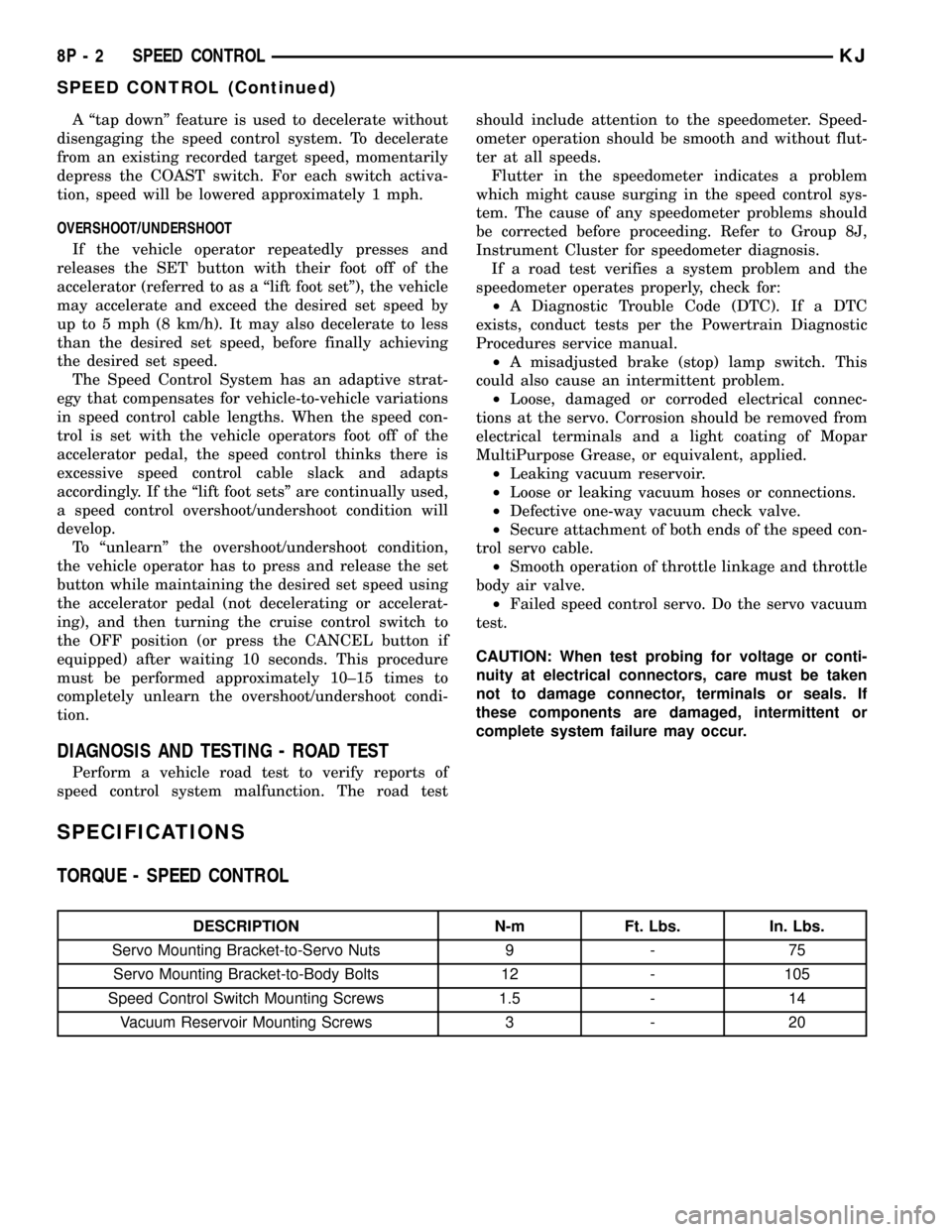
TORQUE - SPEED CONTROL
DESCRIPTION N-m Ft. Lbs. In. Lbs.
Servo Mounting Bracket-to-Servo Nuts 9 - 75
Servo Mounting Bracket-to-Body Bolts 12 - 105
Speed Control Switch Mounting Screws 1.5 - 14
Vacuum Reservoir Mounting Screws 3 - 20
8P - 2 SPEED CONTROLKJ
SPEED CONTROL (Continued)