main power fuse JEEP LIBERTY 2002 KJ / 1.G Owner's Manual
[x] Cancel search | Manufacturer: JEEP, Model Year: 2002, Model line: LIBERTY, Model: JEEP LIBERTY 2002 KJ / 1.GPages: 1803, PDF Size: 62.3 MB
Page 605 of 1803

are closed and the accelerator pedal is depressed.
The rolling door lock feature can be disabled if
desired.
This vehicle also offers several customer program-
mable features, which allows the selection of several
optional electronic features to suit individual prefer-
ences.
The power lock system for this vehicle can also be
operated remotely using the available Remote Key-
less Entry (RKE) system radio frequency transmit-
ters, if equipped.
Certain functions and features of the power lock
system rely upon resources shared with other elec-
tronic modules in the vehicle over the Programmable
Communications Interface (PCI) data bus network.
For proper diagnosis of these electronic modules or of
the PCI data bus network, the use of a DRBIIItscan
tool and the appropriate diagnostic information are
required.
REMOTE KEYLESS ENTRY
A Radio Frequency (RF) type Remote Keyless
Entry (RKE) system is an available factory-installed
option on this model. The RKE system allows the use
of a remote battery-powered radio transmitter to sig-
nal the Body Control Module (BCM) to actuate the
power lock system. The RKE receiver operates on
non-switched battery current through a fuse in the
Junction Block (JB), so that the system remains
operational, regardless of the ignition switch position.
The RKE transmitters are also equipped with a
Panic button. If the Panic button on the RKE trans-
mitter is depressed, the horn will sound and the
exterior lights will flash on the vehicle for about
three minutes, or until the Panic button is depressed
a second time. A vehicle speed of about 25.7 kilome-
ters-per-hour (15 miles-per-hour) will also cancel the
panic event.
The RKE system can also perform other functions
on this vehicle. If the vehicle is equipped with the
optional Vehicle Theft Security System (VTSS), the
RKE transmitter will arm the VTSS when the Lock
button is depressed, and disarm the VTSS when the
Unlock button is depressed.
The RKE system includes two transmitters when
the vehicle is shipped from the factory, but the sys-
tem can retain the vehicle access codes of up to four
transmitters. The transmitter codes are retained in
the RKE receiver memory, even if the battery is dis-
connected. If an RKE transmitter is faulty or lost,
new transmitter vehicle access codes can be pro-
grammed into the system using a DRBIIItscan tool.
This vehicle also offers several customer program-
mable features, which allows the selection of several
optional electronic features to suit individual prefer-ences. Customer programmable feature options
affecting the RKE system include:
²Remote Unlock Sequence- Allows the option
of having only the driver side front door unlock when
the RKE transmitter Unlock button is depressed the
first time. The remaining doors and the tailgate
unlock when the button is depressed a second time
within 5 seconds of the first unlock press. Another
option is having all doors and the tailgate unlock
upon the first depression of the RKE transmitter
Unlock button.
²Sound Horn on Lock- Allows the option of
having the horn sound a short chirp as an audible
verification that the RKE system received a valid
Lock request from the RKE transmitter, or having no
audible verification.
²Flash Lights with Lock and Unlock- Allows
the option of having the lights flash as an optical ver-
ification that the RKE system received a valid Lock
request or Unlock request from the RKE transmitter,
or having no optical verification.
²Programming Additional Transmitters-
Allows up to four transmitter vehicle access codes to
be stored in the receiver memory.
Certain functions and features of the RKE system
rely upon resources shared with other electronic
modules in the vehicle over the Programmable Com-
munications Interface (PCI) data bus network. The
PCI data bus network allows the sharing of sensor
information. This helps to reduce wire harness com-
plexity, internal controller hardware, and component
sensor current loads. For diagnosis of these electronic
modules or of the PCI data bus network, the use of a
DRBIIItscan tool and the appropriate diagnostic
information are required.
TAILGATE / FLIP-UP GLASS POWER RELEASE
SYSTEM
A power operated tailgate / flip-up glass release
system is standard factory installed equipment on
this model. The entire system is controlled by the
Body Control Module (BCM). The tailgate / flip-up
glass power release system allows the flip-up glass
latch to be released electrically by actuating a switch
located integral to the outside tailgate handle. By
pulling the handle to the first detent or turning the
key cylinder to unlock, the flip-up glass will open.
Pulling the handle to the second detent will allow the
tailgate to open.
The tailgate / flip-up glass release system operates
on non-switched battery current supplied through a
fuse in the junction block so that the system remains
functional, regardless of the ignition switch position.
However, the BCM prevents the flip-up glass latch
from being actuated when the tailgate latch is
locked.
8N - 2 POWER LOCKSKJ
POWER LOCKS (Continued)
Page 637 of 1803

The ACM housing also has an integral ground lug
with a tapped hole that protrudes from the lower left
rear corner of the unit. This lug provides a case
ground to the ACM when a ground screw is installed
through the left side of the mounting bracket. Two
molded plastic electrical connector receptacles exit
the right side of the ACM housing. The smaller of the
two receptacles contains twelve terminal pins, while
the larger one contains twenty-three. These terminal
pins connect the ACM to the vehicle electrical system
through two dedicated take outs and connectors of
the instrument panel wire harness.
A molded rubber protective cover is installed
loosely over the ACM to protect the unit from con-
densation or coolant leaking from a damaged or
faulty heater-air conditioner unit housing. An inte-
gral flange on the left side of the cover is secured to
the floor panel transmission tunnel with a short
piece of double-faced tape as an assembly aid during
the manufacturing process, but this tape does not
require replacement following service removal.
The impact sensor and safing sensor internal to
the ACM are calibrated for the specific vehicle, and
are only serviced as a unit with the ACM. The ACM
cannot be repaired or adjusted and, if damaged or
faulty, it must be replaced. The ACM cover is avail-
able for separate service replacement.
OPERATION
The microprocessor in the Airbag Control Module
(ACM) contains the front supplemental restraint sys-
tem logic circuits and controls all of the front supple-
mental restraint system components. The ACM uses
On-Board Diagnostics (OBD) and can communicate
with other electronic modules in the vehicle as well
as with the DRBIIItscan tool using the Programma-
ble Communications Interface (PCI) data bus net-
work. This method of communication is used for
control of the airbag indicator in the ElectroMechani-
cal Instrument Cluster (EMIC) and for supplemental
restraint system diagnosis and testing through the
16-way data link connector located on the driver side
lower edge of the instrument panel. (Refer to 8 -
ELECTRICAL/INSTRUMENT CLUSTER/AIRBAG
INDICATOR - OPERATION).
The ACM microprocessor continuously monitors all
of the front supplemental restraint system electrical
circuits to determine the system readiness. If the
ACM detects a monitored system fault, it sets an
active and stored Diagnostic Trouble Code (DTC) and
sends electronic messages to the EMIC over the PCI
data bus to turn on the airbag indicator. An active
fault only remains for the duration of the fault or in
some cases the duration of the current ignition
switch cycle, while a stored fault causes a DTC to be
stored in memory by the ACM. For some DTCs, if afault does not recur for a number of ignition cycles,
the ACM will automatically erase the stored DTC.
For other internal faults, the stored DTC is latched
forever.
On models equipped with optional side curtain air-
bags, the ACM communicates with both the left and
right Side Impact Airbag Control Modules (SIACM)
over the PCI data bus. The SIACM notifies the ACM
when it has detected a monitored system fault and
stored a DTC in memory for its respective side cur-
tain airbag system, and the ACM sets a DTC and
controls the airbag indicator operation accordingly.
The ACM also monitors a Hall effect-type seat belt
switch located in the buckle of each front seat belt to
determine whether the seatbelts are buckled, and
provides an input to the EMIC over the PCI data bus
to control the seatbelt indicator operation based upon
the status of the driver side front seat belt switch.
The ACM receives battery current through two cir-
cuits; a fused ignition switch output (run) circuit
through a fuse in the Junction Block (JB), and a
fused ignition switch output (run-start) circuit
through a second fuse in the JB. The ACM has a case
ground through a lug on the bottom of the ACM
housing that is secured with a ground screw to the
left side of the ACM mounting bracket. The ACM
also receives a power ground through a ground cir-
cuit and take out of the instrument panel wire har-
ness. This take out has a single eyelet terminal
connector that is secured by a second ground screw
to the left side of the ACM mounting bracket. These
connections allow the ACM to be operational when-
ever the ignition switch is in the Start or On posi-
tions. The ACM also contains an energy-storage
capacitor. When the ignition switch is in the Start or
On positions, this capacitor is continually being
charged with enough electrical energy to deploy the
airbags for up to one second following a battery dis-
connect or failure. The purpose of the capacitor is to
provide backup supplemental restraint system pro-
tection in case there is a loss of battery current sup-
ply to the ACM during an impact.
Two sensors are contained within the ACM, an
electronic impact sensor and a safing sensor. The
ACM also monitors inputs from two remote front
impact sensors located on the back of the right and
left vertical members of the radiator support near
the front of the vehicle. The electronic impact sensors
are accelerometers that sense the rate of vehicle
deceleration, which provides verification of the direc-
tion and severity of an impact. The safing sensor is
an electromechanical sensor within the ACM that
provides an additional logic input to the ACM micro-
processor. The safing sensor is a normally open
switch that is used to verify the need for an airbag
deployment by detecting impact energy of a lesser
8O - 10 RESTRAINTSKJ
AIRBAG CONTROL MODULE (Continued)
Page 670 of 1803

(10) Reinstall the headliner into the vehicle. (Refer
to 23 - BODY/INTERIOR/HEADLINER - INSTALLA-
TION).
(11) Reinstall the lower trim onto the inside of the
B-pillar. (Refer to 23 - BODY/INTERIOR/B-PILLAR
LOWER TRIM - INSTALLATION).
(12) Do not reconnect the battery negative cable at
this time. The airbag system verification test proce-
dure should be performed following service of any
supplemental restraint system component. (Refer to
8 - ELECTRICAL/RESTRAINTS - STANDARD PRO-
CEDURE - VERIFICATION TEST).
SIDE IMPACT AIRBAG
CONTROL MODULE
DESCRIPTION
On vehicles equipped with the optional side curtain
airbags, a Side Impact Airbag Control Module
(SIACM) and its mounting bracket are secured with
four screws to the sill panel at the base of each B-pil-
lar behind the lower B-pillar trim (Fig. 43). Con-
cealed within a hollow in the center of the die cast
aluminum SIACM housing is the electronic circuitry
of the SIACM which includes a microprocessor and
an electronic impact sensor. The SIACM housing is
secured to a stamped steel mounting bracket, which
is unique for the right or left side application of this
component. The SIACM should never be removed
from its mounting bracket. The housing also receives
a case ground through this mounting bracket when it
is secured to the vehicle. A molded plastic electrical
connector receptacle that exits the top of the SIACMhousing connects the unit to the vehicle electrical
system through a dedicated take out and connector of
the body wire harness. Both the SIACM housing and
its electrical connection are sealed to protect the
internal electronic circuitry and components against
moisture intrusion.
The impact sensor internal to the SIACM is cali-
brated for the specific vehicle, and is only serviced as
a unit with the SIACM. The SIACM cannot be
repaired or adjusted and, if damaged or faulty, it
must be replaced.
OPERATION
The microprocessor in the Side Impact Airbag Con-
trol Module (SIACM) contains the side curtain airbag
system logic circuits and controls all of the features
of only the side curtain airbag mounted on the same
side of the vehicle as the SIACM. The SIACM uses
On-Board Diagnostics (OBD) and can communicate
with other electronic modules in the vehicle as well
as with the DRBIIItscan tool using the Programma-
ble Communications Interface (PCI) data bus net-
work. This method of communication is used by the
SIACM to communicate with the Airbag Control
Module (ACM) and for supplemental restraints sys-
tem diagnosis and testing through the 16-way data
link connector located on the driver side lower edge
of the instrument panel. The ACM communicates
with both the left and right SIACM over the PCI
data bus.
The SIACM microprocessor continuously monitors
all of the side curtain airbag electrical circuits to
determine the system readiness. If the SIACM
detects a monitored system fault, it sets an active
and stored Diagnostic Trouble Code (DTC) and sends
electronic messages to the ACM over the PCI data
bus. The ACM will respond by sending an electronic
message to the EMIC to turn on the airbag indicator,
and by storing a DTC that will indicate whether the
left or the right SIACM has stored the DTC that ini-
tiated the airbag indicator illumination. An active
fault only remains for the current ignition switch
cycle, while a stored fault causes a DTC to be stored
in memory by the SIACM. For some DTCs, if a fault
does not recur for a number of ignition cycles, the
SIACM will automatically erase the stored DTC. For
other internal faults, the stored DTC is latched for-
ever.
The SIACM receives battery current on a fused
ignition switch output (run-start) circuit through a
fuse in the Junction Block (JB). The SIACM has a
case ground through its mounting bracket and also
receives a power ground through a ground circuit
and take out of the body wire harness. This take out
has a single eyelet terminal connector that is secured
by a ground screw to the front seat front crossmem-
Fig. 43 Side Impact Airbag Control Module
1 - BRACKET (RIGHT SHOWN)
2 - CONNECTOR RECEPTACLE
3 - SIACM
KJRESTRAINTS 8O - 43
SIDE CURTAIN AIRBAG (Continued)
Page 698 of 1803

the engine compartment, on the front extension of
the right front wheel house panel below and behind
the right headlamp. This unit is designed to provide
the audible alert requirements for the ROW premium
VTA.
The alarm siren module consists of microprocessor-
based electronic control circuitry, the siren, and a
nickel metal hydride backup battery. All of the alarm
module components are protected and sealed within
a black molded plastic housing. A stamped steel
mounting bracket is secured to the module with
three stud plates and nuts that fit into slotted holes
at the top and each side of the bracket. The front
surface of the bracket features a tightly grouped
series of small holes that serves as an outlet for the
audible output of the alarm siren. The bottom of the
mounting bracket is bent at a right angle and has an
integral locating tab feature. Two mounting holes in
the horizontal surface of the bracket are used to
secure the alarm siren module to the wheel house
extension with two screws. An integral connector
receptacle extends forward from the upper left corner
of the alarm siren housing, and connects the unit to
the vehicle electrical system through a dedicated
take out and connector of the headlamp and dash
wire harness.
The alarm siren module cannot be repaired or
adjusted and, if faulty or damaged, it must be
replaced.
OPERATION
The microprocessor within the alarm siren module
performs the tasks required to provide the siren unit
features and functions based upon internal program-
ming and electronic arm and disarm message inputs
received from the Intrusion Transceiver Module
(ITM) over a dedicated serial bus communication cir-
cuit. The alarm siren module will self-detect prob-
lems with its internal and external power supply and
communication circuits, then send electronic mes-
sages indicating the problem to the ITM upon receiv-
ing a request from the ITM. The ITM will store a
Diagnostic Trouble Code (DTC) for a detected alarm
siren module fault that can be retrieved with the
DRBIIItscan tool over the Programmable Communi-
cations Interface (PCI) data bus network through the
16-way data link connector located on the driver side
lower edge of the instrument panel.
When the Rest-Of-World (ROW) premium version
of the Vehicle Theft Alarm (VTA) is armed, the alarm
siren module microprocessor continuously monitors
inputs from the ITM for messages to sound its inter-
nal siren and enters its auto-detect mode. While in
the auto-detect mode, if the alarm siren module
detects that its power supply or communication cir-
cuits are being tampered with or have been sabo-taged, it will sound an alarm and continue to operate
through its on-board backup battery. If the arm siren
module is in its disarmed mode when its power sup-
ply or communication circuits are interrupted, the
siren will not sound. The alarm module will also
notify the ITM when the backup battery requires
charging, and the ITM will send a message that will
allow the backup battery to be charged through the
battery current and ground circuits to the alarm
module only when the ignition switch is in the On
position and the engine is running. This will prevent
the charging of the alarm backup battery from
depleting the charge in the main vehicle battery
while the vehicle is not being operated.
The alarm siren module receives battery current
on a fused B(+) circuit through a fuse in the Power
Distribution Center (PDC), and receives ground
through a ground circuit and take out of the head-
lamp and dash wire harness. This ground take out
has a single eyelet terminal connector that is secured
by a ground screw to the left inner fender shield in
the engine compartment. These connections allow the
alarm siren module to remain operational, regardless
of the ignition switch position. The hard wired inputs
and outputs for the alarm siren module may be diag-
nosed and tested using conventional diagnostic tools
and procedures. However, conventional diagnostic
methods will not prove conclusive in the diagnosis of
the internal circuitry or the backup battery of the
alarm siren module, the ITM, the serial bus commu-
nication line, or the electronic message inputs to and
outputs from the alarm siren module. The most reli-
able, efficient, and accurate means to diagnose the
alarm siren module, the ITM, the serial bus commu-
nication line, and the electronic message inputs to
and outputs from the alarm siren module requires
the use of a DRBIIItscan tool. Refer to the appro-
priate diagnostic information.
REMOVAL
(1) Disconnect and isolate the battery negative
cable.
(2) Disconnect the headlamp and dash wire har-
ness connector for the alarm siren module from the
module connector receptacle (Fig. 14).
(3) Remove the two screws that secure the alarm
siren module to the front extension of the right front
wheel house panel.
(4) Remove the alarm siren module from the front
extension of the right front wheel house panel.
INSTALLATION
(1) Position the alarm siren module onto the front
extension of the right front wheel house panel (Fig.
14).
KJVEHICLE THEFT SECURITY 8Q - 17
SIREN (Continued)
Page 705 of 1803

²Intermittent Wipe Mode- The control knob on
the right (wiper) control stalk of the multi-function
switch has five minor detent intermittent wipe posi-
tions. When selected, these switch positions will
cause the front wiper system to operate with one of
five delay intervals between complete wipe cycles.
²Mist Wipe Mode- The right (wiper) control
stalk of the multi-function switch has a momentary
Mist position. When selected, this switch position
will operate the front wipers in a low speed continu-
ous cycle for as long as the switch is held closed,
then will complete the current wipe cycle and park
the front wiper blades near the base of the wind-
shield when the switch is released.
²Washer Mode- When the momentary front
wash position of the right (wiper) control stalk of the
multi-function switch is selected with the front wiper
system operating in a continuous wipe mode, washer
fluid will be dispensed onto the windshield glass
through the washer nozzles for as long as the washer
switch is held closed. When the front washer switch
is actuated with the front wiper system operating in
an intermittent wipe mode, washer fluid is still dis-
pensed until the switch is released; however, the
front wipers will operate in a low speed continuous
cycle from the time the washer switch is closed until
several wipe cycles after the switch is released,
before returning to the selected intermittent wipe
mode.
²Wipe-After-Wash Mode- When the momentary
front wash position of the right (wiper) control stalk
of the multi-function switch is selected with the front
wiper system turned Off, the internal circuitry of the
BCM provides a wipe-after-wash feature. When
selected, this feature will operate the washer pump/
motor and the front wipers for as long as the front
washer switch is held closed, then provide several
additional wipe cycles after the switch is released
before parking the front wiper blades near the base
of the windshield.
OPERATION
The front wiper and washer system is designed to
provide the vehicle operator with a convenient, safe,
and reliable means of maintaining visibility through
the windshield glass. The various components of this
system are designed to convert electrical energy pro-
duced by the vehicle electrical system into the
mechanical action of the wiper blades to wipe the
outside surface of the glass, as well as into the
hydraulic action of the washer system to apply
washer fluid stored in an on-board reservoir to the
area of the glass to be wiped. When combined, these
components provide the means to effectively main-
tain clear visibility for the vehicle operator by remov-
ing excess accumulations of rain, snow, bugs, mud, orother minor debris from the outside windshield glass
surface that might be encountered while driving the
vehicle under numerous types of inclement operating
conditions.
The vehicle operator initiates all front wiper and
washer system functions with the right (wiper) con-
trol stalk of the multi-function switch that extends
from the right side of the steering column, just below
the steering wheel. Rotating the control knob on the
end of the control stalk, selects the Off, Delay, Low,
or High front wiper system operating modes. In the
Delay mode, the control knob also allows the vehicle
operator to select from one of five intermittent wipe
Delay intervals. Pulling the right control stalk down-
wards actuates the momentary front wiper system
Mist mode switch, while pulling the right control
stalk towards the steering wheel actuates the
momentary front washer system switch. The multi-
function switch provides hard wired resistor multi-
plexed inputs to the Body Control Module (BCM) for
all of the front wiper system functions, as well as a
separate hard wired sense input to the BCM for the
front washer system function.
The front wiper and washer system will only oper-
ate when the ignition switch is in the Accessory or
On positions. Battery current is directed from a B(+)
fuse in the Power Distribution Center (PDC) to the
wiper and washer system circuit breaker in the Junc-
tion Block (JB) through a fused ignition switch out-
put (run-acc) circuit. The automatic resetting circuit
breaker then provides battery current through a
fused ignition switch output (run-acc) circuit to the
wiper high/low relay, the wiper on/off relay, and the
park switch within the front wiper motor. A separate
fuse in the JB provides battery current through
another fused ignition switch output (run-acc) circuit
to the multi-function switch. The multi-function
switch circuitry uses this battery feed and a ground
circuit input to directly control the operation and
direction of the reversible electric washer pump/mo-
tor unit. The BCM uses low side drivers to control
front wiper system operation by energizing or de-en-
ergizing the wiper high/low and wiper on/off relays.
The hard wired circuits and components of the
front wiper and washer system may be diagnosed
and tested using conventional diagnostic tools and
procedures. However, conventional diagnostic meth-
ods may not prove conclusive in the diagnosis of the
Body Control Module (BCM), or the inputs to or out-
puts from the BCM that control the front wiper and
washer system operating modes. The most reliable,
efficient, and accurate means to diagnose the BCM,
or the BCM inputs and outputs related to the various
front wiper and washer system operating modes
requires the use of a DRBIIItscan tool. Refer to the
appropriate diagnostic information.
8R - 4 FRONT WIPERS/WASHERSKJ
FRONT WIPERS/WASHERS (Continued)
Page 732 of 1803

mation includes wiring diagrams, proper wire and
connector repair procedures, details of wire harness
routing and retention, connector pin-out information
and location views for the various wire harness con-
nectors, splices and grounds.
WARNING: ON VEHICLES EQUIPPED WITH AIR-
BAGS, DISABLE THE SUPPLEMENTAL RESTRAINT
SYSTEM BEFORE ATTEMPTING ANY STEERING
WHEEL, STEERING COLUMN, DRIVER AIRBAG,
PASSENGER AIRBAG, SEAT BELT TENSIONER,
SIDE CURTAIN AIRBAG, OR INSTRUMENT PANEL
COMPONENT DIAGNOSIS OR SERVICE. DISCON-
NECT AND ISOLATE THE BATTERY NEGATIVE
(GROUND) CABLE, THEN WAIT TWO MINUTES FOR
THE SYSTEM CAPACITOR TO DISCHARGE BEFORE
PERFORMING FURTHER DIAGNOSIS OR SERVICE.
THIS IS THE ONLY SURE WAY TO DISABLE THE
SUPPLEMENTAL RESTRAINT SYSTEM. FAILURE TO
TAKE THE PROPER PRECAUTIONS COULD
RESULT IN ACCIDENTAL AIRBAG DEPLOYMENT
AND POSSIBLE PERSONAL INJURY.
(1) Check that the interior lighting switch on the
left (lighting) control stalk of the multi-function
switch is not in the dome lamp disable position. With
all four doors and the tailgate closed, open the rear
flip-up glass. The interior lamps should light. Close
the rear flip-up glass. Note whether the interior
lamps remain lighted. They should turn off after
about thirty seconds. If OK, go to Step 2. If not OK,
go to Step 9.
(2) Check the fused B(+) fuse (Fuse 17 - 15
ampere) in the Junction Block (JB). If OK, go to Step
3. If not OK, repair the shorted circuit or component
as required and replace the faulty fuse.
(3) Check for battery voltage at the fused B(+) fuse
(Fuse 17 - 15 ampere) in the JB. If OK, go to Step 4.
If not OK, repair the open fused B(+) circuit between
the JB and the Power Distribution Center (PDC) as
required.
(4) Check the fused ignition switch output (run-
acc) fuse (Fuse 22 - 10 ampere) in the JB. If OK, go
to Step 5. If not OK, repair the shorted circuit or
component as required and replace the faulty fuse.
(5) Turn the ignition switch to the On position.
Check for battery voltage at the fused ignition switch
output (run-acc) fuse (Fuse 22 - 10 ampere) in the
JB. If OK, turn the ignition switch to the Off position
and go to Step 6. If not OK, repair the open fused
ignition switch output (run-acc) circuit between the
JB and the ignition switch as required.
(6) Disconnect and isolate the battery negative
cable. Disconnect the instrument panel wire harness
connector for the multi-function switch (Connector
C-2) from the switch connector receptacle. Reconnect
the battery negative cable. Turn the ignition switchto the On position. Check for battery voltage at the
fused ignition switch output (run-acc) circuit cavity of
the instrument panel wire harness connector for the
multi-function switch (Connector C-2). If OK, go to
Step 7. If not OK, repair the open fused ignition
switch output (run-acc) circuit between the multi-
function switch and the JB as required.
(7) Turn the ignition switch to the Off position.
Disconnect and isolate the battery negative cable.
Test the multi-function switch. (Refer to 8 - ELEC-
TRICAL/LAMPS/LIGHTING - EXTERIOR/MULTI-
FUNCTION SWITCH - DIAGNOSIS AND
TESTING). If the multi-function switch tests OK,
reconnect the instrument panel wire harness connec-
tors for the multi-function switch to the switch con-
nector receptacles and go to Step 8. If the multi-
function switch does not test OK, replace the faulty
switch.
(8) Remove the tailgate inner trim panel. Discon-
nect the tailgate wire harness connector for the rear
wiper module from the module connector receptacle.
Check for continuity between the ground circuit cav-
ity of the tailgate wire harness connector for the rear
wiper module and a good ground. There should be
continuity. If OK, go to Step 9. If not OK, repair the
open ground circuit to ground (G312) as required.
(9) Check for continuity between the flip-up glass
ajar switch sense circuit cavity of the tailgate wire
harness connector for the rear wiper module and a
good ground. There should be continuity with the
rear flip-up glass open, and no continuity with the
rear flip-up glass closed. If OK, go to Step 10. If not
OK, repair the open flip-up glass ajar circuit between
the rear wiper module and the flip-up glass ajar
switch as required.
(10) Reconnect the battery negative cable. Check
for battery voltage at the fused B(+) circuit cavity of
the tailgate wire harness connector for the rear wiper
module. If OK, go to Step 11. If not OK, repair the
open fused B(+) circuit between the rear wiper mod-
ule and the JB as required.
(11) Turn the ignition switch to the On position.
Turn the control ring on the right (wiper) control
stalk of the multi-function switch to the Delay posi-
tion. Check for battery voltage at the rear wiper
intermittent driver circuit cavity of the tailgate wire
harness connector for the rear wiper module. If OK,
go to Step 12. If not OK, repair the open rear wiper
intermittent driver circuit between the rear wiper
module and the multi-function switch as required.
(12) Turn the control ring on the right (wiper) con-
trol stalk of the multi-function switch to the On posi-
tion. Check for battery voltage at the rear wiper on
driver circuit cavity of the tailgate wire harness con-
nector for the rear wiper module. If OK, replace the
faulty rear wiper module. If not OK, repair the open
KJREAR WIPERS/WASHERS 8R - 31
REAR WIPERS/WASHERS (Continued)
Page 752 of 1803
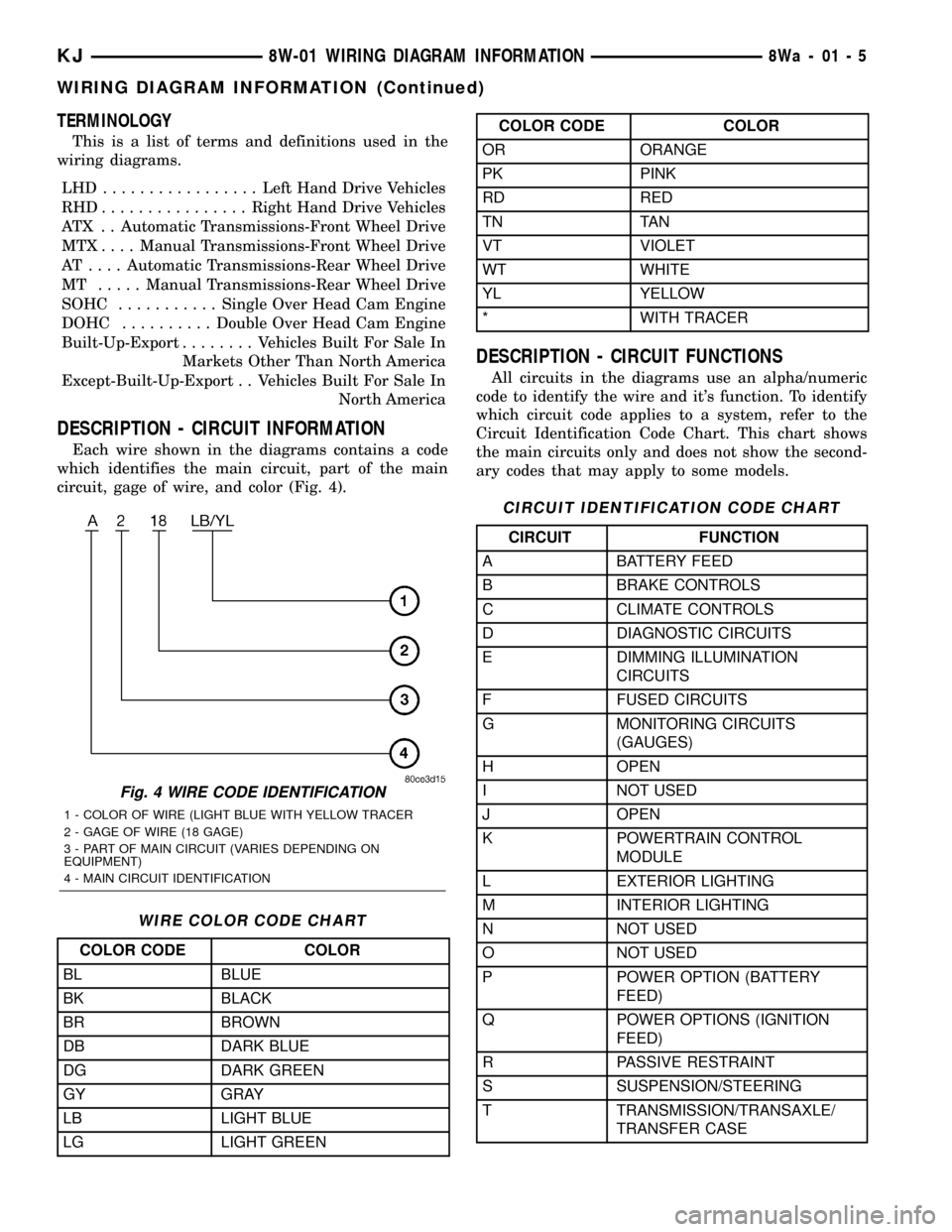
TERMINOLOGY
This is a list of terms and definitions used in the
wiring diagrams.
LHD .................Left Hand Drive Vehicles
RHD................Right Hand Drive Vehicles
ATX . . Automatic Transmissions-Front Wheel Drive
MTX....Manual Transmissions-Front Wheel Drive
AT ....Automatic Transmissions-Rear Wheel Drive
MT .....Manual Transmissions-Rear Wheel Drive
SOHC...........Single Over Head Cam Engine
DOHC..........Double Over Head Cam Engine
Built-Up-Export........ Vehicles Built For Sale In
Markets Other Than North America
Except-Built-Up-Export . . Vehicles Built For Sale In
North America
DESCRIPTION - CIRCUIT INFORMATION
Each wire shown in the diagrams contains a code
which identifies the main circuit, part of the main
circuit, gage of wire, and color (Fig. 4).
WIRE COLOR CODE CHART
COLOR CODE COLOR
BL BLUE
BK BLACK
BR BROWN
DB DARK BLUE
DG DARK GREEN
GY GRAY
LB LIGHT BLUE
LG LIGHT GREEN
COLOR CODE COLOR
OR ORANGE
PK PINK
RD RED
TN TAN
VT VIOLET
WT WHITE
YL YELLOW
* WITH TRACER
DESCRIPTION - CIRCUIT FUNCTIONS
All circuits in the diagrams use an alpha/numeric
code to identify the wire and it's function. To identify
which circuit code applies to a system, refer to the
Circuit Identification Code Chart. This chart shows
the main circuits only and does not show the second-
ary codes that may apply to some models.
CIRCUIT IDENTIFICATION CODE CHART
CIRCUIT FUNCTION
A BATTERY FEED
B BRAKE CONTROLS
C CLIMATE CONTROLS
D DIAGNOSTIC CIRCUITS
E DIMMING ILLUMINATION
CIRCUITS
F FUSED CIRCUITS
G MONITORING CIRCUITS
(GAUGES)
H OPEN
I NOT USED
J OPEN
K POWERTRAIN CONTROL
MODULE
L EXTERIOR LIGHTING
M INTERIOR LIGHTING
N NOT USED
O NOT USED
P POWER OPTION (BATTERY
FEED)
Q POWER OPTIONS (IGNITION
FEED)
R PASSIVE RESTRAINT
S SUSPENSION/STEERING
T TRANSMISSION/TRANSAXLE/
TRANSFER CASE
Fig. 4 WIRE CODE IDENTIFICATION
1 - COLOR OF WIRE (LIGHT BLUE WITH YELLOW TRACER
2 - GAGE OF WIRE (18 GAGE)
3 - PART OF MAIN CIRCUIT (VARIES DEPENDING ON
EQUIPMENT)
4 - MAIN CIRCUIT IDENTIFICATION
KJ8W-01 WIRING DIAGRAM INFORMATION8Wa-01-5
WIRING DIAGRAM INFORMATION (Continued)
Page 1398 of 1803

(1) Remove protective cap at fuel rail test port.
Connect the 0±414 kPa (0-60 psi) fuel pressure gauge
(from gauge set 5069) to test port pressure fitting on
fuel rail (Fig. 20).The DRBtIII Scan Tool along
with the PEP module, the 500 psi pressure
transducer, and the transducer-to-test port
adapter may also be used in place of the fuel
pressure gauge.
(2) Start and warm engine and note pressure
gauge reading. Fuel pressure should be 339 kPa 34
kPa (49.2 psi 5 psi) at idle.
(3) If engine runs, but pressure is below 44.2 psi,
check for a kinked fuel supply line somewhere
between fuel rail and fuel pump module. If line is not
kinked, but specifications for either the Fuel Pump
Capacity, Fuel Pump Amperage or Fuel Pressure
Leak Down Tests were not met, replace lower section
of fuel pump module. Refer to Fuel Pump Module
Removal/Installation.
(4) If operating pressure is above 54.2 psi, electric
fuel pump is OK, but fuel pressure regulator is defec-
tive. Replace lower section of fuel pump module.
Refer to Fuel Pump Module Removal/Installation.
(5) Install protective cap to fuel rail test port.
DIAGNOSIS AND TESTING - FUEL PUMP
AMPERAGE TEST
This amperage (current draw) test is to be done in
conjunction with the Fuel Pump Pressure Test, Fuel
Pump Capacity Test and Fuel Pressure Leak Down
Test. Before performing the amperage test, be sure
the temperature of the fuel tank is above 50É F (10É
C).The DRBtScan Tool along with the DRB Low Cur-
rent Shunt (LCS) adapter (Fig. 21) and its test leads
will be used to check fuel pump amperage specifica-
tions.
(1) Be sure fuel tank contains fuel before starting
test. If tank is empty or near empty, amperage read-
ings will be incorrect.
(2) Obtain LCS adapter.
(3) Plug cable from LCS adapter into DRB scan
tool at SET 1 receptacle.
(4) Plug DRB into vehicle 16±way connector (data
link connector).
(5) Connect (-) and (+) test cable leads into LCS
adapter receptacles. Use10 amp (10A +)receptacle
and common (-) receptacles.
(6) Gain access to MAIN MENU on DRB screen.
(7) Press DVOM button on DRB.
(8) Using left/right arrow keys, highlight CHAN-
NEL 1 function on DRB screen.
(9) Press ENTER three times.
(10) Using up/down arrow keys, highlight RANGE
on DRB screen (screen will default to 2 amp scale).
(11) Press ENTER to change 2 amp scale to 10
amp scale.This step must be done to prevent
damage to DRB scan tool or LCS adapter
(blown fuse).
(12) Remove cover from Power Distribution Center
(PDC).
(13) Remove fuel pump relay from PDC. Refer to
label on PDC cover for relay location.
Fig. 20 FUEL PRESSURE TEST GAUGE (TYPICAL
GAUGE INSTALLATION AT TEST PORT)
1 - SERVICE (TEST) PORT
2 - FUEL PRESSURE TEST GAUGE
3 - FUEL RAIL
Fig. 21 LOW CURRENT SHUNT
1 - LOW CURRENT SHUNT ADAPTER
2 - PLUG TO DRB
3 - TEST LEAD RECEPTACLES
14 - 16 FUEL DELIVERYKJ
FUEL PUMP (Continued)