wheel bolts JEEP LIBERTY 2002 KJ / 1.G Owner's Manual
[x] Cancel search | Manufacturer: JEEP, Model Year: 2002, Model line: LIBERTY, Model: JEEP LIBERTY 2002 KJ / 1.GPages: 1803, PDF Size: 62.3 MB
Page 191 of 1803

SPECIFICATIONS
BRAKE FLUID
The brake fluid used in this vehicle must conform
to DOT 3 specifications and SAE J1703 standards.
No other type of brake fluid is recommended or
approved for usage in the vehicle brake system. Use
only Mopar brake fluid or an equivalent from a
tightly sealed container.
CAUTION: Never use reclaimed brake fluid or fluid
from an container which has been left open. An
open container will absorb moisture from the air
and contaminate the fluid.
CAUTION: Never use any type of a petroleum-based
fluid in the brake hydraulic system. Use of such
type fluids will result in seal damage of the vehicle
brake hydraulic system causing a failure of the
vehicle brake system. Petroleum based fluids would
be items such as engine oil, transmission fluid,
power steering fluid, etc.
DRUM
DIAGNOSIS AND TESTING - BRAKE DRUM
The maximum allowable diameter of the drum
braking surface is indicated on the drum outer edge.
Generally, a drum can be machined to a maximum of
1.52 mm (0.060 in.) oversize. Always replace the
drum if machining would cause drum diameter to
exceed the size limit indicated on the drum.
BRAKE DRUM RUNOUT
Measure drum diameter and runout with an accu-
rate gauge. The most accurate method of measure-
ment involves mounting the drum in a brake lathe
and checking variation and runout with a dial indi-
cator.
Variations in drum diameter should not exceed
0.076 mm (0.003 in.). Drum runout should not exceed
0.20 mm (0.008 in.) out of round. Machine the drum
if runout or variation exceed these values. Replace
the drum if machining causes the drum to exceed the
maximum allowable diameter.
STANDARD PROCEDURES - BRAKE DRUM
MACHINING
The brake drums can be machined on a drum lathe
when necessary. Initial machining cuts should be lim-
ited to 0.12 - 0.20 mm (0.005 - 0.008 in.) at a time as
heavier feed rates can produce taper and surface
variation. Final finish cuts of 0.025 to 0.038 mm(0.001 to 0.0015 in.) are recommended and will gen-
erally provide the best surface finish.
Be sure the drum is securely mounted in the lathe
before machining operations. A damper strap should
always be used around the drum to reduce vibration
and avoid chatter marks.
The maximum allowable diameter of the drum
braking surface is stamped or cast into the drum
outer edge.
CAUTION: Replace the drum if machining will cause
the drum to exceed the maximum allowable diame-
ter.
SUPPORT PLATE
REMOVAL
REMOVAL - 198 RBI AXLE
(1) Remove wheel and tire assembly.
(2) Remove the brake drum.
(3) Remove the brake shoes.
(4) Remove parking brake cable from parking
brake lever.
(5) Compress parking brake cable retainer tabs.
Then push retainer and cable through and out of
support plate.
(6) Disconnect brake line at wheel cylinder.
(7) Remove wheel cylinder from support plate,(Re-
fer to 5 - BRAKES/HYDRAULIC/MECHANICAL/
WHEEL CYLINDERS - REMOVAL).
(8) Remove the four bolts attaching the support
plate to axle and remove the support plate with the
axle, bearing and seal.
(9) Remove axle shaft,(Refer to 3 - DIFFEREN-
TIAL & DRIVELINE/REAR AXLE/AXLE SHAFTS -
REMOVAL).
REMOVAL - 8 1/4 AXLE
(1) Remove the wheel and tire assembly.
(2) Remove the brake drum.
(3) Install the brake pedal prop rod.
(4) Remove the brake shoes (Refer to 5 - BRAKES/
HYDRAULIC/MECHANICAL/BRAKE PADS/SHOES
- REMOVAL).
(5) Remove parking brake cable from parking
brake lever.
(6) Compress parking brake cable retainer tabs.
Then push retainer and cable through and out of
support plate.
(7) Disconnect the brake line at wheel cylinder.
(8) Remove the wheel cylinder from the support
plate,(Refer to 5 - BRAKES/HYDRAULIC/MECHAN-
ICAL/WHEEL CYLINDERS - REMOVAL).
KJBRAKES - BASE 5 - 27
FLUID (Continued)
Page 192 of 1803

(9) Remove the axle shaft, (Refer to 3 - DIFFER-
ENTIAL & DRIVELINE/REAR AXLE - 8 1/4/AXLE
SHAFTS - REMOVAL).
(10) Remove the bolts attaching the support plate
to the axle and remove the support plate (Fig. 43).
INSTALLATION
INSTALLATION - 198 RBI AXLE
(1) Install the support plate on the axle flange.
Tighten 75 N´m (55 ft. lbs.)
(2) Install the axle, bearing and seal into the hous-
ing and tighten the four attaching bolts to 61 N´m
(45 ft. lbs.).
(3) Install the wheel cylinder,(Refer to 5 -
BRAKES/HYDRAULIC/MECHANICAL/WHEEL
CYLINDERS - INSTALLATION).
(4) Install the brake line in the wheel cylinder.
(5) Install the parking brake cable in the support
plate.
(6) Connect parking brake cable to lever on sec-
ondary shoe and install brake shoes on support plate.
(7) Adjust the brake shoes to the drum with the
brake gauge.
(8) Install the brake drum and wheel and tire
assembly (Refer to 22 - TIRES/WHEELS/WHEELS -
STANDARD PROCEDURE).
(9) Bleed brake system,(Refer to 5 - BRAKES -
STANDARD PROCEDURE) OR (Refer to 5 -
BRAKES - STANDARD PROCEDURE).
INSTALLATION - 8 1/4 AXLE
(1) Install the support plate on the axle flange.
Tighten attaching bolts to 61 N´m (45 ft. lbs.) (Fig.
43).(2) Install the wheel cylinder,(Refer to 5 -
BRAKES/HYDRAULIC/MECHANICAL/WHEEL
CYLINDERS - INSTALLATION).
(3) Install the brake line in the wheel cylinder and
tighten the line to 14 N´m (124 in.lbs.)..
(4) Remove the brake pedal prop rod.
(5) Install the parking brake cable in the support
plate.
(6) Install the axle shaft, (Refer to 3 - DIFFEREN-
TIAL & DRIVELINE/REAR AXLE - 8 1/4/AXLE
SHAFTS - INSTALLATION).
(7) Connect the parking brake cable to the lever on
the primary shoe and install the brake shoes on the
support plate (Refer to 5 - BRAKES/HYDRAULIC/
MECHANICAL/BRAKE PADS/SHOES - INSTALLA-
TION).
(8) Adjust the brake shoes to the drum with the
brake gauge (Refer to 5 - BRAKES/HYDRAULIC/
MECHANICAL/BRAKE PADS/SHOES - ADJUST-
MENTS).
(9) Install the brake drum.
(10) Install the wheel and tire assembly (Refer to
22 - TIRES/WHEELS/WHEELS - STANDARD PRO-
CEDURE).
(11) Bleed the brake system,(Refer to 5 - BRAKES
- STANDARD PROCEDURE).
WHEEL CYLINDERS
REMOVAL
(1) Remove wheel and tire assembly.
(2) Remove brake drum.
(3) Install brake pedal prop rod.
(4) Disconnect wheel cylinder brake line.
(5) Remove brake shoe return springs and move
shoes out of engagement with cylinder push rods.
(6) Remove cylinder attaching bolts and remove
cylinder from support plate (Fig. 44).
DISASSEMBLY
(1) Remove push rods and boots (Fig. 45).
(2) Press pistons, cups and spring and expander
out of cylinder bore.
(3) Remove bleed screw.
CLEANING
Clean the cylinder and pistons with clean brake
fluid or brake cleaner only. Do not use any other
cleaning agents.
Dry the cylinder and pistons with compressed air.
Do not use rags or shop towels to dry the cylinder
components. Lint from cloth material will adhere to
the cylinder bores and pistons.
Fig. 43 SUPPORT PLATE 8 1/4
1 - SUPPORT PLATE
2 - MOUNTING NUTS
5 - 28 BRAKES - BASEKJ
SUPPORT PLATE (Continued)
Page 193 of 1803

INSPECTION
Inspect the cylinder bore. Light discoloration and
dark stains in the bore are normal and will not
impair cylinder operation.
The cylinder bore can be lightly polished but only
with crocus cloth. Replace the cylinder if the bore is
scored, pitted or heavily corroded. Honing the bore to
restore the surface is not recommended.
Inspect the cylinder pistons. The piston surfaces
should be smooth and free of scratches, scoring and
corrosion. Replace the pistons if worn, scored, or cor-
roded. Do not attempt to restore the surface by sand-
ing or polishing.Discard the old piston cups and the spring and
expander. These parts are not reusable. The original
dust boots may be reused but only if they are in good
condition.
ASSEMBLY
(1) Lubricate wheel cylinder bore, pistons, piston
cups and spring and expander with clean brake fluid.
(2) Install first piston in cylinder bore. Then
install first cup in bore and against piston.Be sure
lip of piston cup is facing inward (toward
spring and expander) and flat side is against
piston.
(3) Install spring and expander followed by
remaining piston cup and piston.
(4) Install boots on each end of cylinder and insert
push rods in boots.
(5) Install cylinder bleed screw.
INSTALLATION
(1) Install cylinder mounting bolts and tighten to
20 N´m (15 ft. lbs.) (Fig. 44).
(2) Connect brake line to cylinder and tighten to
14 N´m (124 in. lbs.).
(3) Install the brake shoe return springs.
(4) Remove the brake pedal prop rod.
(5) Install the brake drum.
(6) Install the wheel and tire assembly (Refer to 22
- TIRES/WHEELS/WHEELS - STANDARD PROCE-
DURE).
(7) Bleed base brake system (Refer to 5 - BRAKES
- STANDARD PROCEDURE).
PARKING BRAKE
DESCRIPTION
The parking brake is a hand lever and cable oper-
ated system used to apply the rear brakes.
OPERATION
A hand operated lever in the passenger compart-
ment is the main application device. The front cable
is connected between the hand lever and the rear
cables with an equalizer.
The rear cables are connected to the actuating
lever on each primary brake shoe. The levers are
attached to the brake shoes by a pin either pressed
into, or welded to the lever. A clip is used to secure
the pin in the brake shoe. The pin allows each lever
to pivot independently of the brake shoe.
To apply the parking brakes, the hand lever is
pulled upward. This pulls the rear brake shoe actu-
ating levers forward, by means tensioner and cables.
As the actuating lever is pulled forward, the parking
brake strut (which is connected to both shoes), exerts
Fig. 44 WHEEL CYLINDER
1 - WHEEL CYLINDER
2 - SUPPORT PLATE
Fig. 45 Wheel Cylinder Components±Typical
1 - SPRING
2 - CYLINDER
3 - PISTON CLIP
4 - BOOT
5 - PUSH ROD
6 - PISTON
7 - BLEED SCREW
8 - CUP EXPANDERS
KJBRAKES - BASE 5 - 29
WHEEL CYLINDERS (Continued)
Page 206 of 1803

WARNING
WARNING:: EXERCISE CARE WHEN SERVICING
CLUTCH COMPONENTS. FACTORY INSTALLED
CLUTCH DISCS DO NOT CONTAIN ASBESTOS
FIBERS. DUST AND DIRT ON CLUTCH PARTS MAY
CONTAIN ASBESTOS FIBERS FROM AFTERMAR-
KET COMPONENTS. BREATHING EXCESSIVE CON-
CENTRATIONS OF THESE FIBERS CAN CAUSE
SERIOUS BODILY HARM. WEAR A RESPIRATOR
DURING SERVICE AND NEVER CLEAN CLUTCH
COMPONENTS WITH COMPRESSED AIR OR WITH
A DRY BRUSH. EITHER CLEAN THE COMPONENTS
WITH A WATER DAMPENED RAGS OR USE A VAC-
UUM CLEANER SPECIFICALLY DESIGNED FOR
REMOVING ASBESTOS FIBERS AND DUST. DO NOT
CREATE DUST BY SANDING A CLUTCH DISC.
REPLACE THE DISC IF THE FRICTION MATERIAL IS
DAMAGED OR CONTAMINATED. DISPOSE OF ALL
DUST AND DIRT CONTAINING ASBESTOS FIBERS
IN SEALED BAGS OR CONTAINERS. THIS WILL
HELP MINIMIZE EXPOSURE TO YOURSELF AND TO
OTHERS. FOLLOW ALL RECOMMENDED SAFETY
PRACTICES PRESCRIBED BY THE OCCUPATIONAL
SAFETY AND HEALTH ADMINISTRATION (OSHA)
AND THE ENVIRONMENTAL SAFETY AGENCY
(EPA), FOR THE HANDLING AND DISPOSAL OF
PRODUCTS CONTAINING ASBESTOS.
DIAGNOSIS AND TESTING - CLUTCH
Drive the vehicle at normal speeds. Shift the trans-
mission through all gear ranges and observe clutch
action. If the clutch chatters, grabs, slips or does not
release properly, remove and inspect the clutch com-
ponents. If the problem is noise or hard shifting, fur-
ther diagnosis may be needed as the transmission or
another driveline component may be at fault.
NOTE: Vehicles equipped with a Dual Mass Fly-
wheel may produce a rattle when the engine is shut
off. This noise is considered normal.
CLUTCH CONTAMINATION
Fluid contamination is a frequent cause of clutch
malfunctions. Oil, water or clutch fluid on the clutch
disc and pressure plate surfaces will cause chatter,
slip and grab. Inspect components for oil, hydraulic
fluid or water/road splash contamination.
Oil contamination indicates a leak at either the
rear main seal or transmission input shaft. Clutch
fluid leaks are usually from damaged slave cylinder
push rod seals. Heat buildup caused by slippage
between the pressure plate, disc and flywheel can
bake the oil residue onto the components. The glaze-
like residue ranges in color from amber to black.Road splash contamination is dirt/water entering
the clutch housing due to loose bolts, housing cracks.
Driving through deep water puddles can force water/
road splash into the housing through such openings.
IMPROPER RELEASE OR CLUTCH ENGAGEMENT
Clutch release or engagement problems are caused
by wear or damage clutch components. A visual
inspection of the release components will usually
reveal the problem part.
Release problems can result in hard shifting and
noise. Look for leaks at the clutch cylinders and
interconnecting line and loose slave cylinder bolts.
Also worn/loose release fork, pivot stud, clutch disc,
pressure plate or release bearing.
Engagement problems can result in slip, chatter/
shudder and noisy operation. The causes may be
clutch disc contamination, wear, distortion or fly-
wheel damage. Visually inspect to determine the
actual cause of the problem.
CLUTCH MISALIGNMENT
Clutch components must be in proper alignment
with the crankshaft and transmission input shaft.
Misalignment caused by excessive runout or warpage
of any clutch component will cause grab, chatter and
improper clutch release.
PRESSURE PLATE AND DISC RUNOUT
Check the clutch disc before installation. Axial
(face) runout of anewdisc should not exceed 0.50
mm (0.020 in.). Measure runout about 6 mm (1/4 in.)
from the outer edge of the disc facing. Obtain
another disc if runout is excessive.
Check condition of the clutch before installation. A
warped cover or diaphragm spring will cause grab
and incomplete release or engagement. Be careful
when handling the cover and disc. Impact can distort
the cover, diaphragm spring, release fingers and the
hub of the clutch disc.
Use an alignment tool when positioning the disc on
the flywheel. The tool prevents accidental misalign-
ment which could result in cover distortion and disc
damage.
A frequent cause of clutch cover distortion (and
consequent misalignment) is improper bolt tighten-
ing.
FLYWHEEL RUNOUT
Check flywheel runout whenever misalignment is
suspected. Flywheel runout should not exceed 0.08
mm (0.003 in.). Measure runout at the outer edge of
the flywheel face with a dial indicator. Mount the
indicator on a stud installed in place of one of the fly-
wheel bolts.
6 - 2 CLUTCHKJ
CLUTCH (Continued)
Page 207 of 1803

Common causes of runout are:
²heat warpage
²improper machining
²incorrect bolt tightening
²improper seating on crankshaft flange shoulder
²foreign material on crankshaft flange
Flywheel machining is not recommended. The fly-
wheel clutch surface is machined to a unique contour
and machining will negate this feature. Minor fly-
wheel scoring can be cleaned up by hand with 180
grit emery or with surface grinding equipment.
Remove only enough material to reduce scoring
(approximately 0.001 - 0.003 in.). Heavy stock
removal isnot recommended.Replace the flywheel
if scoring is severe and deeper than 0.076 mm (0.003
in.). Excessive stock removal can result in flywheel
cracking or warpage after installation; it can alsoweaken the flywheel and interfere with proper clutch
release.
Clean the crankshaft flange before mounting the
flywheel. Dirt and grease on the flange surface may
cock the flywheel causing excessive runout. Use new
bolts when remounting a flywheel and secure the
bolts with Mopar Lock And Seal or equivalent.
Tighten flywheel bolts to specified torque only. Over-
tightening can distort the flywheel hub causing
runout.
DIAGNOSIS CHART
The diagnosis charts Diagnosis Chart describe
common clutch problems, causes and correction. Con-
ditions, causes and corrective action are outlined in
the indicated columns.
DIAGNOSIS CHART
CONDITION POSSIBLE CAUSES CORRECTION
Disc facing worn out 1. Normal wear. 1. Replace cover and disc.
2. Driver frequently rides (slips) the
clutch. Results in rapid overheating
and wear.2. Replace cover and disc.
3. Insufficient clutch cover
diaphragm spring tension.3. Replace cover and disc.
Clutch disc facing contaminated with
oil, grease, or clutch fluid.1. Leak at rear main engine seal or
transmission input shaft seal.1. Replace appropriate seal.
2. Excessive amount of grease
applied to the input shaft splines.2. Remove grease and apply the
correct amount of grease.
3. Road splash, water entering
housing.3. Replace clutch disc. Clean clutch
cover and reuse if in good condition.
4. Slave cylinder leaking. 4. Replace hydraulic clutch linkage.
Clutch is running partially
disengaged.1. Release bearing sticking or
binding and does not return to the
normal running position.1. Verify failure. Replace the release
bearing and transmission front
bearing retainer as necessary.
Flywheel below minimum thickness
specification.1. Improper flywheel machining.
Flywheel has excessive taper or
excessive material removal.1. Replace flywheel.
Clutch disc, cover and/or diaphragm
spring warped or distorted.1. Rough handling. Impact bent
cover, spring, or disc.1. Replace disc or cover as
necessary.
2. Improper bolt tightening
procedure.2. Tighten clutch cover using proper
procedure.
KJCLUTCH 6 - 3
CLUTCH (Continued)
Page 209 of 1803
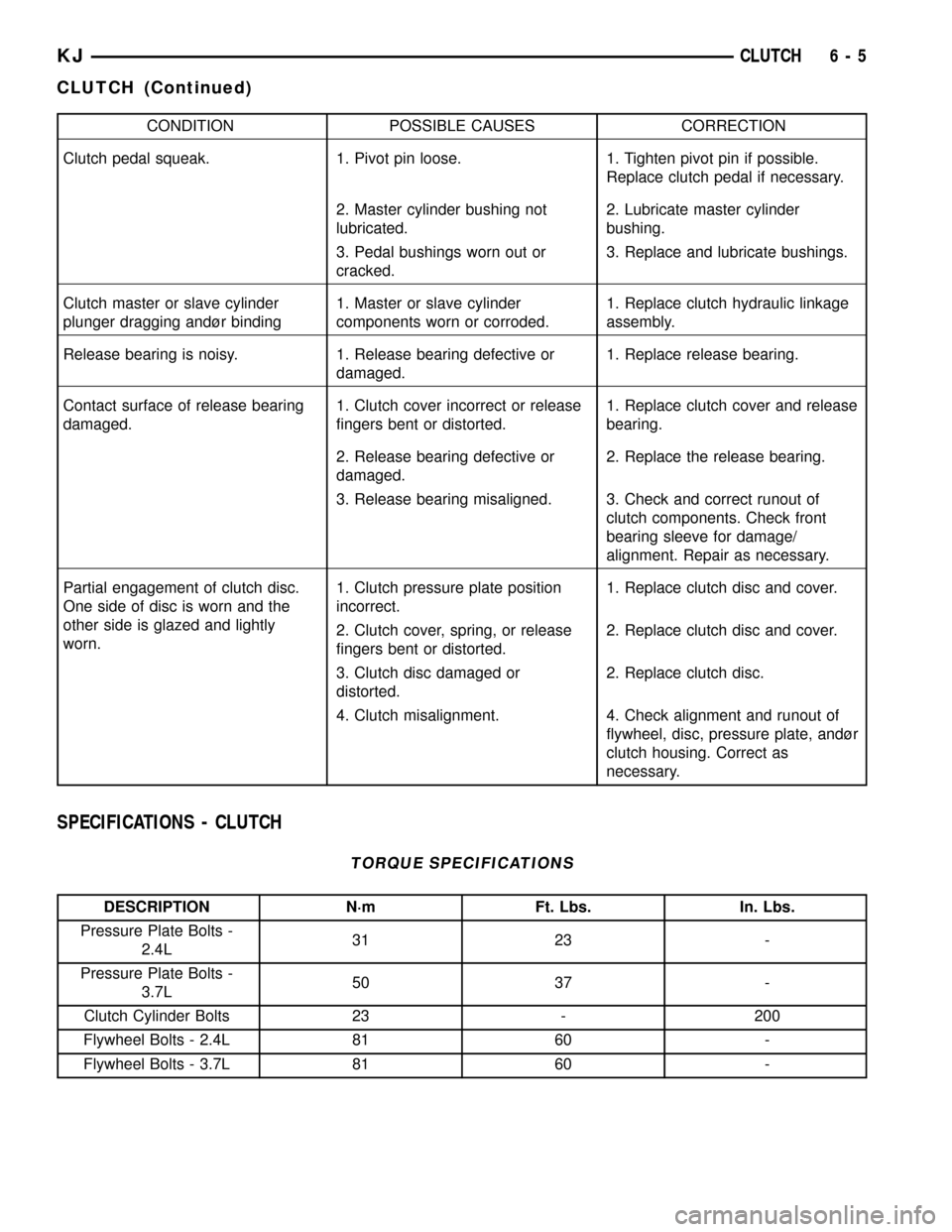
CONDITION POSSIBLE CAUSES CORRECTION
Clutch pedal squeak. 1. Pivot pin loose. 1. Tighten pivot pin if possible.
Replace clutch pedal if necessary.
2. Master cylinder bushing not
lubricated.2. Lubricate master cylinder
bushing.
3. Pedal bushings worn out or
cracked.3. Replace and lubricate bushings.
Clutch master or slave cylinder
plunger dragging andùr binding1. Master or slave cylinder
components worn or corroded.1. Replace clutch hydraulic linkage
assembly.
Release bearing is noisy. 1. Release bearing defective or
damaged.1. Replace release bearing.
Contact surface of release bearing
damaged.1. Clutch cover incorrect or release
fingers bent or distorted.1. Replace clutch cover and release
bearing.
2. Release bearing defective or
damaged.2. Replace the release bearing.
3. Release bearing misaligned. 3. Check and correct runout of
clutch components. Check front
bearing sleeve for damage/
alignment. Repair as necessary.
Partial engagement of clutch disc.
One side of disc is worn and the
other side is glazed and lightly
worn.1. Clutch pressure plate position
incorrect.1. Replace clutch disc and cover.
2. Clutch cover, spring, or release
fingers bent or distorted.2. Replace clutch disc and cover.
3. Clutch disc damaged or
distorted.2. Replace clutch disc.
4. Clutch misalignment. 4. Check alignment and runout of
flywheel, disc, pressure plate, andùr
clutch housing. Correct as
necessary.
SPECIFICATIONS - CLUTCH
TORQUE SPECIFICATIONS
DESCRIPTION N´m Ft. Lbs. In. Lbs.
Pressure Plate Bolts -
2.4L31 23 -
Pressure Plate Bolts -
3.7L50 37 -
Clutch Cylinder Bolts 23 - 200
Flywheel Bolts - 2.4L 81 60 -
Flywheel Bolts - 3.7L 81 60 -
KJCLUTCH 6 - 5
CLUTCH (Continued)
Page 210 of 1803

CLUTCH DISC
REMOVAL
(1) Remove transmission.
(2) Mark position of pressure plate on flywheel
with paint or a scriber for assembly reference, if
clutch is not being replaced.
(3) Loosen pressure plate bolts evenly and in rota-
tion to relieve spring tension and avoid warping the
plate.
(4) Remove pressure plate bolts and pressure plate
and disc.
INSTALLATION
(1) Lightly scuff sand flywheel face with 180 grit
emery cloth, then clean with a wax and grease
remover.
(2) Lubricate pilot bearing with Mopar high tem-
perature bearing grease or equivalent.
(3) Check runout and operation ofnewclutch disc.
NOTE: Disc must slide freely on transmission input
shaft splines.
(4) With the disc on the input shaft, check face
runout with dial indicator. Check runout at disc hub
6 mm (1/4 in.) from outer edge of facing. Obtain
another clutch disc if runout exceed 0.5 mm (0.020
in.).
(5) Position clutch disc on flywheel with side
marked flywheel against the flywheel.
NOTE: If not marked, the flat side of disc hub goes
towards the flywheel on the 3.7L engine and
towards the transmission on 2.4L engine.
(6) Insert clutch alignment tool through the clutch
disc and into the pilot bearing (Fig. 1).
(7) Position clutch pressure plate over disc and on
the flywheel (Fig. 1).
(8) Install pressure plate bolts finger tight.
CAUTION: Use only the factory bolts to mount the
pressure plate. The bolts must be the correct size.
If bolts are too short, there isn't enough thread
engagement, if too long bolts interfere with the Dual
Mass Flywheel.
(9) Tighten pressure plate bolts evenly and in rota-
tion a few threads at a time.
CAUTION: The bolts must be tightened evenly and
to specified torque to avoid distorting the pressure
plate.(10) Tighten pressure plate bolts to 31 N´m (23 ft.
lbs.) on 2.4L engines and 50 N´m (37ft. lbs.) on 3.7L
engines.
(11) Apply light coat of Mopar high temperature
bearing grease or equivalent to clutch disc hub and
splines of transmission input shaft.
CAUTION: Do not over lubricate shaft splines. This
will result in grease contamination of disc.
(12) Install transmission.
CLUTCH RELEASE BEARING
REMOVAL
(1) Remove transmission.
(2) Disconnect release bearing from release lever
and remove the bearing (Fig. 2).
(3) Inspect bearing slide surface of transmission
front bearing retainer. Replace retainer if slide sur-
face is scored, worn, or cracked.
(4) Inspect release fork and fork pivot. Be sure
pivot is secure and in good condition. Be sure fork is
not distorted or worn. Replace release fork retainer
spring if bent or damaged.
INSTALLATION
(1) Lubricate crankshaft pilot bearing with Mopar
high temperature bearing grease or equivalent. Apply
grease to end of long shank, small diameter flat
blade screwdriver. Then insert tool through clutch
disc hub to reach bearing.
Fig. 1 ALIGNING CLUTCH DISC
1 - FLYWHEEL
2 - PRESSURE PLATE
3 - CLUTCH DISC ALIGNMENT TOOL
6 - 6 CLUTCHKJ
Page 212 of 1803

On a Dual Mass Flywheel the additional secondary
mass coupled to the transmission lowers the natural
frequency of the transmission rotating elements. This
decreases the transmission gear rattle. The damper
springs between the two flywheel masses replace the
clutch disc damper springs and assist in a smooth
transfer of torque to the transmission.
CAUTION: The Dual Mass Flywheel is serviced as
an assembly only and should never be taken apart.
DIAGNOSIS AND TESTING - FLYWHEEL
Check flywheel runout whenever misalignment is
suspected. Flywheel runout should not exceed 0.08
mm (0.003 in.). Measure runout at the outer edge of
the flywheel face with a dial indicator. Mount the
indicator on a stud installed in place of one of the fly-
wheel bolts.
Common causes of runout are:
²heat warpage
²improper machining
²incorrect bolt tightening
²improper seating on crankshaft flange shoulder
²foreign material on crankshaft flange
Flywheel machining is not recommended. The fly-
wheel clutch surface is machined to a unique contour
and machining will negate this feature. Minor fly-
wheel scoring can be cleaned up by hand with 180
grit emery or with surface grinding equipment.
Remove only enough material to reduce scoring
(approximately 0.001 - 0.003 in.). Heavy stock
removal isnot recommended.Replace the flywheel
if scoring is severe and deeper than 0.076 mm (0.003
in.). Excessive stock removal can result in flywheel
cracking or warpage after installation; it can also
weaken the flywheel and interfere with proper clutch
release.
Clean the crankshaft flange before mounting the
flywheel. Dirt and grease on the flange surface may
cock the flywheel causing excessive runout. Use new
bolts when remounting a flywheel and secure the
bolts with Mopar Lock And Seal or equivalent.
Tighten flywheel bolts to specified torque only. Over-
tightening can distort the flywheel hub causing
runout.
PILOT BEARING
REMOVAL
(1) Remove the transmission.
(2) Remove pressure plate and clutch disc.
(3) Remove pilot bearing with an internal (blind
hole) puller.
INSTALLATION
(1) Lubricate new bearing with Mopar high tem-
perature bearing grease or equivalent.
(2) Start new bearing into crankshaft by hand.
Then seat bearing with clutch alignment tool (Fig. 5).
(3) Lightly scuff sand flywheel surface with 180
grit emery cloth. Then clean surface with wax and
grease remover.
(4) Install clutch disc and pressure plate.
(5) Install the transmission.
LINKAGE
REMOVAL
NOTE: The clutch master cylinder, slave cylinder
and connecting line are serviced as an assembly
only. The linkage components cannot be over-
hauled or serviced separately. The cylinders and
connecting line are sealed units.
(1) Raise vehicle.
(2) Remove fasteners attaching slave cylinder to
clutch housing.
(3) Remove slave cylinder from clutch housing
(Fig. 6).
(4) Disengage clutch fluid line from body clips, if
applicable.
(5) Lower vehicle.
(6) Verify cap on clutch master cylinder reservoir
is tight to avoid spilling fluid during removal.
(7) Remove clutch master cylinder attaching nuts
(Fig. 7).
(8) Disengage captured bushing on clutch master
cylinder actuator from pivot pin on pedal arm.
Fig. 5 Pilot Bearing Installer
1 - PILOT BEARING
2 - ALIGNMENT TOOL
6 - 8 CLUTCHKJ
FLYWHEEL (Continued)
Page 243 of 1803

Only when sufficient heat is present, will the vis-
cous fan drive engage. This is when the air flowing
through the radiator core causes a reaction to the
bimetallic coil. It then increases fan speed to provide
the necessary additional engine cooling.
Once the engine has cooled, the radiator discharge
temperature will drop. The bimetallic coil again
reacts and the fan speed is reduced to the previous
disengaged speed.
DIAGNOSIS AND TESTING - VISCOUS FAN
DRIVE
If the fan assembly free-wheels without drag (the
fan blades will revolve more than five turns when
spun by hand), replace the fan drive. This spin test
must be performed when the engine is cool.
For the following test, the cooling system must be
in good condition. It also will ensure against exces-
sively high coolant temperature.
WARNING: BE SURE THAT THERE IS ADEQUATE
FAN BLADE CLEARANCE BEFORE DRILLING.
(1) Drill a 3.18-mm (1/8-in) diameter hole in the
top center of the fan shroud.
(2) Obtain a dial thermometer with an 8 inch stem
(or equivalent). It should have a range of -18É to
105ÉC (0É to 220É F). Insert thermometer through the
hole in the shroud. Be sure that there is adequate
clearance from the fan blades.
(3) Connect a tachometer and an engine ignition
timing light (timing light is to be used as a strobe
light).
(4) Block the air flow through the radiator. Secure
a sheet of plastic in front of the radiator (or air con-
ditioner condenser). Use tape at the top to secure the
plastic and be sure that the air flow is blocked.
(5) Be sure that the air conditioner (if equipped) is
turned off.
WARNING: USE EXTREME CAUTION WHEN THE
ENGINE IS OPERATING. DO NOT STAND IN A
DIRECT LINE WITH THE FAN. DO NOT PUT YOUR
HANDS NEAR THE PULLEYS, BELTS OR FAN. DO
NOT WEAR LOOSE CLOTHING.
(6) Start the engine and operate at 2400 rpm.
Within ten minutes the air temperature (indicated on
the dial thermometer) should be up to 93É C (200É F).
Fan driveengagementshould have started to occur
at between 91É to 96É C (195É to 205É F). Engage-
ment is distinguishable by a definiteincreasein fan
flow noise (roaring). The timing light also will indi-
cate an increase in the speed of the fan.
(7) When the air temperature reaches 93É C (200É
F), remove the plastic sheet. Fan drivedisengage-
mentshould have started to occur at between 62É to85É C (145É to 185É F). A definitedecreaseof fan
flow noise (roaring) should be noticed. If not, replace
the defective viscous fan drive unit.
REMOVAL
(1) Disconnect negative battery cable from battery.
NOTE: The thermal viscous fan drive/fan blade
assembly is attached (threaded) to water pump hub
shaft.
(2) Remove fan blade/viscous fan drive assembly
from water pump using special tool 6958 spanner
wrench and 8346 adapters, by turning mounting nut
counterclockwise as viewed from front (Fig. 16).
Threads on viscous fan drive areRIGHT HAND.
(3) Do not attempt to remove fan/viscous fan drive
assembly from vehicle at this time.
(4) Do not unbolt fan blade assembly from viscous
fan drive at this time.
(5) Remove fan shroud to radiator bolts.
(6) Remove fan shroud and fan blade/viscous fan
drive assembly as a complete unit from vehicle.
(7) After removing fan blade/viscous fan drive
assembly,do notplace viscous fan drive in horizon-
tal position. If stored horizontally, silicone fluid in
the viscous fan drive could drain into its bearing
assembly and contaminate lubricant.
Fig. 16 Viscous Fan and Fan Drive 3.7L
1 - SPECIAL TOOL 6958 SPANNER WRENCH WITH ADAPTER
PINS 8346
2-FAN
7 - 28 ENGINEKJ
RADIATOR - FAN - VISCOUS (Continued)
Page 284 of 1803

(8) Install antenna mast.
(9) Tighten fender mounting bolts near door hinge
area.
(10) Install and tighten the upper fender mounting
bolts (Refer to 23 - BODY/EXTERIOR/FRONT
FENDER - INSTALLATION).
(11) Connect the battery negative cable.
CD CHANGER
DESCRIPTION
A factory-installed Compact Disc (CD) changer fea-
turing a six-CD magazine is an available option on
this model. The CD changer is mounted in the cargo
area of the passenger compartment on the right rear
quarter panel.
The controls on the radio receiver operate the CD
changer through messages sent over the Programma-
ble Communications Interface (PCI) data bus net-
work. For diagnosis of the messaging functions of the
radio receiver and the CD changer, or of the PCI data
bus, a DRB scan tool and the proper Diagnostic Pro-
cedures manual are required.
The CD changer can only be serviced by an autho-
rized radio repair station. See the latest Warranty
Policies and Procedures manual for a current listing
of authorized radio repair stations. Refer to the
appropriate wiring information. The wiring informa-
tion includes wiring diagrams, proper wire and con-
nector repair procedures, details of wire harness
routing and retention, connector pin-out information
and location views for the various wire harness con-
nectors, splices and grounds.
OPERATION
The CD changer will only operate when the igni-
tion switch is in the On or Accessory positions, and
the radio is turned on. The six-CD magazine may be
ejected with the ignition in the Off position. For more
information on the features, loading procedures and
radio control functions for the operation of the CD
changer, refer to the owner's manual.
REMOVAL
(1) Disconnect and isolate the battery negative
cable.
(2) Remove the right rear quarter trim panel.
(Refer to 23 - BODY/INTERIOR/QUARTER TRIM
PANEL - REMOVAL).
(3) Disconnect the electrical wire harness connec-
tor (Fig. 4).
(4) Remove the mounting nuts.
(5) Remove the CD Changer from the vehicle.
INSTALLATION
(1) Install the CD Changer to the vehicle.
(2) Install the mounting nuts. Tighten to 11.8 N´m
(104 in. lbs.).
(3) Connect the wire harness connector.
(4) Install the right rear quarter trim panel (Refer
to 23 - BODY/INTERIOR/QUARTER TRIM PANEL -
INSTALLATION).
(5) Connect the battery negative cable.
INSTRUMENT PANEL
ANTENNA CABLE
REMOVAL
WARNING: DISABLE THE AIRBAG SYSTEM
BEFORE ATTEMPTING ANY STEERING WHEEL,
STEERING COLUMN, SEAT BELT TENSIONER, SIDE
AIRBAG, OR INSTRUMENT PANEL COMPONENT
DIAGNOSIS OR SERVICE. DISCONNECT AND ISO-
LATE THE BATTERY NEGATIVE (GROUND) CABLE,
THEN WAIT TWO MINUTES FOR THE AIRBAG SYS-
TEM CAPACITOR TO DISCHARGE BEFORE PER-
FORMING FURTHER DIAGNOSIS OR SERVICE. THIS
IS THE ONLY SURE WAY TO DISABLE THE AIRBAG
SYSTEM. FAILURE TO TAKE THE PROPER PRE-
CAUTIONS COULD RESULT IN ACCIDENTAL AIR-
BAG DEPLOYMENT AND POSSIBLE PERSONAL
INJURY.
(1) Disconnect and isolate the battery negative
cable.
Fig. 4 CD CHANGER
1 - CD CHANGER
2 - WIRE HARNESS CONNECTOR
3 - MOUNTING NUT
KJAUDIO 8A - 7
ANTENNA BODY & CABLE (Continued)