cable JEEP LIBERTY 2002 KJ / 1.G Workshop Manual
[x] Cancel search | Manufacturer: JEEP, Model Year: 2002, Model line: LIBERTY, Model: JEEP LIBERTY 2002 KJ / 1.GPages: 1803, PDF Size: 62.3 MB
Page 1630 of 1803

SEAT - FRONT
REMOVAL
WARNING: DISABLE THE SUPPLEMENTAL
RESTRAINTS SYSTEM BEFORE ATTEMPTING ANY
STEERING WHEEL, STEERING COLUMN, DRIVER
AIRBAG, PASSENGER AIRBAG, SEAT BELT TEN-
SIONER, SIDE CURTAIN AIRBAG, OR INSTRUMENT
PANEL COMPONENT DIAGNOSIS OR SERVICE.
DISCONNECT AND ISOLATE THE BATTERY NEGA-
TIVE (GROUND) CABLE, THEN WAIT TWO MINUTES
FOR THE SYSTEM CAPACITOR TO DISCHARGE
BEFORE PERFORMING FURTHER DIAGNOSIS OR
SERVICE. THIS IS THE ONLY SURE WAY TO DIS-
ABLE THE SUPPLEMENTAL RESTRAINTS SYSTEM.
FAILURE TO TAKE THE PROPER PRECAUTIONS
COULD RESULT IN ACCIDENTAL AIRBAG DEPLOY-
MENT AND POSSIBLE PERSONAL INJURY.
WARNING: DURING AND FOLLOWING ANY SEAT
BELT SERVICE, CAREFULLY INSPECT ALL SEAT
BELTS, BUCKLES, MOUNTING HARDWARE, AND
RETRACTORS FOR PROPER INSTALLATION,
OPERATION, OR DAMAGE. REPLACE ANY BELT
THAT IS CUT, FRAYED, OR TORN. STRAIGHTEN
ANY BELT THAT IS TWISTED. TIGHTEN ANY
LOOSE FASTENERS. REPLACE ANY BELT THAT
HAS A DAMAGED OR INOPERATIVE BUCKLE OR
RETRACTOR. REPLACE ANY BELT THAT HAS A
BENT OR DAMAGED LATCH PLATE OR ANCHOR
PLATE. NEVER ATTEMPT TO REPAIR A SEAT BELT
COMPONENT. ALWAYS REPLACE DAMAGED OR
FAULTY SEAT BELT COMPONENTS WITH THE COR-
RECT, NEW AND UNUSED REPLACEMENT PARTS
LISTED IN THE MOPAR PARTS CATALOG.
(1) Remove the seat belt anchor bolt. (Refer to 8 -
ELECTRICAL/RESTRAINTS/SEAT BELT &
RETRACTOR - REMOVAL)
(2) Slide seat back and remove the front bolts.
(Fig. 1)
(3) Slide seat to forward position and remove the
rear bolt/nut.
(4) Disconnect the electrical connectors and
remove the seat.
INSTALLATION
WARNING: DISABLE THE SUPPLEMENTAL
RESTRAINTS SYSTEM BEFORE ATTEMPTING ANY
STEERING WHEEL, STEERING COLUMN, DRIVER
AIRBAG, PASSENGER AIRBAG, SEAT BELT TEN-
SIONER, SIDE CURTAIN AIRBAG, OR INSTRUMENT
PANEL COMPONENT DIAGNOSIS OR SERVICE.
DISCONNECT AND ISOLATE THE BATTERY NEGA-TIVE (GROUND) CABLE, THEN WAIT TWO MINUTES
FOR THE SYSTEM CAPACITOR TO DISCHARGE
BEFORE PERFORMING FURTHER DIAGNOSIS OR
SERVICE. THIS IS THE ONLY SURE WAY TO DIS-
ABLE THE SUPPLEMENTAL RESTRAINTS SYSTEM.
FAILURE TO TAKE THE PROPER PRECAUTIONS
COULD RESULT IN ACCIDENTAL AIRBAG DEPLOY-
MENT AND POSSIBLE PERSONAL INJURY.
WARNING: DURING AND FOLLOWING ANY SEAT
BELT SERVICE, CAREFULLY INSPECT ALL SEAT
BELTS, BUCKLES, MOUNTING HARDWARE, AND
RETRACTORS FOR PROPER INSTALLATION,
OPERATION, OR DAMAGE. REPLACE ANY BELT
THAT IS CUT, FRAYED, OR TORN. STRAIGHTEN
ANY BELT THAT IS TWISTED. TIGHTEN ANY
LOOSE FASTENERS. REPLACE ANY BELT THAT
HAS A DAMAGED OR INOPERATIVE BUCKLE OR
RETRACTOR. REPLACE ANY BELT THAT HAS A
BENT OR DAMAGED LATCH PLATE OR ANCHOR
PLATE. NEVER ATTEMPT TO REPAIR A SEAT BELT
COMPONENT. ALWAYS REPLACE DAMAGED OR
FAULTY SEAT BELT COMPONENTS WITH THE COR-
RECT, NEW AND UNUSED REPLACEMENT PARTS
LISTED IN THE MOPAR PARTS CATALOG.
(1) Install the seats and connect the electrical con-
nectors.
(2) Slide the seat to the rearward position and
install the bolts.
(3) Tighten the outboard bolt to 43 N´m (32 ft. lbs.)
and then tighten the inboard bolt to 43 N´m (32 ft.
lbs.).
Fig. 1 FRONT SEATS
1 - FRONT SEATS
2 - BOLTS
3 - STUDS
4 - ELECTRICAL CONNECTORS
5 - NUTS
KJSEATS 23 - 165
Page 1631 of 1803
(4) Slide the seat to the forward position and
install the rear bolt and nut.
(5) Tighten the fasteners to 43 N´m (32 ft. lbs.).
(6) Install the seat belt anchor and bolt. (Refer to
8 - ELECTRICAL/RESTRAINTS/SEAT BELT &
RETRACTOR - INSTALLATION)
SEAT BACK - FRONT
REMOVAL
(1) Remove the seat. (Refer to 23 - BODY/SEATS/
SEAT - FRONT - REMOVAL)
(2) Remove the seat cushion side shields. (Refer to
23 - BODY/SEATS/SEAT CUSHION SIDE SHIELDS
- REMOVAL)
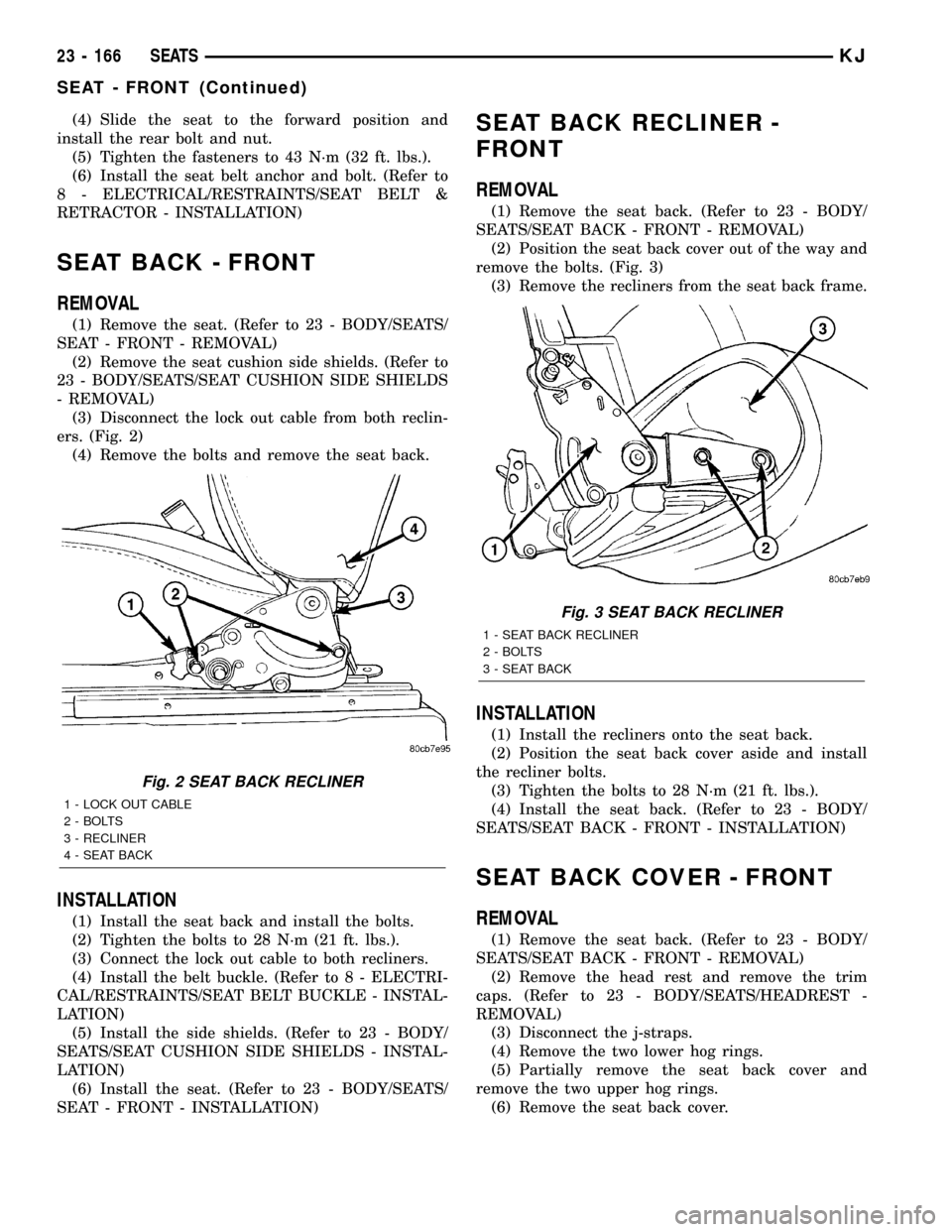
(3) Disconnect the lock out cable from both reclin-
ers. (Fig. 2)
(4) Remove the bolts and remove the seat back.
INSTALLATION
(1) Install the seat back and install the bolts.
(2) Tighten the bolts to 28 N´m (21 ft. lbs.).
(3) Connect the lock out cable to both recliners.
(4) Install the belt buckle. (Refer to 8 - ELECTRI-
CAL/RESTRAINTS/SEAT BELT BUCKLE - INSTAL-
LATION)
(5) Install the side shields. (Refer to 23 - BODY/
SEATS/SEAT CUSHION SIDE SHIELDS - INSTAL-
LATION)
(6) Install the seat. (Refer to 23 - BODY/SEATS/
SEAT - FRONT - INSTALLATION)
SEAT BACK RECLINER -
FRONT
REMOVAL
(1) Remove the seat back. (Refer to 23 - BODY/
SEATS/SEAT BACK - FRONT - REMOVAL)
(2) Position the seat back cover out of the way and
remove the bolts. (Fig. 3)
(3) Remove the recliners from the seat back frame.
INSTALLATION
(1) Install the recliners onto the seat back.
(2) Position the seat back cover aside and install
the recliner bolts.
(3) Tighten the bolts to 28 N´m (21 ft. lbs.).
(4) Install the seat back. (Refer to 23 - BODY/
SEATS/SEAT BACK - FRONT - INSTALLATION)
SEAT BACK COVER - FRONT
REMOVAL
(1) Remove the seat back. (Refer to 23 - BODY/
SEATS/SEAT BACK - FRONT - REMOVAL)
(2) Remove the head rest and remove the trim
caps. (Refer to 23 - BODY/SEATS/HEADREST -
REMOVAL)
(3) Disconnect the j-straps.
(4) Remove the two lower hog rings.
(5) Partially remove the seat back cover and
remove the two upper hog rings.
(6) Remove the seat back cover.
Fig. 2 SEAT BACK RECLINER
1 - LOCK OUT CABLE
2 - BOLTS
3 - RECLINER
4 - SEAT BACK
Fig. 3 SEAT BACK RECLINER
1 - SEAT BACK RECLINER
2 - BOLTS
3 - SEAT BACK
23 - 166 SEATSKJ
SEAT - FRONT (Continued)
Page 1635 of 1803

SEAT BACK CUSHION - REAR
REMOVAL
(1) Remove the seat back cover. (Refer to 23 -
BODY/SEATS/SEAT BACK COVER - REAR -
REMOVAL)
(2) Separate the cushion from the seat back frame.
INSTALLATION
(1) Position the seat back cushion onto the seat
back frame.
(2) Install the seat back cover. (Refer to 23 -
BODY/SEATS/SEAT BACK COVER - REAR -
INSTALLATION)
FOLDING REAR SEAT BACK
LATCH / LOCK
REMOVAL
(1) Remove the rear seat back cushion. (Refer to
23 - BODY/SEATS/SEAT BACK CUSHION / COVER
- REAR - REMOVAL)
(2) Disconnect the shoulder belt release cable. (Fig.
9)
(3) Remove the bolts and remove the latch/lock
assembly. (Fig. 10)
INSTALLATION
(1) Install the latch/lock assembly and install the
bolts.
(2) Tighten the bolts to 28 N´m (21 ft. lbs.).
(3) Connect the shoulder belt release cable.
(4) Install the rear seat back cushion. (Refer to 23
- BODY/SEATS/SEAT BACK CUSHION / COVER -
REAR - INSTALLATION)
REAR SEAT BACK LATCH
STRIKER
REMOVAL
(1) Remove the quarter trim panel. (Refer to 23 -
BODY/INTERIOR/QUARTER TRIM PANEL -
REMOVAL)
(2) Remove the bolts and remove the striker. (Fig.
11 )
Fig. 9 Seat Back Latch Cable Disengage/Engage
1 - LEVER
2 - PLUNGER
3 - LATCH CABLE FITTING
4 - REAR CENTER RETRACTOR
5 - SUPPORT
Fig. 10 LATCH/LOCK ASSEMBLY
1 - LATCH/LOCK ASSEMBLY
2 - SEAT BELT RETRACTOR
3 - RETRACTOR RELEASE CABLE
4 - BOLTS
5 - REAR SEAT BACK FRAME
23 - 170 SEATSKJ
Page 1642 of 1803
Before beginning diagnosis for wind noise or water
leaks, verify that the problem was not caused by
releasing the control switch before the sunroof was
fully closed. The sunroof module has a water-man-agement system. If however, the sunroof glass is in a
partial closed position, high pressure water may be
forced beyond the water management system bound-
aries and onto the headlining.
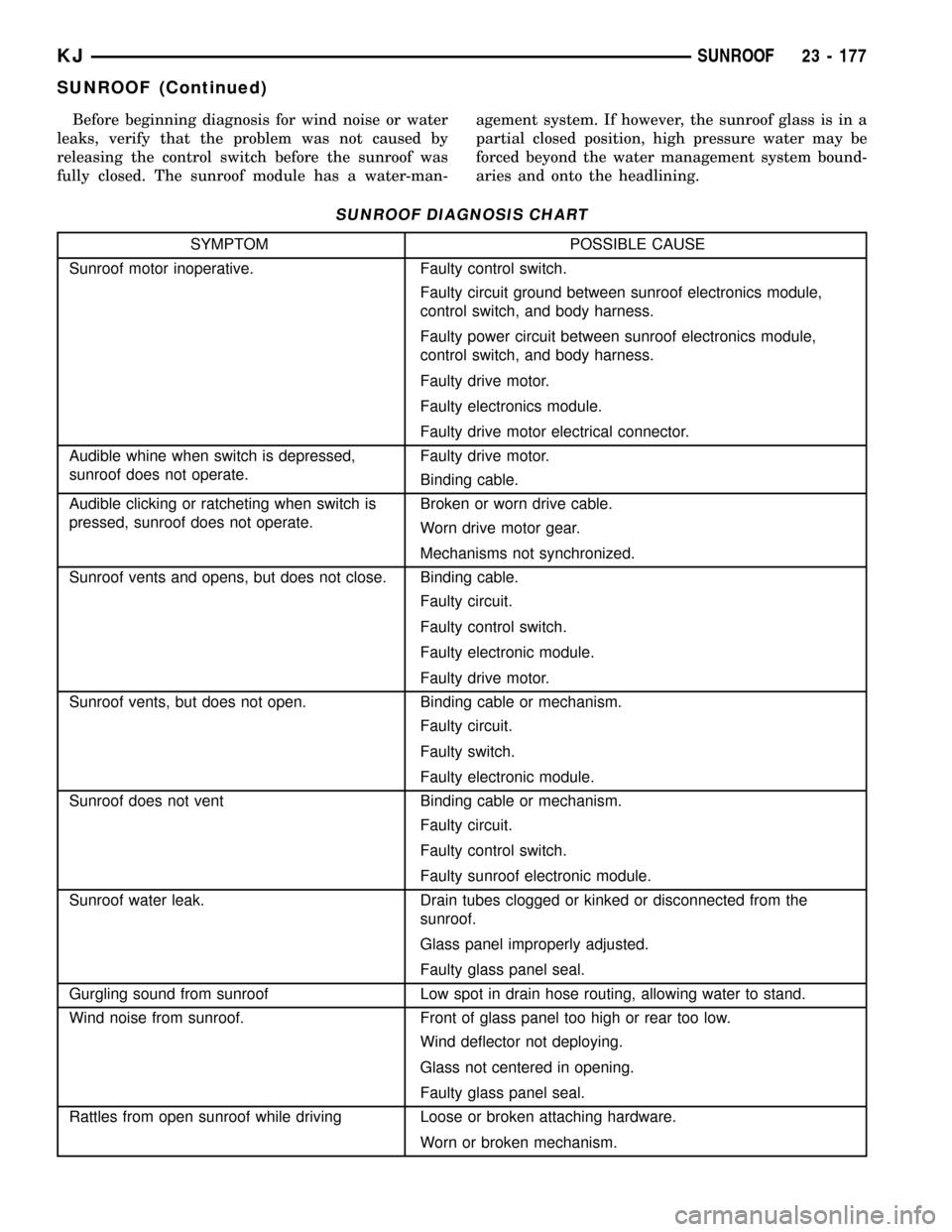
SUNROOF DIAGNOSIS CHART
SYMPTOM POSSIBLE CAUSE
Sunroof motor inoperative. Faulty control switch.
Faulty circuit ground between sunroof electronics module,
control switch, and body harness.
Faulty power circuit between sunroof electronics module,
control switch, and body harness.
Faulty drive motor.
Faulty electronics module.
Faulty drive motor electrical connector.
Audible whine when switch is depressed,
sunroof does not operate.Faulty drive motor.
Binding cable.
Audible clicking or ratcheting when switch is
pressed, sunroof does not operate.Broken or worn drive cable.
Worn drive motor gear.
Mechanisms not synchronized.
Sunroof vents and opens, but does not close. Binding cable.
Faulty circuit.
Faulty control switch.
Faulty electronic module.
Faulty drive motor.
Sunroof vents, but does not open. Binding cable or mechanism.
Faulty circuit.
Faulty switch.
Faulty electronic module.
Sunroof does not vent Binding cable or mechanism.
Faulty circuit.
Faulty control switch.
Faulty sunroof electronic module.
Sunroof water leak. Drain tubes clogged or kinked or disconnected from the
sunroof.
Glass panel improperly adjusted.
Faulty glass panel seal.
Gurgling sound from sunroof Low spot in drain hose routing, allowing water to stand.
Wind noise from sunroof. Front of glass panel too high or rear too low.
Wind deflector not deploying.
Glass not centered in opening.
Faulty glass panel seal.
Rattles from open sunroof while driving Loose or broken attaching hardware.
Worn or broken mechanism.
KJSUNROOF 23 - 177
SUNROOF (Continued)
Page 1646 of 1803

(4) Disconnect the drain hose from the sunroof
housing (Fig. 8).
(5) Drain any liquid from hose connection, if nec-
essary.
(6) Disconnect the grommet, attachment clips and
remove the drain tube.
INSTALLATION
FRONT DRAIN TUBES
(1) Connect the drain hose to the sunroof housing
and test drainage.
(2) Connect the body grommet and attachment
clips.
(3) Install the instrument panel top panel. (Refer
to 23 - BODY/INSTRUMENT PANEL/INSTRUMENT
PANEL TOP COVER - INSTALLATION)
(4) Install the headliner. (Refer to 23 - BODY/IN-
TERIOR/HEADLINER - INSTALLATION)
(5) Install sunroof opening trim lace. (Refer to 23 -
BODY/SUNROOF/OPENING TRIM LACE - INSTAL-
LATION)
REAR DRAIN TUBES
(1) Connect the drain hose to the sunroof housing
and test drainage.
(2) Connect the body grommet and attachment
clips.
(3) Install the headliner.(4) Install sunroof opening trim lace.
MODULE ASSEMBLY
REMOVAL
(1) Move glass panel to the fully closed position.
(2) Disconnect and isolate the negative battery
cable.
(3) Remove sunroof opening trim lace.
(4) Remove headliner. (Refer to 23 - BODY/INTE-
RIOR/HEADLINER - REMOVAL)
(5) Disconnect wire harness push in fasteners and
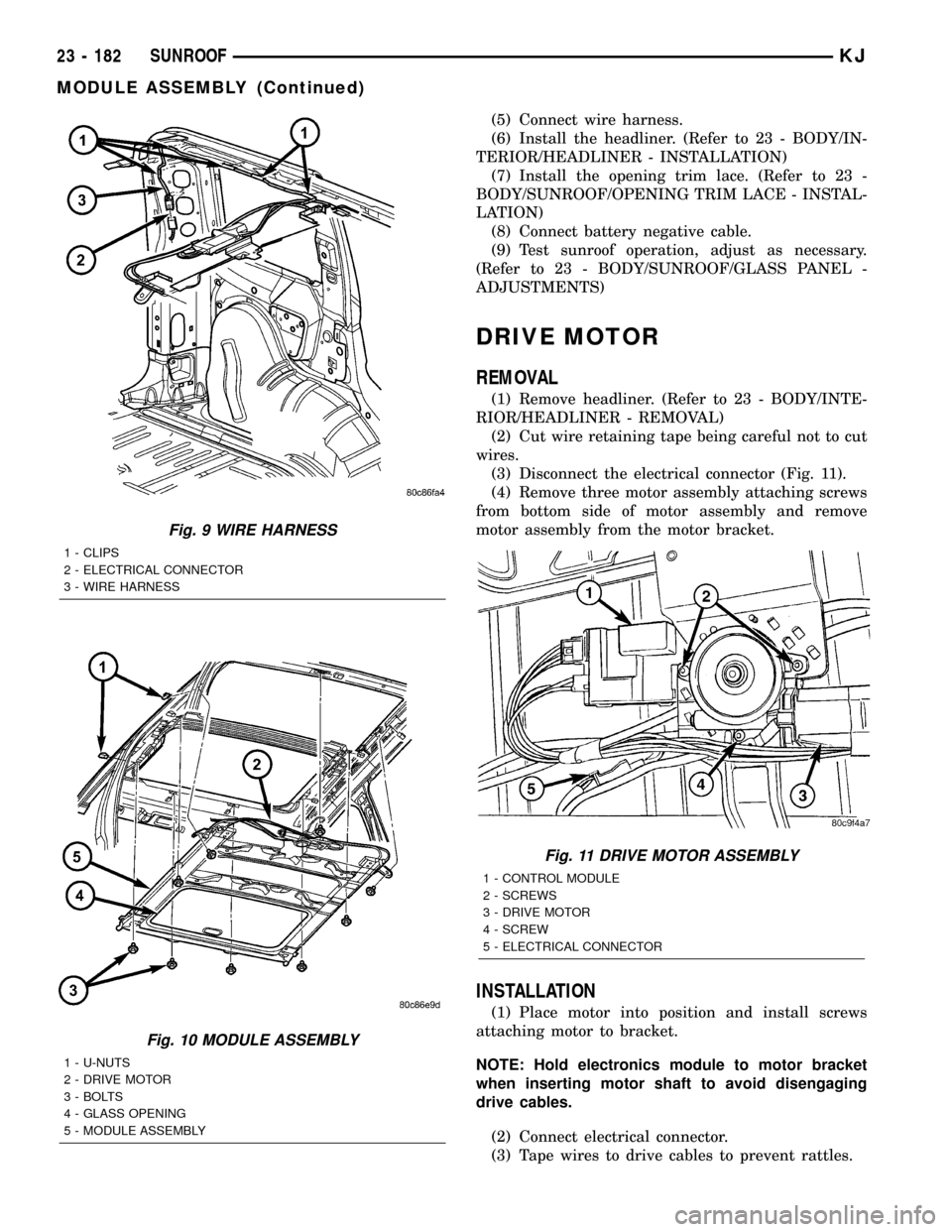
electrical connector. (Fig. 9)
(6) Disconnect the drain tubes from sunroof hous-
ing.
(7) Loosen fasteners attaching sunroof module
assembly.
(8) With the aid of a helper, remove fasteners
attaching sunroof module assembly to roof panel
(Fig. 10).
INSTALLATION
(1) With the Glass panel in the fully closed posi-
tion.
(2) Raise rear end of sunroof module assembly and
guide into position and start fasteners.
(3) Tighten the fasteners to 9 N´m (80 in. lbs.).
(4) Connect the drain tubes.
Fig. 7 FRONT DRAIN TUBE
1 - TUBE
2 - CLIPS
3 - GROMMET
Fig. 8 REAR DRAIN TUBE
1 - GROMMET
2 - TUBE
3 - CLIPS
KJSUNROOF 23 - 181
DRAIN TUBE (Continued)
Page 1647 of 1803
(5) Connect wire harness.
(6) Install the headliner. (Refer to 23 - BODY/IN-
TERIOR/HEADLINER - INSTALLATION)
(7) Install the opening trim lace. (Refer to 23 -
BODY/SUNROOF/OPENING TRIM LACE - INSTAL-
LATION)
(8) Connect battery negative cable.
(9) Test sunroof operation, adjust as necessary.
(Refer to 23 - BODY/SUNROOF/GLASS PANEL -
ADJUSTMENTS)
DRIVE MOTOR
REMOVAL
(1) Remove headliner. (Refer to 23 - BODY/INTE-
RIOR/HEADLINER - REMOVAL)
(2) Cut wire retaining tape being careful not to cut
wires.
(3) Disconnect the electrical connector (Fig. 11).
(4) Remove three motor assembly attaching screws
from bottom side of motor assembly and remove
motor assembly from the motor bracket.
INSTALLATION
(1) Place motor into position and install screws
attaching motor to bracket.
NOTE: Hold electronics module to motor bracket
when inserting motor shaft to avoid disengaging
drive cables.
(2) Connect electrical connector.
(3) Tape wires to drive cables to prevent rattles.
Fig. 9 WIRE HARNESS
1 - CLIPS
2 - ELECTRICAL CONNECTOR
3 - WIRE HARNESS
Fig. 10 MODULE ASSEMBLY
1 - U-NUTS
2 - DRIVE MOTOR
3 - BOLTS
4 - GLASS OPENING
5 - MODULE ASSEMBLY
Fig. 11 DRIVE MOTOR ASSEMBLY
1 - CONTROL MODULE
2 - SCREWS
3 - DRIVE MOTOR
4 - SCREW
5 - ELECTRICAL CONNECTOR
23 - 182 SUNROOFKJ
MODULE ASSEMBLY (Continued)
Page 1648 of 1803
(4) Test sunroof operation, adjust as necessary.
(5) Install headliner. (Refer to 23 - BODY/INTERI-
OR/HEADLINER - INSTALLATION)
CONTROL MODULE
REMOVAL
(1) Remove the module assembly. (Refer to 23 -
BODY/SUNROOF/MODULE ASSEMBLY -
REMOVAL)
(2) Remove three motor assembly retaining screws
from bottom side of motor, and remove motor assem-
bly (Fig. 11).
(3) From top side of module assembly, remove one
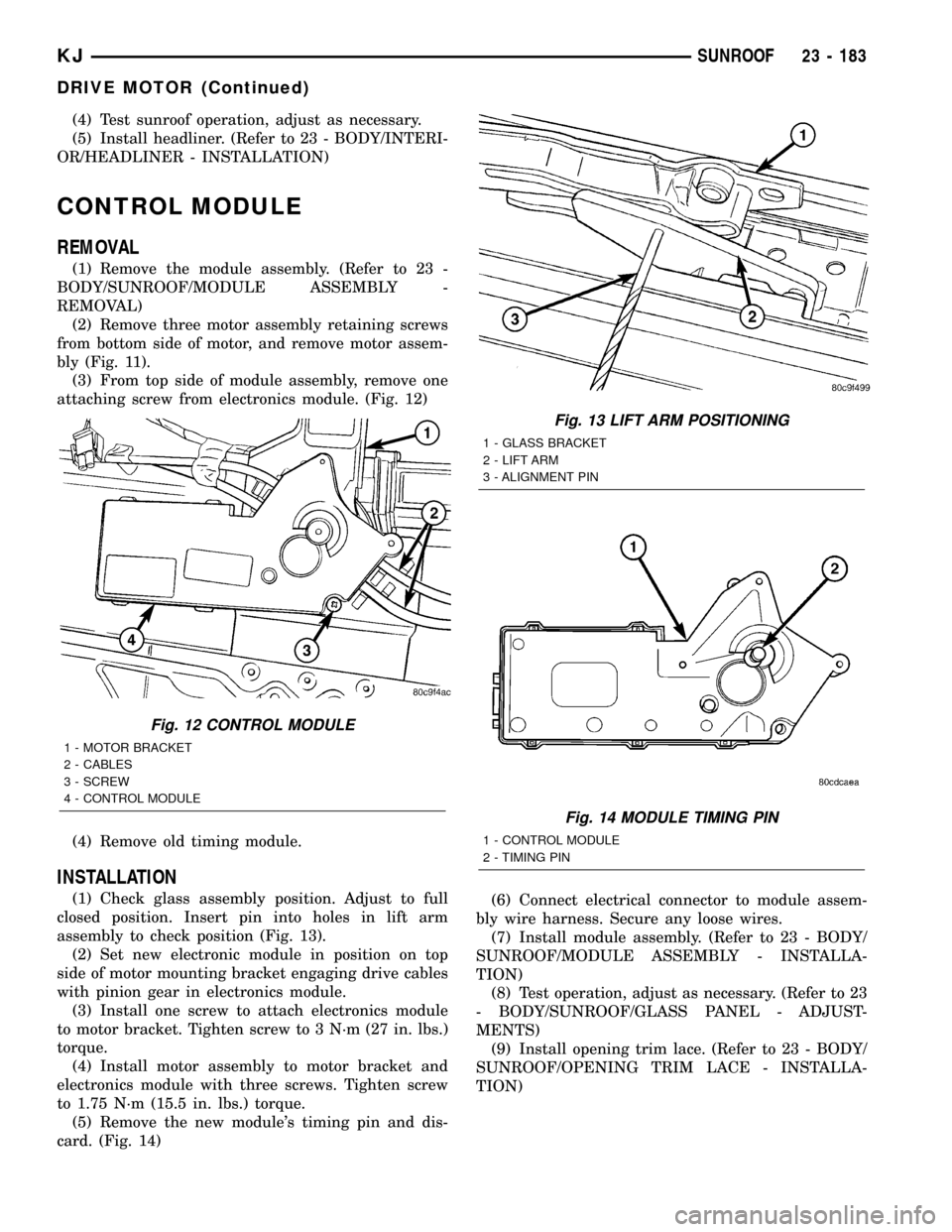
attaching screw from electronics module. (Fig. 12)
(4) Remove old timing module.
INSTALLATION
(1) Check glass assembly position. Adjust to full
closed position. Insert pin into holes in lift arm
assembly to check position (Fig. 13).
(2) Set new electronic module in position on top
side of motor mounting bracket engaging drive cables
with pinion gear in electronics module.
(3) Install one screw to attach electronics module
to motor bracket. Tighten screw to 3 N´m (27 in. lbs.)
torque.
(4) Install motor assembly to motor bracket and
electronics module with three screws. Tighten screw
to 1.75 N´m (15.5 in. lbs.) torque.
(5) Remove the new module's timing pin and dis-
card. (Fig. 14)(6) Connect electrical connector to module assem-
bly wire harness. Secure any loose wires.
(7) Install module assembly. (Refer to 23 - BODY/
SUNROOF/MODULE ASSEMBLY - INSTALLA-
TION)
(8) Test operation, adjust as necessary. (Refer to 23
- BODY/SUNROOF/GLASS PANEL - ADJUST-
MENTS)
(9) Install opening trim lace. (Refer to 23 - BODY/
SUNROOF/OPENING TRIM LACE - INSTALLA-
TION)
Fig. 12 CONTROL MODULE
1 - MOTOR BRACKET
2 - CABLES
3 - SCREW
4 - CONTROL MODULE
Fig. 13 LIFT ARM POSITIONING
1 - GLASS BRACKET
2 - LIFT ARM
3 - ALIGNMENT PIN
Fig. 14 MODULE TIMING PIN
1 - CONTROL MODULE
2 - TIMING PIN
KJSUNROOF 23 - 183
DRIVE MOTOR (Continued)
Page 1649 of 1803
CONTROL SWITCH
DESCRIPTION
Vehicles equipped with a power sunroof utilize an
sunroof control switch. On this model, the sunroof
control switch is located in the overhead console, in
between the two reading lamps. The switch is
mounted in the overhead console with four plastic
retaining tabs, molded into the switch housing.
This switch incorporates four selections of opera-
tion open, auto open, close and vent. The individual
switches in the sunroof control switch unit cannot be
repaired. If one switch is damaged or faulty, the
entire sunroof control switch unit must be replaced.
OPERATION
With the operation of the sunroof control switch,
voltage is directed to the sunroof motor, through the
switch contacts or control module. If the control
switch is depressed and held depressed the voltage
signal is controlled manually through the switch con-
tacts, so when the switch is released the sunroof
stops.
Refer to the owners manual for more information
on the operation of the sunroof switch and system.
DIAGNOSIS AND TESTING
The following test will determine if the sunroof
control switch is operating properly.
(1) Remove the overhead console from the head-
liner (Refer to 8 - ELECTRICAL/OVERHEAD CON-
SOLE - REMOVAL).
(2) Remove the sunroof control switch from the
overhead console (Refer to 23 - BODY/SUNROOF/
CONTROL SWITCH - REMOVAL).
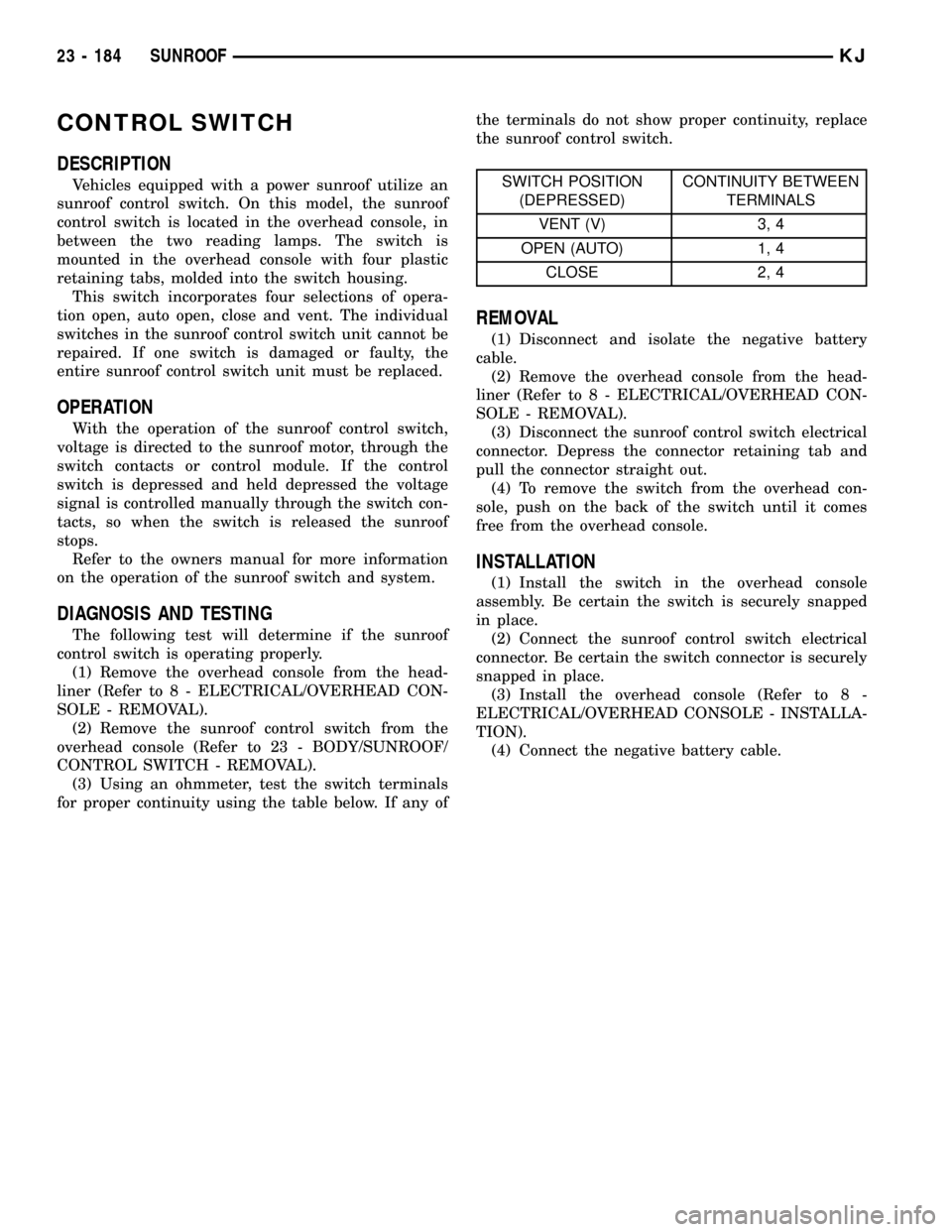
(3) Using an ohmmeter, test the switch terminals
for proper continuity using the table below. If any ofthe terminals do not show proper continuity, replace
the sunroof control switch.
SWITCH POSITION
(DEPRESSED)CONTINUITY BETWEEN
TERMINALS
VENT (V) 3, 4
OPEN (AUTO) 1, 4
CLOSE 2, 4
REMOVAL
(1) Disconnect and isolate the negative battery
cable.
(2) Remove the overhead console from the head-
liner (Refer to 8 - ELECTRICAL/OVERHEAD CON-
SOLE - REMOVAL).
(3) Disconnect the sunroof control switch electrical
connector. Depress the connector retaining tab and
pull the connector straight out.
(4) To remove the switch from the overhead con-
sole, push on the back of the switch until it comes
free from the overhead console.
INSTALLATION
(1) Install the switch in the overhead console
assembly. Be certain the switch is securely snapped
in place.
(2) Connect the sunroof control switch electrical
connector. Be certain the switch connector is securely
snapped in place.
(3) Install the overhead console (Refer to 8 -
ELECTRICAL/OVERHEAD CONSOLE - INSTALLA-
TION).
(4) Connect the negative battery cable.
23 - 184 SUNROOFKJ
Page 1659 of 1803

Use an adjustable vacuum test set (Special Tool
C-3707-B) and a suitable vacuum pump to test the
HVAC vacuum control system. With a finger placed
over the end of the vacuum test hose probe (Fig. 3),
adjust the bleed valve on the test set gauge to obtain
a vacuum of exactly 27 kPa (8 in. Hg.). Release and
block the end of the probe several times to verify that
the vacuum reading returns to the exact 27 kPa (8
in. Hg.) setting. Otherwise, a false reading will be
obtained during testing.
VACUUM CHECK VALVE
(1) Remove the vacuum check valve. The valve is
located in the vacuum supply tube (black) at the
HVAC system vacuum tee.
(2) Connect the test set vacuum supply hose to the
A/C Heater Control side of the valve. When con-
nected to this side of the check valve, no vacuum
should pass and the test set gauge should return to
the 27 kPa (8 in. Hg.) setting. If OK, go to Step 3. If
not OK, replace the faulty valve.
(3) Connect the test set vacuum supply hose to the
engine vacuum side of the valve. When connected to
this side of the check valve, vacuum should flow
through the valve without restriction. If not OK,
replace the faulty valve.
A/C HEATER CONTROLS
(1) Connect the test set vacuum probe to the
HVAC vacuum supply (black) tube at the tee in the
engine compartment. Position the test set gauge so
that it can be viewed from the passenger compart-
ment.(2) Place the A/C Heater Mode Control switch
knob in each mode position, one position at a time,
and pause after each selection. The test set gauge
should return to the 27 kPa (8 in. Hg.) setting
shortly after each selection is made. If not OK, a
component or vacuum line in the vacuum circuit of
the selected mode has a leak. See the procedure in
Locating Vacuum Leaks.
CAUTION: Do not use lubricant on the switch ports
or in the holes in the plug, as lubricant will ruin the
vacuum valve in the switch. A drop of clean water
in the connector plug holes will help the connector
slide onto the switch ports.
LOCATING VACUUM LEAKS
WARNING: ON VEHICLES EQUIPPED WITH AIR-
BAGS, DISABLE THE AIRBAG SYSTEM BEFORE
ATTEMPTING ANY STEERING WHEEL, STEERING
COLUMN, OR INSTRUMENT PANEL COMPONENT
DIAGNOSIS OR SERVICE. DISCONNECT AND ISO-
LATE THE BATTERY NEGATIVE (GROUND) CABLE,
THEN WAIT TWO MINUTES FOR THE AIRBAG SYS-
TEM CAPACITOR TO DISCHARGE BEFORE PER-
FORMING FURTHER DIAGNOSIS OR SERVICE. THIS
IS THE ONLY SURE WAY TO DISABLE THE AIRBAG
SYSTEM. FAILURE TO TAKE THE PROPER PRE-
CAUTIONS COULD RESULT IN AN ACCIDENTAL
AIRBAG DEPLOYMENT AND POSSIBLE PERSONAL
INJURY.
(1) Disconnect the vacuum harness connector from
the back of the HVAC control head(Refer to 24 -
HEATING & AIR CONDITIONING/CONTROLS/A/C
HEATER CONTROL - REMOVAL).
(2) Connect the test set vacuum hose probe to each
port in the HVAC housing half of the vacuum har-
ness connector, one port at a time, and pause after
each connection. The test set gauge should return to
the 27 kPa (8 in. Hg.) setting shortly after each con-
nection is made. If OK, replace the faulty A/C Heater
Control. If not OK, go to Step 3.
(3) Determine the vacuum line color of the vacuum
circuit that is leaking. To determine the vacuum line
colors, refer to the Vacuum Circuits chart (Fig. 4).
(4) Disconnect and plug the vacuum line from the
component (fitting, actuator, valve, switch, or reser-
voir) on the other end of the leaking circuit. Instru-
ment panel disassembly or removal may be necessary
to gain access to some components. See the appropri-
ate service procedures.
Fig. 3 ADJUST VACUUM TEST BLEED VALVE
1 - VACUUM PUMP TOOL C-4289
2 - VACUUM TEST SET C-3707
3 - BLEED VALVE
4 - PROBE
KJHEATING & AIR CONDITIONING 24 - 7
HEATING & AIR CONDITIONING (Continued)
Page 1661 of 1803
(5) Connect the test set hose or probe to the open
end of the leaking circuit. The test set gauge should
return to the 27 kPa (8 in. Hg.) setting shortly after
each connection is made. If OK, replace the faulty
disconnected component. If not OK, go to Step 6.
(6)
To locate a leak in a vacuum line, leave one end
of the line plugged and connect the test set hose or
probe to the other end of the line. Run your fingers
slowly along the line while watching the test set gauge.
The vacuum reading will fluctuate when your fingers
contact the source of the leak. To repair the vacuum
line, cut out the leaking section of the line. Then, insert
the loose ends of the line into a suitable length of 3 mil-
limeter (0.125 inch) inside diameter rubber hose.
STANDARD PROCEDURE - DIODE
REPLACEMENT
(1) Disconnect the battery negative cable and iso-
late it.
(2) Locate the diode in the harness, and remove
the protective covering.
(3) Remove the diode from the harness, pay atten-
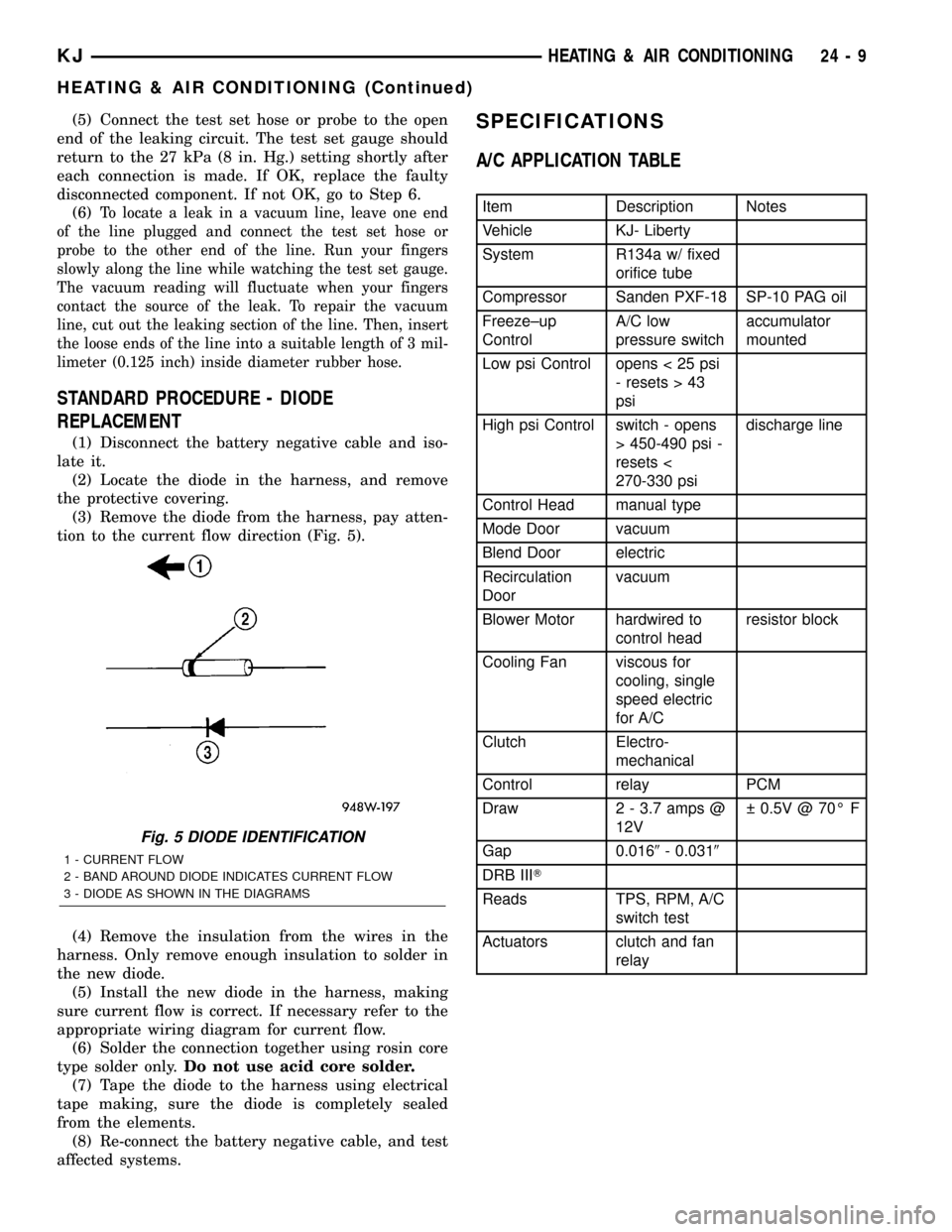
tion to the current flow direction (Fig. 5).
(4) Remove the insulation from the wires in the
harness. Only remove enough insulation to solder in
the new diode.
(5) Install the new diode in the harness, making
sure current flow is correct. If necessary refer to the
appropriate wiring diagram for current flow.
(6) Solder the connection together using rosin core
type solder only.Do not use acid core solder.
(7) Tape the diode to the harness using electrical
tape making, sure the diode is completely sealed
from the elements.
(8) Re-connect the battery negative cable, and test
affected systems.
SPECIFICATIONS
A/C APPLICATION TABLE
Item Description Notes
Vehicle KJ- Liberty
System R134a w/ fixed
orifice tube
Compressor Sanden PXF-18 SP-10 PAG oil
Freeze±up
ControlA/C low
pressure switchaccumulator
mounted
Low psi Control opens < 25 psi
- resets > 43
psi
High psi Control switch - opens
> 450-490 psi -
resets <
270-330 psidischarge line
Control Head manual type
Mode Door vacuum
Blend Door electric
Recirculation
Doorvacuum
Blower Motor hardwired to
control headresistor block
Cooling Fan viscous for
cooling, single
speed electric
for A/C
Clutch Electro-
mechanical
Control relay PCM
Draw 2 - 3.7 amps @
12V 0.5V @ 70É F
Gap 0.0169- 0.0319
DRB IIIT
Reads TPS, RPM, A/C
switch test
Actuators clutch and fan
relay
Fig. 5 DIODE IDENTIFICATION
1 - CURRENT FLOW
2 - BAND AROUND DIODE INDICATES CURRENT FLOW
3 - DIODE AS SHOWN IN THE DIAGRAMS
KJHEATING & AIR CONDITIONING 24 - 9
HEATING & AIR CONDITIONING (Continued)