removal JEEP LIBERTY 2002 KJ / 1.G Workshop Manual
[x] Cancel search | Manufacturer: JEEP, Model Year: 2002, Model line: LIBERTY, Model: JEEP LIBERTY 2002 KJ / 1.GPages: 1803, PDF Size: 62.3 MB
Page 1648 of 1803

(4) Test sunroof operation, adjust as necessary.
(5) Install headliner. (Refer to 23 - BODY/INTERI-
OR/HEADLINER - INSTALLATION)
CONTROL MODULE
REMOVAL
(1) Remove the module assembly. (Refer to 23 -
BODY/SUNROOF/MODULE ASSEMBLY -
REMOVAL)
(2) Remove three motor assembly retaining screws
from bottom side of motor, and remove motor assem-
bly (Fig. 11).
(3) From top side of module assembly, remove one
attaching screw from electronics module. (Fig. 12)
(4) Remove old timing module.
INSTALLATION
(1) Check glass assembly position. Adjust to full
closed position. Insert pin into holes in lift arm
assembly to check position (Fig. 13).
(2) Set new electronic module in position on top
side of motor mounting bracket engaging drive cables
with pinion gear in electronics module.
(3) Install one screw to attach electronics module
to motor bracket. Tighten screw to 3 N´m (27 in. lbs.)
torque.
(4) Install motor assembly to motor bracket and
electronics module with three screws. Tighten screw
to 1.75 N´m (15.5 in. lbs.) torque.
(5) Remove the new module's timing pin and dis-
card. (Fig. 14)(6) Connect electrical connector to module assem-
bly wire harness. Secure any loose wires.
(7) Install module assembly. (Refer to 23 - BODY/
SUNROOF/MODULE ASSEMBLY - INSTALLA-
TION)
(8) Test operation, adjust as necessary. (Refer to 23
- BODY/SUNROOF/GLASS PANEL - ADJUST-
MENTS)
(9) Install opening trim lace. (Refer to 23 - BODY/
SUNROOF/OPENING TRIM LACE - INSTALLA-
TION)
Fig. 12 CONTROL MODULE
1 - MOTOR BRACKET
2 - CABLES
3 - SCREW
4 - CONTROL MODULE
Fig. 13 LIFT ARM POSITIONING
1 - GLASS BRACKET
2 - LIFT ARM
3 - ALIGNMENT PIN
Fig. 14 MODULE TIMING PIN
1 - CONTROL MODULE
2 - TIMING PIN
KJSUNROOF 23 - 183
DRIVE MOTOR (Continued)
Page 1649 of 1803
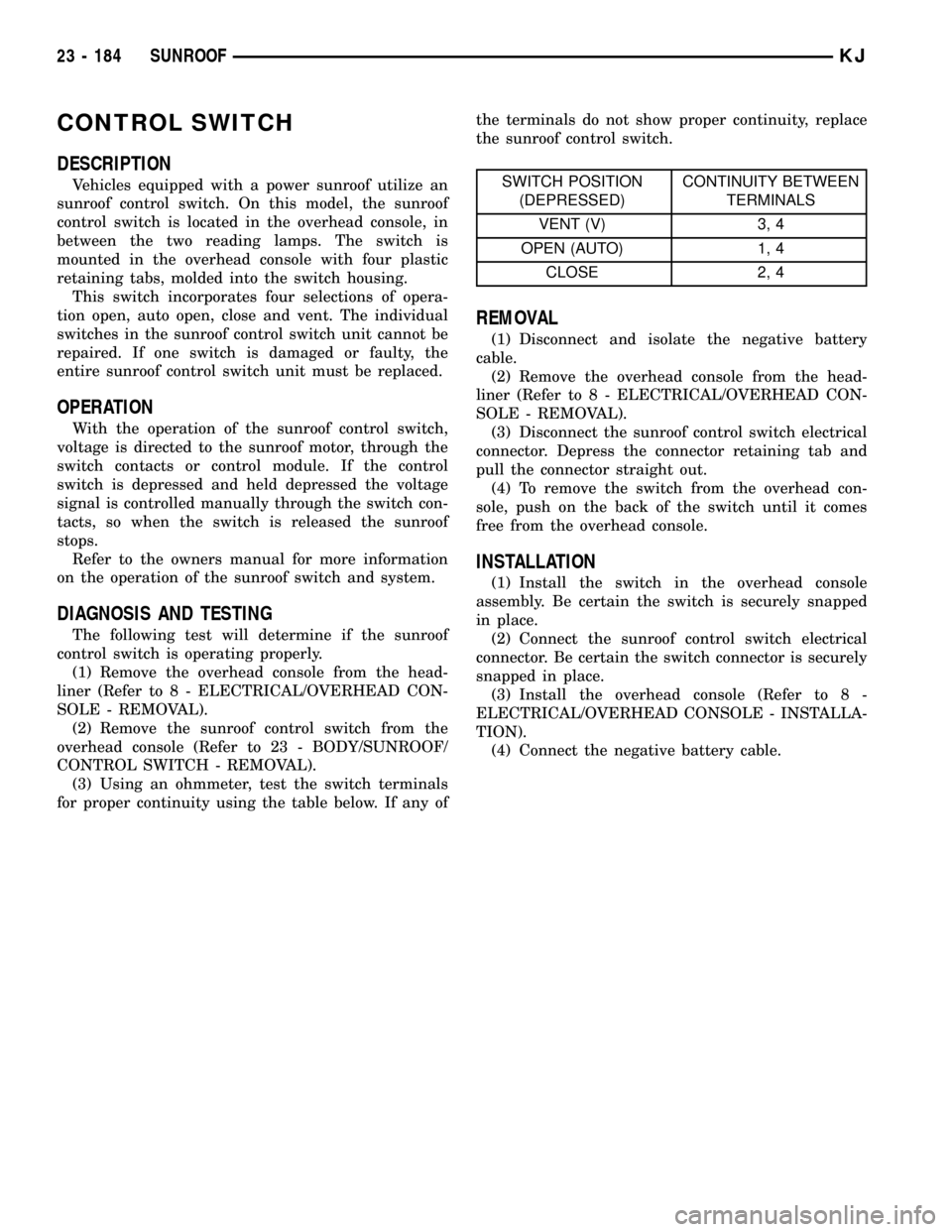
CONTROL SWITCH
DESCRIPTION
Vehicles equipped with a power sunroof utilize an
sunroof control switch. On this model, the sunroof
control switch is located in the overhead console, in
between the two reading lamps. The switch is
mounted in the overhead console with four plastic
retaining tabs, molded into the switch housing.
This switch incorporates four selections of opera-
tion open, auto open, close and vent. The individual
switches in the sunroof control switch unit cannot be
repaired. If one switch is damaged or faulty, the
entire sunroof control switch unit must be replaced.
OPERATION
With the operation of the sunroof control switch,
voltage is directed to the sunroof motor, through the
switch contacts or control module. If the control
switch is depressed and held depressed the voltage
signal is controlled manually through the switch con-
tacts, so when the switch is released the sunroof
stops.
Refer to the owners manual for more information
on the operation of the sunroof switch and system.
DIAGNOSIS AND TESTING
The following test will determine if the sunroof
control switch is operating properly.
(1) Remove the overhead console from the head-
liner (Refer to 8 - ELECTRICAL/OVERHEAD CON-
SOLE - REMOVAL).
(2) Remove the sunroof control switch from the
overhead console (Refer to 23 - BODY/SUNROOF/
CONTROL SWITCH - REMOVAL).
(3) Using an ohmmeter, test the switch terminals
for proper continuity using the table below. If any ofthe terminals do not show proper continuity, replace
the sunroof control switch.
SWITCH POSITION
(DEPRESSED)CONTINUITY BETWEEN
TERMINALS
VENT (V) 3, 4
OPEN (AUTO) 1, 4
CLOSE 2, 4
REMOVAL
(1) Disconnect and isolate the negative battery
cable.
(2) Remove the overhead console from the head-
liner (Refer to 8 - ELECTRICAL/OVERHEAD CON-
SOLE - REMOVAL).
(3) Disconnect the sunroof control switch electrical
connector. Depress the connector retaining tab and
pull the connector straight out.
(4) To remove the switch from the overhead con-
sole, push on the back of the switch until it comes
free from the overhead console.
INSTALLATION
(1) Install the switch in the overhead console
assembly. Be certain the switch is securely snapped
in place.
(2) Connect the sunroof control switch electrical
connector. Be certain the switch connector is securely
snapped in place.
(3) Install the overhead console (Refer to 8 -
ELECTRICAL/OVERHEAD CONSOLE - INSTALLA-
TION).
(4) Connect the negative battery cable.
23 - 184 SUNROOFKJ
Page 1650 of 1803

WEATHERSTRIP/SEALS
TABLE OF CONTENTS
page page
A-PILLAR SEAL
REMOVAL............................185
INSTALLATION........................185
COWL WEATHERSTRIP
REMOVAL............................185
INSTALLATION........................185
DOOR PRIMARY WEATHERSTRIP
REMOVAL............................185
INSTALLATION........................185
DOOR LOWER WEATHERSTRIP
REMOVAL............................186
INSTALLATION........................186
FRONT DOOR OUTER BELT MOLDING
REMOVAL............................186
INSTALLATION........................186
SWING GATE BELTLINE WEATHERSTRIP
REMOVAL............................186
INSTALLATION........................186
SWING GATE OPENING WEATHERSTRIP
REMOVAL............................186INSTALLATION........................186
REAR DOOR OUTER BELT MOLDING
REMOVAL............................186
INSTALLATION........................186
SIDE RAIL WEATHERSTRIP/RETAINER
REMOVAL............................186
INSTALLATION........................186
WINDSHIELD A-PILLAR WEATHERSTRIP/
RETAINER
REMOVAL............................186
INSTALLATION........................187
COWL/PLENUM SEAL
REMOVAL............................187
INSTALLATION........................187
COWL/PLENUM WINDOW BAFFLE SEAL
REMOVAL............................187
INSTALLATION........................187
A-PILLAR SEAL
REMOVAL
(1) Open the doors and peal the seal away from
the a-pillar/windshield and the side rail weather
strip flanges.
INSTALLATION
(1) Position the a-pillar seal over the windshield/a-
pillar and the side rail weatherstrip flanges and seat
fully.
COWL WEATHERSTRIP
REMOVAL
(1) Open the hood and peal the cowl seal from the
cowl panel and cowl flange.
INSTALLATION
(1) Position the weatherstrip over the cowl flange
and the cowl grille and seat fully.
DOOR PRIMARY
WEATHERSTRIP
REMOVAL
(1) Remove the lower b-pillar trim. (Refer to 23 -
BODY/INTERIOR/B-PILLAR LOWER TRIM -
REMOVAL)
(2) Peal seal off of the door opening flange.
INSTALLATION
(1) Position the seal to the bottom of the door
opening, with bulb facing outboard, starting the
installation at the center of the lower flange. Press
the seal onto the sill flange and work around the
perimeter of the door opening until fully seated.
Work in one direction, smoothing the seal to avoid
puckers or wrinkles.
(2) Install the lower b-pillar trim. (Refer to 23 -
BODY/INTERIOR/B-PILLAR LOWER TRIM -
INSTALLATION)
(3) When installing a new weatherstrip on the
front door opening, remove the tear strip starting at
the splice and moving around the front of the door to
the back of the opening.
KJWEATHERSTRIP/SEALS 23 - 185
Page 1651 of 1803

(4) When installing a new weatherstrip on the rear
door opening, remove the tear strip starting at the
splice and moving around the back of the door to the
front of the opening.
DOOR LOWER WEATHERSTRIP
REMOVAL
(1) Carefully disengage the push pin fasteners and
remove the seal.
INSTALLATION
(1) Position the seal and seat the push pin fasten-
ers.
FRONT DOOR OUTER BELT
MOLDING
REMOVAL
(1) Lower the window.
(2) Pull the outer belt molding off of the door
flange starting at the rear and moving forward.
INSTALLATION
(1) Press the belt molding onto the outer door win-
dow flange starting at the rear and working forward.
SWING GATE BELTLINE
WEATHERSTRIP
REMOVAL
(1) Remove the swing gate trim panel. (Refer to 23
- BODY/SWING GATE/TRIM PANEL - REMOVAL)
(2) Pull seal away from the corner tabs and
remove from the swing gate flange.
INSTALLATION
(1) Install the seal over the swing gate flange and
seat the corner tabs.
(2) Install the swing gate trim panel. (Refer to 23 -
BODY/SWING GATE/TRIM PANEL - INSTALLA-
TION)
SWING GATE OPENING
WEATHERSTRIP
REMOVAL
(1) Open the swing gate and peal seal off of the
gate opening flange.
INSTALLATION
(1) Position the seal to the bottom of the gate
opening starting the installation at the center of the
flange. Press the seal onto the sill flange and work
around the perimeter of the door opening until fully
seated. Work in one direction, smoothing the seal to
avoid puckers or wrinkles.
REAR DOOR OUTER BELT
MOLDING
REMOVAL
(1) Lower the window.
(2) Pull the outer belt molding off of the door
flange starting at the rear and moving forward.
INSTALLATION
(1) Press the belt molding onto the outer door win-
dow flange starting at the front and working back.
SIDE RAIL WEATHERSTRIP/
RETAINER
REMOVAL
(1) Remove the windshield weatherstrip retainer.
(Refer to 23 - BODY/WEATHERSTRIP/SEALS/
WINDSHIELD A-PILLAR WEATHERSTRIP/RE-
TAINER - REMOVAL)
(2) Remove the two screws.
(3) Using a trim stick C-4755 or equivalent,
release the push in fasteners and remove the weath-
erstrip.
INSTALLATION
(1) Position the weatherstrip and seat the push in
fasteners.
(2) Install the two screws.
(3) Install the windshield weatherstrip. (Refer to
23 - BODY/WEATHERSTRIP/SEALS/WINDSHIELD
A-PILLAR WEATHERSTRIP/RETAINER - INSTAL-
LATION)
WINDSHIELD A-PILLAR
WEATHERSTRIP/RETAINER
REMOVAL
(1) Open the doors and peal the a-pillar seal away
from the a-pillar/windshield and the side rail
weather strip flanges.
(2) Remove the seven screws and remove the
weatherstrip.
23 - 186 WEATHERSTRIP/SEALSKJ
DOOR PRIMARY WEATHERSTRIP (Continued)
Page 1652 of 1803

INSTALLATION
(1) Position the weatherstrip and install the seven
screws.
(2) Position the a-pillar seal over the windshield/a-
pillar and the side rail weatherstrip flanges and seat
fully.
COWL/PLENUM SEAL
REMOVAL
(1) Remove the cowl grille. (Refer to 23 - BODY/
EXTERIOR/COWL GRILLE - REMOVAL)
(2) Remove the seal from the plenum flange above
the air inlet duct.
INSTALLATION
NOTE: Seal should not be touching the plenum baf-
fle flange seal.
(1) Position the seal on the plenum flange and seat
fully.(2) Install the cowl grille. (Refer to 23 - BODY/EX-
TERIOR/COWL GRILLE - INSTALLATION)
COWL/PLENUM WINDOW
BAFFLE SEAL
REMOVAL
(1) Remove the cowl grille. (Refer to 23 - BODY/
EXTERIOR/COWL GRILLE - REMOVAL)
(2) Remove the seal from the window below the
cowl/plenum seal.
INSTALLATION
(1) Position the seal against the upper flange of
the inner plenum window below the cowl/plenum seal
and seat fully.
(2) Install the cowl grille. (Refer to 23 - BODY/EX-
TERIOR/COWL GRILLE - INSTALLATION)
KJWEATHERSTRIP/SEALS 23 - 187
WINDSHIELD A-PILLAR WEATHERSTRIP/RETAINER (Continued)
Page 1659 of 1803

Use an adjustable vacuum test set (Special Tool
C-3707-B) and a suitable vacuum pump to test the
HVAC vacuum control system. With a finger placed
over the end of the vacuum test hose probe (Fig. 3),
adjust the bleed valve on the test set gauge to obtain
a vacuum of exactly 27 kPa (8 in. Hg.). Release and
block the end of the probe several times to verify that
the vacuum reading returns to the exact 27 kPa (8
in. Hg.) setting. Otherwise, a false reading will be
obtained during testing.
VACUUM CHECK VALVE
(1) Remove the vacuum check valve. The valve is
located in the vacuum supply tube (black) at the
HVAC system vacuum tee.
(2) Connect the test set vacuum supply hose to the
A/C Heater Control side of the valve. When con-
nected to this side of the check valve, no vacuum
should pass and the test set gauge should return to
the 27 kPa (8 in. Hg.) setting. If OK, go to Step 3. If
not OK, replace the faulty valve.
(3) Connect the test set vacuum supply hose to the
engine vacuum side of the valve. When connected to
this side of the check valve, vacuum should flow
through the valve without restriction. If not OK,
replace the faulty valve.
A/C HEATER CONTROLS
(1) Connect the test set vacuum probe to the
HVAC vacuum supply (black) tube at the tee in the
engine compartment. Position the test set gauge so
that it can be viewed from the passenger compart-
ment.(2) Place the A/C Heater Mode Control switch
knob in each mode position, one position at a time,
and pause after each selection. The test set gauge
should return to the 27 kPa (8 in. Hg.) setting
shortly after each selection is made. If not OK, a
component or vacuum line in the vacuum circuit of
the selected mode has a leak. See the procedure in
Locating Vacuum Leaks.
CAUTION: Do not use lubricant on the switch ports
or in the holes in the plug, as lubricant will ruin the
vacuum valve in the switch. A drop of clean water
in the connector plug holes will help the connector
slide onto the switch ports.
LOCATING VACUUM LEAKS
WARNING: ON VEHICLES EQUIPPED WITH AIR-
BAGS, DISABLE THE AIRBAG SYSTEM BEFORE
ATTEMPTING ANY STEERING WHEEL, STEERING
COLUMN, OR INSTRUMENT PANEL COMPONENT
DIAGNOSIS OR SERVICE. DISCONNECT AND ISO-
LATE THE BATTERY NEGATIVE (GROUND) CABLE,
THEN WAIT TWO MINUTES FOR THE AIRBAG SYS-
TEM CAPACITOR TO DISCHARGE BEFORE PER-
FORMING FURTHER DIAGNOSIS OR SERVICE. THIS
IS THE ONLY SURE WAY TO DISABLE THE AIRBAG
SYSTEM. FAILURE TO TAKE THE PROPER PRE-
CAUTIONS COULD RESULT IN AN ACCIDENTAL
AIRBAG DEPLOYMENT AND POSSIBLE PERSONAL
INJURY.
(1) Disconnect the vacuum harness connector from
the back of the HVAC control head(Refer to 24 -
HEATING & AIR CONDITIONING/CONTROLS/A/C
HEATER CONTROL - REMOVAL).
(2) Connect the test set vacuum hose probe to each
port in the HVAC housing half of the vacuum har-
ness connector, one port at a time, and pause after
each connection. The test set gauge should return to
the 27 kPa (8 in. Hg.) setting shortly after each con-
nection is made. If OK, replace the faulty A/C Heater
Control. If not OK, go to Step 3.
(3) Determine the vacuum line color of the vacuum
circuit that is leaking. To determine the vacuum line
colors, refer to the Vacuum Circuits chart (Fig. 4).
(4) Disconnect and plug the vacuum line from the
component (fitting, actuator, valve, switch, or reser-
voir) on the other end of the leaking circuit. Instru-
ment panel disassembly or removal may be necessary
to gain access to some components. See the appropri-
ate service procedures.
Fig. 3 ADJUST VACUUM TEST BLEED VALVE
1 - VACUUM PUMP TOOL C-4289
2 - VACUUM TEST SET C-3707
3 - BLEED VALVE
4 - PROBE
KJHEATING & AIR CONDITIONING 24 - 7
HEATING & AIR CONDITIONING (Continued)
Page 1663 of 1803

CONTROLS
TABLE OF CONTENTS
page page
A/C COMPRESSOR CLUTCH
DESCRIPTION - 3.7L and 2.4L.............12
OPERATION - 3.7L and 2.4L...............12
DIAGNOSIS AND TESTING - A/C
COMPRESSOR CLUTCH COIL...........12
STANDARD PROCEDURE - A/C
COMPRESSOR CLUTCH BREAK-IN.......12
REMOVAL.............................13
INSPECTION..........................14
INSTALLATION.........................14
A/C COMPRESSOR CLUTCH RELAY
DESCRIPTION.........................15
OPERATION...........................15
DIAGNOSIS AND TESTING - COMPRESSOR
CLUTCH RELAY......................15
REMOVAL.............................16
INSTALLATION.........................16
A/C HEATER CONTROL
DESCRIPTION.........................16
REMOVAL.............................17
INSTALLATION.........................17
A/C HIGH PRESSURE SWITCH
DESCRIPTION.........................17
OPERATION...........................18
DIAGNOSIS AND TESTING - A/C HIGH
PRESSURE SWITCH...................18
REMOVAL.............................18
INSTALLATION.........................18
A/C LOW PRESSURE SWITCH
DESCRIPTION.........................18
OPERATION...........................18
DIAGNOSIS AND TESTING - A/C LOW
PRESSURE SWITCH...................19
REMOVAL.............................19
INSTALLATION.........................19
BLEND DOOR ACTUATOR
REMOVAL.............................20
INSTALLATION.........................20BLOWER MOTOR RELAY
DESCRIPTION.........................20
OPERATION...........................20
DIAGNOSIS AND TESTING - BLOWER
MOTOR RELAY.......................21
REMOVAL.............................21
INSTALLATION.........................22
BLOWER MOTOR RESISTOR
DESCRIPTION.........................22
OPERATION...........................22
DIAGNOSIS AND TESTING - BLOWER
MOTOR RESISTOR....................22
REMOVAL.............................22
INSTALLATION.........................22
BLOWER MOTOR SWITCH
DESCRIPTION.........................23
OPERATION...........................23
DIAGNOSIS AND TESTING - BLOWER
MOTOR SWITCH......................23
REMOVAL.............................23
INSTALLATION.........................23
MODE DOOR ACTUATOR
REMOVAL
REMOVAL - PANEL DOOR ACTUATOR.....24
REMOVAL - FLOOR - DEFROST DOOR
ACTUATOR..........................24
INSTALLATION
INSTALLATION - PANEL DOOR ACTUATOR . 25
INSTALLATION - FLOOR - DEFROST DOOR
ACTUATOR..........................25
RECIRCULATION DOOR ACTUATOR
REMOVAL.............................26
INSTALLATION.........................26
VACUUM CHECK VALVE
DESCRIPTION.........................28
OPERATION...........................28
REMOVAL.............................28
INSTALLATION.........................28
KJCONTROLS 24 - 11
Page 1665 of 1803

to 2000 rpm. This procedure (burnishing) will seat
the opposing friction surfaces and provide a higher
compressor clutch torque capability.
REMOVAL
The refrigerant system can remain fully-charged
during compressor clutch, rotor, or coil replacement.
The compressor clutch can be serviced in the vehicle.
(1) Disconnect and isolate the battery negative
cable.
(2) Remove the serpentine drive belt(Refer to 7 -
COOLING/ACCESSORY DRIVE/DRIVE BELTS -
REMOVAL).
(3) Unplug the compressor clutch coil wire harness
connector.
(4) Remove the four bolts that secure the compres-
sor to the mounting bracket.
(5) Remove the compressor from the mounting
bracket. Support the compressor in the engine com-
partment while servicing the clutch.
(6) Insert the two pins of the spanner wrench
(Special Tool C-4489 or equivalent) into the holes of
the clutch plate. Hold the clutch plate stationary and
remove the hex nut (Fig. 2).(7) Remove the clutch plate.
(8) Remove the compressor clutch shims.
(9) Remove the external front housing snap ring
with snap ring pliers (Fig. 3).
(10) Install the lip of the rotor puller (Special Tool
C-6141-1 or equivalent) into the snap ring groove
exposed in the previous step, and install the shaft
protector (Special Tool C-6141-2 or equivalent) (Fig.
4).
Fig. 2 CLUTCH NUT REMOVE
1 - CLUTCH PLATE
2 - SPANNER
Fig. 3 EXTERNAL SNAP RING REMOVE
1 - PULLEY
2 - SNAP RING PLIERS
Fig. 4 SHAFT PROTECTOR AND PULLER
1 - PULLER JAW
2 - SHAFT PROTECTOR
KJCONTROLS 24 - 13
A/C COMPRESSOR CLUTCH (Continued)
Page 1668 of 1803

(2) Resistance between terminals 85 and 86 (elec-
tromagnet) should be 67.5 to 82.5 ohms. If OK, go to
Step 3. If not OK, replace the faulty relay.
(3) Connect a battery to terminals 85 and 86.
There should now be continuity between terminals
30 and 87, and no continuity between terminals 87A
and 30. If OK, see Relay Circuit Test. If not OK,
replace the faulty relay.
RELAY CIRCUIT TEST
For circuit descriptions and diagrams, (Refer to
Appropriate Wiring Information).
(1) The relay common feed terminal cavity (30) is
connected to fused battery feed. There should be bat-
tery voltage at the cavity for relay terminal 30 at all
times. If OK, go to Step 2. If not OK, repair the open
circuit to the fuse in the PDC as required.
(2) The relay normally closed terminal (87A) is not
used in this application. Go to Step 3.
(3) The relay normally open terminal cavity (87) is
connected to the compressor clutch coil. There should
be continuity between this cavity and the A/C com-
pressor clutch relay output circuit cavity of the com-
pressor clutch coil wire harness connector. If OK, go
to Step 4. If not OK, repair the open circuit as
required.
(4) The relay coil battery terminal (86) is con-
nected to the fused ignition switch output (run/start)circuit. There should be battery voltage at the cavity
for relay terminal 86 with the ignition switch in the
On position. If OK, go to Step 5. If not OK, repair the
open circuit to the fuse in the junction block as
required.
(5) The coil ground terminal cavity (85) is switched
to ground through the Powertrain Control Module
(PCM). There should be continuity between this cav-
ity and the A/C compressor clutch relay control cir-
cuit cavity of the PCM wire harness connector C
(gray) at all times. If not OK, repair the open circuit
as required.
REMOVAL
(1) Disconnect and isolate the battery negative
cable.
(2) Remove the cover from the Power Distribution
Center (PDC).
(3) Refer to the label on the PDC for compressor
clutch relay identification and location.
(4) Unplug the compressor clutch relay from the
PDC.
INSTALLATION
(1) Install the compressor clutch relay by aligning
the relay terminals with the cavities in the PDC and
pushing the relay firmly into place.
(2) Install the PDC cover.
(3) Connect the battery negative cable.
(4) Test the relay operation.
A/C HEATER CONTROL
DESCRIPTION
Both the heater-only and A/C heater systems use a
combination of mechanical, electrical, and vacuum
controls. These controls provide the vehicle operator
with a number of setting options to help control the
climate and comfort within the vehicle. Refer to the
owner's manual in the vehicle glove box for more
information on the features, use, and suggested oper-
ation of these controls.
The heater-only or A/C heater control panel is
located to the right of the instrument cluster on the
instrument panel. The control panel contains a rota-
ry-type temperature control knob, a rotary-type mode
control switch knob, and a rotary-type blower motor
speed switch knob. The control also has a push but-
ton to activate the rear window defogger.
The heater-only or A/C heater control panel cannot
be repaired. If faulty or damaged, the entire unit
must be replaced. The illumination lamps are avail-
able for service replacement.
Fig. 10 COMPRESSOR CLUTCH RELAY
30 - COMMON FEED
85 - COIL GROUND
86 - COIL BATTERY
87 - NORMALLY OPEN
87A - NORMALLY CLOSED
24 - 16 CONTROLSKJ
A/C COMPRESSOR CLUTCH RELAY (Continued)
Page 1669 of 1803

REMOVAL
WARNING: ON VEHICLES EQUIPPED WITH AIR-
BAGS, DISABLE THE AIRBAG SYSTEM BEFORE
ATTEMPTING ANY STEERING WHEEL, STEERING
COLUMN, OR INSTRUMENT PANEL COMPONENT
DIAGNOSIS OR SERVICE. DISCONNECT AND ISO-
LATE THE BATTERY NEGATIVE (GROUND) CABLE,
THEN WAIT TWO MINUTES FOR THE AIRBAG SYS-
TEM CAPACITOR TO DISCHARGE BEFORE PER-
FORMING FURTHER DIAGNOSIS OR SERVICE. THIS
IS THE ONLY SURE WAY TO DISABLE THE AIRBAG
SYSTEM. FAILURE TO TAKE THE PROPER PRE-
CAUTIONS COULD RESULT IN AN ACCIDENTAL
AIRBAG DEPLOYMENT AND POSSIBLE PERSONAL
INJURY.
(1) Disconnect and isolate the battery negative
cable.
(2) Remove the center bezel from the instrument
panel(Refer to 23 - BODY/INSTRUMENT PANEL/IN-
STRUMENT PANEL CENTER BEZEL - REMOVAL).
(3) Release the vacuum harness from the A/C
Heater control.
(4) Remove the four screws that secure the A/C
Heater control to the instrument panel (Fig. 11).(5) Pull the A/C Heater control assembly away
from the instrument panel far enough to access the
connections on the back of the control.
(6) Unplug the wire harness connectors from the
back of the A/C Heater control (Fig. 12).
INSTALLATION
(1) Plug the two wire harness connectors and one
vacuum connector into the back of the A/C Heater
control.
(2) Position the A/C Heater control in the instru-
ment panel bezel and secure it with four screws.
Tighten the screws to 2.2 N´m (20 in. lbs.).
(3) Reinstall the center bezel onto the instrument
panel(Refer to 23 - BODY/INSTRUMENT PANEL/IN-
STRUMENT PANEL CENTER BEZEL - INSTALLA-
TION).
(4) Connect the battery negative cable.
A/C HIGH PRESSURE SWITCH
DESCRIPTION
The A/C high pressure switch controls both A/C
compressor clutch engagement/disengagement, and
Fig. 11 A/C HEATER CONTROL
1 - REAR WINDOW DEFOGGER SWITCH
2 - BLOWER SPEED CONTROL
3 - MODE SELECT CONTROL
4 - TEMPERATURE SELECT CONTROL
Fig. 12 A/C HEATER CONTROL HEAD (Rear View)
1 - A/C HEATER CONTROL HEAD
2 - A/C HEATER CONTROL HEAD LIGHT
3 - REAR WINDOW DEFOGGER SWITCH AND TEMPERATURE
BLEND DOOR- CONNECTOR B (12 PIN)
4 - A/C HEATER CONTROL HEAD LIGHT
5 - MODE SELECT CONTROL
6 - BLOWER SPEED CONTROL- CONNECTOR A (7 PIN)
7 - MOUNTING SCREWS (4)
KJCONTROLS 24 - 17
A/C HEATER CONTROL (Continued)