Cooling JEEP LIBERTY 2002 KJ / 1.G Repair Manual
[x] Cancel search | Manufacturer: JEEP, Model Year: 2002, Model line: LIBERTY, Model: JEEP LIBERTY 2002 KJ / 1.GPages: 1803, PDF Size: 62.3 MB
Page 349 of 1803

INSTALLATION
Gasoline Powered Engines
(1) 2.4L Engine: Position generator to engine and
install 2 mounting bolts. Refer to torque specifica-
tions.
(2) 3.7L Engine: Position generator to engine and
install 3 mounting bolts. Tighten 2 horizontal mount-
ing bolts to specified torque. Tighten 1 verticle
mounting bolt to specified torque. Refer to torque
specifications.
(3) Snap field wire connector into rear of genera-
tor.
(4) Install B+ terminal and nut to generator
mounting stud. Refer to torque specifications.
(5) Snap plastic protective cover to B+ terminal.
CAUTION: Never force a belt over a pulley rim
using a screwdriver. The synthetic fiber of the belt
can be damaged.
CAUTION: When installing a serpentine accessory
drive belt, the belt MUST be routed correctly. The
water pump will be rotating in the wrong direction if
the belt is installed incorrectly, causing the engine
to overheat. Refer to belt routing label in engine
compartment, or refer to Belt Schematics in 7, Cool-
ing System.
(6) Install drive belt Refer to 7, Cooling System for
belt routing, belt adjustment and bolt tightening pro-
cedures.
(7) Install negative battery cable to battery.
GENERATOR DECOUPLER
PULLEY
DESCRIPTION
The generator decoupler is used only with
certain engines.The decoupler is used in place of
the standard generator drive pulley (Fig. 5).
Fig. 3 GENERATOR - 2.4L
1 - UPPER MOUNTING BOLT
2 - GENERTOR
3 - LOWER MOUNTING BOLT
Fig. 4 GENERATOR - 3.7L
1 - GENERATOR
2 - VERTICAL MOUNTING BOLT
3 - HORIZONTAL MOUNTING BOLTS
8F - 26 CHARGING SYSTEMKJ
GENERATOR (Continued)
Page 401 of 1803

subjected to a high torque load, deposits partially liq-
uefy and bridge the gap between electrodes (Fig. 23).
This short circuits the electrodes. Spark plugs with
electrode gap bridging can be cleaned using standard
procedures.
SCAVENGER DEPOSITS
Fuel scavenger deposits may be either white or yel-
low (Fig. 24). They may appear to be harmful, but
this is a normal condition caused by chemical addi-
tives in certain fuels. These additives are designed to
change the chemical nature of deposits and decrease
spark plug misfire tendencies. Notice that accumula-
tion on the ground electrode and shell area may be
heavy, but the deposits are easily removed. Spark
plugs with scavenger deposits can be considered nor-
mal in condition and can be cleaned using standard
procedures.
CHIPPED ELECTRODE INSULATOR
A chipped electrode insulator usually results from
bending the center electrode while adjusting the
spark plug electrode gap. Under certain conditions,
severe detonation can also separate the insulator
from the center electrode (Fig. 25). Spark plugs with
this condition must be replaced.
PREIGNITION DAMAGE
Preignition damage is usually caused by excessive
combustion chamber temperature. The center elec-
trode dissolves first and the ground electrode dis-
solves somewhat latter (Fig. 26). Insulators appear
relatively deposit free. Determine if the spark plug
has the correct heat range rating for the engine.
Determine if ignition timing is over advanced or if
other operating conditions are causing engine over-heating. (The heat range rating refers to the operat-
ing temperature of a particular type spark plug.
Spark plugs are designed to operate within specific
temperature ranges. This depends upon the thick-
ness and length of the center electrodes porcelain
insulator.)
SPARK PLUG OVERHEATING
Overheating is indicated by a white or gray center
electrode insulator that also appears blistered (Fig.
27). The increase in electrode gap will be consider-
ably in excess of 0.001 inch per 2000 miles of opera-
tion. This suggests that a plug with a cooler heat
range rating should be used. Over advanced ignition
timing, detonation and cooling system malfunctions
can also cause spark plug overheating.
Fig. 23 Electrode Gap Bridging
1 - GROUND ELECTRODE
2 - DEPOSITS
3 - CENTER ELECTRODE
Fig. 24 Scavenger Deposits
1 - GROUND ELECTRODE COVERED WITH WHITE OR
YELLOW DEPOSITS
2 - CENTER ELECTRODE
Fig. 25 Chipped Electrode Insulator
1 - GROUND ELECTRODE
2 - CENTER ELECTRODE
3 - CHIPPED INSULATOR
8I - 14 IGNITION CONTROLKJ
SPARK PLUG (Continued)
Page 407 of 1803

OPERATION
The ElectroMechanical Instrument Cluster (EMIC)
is designed to allow the vehicle operator to monitor
the conditions of many of the vehicle components and
operating systems. The gauges and indicators in the
EMIC provide valuable information about the various
standard and optional powertrains, fuel and emis-
sions systems, cooling systems, lighting systems,
safety systems and many other convenience items.
The EMIC is installed in the instrument panel so
that all of these monitors can be easily viewed by the
vehicle operator when driving, while still allowing
relative ease of access for service. The microproces-sor-based EMIC hardware and software uses various
inputs to control the gauges and indicators visible on
the face of the cluster. Some of these inputs are hard
wired, but most are in the form of electronic mes-
sages that are transmitted by other electronic mod-
ules over the Programmable Communications
Interface (PCI) data bus network. (Refer to 8 -
ELECTRICAL/ELECTRONIC CONTROL MOD-
ULES/COMMUNICATION - OPERATION).
The EMIC microprocessor smooths the input data
using algorithms to provide gauge readings that are
accurate, stable and responsive to operating condi-
tions. These algorithms are designed to provide
Fig. 2 EMIC Gauges & Indicators
1 - SKIS INDICATOR 16 - REAR FOG LAMP INDICATOR
2 - AIRBAG INDICATOR 17 - ABS INDICATOR
3 - LOW FUEL INDICATOR 18 - CHARGING INDICATOR
4 - WAIT-TO-START INDICATOR 19 - WATER-IN-FUEL INDICATOR
5 - OVERDRIVE-OFF INDICATOR 20 - ENGINE TEMPERATURE GAUGE
6 - COOLANT LOW INDICATOR 21 - ODOMETER/TRIP ODOMETER SWITCH BUTTON
7 - SEATBELT INDICATOR 22 - ODOMETER/TRIP ODOMETER DISPLAY
8 - TACHOMETER 23 - CRUISE INDICATOR
9 - LEFT TURN INDICATOR 24 - LOW OIL PRESSURE INDICATOR
10 - HIGH BEAM INDICATOR 25 - TRANSMISSION OVERTEMP INDICATOR
11 - RIGHT TURN INDICATOR 26 - PART TIME 4WD INDICATOR
12 - SPEEDOMETER 27 - BRAKE INDICATOR
13 - FRONT FOG LAMP INDICATOR 28 - FULL TIME 4WD INDICATOR
14 - 4WD LOW MODE INDICATOR 29 - SECURITY INDICATOR
15 - MALFUNCTION INDICATOR LAMP (MIL) 30 - FUEL GAUGE
8J - 4 INSTRUMENT CLUSTERKJ
INSTRUMENT CLUSTER (Continued)
Page 421 of 1803

The BCM continually monitors the door ajar
switches that are integral to each door latch to deter-
mine the status of the doors. The BCM then sends
the proper door ajar lamp-on and lamp-off messages
to the instrument cluster. For further diagnosis of
the door ajar indicator or the instrument cluster cir-
cuitry that controls the indicator, (Refer to 8 - ELEC-
TRICAL/INSTRUMENT CLUSTER - DIAGNOSIS
AND TESTING). For proper diagnosis of the door
ajar switches and circuits, the BCM, the PCI data
bus, or the electronic message inputs to the instru-
ment cluster that control the door ajar indicator, a
DRBIIItscan tool is required. Refer to the appropri-
ate diagnostic information.
ENGINE TEMPERATURE
GAUGE
DESCRIPTION
An engine coolant temperature gauge is standard
equipment on all instrument clusters. The engine
coolant temperature gauge is located in the right
lower corner of the instrument cluster, to the right of
the speedometer. The engine coolant temperature
gauge consists of a movable gauge needle or pointer
controlled by the instrument cluster circuitry and a
fixed 90 degree scale on the cluster overlay that
reads left-to-right from ªCº (or Cold) to ªHº (or Hot)
for all engines. An International Control and Display
Symbol icon for ªEngine Coolant Temperatureº is
located on the cluster overlay, in the center of the
gauge directly above the hub of the gauge needle.
The engine coolant temperature gauge graphics are
dark blue and black against a beige field, except for a
single light blue graduation at the far left (Cold) end
of the gauge scale and a single red graduation at the
far right (Hot) end of the gauge scale, making them
clearly visible within the instrument cluster in day-
light. When illuminated from behind by the panel
lamps dimmer controlled cluster illumination lighting
with the exterior lamps turned On, the blue graphics
appear blue and the red graphics appear red. The
orange gauge needle is internally illuminated. Gauge
illumination is provided by replaceable incandescent
bulb and bulb holder units located on the instrument
cluster electronic circuit board. The engine coolant
temperature gauge is serviced as a unit with the
instrument cluster.
OPERATION
The engine coolant temperature gauge gives an
indication to the vehicle operator of the engine cool-
ant temperature. This gauge is controlled by the
instrument cluster circuit board based upon cluster
programming and electronic messages received bythe cluster from the Powertrain Control Module
(PCM) over the Programmable Communications
Interface (PCI) data bus. The engine coolant temper-
ature gauge is an air core magnetic unit that receives
battery current on the instrument cluster electronic
circuit board through the fused ignition switch out-
put (run-start) circuit whenever the ignition switch is
in the On or Start positions. The cluster is pro-
grammed to move the gauge needle back to the low
end of the scale after the ignition switch is turned to
the Off position. The instrument cluster circuitry
controls the gauge needle position and provides the
following features:
²Engine Temperature Normal Message- Each
time the cluster receives a message from the PCM
indicating the engine coolant temperature is within
the normal operating range [up to about 124É C (255É
F) for gasoline engines, or about 110É C (230É F) for
diesel engines], the gauge needle is moved to the rel-
ative temperature position of the gauge scale.
²Engine Temperature High Message- Each
time the cluster receives a message from the PCM
indicating the engine coolant temperature is high
[above about 127É C (260É F) for gasoline engines, or
112É C (233É F) for diesel engines], the gauge needle
is moved into the center of the red warning zone on
the gauge scale.
²Engine Temperature Critical Message-
Each time the cluster receives a message from the
PCM indicating the engine coolant temperature is
critical [above about 132É C (269É F) for gasoline
engines, or 115É C (239É F) for diesel engines], the
gauge needle is moved to the high end of the red
warning zone on the gauge scale.
²Actuator Test- Each time the cluster is put
through the actuator test, the gauge needle will be
swept to the gauge calibration points on the gauge
scale in sequence in order to confirm the functional-
ity of the gauge and the cluster control circuitry.
The PCM continually monitors the engine coolant
temperature sensor to determine the engine operat-
ing temperature. The PCM then sends the proper
engine coolant temperature messages to the instru-
ment cluster. For further diagnosis of the engine cool-
ant temperature gauge or the instrument cluster
circuitry that controls the gauge, (Refer to 8 - ELEC-
TRICAL/INSTRUMENT CLUSTER - DIAGNOSIS
AND TESTING). If the instrument cluster moves the
engine coolant temperature gauge needle to indicate
a high or critical engine temperature, it may indicate
that the engine or the engine cooling system requires
service. For proper diagnosis of the engine coolant
temperature sensor, the PCM, the PCI data bus, or
the electronic message inputs to the instrument clus-
ter that control the engine coolant temperature
8J - 18 INSTRUMENT CLUSTERKJ
DOOR AJAR INDICATOR (Continued)
Page 437 of 1803

ible when it is not illuminated. An amber Light
Emitting Diode (LED) behind the cutout in the
opaque layer of the overlay causes the ªTRANS
TEMPº text to appear in amber through the translu-
cent outer layer of the overlay when the indicator is
illuminated from behind by the LED, which is sol-
dered onto the instrument cluster electronic circuit
board. The transmission over-temperature indicator
is serviced as a unit with the instrument cluster.
OPERATION
The transmission over-temperature indicator gives
an indication to the vehicle operator when the trans-
mission fluid temperature is excessive, which may
lead to accelerated transmission component wear or
failure. This indicator is controlled by a transistor on
the instrument cluster electronic circuit board based
upon the cluster programming and electronic mes-
sages received by the cluster from the Powertrain
Control Module (PCM) over the Programmable Com-
munications Interface (PCI) data bus. The transmis-
sion over-temperature indicator Light Emitting Diode
(LED) is completely controlled by the instrument
cluster logic circuit, and that logic will only allow
this indicator to operate when the instrument cluster
receives a battery current input on the fused ignition
switch output (run-start) circuit. Therefore, the LED
will always be off when the ignition switch is in any
position except On or Start. The LED only illumi-
nates when it is provided a path to ground by the
instrument cluster transistor. The instrument cluster
will turn on the transmission over-temperature indi-
cator for the following reasons:
²Bulb Test- Each time the ignition switch is
turned to the On position the transmission over-tem-
perature indicator is illuminated for about three sec-
onds as a bulb test.
²Trans Over-Temp Lamp-On Message- Each
time the cluster receives a trans over-temp lamp-on
message from the PCM indicating that the transmis-
sion fluid temperature is 135É C (275É F) or higher,
the indicator will be illuminated. The indicator
remains illuminated until the cluster receives a trans
over-temp lamp-off message from the PCM, or until
the ignition switch is turned to the Off position,
whichever occurs first.
²Actuator Test- Each time the cluster is put
through the actuator test, the trans over-temp indi-
cator will be turned on, then off again during the
bulb check portion of the test to confirm the function-
ality of the LED and the cluster control circuitry.
The PCM continually monitors the transmission
temperature sensor to determine the transmission
operating condition. The PCM then sends the proper
trans over-temp lamp-on and lamp-off messages to
the instrument cluster. If the instrument clusterturns on the transmission over-temperature indicator
due to a high transmission oil temperature condition,
it may indicate that the transmission and/or the
transmission cooling system are being overloaded or
that they require service. For further diagnosis of the
transmission over-temperature indicator or the
instrument cluster circuitry that controls the indica-
tor, (Refer to 8 - ELECTRICAL/INSTRUMENT
CLUSTER - DIAGNOSIS AND TESTING). For
proper diagnosis of the transmission temperature
sensor, the PCM, the PCI data bus, or the electronic
message inputs to the instrument cluster that control
the transmission over-temperature indicator, a
DRBIIItscan tool is required. Refer to the appropri-
ate diagnostic information.
TURN SIGNAL INDICATOR
DESCRIPTION
Two turn signal indicators, one right and one left,
are standard equipment on all instrument clusters.
The turn signal indicators are located near the upper
edge of the instrument cluster, between the speedom-
eter and the tachometer. Each turn signal indicator
consists of a stencil-like cutout of the International
Control and Display Symbol icon for ªTurn Warningº
in the opaque layer of the instrument cluster overlay.
The dark outer layer of the overlay prevents these
icons from being clearly visible when they are not
illuminated. A green Light-Emitting Diode (LED)
behind each cutout in the opaque layer of the cluster
overlay causes the indicator to appear in green
through the translucent outer layer of the overlay
when it is illuminated from behind by the LED,
which is soldered onto the instrument cluster elec-
tronic circuit board. The turn signal indicators are
serviced as a unit with the instrument cluster.
OPERATION
The turn signal indicators give an indication to the
vehicle operator that the turn signal (left or right
indicator flashing) or hazard warning (both left and
right indicators flashing) have been selected and are
operating. These indicators are controlled by two
individual hard wired inputs from the combination
flasher circuitry within the hazard switch to the
instrument cluster electronic circuit board. Each turn
signal indicator Light Emitting Diode (LED) is
grounded on the instrument cluster electronic circuit
board at all times; therefore, these indicators remain
functional regardless of the ignition switch position.
Each LED will only illuminate when it is provided
battery current by the combination flasher circuitry
of the hazard switch.
8J - 34 INSTRUMENT CLUSTERKJ
TRANS TEMP INDICATOR (Continued)
Page 461 of 1803

stant battery voltage is supplied to the flasher so that it
can perform the hazard warning function, and ignition
switched battery voltage is supplied for the turn signal
function. The Integrated Circuit (IC) within the combi-
nation flasher contains the logic that controls the
flasher operation and the flash rate. The IC receives
separate sense ground inputs from the multi-function
switch for the right and left turn signals, and from the
hazard switch contacts or the BCM for the hazard
warning signals. A special design feature of the combi-
nation flasher allows it to9sense9that a turn signal cir-
cuit or bulb is not operating, and provide the driver an
indication of the condition by flashing the remaining
bulbs in the affected circuit at a higher rate (120 flash-
es-per-minute or higher). Conventional flashers either
continue flashing at their typical rate (heavy-duty type),
or discontinue flashing the affected circuit entirely
(standard-duty type).
Because of the active electronic elements within
the combination flasher, it cannot be tested with con-
ventional automotive electrical test equipment. If the
combination flasher is believed to be faulty, test the
turn signal and hazard warning system. Then
replace the hazard switch with a known good unit to
confirm system operation.
DAYTIME RUNNING LAMP
RELAY
DESCRIPTION
The Daytime Running Lamp (DRL) relay (Fig. 8) is
a solid state relay that is used only on vehicles man-
ufactured for sale in Canada. The DRL relay features
a die cast aluminum housing with integral cooling
fins that act as a heat sink for the solid state DRL
circuitry. Four male spade terminals extend from the
base of the relay through a potting material that
encloses and protects the DRL circuitry. Although the
DRL relay has four terminals that are laid out in a
footprint that is similar to that of a conventional
International Standards Organization (ISO) relay, a
standard ISO relay should never be installed in place
of the DRL relay. The DRL relay is installed in the
Junction Block (JB) on the driver side outboard end
of the instrument panel. Vehicles equipped with this
relay do not have a headlamp high beam relay
installed in the JB.
The DRL relay cannot be adjusted or repaired and,
if faulty or damaged, the unit must be replaced.
OPERATION
The Daytime Running Lamp (DRL) relay is a solid
state relay that controls the flow of battery current
to the high beam filaments of both headlamp bulbs
based upon a duty cycled control input received from
the Body Control Module (BCM) of vehicles equipped
with the DRL feature. By cycling the DRL relay out-
put, the BCM controls the illumination intensity of
the high beam filaments. The DRL relay terminals
are connected to the vehicle electrical system through
a connector receptacle in the Junction Block (JB).
The inputs and outputs of the DRL relay include:
²Battery Current Input- The DRL relay
receives battery current on a fused B(+) circuit from
a fuse in the Power Distribution Center (PDC).
²Ground Input- The DRL relay receives a path
to ground through a splice block located in the
instrument panel wire harness with an eyelet termi-
nal connector that is secured by a nut to a ground
stud on the driver side instrument panel end bracket
near the Junction Block (JB).
²Control Input- The DRL relay control input is
received from the BCM and/or the momentary optical
horn (flash-to-pass) output of the multi-function
switch through a high beam relay control circuit.
²Control Output- The DRL relay supplies bat-
tery current output to the headlamp high beam fila-
ments through the high beam relay output circuit.
Because of active electronic elements within the
DRL relay, it cannot be tested with conventional
automotive electrical test equipment. If the DRL
relay is believed to be faulty, replace the relay with a
known good unit to confirm system operation.
Fig. 8 Daytime Running Lamp Relay
1 - DRL RELAY
2 - HEAT SINK
3 - POTTING MATERIAL
4 - TERMINAL (4)
8L - 20 LAMPS/LIGHTING - EXTERIORKJ
COMBINATION FLASHER (Continued)
Page 545 of 1803

system. Constant battery voltage is supplied to the
flasher so that it can perform the hazard warning func-
tion, and ignition switched battery voltage is supplied
for the turn signal function. The Integrated Circuit (IC)
within the combination flasher contains the logic that
controls the flasher operation and the flash rate. The
IC receives separate sense ground inputs from the
multi-function switch for the right and left turn sig-
nals, and from the hazard switch contacts or the BCM
for the hazard warning signals. A special design feature
of the combination flasher allows it to9sense9that a
turn signal circuit or bulb is not operating, and provide
the driver an indication of the condition by flashing the
remaining bulbs in the affected circuit at a higher rate
(120 flashes-per-minute or higher). Conventional flash-
ers either continue flashing at their typical rate (heavy-
duty type), or discontinue flashing the affected circuit
entirely (standard-duty type).
Because of the active electronic elements within
the combination flasher, it cannot be tested with con-
ventional automotive electrical test equipment. If the
combination flasher is believed to be faulty, test the
turn signal and hazard warning system. Then
replace the hazard switch with a known good unit to
confirm system operation.
DAYTIME RUNNING LAMP
RELAY
DESCRIPTION
The Daytime Running Lamp (DRL) relay (Fig. 8) is
a solid state relay that is used only on vehicles man-
ufactured for sale in Canada. The DRL relay featuresa die cast aluminum housing with integral cooling
fins that act as a heat sink for the solid state DRL
circuitry. Four male spade terminals extend from the
base of the relay through a potting material that
encloses and protects the DRL circuitry. Although the
DRL relay has four terminals that are laid out in a
footprint that is similar to that of a conventional
International Standards Organization (ISO) relay, a
standard ISO relay should never be installed in place
of the DRL relay. The DRL relay is installed in the
Junction Block (JB) on the driver side outboard end
of the instrument panel. Vehicles equipped with this
relay do not have a headlamp high beam relay
installed in the JB.
The DRL relay cannot be adjusted or repaired and,
if faulty or damaged, the unit must be replaced.
OPERATION
The Daytime Running Lamp (DRL) relay is a solid
state relay that controls the flow of battery current
to the high beam filaments of both headlamp bulbs
based upon a duty cycled control input received from
the Body Control Module (BCM) of vehicles equipped
with the DRL feature. By cycling the DRL relay out-
put, the BCM controls the illumination intensity of
the high beam filaments. The DRL relay terminals
are connected to the vehicle electrical system through
a connector receptacle in the Junction Block (JB).
The inputs and outputs of the DRL relay include:
²Battery Current Input- The DRL relay
receives battery current on a fused B(+) circuit from
a fuse in the Power Distribution Center (PDC).
²Ground Input- The DRL relay receives a path
to ground through a splice block located in the
instrument panel wire harness with an eyelet termi-
nal connector that is secured by a nut to a ground
stud on the driver side instrument panel end bracket
near the Junction Block (JB).
²Control Input- The DRL relay control input is
received from the BCM and/or the momentary optical
horn (flash-to-pass) output of the multi-function
switch through a high beam relay control circuit.
²Control Output- The DRL relay supplies bat-
tery current output to the headlamp high beam fila-
ments through the high beam relay output circuit.
Because of active electronic elements within the
DRL relay, it cannot be tested with conventional
automotive electrical test equipment. If the DRL
relay is believed to be faulty, replace the relay with a
known good unit to confirm system operation.
Fig. 8 Daytime Running Lamp Relay
1 - DRL RELAY
2 - HEAT SINK
3 - POTTING MATERIAL
4 - TERMINAL (4)
8Ls - 20 LAMPSKJ
COMBINATION FLASHER (Continued)
Page 1225 of 1803

²Tapping the hole with a special Heli-Coil Tap, or
equivalent.
²Installing an insert into the tapped hole to bring
the hole back to its original thread size.
STANDARD PROCEDURE - ENGINE CORE AND
OIL GALLERY PLUGS
Using a blunt tool such as a drift and a hammer,
strike the bottom edge of the cup plug. With the cup
plug rotated, grasp firmly with pliers or other suit-
able tool and remove plug (Fig. 2).
CAUTION: Do not drive cup plug into the casting as
restricted cooling can result and cause serious
engine problems.
Thoroughly clean inside of cup plug hole in cylin-
der block or head. Be sure to remove old sealer.
Lightly coat inside of cup plug hole with Mopart
Stud and Bearing Mount. Make certain the new plug
is cleaned of all oil or grease. Using proper drive
plug, drive plug into hole so that the sharp edge of
the plug is at least 0.5 mm (0.020 in.) inside the
lead-in chamfer.
It is not necessary to wait for curing of the sealant.
The cooling system can be refilled and the vehicle
placed in service immediately.
REMOVAL
(1) Disconnect the battery negative cable.
(2) Remove hood. Mark hood hinge location for
reinstallation.
(3) Remove air cleaner assembly.(4) Remove radiator core support bracket.
(5) Remove fan shroud with electric fan assembly.
(6) Remove mechanical cooling fan.
(7) Remove drive belt.
NOTE: It is NOT necessary to discharge the A/C
system to remove the engine.
(8) Remove A/C compressor and secure away from
engine with lines attached.
(9) Remove generator and secure away from
engine.
NOTE: Do NOT remove the phenolic pulley from the
P/S pump. It is not required for P/S pump removal.
(10) Remove power steering pump with lines
attached and secure away from engine.
(11) Drain cooling system.
(12) Remove coolant bottle.
(13) Disconnect the heater hoses from the engine.
(14) Disconnect heater hoses from heater core and
remove hose assembly.
(15) Disconnect throttle and speed control cables.
(16) Remove upper radiator hose from engine.
(17) Remove lower radiator hose from engine.
(18) Disconnect the engine to body ground straps
at the left side of cowl.
(19) Disconnect the engine wiring harness at the
following points:
²Intake air temperature (IAT) sensor
²Fuel Injectors
²Throttle Position (TPS) Switch
²Idle Air Control (IAC) Motor
²Engine Oil Pressure Switch
²Engine Coolant Temperature (ECT) Sensor
²Manifold Absolute Pressure MAP) Sensor
²Camshaft Position (CMP) Sensor
²Coil Over Plugs
²Crankshaft Position Sensor
(20) Remove coil over plugs.
(21) Release fuel rail pressure.
(22) Remove fuel rail and secure away from
engine.
NOTE: It is not necessary to release the quick con-
nect fitting from the fuel supply line for engine
removal.
(23) Remove the PCV hose.
(24) Remove the breather hoses.
(25) Remove the vacuum hose for the power brake
booster.
(26) Disconnect knock sensors.
(27) Remove engine oil dipstick tube.
(28) Remove intake manifold.
(29) Install engine lift plate.
Fig. 2 Core Hole Plug Removal
1 - CYLINDER BLOCK
2 - REMOVE PLUG WITH PLIERS
3 - STRIKE HERE WITH HAMMER
4 - DRIFT PUNCH
5 - CUP PLUG
9 - 10 ENGINE - 3.7LKJ
ENGINE - 3.7L (Continued)
Page 1227 of 1803
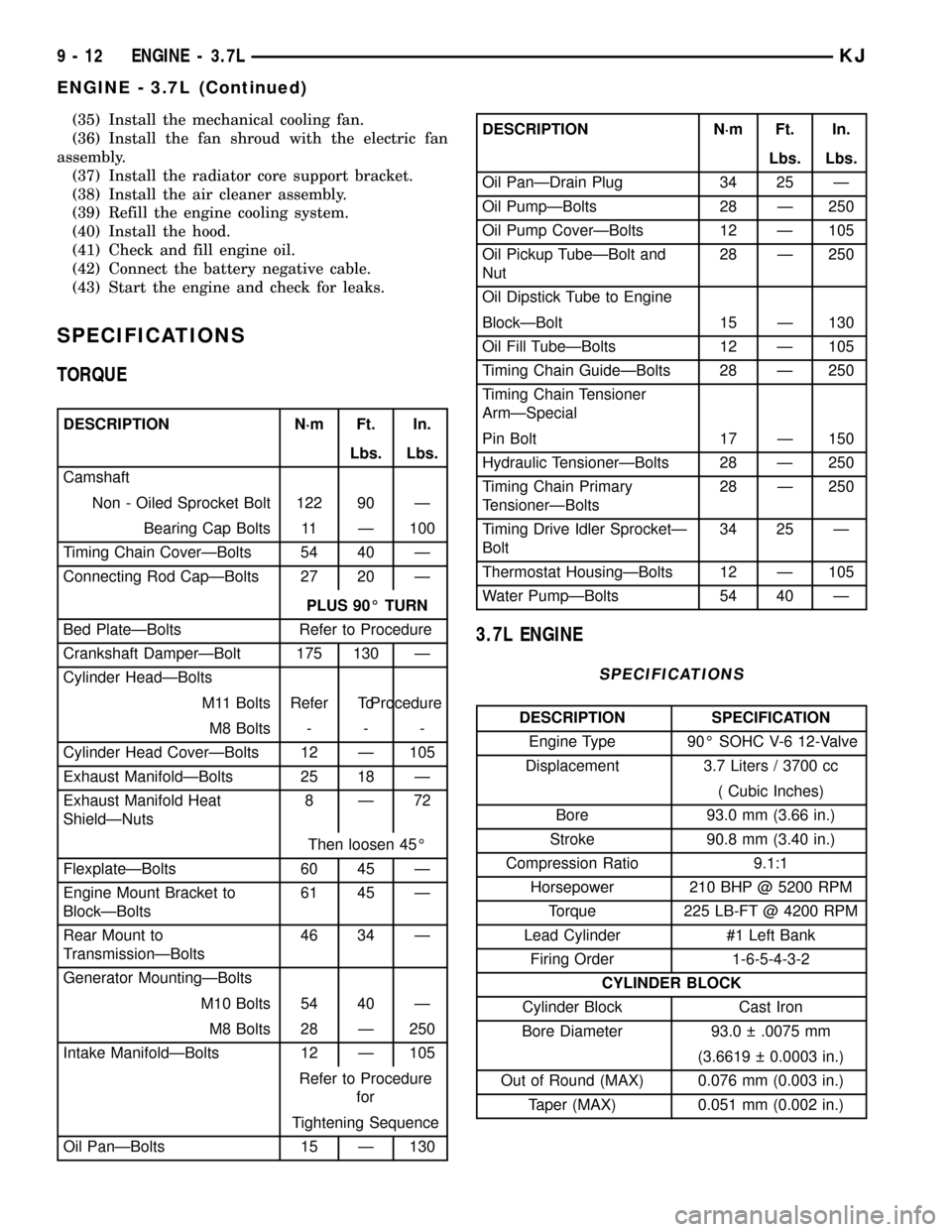
(35) Install the mechanical cooling fan.
(36) Install the fan shroud with the electric fan
assembly.
(37) Install the radiator core support bracket.
(38) Install the air cleaner assembly.
(39) Refill the engine cooling system.
(40) Install the hood.
(41) Check and fill engine oil.
(42) Connect the battery negative cable.
(43) Start the engine and check for leaks.
SPECIFICATIONS
TORQUE
DESCRIPTION N´m Ft. In.
Lbs. Lbs.
Camshaft
Non - Oiled Sprocket Bolt 122 90 Ð
Bearing Cap Bolts 11 Ð 100
Timing Chain CoverÐBolts 54 40 Ð
Connecting Rod CapÐBolts 27 20 Ð
PLUS 90É TURN
Bed PlateÐBolts Refer to Procedure
Crankshaft DamperÐBolt 175 130 Ð
Cylinder HeadÐBolts
M11 Bolts Refer ToProcedure
M8 Bolts - - -
Cylinder Head CoverÐBolts 12 Ð 105
Exhaust ManifoldÐBolts 25 18 Ð
Exhaust Manifold Heat
ShieldÐNuts8Ð72
Then loosen 45É
FlexplateÐBolts 60 45 Ð
Engine Mount Bracket to
BlockÐBolts61 45 Ð
Rear Mount to
TransmissionÐBolts46 34 Ð
Generator MountingÐBolts
M10 Bolts 54 40 Ð
M8 Bolts 28 Ð 250
Intake ManifoldÐBolts 12 Ð 105
Refer to Procedure
for
Tightening Sequence
Oil PanÐBolts 15 Ð 130
DESCRIPTION N´m Ft. In.
Lbs. Lbs.
Oil PanÐDrain Plug 34 25 Ð
Oil PumpÐBolts 28 Ð 250
Oil Pump CoverÐBolts 12 Ð 105
Oil Pickup TubeÐBolt and
Nut28 Ð 250
Oil Dipstick Tube to Engine
BlockÐBolt 15 Ð 130
Oil Fill TubeÐBolts 12 Ð 105
Timing Chain GuideÐBolts 28 Ð 250
Timing Chain Tensioner
ArmÐSpecial
Pin Bolt 17 Ð 150
Hydraulic TensionerÐBolts 28 Ð 250
Timing Chain Primary
TensionerÐBolts28 Ð 250
Timing Drive Idler SprocketÐ
Bolt34 25 Ð
Thermostat HousingÐBolts 12 Ð 105
Water PumpÐBolts 54 40 Ð
3.7L ENGINE
SPECIFICATIONS
DESCRIPTION SPECIFICATION
Engine Type 90É SOHC V-6 12-Valve
Displacement 3.7 Liters / 3700 cc
( Cubic Inches)
Bore 93.0 mm (3.66 in.)
Stroke 90.8 mm (3.40 in.)
Compression Ratio 9.1:1
Horsepower 210 BHP @ 5200 RPM
Torque 225 LB-FT @ 4200 RPM
Lead Cylinder #1 Left Bank
Firing Order 1-6-5-4-3-2
CYLINDER BLOCK
Cylinder Block Cast Iron
Bore Diameter 93.0 .0075 mm
(3.6619 0.0003 in.)
Out of Round (MAX) 0.076 mm (0.003 in.)
Taper (MAX) 0.051 mm (0.002 in.)
9 - 12 ENGINE - 3.7LKJ
ENGINE - 3.7L (Continued)
Page 1235 of 1803

Possible indications of the cylinder head gasket
leaking between adjacent cylinders are:
²Loss of engine power
²Engine misfiring
²Poor fuel economy
Possible indications of the cylinder head gasket
leaking between a cylinder and an adjacent water
jacket are:
²Engine overheating
²Loss of coolant
²Excessive steam (white smoke) emitting from
exhaust
²Coolant foaming
CYLINDER-TO-CYLINDER LEAKAGE TEST
To determine if an engine cylinder head gasket is
leaking between adjacent cylinders, follow the proce-
dures in Cylinder Compression Pressure Test (Refer
to 9 - ENGINE - DIAGNOSIS AND TESTING). An
engine cylinder head gasket leaking between adja-
cent cylinders will result in approximately a 50±70%
reduction in compression pressure.
CYLINDER-TO-WATER JACKET LEAKAGE TEST
WARNING: USE EXTREME CAUTION WHEN THE
ENGINE IS OPERATING WITH COOLANT PRES-
SURE CAP REMOVED.
VISUAL TEST METHOD
With the engine cool, remove the coolant pressure
cap. Start the engine and allow it to warm up until
thermostat opens.
If a large combustion/compression pressure leak
exists, bubbles will be visible in the coolant.
COOLING SYSTEM TESTER METHOD
WARNING: WITH COOLING SYSTEM TESTER IN
PLACE, PRESSURE WILL BUILD UP FAST. EXCES-
SIVE PRESSURE BUILT UP, BY CONTINUOUS
ENGINE OPERATION, MUST BE RELEASED TO A
SAFE PRESSURE POINT. NEVER PERMIT PRES-
SURE TO EXCEED 138 kPa (20 psi).
Install Cooling System Tester 7700 or equivalent to
pressure cap neck. Start the engine and observe the
tester's pressure gauge. If gauge pulsates with every
power stroke of a cylinder a combustion pressure
leak is evident.
CHEMICAL TEST METHOD
Combustion leaks into the cooling system can also
be checked by using Bloc-Chek Kit C-3685-A or
equivalent. Perform test following the procedures
supplied with the tool kit.
REMOVAL
(1) Disconnect the negative cable from the battery.
(2) Raise the vehicle on a hoist.
(3) Disconnect the exhaust pipe at the left side
exhaust manifold.
(4) Drain the engine coolant. Refer to COOLING
SYSTEM.
(5) Lower the vehicle.
(6) Remove the intake manifold. Refer to proce-
dure in this section.
(7) Remove the cylinder head cover. Refer to proce-
dure in this section.
(8) Remove the fan shroud and fan blade assembly.
Refer to COOLING SYSTEM.
(9) Remove accessory drive belt. Refer to COOL-
ING SYSTEM.
(10) Remove the power steering pump and set
aside.
(11) Rotate the crankshaft until the damper timing
mark is aligned with TDC indicator mark (Fig. 4).
(12) Verify the V6 mark on the camshaft sprocket
is at the 12 o'clock position (Fig. 5). Rotate the crank-
shaft one turn if necessary.
(13) Remove the crankshaft damper. Refer to Pro-
cedure.
(14) Remove the timing chain cover. Refer to pro-
cedure.
Fig. 4 Engine Top Dead Center
1 - TIMING CHAIN COVER
2 - CRANKSHAFT TIMING MARKS
9 - 20 ENGINE - 3.7LKJ
CYLINDER HEAD - LEFT (Continued)