Crank sensor JEEP LIBERTY 2002 KJ / 1.G Repair Manual
[x] Cancel search | Manufacturer: JEEP, Model Year: 2002, Model line: LIBERTY, Model: JEEP LIBERTY 2002 KJ / 1.GPages: 1803, PDF Size: 62.3 MB
Page 1413 of 1803

OPERATION
2.4L
Engine speed and crankshaft position are provided
through the CKP (Crankshaft Position) sensor. The
sensor generates pulses that are the input sent to the
Powertrain Control Module (PCM). The PCM inter-
prets the sensor input to determine the crankshaft
position. The PCM then uses this position, along with
other inputs, to determine injector sequence and igni-
tion timing.
The sensor is a hall effect device combined with an
internal magnet. It is also sensitive to steel within a
certain distance from it.
A tonewheel (targetwheel) is a part of the engine
crankshaft (Fig. 4). This tonewheel has sets of
notches at its outer edge.
The notches cause a pulse to be generated when
they pass under the sensor. The pulses are the input
to the PCM.
3.7L
Engine speed and crankshaft position are provided
through the CKP (Crankshaft Position) sensor. The
sensor generates pulses that are the input sent to the
Powertrain Control Module (PCM). The PCM inter-
prets the sensor input to determine the crankshaft
position. The PCM then uses this position, along with
other inputs, to determine injector sequence and igni-
tion timing.
The sensor is a hall effect device combined with an
internal magnet. It is also sensitive to steel within a
certain distance from it.A tonewheel (targetwheel) is bolted to the engine
crankshaft (Fig. 5). This tonewheel has sets of
notches at its outer edge (Fig. 5).
The notches cause a pulse to be generated when
they pass under the sensor. The pulses are the input
to the PCM.
REMOVAL
2.4L
The Crankshaft Position (CKP) sensor is mounted
into the right front side of the cylinder block (Fig. 6).
It is positioned and bolted into a machined hole.
(1) Disconnect sensor electrical connector.
(2) Remove sensor bolt.
(3) Carefully pry sensor from cylinder block in a
rocking action.
(4) Check condition of sensor o-ring (Fig. 7).
3.7L
The Crankshaft Position (CKP) sensor is mounted
into the right rear side of the cylinder block (Fig. 8).
It is positioned and bolted into a machined hole.
(1) Raise vehicle.
(2) Disconnect sensor electrical connector.
(3) Remove sensor mounting bolt (Fig. 8).
(4) Carefully remove sensor from cylinder block in
a rocking and twisting action.
(5) Check condition of sensor o-ring.
Fig. 4 CKP OPERATION-2.4L
1 - NOTCHES
2 - CRANKSHAFT
Fig. 5 CKP OPERATION-3.7L
1 - TONEWHEEL
2 - NOTCHES
3 - CRANKSHAFT POSITION SENSOR
4 - CRANKSHAFT
KJFUEL INJECTION 14 - 31
CRANKSHAFT POSITION SENSOR (Continued)
Page 1414 of 1803

INSTALLATION
2.4L
(1) Clean out machined hole in engine block.
(2) Apply a small amount of engine oil to sensor
o-ring.(3) Install sensor into engine block with a slight
rocking action. Do not twist sensor into position as
damage to o-ring may result.
CAUTION: Before tightening sensor mounting bolt,
be sure sensor is completely flush to cylinder
block. If sensor is not flush, damage to sensor
mounting tang may result.
(4) Install mounting bolt and tighten to 28 N´m
(21 ft. lbs.) torque.
(5) Connect electrical connector to sensor.
3.7L
(1) Clean out machined hole in engine block.
(2) Apply a small amount of engine oil to sensor
o-ring.
(3) Install sensor into engine block with a slight
rocking and twisting action.
CAUTION: Before tightening sensor mounting bolt,
be sure sensor is completely flush to cylinder
block. If sensor is not flush, damage to sensor
mounting tang may result.
(4) Install mounting bolt and tighten to 28 N´m
(21 ft. lbs.) torque.
(5) Connect electrical connector to sensor.
(6) Lower vehicle.
Fig. 6 CKP SENSOR LOCATION-2.4L
1 - RIGHT FRONT ENGINE MOUNT
2 - CKP SENSOR
3 - MOUNTING BOLT
4 - ELECTRICAL CONNECTOR
Fig. 7 CKP AND O-RING-2.4L
1 - CKP SENSOR
2 - O-RING
Fig. 8 CKP - 3.7L
1 - MOUNTING BOLT
2 - CKP SENSOR
3 - O-RING
14 - 32 FUEL INJECTIONKJ
CRANKSHAFT POSITION SENSOR (Continued)
Page 1429 of 1803

THROTTLE POSITION SENSOR
DESCRIPTION
The 3±wire Throttle Position Sensor (TPS) is
mounted on the throttle body and is connected to the
throttle blade shaft.
OPERATION
The 3±wire TPS provides the Powertrain Control
Module (PCM) with an input signal (voltage) that
represents the throttle blade position of the throttle
body. The sensor is connected to the throttle blade
shaft. As the position of the throttle blade changes,
the output voltage of the TPS changes.
The PCM supplies approximately 5 volts to the
TPS. The TPS output voltage (input signal to the
PCM) represents the throttle blade position. The
PCM receives an input signal voltage from the TPS.
This will vary in an approximate range of from .26
volts at minimum throttle opening (idle), to 4.49 volts
at wide open throttle. Along with inputs from other
sensors, the PCM uses the TPS input to determine
current engine operating conditions. In response to
engine operating conditions, the PCM will adjust fuel
injector pulse width and ignition timing.
The PCM needs to identify the actions and position
of the throttle blade at all times. This information is
needed to assist in performing the following calcula-
tions:
²Ignition timing advance
²Fuel injection pulse-width
²Idle (learned value or minimum TPS)
²Off-idle (0.06 volt)
²Wide Open Throttle (WOT) open loop (2.608
volts above learned idle voltage)
²Deceleration fuel lean out
²Fuel cutoff during cranking at WOT (2.608 volts
above learned idle voltage)
²A/C WOT cutoff (certain automatic transmis-
sions only)
REMOVAL
2.4L
The Throttle Position Sensor (TPS) is mounted to
the throttle body (Fig. 31).
(1) Disconnect TPS electrical connector.
(2) Remove 2 TPS mounting screws.
(3) Remove TPS.
Fig. 31 TPS/IAC MOTOR - 2.4L
1 - THROTTLE POSITION SENSOR (TPS)
2 - MOUNTING SCREWS
3 - IDLE AIR CONTROL MOTOR (IAC)
4 - MOUNTING SCREWS
KJFUEL INJECTION 14 - 47
Page 1712 of 1803
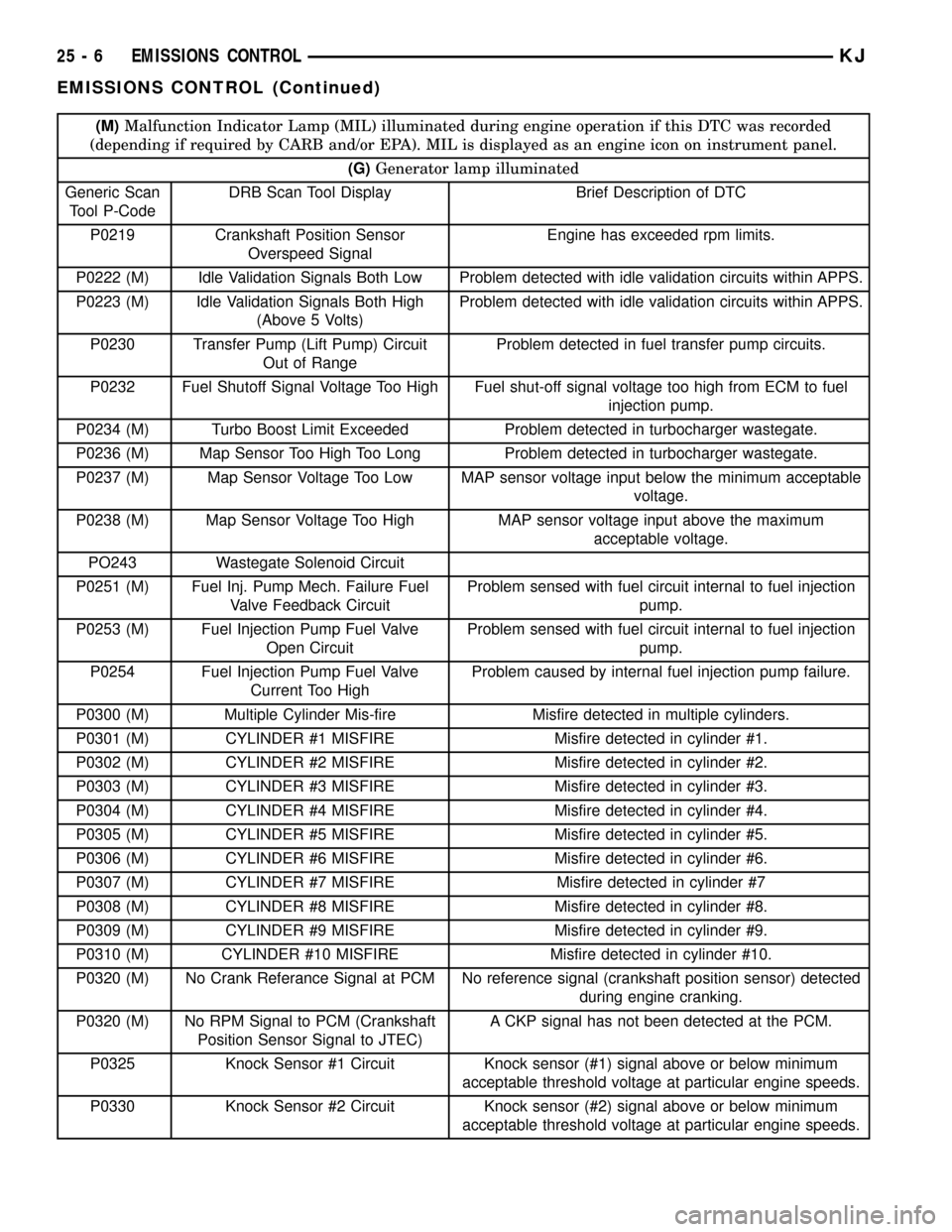
(M)Malfunction Indicator Lamp (MIL) illuminated during engine operation if this DTC was recorded
(depending if required by CARB and/or EPA). MIL is displayed as an engine icon on instrument panel.
(G)Generator lamp illuminated
Generic Scan
Tool P-CodeDRB Scan Tool Display Brief Description of DTC
P0219 Crankshaft Position Sensor
Overspeed SignalEngine has exceeded rpm limits.
P0222 (M) Idle Validation Signals Both Low Problem detected with idle validation circuits within APPS.
P0223 (M) Idle Validation Signals Both High
(Above 5 Volts)Problem detected with idle validation circuits within APPS.
P0230 Transfer Pump (Lift Pump) Circuit
Out of RangeProblem detected in fuel transfer pump circuits.
P0232 Fuel Shutoff Signal Voltage Too High Fuel shut-off signal voltage too high from ECM to fuel
injection pump.
P0234 (M) Turbo Boost Limit Exceeded Problem detected in turbocharger wastegate.
P0236 (M) Map Sensor Too High Too Long Problem detected in turbocharger wastegate.
P0237 (M) Map Sensor Voltage Too Low MAP sensor voltage input below the minimum acceptable
voltage.
P0238 (M) Map Sensor Voltage Too High MAP sensor voltage input above the maximum
acceptable voltage.
PO243 Wastegate Solenoid Circuit
P0251 (M) Fuel Inj. Pump Mech. Failure Fuel
Valve Feedback CircuitProblem sensed with fuel circuit internal to fuel injection
pump.
P0253 (M) Fuel Injection Pump Fuel Valve
Open CircuitProblem sensed with fuel circuit internal to fuel injection
pump.
P0254 Fuel Injection Pump Fuel Valve
Current Too HighProblem caused by internal fuel injection pump failure.
P0300 (M) Multiple Cylinder Mis-fire Misfire detected in multiple cylinders.
P0301 (M) CYLINDER #1 MISFIRE Misfire detected in cylinder #1.
P0302 (M) CYLINDER #2 MISFIRE Misfire detected in cylinder #2.
P0303 (M) CYLINDER #3 MISFIRE Misfire detected in cylinder #3.
P0304 (M) CYLINDER #4 MISFIRE Misfire detected in cylinder #4.
P0305 (M) CYLINDER #5 MISFIRE Misfire detected in cylinder #5.
P0306 (M) CYLINDER #6 MISFIRE Misfire detected in cylinder #6.
P0307 (M) CYLINDER #7 MISFIRE Misfire detected in cylinder #7
P0308 (M) CYLINDER #8 MISFIRE Misfire detected in cylinder #8.
P0309 (M) CYLINDER #9 MISFIRE Misfire detected in cylinder #9.
P0310 (M) CYLINDER #10 MISFIRE Misfire detected in cylinder #10.
P0320 (M) No Crank Referance Signal at PCM No reference signal (crankshaft position sensor) detected
during engine cranking.
P0320 (M) No RPM Signal to PCM (Crankshaft
Position Sensor Signal to JTEC)A CKP signal has not been detected at the PCM.
P0325 Knock Sensor #1 Circuit Knock sensor (#1) signal above or below minimum
acceptable threshold voltage at particular engine speeds.
P0330 Knock Sensor #2 Circuit Knock sensor (#2) signal above or below minimum
acceptable threshold voltage at particular engine speeds.
25 - 6 EMISSIONS CONTROLKJ
EMISSIONS CONTROL (Continued)
Page 1713 of 1803
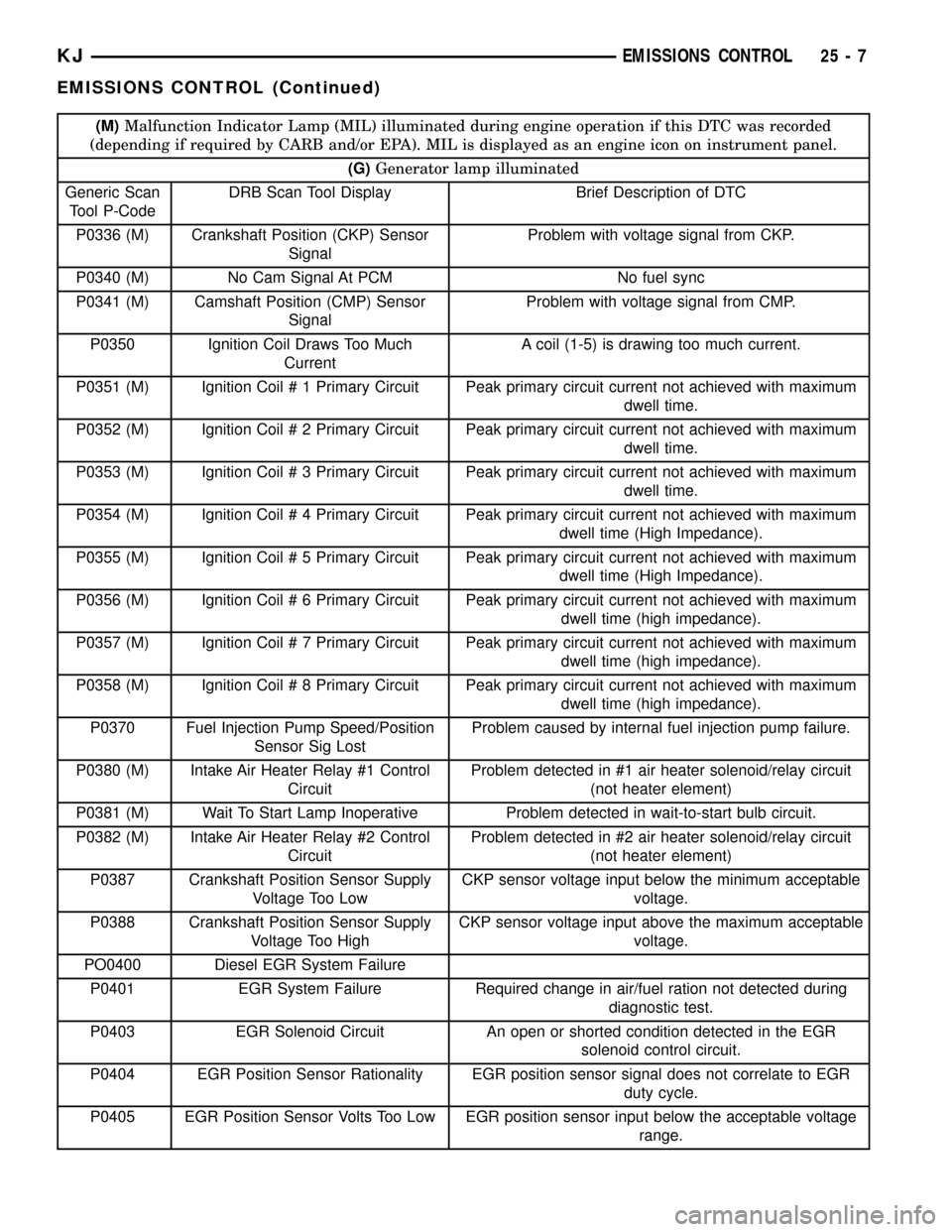
(M)Malfunction Indicator Lamp (MIL) illuminated during engine operation if this DTC was recorded
(depending if required by CARB and/or EPA). MIL is displayed as an engine icon on instrument panel.
(G)Generator lamp illuminated
Generic Scan
Tool P-CodeDRB Scan Tool Display Brief Description of DTC
P0336 (M) Crankshaft Position (CKP) Sensor
SignalProblem with voltage signal from CKP.
P0340 (M) No Cam Signal At PCM No fuel sync
P0341 (M) Camshaft Position (CMP) Sensor
SignalProblem with voltage signal from CMP.
P0350 Ignition Coil Draws Too Much
CurrentA coil (1-5) is drawing too much current.
P0351 (M) Ignition Coil # 1 Primary Circuit Peak primary circuit current not achieved with maximum
dwell time.
P0352 (M) Ignition Coil # 2 Primary Circuit Peak primary circuit current not achieved with maximum
dwell time.
P0353 (M) Ignition Coil # 3 Primary Circuit Peak primary circuit current not achieved with maximum
dwell time.
P0354 (M) Ignition Coil # 4 Primary Circuit Peak primary circuit current not achieved with maximum
dwell time (High Impedance).
P0355 (M) Ignition Coil # 5 Primary Circuit Peak primary circuit current not achieved with maximum
dwell time (High Impedance).
P0356 (M) Ignition Coil # 6 Primary Circuit Peak primary circuit current not achieved with maximum
dwell time (high impedance).
P0357 (M) Ignition Coil # 7 Primary Circuit Peak primary circuit current not achieved with maximum
dwell time (high impedance).
P0358 (M) Ignition Coil # 8 Primary Circuit Peak primary circuit current not achieved with maximum
dwell time (high impedance).
P0370 Fuel Injection Pump Speed/Position
Sensor Sig LostProblem caused by internal fuel injection pump failure.
P0380 (M) Intake Air Heater Relay #1 Control
CircuitProblem detected in #1 air heater solenoid/relay circuit
(not heater element)
P0381 (M) Wait To Start Lamp Inoperative Problem detected in wait-to-start bulb circuit.
P0382 (M) Intake Air Heater Relay #2 Control
CircuitProblem detected in #2 air heater solenoid/relay circuit
(not heater element)
P0387 Crankshaft Position Sensor Supply
Voltage Too LowCKP sensor voltage input below the minimum acceptable
voltage.
P0388 Crankshaft Position Sensor Supply
Voltage Too HighCKP sensor voltage input above the maximum acceptable
voltage.
PO0400 Diesel EGR System Failure
P0401 EGR System Failure Required change in air/fuel ration not detected during
diagnostic test.
P0403 EGR Solenoid Circuit An open or shorted condition detected in the EGR
solenoid control circuit.
P0404 EGR Position Sensor Rationality EGR position sensor signal does not correlate to EGR
duty cycle.
P0405 EGR Position Sensor Volts Too Low EGR position sensor input below the acceptable voltage
range.
KJEMISSIONS CONTROL 25 - 7
EMISSIONS CONTROL (Continued)
Page 1718 of 1803
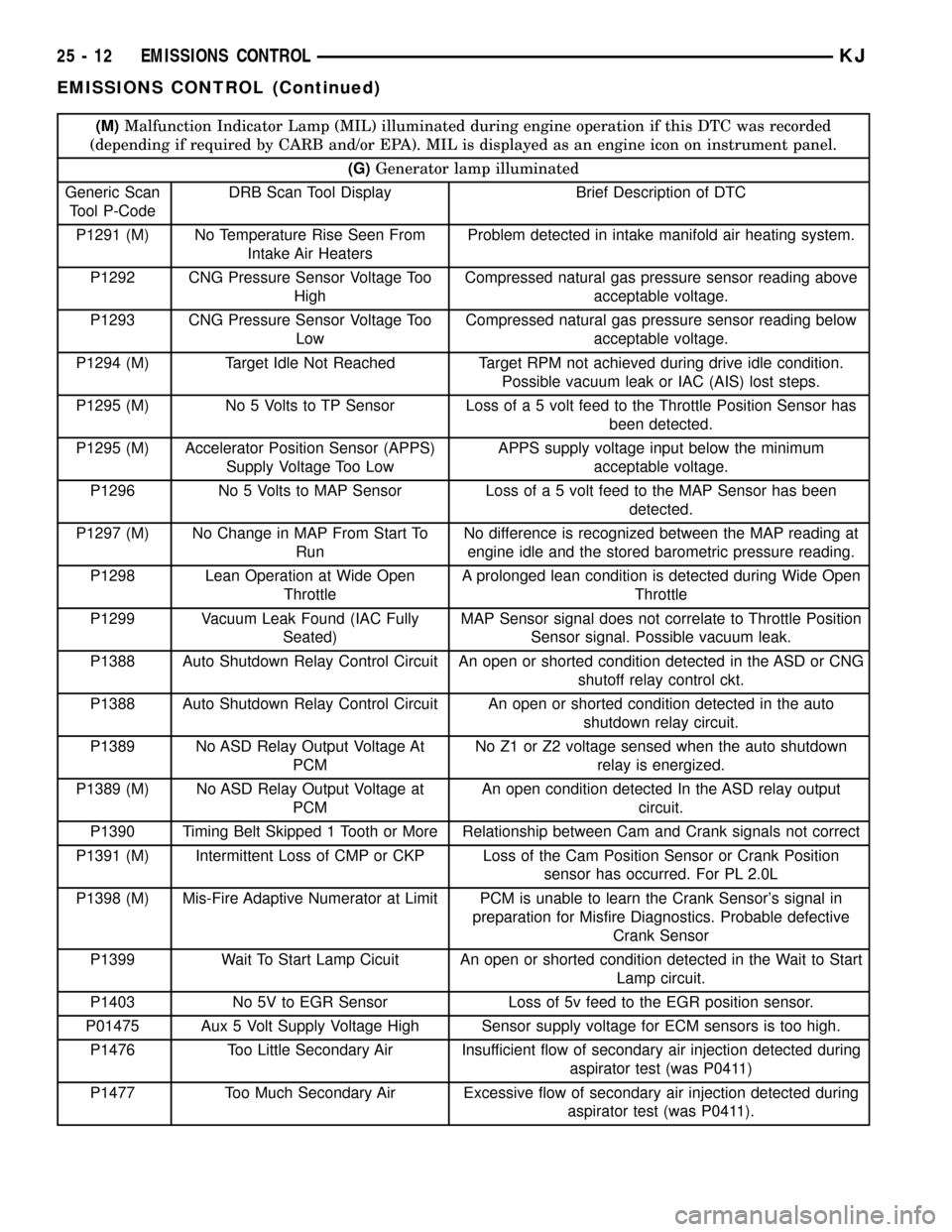
(M)Malfunction Indicator Lamp (MIL) illuminated during engine operation if this DTC was recorded
(depending if required by CARB and/or EPA). MIL is displayed as an engine icon on instrument panel.
(G)Generator lamp illuminated
Generic Scan
Tool P-CodeDRB Scan Tool Display Brief Description of DTC
P1291 (M) No Temperature Rise Seen From
Intake Air HeatersProblem detected in intake manifold air heating system.
P1292 CNG Pressure Sensor Voltage Too
HighCompressed natural gas pressure sensor reading above
acceptable voltage.
P1293 CNG Pressure Sensor Voltage Too
LowCompressed natural gas pressure sensor reading below
acceptable voltage.
P1294 (M) Target Idle Not Reached Target RPM not achieved during drive idle condition.
Possible vacuum leak or IAC (AIS) lost steps.
P1295 (M) No 5 Volts to TP Sensor Loss of a 5 volt feed to the Throttle Position Sensor has
been detected.
P1295 (M) Accelerator Position Sensor (APPS)
Supply Voltage Too LowAPPS supply voltage input below the minimum
acceptable voltage.
P1296 No 5 Volts to MAP Sensor Loss of a 5 volt feed to the MAP Sensor has been
detected.
P1297 (M) No Change in MAP From Start To
RunNo difference is recognized between the MAP reading at
engine idle and the stored barometric pressure reading.
P1298 Lean Operation at Wide Open
ThrottleA prolonged lean condition is detected during Wide Open
Throttle
P1299 Vacuum Leak Found (IAC Fully
Seated)MAP Sensor signal does not correlate to Throttle Position
Sensor signal. Possible vacuum leak.
P1388 Auto Shutdown Relay Control Circuit An open or shorted condition detected in the ASD or CNG
shutoff relay control ckt.
P1388 Auto Shutdown Relay Control Circuit An open or shorted condition detected in the auto
shutdown relay circuit.
P1389 No ASD Relay Output Voltage At
PCMNo Z1 or Z2 voltage sensed when the auto shutdown
relay is energized.
P1389 (M) No ASD Relay Output Voltage at
PCMAn open condition detected In the ASD relay output
circuit.
P1390 Timing Belt Skipped 1 Tooth or More Relationship between Cam and Crank signals not correct
P1391 (M) Intermittent Loss of CMP or CKP Loss of the Cam Position Sensor or Crank Position
sensor has occurred. For PL 2.0L
P1398 (M) Mis-Fire Adaptive Numerator at Limit PCM is unable to learn the Crank Sensor's signal in
preparation for Misfire Diagnostics. Probable defective
Crank Sensor
P1399 Wait To Start Lamp Cicuit An open or shorted condition detected in the Wait to Start
Lamp circuit.
P1403 No 5V to EGR Sensor Loss of 5v feed to the EGR position sensor.
P01475 Aux 5 Volt Supply Voltage High Sensor supply voltage for ECM sensors is too high.
P1476 Too Little Secondary Air Insufficient flow of secondary air injection detected during
aspirator test (was P0411)
P1477 Too Much Secondary Air Excessive flow of secondary air injection detected during
aspirator test (was P0411).
25 - 12 EMISSIONS CONTROLKJ
EMISSIONS CONTROL (Continued)
Page 1724 of 1803

LEAK DETECTION PUMP MONITOR (IF EQUIPPED)
The leak detection assembly incorporates two pri-
mary functions: it must detect a leak in the evapora-
tive system and seal the evaporative system so the
leak detection test can be run.
The primary components within the assembly are:
A three port solenoid that activates both of the func-
tions listed above; a pump which contains a switch,
two check valves and a spring/diaphragm, a canister
vent valve (CVV) seal which contains a spring loaded
vent seal valve.
Immediately after a cold start, between predeter-
mined temperature thresholds limits, the three port
solenoid is briefly energized. This initializes the
pump by drawing air into the pump cavity and also
closes the vent seal. During non test conditions the
vent seal is held open by the pump diaphragm
assembly which pushes it open at the full travel posi-
tion. The vent seal will remain closed while the
pump is cycling due to the reed switch triggering of
the three port solenoid that prevents the diaphragm
assembly from reaching full travel. After the brief
initialization period, the solenoid is de-energized
allowing atmospheric pressure to enter the pump
cavity, thus permitting the spring to drive the dia-
phragm which forces air out of the pump cavity and
into the vent system. When the solenoid is energized
and de energized, the cycle is repeated creating flow
in typical diaphragm pump fashion. The pump is con-
trolled in 2 modes:
Pump Mode:The pump is cycled at a fixed rate to
achieve a rapid pressure build in order to shorten the
overall test length.
Test Mode:The solenoid is energized with a fixed
duration pulse. Subsequent fixed pulses occur when
the diaphragm reaches the Switch closure point.
The spring in the pump is set so that the system
will achieve an equalized pressure of about 7.5º
water. The cycle rate of pump strokes is quite rapid
as the system begins to pump up to this pressure. As
the pressure increases, the cycle rate starts to drop
off. If there is no leak in the system, the pump would
eventually stop pumping at the equalized pressure. If
there is a leak, it will continue to pump at a rate rep-
resentative of the flow characteristic of the size of the
leak. From this information we can determine if the
leak is larger than the required detection limit (cur-
rently set at .040º orifice by CARB). If a leak is
revealed during the leak test portion of the test, the
test is terminated at the end of the test mode and no
further system checks will be performed.
After passing the leak detection phase of the test,
system pressure is maintained by turning on the
LDP's solenoid until the purge system is activated.
Purge activation in effect creates a leak. The cycle
rate is again interrogated and when it increases dueto the flow through the purge system, the leak check
portion of the diagnostic is complete.
The canister vent valve will unseal the system
after completion of the test sequence as the pump
diaphragm assembly moves to the full travel position.
Evaporative system functionality will be verified by
using the stricter evap purge flow monitor. At an
appropriate warm idle the LDP will be energized to
seal the canister vent. The purge flow will be clocked
up from some small value in an attempt to see a
shift in the 02 control system. If fuel vapor, indicated
by a shift in the 02 control, is present the test is
passed. If not, it is assumed that the purge system is
not functioning in some respect. The LDP is again
turned off and the test is ended.
MISFIRE MONITOR
Excessive engine misfire results in increased cata-
lyst temperature and causes an increase in HC emis-
sions. Severe misfires could cause catalyst damage.
To prevent catalytic convertor damage, the PCM
monitors engine misfire.
The Powertrain Control Module (PCM) monitors
for misfire during most engine operating conditions
(positive torque) by looking at changes in the crank-
shaft speed. If a misfire occurs the speed of the
crankshaft will vary more than normal.
FUEL SYSTEM MONITOR
To comply with clean air regulations, vehicles are
equipped with catalytic converters. These converters
reduce the emission of hydrocarbons, oxides of nitro-
gen and carbon monoxide. The catalyst works best
when the Air Fuel (A/F) ratio is at or near the opti-
mum of 14.7 to 1.
The PCM is programmed to maintain the optimum
air/fuel ratio of 14.7 to 1. This is done by making
short term corrections in the fuel injector pulse width
based on the O2S sensor output. The programmed
memory acts as a self calibration tool that the engine
controller uses to compensate for variations in engine
specifications, sensor tolerances and engine fatigue
over the life span of the engine. By monitoring the
actual fuel-air ratio with the O2S sensor (short term)
and multiplying that with the program long-term
(adaptive) memory and comparing that to the limit,
it can be determined whether it will pass an emis-
sions test. If a malfunction occurs such that the PCM
cannot maintain the optimum A/F ratio, then the
MIL will be illuminated.
CATALYST MONITOR
To comply with clean air regulations, vehicles are
equipped with catalytic converters. These converters
reduce the emission of hydrocarbons, oxides of nitro-
gen and carbon monoxide.
25 - 18 EMISSIONS CONTROLKJ
EMISSIONS CONTROL (Continued)
Page 1732 of 1803
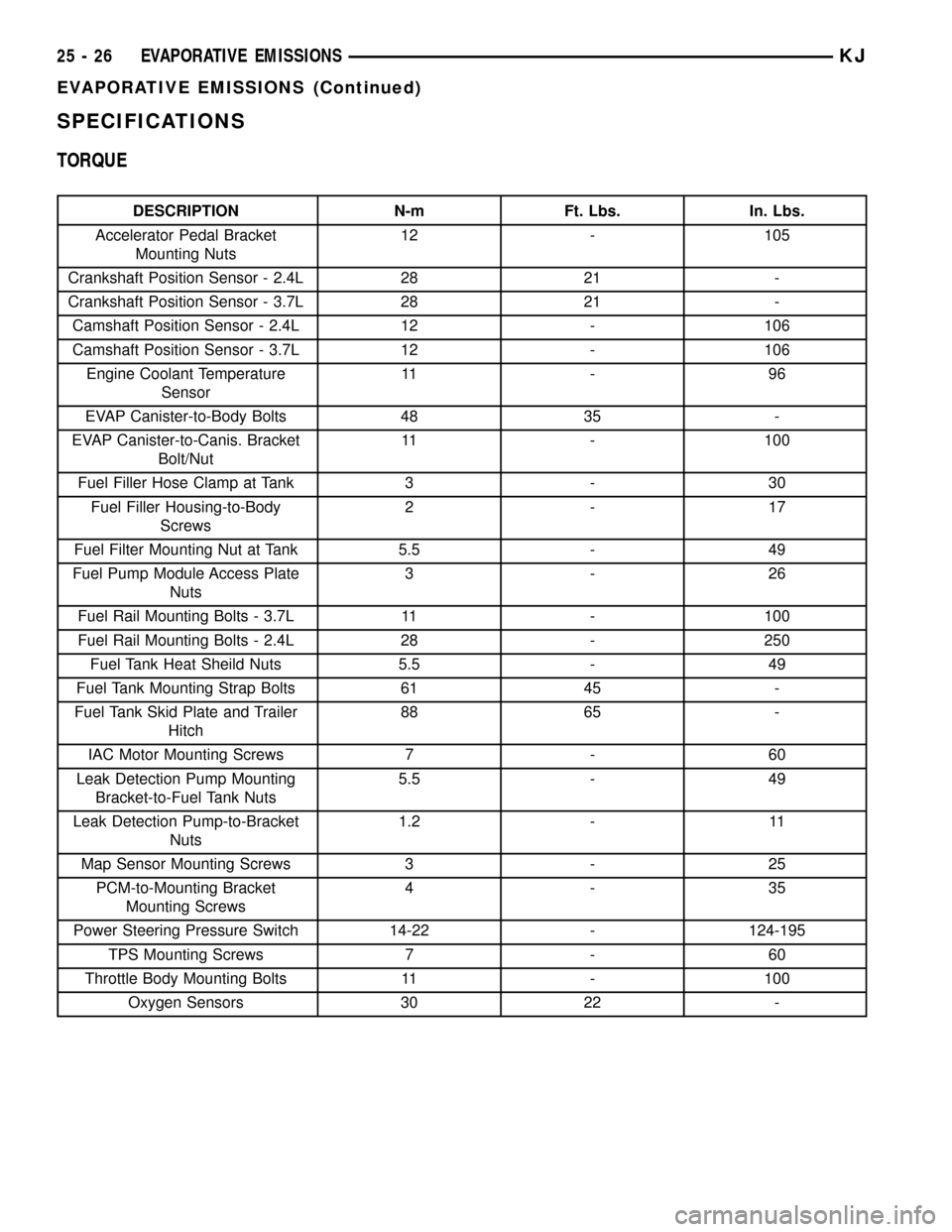
SPECIFICATIONS
TORQUE
DESCRIPTION N-m Ft. Lbs. In. Lbs.
Accelerator Pedal Bracket
Mounting Nuts12 - 105
Crankshaft Position Sensor - 2.4L 28 21 -
Crankshaft Position Sensor - 3.7L 28 21 -
Camshaft Position Sensor - 2.4L 12 - 106
Camshaft Position Sensor - 3.7L 12 - 106
Engine Coolant Temperature
Sensor11 - 9 6
EVAP Canister-to-Body Bolts 48 35 -
EVAP Canister-to-Canis. Bracket
Bolt/Nut11 - 100
Fuel Filler Hose Clamp at Tank 3 - 30
Fuel Filler Housing-to-Body
Screws2-17
Fuel Filter Mounting Nut at Tank 5.5 - 49
Fuel Pump Module Access Plate
Nuts3-26
Fuel Rail Mounting Bolts - 3.7L 11 - 100
Fuel Rail Mounting Bolts - 2.4L 28 - 250
Fuel Tank Heat Sheild Nuts 5.5 - 49
Fuel Tank Mounting Strap Bolts 61 45 -
Fuel Tank Skid Plate and Trailer
Hitch88 65 -
IAC Motor Mounting Screws 7 - 60
Leak Detection Pump Mounting
Bracket-to-Fuel Tank Nuts5.5 - 49
Leak Detection Pump-to-Bracket
Nuts1.2 - 11
Map Sensor Mounting Screws 3 - 25
PCM-to-Mounting Bracket
Mounting Screws4-35
Power Steering Pressure Switch 14-22 - 124-195
TPS Mounting Screws 7 - 60
Throttle Body Mounting Bolts 11 - 100
Oxygen Sensors 30 22 -
25 - 26 EVAPORATIVE EMISSIONSKJ
EVAPORATIVE EMISSIONS (Continued)
Page 1746 of 1803

COVER - REMOVAL, COWL TRIM.......23-157
COVER - REMOVAL, INSTRUMENT
PANEL TOP........................23-152
COVER - REMOVAL, STRUCTURAL........9-55
COVER(S) - DESCRIPTION, CYLINDER
HEAD...............................9-25
COVER(S) - INSTALLATION, CYLINDER
HEAD...........................9-26,9-34
COVER(S) - INSTALLATION, TIMING
BELT / CHAIN........................9-76
COVER(S) - REMOVAL, CYLINDER HEAD . . 9-25,
9-34
COVER(S) - REMOVAL, TIMING BELT /
CHAIN..............................9-74
COWL GRILLE - INSTALLATION........23-140
COWL GRILLE - REMOVAL............23-140
COWL TRIM COVER - INSTALLATION....23-157
COWL TRIM COVER - REMOVAL.......23-157
COWL WEATHERSTRIP - INSTALLATION . 23-185
COWL WEATHERSTRIP - REMOVAL.....23-185
COWL/PLENUM SEAL - INSTALLATION . . . 23-187
COWL/PLENUM SEAL - REMOVAL......23-187
COWL/PLENUM WINDOW BAFFLE SEAL -
INSTALLATION......................23-187
COWL/PLENUM WINDOW BAFFLE SEAL -
REMOVAL.........................23-187
CRADLE CROSSMEMBER -
INSTALLATION, ENGINE................13-6
CRADLE CROSSMEMBER - REMOVAL,
ENGINE.............................13-6
CRANKSHAFT - DESCRIPTION...........9-42
CRANKSHAFT - INSPECTION.............9-43
CRANKSHAFT - INSTALLATION...........9-43
CRANKSHAFT - REMOVAL..............9-43
CRANKSHAFT OIL SEAL - FRONT -
INSTALLATION........................9-47
CRANKSHAFT OIL SEAL - FRONT -
REMOVAL...........................9-46
CRANKSHAFT OIL SEAL - REAR -
INSTALLATION........................9-48
CRANKSHAFT OIL SEAL - REAR -
REMOVAL...........................9-48
CRANKSHAFT POSITION SENSOR -
DESCRIPTION.......................14-30
CRANKSHAFT POSITION SENSOR -
INSTALLATION.......................14-32
CRANKSHAFT POSITION SENSOR -
OPERATION.........................14-31
CRANKSHAFT POSITION SENSOR -
REMOVAL..........................14-31
CROSSMEMBER - INSTALLATION,
ENGINE CRADLE......................13-6
CROSSMEMBER - INSTALLATION,
RADIATOR.........................23-146
CROSSMEMBER - INSTALLATION, REAR . . . 13-7
CROSSMEMBER - REMOVAL, ENGINE
CRADLE.............................13-6
CROSSMEMBER - REMOVAL, RADIATOR . 23-146
CROSSMEMBER - REMOVAL, REAR.......13-7
CROSS-OVER PIPE - INSTALLATION.......11-3
CROSS-OVER PIPE - REMOVAL..........11-3
CRUISE INDICATOR - DESCRIPTION......8J-16
CRUISE INDICATOR - OPERATION.......8J-17
CURTAIN AIRBAG - DESCRIPTION, SIDE . . 8O-38
CURTAIN AIRBAG - INSTALLATION, SIDE . . 8O-41
CURTAIN AIRBAG - OPERATION, SIDE....8O-39
CURTAIN AIRBAG - REMOVAL, SIDE.....8O-40
CUSHION - FRONT - INSTALLATION,
SEAT .............................23-167
CUSHION - FRONT - INSTALLATION,
SEAT BACK........................23-167
CUSHION - FRONT - REMOVAL, SEAT . . . 23-167
CUSHION - FRONT - REMOVAL, SEAT
BACK.............................23-167
CUSHION - REAR - INSTALLATION, SEAT . 23-171
CUSHION - REAR - INSTALLATION, SEAT
BACK.............................23-170
CUSHION - REAR - REMOVAL, SEAT....23-171
CUSHION - REAR - REMOVAL, SEAT
BACK
.............................23-170
CUSHION COVER - FRONT -
INSTALLATION, SEAT
.................23-167
CUSHION COVER - FRONT - REMOVAL,
SEAT
.............................23-167
CUSHION SIDE SHIELDS -
INSTALLATION, SEAT
.................23-167
CUSHION SIDE SHIELDS - REMOVAL,
SEAT
.............................23-167CUSTOMER PREFERENCES - STANDARD
PROCEDURE, RKE TRANSMITTER........8N-8
CV JOINT/BOOT-INNER - INSTALLATION . . . 3-17
CV JOINT/BOOT-INNER - REMOVAL.......3-15
CV JOINT/BOOT-OUTER - INSTALLATION . . . 3-13
CV JOINT/BOOT-OUTER - REMOVAL.......3-12
CYLINDER - DESCRIPTION, MASTER......5-24
CYLINDER - INSPECTION, MASTER........6-9
CYLINDER - INSTALLATION, FLIP-UP
GLASS SUPPORT...................23-139
CYLINDER - INSTALLATION, LOCK......23-125,
23-138
CYLINDER - INSTALLATION, LOCK.......19-11
CYLINDER - INSTALLATION, MASTER.....5-25
CYLINDER - INSTALLATION, SUPPORT . . . 23-120
CYLINDER - OPERATION, MASTER........5-24
CYLINDER - REMOVAL, FLIP-UP GLASS
SUPPORT.........................23-139
CYLINDER - REMOVAL, LOCK....23-125,23-137
CYLINDER - REMOVAL, LOCK...........19-10
CYLINDER - REMOVAL, MASTER.........5-25
CYLINDER - REMOVAL, SUPPORT......23-120
CYLINDER BLEEDING - STANDARD
PROCEDURE, MASTER.................5-24
CYLINDER BORE HONING - STANDARD
PROCEDURE.........................9-39
CYLINDER COMBUSTION PRESSURE
LEAKAGE - DIAGNOSIS AND TESTING......9-8
CYLINDER COMPRESSION PRESSURE -
DIAGNOSIS AND TESTING...............9-8
CYLINDER FLUID LEVEL - STANDARD
PROCEDURES, MASTER................5-26
CYLINDER HEAD - DESCRIPTION.........9-30
CYLINDER HEAD COVER(S) -
DESCRIPTION........................9-25
CYLINDER HEAD COVER(S) -
INSTALLATION....................9-26,9-34
CYLINDER HEAD COVER(S) - REMOVAL . . . 9-25,
9-34
CYLINDER HEAD GASKET - DIAGNOSIS
AND TESTING....................9-19,9-30
CYLINDER LOCK SWITCH -
DESCRIPTION, DOOR..................8Q-9
CYLINDER LOCK SWITCH -
DESCRIPTION, TAILGATE...............8N-9
CYLINDER LOCK SWITCH - DIAGNOSIS
AND TESTING, DOOR.................8Q-10
CYLINDER LOCK SWITCH - DIAGNOSIS
AND TESTING, TAILGATE...............8N-9
CYLINDER LOCK SWITCH -
INSTALLATION, DOOR.................8Q-10
CYLINDER LOCK SWITCH -
INSTALLATION, TAILGATE..............8N-10
CYLINDER LOCK SWITCH - OPERATION,
DOOR.............................8Q-10
CYLINDER LOCK SWITCH - OPERATION,
TAILGATE...........................8N-9
CYLINDER LOCK SWITCH - REMOVAL,
DOOR.............................8Q-10
CYLINDER LOCK SWITCH - REMOVAL,
TAILGATE..........................8N-10
CYLINDER/POWER BOOSTER -
DIAGNOSIS AND TESTING, MASTER . . 5-21,5-24
CYLINDERS - ASSEMBLY, WHEEL.........5-29
CYLINDERS - CLEANING, WHEEL.........5-28
CYLINDERS - DISASSEMBLY, WHEEL......5-28
CYLINDERS - INSPECTION, WHEEL.......5-29
CYLINDERS - INSTALLATION, WHEEL
.....5-29
CYLINDERS - REMOVAL, WHEEL
.........5-28
DAMAGED OR WORN THREADS -
STANDARD PROCEDURE, REPAIR
.........9-9
DAMPER - INSTALLATION, VIBRATION
.....9-55
DAMPER - REMOVAL, VIBRATION
........9-54
DATA LINK CONNECTOR - DESCRIPTION
. . 8E-10
DATA LINK CONNECTOR - OPERATION
....8E-10
DAYTIME RUNNING LAMP RELAY -
DESCRIPTION
.......................8L-20
DAYTIME RUNNING LAMP RELAY -
INSTALLATION
.......................8L-21
DAYTIME RUNNING LAMP RELAY -
OPERATION
.........................8L-20
DAYTIME RUNNING LAMP RELAY -
REMOVAL
..........................8L-21
DECOUPLER - DIAGNOSIS AND
TESTING, GENERATOR
................8F-27
DECOUPLER PULLEY - DESCRIPTION,
GENERATOR
........................8F-26DECOUPLER PULLEY - INSTALLATION,
GENERATOR........................8F-30
DECOUPLER PULLEY - OPERATION,
GENERATOR........................8F-27
DECOUPLER PULLEY - REMOVAL,
GENERATOR........................8F-27
DEFINITION - DESCRIPTION, TRIP.......25-19
DEFLECTOR - INSTALLATION, WIND.....23-180
DEFLECTOR - REMOVAL, WIND........23-180
DEFOGGER - DESCRIPTION, REAR
WINDOW............................8G-3
DEFOGGER - OPERATION, REAR
WINDOW............................8G-3
DEFOGGER FUNCTION - DIAGNOSIS AND
TESTING, REAR HVAC CONTROL
ASSEMBLY WINDOW..................8G-9
DEFOGGER GRID - DESCRIPTION, REAR
WINDOW............................8G-5
DEFOGGER GRID - DIAGNOSIS AND
TESTING, REAR WINDOW..............8G-5
DEFOGGER GRID - OPERATION, REAR
WINDOW............................8G-5
DEFOGGER RELAY - DESCRIPTION,
REAR WINDOW.......................8G-6
DEFOGGER RELAY - DIAGNOSIS AND
TESTING, REAR WINDOW..............8G-6
DEFOGGER RELAY - INSTALLATION,
REAR WINDOW.......................8G-7
DEFOGGER RELAY - OPERATION, REAR
WINDOW............................8G-6
DEFOGGER RELAY - REMOVAL, REAR
WINDOW............................8G-7
DEFOGGER SWITCH - DESCRIPTION,
REAR WINDOW.......................8G-8
DEFOGGER SWITCH - DIAGNOSIS AND
TESTING, REAR WINDOW..............8G-8
DEFOGGER SWITCH - OPERATION, REAR
WINDOW............................8G-8
DEFOGGER SYSTEM - DIAGNOSIS AND
TESTING, REAR WINDOW..............8G-4
DEFROST DOO - INSTALLATION, FLOOR . . 24-37
DEFROST DOOR - REMOVAL...........24-35
DEFROST DOOR - REMOVAL, FLOOR.....24-36
DEFROST DOOR ACTUATOR -
INSTALLATION, FLOOR................24-25
DEFROST DOOR ACTUATOR - REMOVAL,
FLOOR.............................24-24
DEFROST DUCT/DEMISTER ADAPTOR -
REMOVAL..........................24-32
DEFROST/DEMISTER DUCT -
INSTALLATION.......................24-32
DELIVERY - DESCRIPTION, FUEL.........14-2
DELIVERY - OPERATION, FUEL...........14-3
DEMAGNETIZING - STANDARD
PROCEDURE, COMPASS...............8M-2
DEMISTER OUTLETS - DESCRIPTION.....24-29
DEPLOYMENT - STANDARD
PROCEDURE, SERVICE AFTER A
SUPPLEMENTAL RESTRAINT............8O-6
DETECTION PUMP - DESCRIPTION, LEAK . 25-27
DETECTION PUMP - INSTALLATION,
LEAK..............................25-28
DETECTION PUMP - OPERATION, LEAK . . . 25-28
DETECTION PUMP - REMOVAL, LEAK....25-28
DEVICES - STANDARD PROCEDURE,
ELECTROSTATIC DISCHARGE (ESD)
SENSITIVE........................8W-01-8
DIAGNOSIS CHART - DIAGNOSIS AND
TESTING, COOLING SYSTEM.............7-6
DIAGNOSIS, DIAGNOSIS AND TESTING -
WATER DRAINAGE AND WIND NOISE . . . 23-176
DIAGNOSTIC PROCEDURES, DIAGNOSIS
AND TESTING......................23-176
DIAGNOSTIC TROUBLE CODES -
DESCRIPTION........................25-2
DIAGNOSTICS (OBD) - DIAGNOSIS AND
TESTING, ON-BOARD...................7-3
DIAGRAMS - DESCRIPTION, HOW TO
USE WIRING......................8W-01-1
DIAGRAMS - HYDRAULIC SCHEMATICS,
SCHEMATICS.......................21-100
DIESEL - TORQUE, EXCEPT.............8F-23
DIFFERENTIAL - ASSEMBLY
........3-105,3-41
DIFFERENTIAL - DISASSEMBLY
.....3-105,3-41
DIFFERENTIAL - INSTALLATION
. 3-105,3-42,3-73
DIFFERENTIAL - REMOVAL
.....3-104,3-40,3-71
DIFFERENTIAL - TRAC-LOK - ASSEMBLY
. . 3-109,
3-77
KJINDEX 7
Description Group-Page Description Group-Page Description Group-Page
Page 1749 of 1803

FLUID DRAIN AND FILL - STANDARD
PROCEDURE.................21-208,21-246
FLUID FILL/CHECK LOCATIONS -
DESCRIPTION.........................0-4
FLUID INDICATOR - DESCRIPTION,
WASHER...........................8J-35
FLUID INDICATOR - DIAGNOSIS AND
TESTING, WASHER...................8J-36
FLUID INDICATOR - OPERATION,
WASHER...........................8J-36
FLUID LEAK - DIAGNOSIS AND TESTING,
CONVERTER HOUSING................21-80
FLUID LEVEL - DIAGNOSIS AND
TESTING, EFFECTS OF INCORRECT......21-125
FLUID LEVEL - STANDARD
PROCEDURES, MASTER CYLINDER.......5-26
FLUID LEVEL CHECK - STANDARD
PROCEDURE.......................21-126
FLUID LEVEL SWITCH - DESCRIPTION,
WASHER...........................8R-17
FLUID LEVEL SWITCH - INSTALLATION,
WASHER...........................8R-18
FLUID LEVEL SWITCH - OPERATION,
WASHER...........................8R-17
FLUID LEVEL SWITCH - REMOVAL,
WASHER...........................8R-17
FLUID RESERVOIR - INSTALLATION.......5-26
FLUID RESERVOIR - REMOVAL..........5-26
FLUID, SPECIFICATIONS - BRAKE.........5-27
FLUID TYPES - DESCRIPTION.............0-1
FLUSH - SPECIFICATIONS, GAP........23-116
FLUSHING - STANDARD PROCEDURE,
COOLING SYSTEM - REVERSE...........7-12
FLYWHEEL - DESCRIPTION...............6-7
FLYWHEEL - DIAGNOSIS AND TESTING.....6-8
FLYWHEEL - OPERATION................6-7
FOG LAMP BULB - INSTALLATION,
FRONT.............................8L-22
FOG LAMP BULB - REMOVAL, FRONT....8L-21
FOG LAMP INDICATOR - DESCRIPTION,
FRONT.............................8J-19
FOG LAMP INDICATOR - DESCRIPTION,
REAR..............................8J-27
FOG LAMP INDICATOR - OPERATION,
FRONT.............................8J-19
FOG LAMP INDICATOR - OPERATION,
REAR..............................8J-27
FOG LAMP RELAY - DESCRIPTION,
FRONT.............................8L-22
FOG LAMP RELAY - DESCRIPTION, REAR . 8L-56
FOG LAMP RELAY - DIAGNOSIS AND
TESTING, FRONT.....................8L-23
FOG LAMP RELAY - DIAGNOSIS AND
TESTING, REAR......................8L-57
FOG LAMP RELAY - INSTALLATION,
FRONT.............................8L-24
FOG LAMP RELAY - INSTALLATION,
REAR..............................8L-58
FOG LAMP RELAY - OPERATION, FRONT . . 8L-22
FOG LAMP RELAY - OPERATION, REAR . . . 8L-57
FOG LAMP RELAY - REMOVAL, FRONT . . . 8L-24
FOG LAMP RELAY - REMOVAL, REAR....8L-58
FOG LAMP UNIT - ADJUSTMENT, FRONT . . 8L-25
FOG LAMP UNIT - INSTALLATION,
FRONT.............................8L-25
FOG LAMP UNIT - REMOVAL, FRONT.....8L-25
FOLDING REAR SEAT BACK LATCH /
LOCK - INSTALLATION
...............23-170
FOLDING REAR SEAT BACK LATCH /
LOCK - REMOVAL
...................23-170
FOUR LOW MODE INDICATOR -
DESCRIPTION
.......................8J-29
FOUR LOW MODE INDICATOR -
OPERATION
.........................8J-30
FRAME - REAR - INSTALLATION, SEAT
BACK
.............................23-171
FRAME - REAR - REMOVAL, SEAT BACK
. 23-171
FRAME DIMENSIONS - SPECIFICATIONS
. . . 13-3
FRONT - DESCRIPTION
..................2-7
FRONT - INSTALLATION, CRANKSHAFT
OIL SEAL
............................9-47
FRONT - INSTALLATION, PROPELLER
SHAFT
...............................3-6
FRONT - INSTALLATION, SEAT
.........23-165
FRONT - INSTALLATION, SEAT BACK
....23-166
FRONT - INSTALLATION, SEAT BACK
COVER
............................23-167FRONT - INSTALLATION, SEAT BACK
CUSHION..........................23-167
FRONT - INSTALLATION, SEAT BACK
RECLINER.........................23-166
FRONT - INSTALLATION, SEAT CUSHION . 23-167
FRONT - INSTALLATION, SEAT CUSHION
COVER............................23-167
FRONT - REMOVAL, CRANKSHAFT OIL
SEAL...............................9-46
FRONT - REMOVAL, PROPELLER SHAFT....3-6
FRONT - REMOVAL, SEAT.............23-165
FRONT - REMOVAL, SEAT BACK........23-166
FRONT - REMOVAL, SEAT BACK COVER . . 23-166
FRONT - REMOVAL, SEAT BACK
CUSHION..........................23-167
FRONT - REMOVAL, SEAT BACK
RECLINER.........................23-166
FRONT - REMOVAL, SEAT CUSHION.....23-167
FRONT - REMOVAL, SEAT CUSHION
COVER............................23-167
FRONT - WARNING.....................2-7
FRONT AXLE - 186FIA - ADJUSTMENTS....3-25
FRONT AXLE - 186FIA - DESCRIPTION.....3-19
FRONT AXLE - 186FIA - INSTALLATION....3-24
FRONT AXLE - 186FIA - OPERATION......3-19
FRONT AXLE - 186FIA - REMOVAL........3-24
FRONT AXLE - SPECIFICATIONS..........3-33
FRONT AXLE, SPECIAL TOOLS...........3-34
FRONT BRAKE HOSE - INSTALLATION.......5-10
FRONT BRAKE PADS - INSTALLATION.....5-11
FRONT BRAKE PADS - REMOVAL.........5-11
FRONT CHECK VALVE - DESCRIPTION.....8R-8
FRONT CHECK VALVE - INSTALLATION....8R-9
FRONT CHECK VALVE - OPERATION.......8R-9
FRONT CHECK VALVE - REMOVAL........8R-9
FRONT DOOR OUTER BELT MOLDING -
INSTALLATION......................23-186
FRONT DOOR OUTER BELT MOLDING -
REMOVAL.........................23-186
FRONT FASCIA - INSTALLATION..........13-2
FRONT FASCIA - REMOVAL..............13-1
FRONT FENDER - INSTALLATION.......23-141
FRONT FENDER - REMOVAL...........23-141
FRONT FOG LAMP BULB -
INSTALLATION.......................8L-22
FRONT FOG LAMP BULB - REMOVAL.....8L-21
FRONT FOG LAMP INDICATOR -
DESCRIPTION.......................8J-19
FRONT FOG LAMP INDICATOR -
OPERATION.........................8J-19
FRONT FOG LAMP RELAY -
DESCRIPTION.......................8L-22
FRONT FOG LAMP RELAY - DIAGNOSIS
AND TESTING.......................8L-23
FRONT FOG LAMP RELAY -
INSTALLATION.......................8L-24
FRONT FOG LAMP RELAY - OPERATION . . 8L-22
FRONT FOG LAMP RELAY - REMOVAL....8L-24
FRONT FOG LAMP UNIT - ADJUSTMENT . . 8L-25
FRONT FOG LAMP UNIT - INSTALLATION . . 8L-25
FRONT FOG LAMP UNIT - REMOVAL.....8L-25
FRONT HOSE - REMOVAL................5-9
FRONT IMPACT SENSOR - DESCRIPTION . 8O-21
FRONT IMPACT SENSOR -
INSTALLATION......................8O-22
FRONT IMPACT SENSOR - OPERATION . . . 8O-21
FRONT IMPACT SENSOR - REMOVAL....8O-22
FRONT LAMP BULB - INSTALLATION.....8L-27
FRONT LAMP BULB - REMOVAL.........8L-26
FRONT LAMP UNIT - INSTALLATION.....8L-28
FRONT LAMP UNIT - REMOVAL.........8L-27
FRONT MOUNT - INSTALLATION..........9-57
FRONT MOUNT - REMOVAL.............9-56
FRONT OUTPUT SHAFT SEAL -
INSTALLATION................21-208,21-246
FRONT OUTPUT SHAFT SEAL -
REMOVAL...................21-208,21-246
FRONT POSITION LAMP BULB -
INSTALLATION.......................8L-28
FRONT POSITION LAMP BULB -
REMOVAL
..........................8L-28
FRONT SEAL - INSTALLATION, OIL
PUMP
............................21-152
FRONT SEAL - REMOVAL, OIL PUMP
....21-152
FRONT SEAT BELT & RETRACTOR -
INSTALLATION
......................8O-24
FRONT SEAT BELT & RETRACTOR -
REMOVAL
..........................8O-23FRONT SEAT BELT BUCKLE -
INSTALLATION......................8O-26
FRONT SEAT BELT BUCKLE - REMOVAL . . 8O-25
FRONT SKID PLATE - INSTALLATION......13-6
FRONT SKID PLATE - REMOVAL..........13-6
FRONT SUSPENSION, SPECIAL TOOLS.....2-8
FRONT TOW HOOK - INSTALLATION......13-8
FRONT TOW HOOK - REMOVAL..........13-8
FRONT WASHER HOSES/TUBES -
DESCRIPTION.......................8R-10
FRONT WASHER HOSES/TUBES -
OPERATION.........................8R-10
FRONT WASHER NOZZLE -
DESCRIPTION.......................8R-11
FRONT WASHER NOZZLE -
INSTALLATION......................8R-11
FRONT WASHER NOZZLE - OPERATION . . . 8R-11
FRONT WASHER NOZZLE - REMOVAL....8R-11
FRONT WHEEL OPENING FLARE
MOLDINGS - INSTALLATION...........23-145
FRONT WHEEL OPENING FLARE
MOLDINGS - REMOVAL..............23-145
FRONT WHEEL SPEED SENSOR -
INSTALLATION........................5-34
FRONT WHEEL SPEED SENSOR -
REMOVAL...........................5-34
FRONT WHEELHOUSE SPLASH SHIELD -
INSTALLATION......................23-143
FRONT WHEELHOUSE SPLASH SHIELD -
REMOVAL.........................23-143
FRONT WIPER & WASHER SYSTEM -
CLEANING...........................8R-7
FRONT WIPER & WASHER SYSTEM -
DIAGNOSIS AND TESTING..............8R-6
FRONT WIPER & WASHER SYSTEM -
INSPECTION.........................8R-7
FRONT WIPER ARM - DESCRIPTION.....8R-12
FRONT WIPER ARM - INSTALLATION.....8R-13
FRONT WIPER ARM - OPERATION.......8R-12
FRONT WIPER ARM - REMOVAL........8R-12
FRONT WIPER BLADE - DESCRIPTION....8R-13
FRONT WIPER BLADE - INSTALLATION . . . 8R-14
FRONT WIPER BLADE - OPERATION.....8R-14
FRONT WIPER BLADE - REMOVAL.......8R-14
FRONT WIPER MODULE - DESCRIPTION . . 8R-15
FRONT WIPER MODULE - INSTALLATION . 8R-16
FRONT WIPER MODULE - OPERATION....8R-15
FRONT WIPER MODULE - REMOVAL.....8R-16
FRONT WIPERS/WASHERS -
DESCRIPTION........................8R-2
FRONT WIPERS/WASHERS - OPERATION . . 8R-4
FRONT WIPER/WASHER SWITCH -
DESCRIPTION.......................8R-16
FRONT WIPER/WASHER SWITCH -
OPERATION.........................8R-16
FUEL DELIVERY - DESCRIPTION..........14-2
FUEL DELIVERY - OPERATION...........14-3
FUEL FILL DOOR/HOUSING -
INSTALLATION......................23-141
FUEL FILL DOOR/HOUSING - REMOVAL . . 23-141
FUEL FILLER CAP - DESCRIPTION.......25-27
FUEL FILLER CAP - OPERATION.........25-27
FUEL FILTER - DESCRIPTION............14-7
FUEL FILTER - INSTALLATION............14-8
FUEL FILTER - REMOVAL...............14-7
FUEL GAUGE - DESCRIPTION...........8J-19
FUEL GAUGE - OPERATION.............8J-20
FUEL INDICATOR - DESCRIPTION, LOW
. . . 8J-22
FUEL INDICATOR - OPERATION, LOW
.....8J-22
FUEL INJECTION - DESCRIPTION
........14-29
FUEL INJECTOR - DESCRIPTION
.........14-33
FUEL INJECTOR - DIAGNOSIS AND
TESTING
...........................14-33
FUEL INJECTOR - OPERATION
..........14-33
FUEL LEVEL SENDING UNIT -
DIAGNOSIS AND TESTING
..............14-9
FUEL LEVEL SENDING UNIT / SENSOR -
DESCRIPTION
........................14-9
FUEL LEVEL SENDING UNIT / SENSOR -
INSTALLATION
.......................14-10
FUEL LEVEL SENDING UNIT / SENSOR -
OPERATION
..........................14-9
FUEL LEVEL SENDING UNIT / SENSOR -
REMOVAL
...........................14-9
FUEL LINES - DESCRIPTION
............14-10
FUEL PRESSURE LEAK DOWN TEST -
DIAGNOSIS AND TESTING
..............14-3
10 INDEXKJ
Description Group-Page Description Group-Page Description Group-Page