brake system JEEP LIBERTY 2002 KJ / 1.G Repair Manual
[x] Cancel search | Manufacturer: JEEP, Model Year: 2002, Model line: LIBERTY, Model: JEEP LIBERTY 2002 KJ / 1.GPages: 1803, PDF Size: 62.3 MB
Page 527 of 1803

LICENSE PLATE LAMP BULB
REMOVAL.............................44
INSTALLATION.........................45
LICENSE PLATE LAMP UNIT
REMOVAL.............................45
INSTALLATION.........................46
MULTI-FUNCTION SWITCH
DESCRIPTION.........................46
OPERATION...........................48
DIAGNOSIS AND TESTING - MULTI-
FUNCTION SWITCH...................50
REMOVAL.............................53
INSTALLATION.........................53
PARK LAMP RELAY
DESCRIPTION.........................54
OPERATION...........................54
DIAGNOSIS AND TESTING - PARK LAMP
RELAY..............................55
REMOVAL.............................55
INSTALLATION.........................56
REAR FOG LAMP RELAY
DESCRIPTION.........................56
OPERATION...........................57
DIAGNOSIS AND TESTING - REAR FOG
LAMP RELAY.........................57
REMOVAL.............................58
INSTALLATION.........................58
REAR LAMP BULB
REMOVAL.............................59
INSTALLATION.........................59
REAR LAMP UNIT
REMOVAL.............................59
INSTALLATION.........................60
REPEATER LAMP BULB
REMOVAL.............................60INSTALLATION.........................60
REPEATER LAMP UNIT
REMOVAL.............................61
INSTALLATION.........................61
TRAILER TOW CONNECTOR
REMOVAL.............................61
INSTALLATION.........................61
TRAILER TOW RELAY
DESCRIPTION.........................62
OPERATION...........................62
DIAGNOSIS AND TESTING - TRAILER TOW
RELAY..............................62
REMOVAL.............................63
INSTALLATION.........................63
TRAILER TOW WIRING
DESCRIPTION.........................64
LAMP BAR
DESCRIPTION.........................65
OPERATION...........................65
DIAGNOSIS AND TESTING - LAMP BAR.....65
STANDARD PROCEDURE - LAMP BAR
AIMING.............................65
REMOVAL
REMOVAL - LAMP BAR.................65
REMOVAL - LAMP.....................66
INSTALLATION
INSTALLATION - LAMP BAR.............66
INSTALLATION - LAMP.................66
LAMP BAR SWITCH
DESCRIPTION.........................67
REMOVAL.............................67
INSTALLATION.........................67
LAMPS/LIGHTING - EXTERIOR
DESCRIPTION
The exterior lighting system for this model
includes the following exterior lamps (Fig. 1):
²Backup Lamps- The backup (or reverse) lamps
are integral to the rear lamp units mounted to the
back of the quarter panel on each side of the tailgate
at the rear of the vehicle.
²Brake Lamps- The brake (or stop) lamps
include a lamp that is integral to the rear lamp units
mounted to the back of the quarter panel on each
side of the tailgate, and the Center High Mounted
Stop Lamp (CHMSL) that is centered on the rear
edge of the roof panel above the flip-up glass opening
at the rear of the vehicle.
²Daytime Running Lamps- Vehicles manufac-
tured for sale in Canada illuminate the high beam
filament in each headlamp bulb serves as the Day-
time Running Lamps (DRL).²Front Fog Lamps- Optional front fog lamps
include a single round front fog lamp unit with an
adjustable reflector and a removable bulb that is
secured behind a dedicated opening on each forward-
facing end of the front bumper fascia.
²Hazard Warning Lamps- The hazard warning
lamps include all of the right and left turn signal
lamps.
²Headlamps- A single round headlamp housing
with a fixed lens, an adjustable reflector, and a single
removable halogen bulb is secured to the grille open-
ing panel on each side of the grille opening at the
front of the vehicle. In certain markets where
required, a headlamp leveling actuator motor is
included on each headlamp.
²Park Lamps- The park lamps include the front
park lamps and front side marker lamps that are
integral to the front lamp units mounted at each end
of the bumper fascia at the front of the vehicle, as
well as the rear park lamps and rear side marker
lamps that are integral to the rear lamp units
8Ls - 2 LAMPSKJ
Page 529 of 1803

mounted to the back of the quarter panel on each
side of the tailgate at the rear of the vehicle. The
park lamps include a license plate lamp or lamps,
depending upon the requirements of the market for
which the vehicle is manufactured. Vehicles with a
license plate tub located near the left end of the rear
bumper fascia have a single lamp, while vehicles
with a license plate module located on the spare tire
carrier have two license plate lamps. In certain mar-
kets where required, a front position lamp that is
integral to each headlamp unit is illuminated instead
of the front park lamps and front side marker lamps
in the park lamps circuit; and, a rectangular, red
reflector is located on the rear bumper fascia just
inboard and below each rear lamp unit.
²Rear Fog Lamps- Rear fog lamps are avail-
able only in certain markets where they are required
equipment. The rear fog lamps are integral to the
rear lamp units mounted to the back of the quarter
panel on each side of the tailgate at the rear of the
vehicle.
²Turn Signal Lamps- The turn signal lamps
include the front turn signal and front side marker
lamps that are integral to the front lamp units
mounted at each end of the bumper fascia at the
front of the vehicle, as well as rear turn signal lamps
that are integral to the rear lamp units mounted to
the back of the quarter panel on each side of the tail-
gate at the rear of the vehicle. In certain markets
where required, a repeater lamp unit mounted to
each front fender just behind the front wheel opening
is illuminated instead of the front side marker lamp
in each turn signal lamp circuit.
Other components of the exterior lighting system
for this model include:
²Combination Flasher- An electronic combina-
tion flasher is integral to the hazard warning switch
in the center of the instrument panel.
²Backup Lamp Switch- Vehicles equipped with
a manual transmission have a plunger-type backup
lamp switch located on the transmission housing. A
Transmission Range Sensor (TRS) integral to the
solenoid pack on the valve body of the optional elec-
tronic automatic transmission performs the backup
lamp switch function on models that are so equipped.
²Brake Lamp Switch- A plunger-type brake
lamp switch is located on the steering column sup-
port bracket under the instrument panel and actu-
ated by the brake pedal arm.²Body Control Module- The Body Control
Module (BCM) is located on the Junction Block (JB)
under the driver side outboard end of the instrument
panel. (Refer to 8 - ELECTRICAL/ELECTRONIC
CONTROL MODULES/BODY CONTROL MODULE
- DESCRIPTION).
²Daytime Running Lamp Relay- Vehicles
manufactured for sale in Canada use a solid state
Daytime Running Lamps (DRL) relay installed in the
Junction Block (JB) instead of the conventional high
beam relay.
²Front Fog Lamp Relay- Vehicles equipped
with the optional front fog lamps have a front fog
lamp relay located in the Junction Block (JB).
²Hazard Switch- The hazard switch is located
near the center of the instrument panel and includes
the integral electronic combination flasher circuitry
for the hazard warning system and the turn signal
system.
²Headlamp Leveling Motor- A headlamp lev-
eling actuator motor is located on the back of each
headlamp housing of vehicles manufactured for cer-
tain markets where this equipment is required.
²Headlamp Leveling Switch- A thumbwheel
actuated headlamp leveling switch is mounted in the
driver side inboard instrument panel trim bezel of
vehicles manufactured for certain markets where this
equipment is required.
²High Beam Relay- A high beam relay is
located in the Junction Block (JB) of all vehicles
except those that are manufactured for sale in Can-
ada. Canadian vehicles have a solid state Daytime
Running Lamps (DRL) relay in the JB instead of the
high beam relay.
²Low Beam Relay- A low beam relay is located
in the Junction Block (JB) of all vehicles.
²Multi-Function Switch- The multi-function
switch is located on the top of the steering column,
just below the steering wheel. The multi-function
switch includes a left (lighting) control stalk and a
right (wiper) control stalk. The left control stalk is
dedicated to providing almost all of the driver con-
trols for both the exterior and interior lighting sys-
tems.
²Park Lamp Relay- A park lamp relay is
located in the Junction Block (JB) of all vehicles.
²Rear Fog Lamp Relay- Vehicles manufac-
tured for certain markets where rear fog lamps are
required equipment have a rear fog lamp relay
located in the Junction Block (JB).
1 - HEADLAMP UNIT (2)
2 - REPEATER LAMP UNIT (2)
3 - FRONT POSITION LAMP (2)
4 - FRONT LAMP UNIT (2)5 - FRONT FOG LAMP (2)
6 - CENTER HIGH MOUNTED STOP LAMP UNIT
7 - REAR LAMP UNIT
8 - LICENSE PLATE LAMP UNIT
8Ls - 4 LAMPSKJ
LAMPS/LIGHTING - EXTERIOR (Continued)
Page 530 of 1803

²Trailer Tow Adapter- Vehicles equipped with
a factory-installed trailer towing package have an
adapter provided that adapts the factory-installed
heavy duty 7-way trailer tow connector to a conven-
tional 4-way light duty connector.
²Trailer Tow Connector- Vehicles equipped
with a factory-installed trailer towing package have a
heavy duty 7-way trailer tow connector installed in a
bracket on the trailer hitch receiver.
²Trailer Tow Relays- Vehicles equipped with a
factory-installed trailer towing package have a con-
nector bank containing four relays located behind the
right quarter trim panel and over the right rear
wheel housing. The four relays are used to supply
fused ignition switch output (run), brake lamps, right
turn signal, and left turn signal outputs to a trailer
through the trailer tow wiring and connectors.
Hard wired circuitry connects the exterior lighting
system components to the electrical system of the
vehicle. These hard wired circuits are integral to sev-
eral wire harnesses, which are routed throughout the
vehicle and retained by many different methods.
These circuits may be connected to each other, to the
vehicle electrical system and to the exterior lighting
system components through the use of a combination
of soldered splices, splice block connectors, and many
different types of wire harness terminal connectors
and insulators. Refer to the appropriate wiring infor-
mation. The wiring information includes wiring dia-
grams, proper wire and connector repair procedures,
further details on wire harness routing and reten-
tion, as well as pin-out and location views for the
various wire harness connectors, splices and grounds.
OPERATION
Following are paragraphs that briefly describe the
operation of each of the major exterior lighting sys-
tems. The hard wired circuits and components of the
exterior lighting systems may be diagnosed and
tested using conventional diagnostic tools and proce-
dures. However, conventional diagnostic methods
may not prove conclusive in the diagnosis of the Body
Control Module (BCM), the ElectroMechanical
Instrument Cluster (EMIC), the Powertrain Control
Module (PCM), or the Programmable Communica-
tions Interface (PCI) data bus network. The most
reliable, efficient, and accurate means to diagnose
the BCM, the EMIC, the PCM, and the PCI data bus
network inputs and outputs related to the various
exterior lighting systems requires the use of a
DRBIIItscan tool. Refer to the appropriate diagnos-
tic information.BACKUP LAMPS
The backup (or reverse) lamps have a path to
ground at all times through their connection to the
rear lighting wire harness from a take out of the rear
body wire harness with an eyelet terminal connector
that is secured by a ground screw to the base of the
right D-pillar behind the quarter trim panel. The
backup lamps receive battery current from a fused
ignition switch output (run) fuse in the Junction
Block (JB) on the back-up lamp feed circuit only
when the backup lamp switch (manual transmission),
or backup lamp switch circuit of the Transmission
Range Sensor (TRS - electronic automatic transmis-
sion) is closed by the gearshift mechanism within the
transmission.
BRAKE LAMPS
The brake (or stop) lamps have a path to ground at
all times through their connection to the rear light-
ing wire harness from a take out of the rear body
wire harness with an eyelet terminal connector that
is secured by a screw to the base of the right D-pillar
behind the quarter trim panel. The Center High
Mounted Stop Lamp (CHMSL) has a path to ground
at all times through its connection to the rear body
wire harness from a take out of the rear body wire
harness with an eyelet terminal connector that is
secured by a ground screw to the driver side D-pillar
(left side D-pillar for left-hand drive, right side D-pil-
lar for right-hand drive) behind the quarter trim
panel. The brake lamps and CHMSL receive battery
current from a fused B(+) fuse in the Junction Block
(JB) on the brake lamp switch output circuit only
when the brake lamp switch circuit of the brake
lamp switch is closed by the brake pedal arm.
DAYTIME RUNNING LAMPS
Vehicles manufactured for sale in Canada illumi-
nate the high beam filament at a reduced intensity
when the engine is running and the exterior lamps
are turned off. This feature is enabled by the Body
Control Module (BCM) and a solid state Daytime
Running Lamps (DRL) relay, which is installed in the
Junction Block (JB) and the high beam relay is omit-
ted. When the BCM monitors an engine speed signal
of greater than 450 RPM and the status of the exte-
rior lighting switch input from the multi-function
switch is Off, the BCM duty cycles the DRL relay to
produce illumination of the headlamp high beam fil-
aments at a reduced intensity. The BCM also pro-
vides normal headlamp high beam operation through
the DRL relay on vehicles so equipped. When the
DRL relay is energized, it provides battery current
from a fused B(+) fuse in the JB to the headlamp
high beam filament through the DRL relay output
circuit.
KJLAMPS8Ls-5
LAMPS/LIGHTING - EXTERIOR (Continued)
Page 540 of 1803
SPECIFICATIONS - LAMPS/LIGHTING -
EXTERIOR
BULB SPECIFICATIONS
LAMP BULB
Backup 3157 P27/7W
Brake 3157 P27/7W
Center High Mounted
Stop921/W16W
Front Fog 9145
Front Park 3157 P27/7W
Front Position W5W
Front Side Marker 168
Front Turn 3157 P27/7W
Headlamp (North
America)9007QL
Headlamp (Rest-Of-
World)H-4 W0W6
License Plate (North
America)168
License Plate (Rest-Of-
World)W5W
Rear Fog 3157 P27/7W
Rear Park/Tail 3157 P27/7W
Rear Turn 3157 P27/7W
Side Repeater W5W
BACKUP LAMP SWITCH
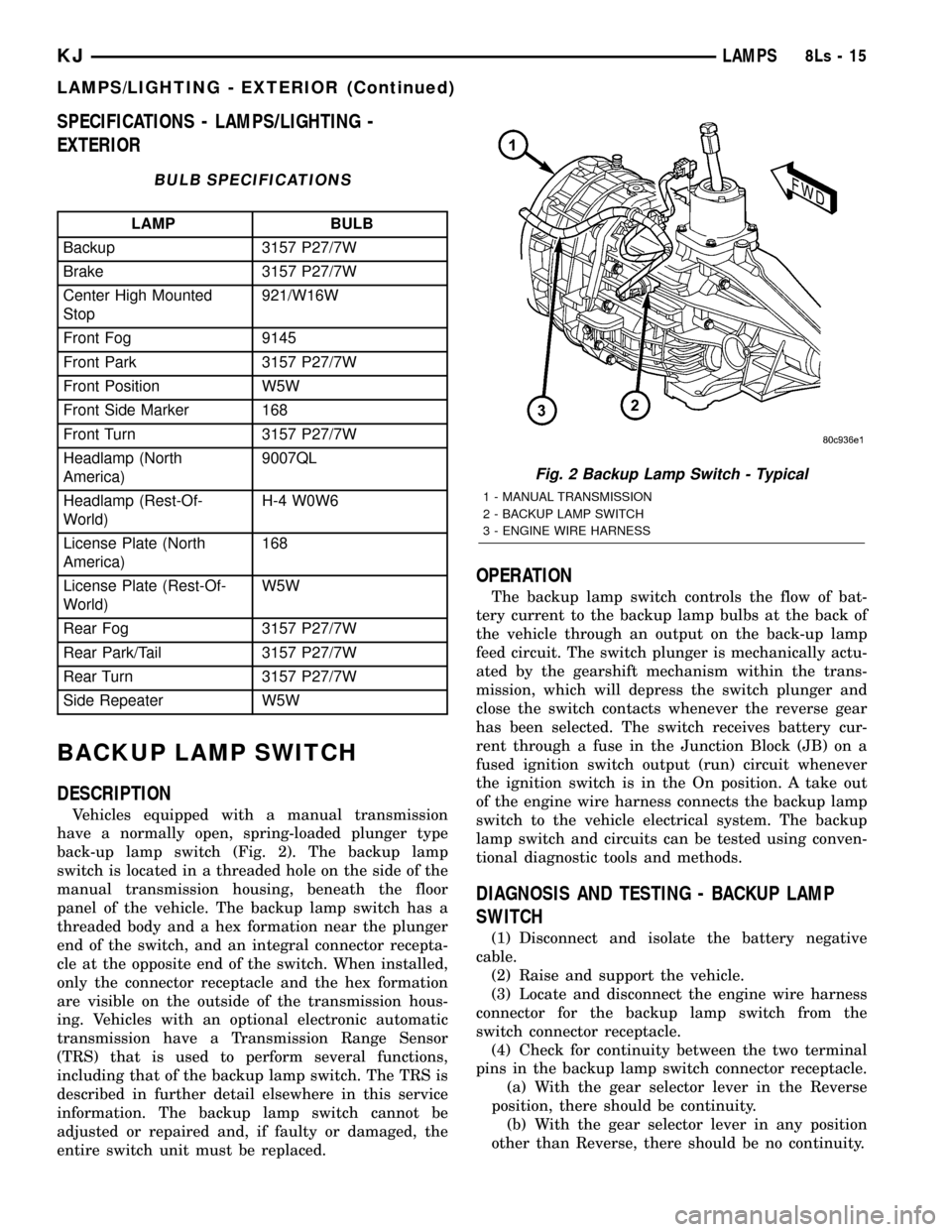
DESCRIPTION
Vehicles equipped with a manual transmission
have a normally open, spring-loaded plunger type
back-up lamp switch (Fig. 2). The backup lamp
switch is located in a threaded hole on the side of the
manual transmission housing, beneath the floor
panel of the vehicle. The backup lamp switch has a
threaded body and a hex formation near the plunger
end of the switch, and an integral connector recepta-
cle at the opposite end of the switch. When installed,
only the connector receptacle and the hex formation
are visible on the outside of the transmission hous-
ing. Vehicles with an optional electronic automatic
transmission have a Transmission Range Sensor
(TRS) that is used to perform several functions,
including that of the backup lamp switch. The TRS is
described in further detail elsewhere in this service
information. The backup lamp switch cannot be
adjusted or repaired and, if faulty or damaged, the
entire switch unit must be replaced.
OPERATION
The backup lamp switch controls the flow of bat-
tery current to the backup lamp bulbs at the back of
the vehicle through an output on the back-up lamp
feed circuit. The switch plunger is mechanically actu-
ated by the gearshift mechanism within the trans-
mission, which will depress the switch plunger and
close the switch contacts whenever the reverse gear
has been selected. The switch receives battery cur-
rent through a fuse in the Junction Block (JB) on a
fused ignition switch output (run) circuit whenever
the ignition switch is in the On position. A take out
of the engine wire harness connects the backup lamp
switch to the vehicle electrical system. The backup
lamp switch and circuits can be tested using conven-
tional diagnostic tools and methods.
DIAGNOSIS AND TESTING - BACKUP LAMP
SWITCH
(1) Disconnect and isolate the battery negative
cable.
(2) Raise and support the vehicle.
(3) Locate and disconnect the engine wire harness
connector for the backup lamp switch from the
switch connector receptacle.
(4) Check for continuity between the two terminal
pins in the backup lamp switch connector receptacle.
(a) With the gear selector lever in the Reverse
position, there should be continuity.
(b) With the gear selector lever in any position
other than Reverse, there should be no continuity.
Fig. 2 Backup Lamp Switch - Typical
1 - MANUAL TRANSMISSION
2 - BACKUP LAMP SWITCH
3 - ENGINE WIRE HARNESS
KJLAMPS8Ls-15
LAMPS/LIGHTING - EXTERIOR (Continued)
Page 541 of 1803

BRAKE LAMP SWITCH
DESCRIPTION
The brake lamp switch is a three circuit, spring-
loaded plunger actuated switch that is secured to the
steering column support bracket under the driver
side of the instrument panel (Fig. 3). The brake lamp
switch is contained within a rectangular molded plas-
tic housing with an integral connector receptacle fea-
turing six terminal pins and a red plastic Connector
Position Assurance (CPA) lock. The switch is con-
nected to the vehicle electrical system through a ded-
icated take out and connector of the instrument
panel wire harness. The switch plunger extends
through a mounting collar on one end of the switch
housing. The plunger has a one time telescoping self-
adjustment feature that is achieved after the switch
is installed by moving an adjustment release lever on
the opposite end of the switch housing clockwise,
until it locks in a position that is parallel to the con-
nector receptacle. The brake lamp switch self-adjust-
ment is a one time feature. Once the feature has
been used, the switch cannot be readjusted. A ªDO
NOT RE-INSTALLº warning is molded into the
switch housing below the connector receptacle.
An installed brake lamp switch cannot be read-
justed or repaired. If the switch is damaged, faulty,
or removed from its mounting position for any rea-
son, it must be replaced with a new unit.
OPERATION
The brake lamp switch controls three different cir-
cuits, one normally open and two normally closed.
These circuits are described as follows:
²Brake Lamp Switch Circuit- A normally
open brake lamp switch circuit receives battery cur-
rent on a fused B(+) circuit from a fuse in the Junc-
tion Block (JB), and supplies battery current to the
brake lamps and the Controller Antilock Brake
(CAB) on a brake lamp switch output circuit when
the brake pedal is depressed (brake lamp switch
plunger released).
²Brake Lamp Switch Signal Circuit- A nor-
mally closed brake lamp switch signal circuit receives
a path to ground through a splice block located in the
instrument panel wire harness with an eyelet termi-
nal connector that is secured by a nut to a ground
stud on the driver side instrument panel end bracket
near the Junction Block (JB). This circuit supplies a
ground input to the Powertrain Control Module
(PCM) on a brake lamp switch sense circuit when the
brake pedal is released (brake lamp switch plunger is
depressed).
²Speed Control Circuit- A normally closed
speed control circuit receives battery current from
the Powertrain Control Module on a speed control
supply circuit, and supplies battery current to the
speed control servo solenoids (dump, vacuum, and
vent) on a speed control brake switch output circuit
when the speed control system is turned on and the
brake pedal is released (brake lamp switch plunger is
depressed).
Concealed within the brake lamp switch housing
the components of the self-adjusting brake switch
plunger consist of a two-piece telescoping plunger, a
split plunger locking collar, and a release wedge. The
release lever has an integral shaft with a wedge that
spreads the plunger locking collar to an open or
released position. After the switch is installed and
the brake pedal is released, the plunger telescopes to
the correct adjustment position. When the release
lever is moved to the release position, the wedge is
disengaged from the locking collar causing the collar
to apply a clamping pressure to the two plunger
halves fixing the plunger length.
The brake lamp switch can be diagnosed using con-
ventional diagnostic tools and methods.
Fig. 3 Brake Lamp Switch
1 - CONNECTOR RECEPTACLE
2 - BRAKE LAMP SWITCH
3 - PLUNGER
4 - COLLAR
5 - LEVER
8Ls - 16 LAMPSKJ
Page 542 of 1803
DIAGNOSIS AND TESTING - BRAKE LAMP
SWITCH
WARNING: ON VEHICLES EQUIPPED WITH AIR-
BAGS, DISABLE THE SUPPLEMENTAL RESTRAINT
SYSTEM BEFORE ATTEMPTING ANY STEERING
WHEEL, STEERING COLUMN, DRIVER AIRBAG,
PASSENGER AIRBAG, SEAT BELT TENSIONER,
FRONT IMPACT SENSORS, SIDE CURTAIN AIRBAG,
OR INSTRUMENT PANEL COMPONENT DIAGNOSIS
OR SERVICE. DISCONNECT AND ISOLATE THE
BATTERY NEGATIVE (GROUND) CABLE, THEN
WAIT TWO MINUTES FOR THE SYSTEM CAPACI-
TOR TO DISCHARGE BEFORE PERFORMING FUR-
THER DIAGNOSIS OR SERVICE. THIS IS THE ONLY
SURE WAY TO DISABLE THE SUPPLEMENTAL
RESTRAINT SYSTEM. FAILURE TO TAKE THE
PROPER PRECAUTIONS COULD RESULT IN ACCI-
DENTAL AIRBAG DEPLOYMENT AND POSSIBLE
PERSONAL INJURY.
(1) Disconnect and isolate the battery negative
cable. Disconnect the instrument panel wire harness
connector for the brake lamp switch from the switch
connector receptacle.
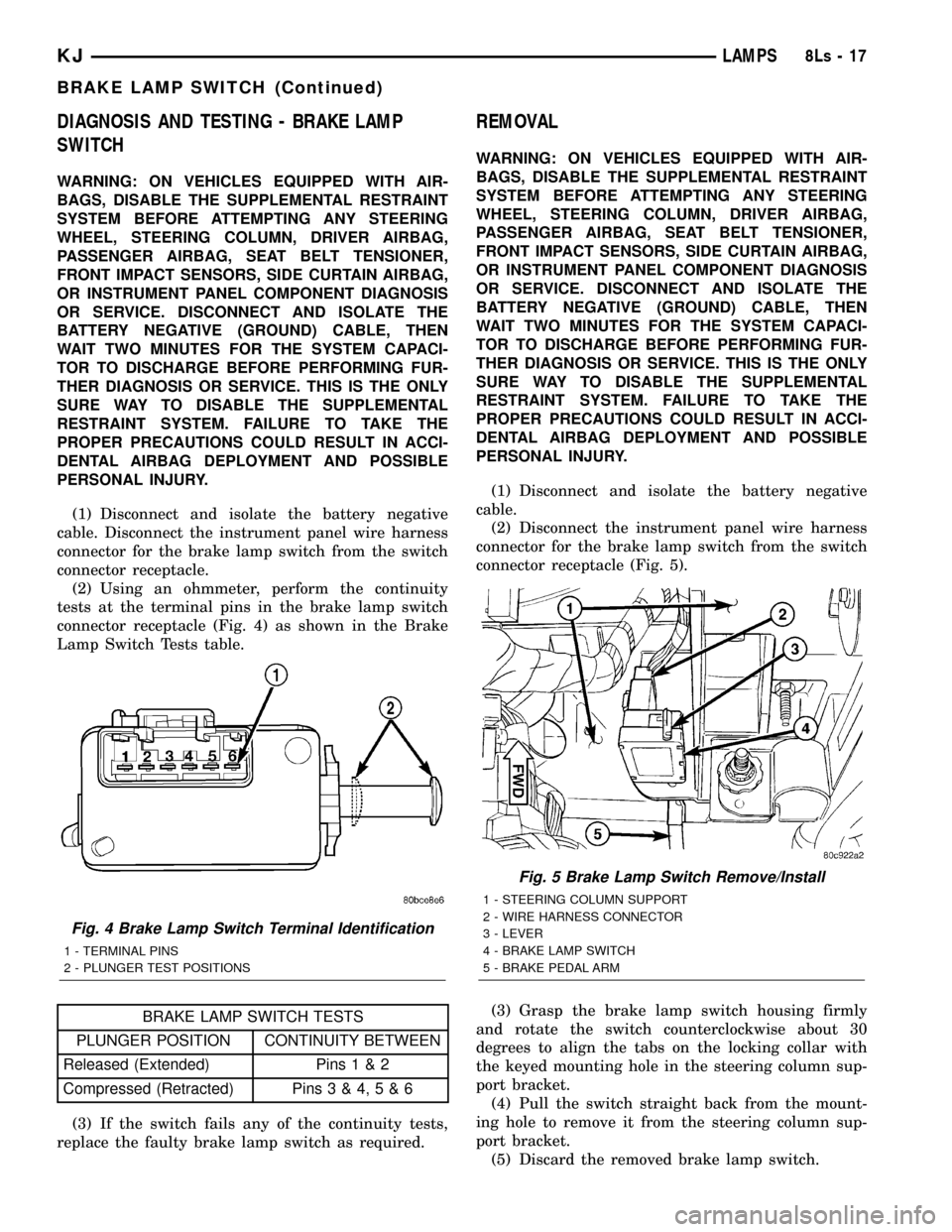
(2) Using an ohmmeter, perform the continuity
tests at the terminal pins in the brake lamp switch
connector receptacle (Fig. 4) as shown in the Brake
Lamp Switch Tests table.
BRAKE LAMP SWITCH TESTS
PLUNGER POSITION CONTINUITY BETWEEN
Released (Extended) Pins1&2
Compressed (Retracted) Pins3&4,5&6
(3) If the switch fails any of the continuity tests,
replace the faulty brake lamp switch as required.
REMOVAL
WARNING: ON VEHICLES EQUIPPED WITH AIR-
BAGS, DISABLE THE SUPPLEMENTAL RESTRAINT
SYSTEM BEFORE ATTEMPTING ANY STEERING
WHEEL, STEERING COLUMN, DRIVER AIRBAG,
PASSENGER AIRBAG, SEAT BELT TENSIONER,
FRONT IMPACT SENSORS, SIDE CURTAIN AIRBAG,
OR INSTRUMENT PANEL COMPONENT DIAGNOSIS
OR SERVICE. DISCONNECT AND ISOLATE THE
BATTERY NEGATIVE (GROUND) CABLE, THEN
WAIT TWO MINUTES FOR THE SYSTEM CAPACI-
TOR TO DISCHARGE BEFORE PERFORMING FUR-
THER DIAGNOSIS OR SERVICE. THIS IS THE ONLY
SURE WAY TO DISABLE THE SUPPLEMENTAL
RESTRAINT SYSTEM. FAILURE TO TAKE THE
PROPER PRECAUTIONS COULD RESULT IN ACCI-
DENTAL AIRBAG DEPLOYMENT AND POSSIBLE
PERSONAL INJURY.
(1) Disconnect and isolate the battery negative
cable.
(2) Disconnect the instrument panel wire harness
connector for the brake lamp switch from the switch
connector receptacle (Fig. 5).
(3) Grasp the brake lamp switch housing firmly
and rotate the switch counterclockwise about 30
degrees to align the tabs on the locking collar with
the keyed mounting hole in the steering column sup-
port bracket.
(4) Pull the switch straight back from the mount-
ing hole to remove it from the steering column sup-
port bracket.
(5) Discard the removed brake lamp switch.
Fig. 4 Brake Lamp Switch Terminal Identification
1 - TERMINAL PINS
2 - PLUNGER TEST POSITIONS
Fig. 5 Brake Lamp Switch Remove/Install
1 - STEERING COLUMN SUPPORT
2 - WIRE HARNESS CONNECTOR
3 - LEVER
4 - BRAKE LAMP SWITCH
5 - BRAKE PEDAL ARM
KJLAMPS8Ls-17
BRAKE LAMP SWITCH (Continued)
Page 543 of 1803

CAUTION: Always replace a removed brake lamp
switch with a new unit. This is a one time compo-
nent and is not intended for reinstallation.
INSTALLATION
WARNING: ON VEHICLES EQUIPPED WITH AIR-
BAGS, DISABLE THE SUPPLEMENTAL RESTRAINT
SYSTEM BEFORE ATTEMPTING ANY STEERING
WHEEL, STEERING COLUMN, DRIVER AIRBAG,
PASSENGER AIRBAG, SEAT BELT TENSIONER,
FRONT IMPACT SENSORS, SIDE CURTAIN AIRBAG,
OR INSTRUMENT PANEL COMPONENT DIAGNOSIS
OR SERVICE. DISCONNECT AND ISOLATE THE
BATTERY NEGATIVE (GROUND) CABLE, THEN
WAIT TWO MINUTES FOR THE SYSTEM CAPACI-
TOR TO DISCHARGE BEFORE PERFORMING FUR-
THER DIAGNOSIS OR SERVICE. THIS IS THE ONLY
SURE WAY TO DISABLE THE SUPPLEMENTAL
RESTRAINT SYSTEM. FAILURE TO TAKE THE
PROPER PRECAUTIONS COULD RESULT IN ACCI-
DENTAL AIRBAG DEPLOYMENT AND POSSIBLE
PERSONAL INJURY.
CAUTION: Always replace a removed brake lamp
switch with a new unit. This is a one time compo-
nent and is not intended for reinstallation.
(1) While holding the brake pedal depressed, align
the tabs on the brake lamp switch locking collar with
the keyed mounting hole in the steering column sup-
port bracket (Fig. 5).
(2) Still holding the brake pedal depressed, insert
the tabs on the brake lamp switch housing through
the keyed mounting hole in the steering column sup-
port bracket until the switch is firmly seated against
the bracket.
(3) Still holding the brake pedal depressed, rotate
the switch clockwise about 30 degrees to lock the
tabs on the brake lamp switch locking collar to the
keyed mounting hole in the steering column support
bracket.
(4) Release the brake pedal.
CAUTION: Do not pull up on the brake pedal before
the switch plunger adjustment has been completed.
(5) Rotate the plunger adjustment release lever
clockwise until it locks into place parallel to the
brake lamp switch connector receptacle. This action
will set the switch plunger length to a final adjust-
ment position and cannot be undone. If not per-
formed properly the first time, a new brake lamp
switchmustbe installed.(6) Reconnect the instrument panel wire harness
connector for the brake lamp switch to the switch
connector receptacle.
(7) Reconnect the battery negative cable.
CENTER HIGH MOUNTED
STOP LAMP BULB
REMOVAL
(1) Disconnect and isolate the battery negative
cable.
(2) Remove the Center High Mounted Stop Lamp
(CHMSL) unit from the roof panel. (Refer to 8 -
ELECTRICAL/LAMPS/LIGHTING - EXTERIOR/
CENTER HIGH MOUNTED STOP LAMP UNIT -
REMOVAL).
(3) Firmly grasp the socket on the back of the
CHMSL unit housing.
(4) Rotate the socket on the back of the CHMSL
unit housing counterclockwise about 30 degrees (Fig.
6).
(5) Pull the socket and bulb straight out of the
back of CHMSL unit housing.
(6) Pull the bulb straight out of the CHMSL unit
socket.
Fig. 6 Center High Mounted Stop Lamp Bulb
Remove/Install
1 - CHMSL UNIT
2 - BULB
3 - SOCKET
4 - BODY WIRE HARNESS CONNECTOR
8Ls - 18 LAMPSKJ
BRAKE LAMP SWITCH (Continued)
Page 587 of 1803

TRAILER TOW RELAY
DESCRIPTION
The trailer tow relays are located in a connector
bank above the right rear wheelhouse and behind the
quarter trim panel on vehicles equipped with the
optional factory-installed trailer towing package.
Four individual relays are used, one each for fused
ignition switch output (run), brake lamps, right turn
signal, and left turn signal outputs to a trailer
through the rear body wiring and connectors. The
trailer tow relays are conventional International
Standards Organization (ISO) micro relays (Fig. 64).
Relays conforming to the ISO specifications have
common physical dimensions, current capacities, ter-
minal patterns, and terminal functions. The relay is
contained within a small, rectangular, molded plastic
housing and is connected to all of the required inputs
and outputs by five integral male spade-type termi-
nals that extend from the bottom of the relay base.
The trailer tow relays cannot be adjusted or
repaired and, if faulty or damaged, the inoperative
relay must be replaced.
OPERATION
The trailer tow relays are electromechanical
switches. The relays each use an input from the cir-
cuit that they isolate from the trailer wiring to con-
trol a high current output to the trailer. The movable
common feed contact point is held against the fixed
normally closed contact point by spring pressure.When the relay coil is energized, an electromagnetic
field is produced by the coil windings. This electro-
magnetic field draws the movable relay contact point
away from the fixed normally closed contact point,
and holds it against the fixed normally open contact
point. When the relay coil is de-energized, spring
pressure returns the movable contact point back
against the fixed normally closed contact point. A
resistor is connected in parallel with the relay coil in
the relay, and helps to dissipate voltage spikes and
electromagnetic interference that can be generated as
the electromagnetic field of the relay coil collapses.
The terminals of each trailer tow relay are con-
nected to the vehicle electrical system through a con-
nector bank in the rear lighting wire harness above
the right rear wheelhouse. Refer to the appropriate
wiring information. The wiring information includes
wiring diagrams, proper wire and connector repair
procedures, details of wire harness routing and
retention, connector pin-out information and location
views for the various wire harness connectors, splices
and grounds. The trailer tow relays can be diagnosed
using conventional diagnostic tools and methods.
DIAGNOSIS AND TESTING - TRAILER TOW
RELAY
The trailer tow relays (Fig. 65) are located in a
connector bank above the right rear wheelhouse.
Refer to the appropriate wiring information. The wir-
ing information includes wiring diagrams, proper
wire and connector repair procedures, details of wire
harness routing and retention, connector pin-out
information and location views for the various wire
harness connectors, splices and grounds.
WARNING: ON VEHICLES EQUIPPED WITH AIR-
BAGS, DISABLE THE SUPPLEMENTAL RESTRAINT
SYSTEM BEFORE ATTEMPTING ANY STEERING
WHEEL, STEERING COLUMN, DRIVER AIRBAG,
PASSENGER AIRBAG, SEAT BELT TENSIONER,
FRONT IMPACT SENSORS, SIDE CURTAIN AIRBAG,
OR INSTRUMENT PANEL COMPONENT DIAGNOSIS
OR SERVICE. DISCONNECT AND ISOLATE THE
BATTERY NEGATIVE (GROUND) CABLE, THEN
WAIT TWO MINUTES FOR THE SYSTEM CAPACI-
TOR TO DISCHARGE BEFORE PERFORMING FUR-
THER DIAGNOSIS OR SERVICE. THIS IS THE ONLY
SURE WAY TO DISABLE THE SUPPLEMENTAL
RESTRAINT SYSTEM. FAILURE TO TAKE THE
PROPER PRECAUTIONS COULD RESULT IN ACCI-
DENTAL AIRBAG DEPLOYMENT AND POSSIBLE
PERSONAL INJURY.
Fig. 64 Trailer Tow Relays
1 - RELAY CONNECTOR BANK
2 - REAR BODY WIRE HARNESS
3 - LEFT TURN RELAY
4 - RIGHT TURN RELAY
5 - BRAKE LAMP RELAY
6 - FUSED IGNITION SWITCH OUTPUT (RUN) RELAY
8Ls - 62 LAMPSKJ
Page 589 of 1803

WARNING: ON VEHICLES EQUIPPED WITH AIR-
BAGS, DISABLE THE SUPPLEMENTAL RESTRAINT
SYSTEM BEFORE ATTEMPTING ANY STEERING
WHEEL, STEERING COLUMN, DRIVER AIRBAG,
PASSENGER AIRBAG, SEAT BELT TENSIONER,
FRONT IMPACT SENSORS, SIDE CURTAIN AIRBAG,
OR INSTRUMENT PANEL COMPONENT DIAGNOSIS
OR SERVICE. DISCONNECT AND ISOLATE THE
BATTERY NEGATIVE (GROUND) CABLE, THEN
WAIT TWO MINUTES FOR THE SYSTEM CAPACI-
TOR TO DISCHARGE BEFORE PERFORMING FUR-
THER DIAGNOSIS OR SERVICE. THIS IS THE ONLY
SURE WAY TO DISABLE THE SUPPLEMENTAL
RESTRAINT SYSTEM. FAILURE TO TAKE THE
PROPER PRECAUTIONS COULD RESULT IN ACCI-
DENTAL AIRBAG DEPLOYMENT AND POSSIBLE
PERSONAL INJURY.
(1) Position the trailer tow relay to the proper con-
nector in the connector bank (Fig. 67).
(2) Align the trailer tow relay terminals with the
terminal cavities in the connector.
(3) Push firmly and evenly on the top of the trailer
tow relay until the terminals are fully seated in the
terminal cavities in the connector.
(4) Carefully restore the foam wrap around the
trailer tow relay connector bank (Fig. 66).
(5) Reach through the access hole in the quarter
inner panel behind the right rear wheelhouse to
place the trailer tow relay connector bank on the top
of the right rear wheelhouse between the quarter
inner and outer panels.(6) Reinstall the trim onto the right side quarter
inner panel. (Refer to 23 - BODY/INTERIOR/QUAR-
TER TRIM PANEL - INSTALLATION).
(7) Reconnect the battery negative cable.
TRAILER TOW WIRING
DESCRIPTION
Vehicles equipped with an optional factory-in-
stalled (not dealer-installed or port-installed) trailer
towing package have a rear body wire harness that
includes an integral trailer tow wiring take out that
connects to a heavy duty, sealed, 7-pin trailer tow
connector located on a bracket on the trailer hitch
receiver (Fig. 68). This harness includes a second
take out with a trailer tow relay connector bank and
four trailer tow relays that isolate the right turn sig-
nal, left turn signal, and brake lamp circuits of the
vehicle from the electrical system of the trailer. The
fourth relay in the connector bank provides a fused
ignition switch output (run) source of battery current
to the trailer tow connector through a trailer tow
relay output circuit. The package also includes an
adapter harness (stored beneath the left rear seat
cushion of the vehicle when it is shipped from the
factory) that adapts the 7-pin trailer tow connector to
a standard, light-duty, 4-pin trailer tow connector.
Refer to the appropriate wiring information. The wir-
ing information includes wiring diagrams, proper
wire and connector repair procedures, further details
on wire harness routing and retention, as well as
pin-out and location views for the various wire har-
ness connectors, splices and grounds.
Fig. 67 Trailer Tow Relay Remove/Install
1 - RELAY CONNECTOR BANK
2 - REAR BODY WIRE HARNESS
3 - LEFT TURN RELAY
4 - RIGHT TURN RELAY
5 - BRAKE LAMP RELAY
6 - FUSED IGNITION SWITCH OUTPUT (RUN) RELAY
Fig. 68 Trailer Tow Wiring
1 - RETAINER CLIP (4)
2 - REAR BODY HARNESS (TRAILER TOW TAKE OUT)
3 - RETAINER CLIP (2)
4 - WIRE HARNESS CONNECTOR
8Ls - 64 LAMPSKJ
TRAILER TOW RELAY (Continued)
Page 674 of 1803

SPEED CONTROL
TABLE OF CONTENTS
page page
SPEED CONTROL
DESCRIPTION..........................1
OPERATION............................1
DIAGNOSIS AND TESTING - ROAD TEST.....2
SPECIFICATIONS
TORQUE - SPEED CONTROL.............2
CABLE
DESCRIPTION..........................3
OPERATION............................3
REMOVAL - 3.7L.........................3
INSTALLATION - 3.7L.....................4
SERVO
DESCRIPTION..........................4
OPERATION............................4REMOVAL.............................4
INSTALLATION..........................5
SWITCH
DESCRIPTION..........................5
OPERATION............................5
REMOVAL.............................6
INSTALLATION..........................6
VACUUM RESERVOIR
DESCRIPTION..........................7
OPERATION............................7
DIAGNOSIS AND TESTING - VACUUM
RESERVOIR..........................7
REMOVAL.............................7
INSTALLATION..........................8
SPEED CONTROL
DESCRIPTION
The speed control system is electronically con-
trolled and vacuum operated. Electronic control of
the speed control system is integrated into the Pow-
ertrain Control Module (PCM). The controls consist
of two steering wheel mounted switches. The
switches are labeled: ON/OFF, RES/ACCEL, SET,
COAST, and CANCEL.
The system is designed to operate at speeds above
30 mph (50 km/h).
WARNING: THE USE OF SPEED CONTROL IS NOT
RECOMMENDED WHEN DRIVING CONDITIONS DO
NOT PERMIT MAINTAINING A CONSTANT SPEED,
SUCH AS IN HEAVY TRAFFIC OR ON ROADS THAT
ARE WINDING, ICY, SNOW COVERED, OR SLIP-
PERY.
OPERATION
When speed control is selected by depressing the
ON switch, the PCM allows a set speed to be stored
in PCM RAM for speed control. To store a set speed,
depress the SET switch while the vehicle is moving
at a speed between 35 and 85 mph. In order for the
speed control to engage, the brakes cannot be
applied, nor can the gear selector be indicating the
transmission is in Park or Neutral.
The speed control can be disengaged manually by:
²Stepping on the brake pedal
²Depressing the OFF switch²Depressing the CANCEL switch.
²Depressing the clutch pedal (if equipped).
NOTE: Depressing the OFF switch or turning off the
ignition switch will erase the set speed stored in
the PCM.
For added safety, the speed control system is pro-
grammed to disengage for any of the following condi-
tions:
²An indication of Park or Neutral
²A rapid increase rpm (indicates that the clutch
has been disengaged)
²Excessive engine rpm (indicates that the trans-
mission may be in a low gear)
²The speed signal increases at a rate of 10 mph
per second (indicates that the coefficient of friction
between the road surface and tires is extremely low)
²The speed signal decreases at a rate of 10 mph
per second (indicates that the vehicle may have
decelerated at an extremely high rate)
Once the speed control has been disengaged,
depressing the RES/ACCEL switch (when speed is
greater than 30 mph) restores the vehicle to the tar-
get speed that was stored in the PCM.
While the speed control is engaged, the driver can
increase the vehicle speed by depressing the RES/AC-
CEL switch. The new target speed is stored in the
PCM when the RES/ACCEL is released. The PCM
also has a9tap-up9feature in which vehicle speed
increases at a rate of approximately 2 mph for each
momentary switch activation of the RES/ACCEL
switch.
KJSPEED CONTROL 8P - 1