wire JEEP LIBERTY 2002 KJ / 1.G Manual PDF
[x] Cancel search | Manufacturer: JEEP, Model Year: 2002, Model line: LIBERTY, Model: JEEP LIBERTY 2002 KJ / 1.GPages: 1803, PDF Size: 62.3 MB
Page 370 of 1803

WINDOW DEFOGGER
TABLE OF CONTENTS
page page
WINDOW DEFOGGER
DESCRIPTION - REAR WINDOW DEFOGGER . . 3
OPERATION - REAR WINDOW DEFOGGER....3
DIAGNOSIS AND TESTING - REAR WINDOW
DEFOGGER SYSTEM...................4
STANDARD PROCEDURE - REAR GLASS
HEATING GRID REPAIR.................4
REAR WINDOW DEFOGGER GRID
DESCRIPTION..........................5
OPERATION............................5
DIAGNOSIS AND TESTING - REAR WINDOW
DEFOGGER GRID......................5
REAR WINDOW DEFOGGER RELAY
DESCRIPTION..........................6
OPERATION............................6DIAGNOSIS AND TESTING - REAR WINDOW
DEFOGGER RELAY.....................6
REMOVAL.............................7
INSTALLATION..........................7
REAR WINDOW DEFOGGER SWITCH
DESCRIPTION..........................8
OPERATION............................8
DIAGNOSIS AND TESTING
DIAGNOSIS AND TESTING - REAR
WINDOW DEFOGGER SWITCH...........8
DIAGNOSIS AND TESTING - REAR HVAC
CONTROL ASSEMBLY WINDOW
DEFOGGER FUNCTION.................9
REMOVAL.............................9
INSTALLATION..........................9
WINDOW DEFOGGER
DESCRIPTION - REAR WINDOW DEFOGGER
The rear window defogger system will only operate
when the ignition switch is in the run position. When
the defogger switch is in the run position, an electric
heater grid on the rear window glass is energized.
Vehicles with the heated mirror options also have
heater grids located behind the outside rear view
mirror glass. Each of these grids produce heat to help
clear the rear window glass and outside rear view
mirrors of ice, snow, or fog.
OPERATION - REAR WINDOW DEFOGGER
The rear window defogger system is controlled by a
switch installed with the HVAC control assembly. An
amber indicator lamp in the switch button will light
to indicate when the rear window defogger system is
turned on. The HVAC control head circuitry, which
contains the defogger system timer logic, monitors
the state of the defogger switch through a hard-wired
input. The instrument cluster circuitry controls therear window defogger system through a hard-wired
control output to the rear window defogger relay. The
rear window defogger timer and logic circuitry cannot
be adjusted or repaired and, if faulty or damaged, the
HVAC control head assembly must be replaced.
The rear window defogger system will be automat-
ically turned off after a programmed time interval of
about ten minutes. After the initial time interval has
expired, if the rear window defogger switch is turned
on again during the same ignition cycle, the defogger
system will automatically turn off after about five
minutes.
The rear window defogger system will automati-
cally shut off if the ignition switch is turned to the
Off position, or it can be turned off manually by
depressing the instrument panel switch. Following
are general descriptions of the major components in
the rear window defogger system. Refer to the own-
er's manual in the vehicle glove box for more infor-
mation on the features, use and operation of the
defogger system.
KJWINDOW DEFOGGER 8G - 3
Page 371 of 1803

DIAGNOSIS AND TESTING - REAR WINDOW
DEFOGGER SYSTEM
For circuit descriptions and diagrams, (Refer to
Appropriate Wiring Information). The operation of
the electrically heated rear window defogger system
can be confirmed in one of the following manners:
²Turn the ignition switch to the run position.
²Set the defogger switch in the run position. The
rear window defogger operation can be checked by
feeling the rear window or outside rear view mirror
glass. A distinct difference in temperature between
the grid lines and the adjacent clear glass or the mir-
ror glass can be detected within three to four min-
utes of operation.
²Using a 12-volt DC voltmeter, contact the rear
glass heating grid terminal B (right side) with the
negative lead, and terminal A (left side) with the pos-
itive lead (Fig. 1). The voltmeter should read battery
voltage.
The above checks will confirm system operation.
Illumination of the defogger switch indicator lamp
means that there is electrical current available at the
output of the defogger relay, but does not confirmthat the electrical current is reaching the rear glass
heating grid lines.
If the defogger system does not operate, the prob-
lem should be isolated in the following manner:
(1) Confirm that the ignition switch is in the run
position.
(2) Ensure that the rear glass heating grid feed
and ground wires are connected to the glass. Confirm
that the ground wire has continuity to ground.
(3) Check the fuses in the Power Distribution Cen-
ter (PDC) and in the junction block. The fuses must
be tight in their receptacles and all electrical connec-
tions must be secure.
When the above steps have been completed and the
rear glass or outside rear view mirror heating grid is
still inoperative, one or more of the following is
faulty:
²Defogger switch
²Defogger relay
²HVAC control head circuitry
²Rear window grid lines (all grid lines would
have to be broken or one of the feed wires discon-
nected for the entire system to be inoperative)
²Outside rear view mirror heating grid.
If setting the defogger switch to the On position
produces a severe voltmeter deflection, check for a
short circuit between the defogger relay output and
the rear glass or outside rear view mirror heating
grids.
STANDARD PROCEDURE - REAR GLASS
HEATING GRID REPAIR
Repair of the rear glass heating grid lines, bus
bars, terminals or pigtail wires can be accomplished
using a Mopar Rear Window Defogger Repair Kit
(Part Number 4267922) or equivalent.
WARNING: MATERIALS CONTAINED IN THE REPAIR
KIT MAY CAUSE SKIN OR EYE IRRITATION. THE
KIT CONTAINS EPOXY RESIN AND AMINE TYPE
HARDENER, WHICH ARE HARMFUL IF SWAL-
LOWED. AVOID CONTACT WITH THE SKIN AND
EYES. FOR SKIN CONTACT, WASH THE AFFECTED
AREAS WITH SOAP AND WATER. FOR CONTACT
WITH THE EYES, FLUSH WITH PLENTY OF WATER.
DO NOT TAKE INTERNALLY. IF TAKEN INTER-
NALLY, INDUCE VOMITING AND CALL A PHYSICIAN
IMMEDIATELY. USE WITH ADEQUATE VENTILA-
TION. DO NOT USE NEAR FIRE OR FLAME. CON-
TAINS FLAMMABLE SOLVENTS. KEEP OUT OF THE
REACH OF CHILDREN.
(1) Mask the repair area so that the conductive
epoxy can be applied neatly. Extend the epoxy appli-
cation onto the grid line or the bus bar on each side
of the break (Fig. 2).
Fig. 1 REAR WINDOW DEFOGGER
1 - DEFOGGER BACKGLASS
2 - HEATED GLASS CONNECTOR9A9
3 - HINDGE MOUNTING SCREWS (2)
4 - HINDGE (LEFT SIDE)
5 - HINDGE MOUNTING SCREWS (2)
6 - HINDGE (RIGHT SIDE)
7 - HEATED GLASS CONNECTOR9B9
8 - BACKGLASS DEFOGGER GRID
8G - 4 WINDOW DEFOGGERKJ
WINDOW DEFOGGER (Continued)
Page 372 of 1803

(2) Follow the instructions in the repair kit for
preparing the damaged area.
(3) Remove the package separator clamp and mix
the two conductive epoxy components thoroughly
within the packaging. Fold the package in half and
cut the center corner to dispense the epoxy.
(4) For grid line repairs, mask the area to be
repaired with masking tape or a template.
(5) Apply the epoxy through the slit in the mask-
ing tape or template. Overlap both ends of the break
by at least 19 millimeters (0.75 inch).
(6) For a terminal or pigtail wire replacement,
mask the adjacent areas so the epoxy can be
extended onto the adjacent grid line as well as the
bus bar. Apply a thin layer of epoxy to the area
where the terminal or pigtail wire was fastened and
onto the adjacent grid line.
(7) Apply a thin layer of conductive epoxy to the
terminal or bare wire end of the pigtail and place it
in the proper location on the bus bar. To prevent the
terminal or pigtail wire from moving while the epoxy
is curing, it must be wedged or clamped.
(8)
Carefully remove the masking tape or template.
CAUTION: Do not allow the glass surface to exceed
204É C (400É F) or the glass may fracture.
(9) Allow the epoxy to cure 24 hours at room tem-
perature, or use a heat gun that will not over heat
the glass. Hold the heat gun approximately 25.4 cen-
timeters (10 inches) from the repair.
(10) After the conductive epoxy is properly cured,
remove the wedge or clamp from the terminal or pig-
tail wire. Do not attach the wire harness connectors
until the curing process is complete.
(11) Check the operation of the rear window defog-
ger glass heating grid.
REAR WINDOW DEFOGGER
GRID
DESCRIPTION
The heated rear window glass has two electrically
conductive vertical bus bars and a series of 11 hori-
zontal grid lines made of a silver-ceramic material,
which is baked on and bonded to the inside surface of
the glass. The grid lines and bus bars comprise a
parallel electrical circuit.
OPERATION
When the rear window defogger switch is placed in
the On position, electrical current is directed to the
rear window grid lines through the bus bars. The
grid lines heat the rear window to clear the surface
of fog or snow. Protection for the heated grid circuit
is provided by a fuse in the Power Distribution Cen-
ter (PDC).
The grid lines and bus bars are highly resistant to
abrasion. However, it is possible for an open circuit
to occur in an individual grid line, resulting in no
current flow through the line.
The grid lines can be damaged or scraped off with
sharp instruments. Care should be taken when clean-
ing the glass or removing foreign materials, decals,
or stickers from the glass. Normal glass cleaning sol-
vents or hot water used with rags or toweling is rec-
ommended.
A repair kit is available to repair the grid lines and
bus bars, or to reinstall the heated glass pigtail
wires.
DIAGNOSIS AND TESTING - REAR WINDOW
DEFOGGER GRID
For circuit descriptions and diagrams, (Refer to
Appropriate Wiring Information). To detect breaks in
the grid lines, the following procedure is required:
(1) Turn the ignition switch to the run position.
Set the defogger switch in the On position. The indi-
cator lamp should light. If OK, go to Step 2. If not
OK, (Refer to 8 - ELECTRICAL/HEATED GLASS/
REAR WINDOW DEFOGGER RELAY - DIAGNOSIS
AND TESTING)
(2) Using a 12-volt DC voltmeter, contact the ver-
tical bus bar on the right side of the vehicle with the
negative lead. With the positive lead, contact the ver-
tical bus bar on the left side of the vehicle. The volt-
meter should read battery voltage. If OK, go to Step
3. If not OK, repair the open circuit to the defogger
relay as required.
(3) With the negative lead of the voltmeter, contact
a good body ground point. The voltage reading should
not change. If OK, go to Step 4. If not OK, repair the
circuit to ground as required.
Fig. 2 GRID LINE REPAIR
1 - BREAK
2 - GRID LINE
3 - MASKING TAPE
KJWINDOW DEFOGGER 8G - 5
WINDOW DEFOGGER (Continued)
Page 375 of 1803

REAR WINDOW DEFOGGER
SWITCH
DESCRIPTION
The rear window defogger switch is installed in the
instrument panel HVAC contol head assembly. The
momentary-type switch provides a hard-wired ground
signal to the HVAC control head each time it is
depressed. The instrument cluster rear window
defogger timer and logic circuitry responds by ener-
gizing or de-energizing the rear window defogger
relay.
OPERATION
Energizing the rear window defogger relay pro-
vides electrical current to the rear window defogger
grid and, if the vehicle is so equipped, the outside
rear view mirror heating grids. An amber indicator
lamp in the defogger switch, which lights to indicate
when the defogger system is turned On, is also pow-
ered by the defogger relay output.
The defogger switch illumination lamp and indica-
tor lamp bulbs are serviceable. The defogger switch
cannot be repaired and, if faulty or damaged the
entire HVAC control head assembly must be
replaced.
DIAGNOSIS AND TESTING
DIAGNOSIS AND TESTING - REAR WINDOW
DEFOGGER SWITCH
For circuit descriptions and diagrams, (Refer to
Appropriate Wiring Information).
WARNING: ON VEHICLES EQUIPPED WITH AIR-
BAGS, DISABLE THE AIRBAG SYSTEM BEFORE
ATTEMPTING ANY STEERING WHEEL, STEERING
COLUMN, OR INSTRUMENT PANEL COMPONENT
DIAGNOSIS OR SERVICE. DISCONNECT AND ISO-
LATE THE BATTERY NEGATIVE (GROUND) CABLE,
THEN WAIT TWO MINUTES FOR THE AIRBAG SYS-
TEM CAPACITOR TO DISCHARGE BEFORE PER-
FORMING FURTHER DIAGNOSIS OR SERVICE. THIS
IS THE ONLY SURE WAY TO DISABLE THE AIRBAG
SYSTEM. FAILURE TO TAKE THE PROPER PRE-
CAUTIONS COULD RESULT IN AN ACCIDENTAL
AIRBAG DEPLOYMENT AND POSSIBLE PERSONAL
INJURY.
(1) Disconnect and isolate the battery negative
cable. Remove the HVAC control head assembly from
the instrument panel and unplug the defogger switch
wire harness connector-B.
(2) Check for continuity between the ground cir-
cuit cavity of the defogger switch wire harness con-nector and a good ground. There should be
continuity. If OK, go to Step 3. If not OK, repair the
open circuit as required.
(3) Check for continuity between the ground cir-
cuit terminal and the rear window defogger switch
sense circuit terminal on the back of the defogger
switch housing (Fig. 5). There should be momentary
continuity as the defogger switch button is depressed,
and then no continuity. If OK, (Refer to 8 - ELEC-
TRICAL/HEATED GLASS/REAR WINDOW DEFOG-
GER SWITCH - DIAGNOSIS AND TESTING -
INSTRUMENT CLUSTER REAR WINDOW DEFOG-
GER FUNCTION) If not OK, replace the faulty
switch (Fig. 5).
(4) Check switch position continuity between:
CONTACT PINS
1 - OFF LAMPS A-1 - A-7
2 - ON MOMENTARY B-6 - B-8
3 - ILLUMINATION LAMP A-7 - A-1
4 - INDICATOR LAMP B-12 - B-7
Fig. 5 A/C HEATER CONTROL HEAD (Rear View)
1 - A/C HEATER CONTROL HEAD
2 - A/C HEATER CONTROL HEAD LIGHT
3 - REAR WINDOW DEFOGGER SWITCH AND TEMPERATURE
BLEND DOOR- CONNECTOR B (12 PIN)
4 - A/C HEATER CONTROL HEAD LIGHT
5 - MODE SELECT CONTROL
6 - BLOWER SPEED CONTROL- CONNECTOR A (7 PIN)
7 - MOUNTING SCREWS (4)
8G - 8 WINDOW DEFOGGERKJ
Page 376 of 1803

DIAGNOSIS AND TESTING - REAR HVAC
CONTROL ASSEMBLY WINDOW DEFOGGER
FUNCTION
Before performing this test, complete the Defogger
Switch and Defogger Relay tests as described in this
group. For circuit descriptions and diagrams, (Refer
to Appropriate Wiring Information).
WARNING: ON VEHICLES EQUIPPED WITH AIR-
BAGS, DISABLE THE AIRBAG SYSTEM BEFORE
ATTEMPTING ANY STEERING WHEEL, STEERING
COLUMN, OR INSTRUMENT PANEL COMPONENT
DIAGNOSIS OR SERVICE. DISCONNECT AND ISO-
LATE THE BATTERY NEGATIVE (GROUND) CABLE,
THEN WAIT TWO MINUTES FOR THE AIRBAG SYS-
TEM CAPACITOR TO DISCHARGE BEFORE PER-
FORMING FURTHER DIAGNOSIS OR SERVICE. THIS
IS THE ONLY SURE WAY TO DISABLE THE AIRBAG
SYSTEM. FAILURE TO TAKE THE PROPER PRE-
CAUTIONS COULD RESULT IN AN ACCIDENTAL
AIRBAG DEPLOYMENT AND POSSIBLE PERSONAL
INJURY.
(1) Disconnect and isolate the battery negative
cable. Remove the defogger relay from the junction
block and unplug the defogger switch wire harness
connector.
(2) Remove the HVAC control head from the
instrument panel. This is accomplished by removing
the ashtray and the screw behind the ashtray and
uncliping the center bezel.
(3) Check for continuity between the rear window
defogger switch sense circuit cavity of the cluster
wire harness connector (connector B) and a good
ground. There should be no continuity. If OK, go to
Step 4. If not OK, repair the short circuit as
required.
(4) Check for continuity between the rear window
defogger switch sense circuit cavity of the right
instrument cluster wire harness connector (connector
B) and the defogger switch wire harness connector.
There should be continuity. If OK, go to Step 5. If not
OK, repair the open circuit as required.
(5) Check for continuity between the rear window
defogger relay control circuit cavity of the right
instrument cluster wire harness connector (connectorB) and a good ground. There should be no continuity.
If OK, go to Step 6. If not OK, repair the short circuit
as required.
(6) Check for continuity between the rear window
defogger relay control circuit cavities of the right
instrument cluster wire harness connector (connector
B) and the defogger relay receptacle (the cavity for
ISO relay terminal 85) in the junction block. There
should be continuity. If OK, replace the faulty HVAC
control head. If not OK, repair the open circuit as
required.
REMOVAL
WARNING: ON VEHICLES EQUIPPED WITH AIR-
BAGS, DISABLE THE AIRBAG SYSTEM BEFORE
ATTEMPTING ANY STEERING WHEEL, STEERING
COLUMN, OR INSTRUMENT PANEL COMPONENT
DIAGNOSIS OR SERVICE. DISCONNECT AND ISO-
LATE THE BATTERY NEGATIVE (GROUND) CABLE,
THEN WAIT TWO MINUTES FOR THE AIRBAG SYS-
TEM CAPACITOR TO DISCHARGE BEFORE PER-
FORMING FURTHER DIAGNOSIS OR SERVICE. THIS
IS THE ONLY SURE WAY TO DISABLE THE AIRBAG
SYSTEM. FAILURE TO TAKE THE PROPER PRE-
CAUTIONS COULD RESULT IN AN ACCIDENTAL
AIRBAG DEPLOYMENT AND POSSIBLE PERSONAL
INJURY.
(1) Disconnect and isolate the battery negative
cable.
(2) The Rear Window Defogger switch is part of
the HVAC assembly and if damaged or inoperative
the entire HVAC control assembly must be replace-
d(Refer to 24 - HEATING & AIR CONDITIONING/
CONTROLS/A/C HEATER CONTROL - REMOVAL).
INSTALLATION
(1) The Rear Window Defogger switch is part of
the HVAC control assembly and if damaged or inop-
erative you must replace the entire HVEAC control
head assembly(Refer to 24 - HEATING & AIR CON-
DITIONING/CONTROLS/A/C HEATER CONTROL -
INSTALLATION).
(2) Connect the battery negative cable.
KJWINDOW DEFOGGER 8G - 9
REAR WINDOW DEFOGGER SWITCH (Continued)
Page 378 of 1803
The heated seat module monitors inputs from the
heated seat sensors and the heated seat switches. In
response to these inputs the heated seat module uses
its internal programming to control outputs to the
heated seat elements in both front seats and to con-
trol the heated seat LED indicator lamps located in
both of the heated seat switches. The heated seat
module is also programmed to provide self-diagnostic
capability. When the module detects certain failures
within the heated seat system, it will provide a
visual indication of the failure by flashing the indica-
tor lamps in the affected heated seat switch. The
heated seat module will automatically turn off the
heated seat elements if it detects a short or open in
the heated seat element circuit or a heated seat sen-
sor value that is out of range.
DIAGNOSIS AND TESTING - HEATED SEAT
SYSTEM
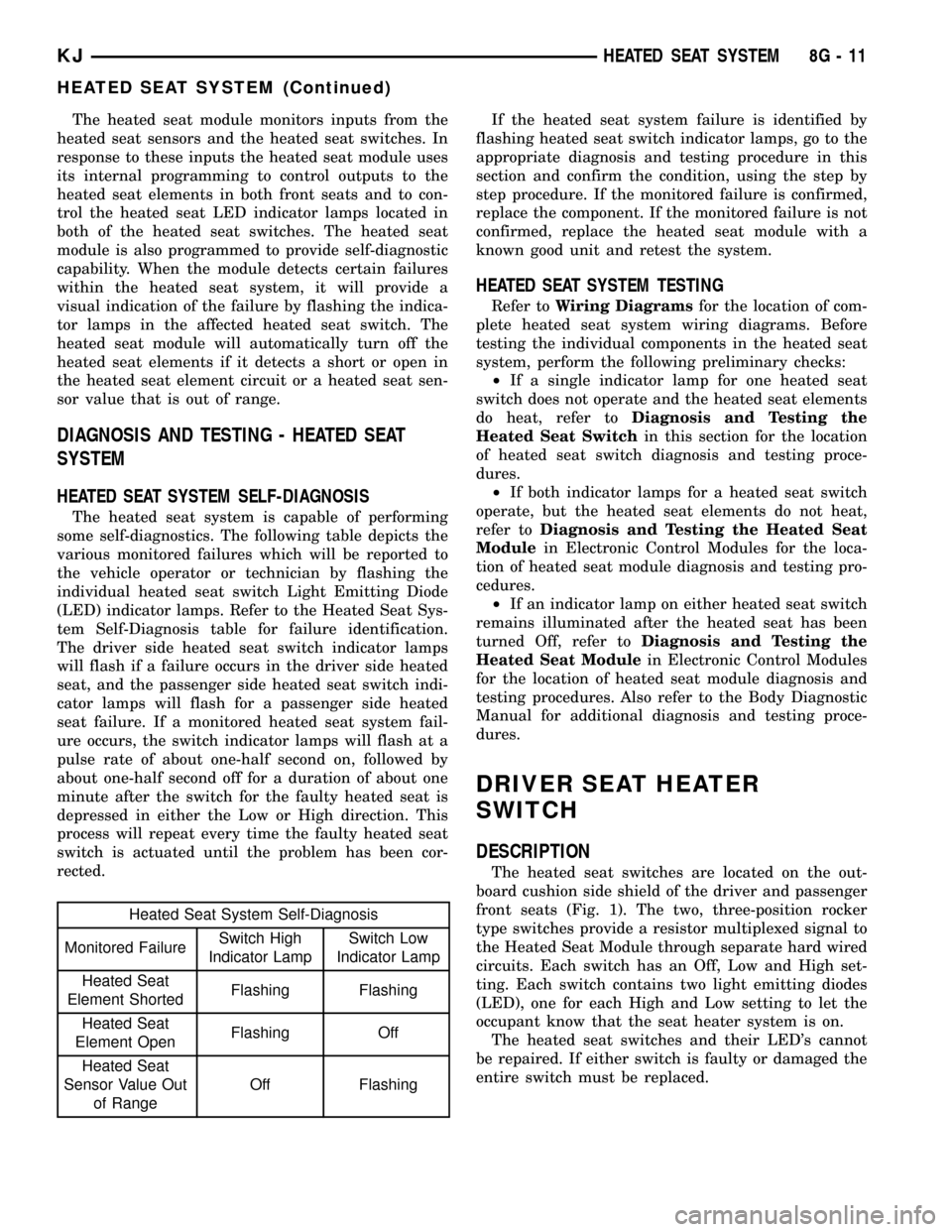
HEATED SEAT SYSTEM SELF-DIAGNOSIS
The heated seat system is capable of performing
some self-diagnostics. The following table depicts the
various monitored failures which will be reported to
the vehicle operator or technician by flashing the
individual heated seat switch Light Emitting Diode
(LED) indicator lamps. Refer to the Heated Seat Sys-
tem Self-Diagnosis table for failure identification.
The driver side heated seat switch indicator lamps
will flash if a failure occurs in the driver side heated
seat, and the passenger side heated seat switch indi-
cator lamps will flash for a passenger side heated
seat failure. If a monitored heated seat system fail-
ure occurs, the switch indicator lamps will flash at a
pulse rate of about one-half second on, followed by
about one-half second off for a duration of about one
minute after the switch for the faulty heated seat is
depressed in either the Low or High direction. This
process will repeat every time the faulty heated seat
switch is actuated until the problem has been cor-
rected.
Heated Seat System Self-Diagnosis
Monitored FailureSwitch High
Indicator LampSwitch Low
Indicator Lamp
Heated Seat
Element ShortedFlashing Flashing
Heated Seat
Element OpenFlashing Off
Heated Seat
Sensor Value Out
of RangeOff FlashingIf the heated seat system failure is identified by
flashing heated seat switch indicator lamps, go to the
appropriate diagnosis and testing procedure in this
section and confirm the condition, using the step by
step procedure. If the monitored failure is confirmed,
replace the component. If the monitored failure is not
confirmed, replace the heated seat module with a
known good unit and retest the system.
HEATED SEAT SYSTEM TESTING
Refer toWiring Diagramsfor the location of com-
plete heated seat system wiring diagrams. Before
testing the individual components in the heated seat
system, perform the following preliminary checks:
²If a single indicator lamp for one heated seat
switch does not operate and the heated seat elements
do heat, refer toDiagnosis and Testing the
Heated Seat Switchin this section for the location
of heated seat switch diagnosis and testing proce-
dures.
²If both indicator lamps for a heated seat switch
operate, but the heated seat elements do not heat,
refer toDiagnosis and Testing the Heated Seat
Modulein Electronic Control Modules for the loca-
tion of heated seat module diagnosis and testing pro-
cedures.
²If an indicator lamp on either heated seat switch
remains illuminated after the heated seat has been
turned Off, refer toDiagnosis and Testing the
Heated Seat Modulein Electronic Control Modules
for the location of heated seat module diagnosis and
testing procedures. Also refer to the Body Diagnostic
Manual for additional diagnosis and testing proce-
dures.
DRIVER SEAT HEATER
SWITCH
DESCRIPTION
The heated seat switches are located on the out-
board cushion side shield of the driver and passenger
front seats (Fig. 1). The two, three-position rocker
type switches provide a resistor multiplexed signal to
the Heated Seat Module through separate hard wired
circuits. Each switch has an Off, Low and High set-
ting. Each switch contains two light emitting diodes
(LED), one for each High and Low setting to let the
occupant know that the seat heater system is on.
The heated seat switches and their LED's cannot
be repaired. If either switch is faulty or damaged the
entire switch must be replaced.
KJHEATED SEAT SYSTEM 8G - 11
HEATED SEAT SYSTEM (Continued)
Page 379 of 1803

OPERATION
There are three positions that can be selected with
each of the heated seat switches: Off, Low, and High.
When the front of the switch rocker is fully
depressed, the High position is selected and the high
position LED indicator illuminates. When the rear of
the switch rocker is fully depressed, the Low position
is selected and the low position LED indicator illumi-
nates. When the switch rocker is depressed a second
time in either direction, Off is selected and both LED
indicators are extinguished.
Both switches provide separate resistor multi-
plexed hard wire inputs to the Heated Seat Module
to indicate the selected switch position. The heated
seat module monitors the switch inputs and responds
to the heated seat switch status messages by control-
ling the output to the seat heater elements of the
selected seat. The Low heat position set point is
about 36É C (97É F), and the High heat position set
point is about 41É C (105É F).
DIAGNOSIS AND TESTING - HEATED SEAT
SWITCH
If a heated seat fails to heat and one or both of the
indicator lamps on a heated seat switch flash, refer
toHeated Seat System Diagnosis and Testingin
this section for flashing LED failure identification.
Refer toWiring Diagramsfor complete heated seat
system wiring diagrams.
(1) If the problem being diagnosed involves a
heated seat switch indicator lamp that remains illu-
minated after the heated seat has been turned Off,refer toDiagnosis and Testing the Heated Seat
Modulein the Electronic Control Modules section for
heated seat module diagnosis and testing procedures.
If not, go to Step 2
(2) Remove the heated seat switch (Refer to 8 -
ELECTRICAL/HEATED SEATS/DRIVER HEATED
SEAT SWITCH - REMOVAL). Check for continuity
between the ground circuit cavity #5 of the heated
seat switch connector and a good ground. There
should be continuity. If OK, go to Step 3. If not OK,
repair the open ground circuit as required.
(3) Turn the ignition switch to the ON position.
Check for battery voltage at the fused ignition switch
output circuit cavity #1 of the heated seat switch con-
nector. If OK, go to Step 4. If not OK, repair the open
fused ignition switch output circuit as required.
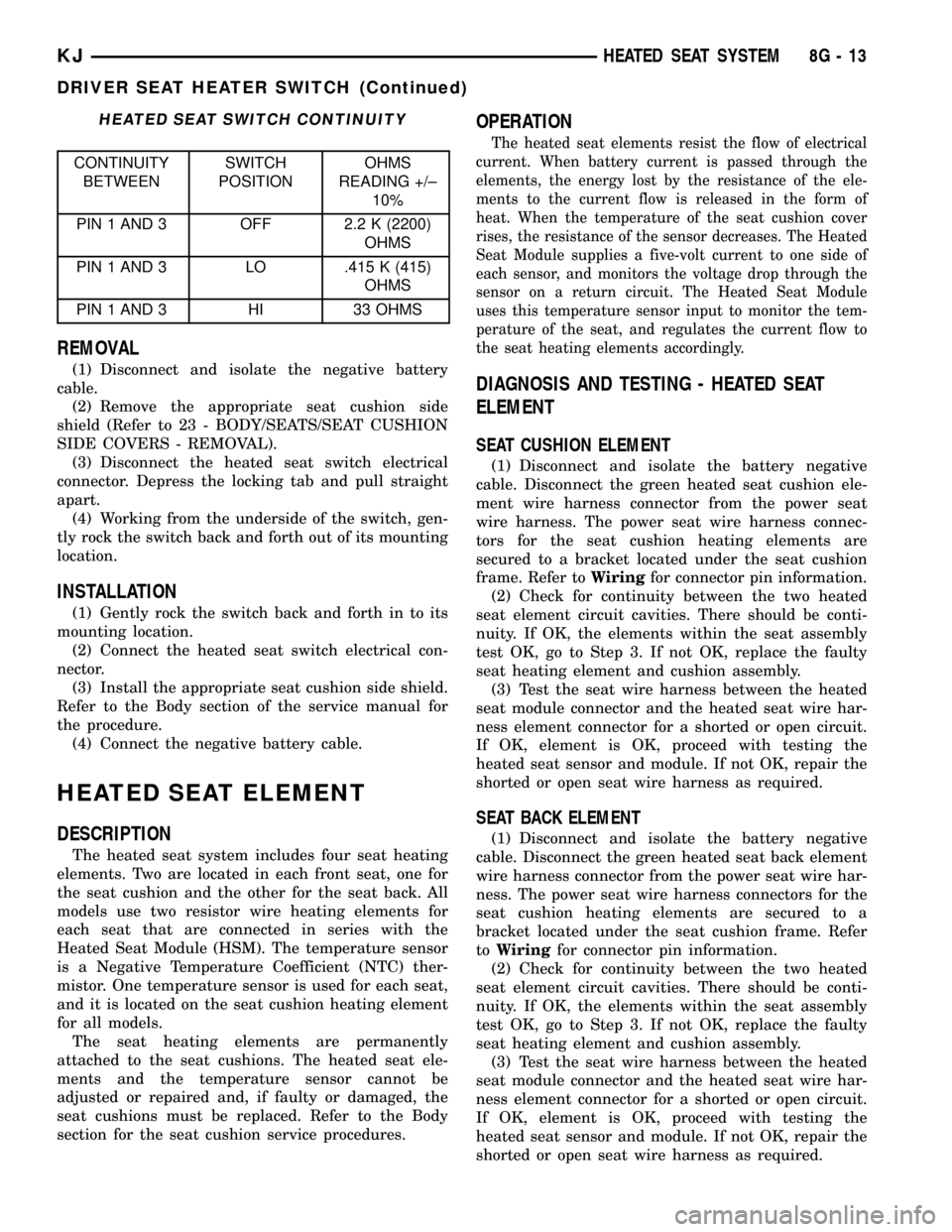
(4) Check the continuity between pin #1 and pin
#3 of the heated seat switch (Fig. 2). If the readings
do not correspond to those in the Heated Seat Switch
Continuity table below, replace the heated seat
switch. If OK, and the heated seat system is still not
operating properly refer toDiagnosis and Testing
the Heated Seat Module.
NOTE: ANY RESISTANCE VALUES (OHMSV) GIVEN
IN THE FOLLOWING TEXT ARE SUPPLIED USING
THE AUTOMATIC RANGE GENERATED BY A
FLUKETAUTOMOTIVE METER. IF ANOTHER TYPE
OF MEASURING DEVICE IS USED, THE VALUES
GENERATED MAY NOT BE THE SAME AS THE
RESULTS SHOWN HERE, OR MAY HAVE TO BE
CONVERTED TO THE RANGE USED HERE.
Fig. 1 KJ POWER / HEATED SEAT
Fig. 2 Heated Seat Switches
8G - 12 HEATED SEAT SYSTEMKJ
DRIVER SEAT HEATER SWITCH (Continued)
Page 380 of 1803
HEATED SEAT SWITCH CONTINUITY
CONTINUITY
BETWEENSWITCH
POSITIONOHMS
READING +/±
10%
PIN 1 AND 3 OFF 2.2 K (2200)
OHMS
PIN 1 AND 3 LO .415 K (415)
OHMS
PIN 1 AND 3 HI 33 OHMS
REMOVAL
(1) Disconnect and isolate the negative battery
cable.
(2) Remove the appropriate seat cushion side
shield (Refer to 23 - BODY/SEATS/SEAT CUSHION
SIDE COVERS - REMOVAL).
(3) Disconnect the heated seat switch electrical
connector. Depress the locking tab and pull straight
apart.
(4) Working from the underside of the switch, gen-
tly rock the switch back and forth out of its mounting
location.
INSTALLATION
(1) Gently rock the switch back and forth in to its
mounting location.
(2) Connect the heated seat switch electrical con-
nector.
(3) Install the appropriate seat cushion side shield.
Refer to the Body section of the service manual for
the procedure.
(4) Connect the negative battery cable.
HEATED SEAT ELEMENT
DESCRIPTION
The heated seat system includes four seat heating
elements. Two are located in each front seat, one for
the seat cushion and the other for the seat back. All
models use two resistor wire heating elements for
each seat that are connected in series with the
Heated Seat Module (HSM). The temperature sensor
is a Negative Temperature Coefficient (NTC) ther-
mistor. One temperature sensor is used for each seat,
and it is located on the seat cushion heating element
for all models.
The seat heating elements are permanently
attached to the seat cushions. The heated seat ele-
ments and the temperature sensor cannot be
adjusted or repaired and, if faulty or damaged, the
seat cushions must be replaced. Refer to the Body
section for the seat cushion service procedures.
OPERATION
The heated seat elements resist the flow of electrical
current. When battery current is passed through the
elements, the energy lost by the resistance of the ele-
ments to the current flow is released in the form of
heat. When the temperature of the seat cushion cover
rises, the resistance of the sensor decreases. The Heated
Seat Module supplies a five-volt current to one side of
each sensor, and monitors the voltage drop through the
sensor on a return circuit. The Heated Seat Module
uses this temperature sensor input to monitor the tem-
perature of the seat, and regulates the current flow to
the seat heating elements accordingly.
DIAGNOSIS AND TESTING - HEATED SEAT
ELEMENT
SEAT CUSHION ELEMENT
(1) Disconnect and isolate the battery negative
cable. Disconnect the green heated seat cushion ele-
ment wire harness connector from the power seat
wire harness. The power seat wire harness connec-
tors for the seat cushion heating elements are
secured to a bracket located under the seat cushion
frame. Refer toWiringfor connector pin information.
(2) Check for continuity between the two heated
seat element circuit cavities. There should be conti-
nuity. If OK, the elements within the seat assembly
test OK, go to Step 3. If not OK, replace the faulty
seat heating element and cushion assembly.
(3) Test the seat wire harness between the heated
seat module connector and the heated seat wire har-
ness element connector for a shorted or open circuit.
If OK, element is OK, proceed with testing the
heated seat sensor and module. If not OK, repair the
shorted or open seat wire harness as required.
SEAT BACK ELEMENT
(1) Disconnect and isolate the battery negative
cable. Disconnect the green heated seat back element
wire harness connector from the power seat wire har-
ness. The power seat wire harness connectors for the
seat cushion heating elements are secured to a
bracket located under the seat cushion frame. Refer
toWiringfor connector pin information.
(2) Check for continuity between the two heated
seat element circuit cavities. There should be conti-
nuity. If OK, the elements within the seat assembly
test OK, go to Step 3. If not OK, replace the faulty
seat heating element and cushion assembly.
(3) Test the seat wire harness between the heated
seat module connector and the heated seat wire har-
ness element connector for a shorted or open circuit.
If OK, element is OK, proceed with testing the
heated seat sensor and module. If not OK, repair the
shorted or open seat wire harness as required.
KJHEATED SEAT SYSTEM 8G - 13
DRIVER SEAT HEATER SWITCH (Continued)
Page 381 of 1803

HEATED SEAT SENSOR
DIAGNOSIS AND TESTING - HEATED SEAT
SENSOR
For complete circuit diagrams, refer toWIRING.
NOTE: ANY RESISTANCE VALUES (OHMSV) GIVEN
IN THE FOLLOWING TEXT ARE SUPPLIED USING
THE AUTOMATIC RANGE GENERATED BY A
FLUKETAUTOMOTIVE METER. IF ANOTHER TYPE
OF MEASURING DEVICE IS USED THE VALUES
GENERATED MAY NOT BE THE SAME AS THE
RESULTS SHOWN HERE, OR MAY HAVE TO BE
CONVERTED TO THE RANGE USED HERE.
(1) Disconnect the heated seat wire harness con-
nector from under the seat. Using an ohmmeter,
check the resistance between the heated seat sensor
input circuit cavity and the heated seat sensor feed
circuit cavity in the heated seat wire harness connec-
tor. The heated seat sensor resistance should be
between 1 kilohm and 100 kilohms. If OK, go to Step
2. If not OK, replace the faulty seat heating element
assembly.
(2) Test the seat wire harness between the heated
seat module connector and the heated seat wire har-
ness connector for a shorted or open circuit. If OK,
refer toDiagnosis and Testing the Heated Seat
Modulein Electronic Control Modules, for the
proper heated seat module diagnosis and testing pro-
cedures. If not OK, repair the shorted or open heated
seat wire harness as required.
PASSENGER SEAT HEATER
SWITCH
DESCRIPTION
The heated seat switches are located on the out-
board cushion side shield of the driver and passenger
front seats (Fig. 3). The two, three-position rocker
type switches provide a resistor multiplexed signal to
the Heated Seat Module through separate hard wired
circuits. Each switch has an Off, Low and High set-
ting. Each switch contains two light emitting diodes
(LED), one for each High and Low setting to let the
occupant know that the seat heater system is on.
The heated seat switches and their LED's cannot
be repaired. If either switch is faulty or damaged the
entire switch must be replaced.
OPERATION
There are three positions that can be selected with
each of the heated seat switches: Off, Low, and High.
When the front of the switch rocker is fullydepressed, the High position is selected and the high
position LED indicator illuminates. When the rear of
the switch rocker is fully depressed, the Low position
is selected and the low position LED indicator illumi-
nates. When the switch rocker is depressed a second
time in either direction, Off is selected and both LED
indicators are extinguished.
Both switches provide separate resistor multi-
plexed hard wire inputs to the Heated Seat Module
to indicate the selected switch position. The heated
seat module monitors the switch inputs and responds
to the heated seat switch status messages by control-
ling the output to the seat heater elements of the
selected seat. The Low heat position set point is
about 36É C (97É F), and the High heat position set
point is about 41É C (105É F).
DIAGNOSIS AND TESTING - HEATED SEAT
SWITCH
If a heated seat fails to heat and one or both of the
indicator lamps on a heated seat switch flash, refer
toHeated Seat System Diagnosis and Testingin
this section for flashing LED failure identification.
Refer toWiring Diagramsfor complete heated seat
system wiring diagrams.
(1) If the problem being diagnosed involves a
heated seat switch indicator lamp that remains illu-
minated after the heated seat has been turned Off,
refer toDiagnosis and Testing the Heated Seat
Modulein the Electronic Control Modules section for
heated seat module diagnosis and testing procedures.
If not, go to Step 2
Fig. 3 KJ POWER / HEATED SEAT
8G - 14 HEATED SEAT SYSTEMKJ
Page 384 of 1803

HORN
TABLE OF CONTENTS
page page
HORN SYSTEM
DESCRIPTION..........................1
OPERATION............................1
DIAGNOSIS AND TESTING - HORN SYSTEM . . . 1
HORN
DIAGNOSIS AND TESTING - HORN..........2
REMOVAL.............................3
INSTALLATION..........................3HORN RELAY
DIAGNOSIS AND TESTING - HORN RELAY....3
REMOVAL.............................3
INSTALLATION..........................3
HORN SWITCH
DESCRIPTION..........................4
DIAGNOSIS AND TESTING - HORN SWITCH . . . 4
HORN SYSTEM
DESCRIPTION
A dual-note electric horn system is standard facto-
ry-installed equipment on this model (Fig. 1).
The dual-note horn system features dual electro-
magnetic horn units. The horn system includes the
following major components:
²Horn- The two horns are located below the
Power Distribution Center (PDC).
²Horn Relay- The horn relay is located in the
Junction Block (JB).²Horn Switch- The horn switch is molded into
the driver airbag assembly.OPERATION
The horn system operates on battery current
received through fuse 3 in the Junction Block (JB).
The horn system circuit is designed so that the sys-
tem will remain operational, regardless of the igni-
tion switch position.
DIAGNOSIS AND TESTING - HORN SYSTEM
In most cases, any problem involving continually
sounding horns can be quickly alleviated by removing
the horn relay from the Junction Block (JB). Refer to
horn relay for the removal procedure. Refer to the
appropriate wiring information. The wiring informa-
tion includes wiring diagrams, proper wire and con-
nector repair procedures, further details on wire
harness routing and retention, as well as pin-out and
location views for the various wire harness connec-
tors, splices and grounds.
WARNING: DISABLE THE AIRBAG SYSTEM
BEFORE ATTEMPTING ANY STEERING WHEEL,
STEERING COLUMN, SEAT BELT TENSIONER, SIDE
AIRBAG, OR INSTRUMENT PANEL COMPONENT
DIAGNOSIS OR SERVICE. DISCONNECT AND ISO-
LATE THE BATTERY NEGATIVE (GROUND) CABLE,
THEN WAIT TWO MINUTES FOR THE AIRBAG SYS-
TEM CAPACITOR TO DISCHARGE BEFORE PER-
FORMING FURTHER DIAGNOSIS OR SERVICE. THIS
IS THE ONLY SURE WAY TO DISABLE THE AIRBAG
SYSTEM. FAILURE TO TAKE THE PROPER PRE-
CAUTIONS COULD RESULT IN ACCIDENTAL AIR-
BAG DEPLOYMENT AND POSSIBLE PERSONAL
INJURY.
Fig. 1 HORN LOCATION
1 - HIGH NOTE HORN
2 - LOW NOTE HORN
KJHORN 8H - 1