high JEEP LIBERTY 2003 Owners Manual
[x] Cancel search | Manufacturer: JEEP, Model Year: 2003, Model line: LIBERTY, Model: JEEP LIBERTY 2003Pages: 374, PDF Size: 5.58 MB
Page 38 of 374

A belt that is buckled into the wrong buckle will not
protect you properly. The lap portion could ride too
high on your body, possibly causing internal injuries.
Always buckle your belt into the buckle nearest you.
A belt that is too loose will not protect you as well. In a
sudden stop you could move too far forward, increasing
the possibility of injury. Wear your seat belt snugly.
A belt that is worn under your arm is very dangerous.
Your body could strike the inside surfaces of the vehicle
in a collision, increasing head and neck injury. A belt
worn under the arm can cause internal injuries. Ribs
aren't as strong as shoulder bones. Wear the belt over
your shoulder so that your strongest bones will take the
force in a collision.
A shoulder belt placed behind will not protect you from
injury during a collision. You are more likely to hit your
head in a collision if you do not wear your shoulder
belt. The lap and shoulder belt are meant to be used
together.
Page 39 of 374

A lap belt worn too high can increase the risk of
injury in a collision. The belt forces won't be at the
strong hip and pelvic bones, but across your abdo-
men. Always wear the lap part of your seat belt as
low as possible and keep it snug.
A twisted belt cannot do its job as well. In a collision
it could even cut into you. Be sure the belt is straight.
If you cannot straighten a belt in your vehicle, take it
to your authorized dealer and have it fixed.
Page 59 of 374

In a collision, an unrestrained child, even a tiny
baby, can become a missile inside the vehicle. The
force required to hold even an infant on your lap can
become so great that you could not hold the child, no
matter how strong you are. The child and others
could be badly injured. Any child riding in your
vehicle should be in a proper restraint for the child's
size.
Infants and Small Children
There are different sizes and types of restraints for
children from newborn size to the child almost large
enough for an adult seat belt. Always check the child seat
owner's manual to ensure you have the right seat for
your child. Use the restraint that is correct for your child:
²This vehicle is not capable of accommodating the
installation of a car bed used for carrying newborn
babies at the right front passenger seat position. If a car
bed must be used to transport a newborn baby, the car
bed must be installed in the second seating row only.
²Safety experts recommend that children ride
rearward-facing in the vehicle until they are at least
one year old and weigh at least 20 lbs (9 kg). Two types
of child restraints can be used rearward facing: infant
carriers and ªconvertibleº child seats.
²The infant carrier is only used rearward-facing in the
vehicle. It is recommended for children who weigh up
to about 20 lbs (9 kg). ªConvertibleº child seats can be
used either rearward-facing or forward-facing in the
vehicle. Convertible child seats often have a higher
weight limit in the rearward-facing direction than
infant carriers do, so they can be used rearward-facing
by children who weigh more than 20 lbs (9 kg) but are
less than one year old.
THINGS TO KNOW BEFORE STARTING YOUR VEHICLE 59
Page 103 of 374
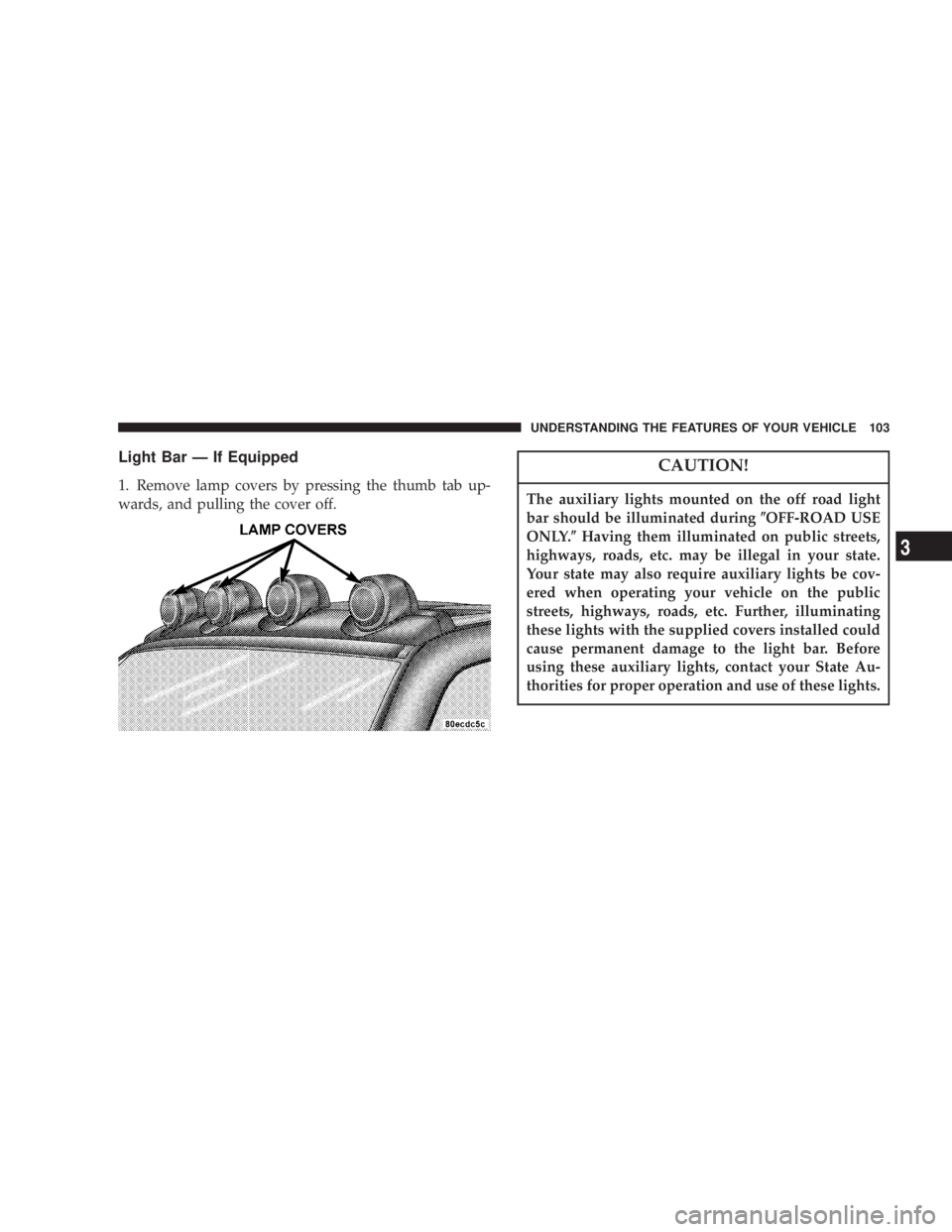
The auxiliary lights mounted on the off road light
bar should be illuminated during(OFF-ROAD USE
ONLY.(Having them illuminated on public streets,
highways, roads, etc. may be illegal in your state.
Your state may also require auxiliary lights be cov-
ered when operating your vehicle on the public
streets, highways, roads, etc. Further, illuminating
these lights with the supplied covers installed could
cause permanent damage to the light bar. Before
using these auxiliary lights, contact your State Au-
thorities for proper operation and use of these lights.
Page 113 of 374
The TPM system is designed to monitor your tire
pressure and will not function as a tire pressure
gauge while adjusting the pressure in your tires.
There will be a delay between the instant you adjust
the air pressure in a tire and when the system
updates the display.
NOTE:The TPM system can inform you about a low or
high tire pressure condition, but it does not replace
normal tire maintenance.
The TPM system is not intended to provide you with
notification of rapid pressure loss.
1. If any tire pressure has exceeded the low or high
pressure (refer to STARTING AND OPERATING Ð
TIRES AND WHEELS), the TPM system will display a
message in the EVIC and sound a chime. It will then go
UNDERSTANDING THE FEATURES OF YOUR VEHICLE 113
Page 134 of 374

Electrical Outlet Use With Engine Off
²Many accessories that can be plugged in draw
power from the vehicle's battery, even when not
in use (i.e., cellular phones, etc.). Eventually, if
plugged in long enough, the vehicle's battery will
discharge sufficiently to degrade battery life
and/or prevent engine starting.
²Accessories that draw higher power (i.e., coolers,
vacuum cleaners, lights, etc.) will degrade the
battery even more quickly. Only use these inter-
mittently and with greater caution.
²After the use of high power draw accessories, or
long periods of the vehicle not being started (with
accessories still plugged in), the vehicle must be
driven a sufficient length of time to allow the
alternator to recharge the vehicle's battery.
Page 143 of 374

WARNING!
Cargo must be securely tied before driving your
vehicle. Improperly secured loads can fly off the
vehicle, particularly at high speeds, resulting in
personal injury or property damage. Follow the roof
rack ªCautionsº when carrying cargo on your roof
rack.
Page 212 of 374

Never pour fuel or other flammable liquids into the
throttle body air inlet opening in an attempt to start
the vehicle. This could result in a flash fire causing
serious personal injury.
Long periods of engine idling, especially at high
engine speeds can cause excessive exhaust tempera-
tures which can damage your vehicle. Do not leave
your vehicle unattended with the engine running.
Page 216 of 374

It is dangerous to shift the selector lever out of ªPº or
ªNº if the engine speed is higher than idle speed. If
your foot is not firmly on the brake pedal, the
vehicle could accelerate quickly forward or in re-
verse. You could lose control of the vehicle and hit
someone or something. Only shift into gear when
the engine is idling normally and when your right
foot is firmly on the brake pedal.
Brake Transmission Shift Interlock System
This vehicle is equipped with a brake transmission shift
interlock system (BTSI) that holds the gearshift lever in
the P (Park) position when the ignition switch is in the
OFF position. To move the gear selector lever out of the
P (Park) position, the ignition switch must be turned to
the ON position, the brake pedal and the button on the
front of the shifter handle must be depressed.
Page 236 of 374
The Anti-Lock Brake System is subject to possible
detrimental effects of electronic interference caused
by improperly installed aftermarket radios or tele-
phones.
NOTE:During severe braking conditions, a pulsing
sensation may occur and a clicking noise will be heard.
This is normal, indicating that the Anti-Lock Brake
System is functioning.
ON-ROAD DRIVING TIPS
Utility vehicles have higher ground clearance and a
narrower track to make them capable of performing in a
wide variety of off-road applications. Specific design
characteristics give them a higher center of gravity than
ordinary cars.An advantage of the higher ground clearance is a better
view of the road, allowing you to anticipate problems.
They are not designed for cornering at the same speeds as
conventional 2-wheel drive vehicles any more than low-
slung sports cars are designed to perform satisfactorily in
off-road conditions. If at all possible, avoid sharp turns or
abrupt maneuvers. As with other vehicles of this type,
failure to operate this vehicle correctly may result in loss
of control or vehicle rollover.
OFF-ROAD DRIVING TIPS
When To Use 4L or 4 LO (Low) Range
When driving off-road, shift to 4L or 4 LO for additional
traction in moving forward or descending a hill, for
low-speed pulling power or to improve handling and
control on slippery or difficult terrain. Also use 4L or 4
LO range on the road in rain, ice, snow, mud or sand to
get heavy loads rolling, or whenever ªHighº range
four-wheel drive traction is insufficient.
236 STARTING AND OPERATING