JEEP LIBERTY 2003 User Guide
LIBERTY 2003
JEEP
JEEP
https://www.carmanualsonline.info/img/16/55993/w960_55993-0.png
JEEP LIBERTY 2003 User Guide
Page 268 of 374
It is necessary to follow these steps to be certain that
the transfer case is fully in N (Neutral) before
recreational towing to prevent damage to internal
parts.
Transmission damage may occur if the automatic
transmission is shifted into P (Park) with the transfer
case in N (Neutral) and the engine running. With the
transfer case in N (Neutral) ensure that the engine is
OFF prior to shifting the transmission into P (Park)
(refer to steps7±8above).
Page 273 of 374
Driving with a hot cooling system could damage
your vehicle. If the temperature gauge reads ªHº,
pull over and stop the vehicle. Idle the vehicle with
the air conditioner turned off until the pointer drops
back into the normal range. If the pointer remains on
the ªHº, and you hear continuous chimes, turn the
engine off immediately, and call for service.
Page 281 of 374
Do not attempt to push or tow your vehicle to get it
started. Unburned fuel could enter the catalytic
converter and, once the engine has started, ignite and
damage the converter and vehicle.
Tow hooks are for emergency use only, to rescue a
vehicle stranded off road. Do not use tow hooks for
tow truck hookup or highway towing. You could
damage your vehicle. Tow straps are recommended
when towing the vehicle, chains may cause vehicle
damage.
WARNING!
Stand clear of vehicles when pulling with tow
hooks. Tow straps and chains may break, causing
serious injury.
Page 291 of 374
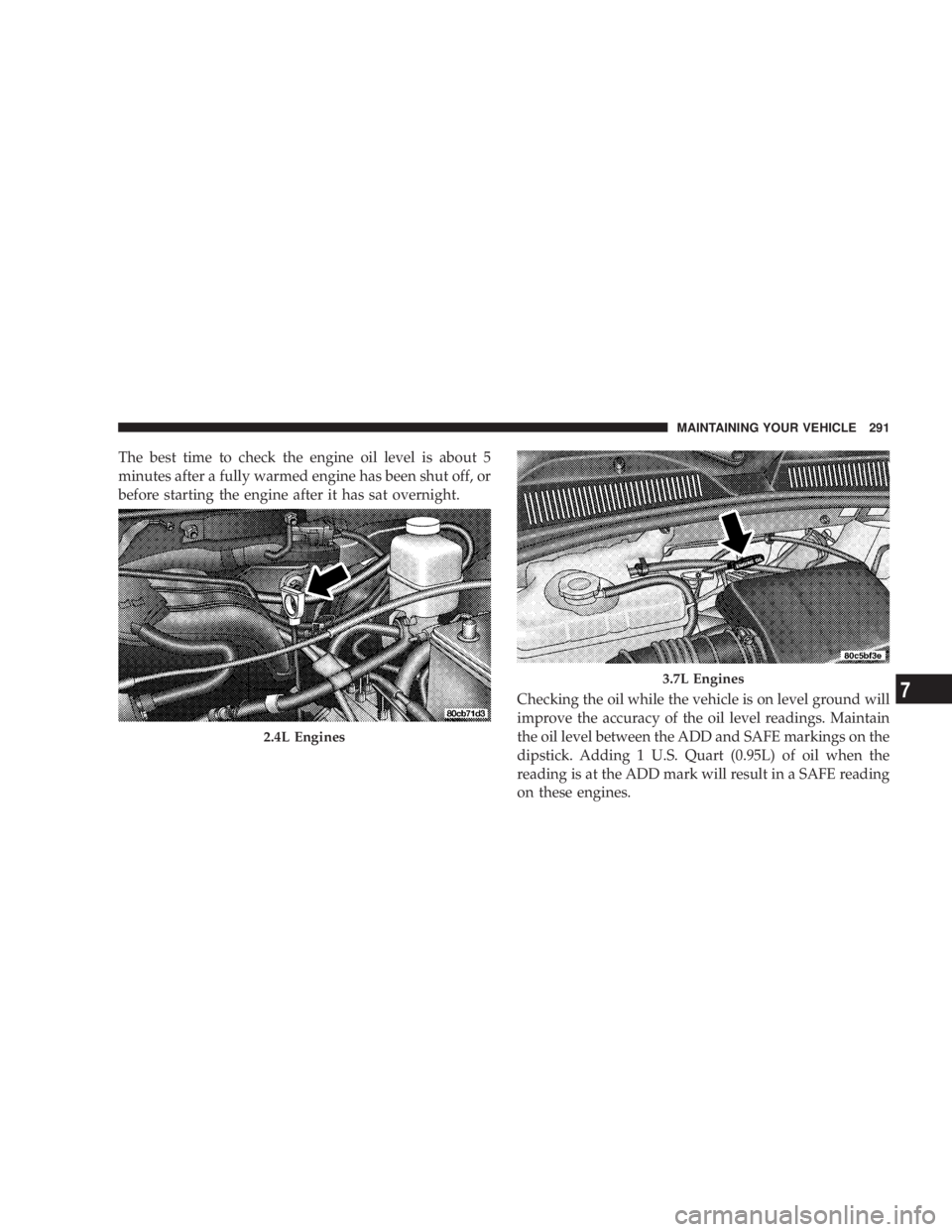
3.7L Engines
MAINTAINING YOUR VEHICLE 291
Page 292 of 374
Overfilling or underfilling the crankcase will cause
aeration or loss of oil pressure. This could damage
your engine.
Change Engine Oil
Road conditions as well as your kind of driving affect the
interval at which your oil should be changed. Check the
following to determine if any apply to you:
²Day or night temperatures are below 32ÉF (0ÉC)
²Stop and go driving
²Extensive engine idling
²Driving in dusty conditions
²Short trip driving of less than 10 miles (16.2 km)
²More than 50% of your driving is at sustained high
speeds during hot weather, above 90ÉF (32ÉC)
²Taxi, Police, or delivery service (commercial service)
²Trailer towing
²Off-road or desert driving
IfANYof these apply to you, then change your engine oil
at every interval shown in schedule ªBº of the ªMainte-
nance Schedulesº section of this manual.
If none of these apply to you, then change your engine oil
at every interval shown on schedule ªAº of the ªMain-
tenance Schedulesº section of this manual
NOTE:Under no circumstances should oil change in-
tervals exceed 6,000 miles (10 000 km) or 6 months
whichever comes first.
292 MAINTAINING YOUR VEHICLE
Page 295 of 374
Damage to the catalytic converter can result if your
vehicle is not kept in proper operating condition. In
the event of engine malfunction, particularly involv-
ing engine misfire or other apparent loss of perfor-
mance, have your vehicle serviced promptly. Contin-
ued operation of your vehicle with a severe
malfunction could cause the converter to overheat,
resulting in possible damage to the converter and
vehicle.
Page 297 of 374
The air cleaner can provide protection in the case of
engine backfire. Do not remove the air cleaner
unless it is necessary for repair or maintenance.
Make sure that no one is near the engine compart-
ment before starting the vehicle with the air cleaner
removed. Failure to do so can result in serious
personal injury.
Page 300 of 374
Fluid level should be checked on a level surface with
the engine off to prevent injury from moving parts,
and to insure accurate fluid level reading. Do not
overfill. Use only the manufacturer's recommended
fluid.
Page 303 of 374
You or others can be badly burned by hot coolant or
steam from your radiator. If you see or hear steam
coming from under the hood, don't open the hood
until the radiator has had time to cool. Never try to
open a cooling system pressure cap when the radia-
tor or coolant bottle is hot.
Coolant Checks
Check coolant protection every 12 months (before the
onset of freezing weather, where applicable). If coolant is
dirty or rusty in appearance, the system should be
drained, flushed and refilled with fresh coolant.
Check the front of the radiator for any accumulation of
bugs, leaves, etc. Clean the radiator by gently spraying
water from a garden hose at the back of the core.
Check the engine cooling system hoses for condition and
tightness of connection. Inspect the entire system for
leaks. Any hoses that show cuts or severe abrasion must
be replaced.
Cooling System Ð Drain, Flush, And Refill
At the intervals shown in the appropriate ªMaintenance
Schedule,º the system should be drained, flushed, and
refilled.
MAINTAINING YOUR VEHICLE 303
Page 305 of 374
The warning words DO NOT OPEN HOT on the
cooling system pressure cap are a safety precaution.
Never add coolant when the engine is overheated.
Do not loosen or remove the cap to cool an over-
heated engine. Heat causes pressure to build up in
the cooling system. To prevent scalding or injury, do
not remove the pressure cap while the system is hot
or under pressure.