warning JEEP LIBERTY 2004 KJ / 1.G Owners Manual
[x] Cancel search | Manufacturer: JEEP, Model Year: 2004, Model line: LIBERTY, Model: JEEP LIBERTY 2004 KJ / 1.GPages: 374, PDF Size: 5.71 MB
Page 276 of 374

Preparation
²
Park on a firm, level surface well off the road, to
provide ample work space. Place automatic transmis-
sion in P (Park), or manual transmission in R (Re-
verse), and stop engine. Set parking brake firmly and
activate hazard warning flasher.
²Block tire diagonally oppo-
site tire to be changed to pre-
vent forward and backward
vehicle movement.
Instructions
1. Remove spare tire, jack and tools from stored location.
2. Before raising vehicle, loosen lug nuts on wheel with
flat tire.3. Assemble the jack and jacking tools as shown. Connect
jack handle driver to extensions, then to lug wrench.
4. Locate the jack as shown. For the front tires, place it in
the notch on the body weld seam behind wheel to be
changed. For the rear tires, place it under the axle as
shown. Position the jack handle on the jack.
Front Scissor Jack Location
276 WHAT TO DO IN EMERGENCIES
Page 277 of 374
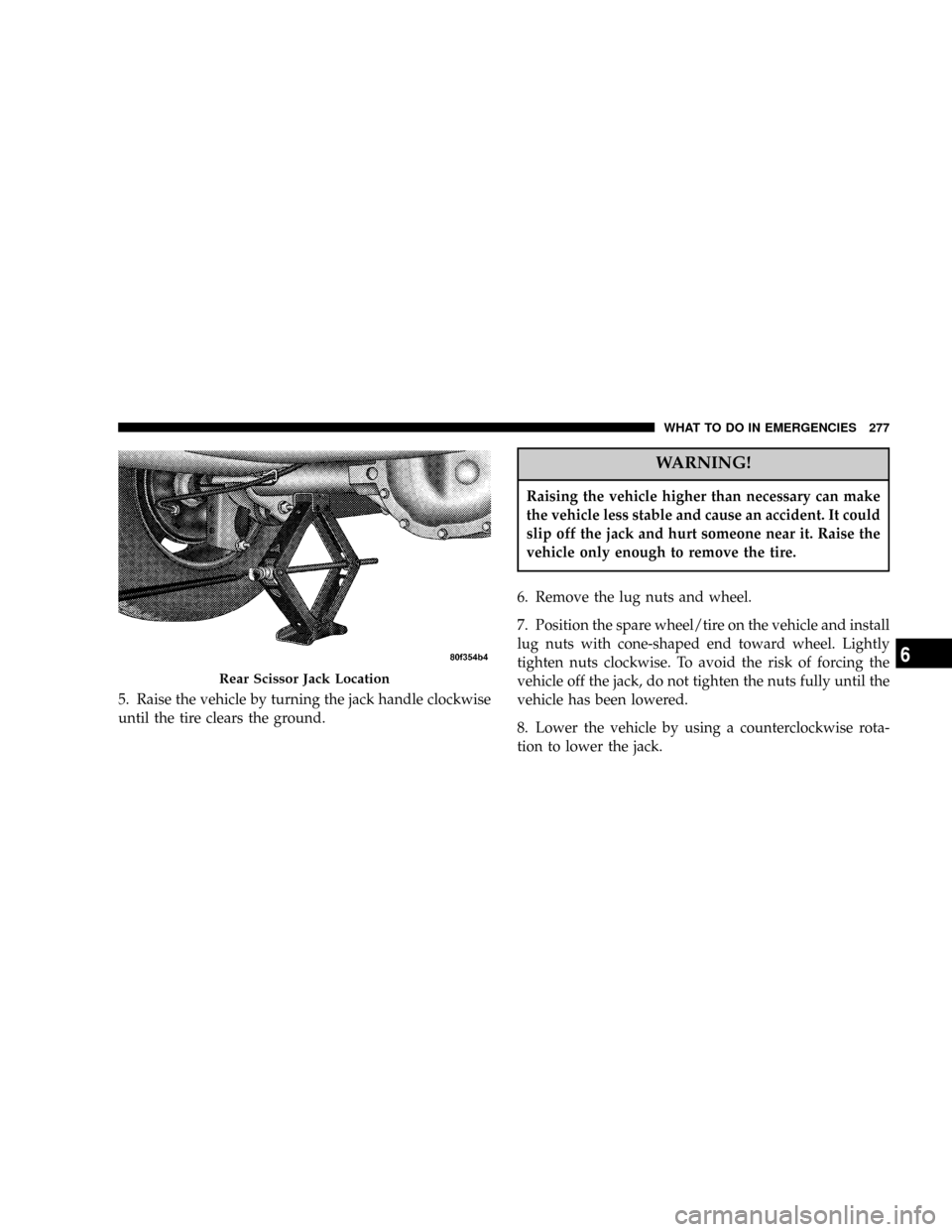
5. Raise the vehicle by turning the jack handle clockwise
until the tire clears the ground.
WARNING!
Raising the vehicle higher than necessary can make
the vehicle less stable and cause an accident. It could
slip off the jack and hurt someone near it. Raise the
vehicle only enough to remove the tire.
6. Remove the lug nuts and wheel.
7. Position the spare wheel/tire on the vehicle and install
lug nuts with cone-shaped end toward wheel. Lightly
tighten nuts clockwise. To avoid the risk of forcing the
vehicle off the jack, do not tighten the nuts fully until the
vehicle has been lowered.
8. Lower the vehicle by using a counterclockwise rota-
tion to lower the jack.
Rear Scissor Jack Location
WHAT TO DO IN EMERGENCIES 277
6
Page 278 of 374

9. Finish tightening the lug nuts securely in crisscross
pattern. Have an authorized service technician check that
the torque is 85-110 ft. lbs. (115-149 N´m) as soon as
possible.
10. Remove jack assembly and wheel blocks.
11. Secure jack, lug wrench, jack handle driver, jack
extension, and tire in proper locations.WARNING!
Carefully follow these tire changing warnings to
help prevent personal injury or damage to your
vehicle:
²Always park on a firm, level surface as far from the
edge of the roadway as possible before raising the
vehicle.
²Apply the parking brake firmly before jacking.
²Always block the wheel diagonally opposite the wheel
being raised.
²Do not raise the vehicle higher than is necessary to
remove the tire.
²Never start the engine with the vehicle on a jack.
278 WHAT TO DO IN EMERGENCIES
Page 280 of 374

7. When removing the jumper cables, reverse the above
sequence exactly. Be careful of the moving belts and fan.
NOTE:To start the vehicle following connection of a
booster battery, the Security Alarm System must first be
disabled by cycling a front door key cylinder or by using
the keyless entry transmitter.
WARNING!
Jump starting can be dangerous. To avoid personal
injury or damage to electrical components in vehicle,
observe the following warnings:
²Battery fluid is a corrosive acid solution and can burn
or even blind you. Don't allow battery fluid to contact
your eyes, skin, or clothing. Don't lean over a batterywhen attaching clamps. If acid splashes in eyes or on
skin, flush the area immediately with large amounts of
water.
²Do not use a booster battery or any other booster
source that has a greater than 12±volt system, i.e., do
not use a 24±volt power source.
²Never attempt to jump start a discharged battery that
is frozen, because it could rupture or explode during
jump starting.
²Be sure your vehicle is not touching the jump start
vehicle.
²Observe all Battery Warnings in Section 7 of this
manual, while jump starting your vehicle.
280 WHAT TO DO IN EMERGENCIES
Page 281 of 374
WARNING!
Do not attempt to push or tow your vehicle to get it
started. Unburned fuel could enter the catalytic
converter and, once the engine has started, ignite and
damage the converter and vehicle.
EMERGENCY TOW HOOKS Ð IF EQUIPPED
If your vehicle is equipped with tow hooks, they are
mounted in the front and the rear.
CAUTION!
Tow hooks are for emergency use only, to rescue a
vehicle stranded off road. Do not use tow hooks for
tow truck hookup or highway towing. You could
damage your vehicle. Tow straps are recommended
when towing the vehicle, chains may cause vehicle
damage.
WARNING!
Stand clear of vehicles when pulling with tow
hooks. Tow straps and chains may break, causing
serious injury.
TOWING A DISABLED VEHICLE
The manufacturer recommends towing with all four
wheels off the ground. Acceptable methods are to tow the
vehicle on a flatbed or with one end of the vehicle raised
and the other end on a towing dolly.
WHAT TO DO IN EMERGENCIES 281
6
Page 290 of 374

NOTE:Intentional tampering with emissions control
systems can result in civil penalties being assessed
against you.
WARNING!
You can be badly injured working on or around a
motor vehicle. Do only that service work for which
you have the knowledge and the proper equipment.
If you have any doubt about your ability to perform
a service job, take your vehicle to a competent
mechanic.
MAINTENANCE PROCEDURES
The pages that follow contain therequiredmaintenance
services determined by the engineers who designed your
vehicle.
Besides the maintenance items for which there are fixed
maintenance intervals, there are other items that should
operate satisfactorily without periodic maintenance.
However, if a malfunction of these items does occur, it
could adversely affect the engine or vehicle performance.
These items should be inspected if a malfunction is
observed or suspected.
Engine Oil
Checking Oil Level
To assure proper lubrication of your vehicle's engine, the
engine oil must be maintained at the correct level. Check
the oil level at regular intervals, such as every fuel stop.
290 MAINTAINING YOUR VEHICLE
Page 296 of 374

WARNING!
A hot exhaust system can start a fire if you park over
materials that can burn. Such materials might be
grass or leaves coming into contact with your ex-
haust system. Do not park or operate your vehicle in
areas where your exhaust system can contact any-
thing that can burn.
In unusual situations involving grossly malfunctioning
engine operation, a scorching odor may suggest severe
and abnormal catalyst overheating. If this occurs, stop
the vehicle, turn off the engine and allow it to cool.
Service, including a tune up to manufacturer's specifica-
tions, should be obtained immediately.
To minimize the possibility of catalytic converter dam-
age:
²Do not shut off the engine or interrupt the ignition
when the transmission is in gear and the vehicle is in
motion.
²Do not try to start the engine by pushing or towing the
vehicle.
²Do not idle the engine with any spark plug wires
disconnected or removed, such as when diagnostic
testing.
²Do not idle the engine for prolonged periods during
very rough idle or malfunctioning operating condi-
tions.
²Do not allow vehicle to run out of fuel.
NOTE:Intentional tampering with emissions control
systems can result in civil penalties being assessed
against you.
296 MAINTAINING YOUR VEHICLE
Page 297 of 374

Engine Timing Belt Ð 2.4L Engine
Replace the engine timing belt at the intervals described
in the appropriate maintenance schedule.
Ignition Wiring System Ð 2.4L Engine
Replace the ignition cables at the intervals described in
the appropriate maintenance schedule.
Crankcase Emission Control System
Proper operation of this system depends on freedom
from sticking or plugging due to deposits. As vehicle
mileage builds up, the PCV valve and passages may
accumulate deposits. If a valve is not working properly,
replace it with a new valve. DO NOT ATTEMPT TO
CLEAN THE OLD PCV VALVE!
Check ventilation hose for indication of damage or
plugging deposits. Replace if necessary.
Air Cleaner Filter
Under normal driving conditions, replace the air filter at
the intervals shown on ªMaintenance Schedule A.º If,
however, you drive the vehicle frequently under dusty or
severe conditions, the filter element should be inspected
periodically and replaced if necessary at the intervals
shown on ªMaintenance Schedule B.º
WARNING!
The air cleaner can provide protection in the case of
engine backfire. Do not remove the air cleaner
unless it is necessary for repair or maintenance.
Make sure that no one is near the engine compart-
ment before starting the vehicle with the air cleaner
removed. Failure to do so can result in serious
personal injury.
MAINTAINING YOUR VEHICLE 297
7
Page 298 of 374
Maintenance-Free Battery
Your vehicle is equipped with a maintenance-free battery.
You will never have to add water, nor is periodic main-
tenance required.
WARNING!
Battery posts, terminals, and related accessories con-
tain lead and lead compounds. Always wash hands
after handling the battery.
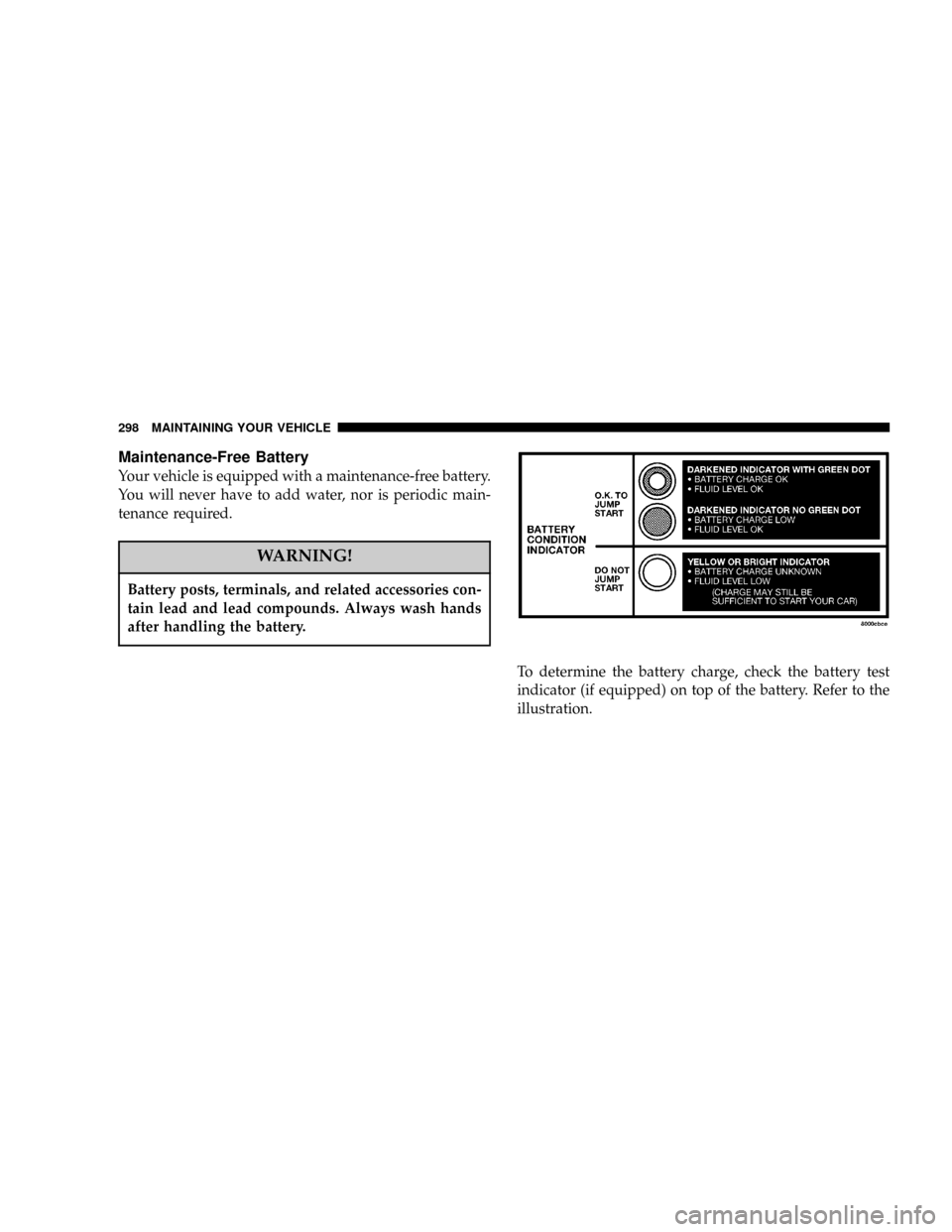
To determine the battery charge, check the battery test
indicator (if equipped) on top of the battery. Refer to the
illustration.
298 MAINTAINING YOUR VEHICLE
Page 299 of 374
CAUTION!
It is essential when replacing the cables on the
battery that the positive cable is attached to the
positive post and the negative cable is attached to the
negative post. Battery posts are marked (+) positive
and negative (-) and identified on the battery case.
Also, if a ªfast chargerº is used while battery is in the
vehicle, disconnect both vehicle battery cables be-
fore connecting the charger to battery. Do not use a
ªfast chargerº to provide starting voltage.
Air Conditioner Maintenance
For best possible performance, your air conditioner
should be checked and serviced by an Authorized Dealer
at the start of each warm season. This service should
include cleaning of the condenser fins and a performance
test. Drive belt tension should also be checked at this
time.
WARNING!
²Use only refrigerants and compressor lubricants
approved by the manufacturer for your air condi-
tioning system. Some unapproved refrigerants are
flammable and can explode, injuring you. Other
unapproved refrigerants or lubricants can cause
the system to fail, requiring costly repairs.
²The air conditioning system contains refrigerant
under high pressure. To avoid risk of personal
injury or damage to the system, adding refrigerant
or any repair requiring lines to be disconnected
should be done by an experienced repairman.
MAINTAINING YOUR VEHICLE 299
7