wheel JEEP LIBERTY 2004 Owners Manual
[x] Cancel search | Manufacturer: JEEP, Model Year: 2004, Model line: LIBERTY, Model: JEEP LIBERTY 2004Pages: 374, PDF Size: 5.58 MB
Page 113 of 374
The TPM system is designed to monitor your tire
pressure and will not function as a tire pressure
gauge while adjusting the pressure in your tires.
There will be a delay between the instant you adjust
the air pressure in a tire and when the system
updates the display.
NOTE:The TPM system can inform you about a low or
high tire pressure condition, but it does not replace
normal tire maintenance.
The TPM system is not intended to provide you with
notification of rapid pressure loss.
1. If any tire pressure has exceeded the low or high
pressure (refer to STARTING AND OPERATING Ð
TIRES AND WHEELS), the TPM system will display a
message in the EVIC and sound a chime. It will then go
UNDERSTANDING THE FEATURES OF YOUR VEHICLE 113
Page 218 of 374
Before moving the shift lever out of P (Park), you
must turn the ignition from LOCK to ON so the
steering wheel and shift lever are released. Other-
wise, damage to the steering column or shifter could
result.
Do not coast in N (Neutral) and never turn off the
ignition to coast down a hill. These are unsafe
practices that limit your response to changing traffic
or road conditions. You might lose control of the
vehicle.
Page 232 of 374
On vehicles equipped with a limited-slip differen-
tial, never run the engine with one rear wheel off the
ground. The vehicle may drive through the rear
wheel remaining on the ground and cause you to
lose control of your vehicle.
Page 234 of 374
Significant over or under-inflation of tires, or mixing
sizes of tires or wheels on the vehicle can lead to loss
of braking effectiveness.
Page 236 of 374
The Anti-Lock Brake System is subject to possible
detrimental effects of electronic interference caused
by improperly installed aftermarket radios or tele-
phones.
NOTE:During severe braking conditions, a pulsing
sensation may occur and a clicking noise will be heard.
This is normal, indicating that the Anti-Lock Brake
System is functioning.
ON-ROAD DRIVING TIPS
Utility vehicles have higher ground clearance and a
narrower track to make them capable of performing in a
wide variety of off-road applications. Specific design
characteristics give them a higher center of gravity than
ordinary cars.An advantage of the higher ground clearance is a better
view of the road, allowing you to anticipate problems.
They are not designed for cornering at the same speeds as
conventional 2-wheel drive vehicles any more than low-
slung sports cars are designed to perform satisfactorily in
off-road conditions. If at all possible, avoid sharp turns or
abrupt maneuvers. As with other vehicles of this type,
failure to operate this vehicle correctly may result in loss
of control or vehicle rollover.
OFF-ROAD DRIVING TIPS
When To Use 4L or 4 LO (Low) Range
When driving off-road, shift to 4L or 4 LO for additional
traction in moving forward or descending a hill, for
low-speed pulling power or to improve handling and
control on slippery or difficult terrain. Also use 4L or 4
LO range on the road in rain, ice, snow, mud or sand to
get heavy loads rolling, or whenever ªHighº range
four-wheel drive traction is insufficient.
236 STARTING AND OPERATING
Page 251 of 374
Combining radial ply tires with other types of tires
on your vehicle will cause your vehicle to handle
poorly. The instability could cause an accident. Al-
ways use radial tires in sets of four. Never combine
them with other types of tires.
Fast spinning tires can be dangerous. Forces gener-
ated by excessive wheel speeds may cause tire dam-
age or failure. A tire could explode and injure
someone. Do not spin your vehicle's wheels faster
than 35 mph (55 km/h) when you are stuck. And
don't let anyone near a spinning wheel, no matter
what the speed.
Page 257 of 374
To avoid damage to your vehicle or tires, observe the following
precautions:
²Because of restricted chain clearance between tires and other
suspension components, it is important that only chains in
good condition are used. Broken chains can cause serious
damage. Stop the vehicle immediately if noise occurs that could
indicate chain breakage. Remove the damaged parts of the
chain before further use.
²Install chains on the rear wheels as tightly as possible and then
retighten after driving about1¤2mile (0.8 km).
²Do not exceed 30 mph (48 km/h).
²Drive cautiously and avoid severe turns and large bumps,
especially with a loaded vehicle.
²Do not drive for prolonged period on dry pavement.
²Observe the tire chain manufacturer's instructions on the
method of installation, operating speed, and conditions for use.
Always use the lower suggested operating speed of the chain
manufacturer if different than the speed recommended by the
manufacture.
Page 267 of 374
Internal damage to the transfer case will occur if a
front or rear wheel lift is used when recreational
towing.
NOTE:The transfer case must be shifted into N (Neu-
tral) for recreational towing.
Shifting Into Neutral (N)
Use the following procedure to prepare your vehicle for
recreational towing.
STARTING AND OPERATING 267
Page 275 of 374
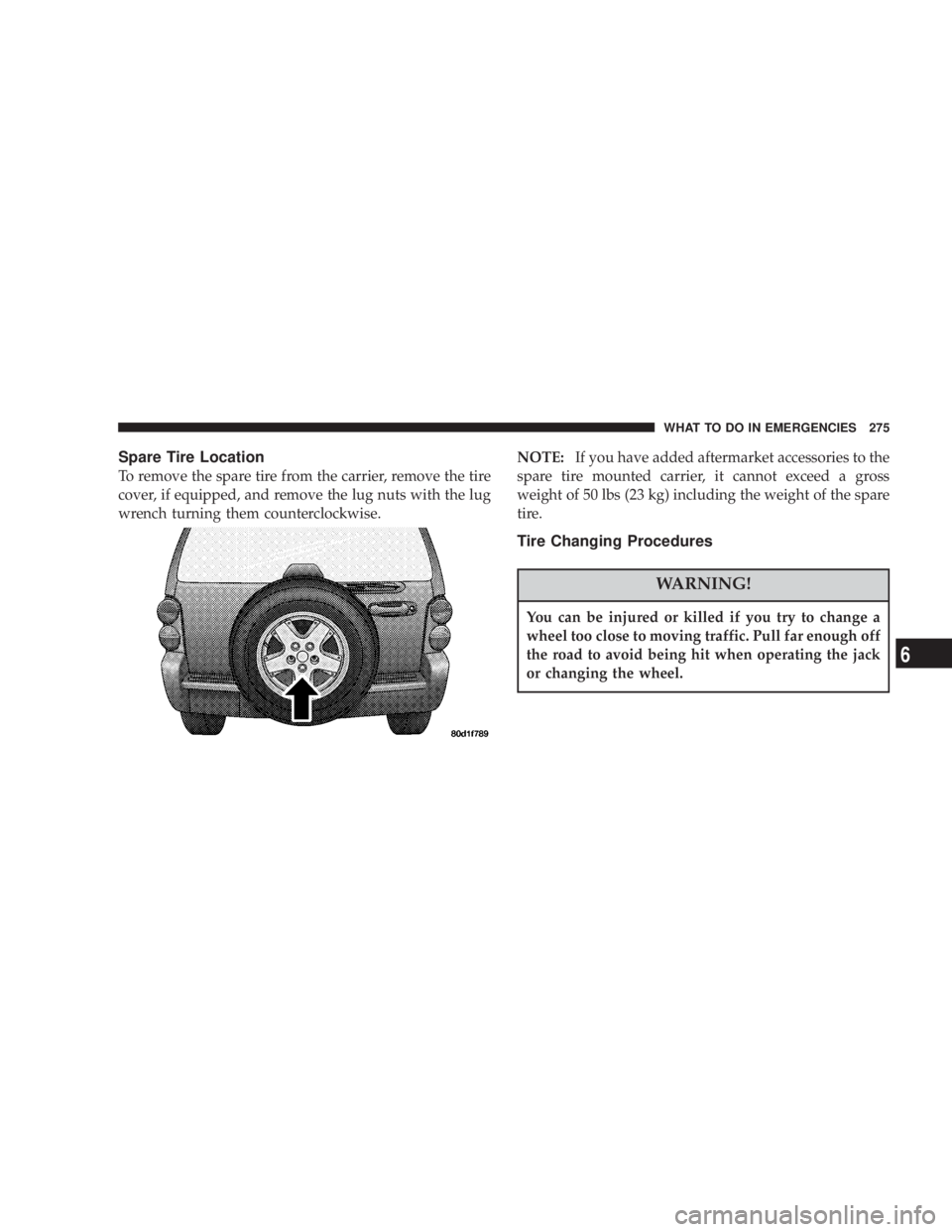
You can be injured or killed if you try to change a
wheel too close to moving traffic. Pull far enough off
the road to avoid being hit when operating the jack
or changing the wheel.