check engine JEEP LIBERTY 2005 KJ / 1.G Owner's Manual
[x] Cancel search | Manufacturer: JEEP, Model Year: 2005, Model line: LIBERTY, Model: JEEP LIBERTY 2005 KJ / 1.GPages: 424, PDF Size: 11.56 MB
Page 325 of 424
have an authorized technician inspect the complete ex-
haust system and adjacent body areas for broken, dam-
aged, deteriorated, or mispositioned parts. Open seams
or loose connections could permit exhaust fumes to seep
into the passenger compartment. In addition, inspect the
exhaust system each time the vehicle is raised for lubri-
cation or oil change. Replace as required.
Cooling System
WARNING!
You or others can be badly burned by hot antifreeze/
coolant or steam from your radiator. If you see or
hear steam coming from under the hood, don’t open
the hood until the radiator has had time to cool.
Never try to open a cooling system pressure cap
when the radiator or coolant bottle is hot.
Engine Coolant Checks
Check antifreeze/coolant protection every 12 months
(before the onset of freezing weather, where applicable).
If antifreeze/coolant is dirty or rusty in appearance, the
system should be drained, flushed and refilled with fresh
antifreeze/coolant. Check the front of the A/C condenser
(if equipped) or radiator for any accumulation of bugs,
leaves, etc. If dirty, clean by gently spraying water from a
garden hose vertically down the face of the A/C con-
denser (if equipped) or the radiator core.
Check the engine cooling system hoses for brittle rubber,
cracking, tears, cuts, and tightness of connection at the
coolant recovery bottle and radiator. Inspect the entire
system for leaks.
MAINTAINING YOUR VEHICLE 325
7
Page 328 of 424
The cap should be inspected and cleaned if there is any
accumulation of foreign material on the sealing surfaces.
WARNING!
The warning words DO NOT OPEN HOT on the
cooling system pressure cap are a safety precaution.
Never add antifreeze/coolant when the engine is
overheated. Do not loosen or remove the cap to cool
an overheated engine. Heat causes pressure to build
up in the cooling system. To prevent scalding or
injury, do not remove the pressure cap while the
system is hot or under pressure.
Disposal of Used Engine Coolant
Used Hybrid Organic Additive Technology (HOAT)
antifreeze/coolant is a regulated substance requiring
proper disposal. Check with your local authorities to
determine the disposal rules for your community. Toprevent ingestion by animals or children, do not store
HOAT antifreeze/coolant in open containers, or allow it
to remain in puddles on the ground. If ingested by a
child, contact a physician immediately. Clean up ground
spills immediately.
Engine Coolant Level
The coolant recovery bottle provides a quick visual
method for determining that the antifreeze/coolant level
is adequate. With the engine idling, and warm to normal
operating temperature, the level of the antifreeze/coolant
should be between the ranges indicated on the bottle.
The radiator normally remains completely full, so there is
no need to remove the radiator cap unless checking for
antifreeze/coolant freeze point or replacing coolant. Ad-
vise your service attendant of this. As long as the engine
operating temperature is satisfactory, the coolant bottle
need only be checked once a month.
328 MAINTAINING YOUR VEHICLE
Page 329 of 424
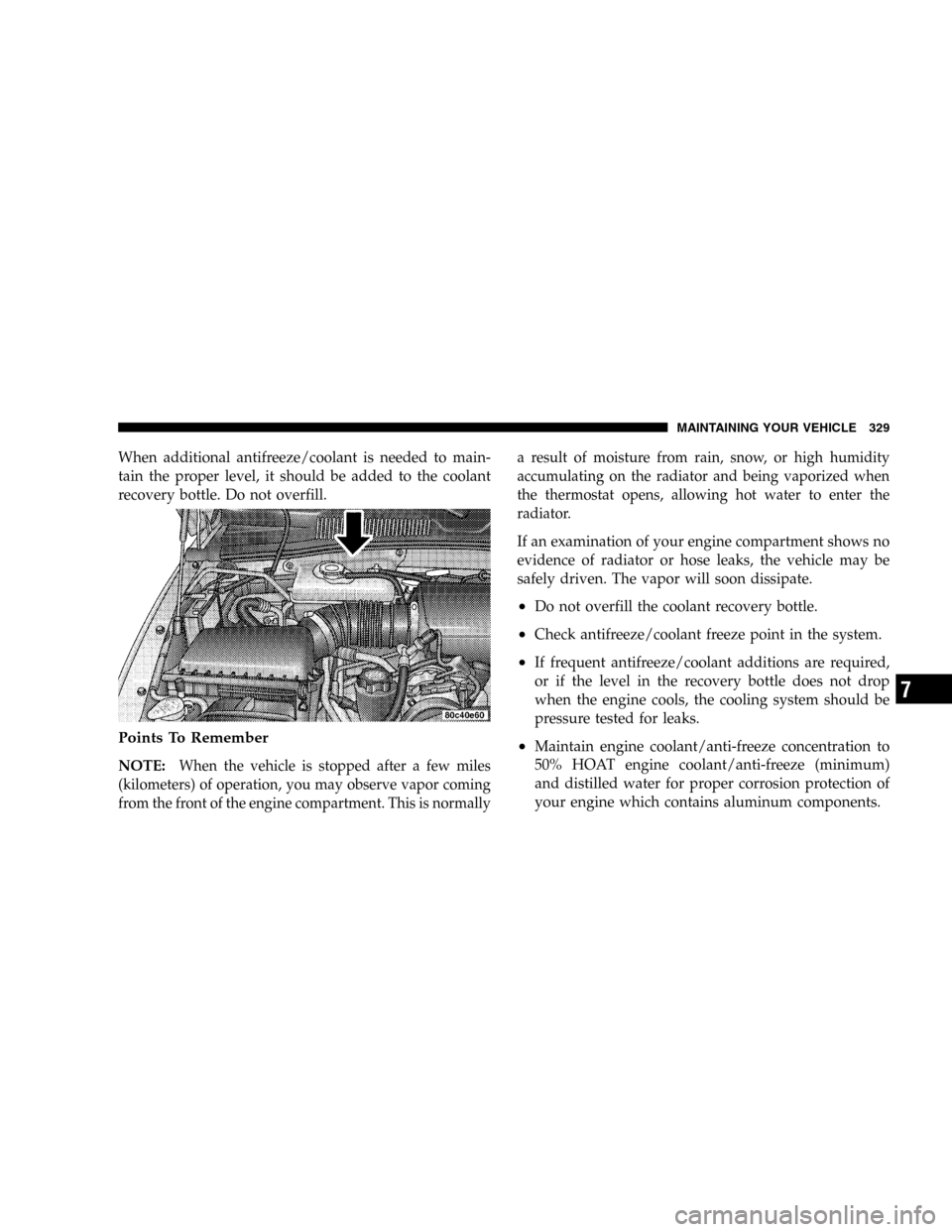
When additional antifreeze/coolant is needed to main-
tain the proper level, it should be added to the coolant
recovery bottle. Do not overfill.
Points To Remember
NOTE:When the vehicle is stopped after a few miles
(kilometers) of operation, you may observe vapor coming
from the front of the engine compartment. This is normallya result of moisture from rain, snow, or high humidity
accumulating on the radiator and being vaporized when
the thermostat opens, allowing hot water to enter the
radiator.
If an examination of your engine compartment shows no
evidence of radiator or hose leaks, the vehicle may be
safely driven. The vapor will soon dissipate.
•Do not overfill the coolant recovery bottle.
•Check antifreeze/coolant freeze point in the system.
•If frequent antifreeze/coolant additions are required,
or if the level in the recovery bottle does not drop
when the engine cools, the cooling system should be
pressure tested for leaks.
•Maintain engine coolant/anti-freeze concentration to
50% HOAT engine coolant/anti-freeze (minimum)
and distilled water for proper corrosion protection of
your engine which contains aluminum components.
MAINTAINING YOUR VEHICLE 329
7
Page 334 of 424
CAUTION!
Using a transmission fluid other than the manufac-
turer’s recommended fluid may cause deterioration
in transmission shift quality and/or torque converter
shudder. Using a transmission fluid other than the
manufacturer’s recommended fluid will result in
more frequent fluid and filter changes. Refer to
Recommended Fluids, Lubricants, and Genuine
Parts for correct fluid type.
Fluid Level Check – 3.7L Gasoline Engine (42RLE)
and 2.8L Diesel Engine (545RFE)
This fluid level should be checked when the engine is
fully warmed up and the fluid in the transmission is
heated to its normal operating temperature. Operation of
the transmission with an improper fluid level will greatly
reduce the life of the transmission and of the fluid.To check the automatic transmission fluid level properly,
the following procedure must be used:
1. The vehicle must be on level ground.
2. The engine should be running at curb idle speed for a
minimum of 60 seconds.
3. Fully apply parking brake.
4. Apply the brakes and shift the transmission into P
(Park).
5. The fluidMUSTbe checked with the transmission in
P (Park) to be sure that the fluid level is accurate.
6. Wipe the dipstick clean and reinsert until seated.
Remove dipstick and note reading.
At normal operating temperature (approximately 180° F
(82° C), the fluid level is correct if it is in the HOT region
334 MAINTAINING YOUR VEHICLE
Page 362 of 424
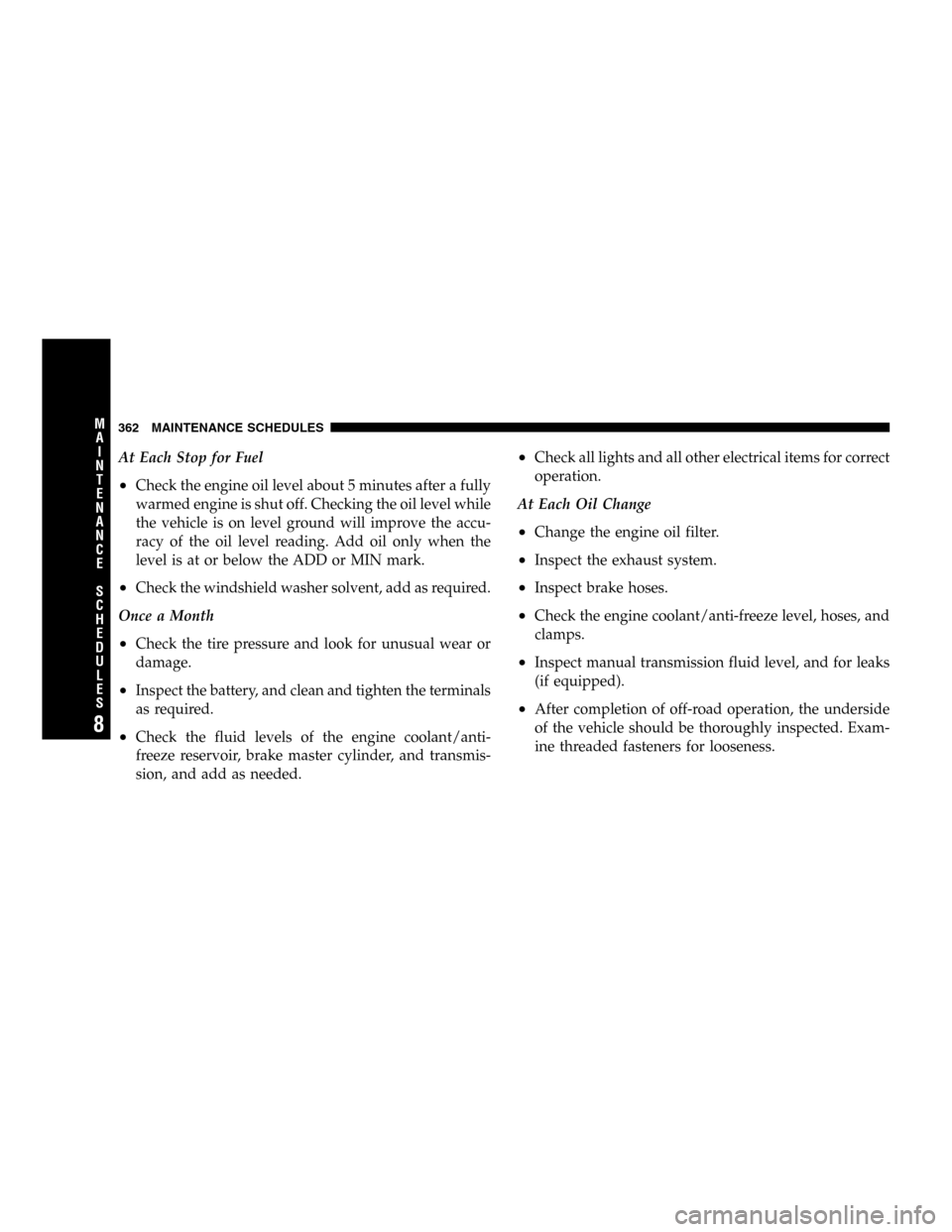
At Each Stop for Fuel
•Check the engine oil level about 5 minutes after a fully
warmed engine is shut off. Checking the oil level while
the vehicle is on level ground will improve the accu-
racy of the oil level reading. Add oil only when the
level is at or below the ADD or MIN mark.
•Check the windshield washer solvent, add as required.
Once a Month
•Check the tire pressure and look for unusual wear or
damage.
•Inspect the battery, and clean and tighten the terminals
as required.
•Check the fluid levels of the engine coolant/anti-
freeze reservoir, brake master cylinder, and transmis-
sion, and add as needed.
•Check all lights and all other electrical items for correct
operation.
At Each Oil Change
•Change the engine oil filter.
•Inspect the exhaust system.
•Inspect brake hoses.
•Check the engine coolant/anti-freeze level, hoses, and
clamps.
•Inspect manual transmission fluid level, and for leaks
(if equipped).
•After completion of off-road operation, the underside
of the vehicle should be thoroughly inspected. Exam-
ine threaded fasteners for looseness.
362 MAINTENANCE SCHEDULES
8
M
A
I
N
T
E
N
A
N
C
E
S
C
H
E
D
U
L
E
S
Page 379 of 424
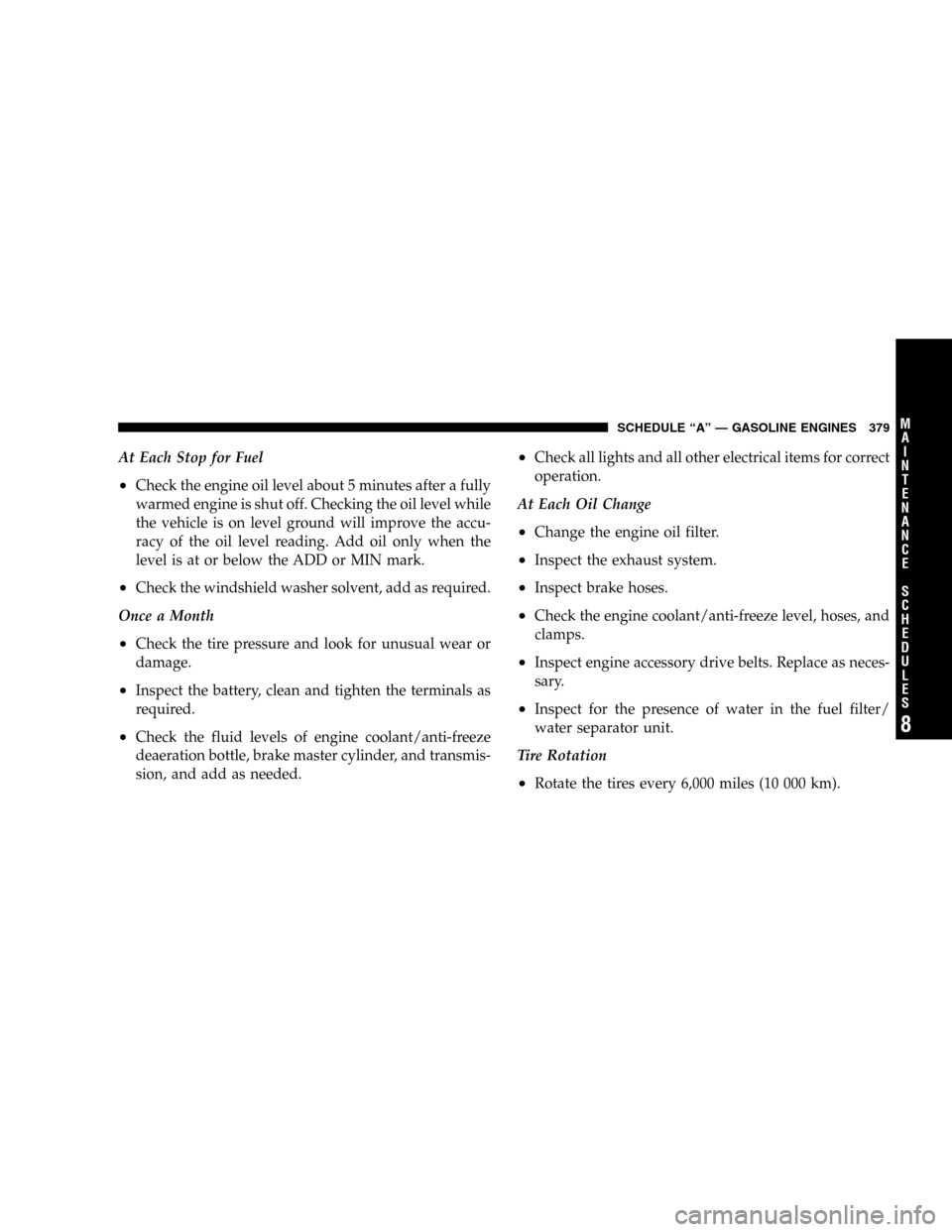
At Each Stop for Fuel
•Check the engine oil level about 5 minutes after a fully
warmed engine is shut off. Checking the oil level while
the vehicle is on level ground will improve the accu-
racy of the oil level reading. Add oil only when the
level is at or below the ADD or MIN mark.
•Check the windshield washer solvent, add as required.
Once a Month
•Check the tire pressure and look for unusual wear or
damage.
•Inspect the battery, clean and tighten the terminals as
required.
•Check the fluid levels of engine coolant/anti-freeze
deaeration bottle, brake master cylinder, and transmis-
sion, and add as needed.
•Check all lights and all other electrical items for correct
operation.
At Each Oil Change
•Change the engine oil filter.
•Inspect the exhaust system.
•Inspect brake hoses.
•Check the engine coolant/anti-freeze level, hoses, and
clamps.
•Inspect engine accessory drive belts. Replace as neces-
sary.
•Inspect for the presence of water in the fuel filter/
water separator unit.
Tire Rotation
•Rotate the tires every 6,000 miles (10 000 km).
SCHEDULE “A” — GASOLINE ENGINES 379
8
M
A
I
N
T
E
N
A
N
C
E
S
C
H
E
D
U
L
E
S
Page 400 of 424
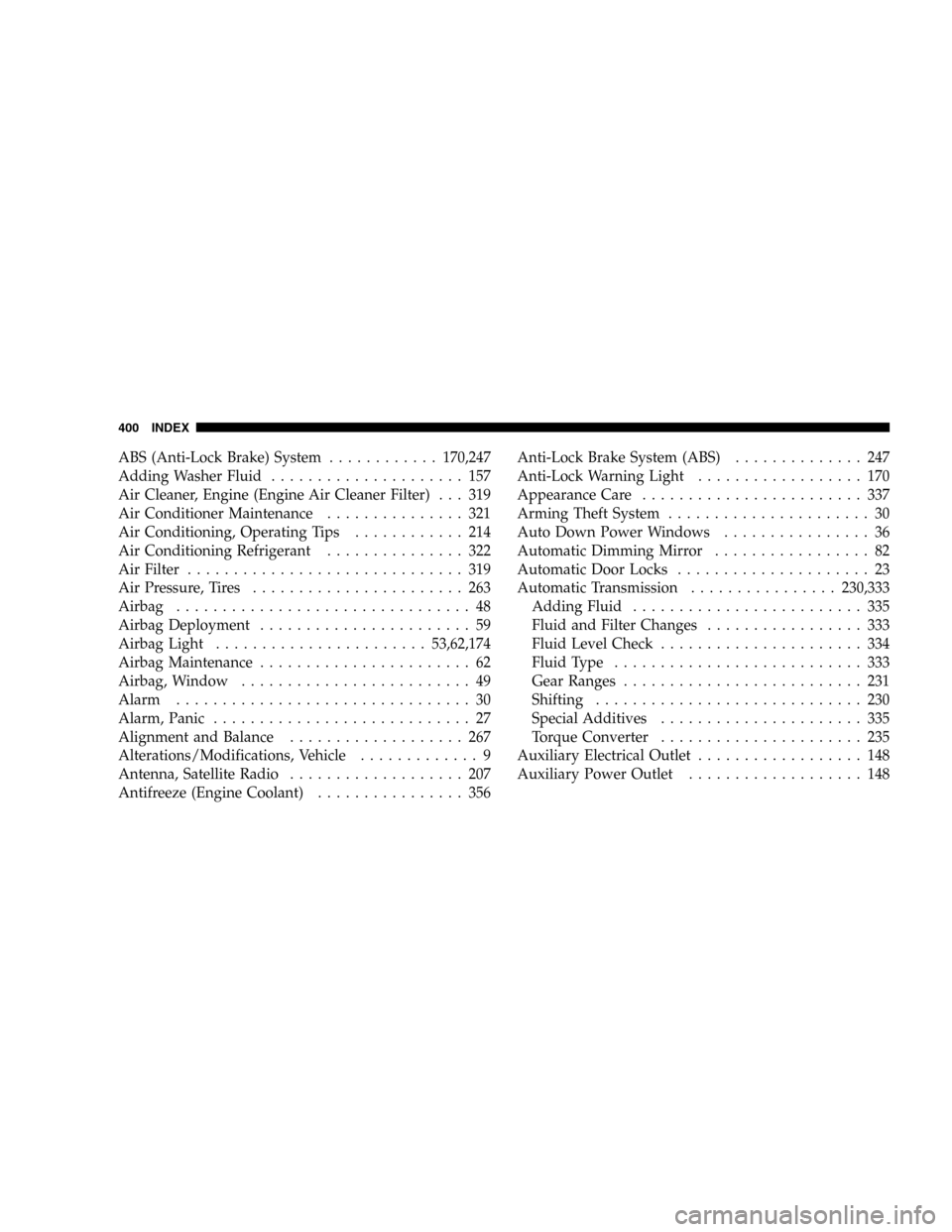
ABS (Anti-Lock Brake) System............170,247
Adding Washer Fluid..................... 157
Air Cleaner, Engine (Engine Air Cleaner Filter) . . . 319
Air Conditioner Maintenance............... 321
Air Conditioning, Operating Tips............ 214
Air Conditioning Refrigerant............... 322
Air Filter.............................. 319
Air Pressure, Tires....................... 263
Airbag................................ 48
Airbag Deployment....................... 59
Airbag Light.......................53,62,174
Airbag Maintenance....................... 62
Airbag, Window......................... 49
Alarm................................ 30
Alarm, Panic............................ 27
Alignment and Balance................... 267
Alterations/Modifications, Vehicle............. 9
Antenna, Satellite Radio................... 207
Antifreeze (Engine Coolant)................ 356Anti-Lock Brake System (ABS).............. 247
Anti-Lock Warning Light.................. 170
Appearance Care........................ 337
Arming Theft System...................... 30
Auto Down Power Windows................ 36
Automatic Dimming Mirror................. 82
Automatic Door Locks..................... 23
Automatic Transmission................230,333
Adding Fluid......................... 335
Fluid and Filter Changes................. 333
Fluid Level Check...................... 334
Fluid Type........................... 333
Gear Ranges.......................... 231
Shifting............................. 230
Special Additives...................... 335
Torque Converter...................... 235
Auxiliary Electrical Outlet.................. 148
Auxiliary Power Outlet................... 148
400 INDEX
Page 402 of 424
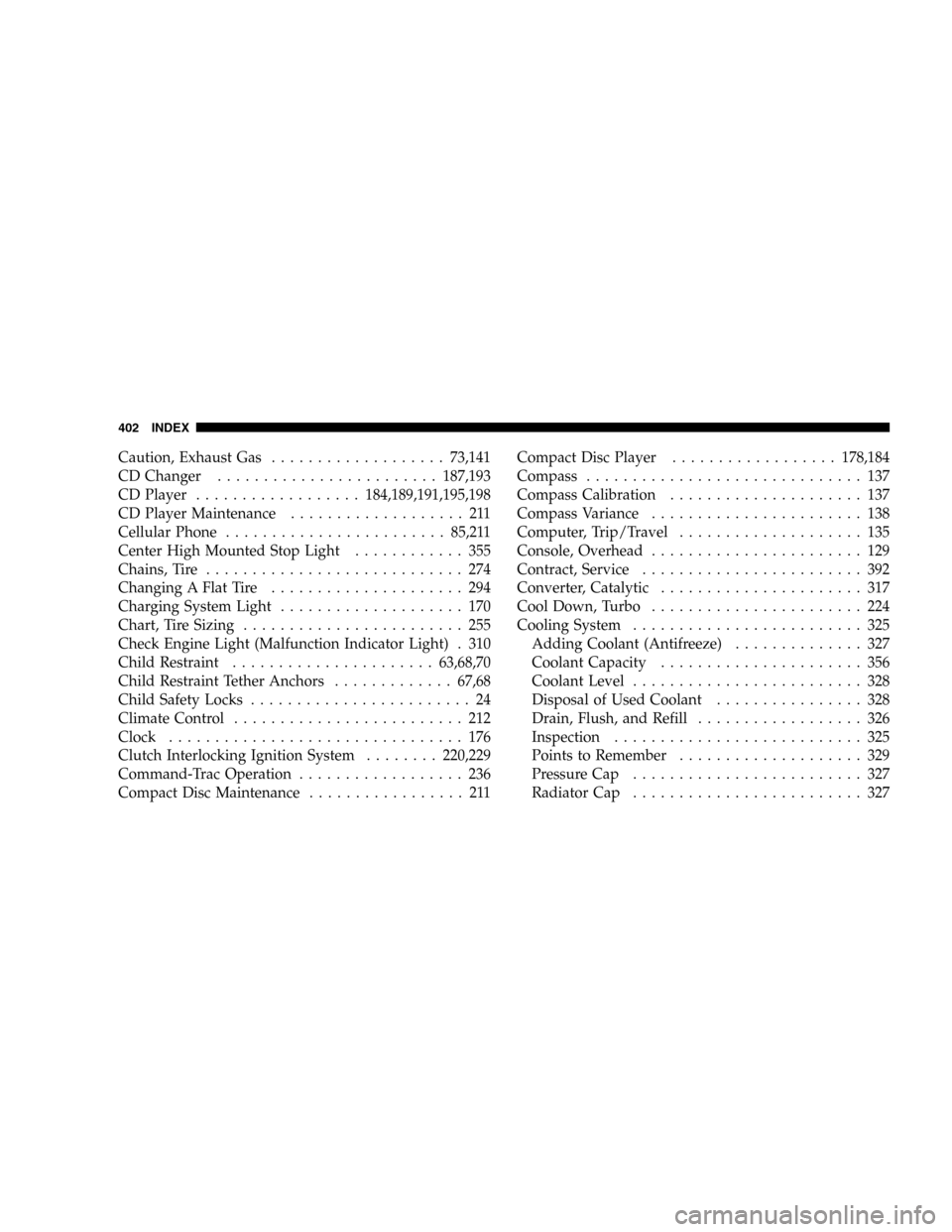
Caution, Exhaust Gas...................73,141
CD Changer........................187,193
CD Player..................184,189,191,195,198
CD Player Maintenance................... 211
Cellular Phone........................85,211
Center High Mounted Stop Light............ 355
Chains, Tire............................ 274
Changing A Flat Tire..................... 294
Charging System Light.................... 170
Chart, Tire Sizing........................ 255
Check Engine Light (Malfunction Indicator Light) . 310
Child Restraint......................63,68,70
Child Restraint Tether Anchors.............67,68
Child Safety Locks........................ 24
Climate Control......................... 212
Clock................................ 176
Clutch Interlocking Ignition System........220,229
Command-Trac Operation.................. 236
Compact Disc Maintenance................. 211Compact Disc Player..................178,184
Compass.............................. 137
Compass Calibration..................... 137
Compass Variance....................... 138
Computer, Trip/Travel.................... 135
Console, Overhead....................... 129
Contract, Service........................ 392
Converter, Catalytic...................... 317
Cool Down, Turbo....................... 224
Cooling System......................... 325
Adding Coolant (Antifreeze).............. 327
Coolant Capacity...................... 356
Coolant Level......................... 328
Disposal of Used Coolant................ 328
Drain, Flush, and Refill.................. 326
Inspection........................... 325
Points to Remember.................... 329
Pressure Cap......................... 327
Radiator Cap......................... 327
402 INDEX
Page 404 of 424
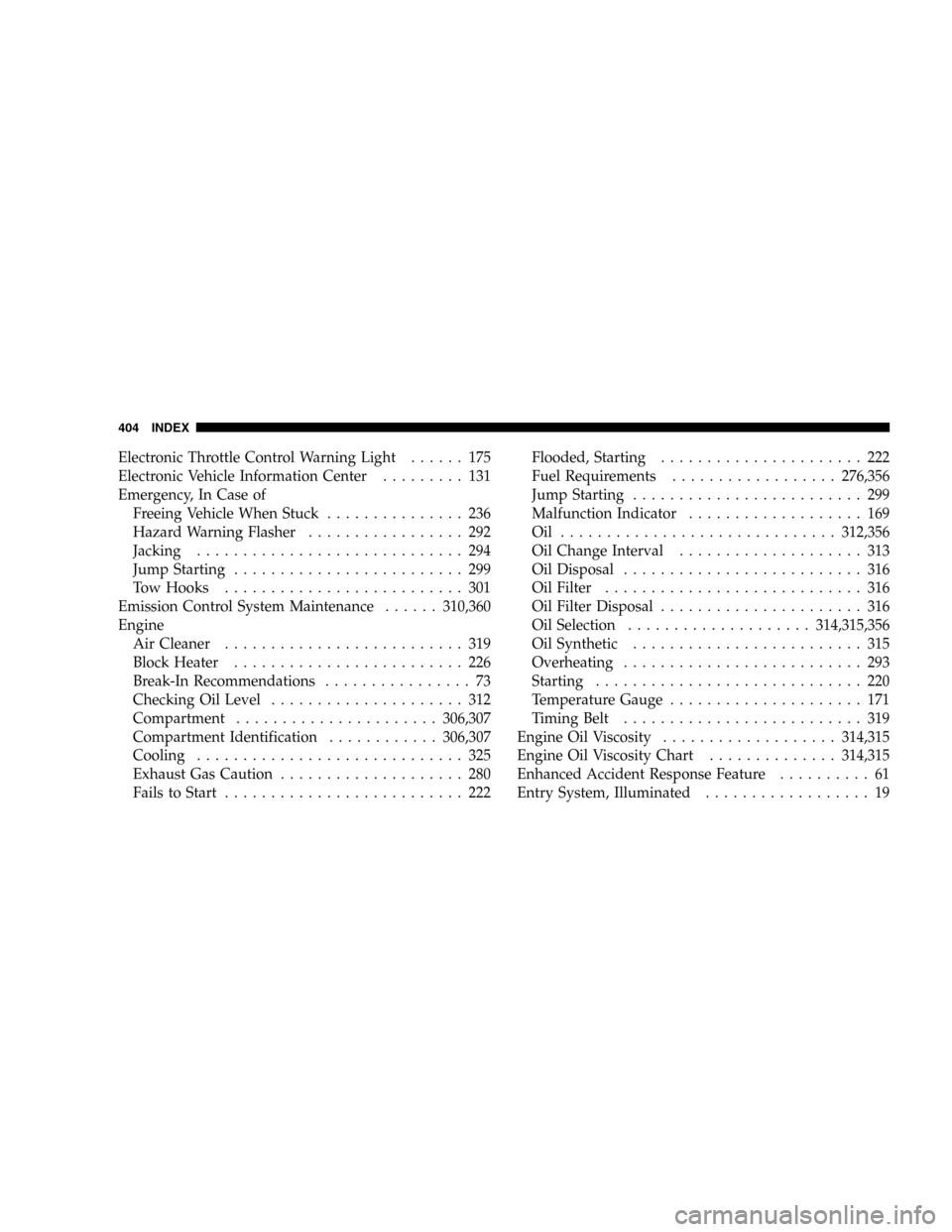
Electronic Throttle Control Warning Light...... 175
Electronic Vehicle Information Center......... 131
Emergency, In Case of
Freeing Vehicle When Stuck............... 236
Hazard Warning Flasher................. 292
Jacking............................. 294
Jump Starting......................... 299
Tow Hooks.......................... 301
Emission Control System Maintenance......310,360
Engine
Air Cleaner.......................... 319
Block Heater......................... 226
Break-In Recommendations................ 73
Checking Oil Level..................... 312
Compartment......................306,307
Compartment Identification............306,307
Cooling............................. 325
Exhaust Gas Caution.................... 280
Fails to Start.......................... 222Flooded, Starting...................... 222
Fuel Requirements..................276,356
Jump Starting......................... 299
Malfunction Indicator................... 169
Oil ..............................312,356
Oil Change Interval.................... 313
Oil Disposal.......................... 316
Oil Filter............................ 316
Oil Filter Disposal...................... 316
Oil Selection....................314,315,356
Oil Synthetic......................... 315
Overheating.......................... 293
Starting............................. 220
Temperature Gauge..................... 171
Timing Belt.......................... 319
Engine Oil Viscosity...................314,315
Engine Oil Viscosity Chart..............314,315
Enhanced Accident Response Feature.......... 61
Entry System, Illuminated.................. 19
404 INDEX
Page 405 of 424
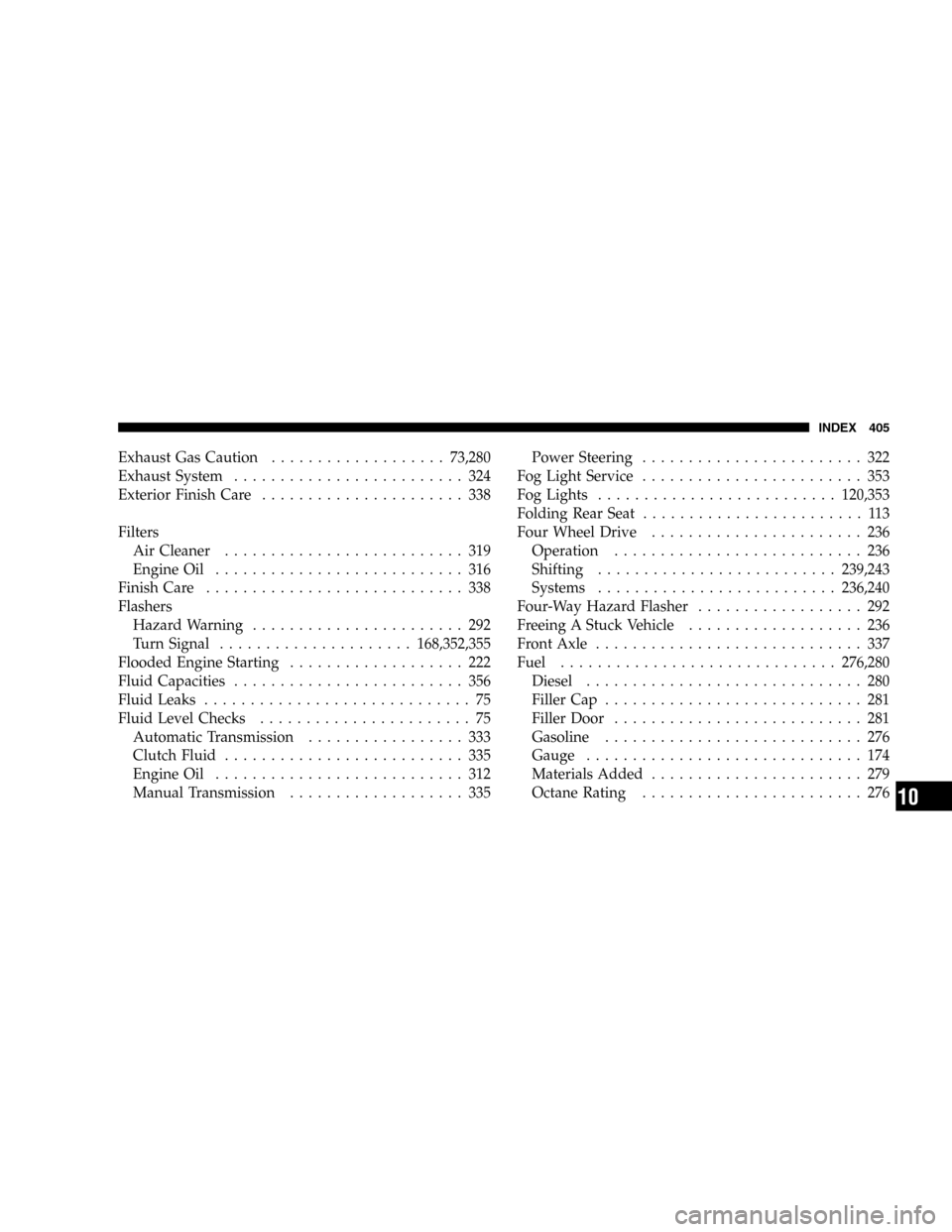
Exhaust Gas Caution...................73,280
Exhaust System......................... 324
Exterior Finish Care...................... 338
Filters
Air Cleaner.......................... 319
Engine Oil........................... 316
Finish Care............................ 338
Flashers
Hazard Warning....................... 292
Turn Signal.....................168,352,355
Flooded Engine Starting................... 222
Fluid Capacities......................... 356
Fluid Leaks............................. 75
Fluid Level Checks....................... 75
Automatic Transmission................. 333
Clutch Fluid.......................... 335
Engine Oil........................... 312
Manual Transmission................... 335Power Steering........................ 322
Fog Light Service........................ 353
Fog Lights..........................120,353
Folding Rear Seat........................ 113
Four Wheel Drive....................... 236
Operation........................... 236
Shifting..........................239,243
Systems..........................236,240
Four-Way Hazard Flasher.................. 292
Freeing A Stuck Vehicle................... 236
Front Axle............................. 337
Fuel..............................276,280
Diesel.............................. 280
Filler Cap............................ 281
Filler Door........................... 281
Gasoline............................ 276
Gauge.............................. 174
Materials Added....................... 279
Octane Rating........................ 276
INDEX 405
10