ignition JEEP LIBERTY 2008 KK / 2.G Owners Manual
[x] Cancel search | Manufacturer: JEEP, Model Year: 2008, Model line: LIBERTY, Model: JEEP LIBERTY 2008 KK / 2.GPages: 493
Page 354 of 493

upon the next ignition key cycle, a chime will sound and
the TPM Telltale Light will turn ON. In addition, the
EVIC will display a Low Pressure message and a graphic
showing the low tire pressure value flashing.
3. After driving the vehicle for up to 10 minutes above 15
mph (25 km/h) the TPM Telltale Light will turn OFF, as
long as no tire pressure is below the low-pressure warn-
ing limit in any of the four active road tires.
4. The EVIC will display a graphic showing the tire
pressure value in place of the flashing low tire pressure
value. The EVIC will also display a ªSPARE LOW
PRESSUREº message to remind you to service the flat
tire.
NOTE:
Vehicles with Compact Spare
1. The compact spare tire does not have a tire pressure
monitoring sensor. Therefore, the TPMS will not monitor
the pressure in the compact spare tire.2. If you install the compact spare tire in place of a road
tire that has a pressure below the low-pressure warning
limit, upon the next ignition key cycle, the TPM Telltale
Light will remain ON and a chime will sound. In
addition, the graphic in the EVIC will still display a
flashing pressure value.
3. After driving the vehicle for up to 10 minutes above 15
mph (25 km/h), the TPM Telltale Light will flash on and
off for 75 seconds and then remain on solid. In addition,
the EVIC will display a9CHECK TPM SYSTEM9message
for 3 seconds and then display dashes (- -) in place of the
pressure value.
4. For each subsequent ignition key cycle, a chime will
sound, the TPM Telltale Light will flash on and off for 75
seconds and then remain on solid, and the EVIC will
display a9CHECK TPM SYSTEM9message for 3 seconds
and then display dashes (- -) in place of the pressure
value.
354 STARTING AND OPERATING
Page 358 of 493

²The use of leaded gas is prohibited by Federal law.
Using leaded gasoline can impair engine performance,
and damage the emission control system.
²An out-of-tune engine, or certain fuel or ignition
malfunctions, can cause the catalytic converter to
overheat. If you notice a pungent burning odor or
some light smoke, your engine may be out of tune or
malfunctioning and may require immediate service.
Contact your dealer for service assistance.
²The use of fuel additives, which are now being sold as
octane enhancers, is not recommended. Most of these
products contain high concentrations of methanol.
Fuel system damage or vehicle performance problems
resulting from the use of such fuels or additives is not
the responsibility of the manufacturer.
NOTE:Intentional tampering with emissions control
systems can result in civil penalties being assessed
against you.
Carbon Monoxide Warnings
WARNING!
Carbon monoxide (CO) in exhaust gases is deadly.
Follow the precautions below to prevent carbon
monoxide poisoning:
²Do not inhale exhaust gases. They contain carbon
monoxide, a colorless and odorless gas, which can kill.
Never run the engine in a closed area, such as a
garage, and never sit in a parked vehicle with the
engine running for an extended period. If the vehicle is
stopped in an open area with the engine running for
more than a short period, adjust the ventilation system
to force fresh, outside air into the vehicle.
358 STARTING AND OPERATING
Page 380 of 493

3. Turn the ignition switch to the ON position.
4. Depress the brake pedal.
5. Shift the transmission to ªNº (Neutral) (automatic
transmission), or depress the clutch pedal (manual trans-
mission).
6. Use the point of a ballpoint pen or similar object to
depress the recessed transfer case Neutral (N) button for
4 seconds. After the shift is complete, and the Neutral (N)
light turns on, release the Neutral (N) button.
7. Start the engine.
8. Shift the automatic transmission into ªRº (Reverse).
9. Release the brake pedal for five seconds and ensure
that there is no vehicle movement.
10. Repeat Steps 8 and 9 with the transmission in ªDº
(Drive) (automatic transmission) or 1st gear (manual
transmission).11. Shut OFF the engine.
12. Turn the ignition switch to the unlocked OFF posi-
tion.
13. Shift the transmission into ªPº (Park) (automatic
transmission), or shift into 4th gear (manual transmis-
sion).
14. Attach the vehicle to a tow vehicle with a tow bar.
15. Disconnect the battery negative cable.
NOTE:
²Steps 1 through 5 are requirements for shifting the
transfer case. If these requirements are not met prior to
depressing the Neutral (N) selection button or while
the shift attempt is in process, then the Neutral (N)
indicator light will flash continuously until all require-
ments are met or until the Neutral (N) button is
released.
380 STARTING AND OPERATING
Page 381 of 493

²The ignition switch must be in the ON position for a
shift to take place and for the position indicator lights
to be operable. If the ignition switch is not in the ON
position, the shift will not take place and no position
indicator lights will be on or flashing.
²Flashing Neutral (N) position indicator light indicates
that shift requirements have not been met.
CAUTION!
Damage to the transmission may occur if the trans-
mission is shifted into ªPº (Park) with the transfer
case in Neutral (N) and the engine RUNNING. With
the transfer case in Neutral (N), ensure that the
engine is OFF prior to shifting the transmission into
ªPº (Park).
Shifting Out of Neutral (N)
Perform the following procedure to prepare your vehicle
for normal usage:
1. Bring the vehicle to a complete stop.
2. Reconnect the battery negative cable.
3. Place the ignition switch in the LOCK position (if it
has been moved or the engine has been started).
4. Turn the ignition switch to the ON position, but do not
start the engine.
5. Depress the brake pedal.
6. Shift the transmission into ªNº (Neutral) (automatic
transmission), or depress the clutch pedal (manual trans-
mission).
7. Use the point of a ballpoint pen or similar object to
depress the recessed transfer case Neutral (N) button.
Release the Neutral (N) button after the Neutral (N)
STARTING AND OPERATING 381
5
Page 382 of 493

indicator light turns off (approximately 1 second). After
the Neutral (N) button is released, the transfer case will
shift to the position identified by the selector switch.
8. Start the engine.
9. Shift the transmission into ªDº (Drive) (automatic
transmission) or into 1st gear and momentarily release
the clutch (manual transmission) to verify that the trans-
fer case has engaged.
10. Set the parking brake.
11. Shift the transmission into ªPº (Park) (automatic
transmission), or into ªNº (Neutral) (manual transmis-
sion).NOTE:
²Steps 1 through 6 are requirements for shifting the
transfer case. If these requirements not met prior to
depressing the Neutral (N) selection button or while
the shift attempt is in process, then all of the mode
position indicator lights will flash continuously until
all requirements are met or until the Neutral (N)
button is released.
²The ignition switch must be in the ON position for a
shift to take place and for the position indicator lights
to be operable. If the ignition switch in not in the ON
position, the shift will not take place and no position
indicator lights will be on or flashing.
²Flashing Neutral (N) position indicator light indicates
that shift requirements have not been met.
382 STARTING AND OPERATING
Page 387 of 493
CAUTION!
The winch mechanism is designed for use with the
jack extension tube only. Use of an air wrench or
other power tools is not recommended and they can
damage the winch.
When the spare is clear, tilt the retainer at the end of the
cable, and pull it through the center of the wheel.
Preparations For Jacking
²
Park the vehicle on a firm level surface as far from the
edge of the roadway as possible. Avoid icy or slippery
areas.
²Set the parking brakeand place the gear selector in
PARK (automatic transmission) or REVERSE (manual
transmission).
²Turn the ignition to the LOCK position.
WARNING!
Do not attempt to change a tire on the side of the
vehicle close to moving traffic. Pull far enough off
the road to avoid being hit when operating the jack
or changing the wheel.
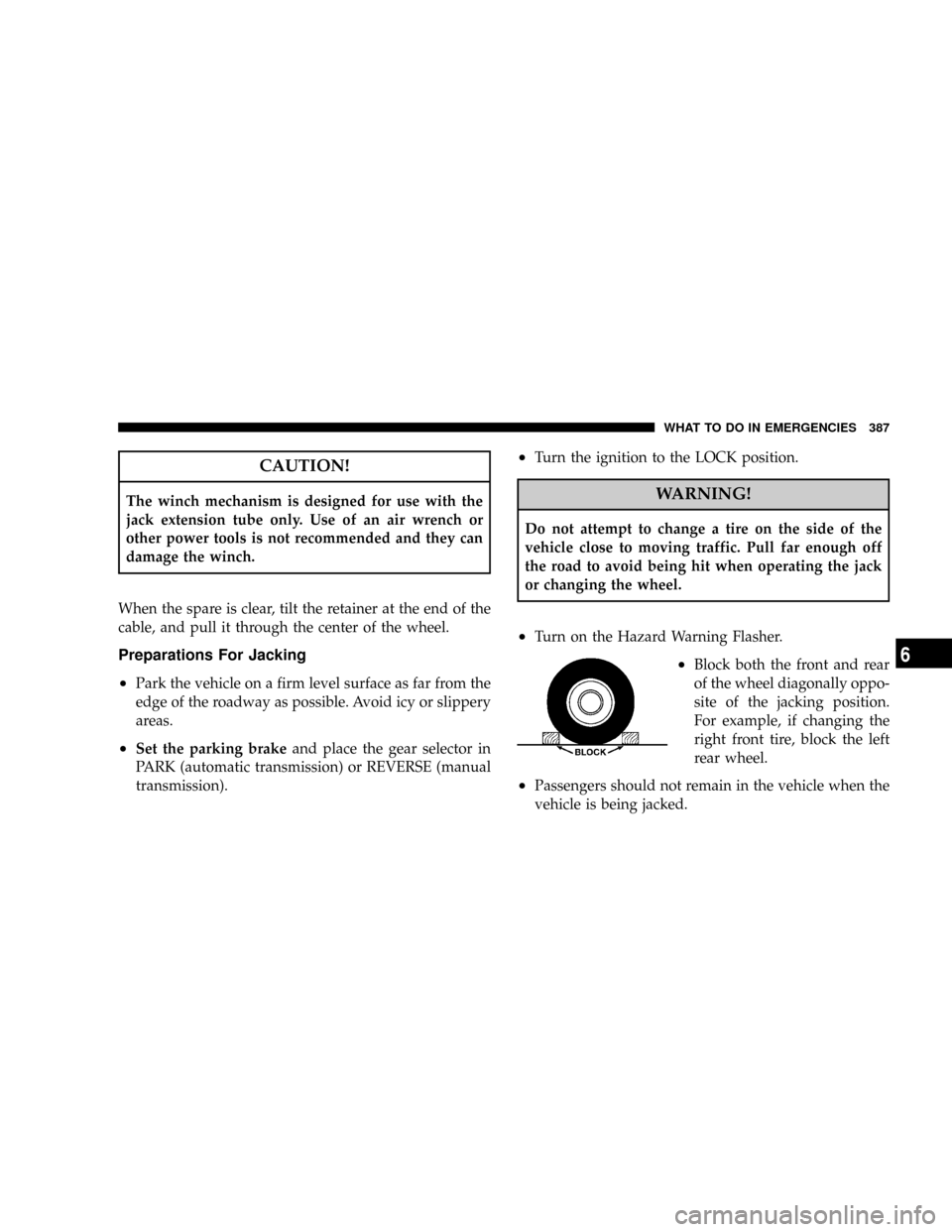
²Turn on the Hazard Warning Flasher.
²Block both the front and rear
of the wheel diagonally oppo-
site of the jacking position.
For example, if changing the
right front tire, block the left
rear wheel.
²Passengers should not remain in the vehicle when the
vehicle is being jacked.
WHAT TO DO IN EMERGENCIES 387
6
Page 390 of 493

nuts until each nut has been tightened twice. Correct
wheel nut tightness is 130 N´m (95 ft. lbs). If in doubt
about the correct tightness, have them checked with a
torque wrench by your authorized dealer or at a service
station.
10. Lower the jack to it's fully closed position.
WARNING!
A loose tire or jack, thrown forward in a collision or
hard stop could endanger the occupants of the ve-
hicle. Always stow the jack parts and the spare tire in
the places provided.
11. Secure the tire, jack, and tools in their proper loca-
tions.
JUMP STARTING
WARNING!
²Take care to avoid the radiator cooling fan whenever the hood is
raised. It can start anytime the ignition switch is on. You can be hurt
by the fan.
²Do not attempt to push or tow your vehicle to get it started. Vehicles
equipped with an automatic transmission cannot be started this
way. Unburned fuel could enter the catalytic converter and once the
engine has started, ignite and damage the converter and vehicle. If
the vehicle has a discharged battery, booster cables may be used to
obtain a start from another vehicle. This type of start can be
dangerous if done improperly, so follow this procedure carefully.
²Battery fluid is a corrosive acid solution; do not allow battery fluid
to contact eyes, skin, or clothing. Don't lean over battery when
attaching clamps or allow the clamps to touch each other. If acid
splashes in eyes or on skin, flush contaminated area immediately
with large quantities of water.
²A battery generates hydrogen gas, which is flammable and explo-
sive. Keep flame or spark away from the vent holes.
²Do not use a booster battery or any other booster source with an
output that exceeds 12 volts.
390 WHAT TO DO IN EMERGENCIES
Page 391 of 493

1. Wear eye protection and remove all metal jewelry such
as watchbands or bracelets that might make an unin-
tended electrical contact.
2. When boosting from a battery in another vehicle, park
that vehicle within booster cable reach, but without
allowing the vehicles to touch.
WARNING!
Do not permit vehicles to touch each other as this
could establish a ground connection and personal
injury could result.3. Set the parking brake, place the automatic transmis-
sion in PARK (or NEUTRAL for manual transmission),
and turn the ignition OFF for both vehicles.
4. Turn OFF the heater, radio and all unnecessary elec-
trical loads.
5. Connect one end of the jumper cable to the positive
battery post. Connect the other end of the same cable to
the positive terminal of the booster battery.
6. Connect the other cable, first to the negative terminal
of the booster battery and then to the engine ground of
the vehicle with the discharged battery. Make sure you
have a good contact on the engine ground.
WHAT TO DO IN EMERGENCIES 391
6
Page 392 of 493

WARNING!
²You should not try to start your vehicle by pushing
or towing.
²Do not connect the cable to the negative post of the
discharge battery. The resulting electrical spark
could cause the battery to explode.
²During cold weather when temperatures are be-
low freezing point, electrolyte in a discharged
battery may freeze. Do not attempt jump-starting
because the battery could rupture or explode. The
battery temperature must be brought up above
freezing point before attempting jump-start.7. If the vehicle is equipped with Sentry Key Immobi-
lizer, turn the ignition switch to the ON position for 3
seconds before moving the ignition switch to the START
position.
8. Start the engine in the vehicle that has the booster
battery, let the engine idle a few minutes, and then start
the engine in the vehicle with the discharged battery.
9. When removing the jumper cables, reverse the above
sequence exactly. Be careful of the moving belts and fan.
392 WHAT TO DO IN EMERGENCIES
Page 400 of 493

Loose Fuel Filler Cap Message
If the vehicle diagnostic system determines that the fuel
filler cap in loose, improperly installed, or damaged, a
ªgASCAPº message will display in the instrument clus-
ter. Tighten the gas cap until a ªclickingº sound is heard.
This is an indication that the gas cap is properly tight-
ened. Press the trip odometer reset button to turn off the
message. If the problem persists, the message will appear
the next time the vehicle is started. This might indicate a
damaged cap. If the problem is detected twice in a row,
the system will turn on the Malfunction Indicator Light
(MIL). Resolving the problem will turn the MIL light off.
EMISSIONS INSPECTION AND MAINTENANCE
PROGRAMS
In some localities, it may be a legal requirement to pass
an inspection of your vehicle's emissions control system.
Failure to pass could prevent vehicle registration.For states, which have an I/M (Inspection and
Maintenance) requirement, this check verifies the
following: the MIL (Malfunction Indicator Light)
is functioning and is not on when the engine is running,
and that the OBD (On Board Diagnostic) system is ready
for testing.
Normally, the OBD system will be ready. The OBD
system maynotbe ready if your vehicle was recently
serviced, if you recently had a dead battery, or a battery
replacement. If the OBD system should be determined
not ready for the I/M test, your vehicle may fail the test.
Your vehicle has a simple ignition key actuated test,
which you can use prior to going to the test station. To
check if your vehicle's OBD system is ready, you must do
the following:
1. Insert your ignition key into the ignition switch.
400 MAINTAINING YOUR VEHICLE