engine JEEP LIBERTY 2008 KK / 2.G Manual PDF
[x] Cancel search | Manufacturer: JEEP, Model Year: 2008, Model line: LIBERTY, Model: JEEP LIBERTY 2008 KK / 2.GPages: 493
Page 322 of 493

3. Apply the parking brake.
4. Start the engine.
5. Release the clutch pedal (manual transmission).
6. Rotate the steering wheel
1¤2turn to the left.
7. Press the ªESP OFFº button located in the lower
switch bank below the climate control four times within
twenty seconds. The ªESP/TCS Indicatorº light should
turn on and turn off two times.
8. Rotate the steering wheel back to center and then an
additional
1¤2turn to the right.
9. Turn the ignition switch to the OFF position and then
back to the ON position. If the sequence was completed
properly, the ªESP/TCS Indicatorº light will blink sev-
eral times to confirm HSA is disabled.
10. Repeat these steps if you want to return this feature
to its previous setting.
HDC (Hill Descent Control) ± If Equipped
HDC is only intended for low speed off-road driving.
HDC maintains vehicle speed while descending hills in
off-road driving conditions by applying the brakes when
necessary.
When enabled, HDC senses the terrain and activates
when the vehicle is descending a hill. HDC speed may be
adjusted by the driver to suit the driving conditions. The
speed corresponds to the transmission gear selected.
Gear Approximate HDC Set Speed
1st 1 mph (1.5 km/h)
2nd 3 mph (4.5 km/h)
D (Drive) 7.5 mph (12 km/h)
R (Reverse) 1 mph (1.5 km/h)
N (Neutral) 3 mph (4.5 km/h)
However, the driver can override HDC operation by
applying the brake to slow the vehicle down below the
322 STARTING AND OPERATING
Page 324 of 493

Press the ªHill Descentº button. The ªHill
Descent Control Indicatorº light in the instru-
ment cluster will turn on solid.
NOTE:If the transfer case is not in 4WD low range, the
ªHill Descent Control Indicatorº light will flash for 5
seconds and HDC will not be enabled.
Disabling HDC
1. Press the ªHill Descentº button or shift the transfer
case out of 4WD low range. The ªHill Descent Control
Indicatorº light in the instrument cluster will turn off.
ESP (Electronic Stability Program)
This system enhances directional control and stability of
the vehicle under various driving conditions. ESP cor-
rects for oversteering and understeering the vehicle by
applying the brake of the appropriate wheel. Engine
power may also be reduced to help the vehicle maintain
the desired path.The ESP uses sensors in the vehicle to determine the path
that the driver intends to steer the vehicle and compares
it to the actual path of the vehicle. When the actual path
does not match the intended path, the ESP applies the
brake of the appropriate wheel to assist in counteracting
the condition of oversteer or understeer.
²Oversteer - when the vehicle is turning more than
appropriate for the steering wheel position.
²Understeer - when the vehicle is turning less than
appropriate for the steering wheel position.
ESP/TCS Indicator Light
The9ESP/TCS Indicatorº light located in the
instrument cluster, starts to flash as soon as the
tires lose traction and the ESP system becomes
active. The9ESP/TCS Indicatorº light also
flashes when TCS is active. If the9ESP/TCS Indicatorº
light begins to flash during acceleration, ease up on the
324 STARTING AND OPERATING
Page 327 of 493

mode is overcome, turn ESP back on by momentarily
depressing the ªESP OFFº button. This may be done
while the vehicle is in motion.
Full Off Ð 4WD Vehicles in 4WD High & 4WD Low
Range
The ªFull Offº mode is intended for off-highway and
off-road use when ESP stability features could inhibit
vehicle maneuverability due to trail conditions.
The ªESP OFFº button is located in the lower switch bank
below the climate Control. To enter ªFull Offº mode,
depress and hold the ªESP Offº button for 5 seconds
while the vehicle is stopped with the engine running.
After 5 seconds, the ªESP/TCS Indicatorº light will
illuminate and an ªESP Offº message will appear in the
odometer. Press and release the trip odometer button
located on the instrument cluster to turn off this message.
In this mode, ESP and TCS are turned off (except for the
ªlimited slipº feature described in the TCS section) untilthe vehicle reaches a speed of 40 mph. At speeds over 40
mph, the system automatically switches to ªPartial Offº
mode, described above. When the vehicle speed returns
to less than 35 mph, the ESP system will return to ªFull
Offº mode. The ªESP/TCS Indicatorº light is always
illuminated when ESP is off. To turn ESP on again,
momentarily depress the ªESP Offº button. This will
restore the normal ªESP Onº mode of operation.
NOTE:
²ªFull Offº is the only operating mode for ESP in 4WD
low range. Therefore, ESP system will be in this mode
whenever the vehicle is started in 4WD low range or
the transfer case is shifted into 4WD low range.
²The ªESP OFFº message will display and a chime will
sound when the gear selector is moved from any
position to the ªPº (Park) position and then moved out
of the ªPº (Park) position. This will occur even if the
message was cleared previously.
STARTING AND OPERATING 327
5
Page 328 of 493

WARNING!
With the ESP switched off, the enhanced vehicle
stability offered by ESP is unavailable. In an emer-
gency evasive maneuver, the ESP system will not
engage to assist in maintaining stability. ªFull Offº
mode is only intended for off-highway or off-road
use.
ESP/BAS Warning Light & ESP/TCS Indicator
Light
The malfunction indicator for the ESP is com-
bined with the BAS indicator. The ªESP/BAS
Malfunction Indicatorº light and the ªESP/
TCS Indicatorº light in the instrument cluster
both turn on when the ignition switch is turned to the
ON position. They should both turn off with the engine
running. If the ªESP/BAS Malfunction Indicatorº lightturns on continuously with the engine running, a mal-
function has been detected in either the ESP or the BAS
system, or both. If this light remains on after several
ignition cycles, and the vehicle has been driven several
miles at speeds greater than 30 mph (48 km/h), see your
authorized dealer as soon as possible to have the problem
diagnosed and corrected.
NOTE:
²9The9ESP/TCS Indicatorº light and the9ESP/BAS
Malfunction Indicatorº light will turn on momentarily
each time the ignition switch is turned ON.
²Each time the ignition is turned ON, the ESP System
will be ON even if it was turned off previously.
²The ESP Control System will make buzzing or clicking
sounds when it is active. This is normal; the sounds
will stop when ESP becomes inactive following the
maneuver that caused the ESP activation.
328 STARTING AND OPERATING
Page 355 of 493

5. Once you repair or replace the original road tire, and
reinstall it on the vehicle in place of the compact spare,
the TPMS will update automatically. In addition, the
TPM Telltale Light will turn OFF and the graphic in the
EVIC will display a new pressure value instead of dashes
(- -), as long as no tire pressure is below the low-pressure
warning limit in any of the four active road tires. The
vehicle may need to be driven for up to 10 minutes above
15 mph (25 km/h) in order for the TPMS to receive this
information.
General Information
This device complies with part 15 of the FCC rules and
RSS 210 of Industry Canada. Operation is subject to the
following conditions:
²This device may not cause harmful interference.
²This device must accept any interference received,
including interference that may cause undesired op-
eration.The tire pressure sensors are covered under one of the
following licenses:
United States.....................KR5S120123
Canada........................2671-S120123
FUEL REQUIREMENTS
Your engine is designed to meet all emis-
sions regulations and provide excellent
fuel economy and performance when us-
ing high quality unleaded ªregularº gaso-
line having an octane rating of 87. The use
of premium gasoline is not recommended.
Under normal conditions, the use of premium gasoline
will not provide a benefit over high quality regular
gasolines, and in some circumstances may result in
poorer performance.
Light spark knock at low engine speeds is not harmful to
your engine. However, continued heavy spark knock at
STARTING AND OPERATING 355
5
Page 356 of 493

high speeds can cause damage and immediate service is
required. Poor quality gasoline can cause problems such
as hard starting, stalling, and hesitations. If you experi-
ence these symptoms, try another brand of gasoline
before considering service for the vehicle.
Over 40 auto manufacturers worldwide have issued and
endorsed consistent gasoline specifications (the World-
wide Fuel Charter, WWFC) which define fuel properties
necessary to deliver enhanced emissions, performance,
and durability for your vehicle. The manufacturer recom-
mends the use of gasoline that meets the WWFC speci-
fications if they are available.
Reformulated Gasoline
Many areas of the country require the use of cleaner
burning gasoline referred to as ªReformulated Gasoline.º
Reformulated gasolines contain oxygenates, and are spe-
cifically blended to reduce vehicle emissions and im-
prove air quality.The manufacturer supports the use of reformulated gaso-
lines. Properly blended reformulated gasolines will pro-
vide excellent performance and durability of engine and
fuel system components.
Gasoline/Oxygenate Blends
Some fuel suppliers blend unleaded gasoline with oxy-
genates such as 10% ethanol, MTBE, and ETBE. Oxygen-
ates are required in some areas of the country during the
winter months to reduce carbon monoxide emissions.
Fuels blended with these oxygenates may be used in
your vehicle.
CAUTION!
DO NOT use gasolines containing Methanol or E85
Ethanol. Use of these blends may result in starting
and driveability problems and may damage critical
fuel system components.
356 STARTING AND OPERATING
Page 358 of 493
²The use of leaded gas is prohibited by Federal law.
Using leaded gasoline can impair engine performance,
and damage the emission control system.
²An out-of-tune engine, or certain fuel or ignition
malfunctions, can cause the catalytic converter to
overheat. If you notice a pungent burning odor or
some light smoke, your engine may be out of tune or
malfunctioning and may require immediate service.
Contact your dealer for service assistance.
²The use of fuel additives, which are now being sold as
octane enhancers, is not recommended. Most of these
products contain high concentrations of methanol.
Fuel system damage or vehicle performance problems
resulting from the use of such fuels or additives is not
the responsibility of the manufacturer.
NOTE:Intentional tampering with emissions control
systems can result in civil penalties being assessed
against you.
Carbon Monoxide Warnings
WARNING!
Carbon monoxide (CO) in exhaust gases is deadly.
Follow the precautions below to prevent carbon
monoxide poisoning:
²Do not inhale exhaust gases. They contain carbon
monoxide, a colorless and odorless gas, which can kill.
Never run the engine in a closed area, such as a
garage, and never sit in a parked vehicle with the
engine running for an extended period. If the vehicle is
stopped in an open area with the engine running for
more than a short period, adjust the ventilation system
to force fresh, outside air into the vehicle.
358 STARTING AND OPERATING
Page 360 of 493

CAUTION!
²Damage to the fuel system or emission control
system could result from using an improper fuel
tank filler tube cap (gas cap).
²A poorly fitting gas cap could let impurities into
the fuel system.
²A poorly fitting gas cap may cause the Malfunc-
tion Indicator Light to turn on.
²To avoid fuel spillage and overfilling, do not ªtop
offº the fuel tank after filling. When the fuel
nozzle ªclicksº or shuts off, the fuel tank is full.
WARNING!
²Never have any smoking materials lit in or near
the vehicle when the gas cap is removed or the
tank filled.
²Never add fuel to the vehicle when the engine is
running.
²A fire may result if gasoline is pumped into a
portable container that is inside of a vehicle. You
could be burned. Always place gas containers on
the ground while filling.
360 STARTING AND OPERATING
Page 369 of 493
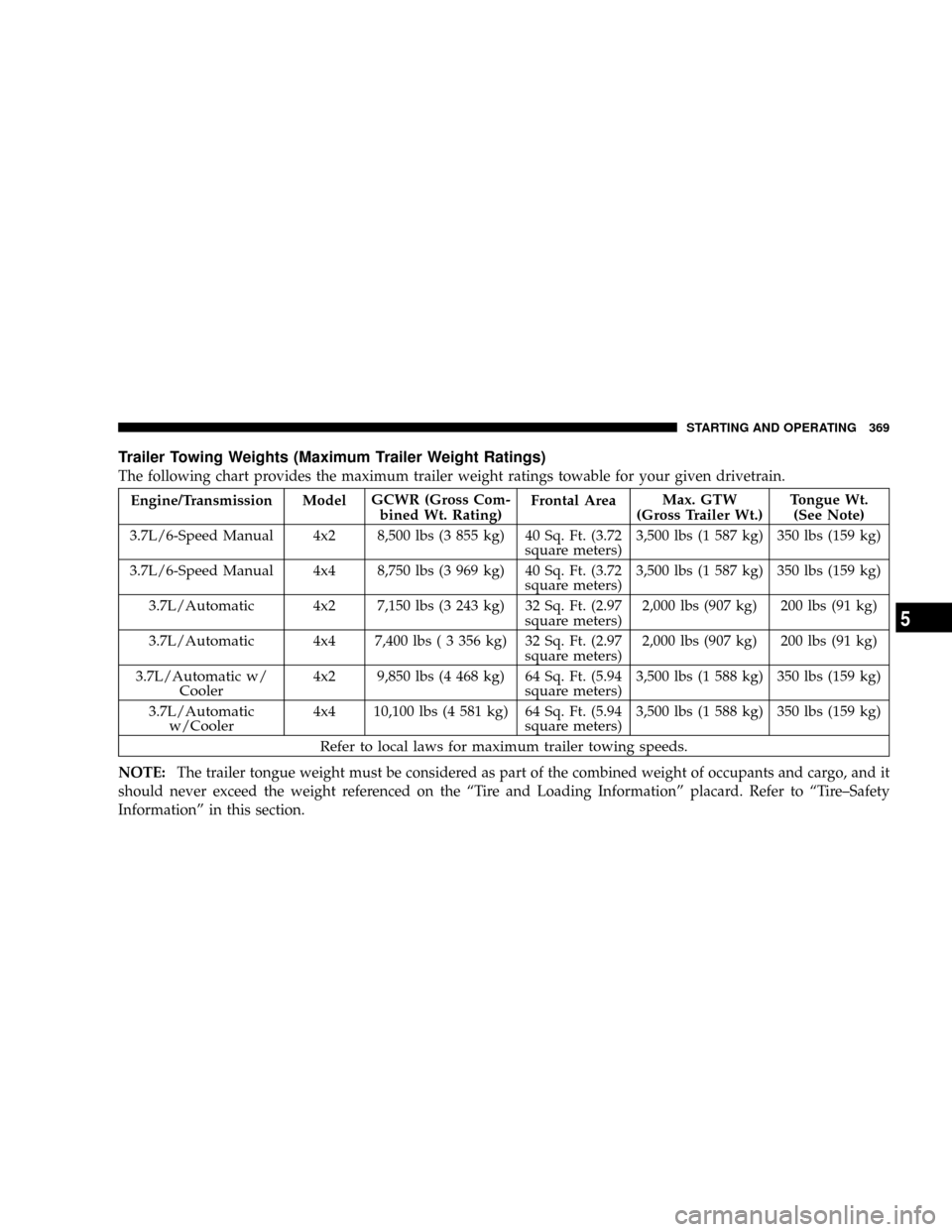
Trailer Towing Weights (Maximum Trailer Weight Ratings)
The following chart provides the maximum trailer weight ratings towable for your given drivetrain.
Engine/Transmission ModelGCWR (Gross Com-
bined Wt. Rating)Frontal AreaMax. GTW
(Gross Trailer Wt.)Tongue Wt.
(See Note)
3.7L/6-Speed Manual 4x2 8,500 lbs (3 855 kg) 40 Sq. Ft. (3.72
square meters)3,500 lbs (1 587 kg) 350 lbs (159 kg)
3.7L/6-Speed Manual 4x4 8,750 lbs (3 969 kg) 40 Sq. Ft. (3.72
square meters)3,500 lbs (1 587 kg) 350 lbs (159 kg)
3.7L/Automatic 4x2 7,150 lbs (3 243 kg) 32 Sq. Ft. (2.97
square meters)2,000 lbs (907 kg) 200 lbs (91 kg)
3.7L/Automatic 4x4 7,400 lbs ( 3 356 kg) 32 Sq. Ft. (2.97
square meters)2,000 lbs (907 kg) 200 lbs (91 kg)
3.7L/Automatic w/
Cooler4x2 9,850 lbs (4 468 kg) 64 Sq. Ft. (5.94
square meters)3,500 lbs (1 588 kg) 350 lbs (159 kg)
3.7L/Automatic
w/Cooler4x4 10,100 lbs (4 581 kg) 64 Sq. Ft. (5.94
square meters)3,500 lbs (1 588 kg) 350 lbs (159 kg)
Refer to local laws for maximum trailer towing speeds.
NOTE:The trailer tongue weight must be considered as part of the combined weight of occupants and cargo, and it
should never exceed the weight referenced on the ªTire and Loading Informationº placard. Refer to ªTire±Safety
Informationº in this section.
STARTING AND OPERATING 369
5
Page 370 of 493

When Towing Trailers with Gross Trailer Weight (GTW) between 3,500 Lbs (1 588 kg) and 5,000 Lbs (2 268 kg)
The following chart provides maximum trailer weight ratings towable for the following engine/transmission
combinations,ONLYif using a weight distributing hitch.
Engine/
TransmissionModel GCWR (Gross Com-
bined Wt. Rating)Frontal Area Max. GTW
(Gross Trailer Wt.)Tongue Wt.
(See Note)
3.7L/
Automatic w/
Cooler4x2 9,850 lbs (4 468 kg) 64 Sq. Ft. (5.94
square meters)5,000 lbs (2 268 kg) 500 lbs (227 kg)
3.7L/
Automatic
w/Cooler4x4 10,100 lbs (4 581 kg) 64 Sq. Ft. (5.94
square meters)5,000 lbs (2 268 kg) 500 lbs (227 kg)
Refer to local laws for maximum trailer towing speeds.
NOTE:The trailer tongue weight must be considered as part of the combined weight of occupants and cargo, and it
should never exceed the weight referenced on the ªTire and Loading Informationº placard. Refer to ªTire±Safety
Informationº in this section.
370 STARTING AND OPERATING