seats JEEP LIBERTY 2009 KK / 2.G Owners Manual
[x] Cancel search | Manufacturer: JEEP, Model Year: 2009, Model line: LIBERTY, Model: JEEP LIBERTY 2009 KK / 2.GPages: 506
Page 35 of 506
3. Press the power door UNLOCK switch to unlock the
doors.
4. A single chime will indicate the completion of the
programming.
Repeat these steps if you want to return this feature to its
previous setting.
NOTE:Use the Automatic Unlock Doors On Exit feature
in accordance with local laws.
Child-Protection Door Lock System (Rear Doors)
To provide a safer environment for small children riding
in the rear seats, the rear doors are equipped with a Child
Protection Door Lock system.
To Engage the Child Protection Door Lock
1. Open the rear door.
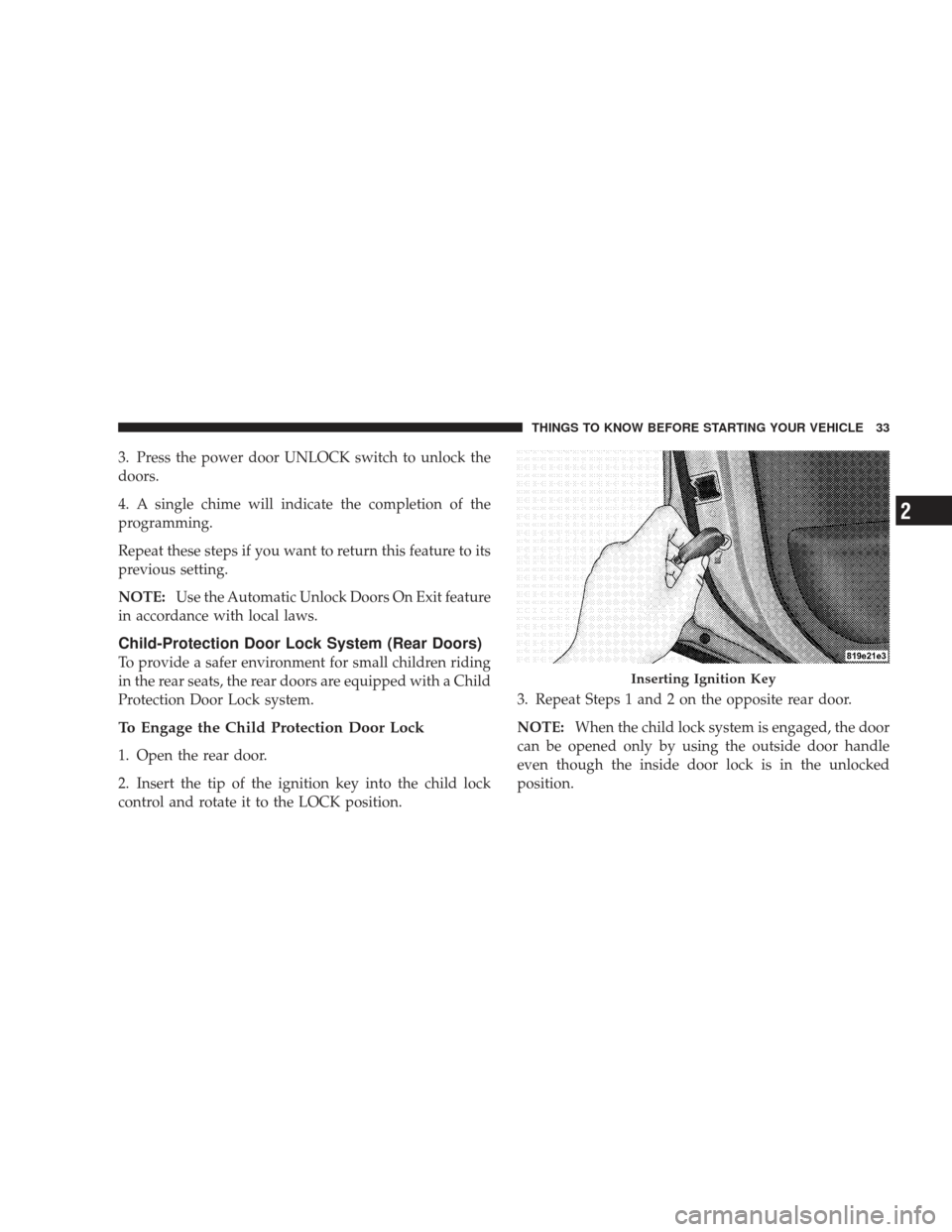
2. Insert the tip of the ignition key into the child lock
control and rotate it to the LOCK position. 3. Repeat Steps 1 and 2 on the opposite rear door.
NOTE:
When the child lock system is engaged, the door
can be opened only by using the outside door handle
even though the inside door lock is in the unlocked
position.
Inserting Ignition Key
THINGS TO KNOW BEFORE STARTING YOUR VEHICLE 33
2
Page 45 of 506
inside of the vehicle.Everyonein a motor vehicle should
be belted at all times to reduce or prevent injuries.
Lap/Shoulder Belts
All seating positions in your vehicle have combination
lap/shoulder belts. The belt webbing retractor is de-
signed to lock during very sudden stops or collisions.
This feature allows the shoulder part of the belt to move
freely with you under normal conditions. However, in a
collision, the belt will lock and reduce your risk of
striking the inside of the vehicle or being thrown out.
WARNING!
•It is extremely dangerous to ride in a cargo area,
inside or outside of a vehicle. In a collision, people
riding in these areas are more likely to be seri-
ously injured or killed.
(Continued)
WARNING! (Continued)
•Do not allow people to ride in any area of your
vehicle that is not equipped with seats and seat
belts.
•Be sure everyone in your vehicle is in a seat and
using a seat belt properly.
•Wearing a seat belt incorrectly is dangerous. Seat
belts are designed to go around the large bones of
your body. These are the strongest parts of your
body and can take the forces of a collision the best.
•Wearing your belt in the wrong place could make
your injuries in a collision much worse. You might
suffer internal injuries, or you could even slide out
of part of the belt. Follow these instructions to
wear your seat belt safely and to keep your pas-
sengers safe, too.(Continued)
THINGS TO KNOW BEFORE STARTING YOUR VEHICLE 43
2
Page 58 of 506
trigger on the crash side of the vehicle in moderate-to-
severe side collisions or on both sides of the vehicle in
rollover collisions. In certain types of collisions, both the
front and side airbags may be triggered. However, even
in collisions where the airbags deploy, you need the seat
belts to keep you in the right position for the airbags to
protect you properly.
NOTE:The passenger front airbag may not deploy even
when the driver front airbag has; particularly if the
Occupant Classification System has determined the pas-
senger seat is empty or is occupied by someone that is
classified in a category other than that of an adult (refer
to information on Occupant Classification System in this
section). This could be a child, teenager, or even a small
size adult. Here are some simple steps you can take to minimize
the risk of harm from a deploying airbag:
1. Children 12 years old and younger should always ride
buckled up in the rear seat.
Infants in rear facing child restraints should
NEVERride
in the front seat of a vehicle with a passenger front airbag.
An airbag deployment could cause severe injury or death
to infants in that position.
Children that are not big enough to wear the vehicle seat
belt properly should be secured in the rear seat in child
restraints or belt-positioning booster seats. Older chil-
dren who do not use child restraints or belt-positioning
booster seats should ride properly buckled up in the rear
seat. Never allow children to slide the shoulder belt
behind them or under their arms.
56 THINGS TO KNOW BEFORE STARTING YOUR VEHICLE
Page 59 of 506
If a child from 1 to 12 years old must ride in the front
passenger seat because the vehicle is crowded, move the
seat as far back as possible, and use the proper child
restraint (refer to information on Child Restraint in this
section).
You should read the instructions provided with your
child restraint to make sure that you are using it properly.
2. All occupants should use their lap and shoulder belts
properly.
3. The driver and front passenger seats should be moved
back as far as practical to allow the front airbags room to
inflate.
4. Do not lean against the door or window; airbags will
inflate forcefully into the space between you and the
door.
5. If the airbag system in this vehicle needs to be
modified to accommodate a disabled person, contact theCustomer Center. Phone numbers are provided under “If
You Need Assistance” in Section 9 of this manual.
WARNING!
•Relying on the airbags alone could lead to more
severe injuries in a collision. The airbags work
with your seat belt to restrain you properly. In
some collisions, the airbags won’t deploy at all.
Always wear your seat belts even though you have
airbags.
•Being too close to the steering wheel or instrument
panel during airbag deployment could cause seri-
ous injury. Airbags need room to inflate. Sit back,
comfortably extending your arms to reach the
steering wheel or instrument panel.
•The side curtain airbags need room to inflate. Do
not lean against the door or window. Sit upright in
the center of the seat.
THINGS TO KNOW BEFORE STARTING YOUR VEHICLE 57
2
Page 73 of 506
Child Restraint
Everyone in your vehicle needs to be buckled up all the
time, including babies and children. Every state in the
United States and all Canadian provinces require that
small children ride in proper restraint systems. This is the
law, and you can be prosecuted for ignoring it.
Children 12 years and younger should ride properly
buckled up in a rear seat, if available. According to crash
statistics, children are safer when properly restrained in
the rear seats rather than in the front.WARNING!
In a collision, an unrestrained child, even a tiny baby,
can become a missile inside the vehicle. The force
required to hold even an infant on your lap can
become so great that you could not hold the child, no
matter how strong you are. The child and others
could be badly injured. Any child riding in your
vehicle should be in a proper restraint for the child’s
size.
There are different sizes and types of restraints for
children from newborn size to the child almost large
enough for an adult safety belt. Always check the child
seat Owner’s Manual to ensure you have the right seat
for your child. Use the restraint that is correct for your
child.
THINGS TO KNOW BEFORE STARTING YOUR VEHICLE 71
2
Page 74 of 506
Infants and Child Restraints
•
Safety experts recommend that children ride
rearward-facing in the vehicle until they are at least
one year oldandweigh at least 20 lbs (9 kg). Two types
of child restraints can be used rearward-facing: infant
carriers and “convertible” child seats.
•The infant carrier is only used rearward-facing in the
vehicle. It is recommended for children who weigh up
to about 20 lbs (9 kg). “Convertible” child seats can be
used either rearward-facing or forward-facing in the
vehicle. Convertible child seats often have a higher
weight limit in the rearward-facing direction than
infant carriers do, so they can be used rearward-facing
by children who weigh more than 20 lbs (9 kg) but are
less than one year old. Both types of child restraints are
held in the vehicle by the lap/shoulder belt or the
LATCH child restraint anchorage system. Refer to “LATCH — Child Seat Anchorage System (Lower
Anchors and Tether for CHildren)” in this section.
•Rearward-facing child seats must
NEVERbe used in
the front seat of a vehicle with the front passenger
airbag unless the airbag is turned off. An airbag
deployment could cause severe injury or death to
infants in this position.
Older Children and Child Restraints
Children who weigh more than 20 lbs (9 kg) and who are
older than one year can ride forward-facing in the
vehicle. Forward-facing child seats and convertible child
seats used in the forward-facing direction are for children
who weigh 20 to 40 lbs (9 to 18 kg) and who are older
than one year. These child seats are also held in the
vehicle by the lap/shoulder belt or the LATCH child
restraint anchorage system. Refer to “LATCH — Child
Seat Anchorage System (Lower Anchors and Tether for
CHildren)” in this section.
72 THINGS TO KNOW BEFORE STARTING YOUR VEHICLE
Page 75 of 506
The belt-positioning booster seat is for children weighing
more than 40 lbs (18 kg), but who are still too small to fit
the vehicle’s seat belts properly. If the child cannot sit
with knees bent over the vehicle’s seat cushion while the
child’s back is against the seatback, they should use a
belt-positioning booster seat. The child and belt-
positioning booster seat are held in the vehicle by the
lap/shoulder belt.
Children Too Large for Booster Seats
Children who are large enough to wear the shoulder belt
comfortably, and whose legs are long enough to bend
over the front of the seat when their back is against the
seat back, should use the lap/shoulder belt in a rear seat.
•Make sure that the child is upright in the seat.
•The lap portion of the seat belt should be low on the
hips and as snug as possible.
•Check belt fit periodically. A child’s squirming or
slouching can move the belt out of position.
•If the shoulder belt contacts the face or neck, move the
child closer to the center of the vehicle. Never allow a
child to put the shoulder belt under an arm or behind
their back.
NOTE: For additional information, refer to
www.seatcheck.org or call 1–866–SEATCHECK.
WARNING!
•Improper installation can lead to failure of an
infant or child restraint. It could come loose in a
collision. The child could be badly injured or
killed. Follow the manufacturer’s directions ex-
actly when installing an infant or child restraint. (Continued)
THINGS TO KNOW BEFORE STARTING YOUR VEHICLE 73
2
Page 76 of 506
WARNING! (Continued)
•A rearward- facing infant restraint should only be
used in a rear seat. A rearward-facing infant re-
straint in the front seat may be struck by a deploy-
ing passenger airbag, which may cause severe or
fatal injury to the infant.
Here are some tips on getting the most out of your child
restraint:
•Before buying any restraint system, make sure that it
has a label certifying that it meets all applicable Safety
Standards. The manufacturer also recommends that
you try a child restraint in the vehicle seats where you
will use it before you buy it.
•The restraint must be appropriate for your child’s
weight and height. Check the label on the restraint for
weight and height limits.
•Carefully follow the instructions that come with the
restraint. If you install the restraint improperly, it may
not work when you need it.
•Buckle the child into the restraint exactly as the
manufacturer’s instructions tell you.
•When your child restraint is not in use, secure it in the
vehicle with the seat belt or remove it from the vehicle.
Do not leave it loose in the vehicle. In a sudden stop or
collision, it could strike the occupants or seat backs
and cause serious personal injury.
LATCH — Child Seat Anchorage System (Lower
Anchors and Tether for CHildren)
Your vehicle’s rear seat is equipped with the child
restraint anchorage system called LATCH. The LATCH
system provides for the installation of the child restraint
without using the vehicle’s seat belts, instead securing
74 THINGS TO KNOW BEFORE STARTING YOUR VEHICLE
Page 77 of 506
the child restraint using lower anchorages and upper
tether straps from the child restraint to the vehicle
structure.
LATCH-compatible child restraint systems are now avail-
able. However, because the lower anchorages are to be
introduced over a period of years, child restraint systems
having attachments for those anchorages will continue to
have features for installation using the vehicle’s seat
belts. Child restraints having tether straps and hooks for
connection to the top tether anchorages, have been
available for some time. For some older child restraints,
many child restraint manufacturers offer add-on tether
strap kits or retrofit kits. You are urged to take advantage
of all the available attachments provided with your child
restraint in any vehicle.
All three rear seating positions have lower anchorages
that are capable of accommodating LATCH-compatible
child seats having fixed lower attachments or flexiblewebbing-mounted lower attachments. Child seats with
fixed lower attachments must be installed in the out-
board seating positions only. The center seating position
will accommodate LATCH-compatible lower anchorages
with flexible webbing mounted attachments only. Re-
gardless of the specific type of lower attachment.
NEVER
install LATCH-compatible child seats such that two seats
share a common lower anchorage.
If you are installing LATCH-compatible child restraints
in adjacent rear seating positions, you can use the
LATCH anchors or the vehicle’s seat belt for the outboard
position, but you must use the vehicle’s seat belt at the
center position. If your child restraints are not LATCH-
compatible, you can only install the child restraints using
the vehicle’s seat belts. Please refer to “Installing the
LATCH-Compatible Child Restraint System” and “In-
stalling Child Restraints Using the Vehicle Seat Belt” in
this section for typical installation instructions.
THINGS TO KNOW BEFORE STARTING YOUR VEHICLE 75
2
Page 83 of 506
A new engine may consume some oil during its first few
thousand miles (kilometers) of operation. This should be
considered a normal part of the break-in and not inter-
preted as an indication of difficulty.
SAFETY TIPS
Transporting Passengers
NEVER TRANSPORT PASSENGERS IN THE CARGO
AREA.
WARNING!
•It is extremely dangerous to ride in a cargo area,
inside or outside of a vehicle. In a collision, people
riding in these areas are more likely to be seri-
ously injured or killed.
•Do not allow people to ride in any area of your
vehicle that is not equipped with seats and seat belts.
(Continued)
WARNING! (Continued)
•Be sure everyone in your vehicle is in a seat and
using a seat belt properly.
Exhaust Gas
WARNING!
Exhaust gases can injure or kill. They contain carbon
monoxide (CO), which is colorless and odorless.
Breathing it can make you unconscious and can
eventually poison you. To avoid breathing (CO)
follow these safety tips:
Do not run the engine in a closed garage or in confined
areas any longer than needed to move your vehicle in or
out of the area.
THINGS TO KNOW BEFORE STARTING YOUR VEHICLE 81
2