JEEP LIBERTY 2010 Owners Manual
LIBERTY 2010
JEEP
JEEP
https://www.carmanualsonline.info/img/16/55996/w960_55996-0.png
JEEP LIBERTY 2010 Owners Manual
Page 43 of 522
ejection and the risk of injury caused by striking the
inside of the vehicle.Everyone in a motor vehicle should
be belted at all times.
Lap/Shoulder Belts
All seating positions in your vehicle have combination
lap/shoulder belts. The belt webbing retractor is de-
signed to lock during very sudden stops or collisions.
This feature allows the shoulder part of the belt to move
freely with you under normal conditions. However, in a
collision, the belt will lock and reduce your risk of
striking the inside of the vehicle or being thrown out.
Page 65 of 522
START or ON positions. If the key is in the LOCK
position, in the ACC position, or not in the ignition, the
airbags are not on and will not inflate.
The ORC contains a backup power supply system that
may deploy the airbags even if the battery loses power or
it becomes disconnected prior to deployment.
•Also, the ORC turns on the “Airbag Warn-
ing Light” for six to eight seconds for a
self-check when the ignition is first turned
ON. After the self-check, the “Airbag Warn-
ing Light” will turn off. If the ORC detects a malfunc-
tion in any part of the system, it turns on the “Airbag
Warning Light” either momentarily or continuously. A
single chime will sound if the light comes on again
after initial startup.
Page 73 of 522
Enhanced Accident Response System
In the event of an impact causing airbag deployment, if
the communication network remains intact, and the
power remains intact, depending on the nature of the
event the ORC will determine whether to have the
Enhanced Accident Response System to perform the
following functions:
•Cut off fuel to the engine.
•Flash hazard lights as long as the battery has power or
until the ignition key is turned off.
•Turn on the interior lights, which remain on as long as
the battery has power or until the ignition key is
removed.
•Unlock the doors automatically.
Maintaining Your Airbag System
Page 141 of 522
WARNING! (Continued)
•Do not allow people to ride in any area of your
vehicle that is not equipped with seats and seat
belts.
•Be sure everyone in your vehicle is in a seat and
using a seat belt properly.
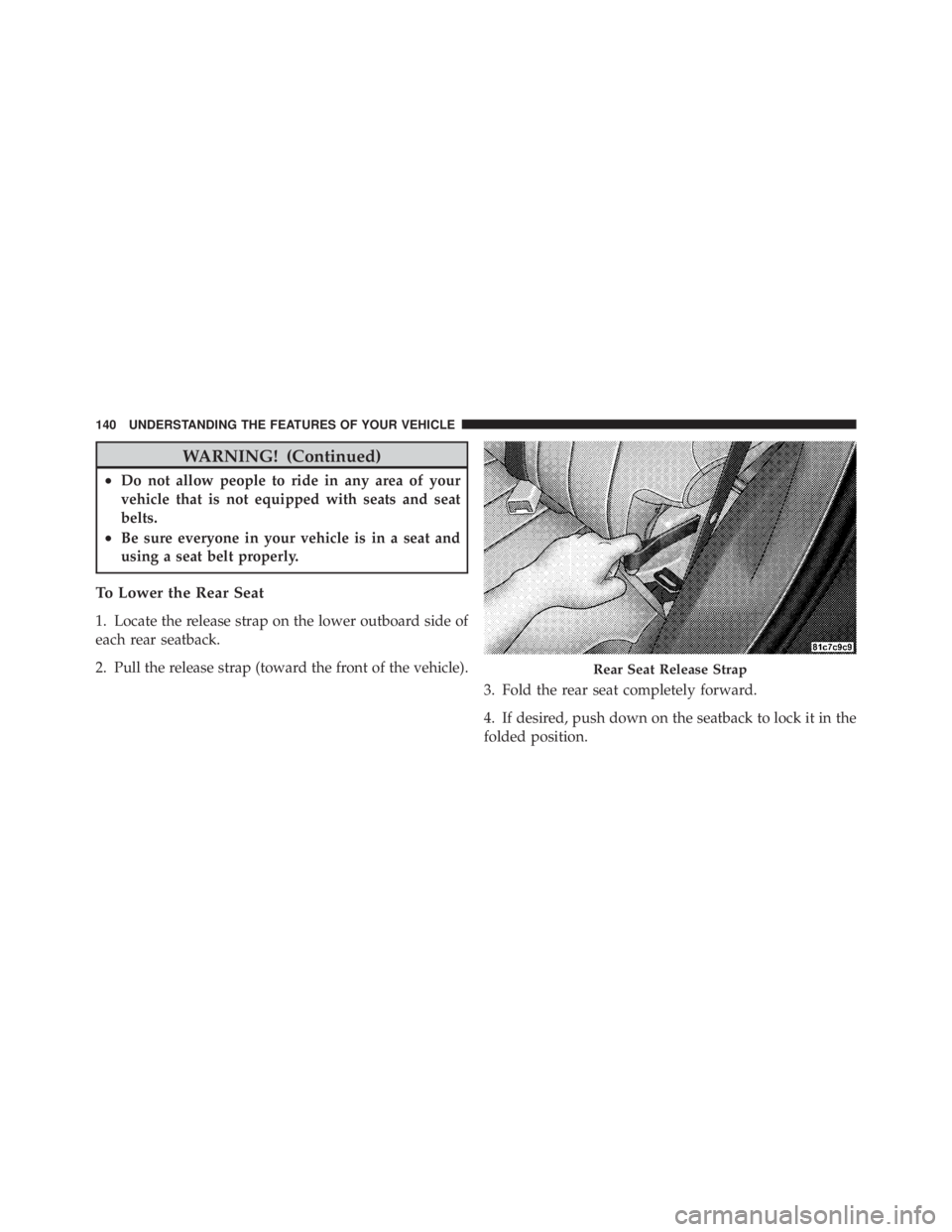
To Lower the Rear Seat
1. Locate the release strap on the lower outboard side of
each rear seatback.
2. Pull the release strap (toward the front of the vehicle).3. Fold the rear seat completely forward.
4. If desired, push down on the seatback to lock it in the
folded position.
Page 161 of 522
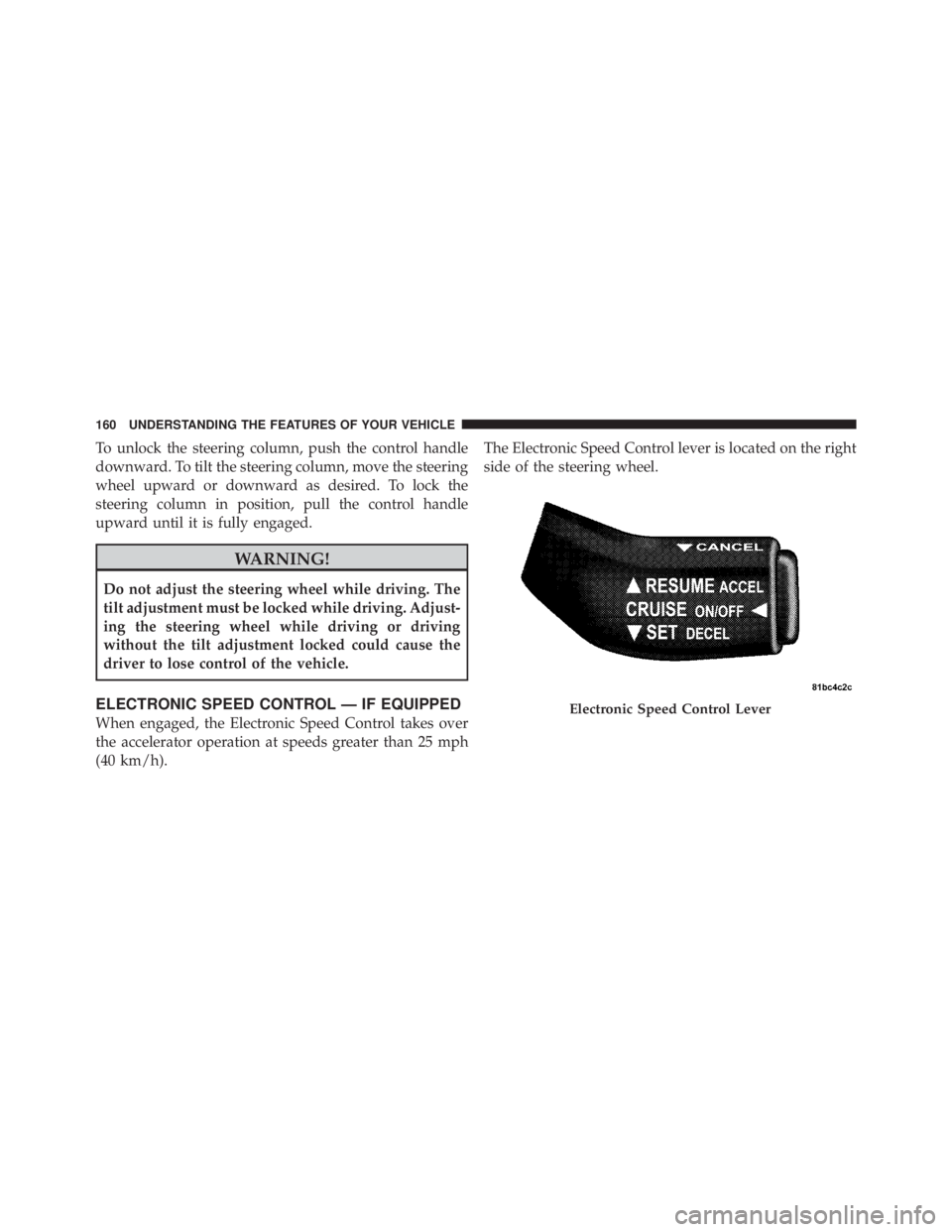
To unlock the steering column, push the control handle
downward. To tilt the steering column, move the steering
wheel upward or downward as desired. To lock the
steering column in position, pull the control handle
upward until it is fully engaged.
Page 301 of 522
Extreme Cold Weather (below –20°F or –29°C)
To ensure reliable starting at these temperatures, use of
an externally powered electric engine block heater (avail-
able from your authorized dealer) is recommended.
If Engine Fails to Start
Page 329 of 522
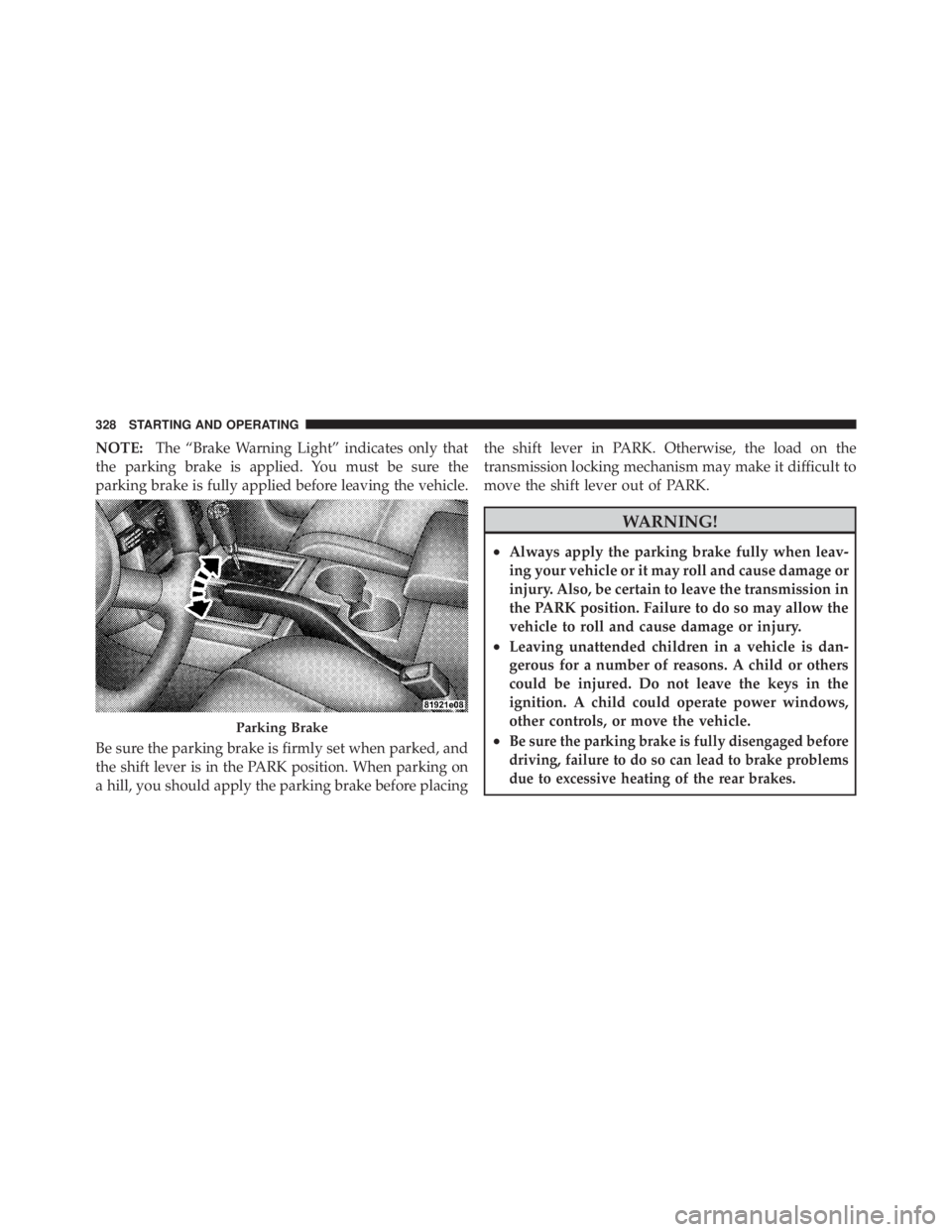
NOTE:The “Brake Warning Light” indicates only that
the parking brake is applied. You must be sure the
parking brake is fully applied before leaving the vehicle.
Be sure the parking brake is firmly set when parked, and
the shift lever is in the PARK position. When parking on
a hill, you should apply the parking brake before placing the shift lever in PARK. Otherwise, the load on the
transmission locking mechanism may make it difficult to
move the shift lever out of PARK.
Page 331 of 522
WARNING!
•Pumping of the Anti-Lock Brakes will diminish
their effectiveness and may lead to an accident.
Pumping makes the stopping distance longer. Just
press firmly on your brake pedal when you need
to slow down or stop.
•The ABS cannot prevent the natural laws of phys-
ics from acting on the vehicle, nor can it increase
braking or steering efficiency beyond that af-
forded by the condition of the vehicle brakes and
tires or the traction afforded.
•The ABS cannot prevent accidents, including
those resulting from excessive speed in turns,
following another vehicle too closely, or hydro-
planing. Only a safe, attentive, and skillful driver
can prevent accidents.(Continued)
Page 333 of 522
Two additional electronic brake control system options
are Hill Descent Control (HDC) and Trailer Sway Control
(TSC). Your vehicle may be equipped with one or both of
these options.
Anti-Lock Brake System (ABS)
This system aids the driver in maintaining vehicle control
under adverse braking conditions. The system controls
hydraulic brake pressure to prevent wheel lock-up to
help avoid skidding on slippery surfaces during braking.
Refer to “Anti-Lock Brake System” in Section 5 of this
manual for more information about ABS.
Page 393 of 522
WARNING! (Continued)
•Safety chains must always be used between your
vehicle and trailer. Always connect the chains to
the frame or hook retainers of the vehicle hitch.
Cross the chains under the trailer tongue and
allow enough slack for turning corners.
•Vehicles with trailers should not be parked on a
grade. When parking, apply the parking brake on
the tow vehicle. Put the tow vehicle transmission
in PARK. Always, block or\bchock\bthe trailer
wheels.
•GCWR must not be exceeded.
•Total weight must be distributed between the tow
vehicle and the trailer such that the following four
ratings are not exceeded:
1. GVWR
2. GTW
(Continued)