heating JEEP LIBERTY 2011 KK / 2.G User Guide
[x] Cancel search | Manufacturer: JEEP, Model Year: 2011, Model line: LIBERTY, Model: JEEP LIBERTY 2011 KK / 2.GPages: 542
Page 308 of 542
Window Fogging
Interior fogging on the windshield can be quickly re-
moved by turning the mode selector to Defrost. The
Defrost/Floor mode can be used to maintain a clear
windshield and provide sufficient heating. If side win-
dow fogging becomes a problem, increase blower speed.
Vehicle windows tend to fog on the inside in mild but
rainy or humid weather.
NOTE:Recirculate without A/C should not be used for
long periods as fogging may occur.
Side Window Demisters
A side window demister outlet is located at each end of
the instrument panel. These non-adjustable outlets direct
air toward the side windows when the system is in the
FLOOR, MIX, or DEFROST mode. The air is directed at
the area of the windows through which you view the
outside mirrors.
Outside Air Intake
Make sure the air intake, located directly in front of the
windshield, is free of obstructions such as leaves. Leaves
collected in the air intake may reduce airflow, and if they
enter the plenum, they could plug the water drains. In
winter months, make sure the air intake is clear of ice,
slush, and snow.
A/C Air Filter — If Equipped
The A/C Filter prevents most dust and pollen from
entering the cabin. The filter acts on air coming from
outside the vehicle and recirculated air within the pas-
senger compartment. Refer to “Maintenance Procedures”
in “Maintaining Your Vehicle” for A/C Air Filter service
information or see your authorized dealer for service.
Refer to “Maintenance Schedules” for filter service
intervals.
306 UNDERSTANDING YOUR INSTRUMENT PANEL
Page 321 of 542
2 (Second)
This range is used for moderate grades and to assist
braking on dry pavement or in mud and snow. Begins at
a stop in low gear with automatic upshift into second
gear. Will not shift into third gear.
1 (First)
This range is used for hard pulling at low speeds in mud,
sand, snow, or on steep grades. Begins and stays in low
gear with no upshift. Provides engine compression brak-
ing at low speeds.
Overdrive Operation
The overdrive automatic transmission contains an elec-
tronically controlled fourth gear (OVERDRIVE). The
transmission will automatically shift from third gear into
OVERDRIVE if the following conditions are present:
•the shift lever is in DRIVE
•vehicle speed is above approximately 30 mph
(48 km/h)
•the TOW/HAUL button has not been activated
The transmission will downshift from OVERDRIVE to
DRIVE if the accelerator pedal is fully pressed at vehicle
speeds above approximately 35 mph (56 km/h).
When To Use TOW/HAUL Mode
When driving in hilly areas, towing a trailer, carrying a
heavy load, etc., and frequent transmission shifting oc-
curs, press the TOW/HAUL button. This will improve
performance and reduce the potential for transmission
overheating or failure due to excessive shifting. When
operating in TOW/HAUL mode, the transmission will
shift into third gear.5
STARTING AND OPERATING 319
Page 368 of 542
WARNING!
Overloading of your tires is dangerous. Overloading
can cause tire failure, affect vehicle handling, and
increase your stopping distance. Use tires of the
recommended load capacity for your vehicle. Never
overload them.
TIRES — GENERAL INFORMATION
Tire Pressure
Proper tire inflation pressure is essential to the safe and
satisfactory operation of your vehicle. Three primary
areas are affected by improper tire pressure:
Safety
WARNING!
•Improperly inflated tires are dangerous and can
cause collisions.
•Under-inflation increases tire flexing and can re-
sult in over-heating and tire failure.
•Over-inflation reduces a tire’s ability to cushion
shock. Objects on the road and chuckholes can
cause damage that result in tire failure.
•Over-inflated or under-inflated tires can affect
vehicle handling and can fail suddenly, resulting
in loss of vehicle control.
•Unequal tire pressures can cause steering prob-
lems. You could lose control of your vehicle.(Continued)
366 STARTING AND OPERATING
Page 414 of 542
Electronic Speed Control – If Equipped
Do not use in hilly terrain or with heavy loads.
When using the speed control, if you experience speed
drops greater than 10 mph (16 km/h), disengage until
you can get back to cruising speed.
Use speed control in flat terrain and with light loads to
maximize fuel efficiency.
Cooling System
To reduce potential for engine and transmission over-
heating, take the following actions:
City Driving
When stopped for short periods of time, shift the trans-
mission into NEUTRAL and increase engine idle speed.
Highway Driving
Reduce speed.
Air Conditioning
Turn off temporarily.
412 STARTING AND OPERATING
Page 424 of 542
HAZARD WARNING FLASHERS
The Hazard Warning flasher switch is located in the
switch bank below the climate controls.Press the switch to turn on the Hazard Warning
flasher. When the switch is activated, all directional
turn signals will flash on and off to warn oncoming
traffic of an emergency. Press the switch a second time to
turn off the Hazard Warning flashers.
This is an emergency warning system and it should not
be used when the vehicle is in motion. Use it when your
vehicle is disabled and it is creating a safety hazard for
other motorists.
When you must leave the vehicle to seek assistance, the
Hazard Warning flashers will continue to operate even
though the ignition is placed in the OFF position.
NOTE: With extended use the Hazard Warning flashers
may wear down your battery.
IF YOUR ENGINE OVERHEATS
In any of the following situations, you can reduce the
potential for overheating your engine by taking the
appropriate action.
•On the highways — slow down.
•In city traffic — while stopped, put transmission in
NEUTRAL, but do not increase engine idle speed.
CAUTION!
Driving with a hot cooling system could damage
your vehicle. If the temperature gauge reads “H,”
pull over and stop the vehicle. Idle the vehicle with
the air conditioner turned off until the pointer drops
back into the normal range. If the pointer remains on
the “H” and you hear continuous chimes, turn the
engine off immediately and call for service.
422 WHAT TO DO IN EMERGENCIES
Page 436 of 542
FREEING A STUCK VEHICLE
If your vehicle becomes stuck in mud, sand or snow, it
can often be moved by a rocking motion. Turn your
steering wheel right and left to clear the area around the
front wheels. Then shift back and forth between DRIVE
and REVERSE. Using minimal accelerator pedal pressure
to maintain the rocking motion, without spinning the
wheels, is most effective.
CAUTION!
Racing the engine or spinning the wheels may lead to
transmission overheating and failure. Allow the en-
gine to idle with the shift lever in NEUTRAL for at
least one minute after every five rocking-motion
cycles. This will minimize overheating and reduce
the risk of transmission failure during prolonged
efforts to free a stuck vehicle.NOTE:
If your vehicle is equipped with Traction Con-
trol or Electronic Stability Control (ESC), turn the system
OFF before attempting to “rock” the vehicle.
CAUTION!
•When “rocking” a stuck vehicle by moving be-
tween DRIVE and REVERSE, do not spin the
wheels faster than 15 mph (24 km/h), or drivetrain
damage may result.
•Revving the engine or spinning the wheels too fast
may lead to transmission overheating and failure.
It can also damage the tires. Do not spin the
wheels above 30 mph (48 km/h) while in gear (no
transmission shifting occurring).
434 WHAT TO DO IN EMERGENCIES
Page 460 of 542
NOTE:Intentional tampering with emissions control
systems can result in civil penalties being assessed
against you.
In unusual situations involving grossly malfunctioning
engine operation, a scorching odor may suggest severe
and abnormal catalyst overheating. If this occurs, stop
the vehicle, turn off the engine and allow it to cool.
Service, including a tune-up to manufacturer’s specifica-
tions, should be obtained immediately.
To minimize the possibility of catalytic converter dam-
age:
•Do not shut off the engine or interrupt the ignition,
when the transmission is in gear and the vehicle is in
motion.
•Do not try to start the engine by pushing or towing the
vehicle.
•Do not idle the engine with any spark plug wires
disconnected or removed, such as when diagnostic
testing, or for prolonged periods during very rough
idle or malfunctioning operating conditions.
Cooling System
WARNING!
•You or others can be badly burned by hot coolant
or steam from your radiator. If you see or hear
steam coming from under the hood, do not open
the hood until the radiator has had time to cool.
Never try to open a cooling system pressure cap
when the radiator is hot.
Engine Coolant Checks
Check the engine coolant (antifreeze) protection every
12 months (before the onset of freezing weather, where
applicable). If the engine coolant (antifreeze) is dirty or
458 MAINTAINING YOUR VEHICLE
Page 524 of 542
DisposalAntifreeze (Engine Coolant) ............. 462
Engine Oil ......................... 450
Door Locks ............................. 29
Door Locks, Automatic .................... 31
Door Opener, Garage ..................... 183
Driving ............................... 333
Off-Pavement ....................... 333
Off-Road .......................... 333
On Hills ........................... 333
Through Flowing, Rising, or Shallow
Standing Water ...................... 333
When to Use Low Range ............... 333
Electric Remote Mirrors ................... 101
Electrical Outlet, Auxiliary (Power Outlet) ...... 198
Electrical Power Outlets ................... 198
Electronic Brake Control System ............. 344
Anti-Lock Brake System ................ 344 Brake Assist System
................... 346
Electronic Roll Mitigation ............... 347
Traction Control System ................ 345
Electronic Roll Mitigation (ERM) ............. 347
Electronic Speed Control (Cruise Control) ...... 171
Electronic Stability Control (ESC) ............. 352
Electronic Vehicle Information Center (EVIC) .... 235
Emergency, In Case of Hazard Warning Flasher ............... 422
Jacking ............................ 423
Jump Starting ....................... 430
Overheating ........................ 422
Emission Control System Maintenance ......... 445
Engine ............................... 443
Air Cleaner ......................... 450
Block Heater ........................ 315
Break-In Recommendations .............. 87
Checking Oil Level ................... 448
Compartment ....................... 443
522 INDEX
Page 525 of 542
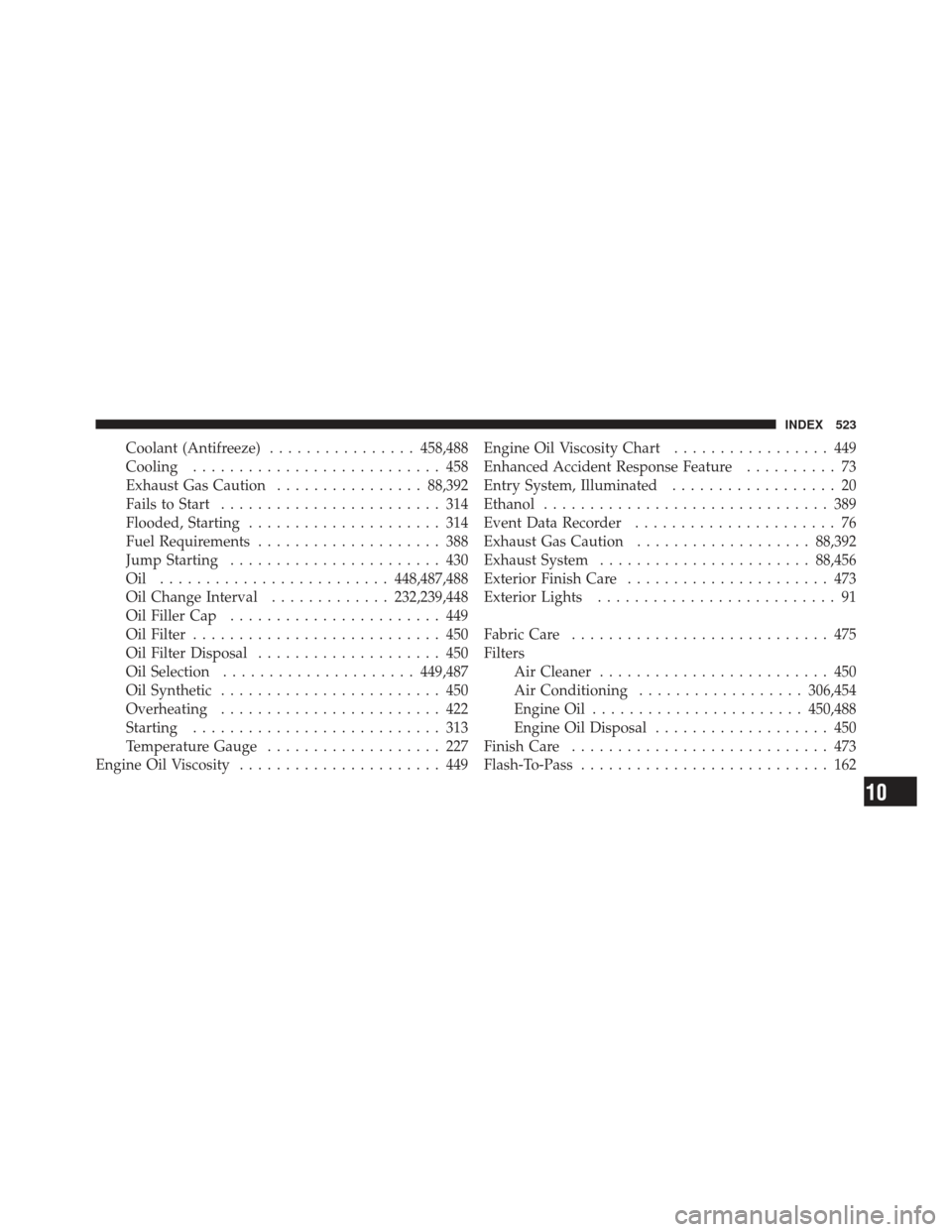
Coolant (Antifreeze)................ 458,488
Cooling ........................... 458
Exhaust Gas Caution ................88,392
Fails to Start ........................ 314
Flooded, Starting ..................... 314
Fuel Requirements .................... 388
Jump Starting ....................... 430
Oil ......................... 448,487,488
Oil Change Interval .............232,239,448
Oil Filler Cap ....................... 449
Oil Filter ........................... 450
Oil Filter Disposal .................... 450
Oil Selection ..................... 449,487
Oil Synthetic ........................ 450
Overheating ........................ 422
Starting ........................... 313
Temperature Gauge ................... 227
Engine Oil Viscosity ...................... 449 Engine Oil Viscosity Chart
................. 449
Enhanced Accident Response Feature .......... 73
Entry System, Illuminated .................. 20
Ethanol ............................... 389
Event Data Recorder ...................... 76
Exhaust Gas Caution ................... 88,392
Exhaust System ....................... 88,456
Exterior Finish Care ...................... 473
Exterior Lights .......................... 91
Fabric Care ............................ 475
Filters Air Cleaner ......................... 450
Air Conditioning .................. 306,454
Engine Oil ....................... 450,488
Engine Oil Disposal ................... 450
Finish Care ............................ 473
Flash-To-Pass ........................... 162
10
INDEX 523
Page 533 of 542
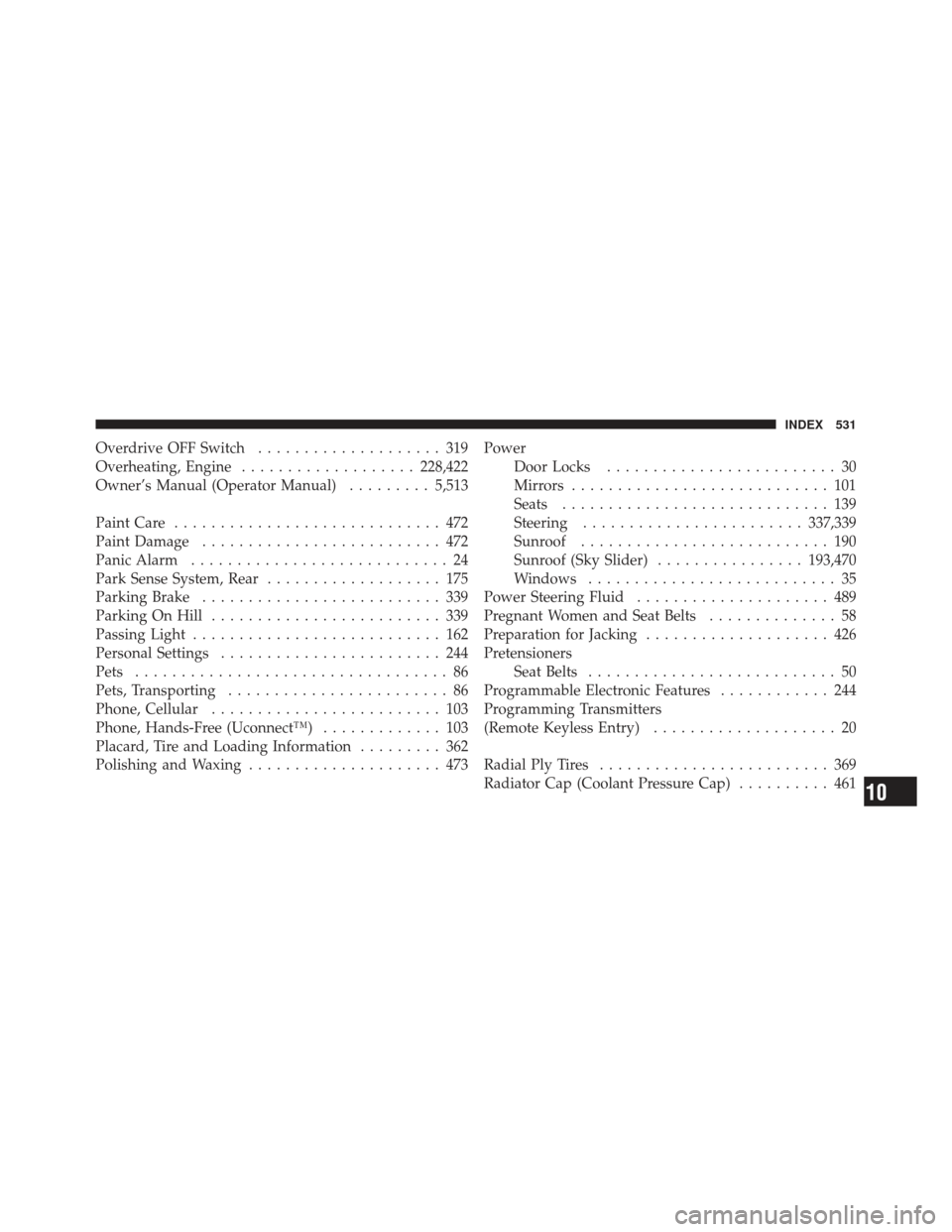
Overdrive OFF Switch.................... 319
Overheating, Engine ................... 228,422
Owner’s Manual (Operator Manual) .........5,513
Paint Care ............................. 472
Paint Damage .......................... 472
Panic Alarm ............................ 24
Park Sense System, Rear ................... 175
Parking Brake .......................... 339
Parking On Hill ......................... 339
Passing Light ........................... 162
Personal Settings ........................ 244
Pets .................................. 86
Pets, Transporting ........................ 86
Phone, Cellular ......................... 103
Phone, Hands-Free (Uconnect™) ............. 103
Placard, Tire and Loading Information ......... 362
Polishing and Waxing ..................... 473 Power
Door Locks ......................... 30
Mirrors ............................ 101
Seats ............................. 139
Steering ........................ 337,339
Sunroof ........................... 190
Sunroof (Sky Slider) ................ 193,470
Windows ........................... 35
Power Steering Fluid ..................... 489
Pregnant Women and Seat Belts .............. 58
Preparation for Jacking .................... 426
Pretensioners Seat Belts ........................... 50
Programmable Electronic Features ............ 244
Programming Transmitters
(Remote Keyless Entry) .................... 20
Radial Ply Tires ......................... 369
Radiator Cap (Coolant Pressure Cap) .......... 461
10
INDEX 531