clutch JEEP PATRIOT 2007 1.G Owners Manual
[x] Cancel search | Manufacturer: JEEP, Model Year: 2007, Model line: PATRIOT, Model: JEEP PATRIOT 2007 1.GPages: 440, PDF Size: 7.26 MB
Page 129 of 440
WARNING!
Leaving the Electronic Speed Control system on
when not in use is dangerous. You could accidentally
set the system or cause it to go faster than you want.
You could lose control and have an accident. Always
leave the system OFF when you are not using it.
To Set At A Desired Speed:
When the vehicle has reached the desired speed, press
down on the lever and release. Release the accelerator
and the vehicle will operate at the selected speed.
NOTE:The vehicle should be traveling at a steady
speed and on level ground before pressing the SET lever.
To Deactivate:
A soft tap on the brake pedal, pulling the speed control
lever towards you ªCANCELº, or normal brake or clutch
pressure while slowing the vehicle will deactivate speed
control without erasing the set speed memory. Pressing
the ON/OFF button or turning off the ignition switch
erases the set speed memory.
To Resume Speed:
To resume a previously set speed, push the ªRESUME
ACCELº lever up and release. Resume can be used at any
speed above 20 mph (32 km/h).
To Vary The Speed Setting:
When the speed control is ON, speed can be increased by
pushing up and holding ªRESUME ACCELº. Release the
lever when the desired speed is reached, and the new
speed will be set.
128 UNDERSTANDING THE FEATURES OF YOUR VEHICLE
Page 130 of 440
Tapping ªRESUME ACCELº once will result ina1mph
(1.6 km/h) speed increase. Each time the lever is tapped,
speed increases so that tapping the lever three times will
increase speed by 3 mph (4.8 km/h), etc.
To decrease speed while speed control is ON, push down
and hold ªSET DECELº. Release the lever when the
desired speed is reached, and the new speed will be set.
Tapping the ªSET DECELº button once will result in a 1
mph (1.6 km/h) speed decrease. Each time the button is
tapped, speed decreases.
Manual Transaxle:
Depressing the clutch pedal will disengage the speed
control. A slight increase in engine RPM before the speed
control disengages is normal.
Vehicles equipped with manual transaxles may need to
be shifted into a lower gear to climb hills without speed
loss.
WARNING!
Speed Control can be dangerous where the system
can't maintain a constant speed. Your vehicle could
go too fast for the conditions, and you could lose
control. An accident could be the result. Don't use
Speed Control in heavy traffic or on roads that are
winding, icy, snow-covered, or slippery.
To Accelerate For Passing:
Depress the accelerator as you would normally. When the
pedal is released, the vehicle will return to the set speed.
Using Speed Control On Hills
NOTE:The speed control system maintains speed up
and down hills. A slight speed change on moderate hills
is normal.
UNDERSTANDING THE FEATURES OF YOUR VEHICLE 129
3
Page 239 of 440
Manual Transaxle
Before starting the engine fully apply the parking brake,
press the clutch pedal to the floor and place the gear
selector in NEUTRAL.
NOTE:The engine will not start unless the clutch pedal
is pressed to the floor.
NOTE:If key won't turn and steering wheel is locked,
rotate the wheel in either direction to relieve pressure on
the locking mechanism and then turn the key.
Normal Starting
Normal Starting of either a cold or a warm engine does
not require pumping or depressing the accelerator pedal.
Simply turn the ignition switch to the ªSTART'º position
and release when the engine starts. If the engine fails to
start within 15 seconds, turn the ignition switch to the
ªOFFº position, wait 10 to 15 seconds, then repeat the
normal starting procedure.
WARNING!
Do not attempt to push or tow your vehicle to get it
started. Vehicles equipped with an automatic trans-
axle cannot be started this way. Unburned fuel could
enter the catalytic converter and once the engine has
started, ignite and damage the converter and vehicle.
If the vehicle has a discharged battery, booster cables
may be used to obtain a start from another vehicle.
This type of start can be dangerous if done improp-
erly, so follow the procedure carefully. See section 6
of this manual for jump starting instructions.
Extremely Cold Weather (below220ÉF or229ÉC)
To insure reliable starting at these temperatures, use of an
externally powered electric engine block heater (available
from your dealer) is recommended.
238 STARTING AND OPERATING
Page 245 of 440
MANUAL TRANSAXLE OPERATION
WARNING!
You or others could be injured if you leave the
vehicle unattended without having the parking
brake fully applied. The parking brake should al-
ways be applied when the driver is not in the vehicle,
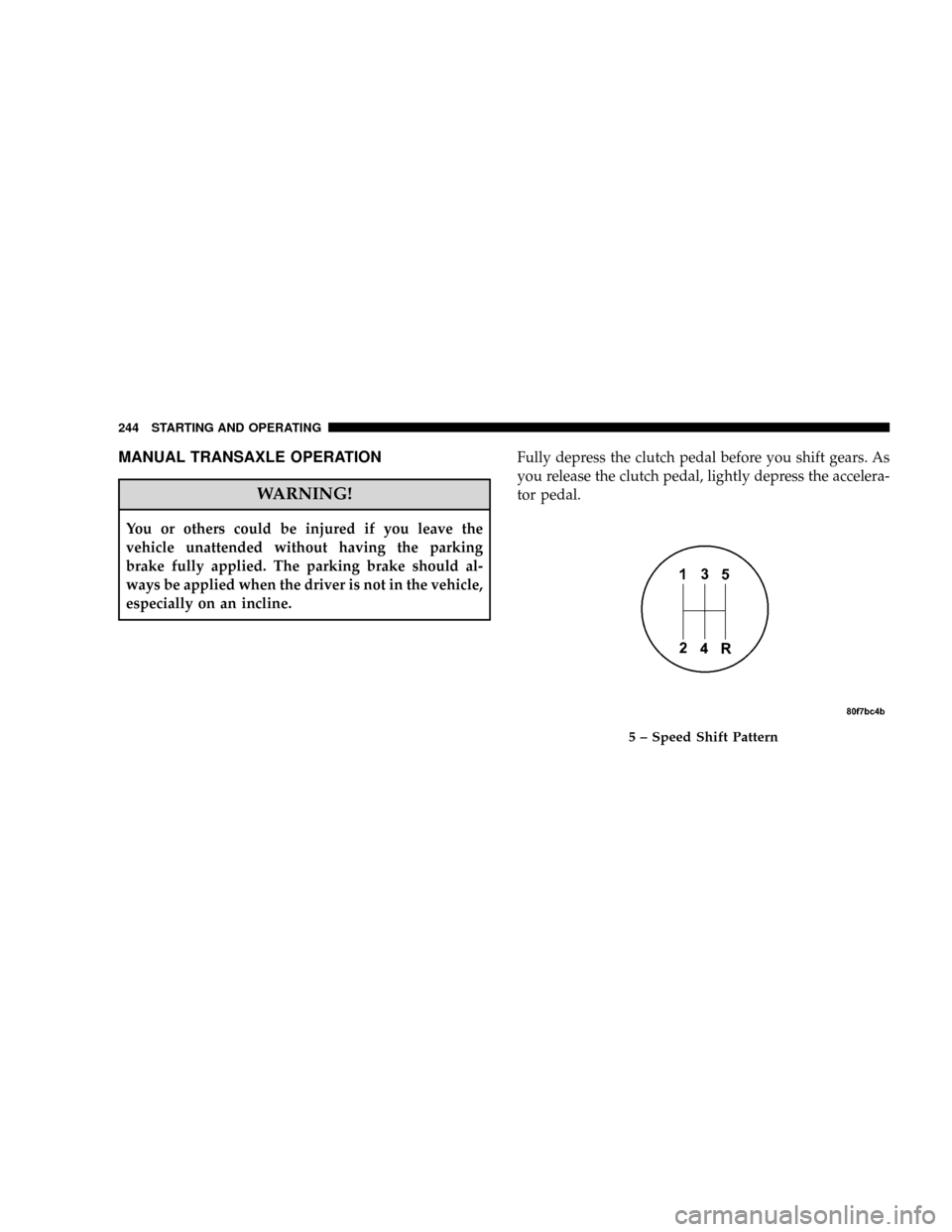
especially on an incline.Fully depress the clutch pedal before you shift gears. As
you release the clutch pedal, lightly depress the accelera-
tor pedal.
5 ± Speed Shift Pattern
244 STARTING AND OPERATING
Page 246 of 440
Use each gear in numerical order - do not skip a gear. Be
sure the transaxle is in FIRST gear, (not THIRD), when
starting from a standing position. Damage to the clutch
can result from starting in THIRD.
For most city driving you will find it easier to use only
the lower gears. For steady highway driving with light
accelerations, 5th gear is recommended.
Never drive with your foot resting on the clutch pedal, or
try to hold the vehicle on a hill with the clutch pedal
partially engaged. This will cause abnormal wear on the
clutch.
Never shift into REVERSE until the vehicle has come to a
complete stop.
NOTE:During cold weather, until the transaxle lubri-
cant is warm, you may experience slightly higher shift
efforts. This is normal and not harmful to the transaxle.Recommended Shift Speeds
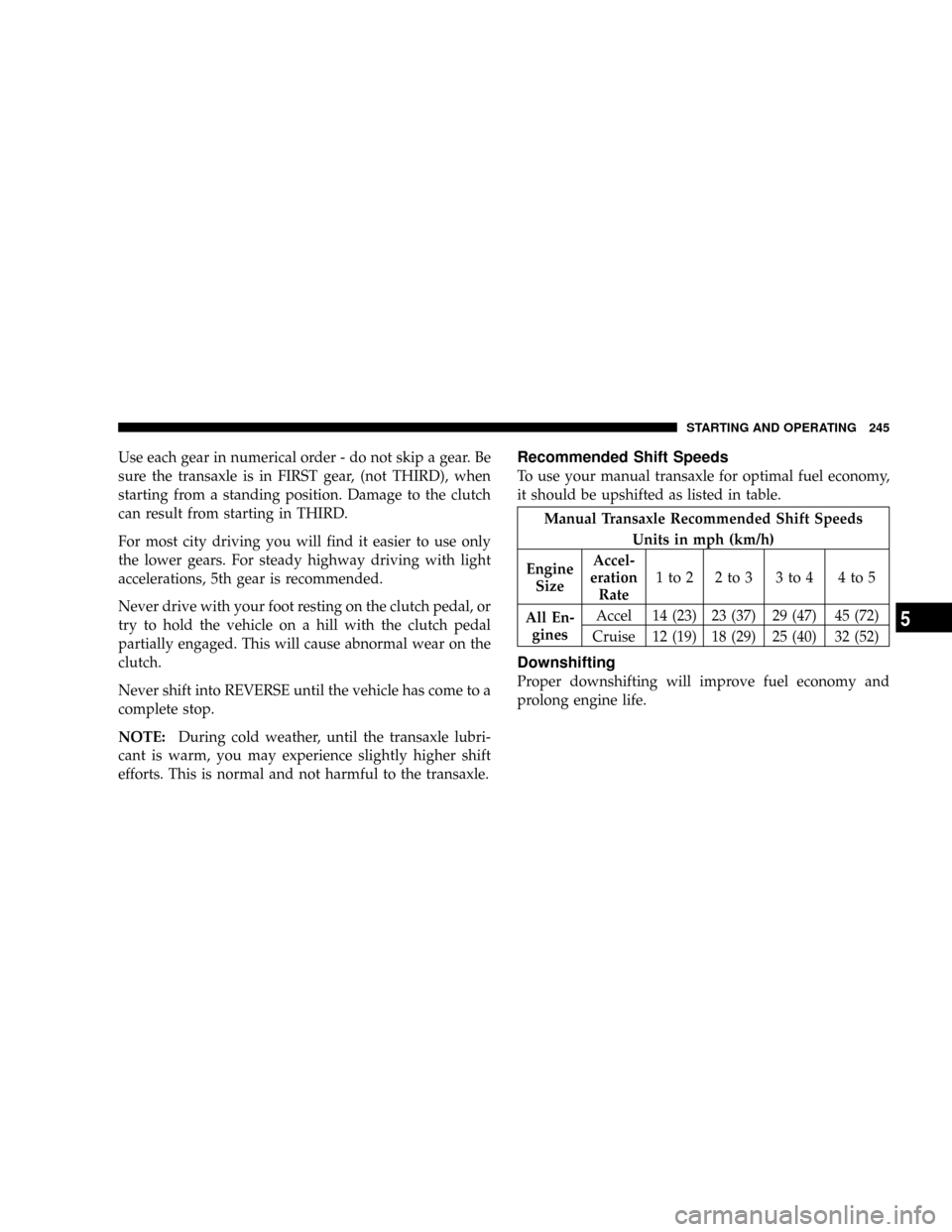
To use your manual transaxle for optimal fuel economy,
it should be upshifted as listed in table.
Manual Transaxle Recommended Shift Speeds
Units in mph (km/h)
Engine
SizeAccel-
eration
Rate1to2 2to3 3to4 4to5
All En-
ginesAccel 14 (23) 23 (37) 29 (47) 45 (72)
Cruise 12 (19) 18 (29) 25 (40) 32 (52)
Downshifting
Proper downshifting will improve fuel economy and
prolong engine life.
STARTING AND OPERATING 245
5
Page 247 of 440
CAUTION!
If you skip more than one gear while downshifting
or downshift at too high a vehicle speed, you could
damage the engine, transmission, or clutch.
To maintain a safe speed and prolong brake life, shift
down to 2nd or 1st when descending a steep grade.
When turning a corner, or driving up a steep grade,
downshift early so that the engine will not be overbur-
dened.
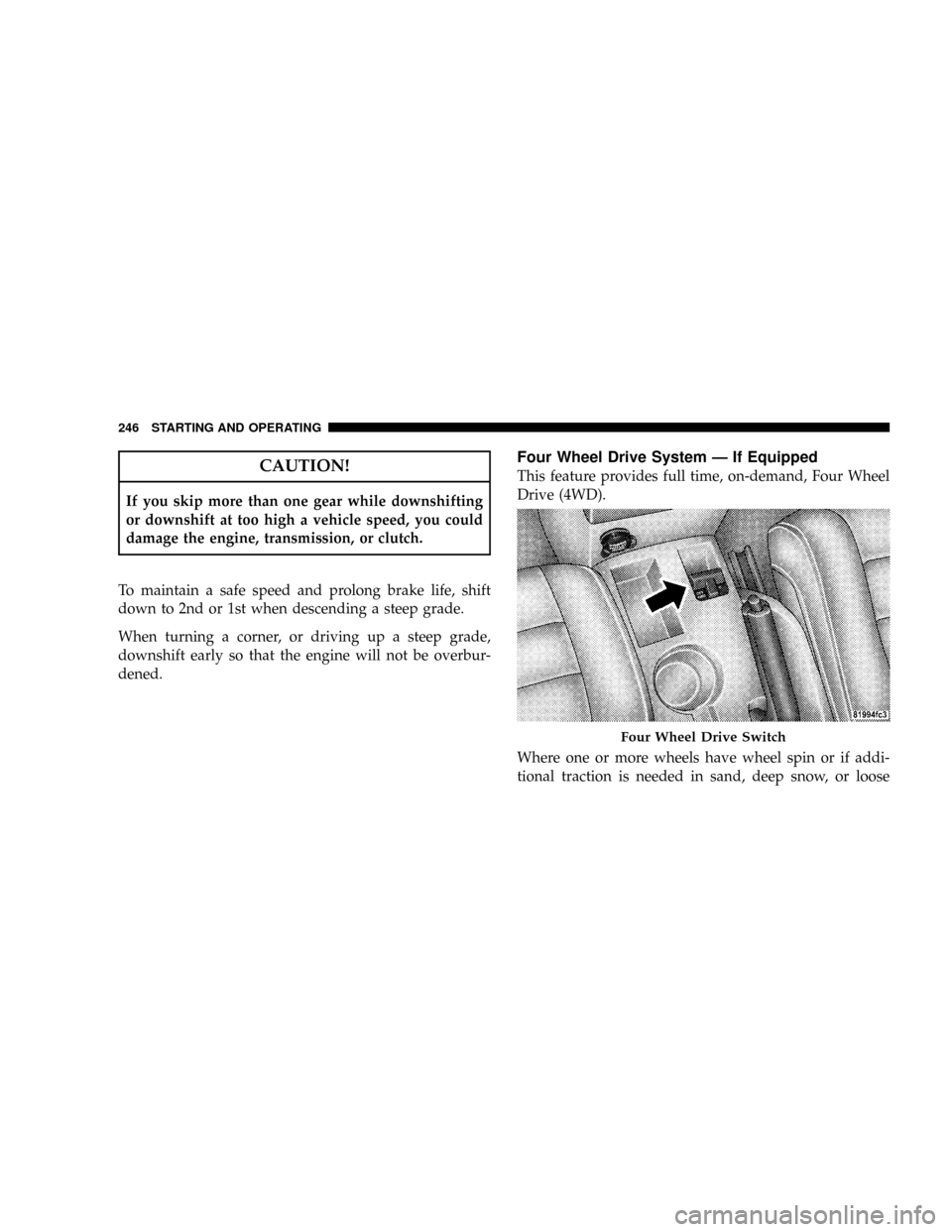
Four Wheel Drive System Ð If Equipped
This feature provides full time, on-demand, Four Wheel
Drive (4WD).
Where one or more wheels have wheel spin or if addi-
tional traction is needed in sand, deep snow, or loose
Four Wheel Drive Switch
246 STARTING AND OPERATING
Page 368 of 440
NOTE:Inspection of brake hoses should be done when-
ever the brake system is serviced and at every engine oil
change.
WARNING!
Worn brake hoses can burst and cause brake failure.
You could have an accident. If you see any signs of
cracking, scuffing, or worn spots, have the brake
hoses replaced immediately.
Brake Master Cylinder
The fluid level in the master cylinder should be checked
when performing under hood services, or immediately if
the brake system warning lamp is on.
Be sure to clean the top of the master cylinder area before
removing the cap. If necessary, add fluid to bring the
fluid level up to the requirements described on the brakefluid reservoir. Fluid level can be expected to fall as the
brake pads wear. Brake fluid level should be checked
when pads are replaced. However, low fluid level may be
caused by a leak and a checkup may be needed.
NOTE:If your vehicle is equipped with aManual
Transaxle, the Brake Fluid Reservoir supplies fluid to
both the Brake System and the Clutch Release System.
The two systems are separated in the reservoir and a leak
in one system will not affect the other system. The
Manual TransaxleClutch Release System should not
require fluid replacement during the life of the vehicle. If
the Brake Fluid Reservoir is low, and the brake system
does not indicate any leaks or other problems, it may be
a result of a leak in the Hydraulic Clutch Release System.
See your local authorized dealer for service.
Use only manufacturers recommended brake fluid, refer
to Fluids, Lubricants and Genuine Parts for correct fluid
type.
MAINTAINING YOUR VEHICLE 367
7
Page 369 of 440
WARNING!
Use of a brake fluid that may have a lower initial
boiling point or unidentified as to specification, may
result in sudden brake failure during hard prolonged
braking. You could have an accident.
CAUTION!
Use of improper brake fluids will affect overall
clutch system performance. Improper brake fluids
may damage the clutch system resulting in loss of
clutch function and the ability to shift the transaxle.
WARNING!
Overfilling the brake fluid reservoir can result in
spilling brake fluid on hot engine parts and the
brake fluid catching fire.
Use only brake fluid that has been in a tightly closed
container to avoid contamination from foreign matter.
Do not allow petroleum based fluid to contaminate the
brake fluid as seal damage will result!
Automatic Transaxle (CVT)
Selection Of Lubricant
It is important that the proper lubricant is used in the
transaxle to assure optimum transaxle performance. Use
only the manufacturer's recommended transmission
fluid which has been formulated with special metal to
metal friction coefficient additives to provide the proper
368 MAINTAINING YOUR VEHICLE
Page 395 of 440
Once a Month
²Check tire pressure and look for unusual wear or
damage.
²Inspect the battery and clean and tighten the terminals
as required.
²Check the fluid levels of coolant reservoir, brake/
clutch master cylinder, and manual transaxle and add
as needed.
²Check all lights and all other electrical items for correct
operation.
At Each Oil Change
²Change the engine oil filter.
²Inspect the exhaust system.
²Inspect the brake hoses.
²Inspect the CV joints (if equipped) and front suspen-
sion components.
²Check the manual transmission fluid level (if
equipped).
²Check the coolant level, hoses, and clamps.
CAUTION!
Do not check the automatic transaxle fluid. It must be
check by a trained service technician every 15,000
miles and if required only the recommended fluid be
added. Refer to the section ªFluids, Lubricants And
Genuine Partsº for the proper fluid.
394 MAINTENANCE SCHEDULES
8
M
A
I
N
T
E
N
A
N
C
E
S
C
H
E
D
U
L
E
S
Page 425 of 440
CD (Compact Disc) Player Maintenance........ 222
Cellular Phone........................82,223
Center High Mounted Stop Light............ 387
Chains, Tire............................ 301
Changing A Flat Tire..................... 326
Chart, Tire Sizing........................ 278
Check Engine Light (Malfunction Indicator Light) . 344
Child Restraint.......................... 60
Child Restraint Tether Anchors............... 64
Child Restraint with Automatic Belts........... 63
Child Safety Locks........................ 23
Child Seat.............................. 66
Clean Air Gasoline....................... 303
Cleaning
Wheels............................. 373
Climate Control......................... 223
Clock........................190,193,201,213
Clutch............................... 367
Clutch Fluid........................... 367Coin Holder........................... 151
Compact Disc (CD) Maintenance............. 222
Compact Spare Tire...................... 289
Compass.............................. 188
Compass Calibration..................... 188
Compass Variance....................... 186
Console.............................. 151
Contract, Service........................ 414
Coolant (Antifreeze)...................... 388
Cooling System......................... 360
Adding Coolant (Antifreeze).............. 362
Coolant Level......................360,363
Disposal of Used Coolant................ 363
Drain, Flush, and Refill.................. 360
Inspection........................... 363
Points to Remember.................362,364
Pressure Cap......................... 362
Selection of Coolant (Antifreeze)........... 361
Corrosion Protection..................... 371
424 INDEX