stop start JEEP PATRIOT 2010 1.G Owner's Manual
[x] Cancel search | Manufacturer: JEEP, Model Year: 2010, Model line: PATRIOT, Model: JEEP PATRIOT 2010 1.GPages: 496, PDF Size: 6.45 MB
Page 312 of 496
WARNING!
If the engine stalls or you lose headway or cannot
make it to the top of a steep hill or grade, never
attempt to turn around. To do so may result in
tipping and rolling the vehicle, which may result in
severe injury. Always back carefully straight down a
hill in REVERSE gear. Never back down a hill in
NEUTRAL using only the vehicle brakes. Never
drive diagonally across a hill, always drive straight
up or down.
Driving Through Water
Extreme care should be taken crossing any type of water.
Water crossings should be avoided if possible, and only
be attempted when necessary in a safe responsible man-
ner. You should only drive through areas which are
designated and approved. You should tread lightly and
avoid damage to the environment. You should knowyour vehicles abilities and be able to recover it if some-
thing goes wrong. You should never stop or shut a
vehicle off when crossing deep water unless you ingested
water into the engine air intake. If the engine stalls, do
not attempt to restart it. Determine if it has ingested
water first. The key to any crossing is low and slow. You
want to use low (L Off-Road) with the 4WD LOCK
engaged and proceed very slowly with a constant slow
speed {3-5 mph (5–8 km/h) maximum} and light throttle.
Keep the vehicle moving; do not try to accelerate through
the crossing. After crossing any water higher than the
bottom of the axle differentials, you should inspect all of
the vehicle fluids for signs of water ingestion.
5
STARTING AND OPERATING 311
Page 319 of 496
CAUTION!
If the Brake System Warning Light remains on with
the parking brake released, a brake system malfunc-
tion is indicated. Have the brake system serviced by
an authorized dealer immediately.
BRAKE SYSTEM
Your vehicle is equipped with power assisted brakes as
standard equipment. In the event power assist is lost for
any reason (for example, repeated brake applications
with the engine off), the brakes will still function. How-
ever, the effort required to brake the vehicle will be much
greater than that required with the power system oper-
ating.
WARNING!
Riding the brakes can lead to brake failure and
possibly an accident. Driving with your foot resting
or riding on the brake pedal can result in abnormally
high brake temperatures, excessive lining wear, and
possible brake damage. You would not have your full
braking capacity in an emergency.
If either of the two hydraulic systems lose normal capa-
bility, the remaining system will still function with some
loss of overall braking effectiveness. This will be evident
by increased pedal travel during application and greater
pedal force required to slow or stop. In addition, if the
malfunction is caused by an internal leak, as the brake
fluid in the master cylinder drops, the “Brake Warning
Light” will light.
318 STARTING AND OPERATING
Page 320 of 496
WARNING!
Driving a vehicle with the “Brake Warning Light” on
is dangerous. A significant decrease in braking per-
formance or vehicle stability during braking may
occur. It will take you longer to stop the vehicle or
will make your vehicle harder to control. You could
have an accident. Have the vehicle checked immedi-
ately.
Anti-Lock Brake System (ABS)
The ABS provides increased vehicle stability and brake
performance under most braking conditions. The system
automatically “pumps” the brakes during severe braking
conditions to prevent wheel lock-up.
WARNING!
•Pumping of the anti-lock brakes will diminish
their effectiveness and may lead to an accident.
Pumping makes the stopping distance longer. Just
press firmly on your brake pedal when you need
to slow down or stop.
•The ABS cannot prevent the natural laws of phys-
ics from acting on the vehicle, nor can it increase
braking or steering efficiency beyond that af-
forded by the condition of the vehicle brakes and
tires or the traction afforded.
•The ABS cannot prevent accidents, including
those resulting from excessive speed in turns,
following another vehicle too closely, or hydro-
planing. Only a safe, attentive, and skillful driver
can prevent accidents.(Continued)
5
STARTING AND OPERATING 319
Page 321 of 496
WARNING! (Continued)
•The capabilities of an ABS-equipped vehicle must
never be exploited in a reckless or dangerous
manner which could jeopardize the user’s safety
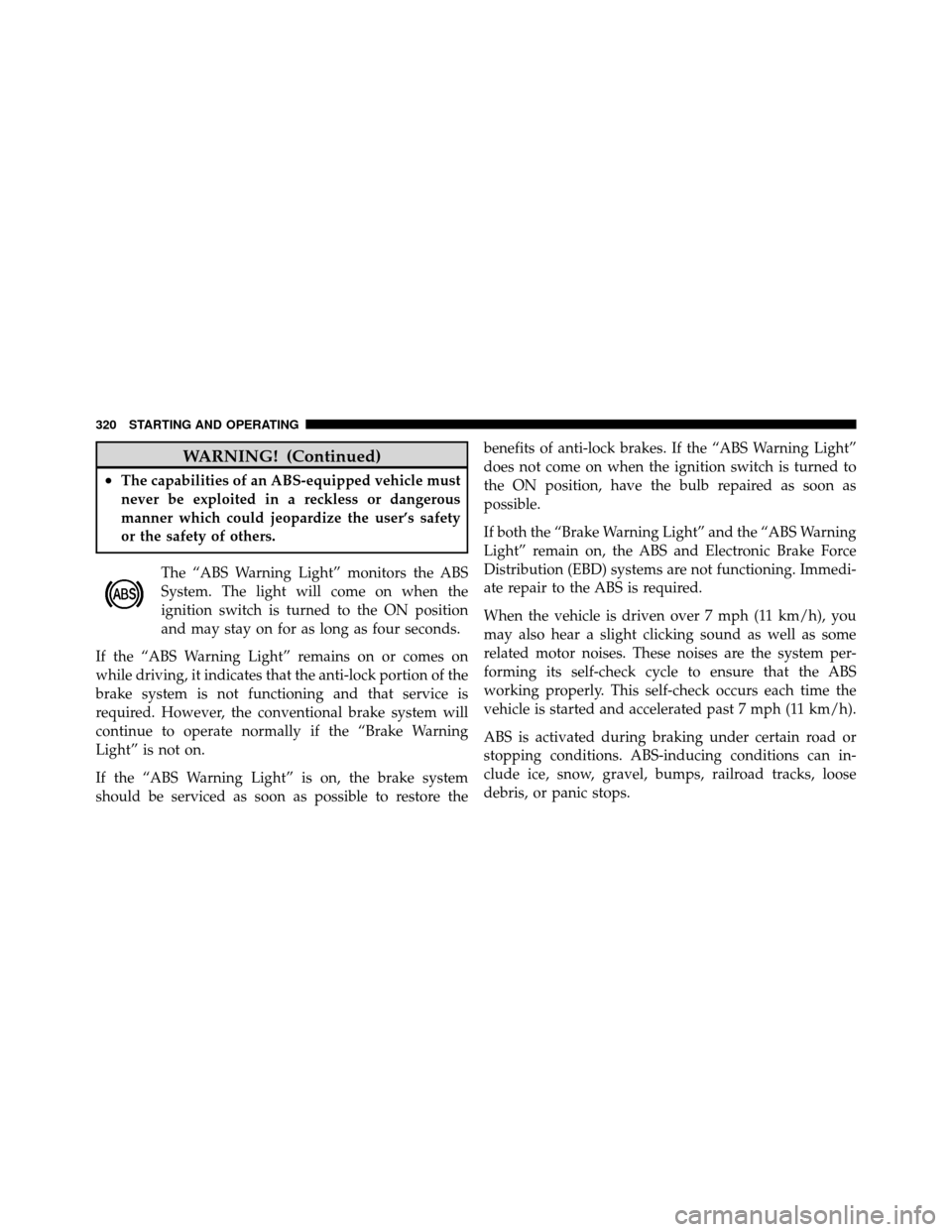
or the safety of others.The “ABS Warning Light” monitors the ABS
System. The light will come on when the
ignition switch is turned to the ON position
and may stay on for as long as four seconds.
If the “ABS Warning Light” remains on or comes on
while driving, it indicates that the anti-lock portion of the
brake system is not functioning and that service is
required. However, the conventional brake system will
continue to operate normally if the “Brake Warning
Light” is not on.
If the “ABS Warning Light” is on, the brake system
should be serviced as soon as possible to restore the benefits of anti-lock brakes. If the “ABS Warning Light”
does not come on when the ignition switch is turned to
the ON position, have the bulb repaired as soon as
possible.
If both the “Brake Warning Light” and the “ABS Warning
Light” remain on, the ABS and Electronic Brake Force
Distribution (EBD) systems are not functioning. Immedi-
ate repair to the ABS is required.
When the vehicle is driven over 7 mph (11 km/h), you
may also hear a slight clicking sound as well as some
related motor noises. These noises are the system per-
forming its self-check cycle to ensure that the ABS
working properly. This self-check occurs each time the
vehicle is started and accelerated past 7 mph (11 km/h).
ABS is activated during braking under certain road or
stopping conditions. ABS-inducing conditions can in-
clude ice, snow, gravel, bumps, railroad tracks, loose
debris, or panic stops.
320 STARTING AND OPERATING
Page 322 of 496
You may also experience the following when the brake
system goes into anti-lock mode:
•the ABS motor running (it may continue to run for a
short time after the stop)
•the clicking sound of solenoid valves
•brake pedal pulsations
•a slight drop or fall away of the brake pedal at the end
of the stop
These are all normal characteristics of ABS.
WARNING!
The Anti-Lock Brake System (ABS) contains sophis-
ticated electronic equipment that may be susceptible
to interference caused by improperly installed or
high output radio transmitting equipment. This in-
terference can cause possible loss of Anti-Lock brak-
ing capability. Installation of such equipment should
be performed by qualified professionals.
All vehicle wheels and tires must be the same size and
type and tires must be properly inflated to produce
accurate signals for the computer.
ELECTRONIC BRAKE CONTROL SYSTEM
Your vehicle may be equipped with an optional ad-
vanced electronic brake control system that includes
Anti-Lock Brake System (ABS), Brake Assist System
(BAS), Traction Control System (TCS), Electronic Roll
Mitigation (ERM), Hill Decent Control (HDC), Hill Start
5
STARTING AND OPERATING 321
Page 323 of 496

Assist (HSA), and Electronic Stability Control (ESC). All
systems work together to enhance vehicle stability and
control in various driving conditions and are commonly
referred to as ESC.
Anti-Lock Brake System (ABS)
This system aids the driver in maintaining vehicle control
under adverse braking conditions. The system controls
hydraulic brake pressure to prevent wheel lockup and
help avoid skidding on slippery surfaces during braking.
Refer to “Anti-Lock Brake System” in “Starting and
Operating” for further information.
Brake Assist System (BAS)
The BAS is designed to optimize the vehicle’s braking
capability during emergency braking maneuvers. The
system detects an emergency braking situation by sens-
ing the rate and amount of brake application and then
applies optimum pressure to the brakes. This can help
reduce braking distances. The BAS complements theAnti-Lock Brake System (ABS). Applying the brakes very
quickly results in the best BAS assistance. To receive the
benefit of the system, you must apply
continuousbrak-
ing pressure during the stopping sequence (do not
“pump” the brakes). Do not reduce brake pedal pressure
unless braking is no longer desired. Once the brake pedal
is released, the BAS is deactivated.
WARNING!
•The Brake Assist System (BAS) cannot prevent the
natural laws of physics from acting on the vehicle,
nor can it increase the traction afforded by prevail-
ing road conditions.
(Continued)
322 STARTING AND OPERATING
Page 326 of 496
in “Off-Road” mode and placing the shift lever in LOW
or REVERSE. Refer to “Safe Off-Road Driving” in “Start-
ing and Operating” for further information.When HDC is properly enabled, the “Hill
Decent Control Light” in the instrument cluster
will be illuminated.
HDC has the capability to sense terrain and will only
activate when the vehicle is descending a hill. It will not
activate on level ground. If desired, HDC can be fully
deactivated by putting the vehicle into ESC “Full Off”
mode. This is done by pressing and holding the “ESC
Off” button for five seconds. Refer to “Electronic Stability
Control (ESC)” in this section of the manual.
HDC operation can be overridden with brake application
to slow the vehicle down below the HDC control speed.
Conversely, if more speed is desired during HDC control,
the accelerator pedal will increase vehicle speed like normal. When either the brake or the accelerator is
released, HDC will control the vehicle back to the origi-
nal set speed.
HDC is only intended for low speed off-road driving. At
vehicle speeds above 31 mph (50 km/h) HDC will no
longer function. If the “HDC Indicator Light” begins to
flash this indicates that the brakes are getting too hot and
the vehicle should be stopped to allow the brakes to cool.
WARNING!
HDC is only intended to assist the driver in control-
ling vehicle speed when descending hills. The driver
must remain attentive to the driving conditions and
is responsible for maintaining a safe vehicle speed.
5
STARTING AND OPERATING 325
Page 327 of 496
Hill Start Assist (HSA) – Manual Transmission or
Off-Road Package Only
The HSA system is designed to assist the driver when
starting a vehicle from a stop on a hill. HSA will maintain
the level of brake pressure the driver applied for a short
period of time after the driver takes their foot off of the
brake pedal. If the driver does not apply the throttle
during this short period of time, the system will release
brake pressure and the vehicle will roll down the hill. The
system will release brake pressure in proportion to
amount of throttle applied as the vehicle starts to move in
the intended direction of travel.
HSA Activation Criteria
The following criteria must be met in order for HSA to
activate:
•Vehicle must be stopped.
•Vehicle must be on a 7% grade or greater hill.
•Gear selection matches vehicle uphill direction (i.e.,
vehicle facing uphill is in forward gear; vehicle back-
ing uphill is in REVERSE gear).
WARNING!
There may be situations on minor hills (i.e., less than
8%), with a loaded vehicle, or while pulling a trailer,
when the system will not activate and slight rolling
may occur. This could cause a collision with another
vehicle or object. Always remember the driver is
responsible for braking the vehicle.
Disabling/Enabling HSA
If you wish to turn on or off the HSA system, it can be
done using the Customer Programmable Features in the
Electronic Vehicle Information Center (EVIC). Refer to
“Electronic Vehicle Information Center (EVIC)” in “Un-
derstanding Your Instrument Panel” for further informa-
tion.
326 STARTING AND OPERATING
Page 330 of 496
ESC Malfunction Indicator Light
The “ESC Malfunction Indicator Light” in the
instrument cluster will come on when the
ignition switch is turned to the ON position. It
should go out with the engine running. If the
“ESC Malfunction Indicator Light” comes on continu-
ously with the engine running, a malfunction has been
detected in the ESC system. If this light remains on after
several ignition cycles, and the vehicle has been driven
several miles (kilometers) at speeds greater than 30 mph
(48 km/h), see your authorized dealer as soon as possible
to have the problem diagnosed and corrected.
NOTE:
•The “ESC Off Indicator Light” and the “ESC Malfunc-
tion Indicator Light” come on momentarily each time
the ignition switch is turned ON.
•Each time the ignition is turned ON, the ESC system
will be ON even if it was turned off previously.
•The ESC system will make buzzing or clicking sounds
when it is active. This is normal; the sounds will stop
when ESC becomes inactive following the maneuver
that caused the ESC activation.
ESC Operating Modes
The ESC system has three available operating modes for
four-wheel drive equipped vehicles and two available
operating modes for two-wheel drive equipped vehicles.
Full On (Four-Wheel Drive Models) or On (Two-Wheel
Drive Models)
This is the normal operating mode for ESC. Whenever
the vehicle is started the ESC system will be in this “On”
mode. This mode should be used for most driving
situations. ESC should only be turned to “Partial Off” or
“ESC Off” for specific reasons as noted below.
5
STARTING AND OPERATING 329
Page 331 of 496
Partial Off (Four-Wheel Drive Models) or On
(Two-Wheel Drive Models)
This mode is entered by momentarily pressing the “ESC
Off” switch. When in “Partial Off” mode, the “ESC Off
Indicator Light” will be illuminated. This mode is in-
tended to be used if the vehicle is in deep snow, sand or
gravel conditions and more wheel spin than ESC would
normally allow is required to gain traction.
To turn ESC on again, momentarily press the “ESC Off”
switch. This will restore the normal “ESC On” mode of
operation.
NOTE:To improve the vehicle’s traction when driving
with snow chains, or starting off in deep snow, sand or
gravel, it may be desirable to switch to the “Partial Off”
mode by pressing the “ESC Off” switch. Once the situa-
tion requiring ESC to be switched to the “Partial Off” mode is overcome, turn ESC back on by momentarily
pressing the “ESC Off” switch. This may be done while
the vehicle is in motion.
Full Off (Four-Wheel Drive Models Only)
This mode is intended for off-highway or off-road use
when ESC stability features could inhibit vehicle maneu-
verability due to trail conditions. This mode is entered by
pressing and holding the “ESC Off” switch for five
seconds when the vehicle is stopped and the engine is
running. After five seconds, the “ESC Off Indicator
Light” will illuminate and the “ESC Off” message will
appear in the odometer. Press and release the Trip
Odometer button located on the instrument cluster to
clear this message.
In this mode, ESC is turned off until the vehicle reaches
a speed of 35 mph (56 km/h). At 35 mph (56 km/h) the
system returns to “Partial Off” mode, as described above.
When the vehicle speed drops below 30 mph (48 km/h)
330 STARTING AND OPERATING