traction control JEEP PATRIOT 2012 1.G User Guide
[x] Cancel search | Manufacturer: JEEP, Model Year: 2012, Model line: PATRIOT, Model: JEEP PATRIOT 2012 1.GPages: 505, PDF Size: 8.98 MB
Page 330 of 505
WARNING! (Continued)
•The capabilities of a BAS-equipped vehicle must
never be exploited in a reckless or dangerous
manner which could jeopardize the user ’s safety
or the safety of others.
Traction Control System (TCS)
This system monitors the amount of wheel spin of each of
the driven wheels. If wheel spin is detected, brake
pressure is applied to the slipping wheel(s) and engine
power is reduced to provide enhanced acceleration and
stability. A feature of the TCS system functions similar to
a limited slip differential and controls the wheel spin
across a driven axle. If one wheel on a driven axle is
spinning faster than the other, the system will apply the
brake of the spinning wheel. This will allow more engine
torque to be applied to the wheel that is not spinning.
This feature remains active even if TCS and ESC are ineither the “Partial Off” or “Full Off” modes. Refer to
“Electronic Stability Control (ESC)” in this section of this
manual.
Electronic Roll Mitigation (ERM)
This system anticipates the potential for wheel lift by
monitoring the driver ’s steering wheel input and the
speed of the vehicle. When ERM determines that the rate
of change of the steering wheel angle and vehicles speed
are sufficient to potentially cause wheel lift, it applies the
brake of the appropriate wheel and may also reduce
engine power to lessen the chance that wheel lift will
occur. ERM will only intervene during very severe or
evasive driving maneuvers.
ERM can only reduce the chance of wheel lift occurring
during severe or evasive driving maneuvers. It can not
prevent wheel lift due to other factors such as road
conditions, leaving the roadway or striking objects or
other vehicles.
328 STARTING AND OPERATING
Page 335 of 505
WARNING!
•Electronic Stability Control (ESC) cannot prevent
the natural laws of physics from acting on the
vehicle, nor can it increase the traction afforded by
prevailing road conditions.
•ESC cannot prevent collisions, including those
resulting from excessive speed in turns, driving on
very slippery surfaces, or hydroplaning. ESC also
cannot prevent collisions resulting from loss of
vehicle control due to inappropriate driver input
for the conditions. Only a safe, attentive, and
skillful driver can prevent collisions.
•The capabilities of an ESC equipped vehicle must
never be exploited in a reckless or dangerous
manner which could jeopardize the user ’s safety
or the safety of others.
ESC Operating Modes
The ESC system has three available operating modes for
four-wheel drive equipped vehicles and two available
operating modes for two-wheel drive equipped vehicles.
Full On (Four-Wheel Drive Models) Or On
(Two-Wheel Drive Models)
This is the normal operating mode for ESC. Whenever
the vehicle is started the ESC system will be in this “On”
mode. This mode should be used for most driving
situations. ESC should only be turned to “Partial Off” or
“ESC Off” for specific reasons as noted below.
Partial Off (Four-Wheel Drive Models) Or On
(Two-Wheel Drive Models)
This mode is entered by momentarily pressing the “ESC
Off” switch. When in “Partial Off” mode, the “ESC
Activation/Malfunction Indicator Light” will be illumi-
nated. This mode is intended to be used if the vehicle is
5
STARTING AND OPERATING 333
Page 338 of 505
Light” comes on continuously with the engine running, a
malfunction has been detected in the ESC system. If this
light remains on after several ignition cycles, and the
vehicle has been driven several miles (kilometers) at
speeds greater than 30 mph (48 km/h), see your autho-
rized dealer as soon as possible to have the problem
diagnosed and corrected.
The “ESC Activation/Malfunction Indicator Light” (lo-
cated in the instrument cluster) starts to flash as soon as
the tires lose traction and the ESC system becomes active.
The “ESC Activation/Malfunction Indicator Light” also
flashes when TCS is active. If the “ESC Activation/
Malfunction Indicator Light” begins to flash during ac-
celeration, ease up on the accelerator and apply as little
throttle as possible. Be sure to adapt your speed and
driving to the prevailing road conditions.NOTE:
•The “ESC Activation/Malfunction Indicator Light”
and the “ESC OFF Indicator Light” come on momen-
tarily each time the ignition switch is turned ON.
•Each time the ignition is turned ON, the ESC system
will be ON even if it was turned off previously.
•The ESC system will make buzzing or clicking sounds
when it is active. This is normal; the sounds will stop
when ESC becomes inactive following the maneuver
that caused the ESC activation.
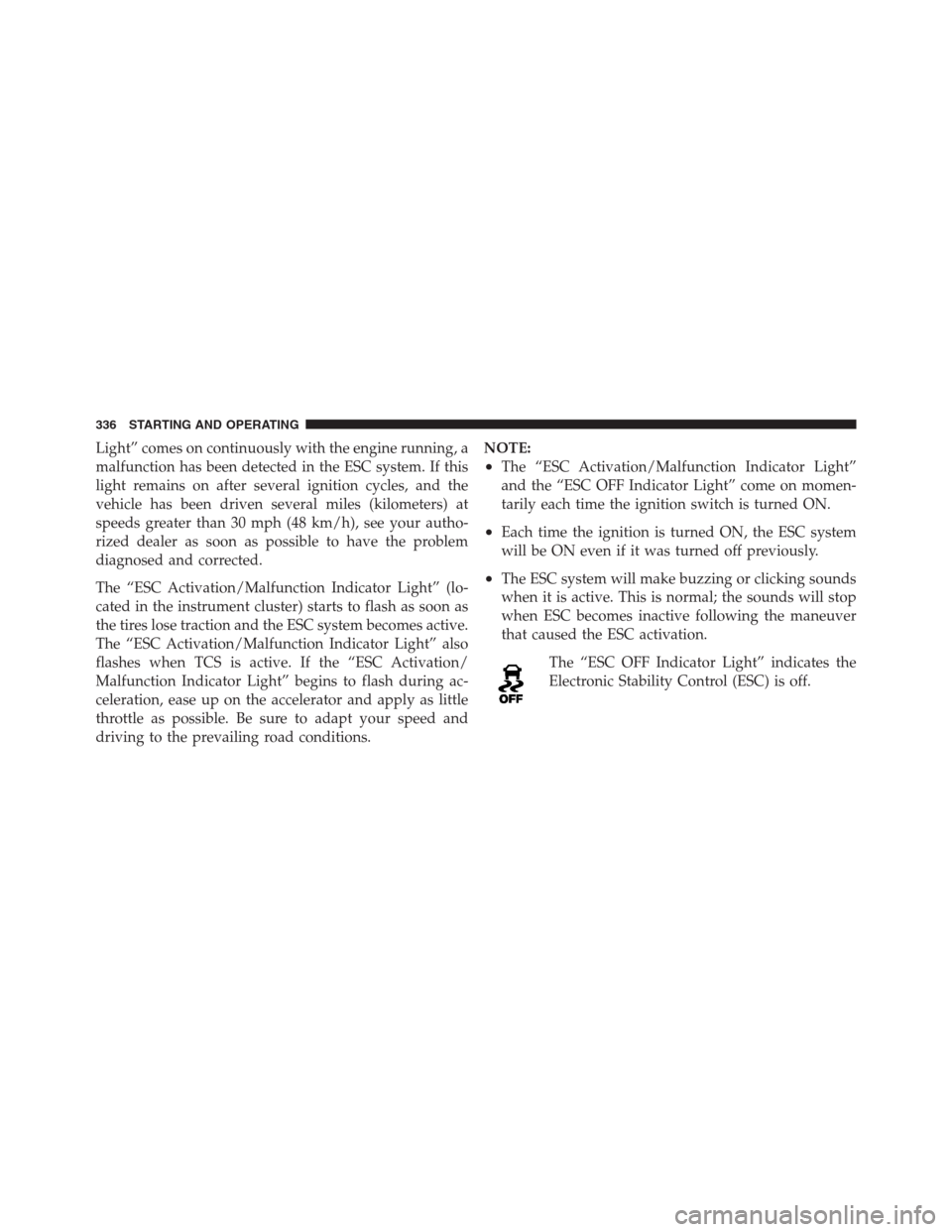
The “ESC OFF Indicator Light” indicates the
Electronic Stability Control (ESC) is off.
336 STARTING AND OPERATING
Page 409 of 505
NOTE:If your vehicle is equipped with Traction Con-
trol or Electronic Stability Control (ESC), turn the system
OFF before attempting to “rock” the vehicle.
CAUTION!
•When “rocking” a stuck vehicle by moving be-
tween DRIVE and REVERSE (with automatic
transmission) or 1st gear and Reverse (with
manual transmission), do not spin the wheels
faster than 15 mph (24 km/h), or drivetrain damage
may result.
•Revving the engine or spinning the wheels too fast
may lead to transmission overheating and failure.
It can also damage the tires. Do not spin the
wheels above 30 mph (48 km/h) while in gear (no
transmission shifting occurring).
WARNING!
Fast spinning tires can be dangerous. Forces gener-
ated by excessive wheel speeds may cause damage, or
even failure, of the axle and tires. A tire could
explode and injure someone. Do not spin your vehi-
cle’s wheels faster than 30 mph (48 km/h) or for
longer than 30 seconds continuously without stop-
ping when you are stuck and do not let anyone near
a spinning wheel, no matter what the speed.
SHIFT LEVER OVERRIDE
If a malfunction occurs and the shift lever cannot be
moved out of the PARK position, you can use the
following procedure to temporarily move the shift lever:
1. Firmly apply the parking brake.
6
WHAT TO DO IN EMERGENCIES 407
Page 483 of 505
DEPARTMENT OF TRANSPORTATION UNIFORM
TIRE QUALITY GRADES
The following tire grading categories were established by
the National Highway Traffic Safety Administration. The
specific grade rating assigned by the tire’s manufacturer
in each category is shown on the sidewall of the tires on
your vehicle.
All passenger car tires must conform to Federal safety
requirements in addition to these grades.
Treadwear
The Treadwear grade is a comparative rating, based on
the wear rate of the tire when tested under controlled
conditions on a specified government test course. For
example, a tire graded 150 would wear one and one-half
times as well on the government course as a tire graded
100. The relative performance of tires depends upon the
actual conditions of their use, however, and may departsignificantly from the norm due to variations in driving
habits, service practices, and differences in road charac-
teristics and climate.
Traction Grades
The Traction grades, from highest to lowest, are AA, A, B,
and C. These grades represent the tire’s ability to stop on
wet pavement, as measured under controlled conditions
on specified government test surfaces of asphalt and
concrete. A tire marked C may have poor traction perfor-
mance.
WARNING!
The traction grade assigned to this tire is based on
straight-ahead braking traction tests, and does not
include acceleration, cornering, hydroplaning, or
peak traction characteristics.
9
IF YOU NEED CONSUMER ASSISTANCE 481
Page 490 of 505
Electronic Brake Control System............. 326
Anti-Lock Brake System................ 327
Brake Assist System................... 327
Electronic Roll Mitigation............... 328
Traction Control System................ 328
Electronic Speed Control (Cruise Control)...... 158
Electronic Stability Control (ESC)............. 332
Electronic Vehicle Information Center (EVIC).... 213
Emergency, In Case of
Jacking............................ 392
Jump Starting....................... 402
Towing............................ 409
Emission Control System Maintenance......... 416
Engine............................413,414
Block Heater........................ 298
Break-In Recommendations.............. 84
Checking Oil Level................... 419
Cooling........................... 431Exhaust Gas Caution................85,370
Fuel Requirements.................... 367
Jump Starting....................... 402
Oil .........................419,454,455
Oil Change Interval................... 420
Oil Filler Cap..................413,414,421
Oil Filter........................... 455
Oil Selection........................ 420
Oil Synthetic........................ 421
Overheating........................ 390
Temperature Gauge................... 203
Enhanced Accident Response Feature.......... 71
Ethanol............................... 368
Event Data Recorder...................... 74
Exhaust Gas Caution.................38,85,370
Exhaust System.......................85,429
Exterior Lights.......................... 88
488 INDEX
Page 494 of 505
Lead Free Gasoline...................... 367
Leaks, Fluid............................ 88
Life of Tires............................ 353
Liftgate (Sedan).......................... 37
Liftgate Window Wiper/Washer............. 187
Light Bulbs..........................88,452
Lights..............................88,149
Airbag....................68,69,74,86,199
Alarm............................ 203
Anti-Lock.......................... 200
Back-Up........................... 453
Brake Assist Warning.................. 335
Brake Warning...................... 201
Bulb Replacement.................... 453
Cargo ............................. 182
Center Mounted Stop.................. 454
Daytime Running.................... 150
Dimmer Switch, Headlight.............. 149
Electronic Stability Program (ESP) Indicator . . 335Engine Temperature Warning............ 201
Exterior............................ 88
Fog .........................150,210,453
Headlight Switch..................... 150
Headlights......................... 150
High Beam Indicator.................. 200
Instrument Cluster................... 150
License............................ 454
Lights On Reminder.................. 150
Low Fuel.......................... 199
Malfunction Indicator (Check Engine)...... 209
Map Reading....................... 153
Oil Pressure........................ 199
Seat Belt Reminder................... 200
Security Alarm (Theft Alarm)..........18,203
Theft Alarm (Security Alarm)............ 203
Tire Pressure Monitoring (TPMS)......... 205
Traction Control..................... 335
Turn Signal.................88,149,151,453
492 INDEX