ECU JEEP PATRIOT 2012 1.G Owner's Manual
[x] Cancel search | Manufacturer: JEEP, Model Year: 2012, Model line: PATRIOT, Model: JEEP PATRIOT 2012 1.GPages: 108, PDF Size: 4.19 MB
Page 64 of 108
FOUR-WHEEL DRIVE OPERATION
• This vehicle has two full time, on-demand, four-wheel-drive (4WD)
systems available, Freedom Drive I and Freedom-Drive II. They provide
for all-weather, all-terrain capability for added driving security in
less-than-ideal road conditions.
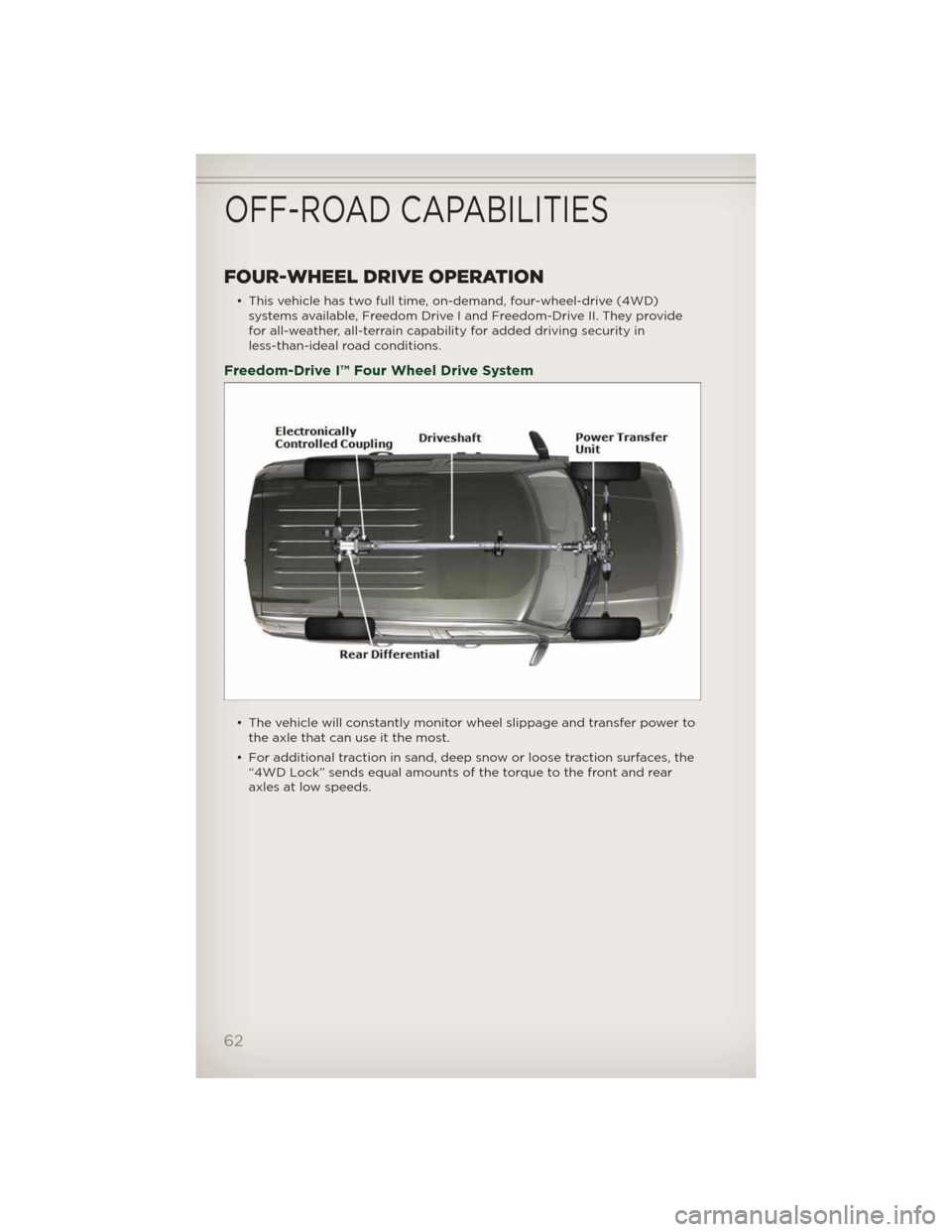
Freedom-Drive I™ Four Wheel Drive System
• The vehicle will constantly monitor wheel slippage and transfer power to
the axle that can use it the most.
• For additional traction in sand, deep snow or loose traction surfaces, the
“4WD Lock” sends equal amounts of the torque to the front and rear
axles at low speeds.
OFF-ROAD CAPABILITIES
62
Page 75 of 108
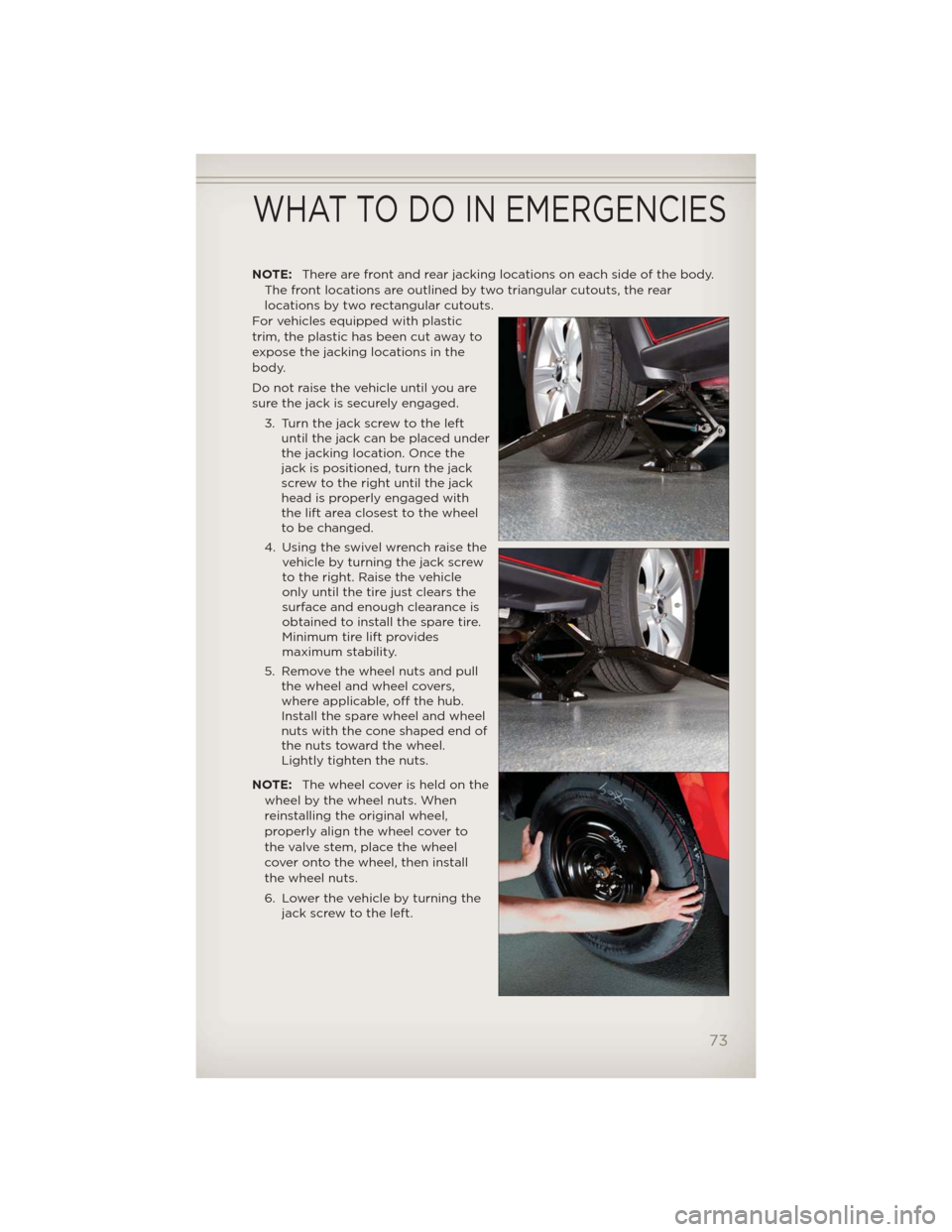
NOTE:There are front and rear jacking locations on each side of the body.
The front locations are outlined by two triangular cutouts, the rear
locations by two rectangular cutouts.
For vehicles equipped with plastic
trim, the plastic has been cut away to
expose the jacking locations in the
body.
Do not raise the vehicle until you are
sure the jack is securely engaged.
3. Turn the jack screw to the left
until the jack can be placed under
the jacking location. Once the
jack is positioned, turn the jack
screw to the right until the jack
head is properly engaged with
the lift area closest to the wheel
to be changed.
4. Using the swivel wrench raise the
vehicle by turning the jack screw
to the right. Raise the vehicle
only until the tire just clears the
surface and enough clearance is
obtained to install the spare tire.
Minimum tire lift provides
maximum stability.
5. Remove the wheel nuts and pull
the wheel and wheel covers,
where applicable, off the hub.
Install the spare wheel and wheel
nuts with the cone shaped end of
the nuts toward the wheel.
Lightly tighten the nuts.
NOTE:The wheel cover is held on the
wheel by the wheel nuts. When
reinstalling the original wheel,
properly align the wheel cover to
the valve stem, place the wheel
cover onto the wheel, then install
the wheel nuts.
6. Lower the vehicle by turning the
jack screw to the left.
WHAT TO DO IN EMERGENCIES
73
Page 76 of 108
7. Finish tightening the nuts. Push down on the wrench while at the end of
the handle for increased leverage. Tighten the lug nuts in a star pattern
until each nut has been tightened twice. The correct wheel nut torque is
100 ft lbs (135 N·m). If you doubt that you have tightened the nuts
correctly, have them checked with a torque wrench by your authorized
dealer or service station.
8. Remove the wheel blocks and lower the jack until it is free. Reassemble
the lug wrench to the jack assembly and stow it in the spare tire area.
Secure the assembly using the means provided.
9. Place the deflated (flat) tire in the cargo area,have the tire repaired or
replaced as soon as possible.
10. Check the spare tire pressure as soon as possible. Correct the tire
pressure as required.
Road Tire Installation
Vehicles Equipped With Wheel Covers
1. Mount the road tire on the axle.
2. To ease the installation process for steel wheels with wheel covers,
install two lug nuts on the mounting studs which are on each side of the
valve stem. Install the lug nuts with the cone shaped end of the nut
toward the wheel. Lightly tighten the lug nuts.
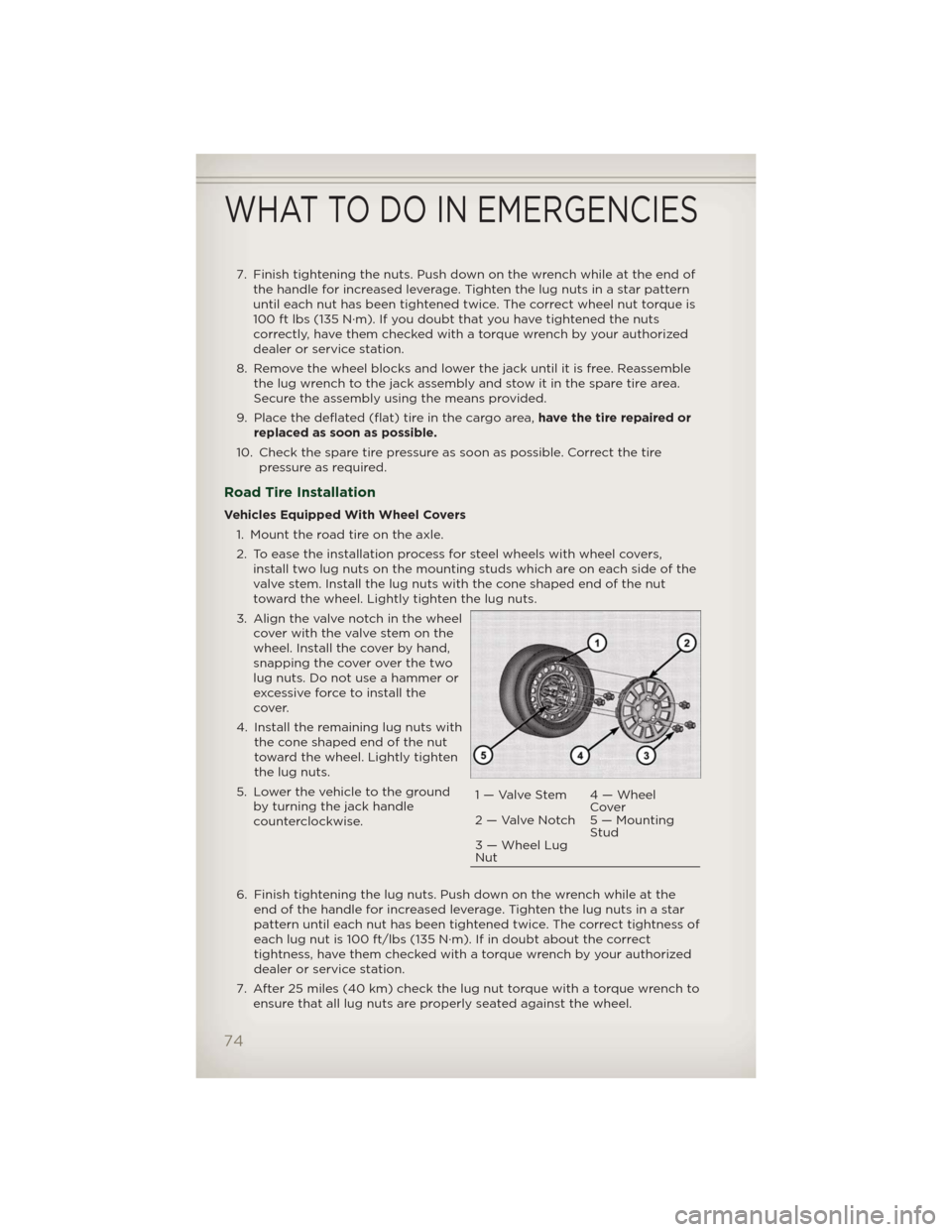
3. Align the valve notch in the wheel
cover with the valve stem on the
wheel. Install the cover by hand,
snapping the cover over the two
lug nuts. Do not use a hammer or
excessive force to install the
cover.
4. Install the remaining lug nuts with
the cone shaped end of the nut
toward the wheel. Lightly tighten
the lug nuts.
5. Lower the vehicle to the ground
by turning the jack handle
counterclockwise.
6. Finish tightening the lug nuts. Push down on the wrench while at the
end of the handle for increased leverage. Tighten the lug nuts in a star
pattern until each nut has been tightened twice. The correct tightness of
each lug nut is 100 ft/lbs (135 N·m). If in doubt about the correct
tightness, have them checked with a torque wrench by your authorized
dealer or service station.
7. After 25 miles (40 km) check the lug nut torque with a torque wrench to
ensure that all lug nuts are properly seated against the wheel.
1 — Valve Stem 4 — Wheel
Cover
2 — Valve Notch 5 — Mounting
Stud
3 — Wheel Lug
Nut
WHAT TO DO IN EMERGENCIES
74
Page 78 of 108
WARNING!(Continued)
• Carefully follow these tire changing warnings to help prevent
personal injury or damage to your vehicle:
• Alwayspark on a firm, level surface as far from the edge of the
roadway as possible before raising the vehicle.
• Turn on the Hazard Warning flasher.
• Block the wheel diagonally opposite the wheel to be raised.
• Set the parking brake firmly and set an automatic transmission in
PARK; a manual transmission in REVERSE.
• Never start or run the engine with the vehicle on a jack.
• Do not let anyone sit in the vehicle when it is on a jack.
• Do not get under the vehicle when it is on a jack.
• Only use the jack in the positions indicated and for lifting this
vehicle during a tire change.
• If working on or near a roadway, be extremely careful of motor
traffic.
• To assure that spare tires, flat or inflated, are securely stowed,
spares must be stowed with the valve stem facing the ground.
• Raising the vehicle higher than necessary can make the vehicle
less stable. It could slip off the jack and hurt someone near it.
Raise the vehicle only enough to remove the tire.
• To avoid possible personal injury, handle the wheel covers with
care to avoid contact with any sharp edges.
• A loose tire or jack thrown forward in a collision or hard stop
could injure the occupants in the vehicle. Have the deflated (flat)
tire repaired or replaced immediately.
• To avoid the risk of forcing the vehicle off the jack, do not tighten
the lug nuts fully until the vehicle is lowered to the ground.
Failure to follow this warning may result in personal injury.
JUMP-STARTING PROCEDURES
• If your vehicle has a discharged battery it can be jump-started using a
set of jumper cables and a battery in another vehicle or by using a
portable battery booster pack. Jump-starting can be dangerous if done
improperly so please follow the procedures in this section carefully.
NOTE:When using a portable battery booster pack follow the
manufacturer’s operating instructions and precautions.
WHAT TO DO IN EMERGENCIES
76
Page 93 of 108
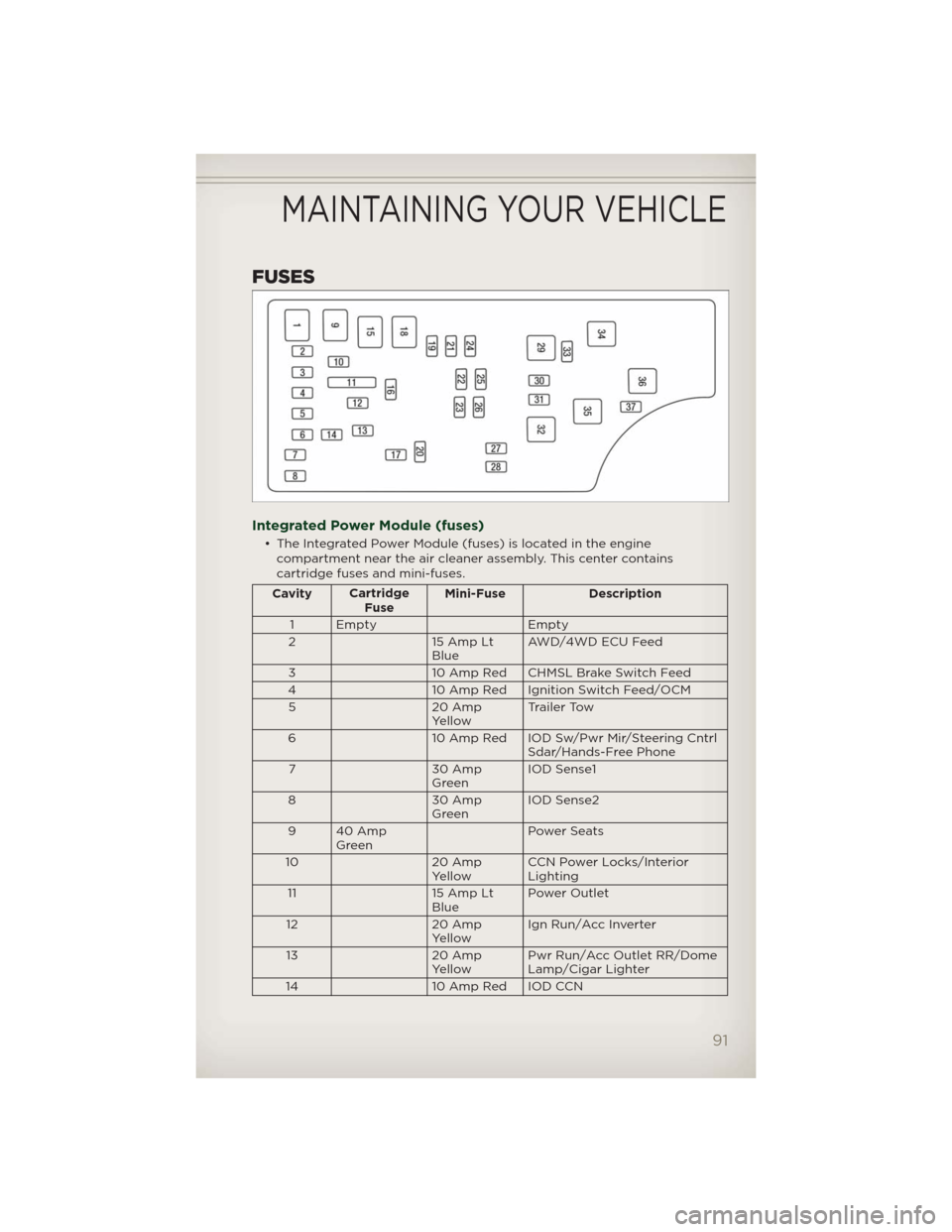
FUSES
Integrated Power Module (fuses)
• The Integrated Power Module (fuses) is located in the engine
compartment near the air cleaner assembly. This center contains
cartridge fuses and mini-fuses.
CavityCartridge
FuseMini-Fuse Description
1 Empty Empty
2 15 Amp Lt
BlueAWD/4WD ECU Feed
3 10 Amp Red CHMSL Brake Switch Feed
4 10 Amp Red Ignition Switch Feed/OCM
5 20 Amp
YellowTrailer Tow
6 10 Amp Red IOD Sw/Pwr Mir/Steering Cntrl
Sdar/Hands-Free Phone
7 30 Amp
GreenIOD Sense1
8 30 Amp
GreenIOD Sense2
9 40 Amp
GreenPower Seats
10 20 Amp
YellowCCN Power Locks/Interior
Lighting
11 15 Amp Lt
BluePower Outlet
12 20 Amp
YellowIgn Run/Acc Inverter
13 20 Amp
YellowPwr Run/Acc Outlet RR/Dome
Lamp/Cigar Lighter
14 10 Amp Red IOD CCN
MAINTAINING YOUR VEHICLE
91
Page 98 of 108
NOTE:A street address is required when ordering manuals (no P.O. Boxes).
NOTE:
• The Owner's Manual and User Guide electronic files are also available on
the Chrysler, Jeep, Ram Truck and Dodge websites.
• Click on the "For Owners" tab, select "Owner/Service Manuals", then select
your desired model year and vehicle from the drop-down lists.
REPORTING SAFETY DEFECTS IN THE 50 UNITED
STATES AND WASHINGTON, D.C.
• If you believe that your vehicle has a defect that could cause a collision
or cause injury or death, you should immediately inform the National
Highway Traffic Safety Administration (NHTSA) in addition to notifying
the manufacturer.
• If NHTSA receives similar complaints, it may open an investigation, and if
it finds that a safety defect exists in a group of vehicles, it may order a
recall and remedy campaign. However, NHTSAcannot become involved
in individual problems between you, your authorized dealer, and the
manufacturer.
• To contact NHTSA, you may either call the Auto Safety Hotline toll free
at 1–888–327–4236 (TTY: 1–800–424– 9153), or go to http://
www.safercar.gov; or write to: Administrator, NHTSA, 1200 New Jersey
Avenue, SE., West Building, Washington, D.C. 20590. You can also obtain
other information about motor vehicle safety from
http://www.safercar.gov.
In Canada
• If you believe that your vehicle has a safety defect, you should contact
the Customer Service Department immediately. Canadian customers who
wish to report a safety defect to the Canadian government should
contact Transport Canada, Motor Vehicle Defect Investigations and
Recalls at 1-800-333-0510 or go to http://www.tc.gc.ca/roadsafety/
• French Canadian customers who wish to report a safety defect to the
Canadian government should contact Transport Canada, Motor Vehicle
Defect Investigations and Recalls at 1-800-333-0510 or go to
http://www.tc.gc.ca/securiteroutiere/
CONSUMER ASSISTANCE
96
Page 100 of 108
Airbag .................10
Alarm,Panic ..............8
Arming Theft System (Security
Alarm) ..................9
AudioSettings ..........28,29,
30,32,33,34,38
Automatic Temperature Control
(ATC) ..................23
Automatic Transmission
FluidType .............86
Overheating .............71
AxleFluid ...............86
Belts, Seat................9
BrakeFluid ..............86
Break-In Recommendations, New
Vehicle .................17
Bulb Replacement..........94
Calibration, Compass........56
Change Oil Indicator........70
Changing A Flat Tire.........71
ChildRestraint .............11
Child Restraint Tether Anchors . . 11
Clock Setting.......28,30,33,35
Compass Calibration........56
Cooling System
Coolant Capacity.........86
Cruise Control (Speed Control) . 20
CruiseLight ..............20
Customer Assistance........95
Defects, Reporting.........96
Dimmer Control............18
Dimmer Switch, Headlight.....18
Disarming, Theft System . . . . . . 9
Electronic Speed Control
(CruiseControl) ...........20
Electronic Vehicle Information
Center(EVIC)...........55,56
Electronics
Your Vehicle's Sound System..26
Emergency, In Case of
Jacking................71
Jump Starting...........76
Overheating ............70Engine
Break-In Recommendations . . . 17
Compartment . . . . . . . . . . . 84
Jump Starting . . . . . . . . . . . 76
Oil Selection . . . . . . . . . . . . 86
Overheating ............70
Event Data Recorder . . . . . . . . 82
ExteriorLights ............94
Flash-To-Pass .............18
Fluid Capacities . . .........86
Fluids ..................86
FogLights ...............18
Folding Front Passenger Seat . . 14
FoldingRearSeat ..........14
FreeingAStuckVehicle ......81
Front Heated Seats . . . . . . . . . 15
Fuel
Specifications . . . . . . . . . . . 86
Garage Door Opener
(HomeLink®) . ............57
Headlights . . . . . . . . . . . . . . . 18
Dimmer Switch . . . . . . . . . . . 18
High Beam . . . . . . . . . . . . . 18
HeatedMirrors ..........22,23
HeatedSeats .............15
High Beam/Low Beam Select
(Dimmer) Switch . . . . . . . . . . . 18
HomeLink® (Garage Door
Opener) Transmitter . . . . . . . . 57
Hood Release . . . . . . . . . . . . . 83
Instrument Cluster . . . . . . . . . . 6
Indicators ...............7
Instrument Cluster Warning
Lights ................6,66
Intermittent Wipers
(DelayWipers) ............19
Introduction . . . . . . . . ......2
Inverter Outlet (115V) . . . . . . . . 60
Inverter,Power ............60
iPod®/USB/MP3 Control . . . . . . 48
Bluetooth Streaming Audio . . 55
INDEX
98
Page 101 of 108
Jack Location.............71
Jack Operation..........71,72
Jacking Instructions . . .......72
Jump Starting............76
KeyFob .................8
Key Fob Programmable
Features ................56
Lane Change Assist . . . . . . . . . 18
LATCH (Lower Anchors and Tether
forCHildren) ..............11
Lights
Headlights..............18
Park ..................18
Turn Signal.............18
Warning (Instrument Cluster
Description) .............6
Maintenance Record........90
Maintenance Schedule.......88
Media Center Radio . . . . . 28,30,32
Mirrors
Heated ..............22,23
MOPAR®Accessories ........97
Navigation ...............41
New Vehicle Break-In Period . . . 17
Oil Change Indicator . . . .....70
Oil, Engine
Capacity...............86
Outlet
Power.................61
Overheating, Engine . . . . . . . . 70
PanicAlarm ...............8
Phone (Pairing)...........50
Phone (Uconnect)..........49
Placard, Tire and Loading
Information ..............93
Power
Glass Sunroof...........24
Inverter ...............60
Outlet (Auxiliary Electrical
Outlet) ................61
Seats .................13Steering ...............86
Preparation for Jacking......72
Programmable Electronic
Features ................56
Radio Operation . . . . . ......35
Rain Sensitive Wiper System . . . 19
Rear Seat, Folding . . . . . . . . . . 14
Recreational Towing ........65
Remote Starting System ......8
Replacement Bulbs . . . . .....94
Reporting Safety Defects . . . . . 96
Restraints,Child ............11
RollOverWarning ..........3
SeatBelts ................9
Seats ..................13
Adjustment . . . . .........13
Folding Front Passenger . . . . 14
Heated ................15
Power .................13
RearFolding ............14
Seek Button . . . . . . . . 29,31,33,34
Setting the Clock . . . . 28,30,33,35
Shift Lever Override . . . . . . . . 79
Short Message Service (SMS) . . 54
Signals,Turn ..............18
SIRIUS Travel Link . . . . . . . . . . 46
Spare Tire . . . . . . . . .......71
Spark Plugs . . . . . . . . . .....86
Speed Control (Cruise
Control) ................20
Starting
Remote . . . . . . . . . . . . . . . . 8
Steering
TiltColumn .............16
Steering Wheel Audio Controls . 48
Store Radio Presets .....29,31,33
SunRoof ................24
Supplemental Restraint System -
Airbag .................10
Temperature Gauge, Engine
Coolant ................70
TextMessaging............54
Theft Alarm (Security Alarm) . . . 9
TheftSystemArming.........9
TheftSystemDisarming .......9
INDEX
99