air conditioning JEEP PATRIOT 2014 1.G User Guide
[x] Cancel search | Manufacturer: JEEP, Model Year: 2014, Model line: PATRIOT, Model: JEEP PATRIOT 2014 1.GPages: 568, PDF Size: 3.61 MB
Page 313 of 568
Winter Operation
Use of the air Recirculation Mode during winter months
is not recommended because it may cause window
fogging.
Vacation Storage
Anytime you store your vehicle, or keep it out of service
(i.e., vacation) for two weeks or more, run the air
conditioning system at idle for about five minutes in the
fresh air and high blower settings. This will ensure
adequate system lubrication to minimize the possibility
of compressor damage when the system is started again.
Window Fogging
Interior fogging on the windshield can be quickly re-
moved by turning the mode selector to Defrost. The
Defrost/Floor mode can be used to maintain a clearwindshield and provide sufficient heating. If side win-
dow fogging becomes a problem, increase blower speed.
Vehicle windows tend to fog on the inside in mild but
rainy or humid weather.
NOTE:
Recirculate without A/C should not be used for
long periods as fogging may occur.
Side Window Demisters
A side window demister outlet is located at each end of
the instrument panel. These non-adjustable outlets direct
air toward the side windows when the system is in the
FLOOR, MIX, or DEFROST mode. The air is directed at
the area of the windows through which you view the
outside mirrors.
4
UNDERSTANDING YOUR INSTRUMENT PANEL 311
Page 433 of 568
Cooling System
To reduce potential for engine and transmission over-
heating, take the following actions:
City Driving
When stopped for short periods of time, shift the trans-
mission into NEUTRAL and increase engine idle speed.Highway Driving
Reduce speed.
Air Conditioning
Turn off temporarily.
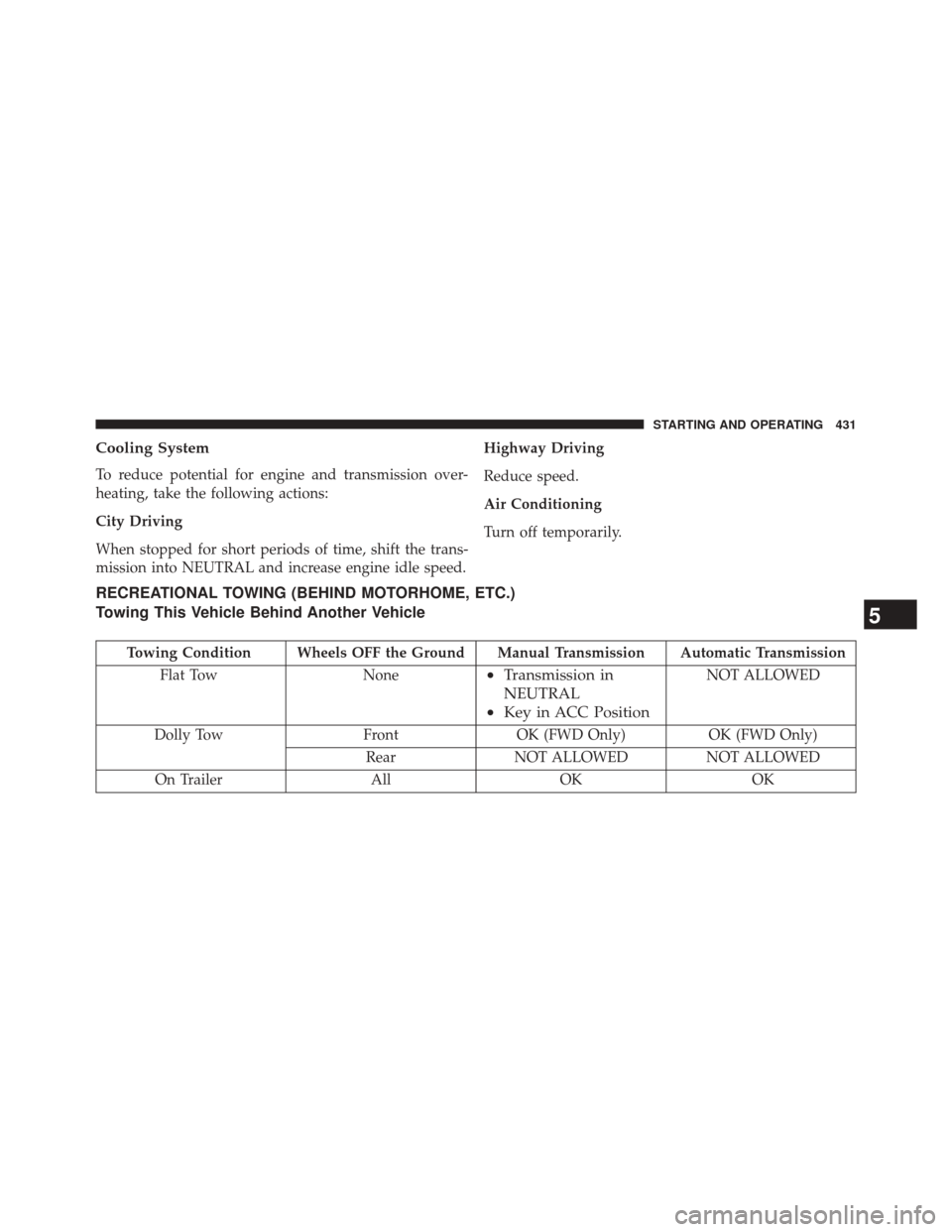
RECREATIONAL TOWING (BEHIND MOTORHOME, ETC.)
Towing This Vehicle Behind Another Vehicle
Towing Condition Wheels OFF the Ground Manual Transmission Automatic Transmission
Flat Tow None
•Transmission in
NEUTRAL
• Key in ACC PositionNOT ALLOWED
Dolly Tow Front OK (FWD Only) OK (FWD Only) Rear NOT ALLOWED NOT ALLOWED
On Trailer AllOK OK
5
STARTING AND OPERATING 431
Page 438 of 568
CAUTION!
Driving with a hot cooling system could damage your
vehicle. If the pointer rises to the H (red) mark, the
instrument cluster will sound a chime. When safe, pull
over and stop the vehicle with the engine at idle. Turn
off the air conditioning and wait until the pointer
drops back into the normal range. If the pointer
remains on the H (red) mark for more than a minute,
turn the engine off immediately and call for service.
WARNING!
You or others can be badly burned by hot engine
coolant (antifreeze) or steam from your radiator. If
you see or hear steam coming from under the hood,
(Continued)
WARNING!(Continued)
do not open the hood until the radiator has had time
to cool. Never try to open a cooling system pressure
cap when the radiator or coolant bottle is hot.
AUTOMATIC TRANSMISSION OVERHEATING
During sustained high speed driving or trailer towing up
long grades on hot days, the automatic transmission oil
may become too hot.
If this happens, the transmission overheat in-
dicator light will come on, and the vehicle will
slow slightly until the automatic transmission
cools down enough to allow a return to the
requested speed. If the high speed is maintained, the
overheating may reoccur, as before, in a cyclic fashion.
436 WHAT TO DO IN EMERGENCIES
Page 481 of 568
CAUTION!(Continued)
•Your vehicle has been built with improved fluids
that protect the performance and durability of your
vehicle and also allow extended maintenance inter-
vals. Do not use chemical flushes in these compo-
nents as the chemicals can damage your engine,
transmission, power steering or air conditioning.
Such damage is not covered by the New Vehicle
Limited Warranty. If a flush is needed because of
component malfunction, use only the specified
fluid for the flushing procedure.
Engine Oil
Checking Oil Level
To assure proper engine lubrication, the engine oil must
be maintained at the correct level. Check the oil level at
regular intervals, such as every fuel stop. The best time to
check the engine oil level is about five minutes after a
fully warmed engine is shut off. Do not check oil level
before starting the engine after it has sat overnight.
Checking engine oil level when the engine is cold will
give you an incorrect reading.
Checking the oil while the vehicle is on level ground and
only when the engine is hot, will improve the accuracy of
the oil level readings. Maintain the oil level between the
range markings on the dipstick. The range markings will
consist of a crosshatch zone which depicts the MIN at the
7
MAINTAINING YOUR VEHICLE 479
Page 487 of 568
WARNING!(Continued)
•The air conditioning system contains refrigerant
under high pressure. To avoid risk of personal
injury or damage to the system, adding refrigerant
or any repair requiring lines to be disconnected
should be done by an experienced technician.
CAUTION!
Do not use chemical flushes in your air conditioning
system as the chemicals can damage your air condi-
tioning components. Such damage is not covered by
the New Vehicle Limited Warranty.
Refrigerant Recovery And Recycling
R-134a Air Conditioning Refrigerant is a hydrofluoro-
carbon (HFC) that is endorsed by the Environmental
Protection Agency and is an ozone-saving product. How-
ever, the manufacturer recommends that air conditioning
service be performed by authorized dealer or other
service facilities using recovery and recycling equipment.
NOTE: Use only manufacturer approved A/C system
PAG compressor oil and refrigerants.
A/C Air Filter
Refer to the “Maintenance Schedule” for the proper
maintenance intervals.
WARNING!
Do not remove the A/C air filter while the blower is
operating or personal injury may result.
7
MAINTAINING YOUR VEHICLE 485
Page 499 of 568
If an examination of your engine compartment shows no
evidence of radiator or hose leaks, the vehicle may be
safely driven. The vapor will soon dissipate.
•Do not overfill the coolant expansion bottle.
•
Check the coolant freeze point in the radiator and in the
coolant expansion bottle. If engine coolant (antifreeze)
needs to be added, the contents of the coolant expansion
bottle must also be protected against freezing.
• If frequent engine coolant (antifreeze) additions are
required, the cooling system should be pressure tested
for leaks.
•
Maintain engine coolant (antifreeze) concentration at a
minimum of 50% OAT coolant (conforming to MS-12106)
and distilled water for proper corrosion protection of
your engine which contains aluminum components.
• Make sure that the coolant expansion bottle overflow
hoses are not kinked or obstructed.
• Keep the front of the radiator clean. If your vehicle is
equipped with air conditioning, keep the front of the
condenser clean.
•
Do not change the thermostat for Summer or Winter
operation. If replacement is ever necessary, install ONLY
the correct type thermostat. Other designs may result in
unsatisfactory engine coolant (antifreeze) performance,
poor gas mileage, and increased emissions.
Brake System
In order to assure brake system performance, all brake
system components should be inspected periodically.
Refer to the “Maintenance Schedule” for the proper
maintenance intervals.7
MAINTAINING YOUR VEHICLE 497
Page 519 of 568
CAUTION!
•When installing the IPM cover, it is important to
ensure the cover is properly positioned and fully
latched. Failure to do so may allow water to get into
the IPM, and possibly result in an electrical system
failure.
• When replacing a blown fuse, it is important to use
only a fuse having the correct amperage rating. The
use of a fuse with a rating other than indicated may
result in a dangerous electrical system overload. If
a properly rated fuse continues to blow, it indicates
a problem in the circuit that must be corrected.
VEHICLE STORAGE
If you will not be using your vehicle for more than 21
days, you may want to take steps to preserve your
battery. •
Disengage the mini-fuse in the Power Distribution
Center labeled IOD (Ignition Off-Draw).
• Or disconnect the negative cable from the battery.
• Anytime you store your vehicle, or keep it out of
service (i.e., vacation) for two weeks or more, run the
air conditioning system at idle for about five minutes
in the fresh air and high blower setting. This will
ensure adequate system lubrication to minimize the
possibility of compressor damage when the system is
started again.
REPLACEMENT BULBS
All the inside bulbs are brass or glass wedge base.
Aluminum base bulbs are not approved and should not
be used for replacement7
MAINTAINING YOUR VEHICLE 517
Page 531 of 568
Mileage or time passed (whichever comes first)
20,000
30,000
40,000
50,000
60,000
70,000
80,000
90,000
100,000
110,000
120,000
130,000
140,000
150,000
Or Years: 2 3 4 5 6 7 8 9 10 11 12 13 14 15
Or Kilometers:
32,000
48,000
64,000
80,000
96,000
112,000
128,000
144,000
160,000
176,000
192,000
208,000
224,000
240,000
Additional Maintenance
Replace engine air cleaner filter. XX X X X
Replace air conditioning/cabin air filter. X X X X X X X
Replace spark plugs** XX X X X
Flush and replace the engine coolant at 10 years or
150,000 miles (240,000 km) whichever comes first.XX
Replace rear drive assembly (RDA) fluid. XX
Replace power transfer unit (PTU) fluid. XX
Change automatic transmission fluid and filter if
using your vehicle for any of the following: police,
taxi, fleet, or frequent trailer towing. (CVT only) X
8
M
A I
N T
E
N
A
N
C E
S
C
H E
D
U L
E
SMAINTENANCE SCHEDULES 529
Page 548 of 568
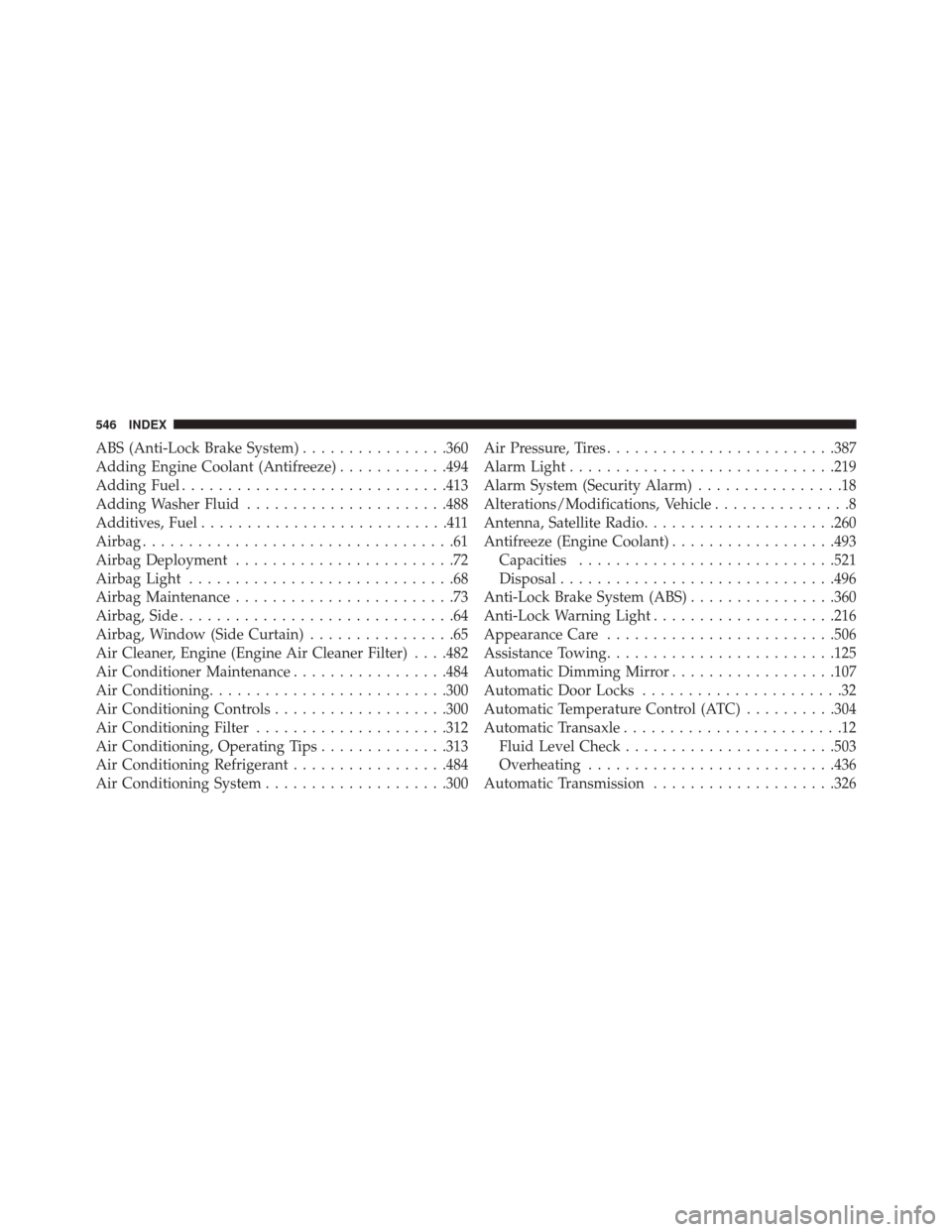
ABS (Anti-Lock Brake System)................360
Adding Engine Coolant (Antifreeze) ............494
Adding Fuel ............................ .413
Adding Washer Fluid ..................... .488
Additives, Fuel ...........................411
Airbag ..................................61
Airbag Deployment ........................72
Airbag Light .............................68
Airbag Maintenance ........................73
Airbag, Side ..............................64
Airbag, Window (Side Curtain) ................65
Air Cleaner, Engine (Engine Air Cleaner Filter) . . . .482
Air Conditioner Maintenance .................484
Air Conditioning ......................... .300
Air Conditioning Controls ...................300
Air Conditioning Filter .....................312
Air Conditioning, Operating Tips ..............313
Air Conditioning Refrigerant .................484
Air Conditioning System ....................300 Air Pressure, Tires
........................ .387
Alarm Light ............................ .219
Alarm System (Security Alarm) ................18
Alterations/Modifications, Vehicle ...............8
Antenna, Satellite Radio .....................260
Antifreeze (Engine Coolant) ..................493
Capacities ........................... .521
Disposal ............................. .496
Anti-Lock Brake System (ABS) ................360
Anti-Lock Warning Light ....................216
Appearance Care ........................ .506
Assistance Towing ........................ .125
Automatic Dimming Mirror ..................107
Automatic Door Locks ......................32
Automatic Temperature Control (ATC) ..........304
Automatic Transaxle ........................12
Fluid Level Check ...................... .503
Overheating .......................... .436
Automatic Transmission ................... .326
546 INDEX
Page 553 of 568
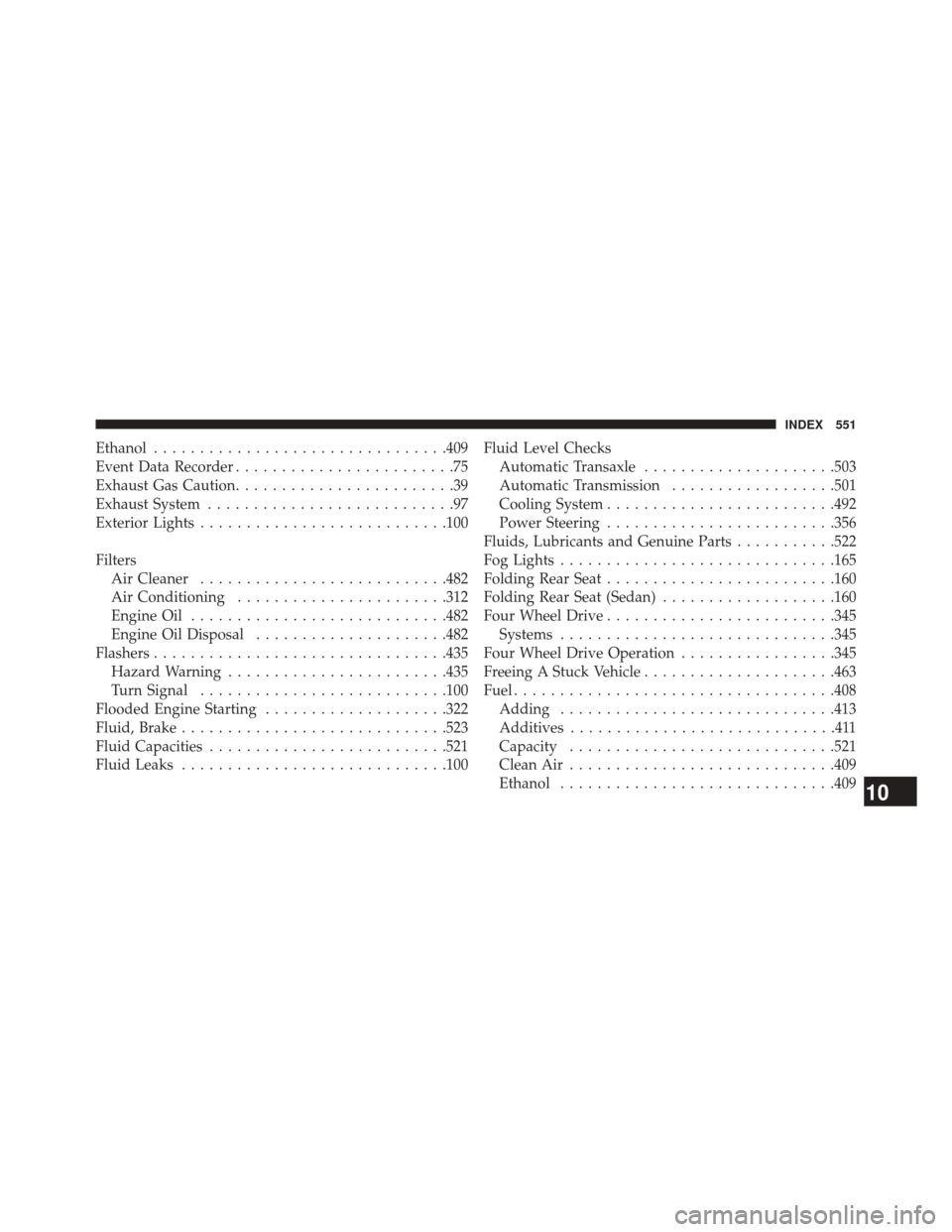
Ethanol............................... .409
Event Data Recorder ........................75
Exhaust Gas Caution ........................39
Exhaust System ...........................97
Exterior Lights .......................... .100
Filters Air Cleaner .......................... .482
Air Conditioning ...................... .312
Engine Oil ........................... .482
Engine Oil Disposal .....................482
Flashers ............................... .435
Hazard Warning ....................... .435
Turn Signal .......................... .100
Flooded Engine Starting ....................322
Fluid, Brake ............................ .523
Fluid Capacities ......................... .521
Fluid Leaks ............................ .100Fluid Level Checks
Automatic Transaxle .....................503
Automatic Transmission ..................501
Cooling System ........................ .492
Power Steering ........................ .356
Fluids, Lubricants and Genuine Parts ...........522
Fog Lights ............................. .165
Folding Rear Seat ........................ .160
Folding Rear Seat (Sedan) ...................160
Four Wheel Drive ........................ .345
Systems ............................. .345
Four Wheel Drive Operation .................345
Freeing A Stuck Vehicle .....................463
Fuel .................................. .408
Adding ............................. .413
Additives .............................411
Capacity ............................ .521
Clean Air ............................ .409
Ethanol ............................. .409
10
INDEX 551