warning JEEP PATRIOT 2015 1.G Owners Manual
[x] Cancel search | Manufacturer: JEEP, Model Year: 2015, Model line: PATRIOT, Model: JEEP PATRIOT 2015 1.GPages: 572, PDF Size: 11.46 MB
Page 504 of 572
when the pads are replaced. However, low fluid level
may be caused by a leak and a checkup may be needed.
NOTE:If your vehicle is equipped with amanual trans-
mission, the brake fluid reservoir supplies fluid to both
the brake system and the clutch release system. The two
systems are separated in the reservoir, and a leak in one
system will not affect the other system. Themanual
transmissionclutch release system should not require
fluid replacement during the life of the vehicle. If the
brake fluid reservoir is low and the brake system does
not indicate any leaks or other problems, it may be a
result of a leak in the hydraulic clutch release system. See
your local authorized dealer for service.
Use only manufacturer’s recommended brake fluid. Re-
fer to “Fluids, Lubricants, and Genuine Parts” in “Main-
taining Your Vehicle” for further information.
WARNING!
•Use only manufacturer’s recommended brake
fluid. Refer to “Fluids, Lubricants, and Genuine
Parts” in “Maintaining Your Vehicle” for further
information. Using the wrong type of brake fluid
can severely damage your brake system and/or
impair its performance. The proper type of brake
fluid for your vehicle is also identified on the
original factory installed hydraulic master cylinder
reservoir.
(Continued)
502 MAINTAINING YOUR VEHICLE
Page 505 of 572
WARNING!(Continued)
•To avoid contamination from foreign matter or
moisture, use only new brake fluid or fluid that has
been in a tightly closed container. Keep the master
cylinder reservoir cap secured at all times. Brake
fluid in a open container absorbs moisture from the
air resulting in a lower boiling point. This may
cause it to boil unexpectedly during hard or pro-
longed braking, resulting in sudden brake failure.
This could result in a collision.
•Overfilling the brake fluid reservoir can result in
spilling brake fluid on hot engine parts, causing
the brake fluid to catch fire. Brake fluid can also
damage painted and vinyl surfaces, care should be
taken to avoid its contact with these surfaces.
WARNING!(Continued)
•Do not allow petroleum based fluid to contaminate
the brake fluid. Brake seal components could be
damaged, causing partial or complete brake failure.
This could result in a collision.
CAUTION!
Use of improper brake fluids will affect overall
clutch system performance. Improper brake fluids
may damage the clutch system resulting in loss of
clutch function and the ability to shift the transmis-
sion.
7
MAINTAINING YOUR VEHICLE 503
Page 515 of 572
•For tough stains, apply MOPAR® Total Clean, or a
mild soap solution to a clean, damp cloth and remove
stain. Use a fresh, damp towel to remove soap residue.
•For grease stains, apply MOPAR® Multi-Purpose
Cleaner to a clean, damp cloth and remove stain. Use
a fresh, damp towel to remove soap residue.
•Do not use any harsh solvents or any other form of
protectants on Stain Repel products.
Interior Care
Use MOPAR® Total Clean to clean fabric upholstery and
carpeting.
Use MOPAR® Total Clean to clean vinyl upholstery.
MOPAR® Total Clean is specifically recommended for
leather upholstery.
Your leather upholstery can be best preserved by regular
cleaning with a damp soft cloth. Small particles of dirt
can act as an abrasive and damage the leather upholstery
and should be removed promptly with a damp cloth.
Stubborn soils can be removed easily with a soft cloth
and MOPAR® Total Clean. Care should be taken to avoid
soaking your leather upholstery with any liquid. Please
do not use polishes, oils, cleaning fluids, solvents, deter-
gents, or ammonia-based cleaners to clean your leather
upholstery. Application of a leather conditioner is not
required to maintain the original condition.
WARNING!
Do not use volatile solvents for cleaning purposes.
Many are potentially flammable, and if used in
closed areas they may cause respiratory harm.
7
MAINTAINING YOUR VEHICLE 513
Page 518 of 572
WARNING!
A frayed or torn belt could rip apart in a collision and
leave you with no protection. Inspect the belt system
periodically, checking for cuts, frays, or loose parts.
Damaged parts must be replaced immediately. Do
not disassemble or modify the system. Seat belt
assemblies must be replaced after a collision if they
have been damaged (i.e., bent retractor, torn web-
bing, etc.).
FUSES
WARNING!
•When replacing a blown fuse, always use an ap-
propriate replacement fuse with the same amp
rating as the original fuse. Never replace a fuse
with another fuse of higher amp rating. Never
replace a blown fuse with metal wires or any other
material. Failure to use proper fuses may result in
serious personal injury, fire and/or property dam-
age.
•Before replacing a fuse, make sure that the ignition
is off and that all the other services are switched off
and/or disengaged.
•If the replaced fuse blows again, contact an autho-
rized dealer.
(Continued)
516 MAINTAINING YOUR VEHICLE
Page 519 of 572
WARNING!(Continued)
•If a general protection fuse for safety systems (air
bag system, braking system), power unit systems
(engine system, gearbox system) or steering system
blows, contact an authorized dealer.
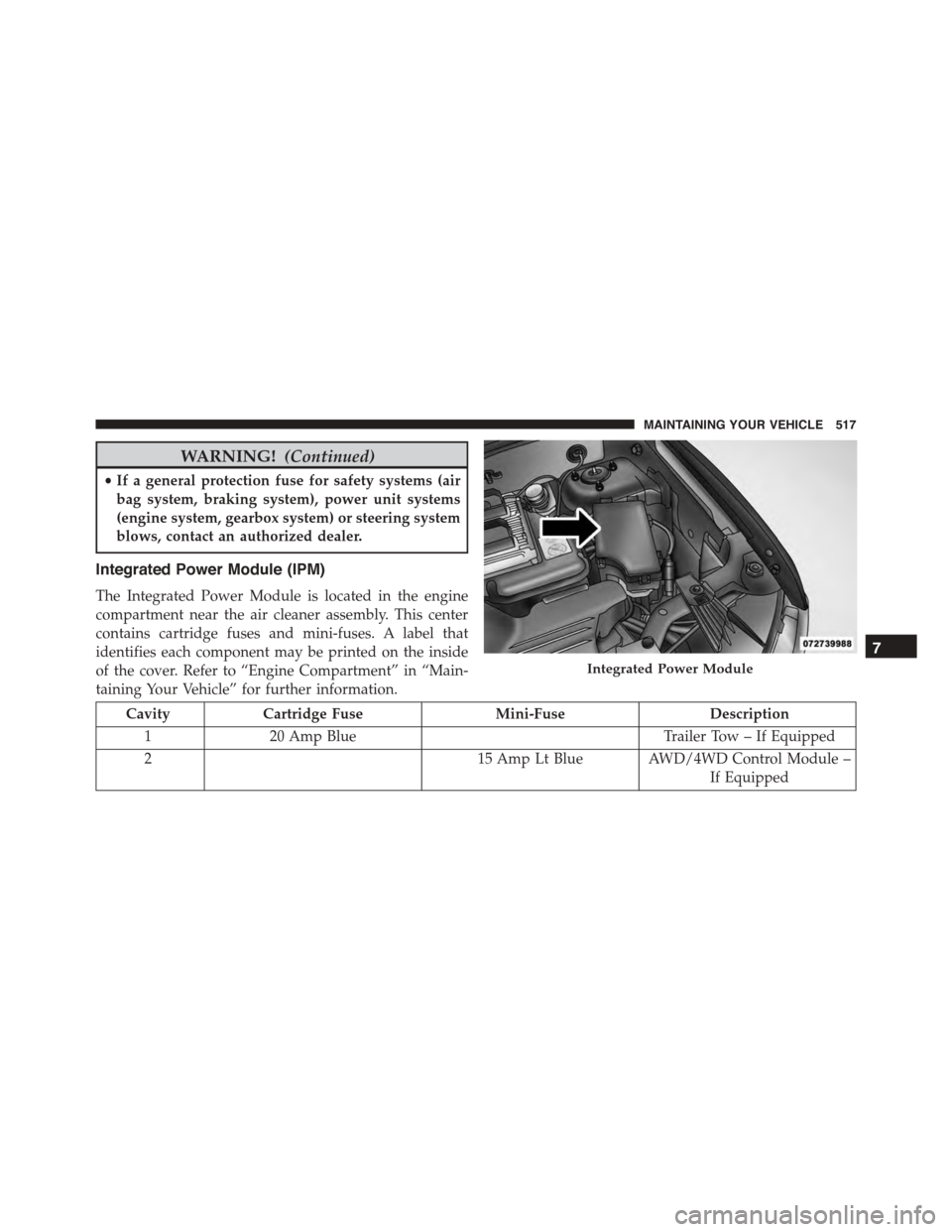
Integrated Power Module (IPM)
The Integrated Power Module is located in the engine
compartment near the air cleaner assembly. This center
contains cartridge fuses and mini-fuses. A label that
identifies each component may be printed on the inside
of the cover. Refer to “Engine Compartment” in “Main-
taining Your Vehicle” for further information.
CavityCartridge FuseMini-FuseDescription
120 Amp BlueTrailer Tow – If Equipped
215 Amp Lt Blue AWD/4WD Control Module –
If Equipped
Integrated Power Module
7
MAINTAINING YOUR VEHICLE 517
Page 540 of 572
WARNING!
•You can be badly injured working on or around a
motor vehicle. Do only service work for which you
have the knowledge and the right equipment. If
you have any doubt about your ability to perform a
service job, take your vehicle to a competent me-
chanic.
•Failure to properly inspect and maintain your ve-
hicle could result in a component malfunction and
effect vehicle handling and performance. This
could cause an accident.
538 MAINTENANCE SCHEDULES
Page 546 of 572
The manufacturer will not stand behind any service
contract that is not the manufacturer’s service contract. It
is not responsible for any service contract other than the
manufacturer’s service contract. If you purchased a ser-
vice contract that is not a manufacturer’s service contract,
and you require service after the manufacturer’s New
Vehicle Limited Warranty expires, please refer to the
contract documents, and contact the person listed in
those documents.
We appreciate that you have made a major investment
when you purchased the vehicle. An authorized dealer
has also made a major investment in facilities, tools, and
training to assure that you are absolutely delighted with
the ownership experience. You will be pleased with their
sincere efforts to resolve any warranty issues or related
concerns.
WARNING!
Engine exhaust (internal combustion engines only),
some of its constituents, and certain vehicle compo-
nents contain, or emit, chemicals known to the State
of California to cause cancer and birth defects, or
other reproductive harm. In addition, certain fluids
contained in vehicles and certain products of compo-
nent wear contain, or emit, chemicals known to the
State of California to cause cancer and birth defects,
or other reproductive harm.
WARRANTY INFORMATION
See the Warranty Information Booklet, located on the
DVD, for the terms and provisions of FCA US LLC
warranties applicable to this vehicle and market.
544 IF YOU NEED CONSUMER ASSISTANCE
Page 550 of 572
WARNING!
The traction grade assigned to this tire is based on
straight-ahead braking traction tests, and does not
include acceleration, cornering, hydroplaning, or
peak traction characteristics.
Temperature Grades
The temperature grades are A (the highest), B, and C,
representing the tire’s resistance to the generation of heat
and its ability to dissipate heat, when tested under
controlled conditions on a specified indoor laboratory
test wheel. Sustained high temperature can cause the
material of the tire to degenerate and reduce tire life, and
excessive temperature can lead to sudden tire failure. The
grade C corresponds to a level of performance, which all
passenger car tires must meet under the Federal Motor
Vehicle Safety Standard No. 109. Grades B and A repre-
sent higher levels of performance on the laboratory test
wheel, than the minimum required by law.
WARNING!
The temperature grade for this tire is established for
a tire that is properly inflated and not overloaded.
Excessive speed, under-inflation, or excessive load-
ing, either separately or in combination, can cause
heat buildup and possible tire failure.
548 IF YOU NEED CONSUMER ASSISTANCE
Page 552 of 572
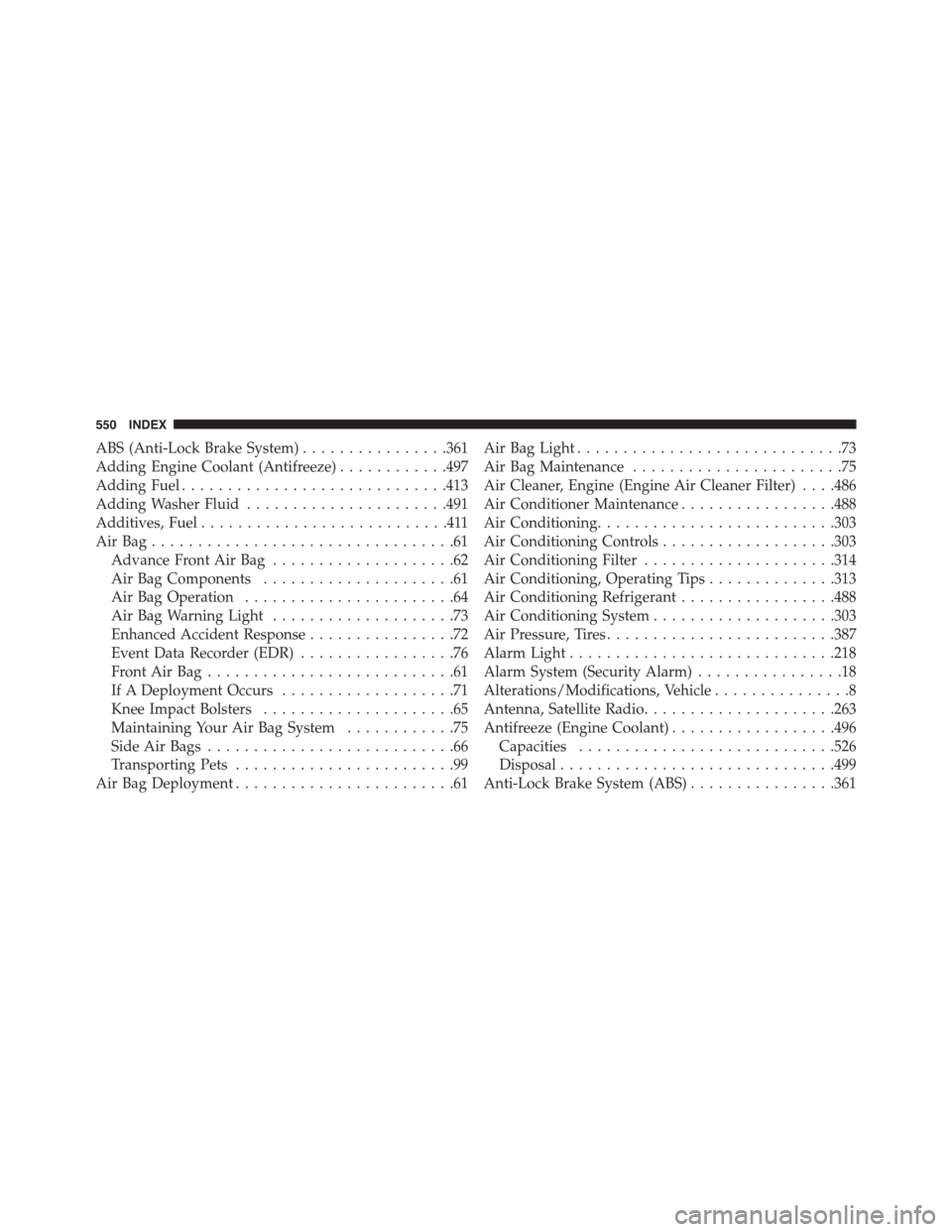
ABS (Anti-Lock Brake System)................361
Adding Engine Coolant (Antifreeze)............497
Adding Fuel.............................413
Adding Washer Fluid......................491
Additives, Fuel...........................411
Air Bag . . . . . . . . . . . . . . . . . . . . . . . . . . . . . . . . .61
Advance Front Air Bag....................62
Air Bag Components.....................61
Air Bag Operation.......................64
Air Bag Warning Light....................73
Enhanced Accident Response................72
Event Data Recorder (EDR).................76
Front Air Bag . . . . . . . . . . . . . . . . . . . . . . . . . . .61
If A Deployment Occurs...................71
Knee Impact Bolsters.....................65
Maintaining Your Air Bag System............75
Side Air Bags...........................66
Transporting Pets........................99
Air Bag Deployment........................61
Air Bag Light.............................73
Air Bag Maintenance.......................75
Air Cleaner, Engine (Engine Air Cleaner Filter) . . . .486
Air Conditioner Maintenance.................488
Air Conditioning..........................303
Air Conditioning Controls...................303
Air Conditioning Filter.....................314
Air Conditioning, Operating Tips..............313
Air Conditioning Refrigerant.................488
Air Conditioning System....................303
Air Pressure, Tires.........................387
Alarm Light.............................218
Alarm System (Security Alarm)................18
Alterations/Modifications, Vehicle...............8
Antenna, Satellite Radio.....................263
Antifreeze (Engine Coolant)..................496
Capacities............................526
Disposal..............................499
Anti-Lock Brake System (ABS)................361
550 INDEX
Page 553 of 572
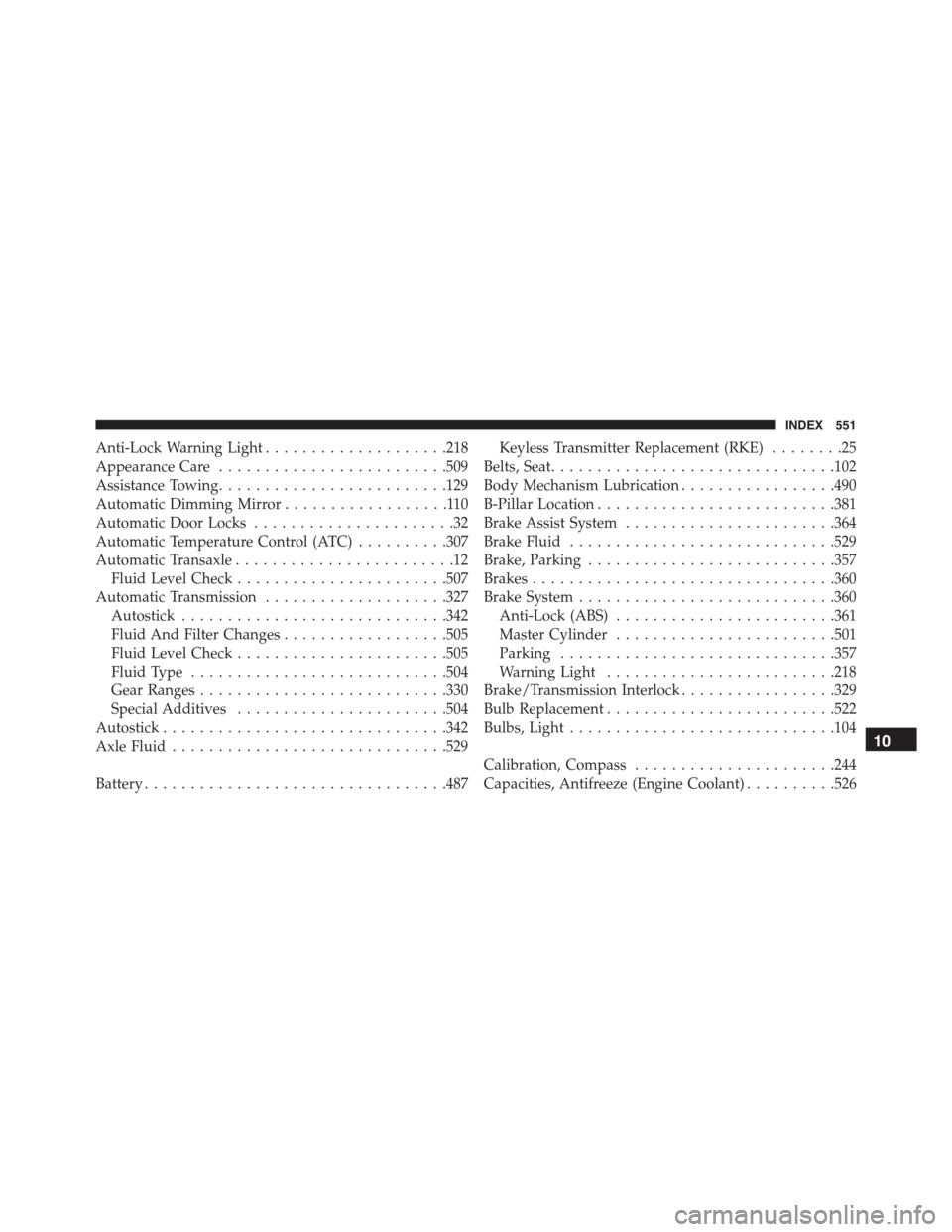
Anti-Lock Warning Light....................218
Appearance Care.........................509
Assistance Towing.........................129
Automatic Dimming Mirror..................110
Automatic Door Locks......................32
Automatic Temperature Control (ATC)..........307
Automatic Transaxle........................12
Fluid Level Check.......................507
Automatic Transmission....................327
Autostick.............................342
Fluid And Filter Changes..................505
Fluid Level Check.......................505
Fluid Type............................504
Gear Ranges...........................330
Special Additives.......................504
Autostick...............................342
Axle Fluid..............................529
Battery.................................487
Keyless Transmitter Replacement (RKE)........25
Belts, Seat...............................102
Body Mechanism Lubrication.................490
B-Pillar Location..........................381
Brake Assist System.......................364
Brake Fluid.............................529
Brake, Parking...........................357
Brakes.................................360
Brake System............................360
Anti-Lock (ABS)........................361
Master Cylinder........................501
Parking..............................357
Warning Light.........................218
Brake/Transmission Interlock.................329
Bulb Replacement.........................522
Bulbs, Light.............................104
Calibration, Compass......................244
Capacities, Antifreeze (Engine Coolant)..........526
10
INDEX 551