belt JEEP PATRIOT 2017 1.G Workshop Manual
[x] Cancel search | Manufacturer: JEEP, Model Year: 2017, Model line: PATRIOT, Model: JEEP PATRIOT 2017 1.GPages: 421, PDF Size: 3.4 MB
Page 192 of 421
Whenever a change is noticed in the sound of the exhaust
system, when exhaust fumes can be detected inside the
vehicle, or when the underside or rear of the vehicle is
damaged, have a competent mechanic inspect the complete
exhaust system and adjacent body areas for broken, dam-
aged, deteriorated, or mispositioned parts. Open seams or
loose connections could permit exhaust fumes to seep into
the passenger compartment. In addition, inspect the ex-
haust system each time the vehicle is raised for lubrication
or oil change. Replace as required.
Safety Checks You Should Make Inside The Vehicle
Seat Belts
Inspect the seat belt system periodically, checking for cuts,
frays, and loose parts. Damaged parts must be replaced
immediately. Do not disassemble or modify the system.
Front seat belt assemblies must be replaced after a collision.
Rear seat belt assemblies must be replaced after a collision
if they have been damaged (i.e., bent retractor, torn web-
bing, etc.). If there is any question regarding seat belt or
retractor condition, replace the seat belt.
Air Bag Warning Light
The Air Bag warning lightwill turn on for four to
eight seconds as a bulb check when the ignition switch is first turned to ON/RUN. If the light is either not on
during starting, stays on, or turns on while driving,
have the system inspected at an authorized dealer as
soon as possible. This light will illuminate with a single
chime when a fault with the Air Bag Warning Light has
been detected, it will stay on until the fault is cleared. If
the light comes on intermittently or remains on while
driving, have an authorized dealer service the vehicle
immediately. Refer to “Occupant Restraint Systems” in
“Safety” for further information.
Defroster
Check operation by selecting the defrost mode and place
the blower control on high speed. You should be able to
feel the air directed against the windshield. See your
authorized dealer for service if your defroster is inoper-
able.
Floor Mat Safety Information
Always use floor mats designed to fit your vehicle. Only use
a floor mat that does not interfere with the operation of the
accelerator, brake or clutch pedals. Only use a floor mat that
is securely attached using the floor mat fasteners so it cannot
slip out of position and interfere with the accelerator, brake
or clutch pedals or impair safe operation of your vehicle in
other ways.
190 SAFETY
Page 197 of 421
STARTING PROCEDURES
Before starting your vehicle, adjust your seat, adjust both
inside and outside mirrors, and fasten your seat belts.
WARNING!
•Before exiting a vehicle, always shift the transmis-
sion into PARK, apply the parking brake and remove
the key fob from the ignition. When leaving the
vehicle, always lock your vehicle.
• Never leave children alone in a vehicle, or with
access to an unlocked vehicle.
• Allowing children to be in a vehicle unattended is
dangerous for a number of reasons. A child or others
could be seriously or fatally injured. Children
should be warned not to touch the parking brake,
brake pedal or the gear selector.
• Do not leave the key fob in or near the vehicle, or in
a location accessible to children. A child could oper-
ate power windows, other controls, or move the
vehicle.
Manual Transmission — If Equipped
Before starting the engine fully apply the parking brake,
press the clutch pedal to the floor, and place the gear
selector in NEUTRAL.
NOTE:
• The engine will not start unless the clutch pedal is
pressed to the floor.
• If the key will not turn and the steering wheel is locked,
rotate the wheel in either direction to relieve pressure on
the locking mechanism and then turn the key.
Automatic Transmission — If Equipped
The gear selector must be in the PARK or NEUTRAL
position before you can start the engine. Press the brake
pedal before shifting to any driving gear.
NOTE: You must press the brake pedal before shifting out
of PARK.
Tip Start
Do not press the accelerator. Turn the ignition switch to the
START position and release it as soon as the starter
engages. The starter motor will continue to run, and it will
disengage automatically when the engine is running. If the
6
STARTING AND OPERATING 195
Page 235 of 421
DRIVING TIPS
On-Road Driving Tips
Utility vehicles have higher ground clearance and a nar-
rower track to make them capable of performing in a wide
variety of off-road applications. Specific design character-
istics give them a higher center of gravity than conven-
tional passenger cars.
An advantage of the higher ground clearance is a better
view of the road, allowing you to anticipate problems.
They are not designed for cornering at the same speeds as
conventional passenger cars any more than low-slung
sports cars are designed to perform satisfactorily in off-
road conditions. Avoid sharp turns or abrupt maneuvers.
As with other vehicles of this type, failure to operate this
vehicle correctly may result in loss of control or vehicle
rollover.
Off-Road Driving Tips
You will encounter many types of terrain driving off-road.
You should be familiar with the terrain and area before
proceeding. There are many types of surface conditions:
hard packed dirt, gravel, rocks, grass, sand, mud, snow
and ice. Every surface has a different effect on your
vehicle’s steering, handling and traction. Controlling yourvehicle is one of the keys to successful off-road driving, so
always keep a firm grip on the steering wheel and maintain
a good driving posture. Avoid sudden accelerations, turns
or braking. In most cases there are no road signs, posted
speed limits or signal lights. Therefore you will need to use
your own good judgment on what is safe and what is not.
When on a trail, you should always be looking ahead for
surface obstacles and changes in terrain. The key is to plan
your future driving route while remembering what you are
currently driving over.
CAUTION!
Never park your vehicle over dry grass or other com-
bustible materials. The heat from your vehicle exhaust
system could cause a fire.
WARNING!
Always wear your seat belt and firmly tie down cargo.
Unsecured cargo can become projectiles in an off-road
situation.
6
STARTING AND OPERATING 233
Page 290 of 421
cleaning of the condenser fins and a performance test.
Drive belt tension should also be checked at this time.
WARNING!
•Use only refrigerants and compressor lubricants ap-
proved by the manufacturer for your air conditioning
system. Some unapproved refrigerants are flam-
mable and can explode, injuring you. Other unap-
proved refrigerants or lubricants can cause the sys-
tem to fail, requiring costly repairs. Refer to
Warranty Information Book, in the owner ’s informa-
tion kit.
• The air conditioning system contains refrigerant un-
der high pressure. To avoid risk of personal injury or
damage to the system, adding refrigerant or any
repair requiring lines to be disconnected should be
done by an experienced technician.
CAUTION!
Do not use chemical flushes in your air conditioning
system as the chemicals can damage your air condition-
ing components. Such damage is not covered by the
New Vehicle Limited Warranty.
Refrigerant Recovery And Recycling
R-134a Air Conditioning Refrigerant is a hydrofluoro-
carbon (HFC) that is endorsed by the Environmental
Protection Agency and is an ozone-saving product. How-
ever, the manufacturer recommends that air conditioning
service be performed by authorized dealer or other service
facilities using recovery and recycling equipment.
NOTE: Use only manufacturer approved A/C system PAG
compressor oil and refrigerants.
A/C Air Filter
Refer to the “Maintenance Plan” for the proper mainte-
nance intervals.
WARNING!
Do not remove the cabin air filter while the vehicle is
running, or while the ignition is in the ACC or ON/
RUN mode. With the cabin air filter removed and the
blower operating, the blower can contact hands and
may propel dirt and debris into your eyes, resulting in
personal injury.
288 SERVICING AND MAINTENANCE
Page 302 of 421
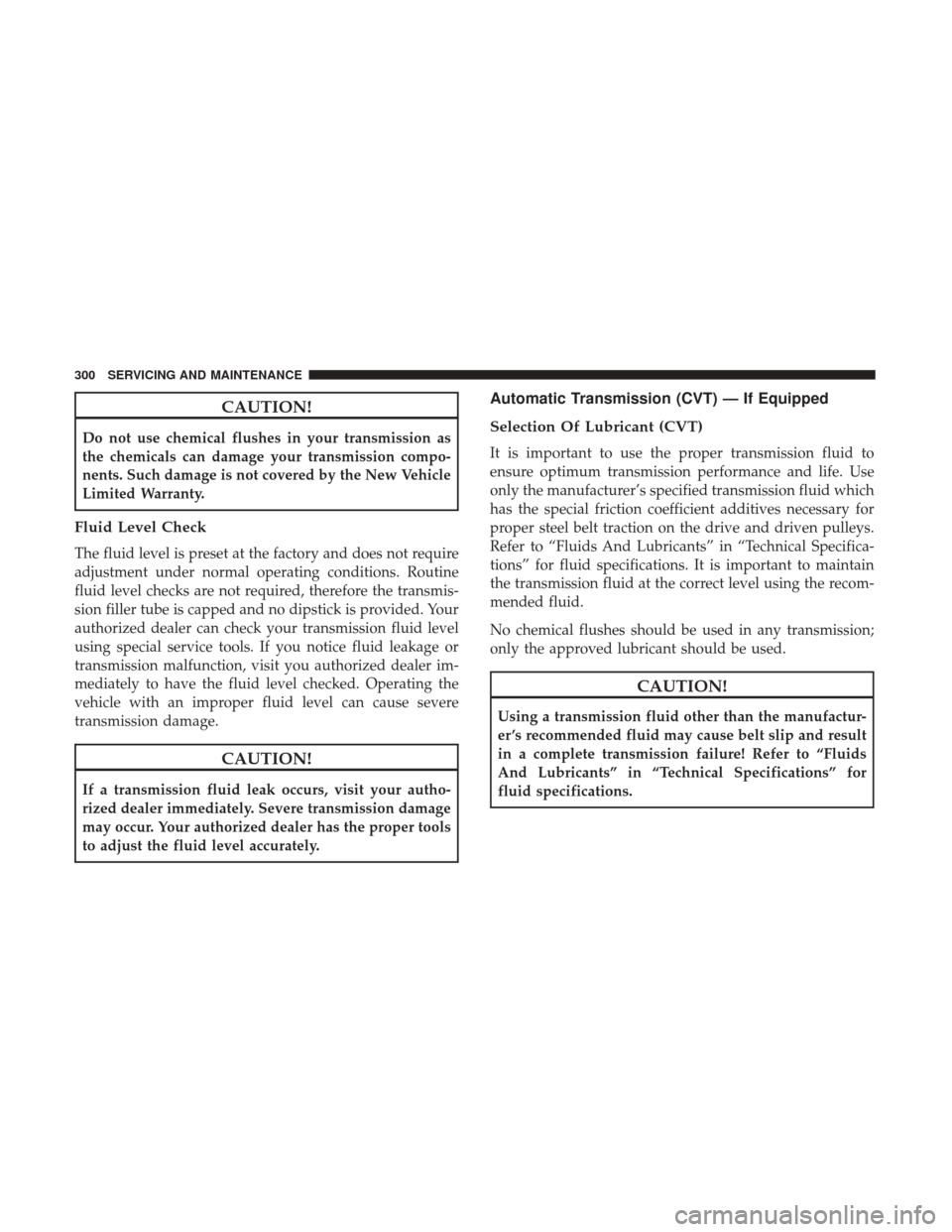
CAUTION!
Do not use chemical flushes in your transmission as
the chemicals can damage your transmission compo-
nents. Such damage is not covered by the New Vehicle
Limited Warranty.
Fluid Level Check
The fluid level is preset at the factory and does not require
adjustment under normal operating conditions. Routine
fluid level checks are not required, therefore the transmis-
sion filler tube is capped and no dipstick is provided. Your
authorized dealer can check your transmission fluid level
using special service tools. If you notice fluid leakage or
transmission malfunction, visit you authorized dealer im-
mediately to have the fluid level checked. Operating the
vehicle with an improper fluid level can cause severe
transmission damage.
CAUTION!
If a transmission fluid leak occurs, visit your autho-
rized dealer immediately. Severe transmission damage
may occur. Your authorized dealer has the proper tools
to adjust the fluid level accurately.
Automatic Transmission (CVT) — If Equipped
Selection Of Lubricant (CVT)
It is important to use the proper transmission fluid to
ensure optimum transmission performance and life. Use
only the manufacturer’s specified transmission fluid which
has the special friction coefficient additives necessary for
proper steel belt traction on the drive and driven pulleys.
Refer to “Fluids And Lubricants” in “Technical Specifica-
tions” for fluid specifications. It is important to maintain
the transmission fluid at the correct level using the recom-
mended fluid.
No chemical flushes should be used in any transmission;
only the approved lubricant should be used.
CAUTION!
Using a transmission fluid other than the manufactur-
er ’s recommended fluid may cause belt slip and result
in a complete transmission failure! Refer to “Fluids
And Lubricants” in “Technical Specifications” for
fluid specifications.
300 SERVICING AND MAINTENANCE
Page 327 of 421
•If a lot of driving is done on gravel roads, consider mud
or stone shields behind each wheel.
• Use MOPAR Touch Up Paint on scratches as soon as
possible. Your authorized dealer has touch up paint to
match the color of your vehicle.
INTERIORS
Seats And Fabric Parts
Use MOPAR Total Clean to clean fabric upholstery and
carpeting.
WARNING!
Do not use volatile solvents for cleaning purposes.
Many are potentially flammable, and if used in closed
areas they may cause respiratory harm.
Seat Belt Maintenance
Do not bleach, dye or clean the belts with chemical solvents
or abrasive cleaners. This will weaken the fabric. Sun
damage can also weaken the fabric.
If the belts need cleaning, use a mild soap solution or
lukewarm water. Do not remove the belts from the vehicle
to wash them. Dry with a soft cloth. Replace the belts if they appear frayed or worn or if the
buckles do not work properly.
WARNING!
A frayed or torn belt could rip apart in a collision and
leave you with no protection. Inspect the belt system
periodically, checking for cuts, frays, or loose parts.
Damaged parts must be replaced immediately. Do not
disassemble or modify the system. Seat belt assemblies
must be replaced after a collision if they have been
damaged (i.e., bent retractor, torn webbing, etc.).
Plastic And Coated Parts
Use MOPAR Total Clean to clean vinyl upholstery.
CAUTION!
Direct contact of air fresheners, insect repellents, sun-
tan lotions, or hand sanitizers to the plastic, painted, or
decorated surfaces of the interior may cause permanent
damage. Wipe away immediately.
8
SERVICING AND MAINTENANCE 325
Page 407 of 421
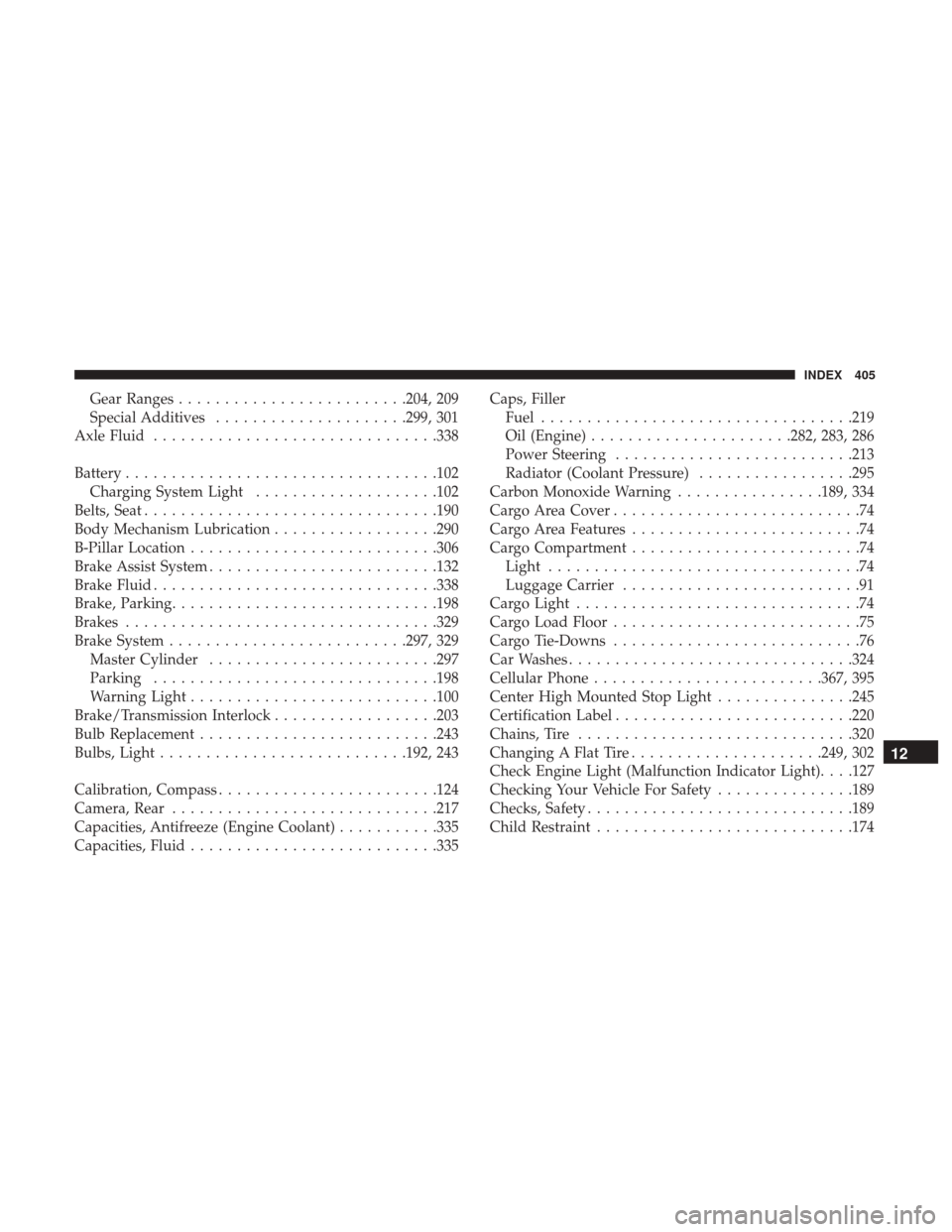
Gear Ranges........................ .204, 209
Special Additives .....................299, 301
Axle Fluid .............................. .338
Battery ................................. .102
Charging System Light ....................102
Belts, Seat ............................... .190
Body Mechanism Lubrication ..................290
B-Pillar Location .......................... .306
Brake Assist System ........................ .132
Brake Fluid .............................. .338
Brake, Parking ............................ .198
Brakes ................................. .329
Brake System ......................... .297, 329
Master Cylinder ........................ .297
Parking .............................. .198
Warning Light .......................... .100
Brake/Transmission Interlock ..................203
Bulb Replacement ......................... .243
Bulbs, Light .......................... .192, 243
Calibration, Compass ....................... .124
Camera, Rear ............................ .217
Capacities, Antifreeze (Engine Coolant) ...........335
Capacities, Fluid .......................... .335Caps, Filler
Fuel ................................. .219
Oil (Engine) ..................... .282, 283, 286
Power Steering ......................... .213
Radiator (Coolant Pressure) .................295
Carbon Monoxide Warning ................189, 334
Cargo Area Cover ...........................74
Cargo Area Features .........................74
Cargo Compartment .........................74
Light ..................................74
Luggage Carrier ..........................91
Cargo Light ...............................74
Cargo Load Floor ...........................75
Cargo Tie-Downs ...........................76
Car Washes .............................. .324
Cellular
Phone........................ .367, 395
Center High Mounted Stop Light ...............245
Certification Label ......................... .220
Chains, Tire ............................. .320
Changing A Flat Tire .....................249, 302
Check Engine Light (Malfunction Indicator Light). . . .127
Checking Your Vehicle For Safety ...............189
Checks, Safety ............................ .189
Child Restraint ........................... .174
12
INDEX 405
Page 408 of 421
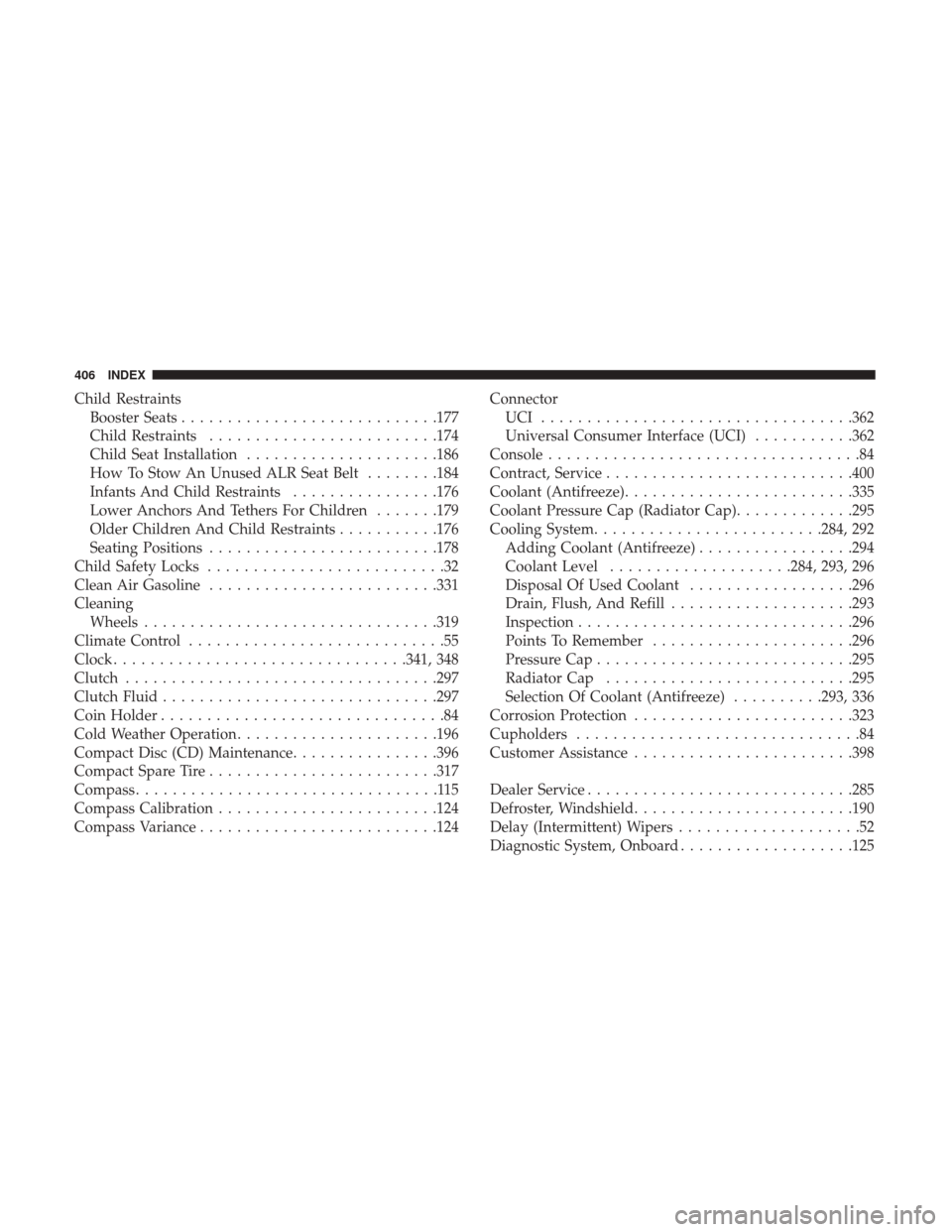
Child RestraintsBooster Seats ........................... .177
Child Restraints ........................ .174
Child Seat Installation .....................186
How To Stow An Unused ALR Seat Belt ........184
Infants And Child Restraints ................176
Lower Anchors And Tethers For Children .......179
Older Children And Child Restraints ...........176
Seating Positions ........................ .178
Child Safety Locks ..........................32
Clean Air Gasoline ........................ .331
Cleaning Wheels ............................... .319
Climate Control ............................55
Clock ............................... .341, 348
Clutch ................................. .297
Clutch Fluid ............................. .297
Coin Holder ...............................84
Cold Weather Operation ..................... .196
Compact Disc (CD) Maintenance ................396
Compact Spare Tire ........................ .317
Compass .................................115
Compass Calibration ....................... .124
Compass Variance ......................... .124Connector
UCI ................................. .362
Universal Consumer Interface (UCI) ...........362
Console ..................................84
Contract, Service .......................... .400
Coolant (Antifreeze) ........................ .335
Coolant Pressure Cap (Radiator Cap) .............295
Cooling System ........................ .284, 292
Adding Coolant (Antifreeze) .................294
Coolant Level ....................284, 293, 296
Disposal Of Used Coolant ..................296
Drain, Flush, And Refill ....................293
Inspection ............................. .296
Points To Remember ..................... .296
Pr
essure Cap ........................... .295
Radiator Cap .......................... .295
Selection Of Coolant (Antifreeze) ..........293, 336
Corrosion Protection ....................... .323
Cupholders ...............................84
Customer Assistance ....................... .398
Dealer Service ............................ .285
Defroster, Windshield ....................... .190
Delay (Intermittent) Wipers ....................52
Diagnostic System, Onboard ...................125
406 INDEX
Page 412 of 421
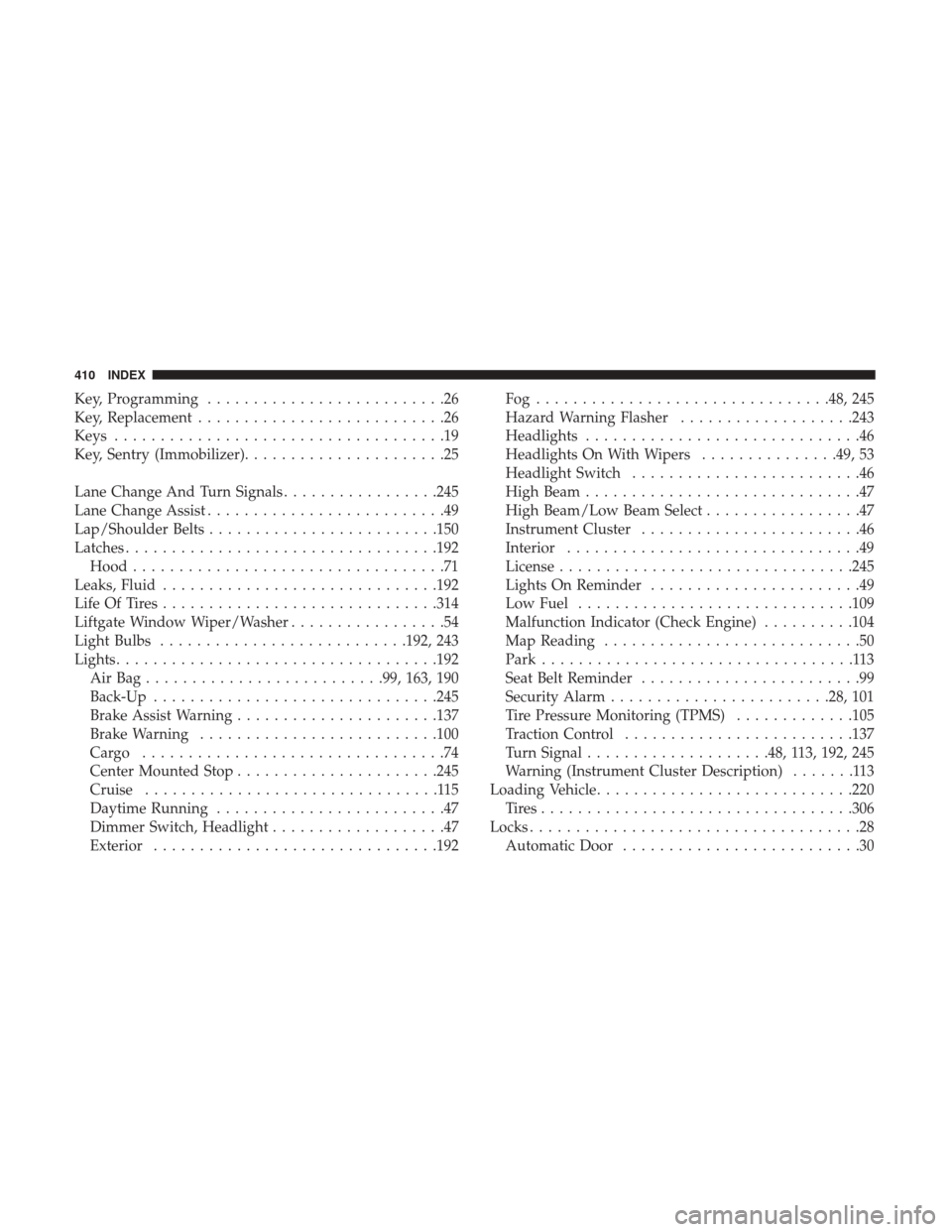
Key, Programming..........................26
Key, Replacement ...........................26
Keys ....................................19
Key, Sentry (Immobilizer) ......................25
Lane Change And Turn Signals .................245
Lane Change Assist ..........................49
Lap/Shoulder Belts ........................ .150
Latches ................................. .192
Hood ..................................71
Leaks, Fluid ............................. .192
Life Of Tires ............................. .314
Liftgate Window Wiper/Washer .................54
Light Bulbs .......................... .192, 243
Lights .................................. .192
AirBag......................... .99, 163, 190
Back-Up .............................. .245
Brake Assist Warning ..................... .137
Brake Warning ......................... .100
Cargo .................................74
Center Mounted Stop ..................... .245
Cruise ................................115
Daytime Running .........................47
Dimmer Switch, Headlight ...................47
Exterior .............................. .192Fog...............................
.48, 245
Hazard Warning Flasher ...................243
Headlights ..............................46
Headlights On With Wipers ...............49, 53
Headlight Switch .........................46
High Beam ..............................47
High Beam/Low Beam Select .................47
Instrument Cluster ........................46
Interior ................................49
License ............................... .245
Lights On Reminder .......................49
Low Fuel ............................. .109
Malfunction Indicator (Check Engine) ..........104
Map Reading ............................50
Park ..................................113
Seat Belt Reminder ........................99
Security Alarm....................... .28, 101
Tire Pressure Monitoring (TPMS) .............105
Traction Control ........................ .137
T
urn Signal ....................48, 113, 192, 245
Warning (Instrument Cluster Description) .......113
Loading Vehicle ........................... .220
Tires................................. .306
Locks ....................................28
Automatic Door ..........................30
410 INDEX
Page 414 of 421
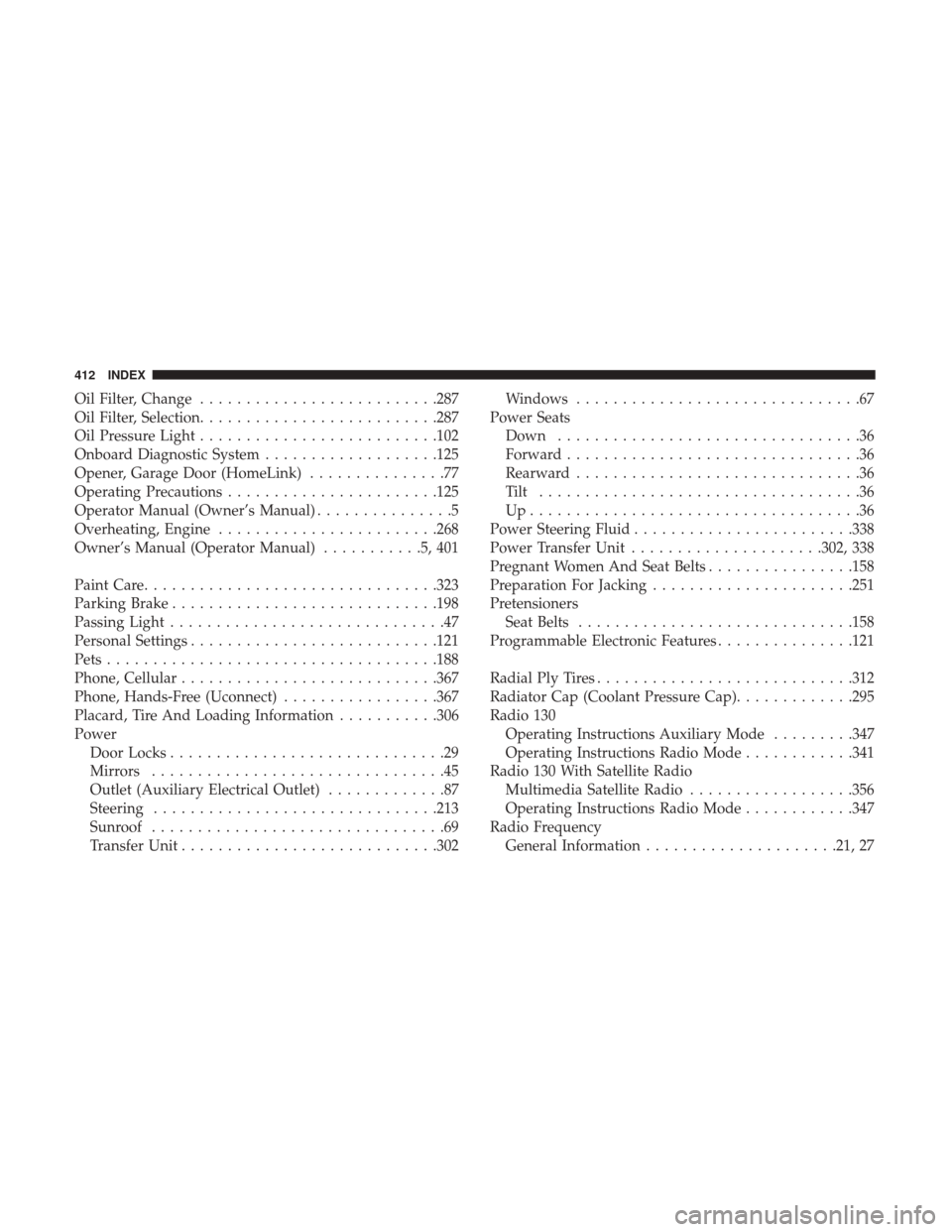
Oil Filter, Change......................... .287
Oil Filter, Selection ......................... .287
Oil Pressure Light ......................... .102
Onboard Diagnostic System ...................125
Opener, Garage Door (HomeLink) ...............77
Operating Precautions ...................... .125
Operator Manual (Owner’s Manual) ...............5
Overheating, Engine ....................... .268
Owner’s Manual (Operator Manual) ...........5,401
Paint Care ............................... .323
Parking Brake ............................ .198
Passing Light ..............................47
Personal Settings .......................... .121
Pets ................................... .188
Phone, Cellular ........................... .367
Phone, Hands-Free (Uconnect) .................367
Placard, Tire And Loading Information ...........306
Power Door Locks ..............................29
Mirrors ................................45
Outlet (Auxiliary Electrical Outlet) .............87
Steering .............................. .213
Sunroof ................................69
Transfer Unit ........................... .302Windows
...............................67
Power Seats Down .................................36
Forward ................................36
Rearward ...............................36
Tilt ...................................36
Up....................................36
Power Steering Fluid ....................... .338
Power Transfer Unit .....................302, 338
Pregnant Women And Seat Belts ................158
Preparation For Jacking ..................... .251
Pretensioners Seat Belts ............................. .158
Programmable Electronic Features ...............121
Radial Ply Tires ........................... .312
Radiator Cap (Coolant Pressure Cap) .............295
Radio 130 Operating Instructions Auxiliary Mode .........347
Operating Instructions Radio Mode ............341
Radio
130 With Satellite Radio
Multimedia Satellite Radio ..................356
Operating Instructions Radio Mode ............347
Radio Frequency General Information .....................21, 27
412 INDEX