ABS JEEP PATRIOT 2021 Owner handbook (in English)
[x] Cancel search | Manufacturer: JEEP, Model Year: 2021, Model line: PATRIOT, Model: JEEP PATRIOT 2021Pages: 332, PDF Size: 1.99 MB
Page 193 of 332
Brake Assist System (BAS)The BAS is designed to optimize the vehicle’s
braking capability during emergency braking
maneuvers. The system detects an emergency
braking situation by sensing the rate and
amount of brake application and then applies
optimum pressure to the brakes. This can help
reduce braking distances. The BAS comple-
ments the anti-lock brake system (ABS). Apply-
ing the brakes very quickly results in the best
BAS assistance. To receive the benefit of the
system, you must apply continuous braking
pressure during the stopping sequence, (do not
“pump” the brakes). Do not reduce brake pedal
pressure unless braking is no longer desired.
Once the brake pedal is released, the BAS is
deactivated.
WARNING!
The Brake Assist System (BAS) cannot pre-
vent the natural laws of physics from acting
on the vehicle, nor can it increase the trac-
tion afforded by prevailing road conditions.
(Continued)
WARNING!(Continued)
BAS cannot prevent collisions, including
those resulting from excessive speed in
turns, driving on very slippery surfaces, or
hydroplaning. The capabilities of a BAS-
equipped vehicle must never be exploited in
a reckless or dangerous manner, which
could jeopardize the user’s safety or the
safety of others.
Hill Start Assist (HSA)The HSA system is designed to mitigate roll
back from a complete stop while on an incline. If
the driver releases the brake while stopped on
an incline, HSA will continue to hold the brake
pressure for a short period. If the driver does not
apply the throttle before this time expires, the
system will release brake pressure and the
vehicle will roll down the hill as normal.
The following conditions must be met in order
for HSA to activate:
•The feature must be enabled.
•The vehicle must be stopped.•Park brake must be off.
•Driver door must be closed.
•The vehicle must be on a sufficient grade.
•The gear selection must match vehicle uphill
direction (i.e., vehicle facing uphill is in for-
ward gear; vehicle backing uphill is in RE-
VERSE gear).
•HSA will work in REVERSE gear and all
forward gears. The system will not activate if
the transmission is in PARK or NEUTRAL.
For vehicles equipped with a manual trans-
mission, if the clutch is pressed, HSA will
remain active.
WARNING!
There may be situations where the Hill Start
Assist (HSA) will not activate and slight roll-
ing may occur, such as on minor hills or with
a loaded vehicle, or while pulling a trailer.
HSA is not a substitute for active driving
involvement. It is always the driver’s respon-
sibility to be attentive to distance to other
(Continued)
189
Page 241 of 332
WARNING!(Continued)
•Keep Tire Service Kit away from open
flames or heat source.
•A loose Tire Service Kit thrown forward in a
collision or hard stop could endanger the
occupants of the vehicle. Always stow the
Tire Service Kit in the place provided.
Failure to follow these warnings can result
in injuries that are serious or fatal to you,
your passengers, and others around you.
•Take care not to allow the contents of Tire
Service Kit to come in contact with hair,
eyes, or clothing. Tire Service Kit sealant is
harmful if inhaled, swallowed, or absorbed
through the skin. It causes skin, eye, and
respiratory irritation. Flush immediately
with plenty of water if there is any contact
with eyes or skin. Change clothing as soon
as possible, if there is any contact with
clothing.
(Continued)
WARNING!(Continued)
•Tire Service Kit Sealant solution contains
latex. In case of an allergic reaction or
rash, consult a physician immediately.
Keep Tire Service Kit out of reach of
children. If swallowed, rinse mouth imme-
diately with plenty of water and drink plenty
of water. Do not induce vomiting! Consult a
physician immediately.
Sealing A Tire With Tire Service Kit
(A) Whenever You Stop To Use Tire Service
Kit:
1. Pull over to a safe location and turn on the
vehicle’s Hazard Warning flashers.
2. Verify that the valve stem (on the wheel with
the deflated tire) is in a position that is near
to the ground. This will allow the Tire Service
Kit Hoses (6) and (7) to reach the valve stem
and keep the Tire Service Kit flat on the
ground. This will provide the best positioning
of the kit when injecting the sealant into thedeflated tire and running the air pump. Move
the vehicle as necessary to place the valve
stem in this position before proceeding.
3. Place the transmission in PARK (auto trans-
mission) or in Gear (manual transmission)
and place the ignition in the OFF position.
4. Set the parking brake.
(B) Setting Up To Use Tire Service Kit:
1. Push in the Mode Select Knob (5) and turn to
the Sealant Mode position.
2. Uncoil the Sealant Hose (6) and then re-
move the cap from the fitting at the end of the
hose.
3. Place the Tire Service Kit flat on the ground
next to the deflated tire.
4. Remove the cap from the valve stem and
then screw the fitting at the end of the
Sealant Hose (6) onto the valve stem.
5. Uncoil the Power Plug (8) and insert the plug
into the vehicle’s 12 Volt power outlet.
237
Page 264 of 332
CAUTION!(Continued)
Such damage is not covered by the New
Vehicle Limited Warranty.
Refrigerant Recovery And Recycling
R-134a Air Conditioning Refrigerant is a hydro-
fluorocarbon (HFC) that is endorsed by the
Environmental Protection Agency and is an
ozone-saving product. However, the manufac-
turer recommends that air conditioning service
be performed by authorized dealer or other
service facilities using recovery and recycling
equipment.
NOTE:
Use only manufacturer approved A/C sys-
tem PAG compressor oil and refrigerants.
A/C Air Filter
Refer to the “Maintenance Schedule” for the
proper maintenance intervals.
WARNING!
Do not remove the A/C air filter while the
vehicle is running, or while the ignition is in
the ACC or ON/RUN mode. With the A/C air
filter removed and the blower operating, the
blower can contact hands and may propel
dirt and debris into your eyes, resulting in
personal injury.
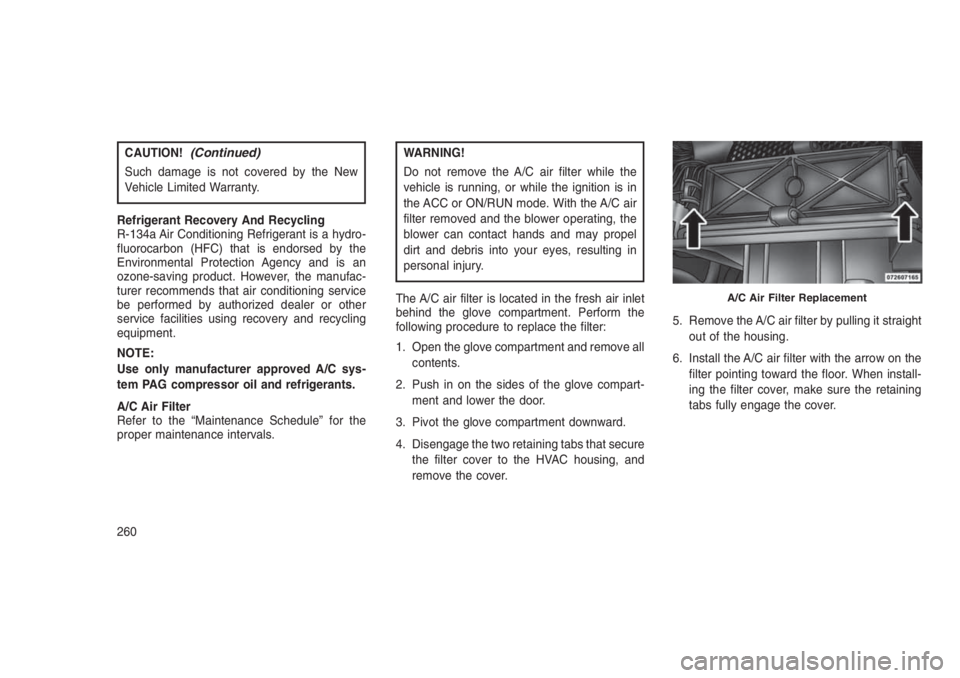
The A/C air filter is located in the fresh air inlet
behind the glove compartment. Perform the
following procedure to replace the filter:
1. Open the glove compartment and remove all
contents.
2. Push in on the sides of the glove compart-
ment and lower the door.
3. Pivot the glove compartment downward.
4. Disengage the two retaining tabs that secure
the filter cover to the HVAC housing, and
remove the cover.5. Remove the A/C air filter by pulling it straight
out of the housing.
6. Install the A/C air filter with the arrow on the
filter pointing toward the floor. When install-
ing the filter cover, make sure the retaining
tabs fully engage the cover.
A/C Air Filter Replacement
260
Page 271 of 332
WARNING!
•Use only manufacturer’s recommended
brake fluid. Refer to “Fluids, Lubricants,
And Genuine Parts” in “Maintaining Your
Vehicle” for further information. Using the
wrong type of brake fluid can severely
damage your brake system and/or impair
its performance. The proper type of brake
fluid for your vehicle is also identified on
the original factory installed hydraulic mas-
ter cylinder reservoir.
•To avoid contamination from foreign matter
or moisture, use only new brake fluid or
fluid that has been in a tightly closed
container. Keep the master cylinder reser-
voir cap secured at all times. Brake fluid in
a open container absorbs moisture from
the air resulting in a lower boiling point.
This may cause it to boil unexpectedly
during hard or prolonged braking, resulting
in sudden brake failure. This could result in
a collision.
(Continued)
WARNING!(Continued)
•Overfilling the brake fluid reservoir can
result in spilling brake fluid on hot engine
parts, causing the brake fluid to catch fire.
Brake fluid can also damage painted and
vinyl surfaces, care should be taken to
avoid its contact with these surfaces.
•Do not allow petroleum based fluid to
contaminate the brake fluid. Brake seal
components could be damaged, causing
partial or complete brake failure. This
could result in a collision.
CAUTION!
Use of improper brake fluids will affect over-
all clutch system performance. Improper
brake fluids may damage the clutch system
resulting in loss of clutch function and the
ability to shift the transmission.
Automatic Transmission (6-Speed)
— If Equipped
Selection Of Lubricant — 6-Speed
Transmission
It is important to use the proper transmission
fluid to ensure optimum transmission perfor-
mance and life. Use only the manufacturer’s
specified transmission fluid. Refer to “Fluids,
Lubricants, and Genuine Parts” in this section
for fluid specifications. It is important to maintain
the transmission fluid at the correct level using
the recommended fluid.
No chemical flushes should be used in any
transmission; only the approved lubricant
should be used.
CAUTION!
Using a transmission fluid other than the
manufacturer’s recommended fluid may
cause deterioration in transmission shift
quality and/or torque converter shudder. Re-
fer to “Fluids, Lubricants, And Genuine
Parts” in this section for fluid specifications.
267
Page 322 of 332

Adding Engine Coolant (Antifreeze). . . .264
Adding Fuel..................212
Adding Washer Fluid.............261
Additives, Fuel................211
Adjust
Down....................89
Forward...................89
Rearward..................89
Up......................89
AirBag.....................38
Advance Front Air Bag..........38
Air Bag Operation.............39
Air Bag Warning Light...........44
Enhanced Accident Response......43
Event Data Recorder (EDR).......45
Front Air Bag................38
If A Deployment Occurs..........43
Knee Impact Bolsters...........40
Maintaining Your Air Bag System.....45
Side Air Bags...............40
Transporting Pets.............57
Air Bag Deployment..............38
Air Bag Light.............44, 59, 123
Air Bag Maintenance.............45
Air Cleaner, Engine (Engine Air Cleaner
Filter)....................258
Air Conditioner Maintenance........259Air Conditioning................150
Air Conditioning Controls..........150
Air Conditioning Filter.........158, 260
Air Conditioning Refrigerant......259, 260
Air Conditioning System.....150, 153, 259
Air Conditioning, Operating Tips. . . .157, 159
Air Pressure, Tires..............196
Alarm (Security Alarm)............125
Alarm System (Security Alarm)......14, 15
Alterations/Modifications, Vehicle.......8
Anti-Lock Brake System (ABS).......187
Anti-Lock Warning Light...........133
Antifreeze (Engine Coolant)......263, 280
Capacities................280
Disposal..................265
Appearance Care...............271
Assist, Hill Start................189
Automatic Dimming Mirror..........65
Automatic Door Locks.............22
Automatic Temperature Control (ATC) . . .153
Automatic Transaxle..............12
Fluid Level Check.........268, 269
Automatic Transmission . .168, 169, 267, 268
Autostick.................176
Fluid And Filter Changes........269
Fluid Type.............267, 268
Gear Ranges............170, 174Special Additives..........268, 269
Autostick.................176, 177
Battery..................127, 258
Charging System Light.........127
Keyless Transmitter Replacement
(RKE)...................18
Belts, Seat...................59
Body Mechanism Lubrication........261
Brake Assist System.............189
Brake Fluid..................282
Brake System..............186, 266
Master Cylinder.............266
Parking..................185
Warning Light..............124
Brake, Parking................185
Brake/Transmission Interlock........169
Brakes.....................186
Bulb Replacement..............279
Bulbs, Light................60, 279
Calibration, Compass............144
Camera, Rear.................104
Capacities, Antifreeze (Engine Coolant) . .280
Capacities, Fluid...............280
Caps, Filler
Fuel....................212
318