air conditioning JEEP PATRIOT 2021 Owner handbook (in English)
[x] Cancel search | Manufacturer: JEEP, Model Year: 2021, Model line: PATRIOT, Model: JEEP PATRIOT 2021Pages: 332, PDF Size: 1.99 MB
Page 231 of 332
HAZARD WARNING FLASHERS
The Hazard Warning flasher switch is located
on the instrument panel below the climate
controls.
Push the switch to turn on the Hazard
Warning flasher. When the switch is
activated, all directional turn signals
will flash on and off to warn oncoming traffic of
an emergency. Push the switch a second time
to turn off the Hazard Warning flashers.
This is an emergency warning system and it
should not be used when the vehicle is in
motion. Use it when your vehicle is disabled and
it is creating a safety hazard for other motorists.
When you must leave the vehicle to seek assis-
tance, the Hazard Warning flashers will con-
tinue to operate even though the ignition is
placed in the OFF position.
NOTE:
With extended use the Hazard Warning
flashers may wear down your battery.
IF YOUR ENGINE OVERHEATS
In any of the following situations, you can
reduce the potential for overheating by taking
the appropriate action.
•On the highways — slow down.
•In city traffic — while stopped, place the
transmission in NEUTRAL, but do not in-
crease engine idle speed.
NOTE:
There are steps that you can take to slow
down an impending overheat condition:
•If your air conditioner (A/C) is on, turn it
off. The A/C system adds heat to the
engine cooling system and turning the
A/C off can help remove this heat.
•You can also turn the temperature control
to maximum heat, the mode control to
floor and the blower control to high. This
allows the heater core to act as a supple-
ment to the radiator and aids in removing
heat from the engine cooling system.CAUTION!
Driving with a hot cooling system could dam-
age your vehicle. If the pointer rises to the
H(red) mark, the instrument cluster will
sound a chime. When safe, pull over and
stop the vehicle with the engine at idle. Turn
off the air conditioning and wait until the
pointer drops back into the normal range. If
the pointer remains on theH(red) mark for
more than a minute, turn the engine off
immediately and call for service.
WARNING!
You or others can be badly burned by hot
engine coolant (antifreeze) or steam from
your radiator. If you see or hear steam com-
ing from under the hood, do not open the
hood until the radiator has had time to cool.
Never try to open a cooling system pressure
cap when the radiator or coolant bottle is hot.
227
Page 260 of 332
Loose Fuel Filler Cap MessageAfter fuel is added, the vehicle diagnostic sys-
tem can determine if the fuel filler cap is possi-
bly loose or improperly installed. A “gASCAP”
message will be displayed in the instrument
cluster. Tighten the gas cap until a “clicking”
sound is heard. This is an indication that the gas
cap is properly tightened. Push the trip odom-
eter RESET button to turn off the message. If
the problem persists, the message will appear
the next time the vehicle is started. This might
indicate a damaged cap. If the problem is
detected twice in a row, the system will turn on
the MIL. Resolving the problem will turn the MIL
light off.
REPLACEMENT PARTS
Use of genuine MOPAR parts for normal/
scheduled maintenance and repairs is highly
recommended to ensure the designed perfor-
mance. Damage or failures caused by the use
of non-MOPAR parts for maintenance and re-
pairs will not be covered by the New Vehicle
Limited Warranty.
MAINTENANCE PROCEDURES
The pages that follow contain therequired
maintenance services determined by the engi-
neers who designed your vehicle.
Besides those maintenance items specified in
the fixed “Maintenance Schedule”, there are
other components which may require servicing
or replacement in the future.
CAUTION!
•Failure to properly maintain your vehicle or
perform repairs and service when neces-
sary could result in more costly repairs,
damage to other components or negatively
impact vehicle performance. Immediately
have potential malfunctions examined by
an authorized dealer or qualified repair
center.
(Continued)
CAUTION!(Continued)
•Your vehicle has been built with improved
fluids that protect the performance and
durability of your vehicle and also allow
extended maintenance intervals. Do not
use chemical flushes in these components
as the chemicals can damage your engine,
transmission, or air conditioning. Such
damage is not covered by the New Vehicle
Limited Warranty. If a flush is needed
because of component malfunction, use
only the specified fluid for the flushing
procedure.
Engine Oil
Checking Oil Level
To assure proper engine lubrication, the engine
oil must be maintained at the correct level.
Check the oil level at regular intervals, such as
every fuel stop.
The best time to check the engine oil level is
about five minutes after a fully warmed engine is
shut off. Do not check oil level before starting
256
Page 263 of 332
WARNING!
•
Battery fluid is a corrosive acid solution and
can burn or even blind you. Do not allow
battery fluid to contact your eyes, skin, or
clothing. Do not lean over a battery when
attaching clamps. If acid splashes in eyes or
on skin, flush the area immediately with
large amounts of water. Refer to “Jump-
Starting Procedures” in “What To Do In
Emergencies” for further information.
•Battery gas is flammable and explosive.
Keep flame or sparks away from the bat-
tery. Do not use a booster battery or any
other booster source with an output
greater than 12 Volts. Do not allow cable
clamps to touch each other.
•Battery posts, terminals, and related ac-
cessories contain lead and lead com-
pounds. Wash hands after handling.
•
The battery in this vehicle has a vent hose
that should not be disconnected and should
only be replaced with a battery of the same
type (vented).
CAUTION!
•It is essential when replacing the cables on
the battery that the positive cable is at-
tached to the positive post and the nega-
tive cable is attached to the negative post.
Battery posts are marked positive (+) and
negative (-) and are identified on the bat-
tery case. Cable clamps should be tight on
the terminal posts and free of corrosion.
•If a “fast charger” is used while the battery
is in the vehicle, disconnect both vehicle
battery cables before connecting the char-
ger to the battery. Do not use a “fast
charger” to provide starting voltage.
Air Conditioner MaintenanceFor best possible performance, your air condi-
tioner should be checked and serviced by an
authorized dealer at the start of each warm
season. This service should include cleaning of
the condenser fins and a performance test.
Drive belt tension should also be checked at
this time.
WARNING!
•Use only refrigerants and compressor lu-
bricants approved by the manufacturer for
your air conditioning system. Some unap-
proved refrigerants are flammable and can
explode, injuring you. Other unapproved
refrigerants or lubricants can cause the
system to fail, requiring costly repairs. Re-
fer to Warranty Information Book, for fur-
ther warranty information.
•The air conditioning system contains re-
frigerant under high pressure. To avoid risk
of personal injury or damage to the sys-
tem, adding refrigerant or any repair re-
quiring lines to be disconnected should be
done by an experienced technician.
CAUTION!
Do not use chemical flushes in your air
conditioning system as the chemicals can
damage your air conditioning components.
(Continued)
259
Page 264 of 332
CAUTION!(Continued)
Such damage is not covered by the New
Vehicle Limited Warranty.
Refrigerant Recovery And Recycling
R-134a Air Conditioning Refrigerant is a hydro-
fluorocarbon (HFC) that is endorsed by the
Environmental Protection Agency and is an
ozone-saving product. However, the manufac-
turer recommends that air conditioning service
be performed by authorized dealer or other
service facilities using recovery and recycling
equipment.
NOTE:
Use only manufacturer approved A/C sys-
tem PAG compressor oil and refrigerants.
A/C Air Filter
Refer to the “Maintenance Schedule” for the
proper maintenance intervals.
WARNING!
Do not remove the A/C air filter while the
vehicle is running, or while the ignition is in
the ACC or ON/RUN mode. With the A/C air
filter removed and the blower operating, the
blower can contact hands and may propel
dirt and debris into your eyes, resulting in
personal injury.
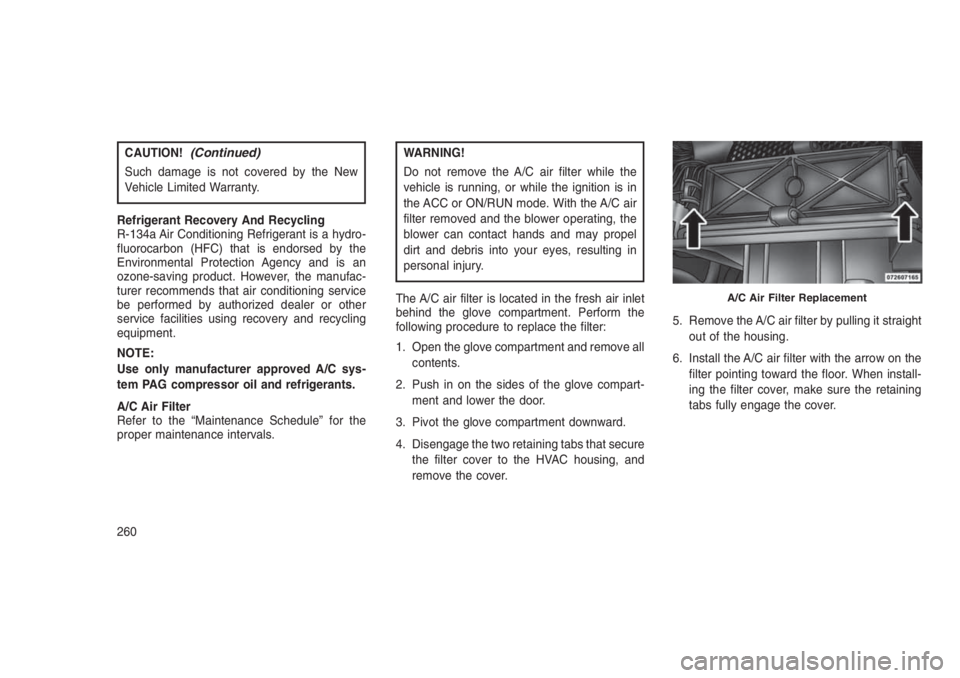
The A/C air filter is located in the fresh air inlet
behind the glove compartment. Perform the
following procedure to replace the filter:
1. Open the glove compartment and remove all
contents.
2. Push in on the sides of the glove compart-
ment and lower the door.
3. Pivot the glove compartment downward.
4. Disengage the two retaining tabs that secure
the filter cover to the HVAC housing, and
remove the cover.5. Remove the A/C air filter by pulling it straight
out of the housing.
6. Install the A/C air filter with the arrow on the
filter pointing toward the floor. When install-
ing the filter cover, make sure the retaining
tabs fully engage the cover.
A/C Air Filter Replacement
260
Page 270 of 332
•If frequent engine coolant (antifreeze) addi-
tions are required, the cooling system should
be pressure tested for leaks.
•Maintain engine coolant (antifreeze) concen-
tration at a minimum of 50% OAT coolant
(conforming to MS.90032) and distilled water
for proper corrosion protection of your engine
which contains aluminum components.
•Make sure that the coolant expansion bottle
overflow hoses are not kinked or obstructed.
•Keep the front of the radiator clean. If your
vehicle is equipped with air conditioning,
keep the front of the condenser clean.
•Do not change the thermostat for Summer or
Winter operation. If replacement is ever nec-
essary, install ONLY the correct type thermo-
stat. Other designs may result in unsatisfac-
tory engine coolant (antifreeze) performance,
poor gas mileage, and increased emissions.
Brake SystemIn order to assure brake system performance,
all brake system components should be in-spected periodically. Refer to the “Maintenance
Schedule” for the proper maintenance intervals.
WARNING!
Riding the brakes can lead to brake failure
and possibly a collision. Driving with your
foot resting or riding on the brake pedal can
result in abnormally high brake tempera-
tures, excessive lining wear, and possible
brake damage. You would not have your full
braking capacity in an emergency.
Brake Master Cylinder
The fluid level in the master cylinder should be
checked when performing under hood services,
or immediately if the brake system warning light
is on.
Be sure to clean the top of the master cylinder
area before removing the cap. If necessary, add
fluid to bring the fluid level up to the require-
ments described on the brake fluid reservoir.
Fluid level can be expected to fall as the brake
pads wear. The brake fluid level should be
checked when the pads are replaced. However,low fluid level may be caused by a leak and a
checkup may be needed.
NOTE:
If your vehicle is equipped with a manual
transmission, the brake fluid reservoir sup-
plies fluid to both the brake system and the
clutch release system. The two systems are
separated in the reservoir, and a leak in one
system will not affect the other system. The
manual transmission clutch release system
should not require fluid replacement during
the life of the vehicle. If the brake fluid
reservoir is low and the brake system does
not indicate any leaks or other problems, it
may be a result of a leak in the hydraulic
clutch release system. See your local autho-
rized dealer for service.
Use only manufacturer’s recommended brake
fluid. Refer to “Fluids, Lubricants, And Genuine
Parts” in “Maintaining Your Vehicle” for further
information.
266
Page 282 of 332
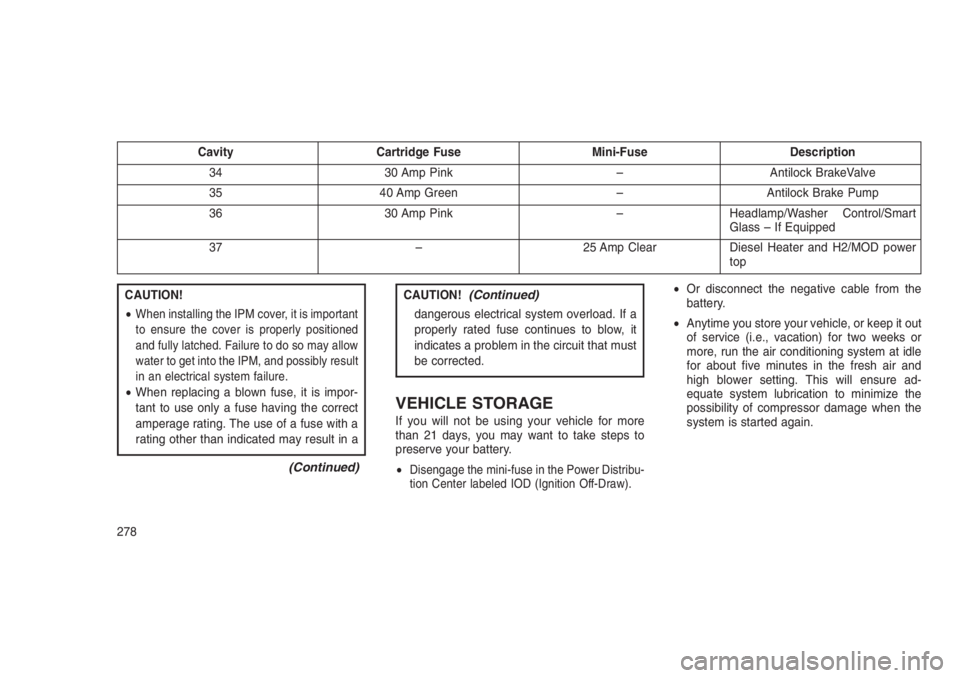
Cavity Cartridge Fuse Mini-Fuse Description
34 30 Amp Pink – Antilock BrakeValve
35 40 Amp Green – Antilock Brake Pump
36 30 Amp Pink – Headlamp/Washer Control/Smart
Glass – If Equipped
37 – 25 Amp Clear Diesel Heater and H2/MOD power
top
CAUTION!
•
When installing the IPM cover, it is important
to ensure the cover is properly positioned
and fully latched. Failure to do so may allow
water to get into the IPM, and possibly result
in an electrical system failure.
•When replacing a blown fuse, it is impor-
tant to use only a fuse having the correct
amperage rating. The use of a fuse with a
rating other than indicated may result in a
(Continued)
CAUTION!(Continued)
dangerous electrical system overload. If a
properly rated fuse continues to blow, it
indicates a problem in the circuit that must
be corrected.
VEHICLE STORAGE
If you will not be using your vehicle for more
than 21 days, you may want to take steps to
preserve your battery.
•
Disengage the mini-fuse in the Power Distribu-
tion Center labeled IOD (Ignition Off-Draw).
•Or disconnect the negative cable from the
battery.
•Anytime you store your vehicle, or keep it out
of service (i.e., vacation) for two weeks or
more, run the air conditioning system at idle
for about five minutes in the fresh air and
high blower setting. This will ensure ad-
equate system lubrication to minimize the
possibility of compressor damage when the
system is started again.
278
Page 291 of 332
Mileage or time passed
(whichever comes first)
7,500
15,000
22,500
30,000
37,500
45,000
52,500
60,000
67,500
75,000
82,500
90,000
97,500
105,000
112,500
120,000
127,500
135,000
142,500
150,000
Or Months: 12 24 36 48 60 72 84 96 108 120 132 144 156 168 180 192 204 216 228 240
Or Kilometers:
12,000
24,000
36,000
48,000
60,000
72,000
84,000
96,000
108,000
120,000
132,000
144,000
156,000
168,000
180,000
192,000
204,000
216,000
228,000
240,000
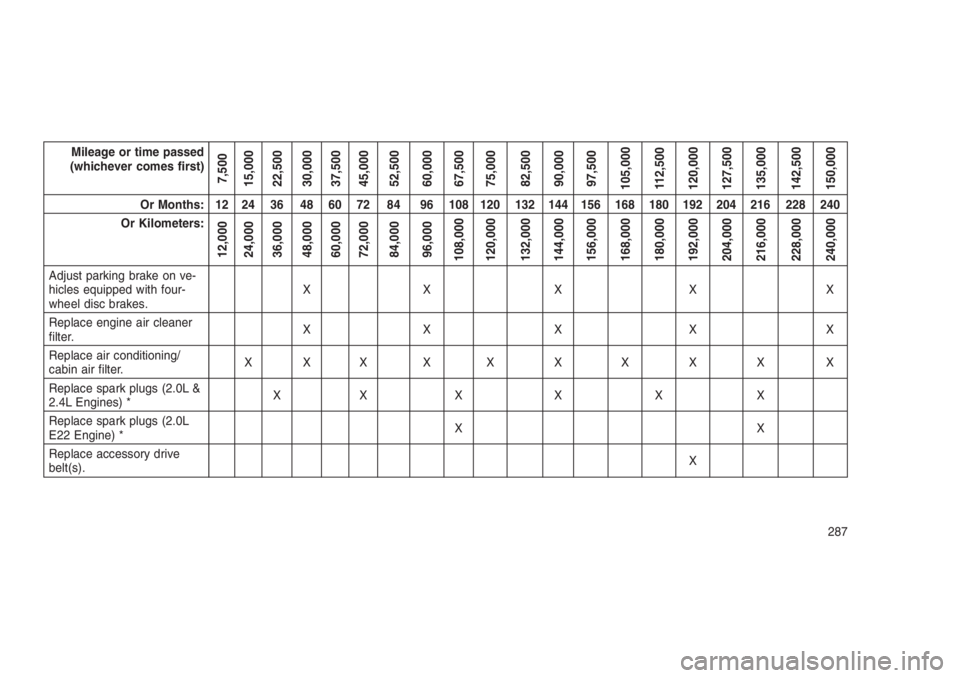
Adjust parking brake on ve-
hicles equipped with four-
wheel disc brakes.XX X X X
Replace engine air cleaner
filter.XX X X X
Replace air conditioning/
cabin air filter.XXX X X X X X X X
Replace spark plugs (2.0L &
2.4L Engines) *XX X X X X
Replace spark plugs (2.0L
E22 Engine) *XX
Replace accessory drive
belt(s).X
287
Page 322 of 332
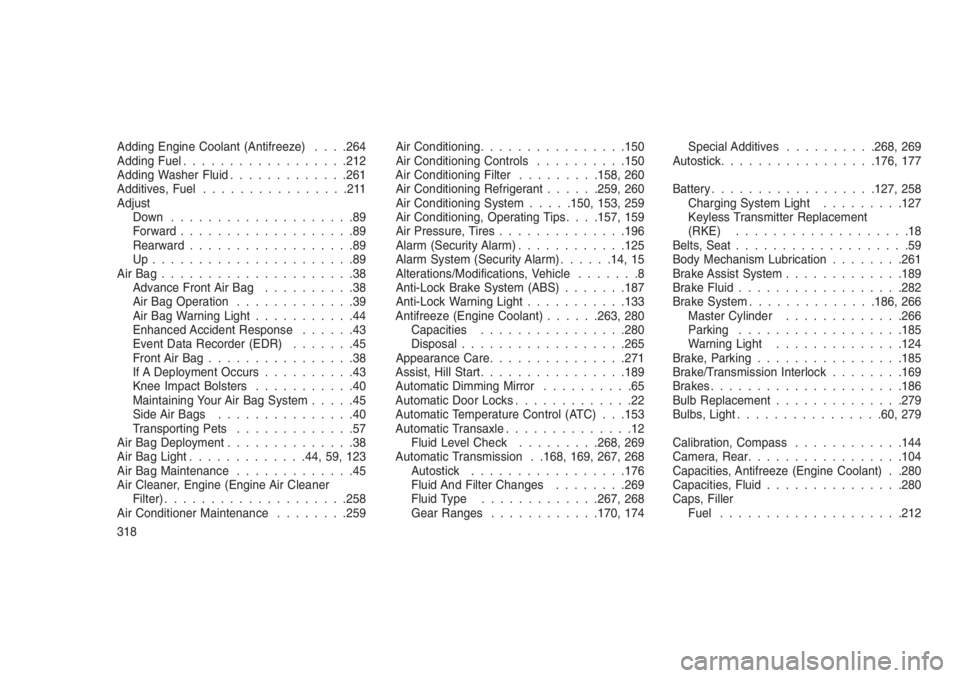
Adding Engine Coolant (Antifreeze). . . .264
Adding Fuel..................212
Adding Washer Fluid.............261
Additives, Fuel................211
Adjust
Down....................89
Forward...................89
Rearward..................89
Up......................89
AirBag.....................38
Advance Front Air Bag..........38
Air Bag Operation.............39
Air Bag Warning Light...........44
Enhanced Accident Response......43
Event Data Recorder (EDR).......45
Front Air Bag................38
If A Deployment Occurs..........43
Knee Impact Bolsters...........40
Maintaining Your Air Bag System.....45
Side Air Bags...............40
Transporting Pets.............57
Air Bag Deployment..............38
Air Bag Light.............44, 59, 123
Air Bag Maintenance.............45
Air Cleaner, Engine (Engine Air Cleaner
Filter)....................258
Air Conditioner Maintenance........259Air Conditioning................150
Air Conditioning Controls..........150
Air Conditioning Filter.........158, 260
Air Conditioning Refrigerant......259, 260
Air Conditioning System.....150, 153, 259
Air Conditioning, Operating Tips. . . .157, 159
Air Pressure, Tires..............196
Alarm (Security Alarm)............125
Alarm System (Security Alarm)......14, 15
Alterations/Modifications, Vehicle.......8
Anti-Lock Brake System (ABS).......187
Anti-Lock Warning Light...........133
Antifreeze (Engine Coolant)......263, 280
Capacities................280
Disposal..................265
Appearance Care...............271
Assist, Hill Start................189
Automatic Dimming Mirror..........65
Automatic Door Locks.............22
Automatic Temperature Control (ATC) . . .153
Automatic Transaxle..............12
Fluid Level Check.........268, 269
Automatic Transmission . .168, 169, 267, 268
Autostick.................176
Fluid And Filter Changes........269
Fluid Type.............267, 268
Gear Ranges............170, 174Special Additives..........268, 269
Autostick.................176, 177
Battery..................127, 258
Charging System Light.........127
Keyless Transmitter Replacement
(RKE)...................18
Belts, Seat...................59
Body Mechanism Lubrication........261
Brake Assist System.............189
Brake Fluid..................282
Brake System..............186, 266
Master Cylinder.............266
Parking..................185
Warning Light..............124
Brake, Parking................185
Brake/Transmission Interlock........169
Brakes.....................186
Bulb Replacement..............279
Bulbs, Light................60, 279
Calibration, Compass............144
Camera, Rear.................104
Capacities, Antifreeze (Engine Coolant) . .280
Capacities, Fluid...............280
Caps, Filler
Fuel....................212
318
Page 324 of 332
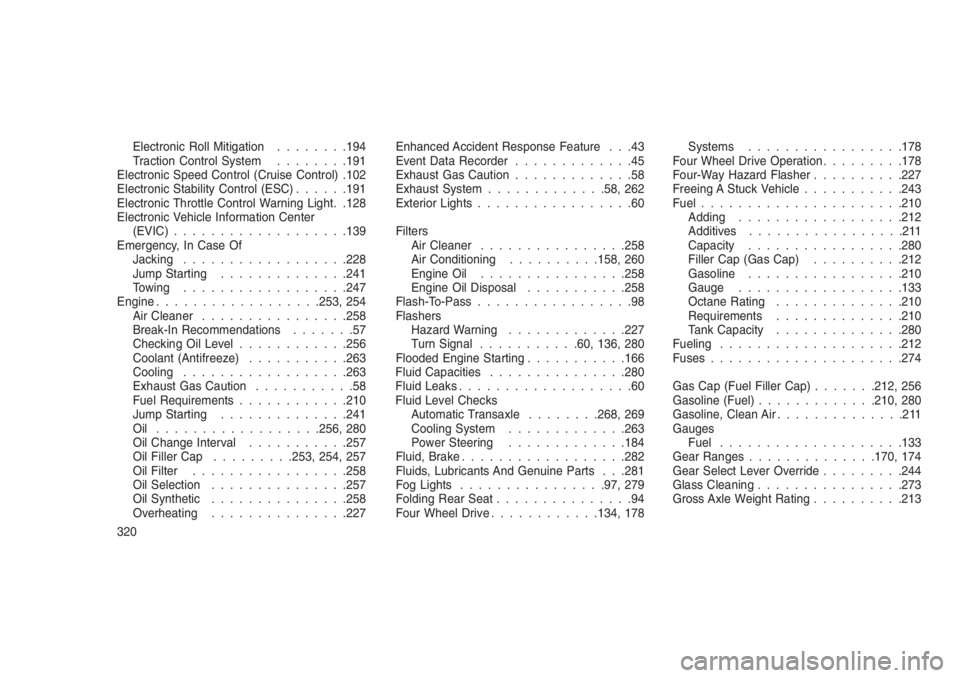
Electronic Roll Mitigation........194
Traction Control System........191
Electronic Speed Control (Cruise Control) .102
Electronic Stability Control (ESC)......191
Electronic Throttle Control Warning Light. .128
Electronic Vehicle Information Center
(EVIC)...................139
Emergency, In Case Of
Jacking..................228
Jump Starting..............241
Towing..................247
Engine..................253, 254
Air Cleaner................258
Break-In Recommendations.......57
Checking Oil Level............256
Coolant (Antifreeze)...........263
Cooling..................263
Exhaust Gas Caution...........58
Fuel Requirements............210
Jump Starting..............241
Oil ..................256, 280
Oil Change Interval...........257
Oil Filler Cap.........253, 254, 257
Oil Filter.................258
Oil Selection...............257
Oil Synthetic...............258
Overheating...............227Enhanced Accident Response Feature . . .43
Event Data Recorder.............45
Exhaust Gas Caution.............58
Exhaust System.............58, 262
Exterior Lights.................60
Filters
Air Cleaner................258
Air Conditioning..........158, 260
Engine Oil................258
Engine Oil Disposal...........258
Flash-To-Pass.................98
Flashers
Hazard Warning.............227
Turn Signal...........60, 136, 280
Flooded Engine Starting...........166
Fluid Capacities...............280
Fluid Leaks...................60
Fluid Level Checks
Automatic Transaxle........268, 269
Cooling System.............263
Power Steering.............184
Fluid, Brake..................282
Fluids, Lubricants And Genuine Parts . . .281
Fog Lights................97, 279
Folding Rear Seat...............94
Four Wheel Drive............134, 178Systems.................178
Four Wheel Drive Operation.........178
Four-Way Hazard Flasher..........227
Freeing A Stuck Vehicle...........243
Fuel......................210
Adding..................212
Additives.................211
Capacity.................280
Filler Cap (Gas Cap)..........212
Gasoline.................210
Gauge..................133
Octane Rating..............210
Requirements..............210
Tank Capacity..............280
Fueling....................212
Fuses.....................274
Gas Cap (Fuel Filler Cap).......212, 256
Gasoline (Fuel).............210, 280
Gasoline, Clean Air..............211
Gauges
Fuel....................133
Gear Ranges..............170, 174
Gear Select Lever Override.........244
Glass Cleaning................273
Gross Axle Weight Rating..........213
320