engine oil JEEP PATRIOT 2021 Owner handbook (in English)
[x] Cancel search | Manufacturer: JEEP, Model Year: 2021, Model line: PATRIOT, Model: JEEP PATRIOT 2021Pages: 332, PDF Size: 1.99 MB
Page 144 of 332
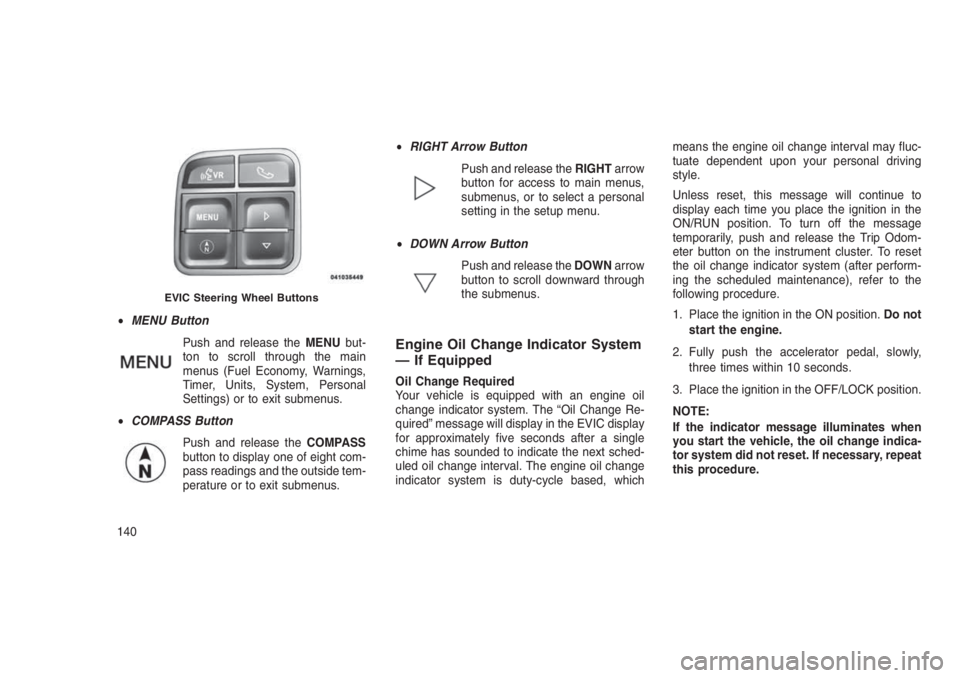
•MENU Button
Push and release theMENUbut-
ton to scroll through the main
menus (Fuel Economy, Warnings,
Timer, Units, System, Personal
Settings) or to exit submenus.
•COMPASS Button
Push and release theCOMPASS
button to display one of eight com-
pass readings and the outside tem-
perature or to exit submenus.•RIGHT Arrow Button
Push and release theRIGHTarrow
button for access to main menus,
submenus, or to select a personal
setting in the setup menu.
•DOWN Arrow Button
Push and release theDOWNarrow
button to scroll downward through
the submenus.
Engine Oil Change Indicator System
— If Equipped
Oil Change Required
Your vehicle is equipped with an engine oil
change indicator system. The “Oil Change Re-
quired” message will display in the EVIC display
for approximately five seconds after a single
chime has sounded to indicate the next sched-
uled oil change interval. The engine oil change
indicator system is duty-cycle based, whichmeans the engine oil change interval may fluc-
tuate dependent upon your personal driving
style.
Unless reset, this message will continue to
display each time you place the ignition in the
ON/RUN position. To turn off the message
temporarily, push and release the Trip Odom-
eter button on the instrument cluster. To reset
the oil change indicator system (after perform-
ing the scheduled maintenance), refer to the
following procedure.
1. Place the ignition in the ON position.Do not
start the engine.
2. Fully push the accelerator pedal, slowly,
three times within 10 seconds.
3. Place the ignition in the OFF/LOCK position.
NOTE:
If the indicator message illuminates when
you start the vehicle, the oil change indica-
tor system did not reset. If necessary, repeat
this procedure.
EVIC Steering Wheel Buttons
140
Page 180 of 332
CAUTION!(Continued)
NEUTRAL can cause severe transmission
damage. Refer to “Recreational Towing” in
“Starting And Operating” and “Towing A Dis-
abled Vehicle” in “What To Do In Emergen-
cies” for further information.
DRIVE (D)
This range should be used for most city and
highway driving. It provides the best fuel
economy. The DRIVE position provides opti-
mum driving characteristics under all normal
operating conditions.
When frequent transmission shifting occurs
(such as when operating the vehicle under
heavy loading conditions, in hilly terrain, travel-
ing into strong head winds, or while towing
heavy trailers), use the AutoStick shift control (if
equipped, refer to"AutoStick (CVT)"in this
section for further information) to select a lower
gear ratio. Under these conditions, using a
lower gear ratio will improve performance and
extend transmission life by reducing excessive
shifting and heat buildup.During sustained high speed driv-
ing or trailer towing up long grades
on hot days, the automatic trans-
mission oil may become too hot. If
this happens, the transmission
overheat indicator light will come on, and the
vehicle will slow slightly until the transmission
cools down enough to allow a return to the
requested speed. This is done to prevent trans-
mission damage due to overheating. If the high
speed is maintained, the overheating may reoc-
cur, as before, in a cyclic fashion.
LOW (L) — If Equipped
Use this range for engine braking when de-
scending very steep grades. In this range, the
transmission will downshift for maximum engine
braking, and upshifts will occur only to prevent
engine overspeed.
AUTOSTICK
AutoStick (Six-Speed Automatic
Transmission) — If Equipped
AutoStick is a driver-interactive transmission
feature providing manual shift control, givingyou more control of the vehicle. AutoStick al-
lows you to maximize engine braking, eliminate
undesirable upshifts and downshifts, and im-
prove overall vehicle performance. This system
can also provide you with more control during
passing, city driving, cold slippery conditions,
mountain driving, trailer towing, and many other
situations.
Operation
When the gear selector is in the DRIVE position,
the transmission will operate automatically,
shifting between the six available gears. To
engage AutoStick, simply tap the gear selector
to the right or left (+/-) while in the DRIVE
position. Tapping (-) to enter AutoStick mode will
downshift the transmission to the next lower
gear, while using (+) to enter AutoStick mode
will retain the current gear. When AutoStick is
active, the current transmission gear is dis-
played in the instrument cluster.
In AutoStick mode, the transmission will shift up
or down when the driver moves the gear selec-
tor to the right (+) or left (-), unless an engine
lugging or overspeed condition would result. It
176
Page 186 of 332
WARNING!
Do not descend a steep grade in NEUTRAL.
Use vehicle brakes in conjunction with en-
gine braking. Descending a grade too fast
could cause you to lose control and be
seriously injured or killed.
Driving Across An Incline
If at all possible avoid driving across an incline.
If it is necessary, know your vehicle’s abilities.
Driving across an incline places more weight on
the down-hill wheels, which increases the pos-
sibilities of a down-hill slide or rollover. Make
sure the surface has good traction with firm and
stable soils. If possible transverse the incline at
an angle heading slightly up or down.
WARNING!
Driving across an incline increases the risk of
a rollover, which may result in severe injury.
If You Stall Or Begin To Lose Headway
If you stall or begin to lose headway while
climbing a steep hill, allow your vehicle to cometo a stop and immediately apply the brake.
Restart the engine and shift to REVERSE. Back
slowly down the hill allowing engine and hill
descent braking to control the descent and
apply your brakes if necessary, but do not allow
the tires to lock.
WARNING!
If the engine stalls or you lose headway or
cannot make it to the top of a steep hill or
grade, never attempt to turn around. To do so
may result in tipping and rolling the vehicle,
which may result in severe injury. Always
back carefully straight down a hill in RE-
VERSE gear. Never back down a hill in
NEUTRAL using only the vehicle brakes.
Never drive diagonally across a hill, always
drive straight up or down.
Driving Through WaterExtreme care should be taken crossing any
type of water. Water crossings should be
avoided if possible, and only be attempted
when necessary in a safe responsible manner.You should only drive through areas which are
designated and approved. You should tread
lightly and avoid damage to the environment.
You should know your vehicles abilities and be
able to recover it if something goes wrong. You
should never stop or shut a vehicle off when
crossing deep water unless you ingested water
into the engine air intake. If the engine stalls, do
not attempt to restart it. Determine if it has
ingested water first. The key to any crossing is
low and slow. You want to use low (L Off-Road
[if equipped] ) with the 4WD LOCK engaged
and proceed very slowly with a constant slow
speed (3-5 mph [5–8 km/h] maximum) and light
throttle. Keep the vehicle moving; do not try to
accelerate through the crossing. After crossing
any water higher than the bottom of the axle
differentials, you should inspect all of the ve-
hicle fluids for signs of water ingestion.
CAUTION!
Water ingestion into the transaxle, transfer
case, engine or vehicle interior can occur if
you drive too fast or through too deep of
(Continued)
182
Page 255 of 332
7
MAINTAINING YOUR VEHICLE
•ENGINE COMPARTMENT — 2.0L . . . . . . . . . . . . .. . . . . .253
•ENGINE COMPARTMENT — 2.4L . . . . . . . . . . . . .. . . . . .254
•ONBOARD DIAGNOSTIC SYSTEM — OBD II . . ..........255
•Onboard Diagnostic System (OBD II) Cybersecurity.......255
•Loose Fuel Filler Cap Message...................256
•REPLACEMENT PARTS . . . . . . . . . . . . . . . . . . . . . . . . .256
•MAINTENANCE PROCEDURES . . . . . . . . . . . . . . ......256
•Engine Oil................................256
•Engine Oil Filter............................258
•Engine Air Cleaner Filter.......................258
•Maintenance-Free Battery.......................258
•Air Conditioner Maintenance.....................259
•Body Lubrication............................261
•Windshield Wiper Blades.......................261
•Adding Washer Fluid.........................261
•Exhaust System............................262
•Cooling System............................263
•Brake System..............................266
•Automatic Transmission (6-Speed) — If Equipped........267
251
Page 257 of 332
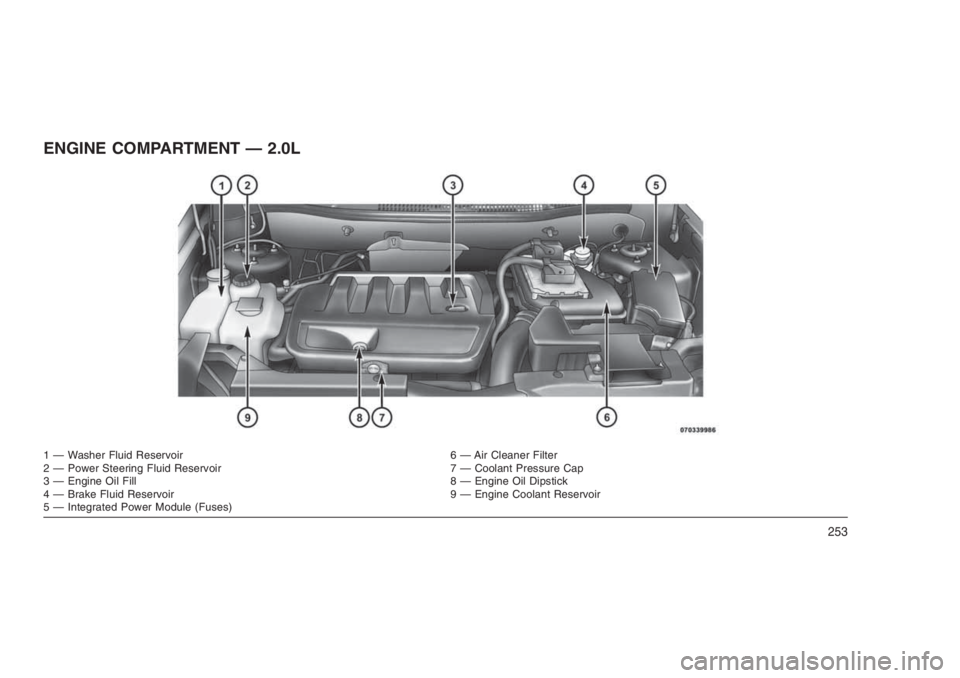
ENGINE COMPARTMENT — 2.0L
1 — Washer Fluid Reservoir 6 — Air Cleaner Filter
2 — Power Steering Fluid Reservoir 7 — Coolant Pressure Cap
3 — Engine Oil Fill 8 — Engine Oil Dipstick
4 — Brake Fluid Reservoir 9 — Engine Coolant Reservoir
5 — Integrated Power Module (Fuses)
253
Page 258 of 332
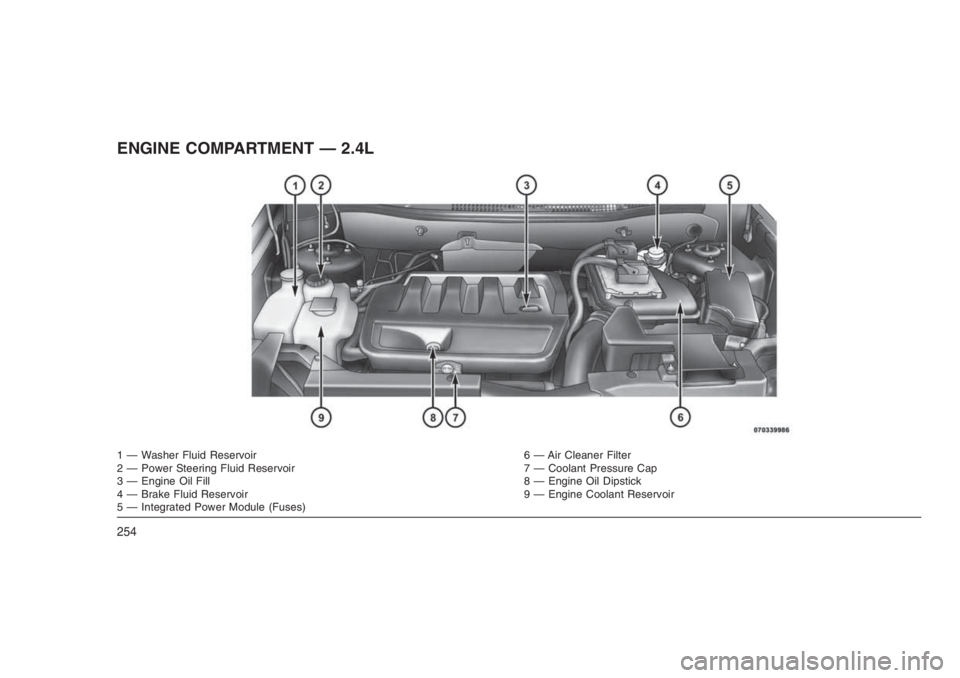
ENGINE COMPARTMENT — 2.4L
1 — Washer Fluid Reservoir 6 — Air Cleaner Filter
2 — Power Steering Fluid Reservoir 7 — Coolant Pressure Cap
3 — Engine Oil Fill 8 — Engine Oil Dipstick
4 — Brake Fluid Reservoir 9 — Engine Coolant Reservoir
5 — Integrated Power Module (Fuses)
254
Page 260 of 332
Loose Fuel Filler Cap MessageAfter fuel is added, the vehicle diagnostic sys-
tem can determine if the fuel filler cap is possi-
bly loose or improperly installed. A “gASCAP”
message will be displayed in the instrument
cluster. Tighten the gas cap until a “clicking”
sound is heard. This is an indication that the gas
cap is properly tightened. Push the trip odom-
eter RESET button to turn off the message. If
the problem persists, the message will appear
the next time the vehicle is started. This might
indicate a damaged cap. If the problem is
detected twice in a row, the system will turn on
the MIL. Resolving the problem will turn the MIL
light off.
REPLACEMENT PARTS
Use of genuine MOPAR parts for normal/
scheduled maintenance and repairs is highly
recommended to ensure the designed perfor-
mance. Damage or failures caused by the use
of non-MOPAR parts for maintenance and re-
pairs will not be covered by the New Vehicle
Limited Warranty.
MAINTENANCE PROCEDURES
The pages that follow contain therequired
maintenance services determined by the engi-
neers who designed your vehicle.
Besides those maintenance items specified in
the fixed “Maintenance Schedule”, there are
other components which may require servicing
or replacement in the future.
CAUTION!
•Failure to properly maintain your vehicle or
perform repairs and service when neces-
sary could result in more costly repairs,
damage to other components or negatively
impact vehicle performance. Immediately
have potential malfunctions examined by
an authorized dealer or qualified repair
center.
(Continued)
CAUTION!(Continued)
•Your vehicle has been built with improved
fluids that protect the performance and
durability of your vehicle and also allow
extended maintenance intervals. Do not
use chemical flushes in these components
as the chemicals can damage your engine,
transmission, or air conditioning. Such
damage is not covered by the New Vehicle
Limited Warranty. If a flush is needed
because of component malfunction, use
only the specified fluid for the flushing
procedure.
Engine Oil
Checking Oil Level
To assure proper engine lubrication, the engine
oil must be maintained at the correct level.
Check the oil level at regular intervals, such as
every fuel stop.
The best time to check the engine oil level is
about five minutes after a fully warmed engine is
shut off. Do not check oil level before starting
256
Page 261 of 332
the engine after it has sat overnight. Checking
engine oil level when the engine is cold will give
you an incorrect reading.
Checking the oil while the vehicle is on level
ground and only when the engine is hot, will
improve the accuracy of the oil level readings.
Maintain the oil level between the range mark-
ings on the dipstick. The range markings will
consist of a crosshatch zone that says SAFE or
a crosshatch zone that says MIN at the low end
of the range and MAX at the high end of the
range. Adding one quart of oil when the reading
is at the low end of the indicated range will result
in the oil level at the full end of the indicator
range.
CAUTION!
Do not overfill the engine. Overfilling the
engine will cause oil aeration, which can lead
to loss of oil pressure and an increase in oil
temperature. This could damage your en-
gine. Also, be sure the oil fill cap is replaced
and tightened after adding oil.Change Engine Oil – All Engines
Refer to the “Maintenance Schedule” for the
proper maintenance intervals.
Engine Oil Selection
For best performance and maximum protection
under all types of operating conditions, the manu-
facturer only recommends engine oils that are API
certified and meet the requirements of FCA Ma-
terial Standard MS-6395 or ACEA A1/B1.
American Petroleum Institute (API) Engine
Oil Identification Symbol
This symbol means that
the oil has been certified
by the American Petro-
leum Institute (API). The
manufacturer only rec-
ommends API Certified
engine oils.
This symbol certifies 0W-20, 5W-20, 0W-30,
5W-30 and 10W-30 engine oils.
CAUTION!
Do not use chemical flushes in your engine
oil as the chemicals can damage your en-
gine. Such damage is not covered by the
New Vehicle Limited Warranty.
Engine Oil Viscosity (SAE Grade)
MOPAR SAE 5W-20 engine oil is recom-
mended for all operating temperatures. This
engine oil improves low temperature starting
and vehicle fuel economy.
The engine oil filler cap also shows the recom-
mended engine oil viscosity for your engine. For
information on engine oil filler cap location, refer
to “Engine Compartment” in “Maintaining Your
Vehicle” for further information.
NOTE:
MOPAR SAE 5W-30 engine oil approved to
FCA MS-6395 or FCA Material Standard
9.55535-CR1 may be used when SAE 5W-20
engine oil meeting FCA MS-6395 or FCA
Material Standard 9.55535-CR1 is not avail-
able.
257
Page 262 of 332
Synthetic Engine Oils
There are a number of engine oils being pro-
moted as either synthetic or semi-synthetic. If
you chose to use such a product, use only those
oils that are approved to FCA MS-6395 or FCA
Material Standard 9.55535-CR1. Follow the
maintenance schedule that describes your driv-
ing type.
Materials Added To Engine Oil
The manufacturer strongly recommends
against the addition of any additives (other than
leak detection dyes) to the engine oil. Engine oil
is an engineered product and its performance
may be impaired by supplemental additives.
Disposing Of Used Engine Oil And Oil
Filters
Care should be taken in disposing of used
engine oil and oil filters from your vehicle. Used
oil and oil filters, indiscriminately discarded, can
present a problem to the environment. Contact
your authorized dealer, service station or gov-
ernmental agency for advice on how and where
used oil and oil filters can be safely discarded in
your area.Engine Oil FilterThe engine oil filter should be replaced with a
new filter at every engine oil change.
Engine Oil Filter Selection
This manufacturer’s engines have a full-flow
type oil filter. Use a filter of this type for replace-
ment. The quality of replacement filters varies
considerably. Only high quality filters should be
used to assure most efficient service. MOPAR
engine oil filters are a high quality oil filter and
are recommended.
Engine Air Cleaner FilterRefer to the “Maintenance Schedule” in the
“Maintenance Schedules” section for the proper
maintenance intervals.
WARNING!
The air induction system (air cleaner, hoses,
etc.) can provide a measure of protection in
the case of engine backfire. Do not remove
the air induction system (air cleaner, hoses,
etc.) unless such removal is necessary for
(Continued)
WARNING!(Continued)
repair or maintenance. Make sure that no
one is near the engine compartment before
starting the vehicle with the air induction
system (air cleaner, hoses, etc.) removed.
Failure to do so can result in serious per-
sonal injury.
Engine Air Cleaner Filter Selection
The quality of replacement engine air cleaner
filters varies considerably. Only high quality
filters should be used to assure most efficient
service. MOPAR engine air cleaner filters are a
high quality filter and are recommended.
Maintenance-Free BatteryYour vehicle is equipped with a maintenance-
free battery. You will never have to add water,
nor is periodic maintenance required.
258
Page 265 of 332
CAUTION!
The A/C air filter is identified with an arrow to
indicate airflow direction through the filter.
Failure to properly install the filter will result
in the need to replace it more often.
7. Rotate the glove compartment door back
into position.
Body LubricationLocks and all body pivot points, including such
items as seat tracks, door hinge pivot points
and rollers, liftgate, tailgate, decklid, sliding
doors and hood hinges, should be lubricated
periodically with a lithium based grease, such
as MOPAR Spray White Lube to assure quiet,
easy operation and to protect against rust and
wear. Prior to the application of any lubricant,
the parts concerned should be wiped clean to
remove dust and grit; after lubricating excess oil
and grease should be removed. Particular at-
tention should also be given to hood latching
components to ensure proper function. When
performing other underhood services, the hoodlatch, release mechanism and safety catch
should be cleaned and lubricated.
The external lock cylinders should be lubricated
twice a year, preferably in the Fall and Spring.
Apply a small amount of a high quality lubricant,
such as MOPAR Lock Cylinder Lubricant di-
rectly into the lock cylinder.
Windshield Wiper BladesClean the rubber edges of the wiper blades and
the windshield periodically with a sponge or soft
cloth and a mild nonabrasive cleaner. This will
remove accumulations of salt or road film.
Operation of the wipers on dry glass for long
periods may cause deterioration of the wiper
blades. Always use washer fluid when using the
wipers to remove salt or dirt from a dry wind-
shield.
Avoid using the wiper blades to remove frost or
ice from the windshield. Keep the blade rubber
out of contact with petroleum products such as
engine oil, gasoline, etc.NOTE:
Life expectancy of wiper blades varies de-
pending on geographical area and fre-
quency of use. Poor performance of blades
may be present with chattering, marks, wa-
ter lines or wet spots. If any of these condi-
tions are present, clean the wiper blades or
replace as necessary.Adding Washer FluidThe washer fluid reservoir is located in the
engine compartment, and the fluid level should
be checked at regular intervals. Fill the reservoir
with windshield washer solvent only (not radia-
tor antifreeze).
When refilling the washer fluid reservoir, take
some washer fluid and apply it to a cloth or
towel and wipe clean the wiper blades, this will
help blade performance. To prevent freeze-up
of your windshield washer system in cold
weather, select a solution or mixture that meets
or exceeds the temperature range of your cli-
mate. This rating information can be found on
most washer fluid containers.
261