ESP JEEP PATRIOT 2021 Owner handbook (in English)
[x] Cancel search | Manufacturer: JEEP, Model Year: 2021, Model line: PATRIOT, Model: JEEP PATRIOT 2021Pages: 332, PDF Size: 1.99 MB
Page 179 of 332
WARNING!(Continued)
•When leaving the vehicle, always remove
the ignition key from the vehicle and lock
the vehicle.
•Never leave children alone in a vehicle, or
with access to an unlocked vehicle. Allow-
ing children to be in a vehicle unattended
is dangerous for a number of reasons. A
child or others could be seriously or fatally
injured. Children should be warned not to
touch the parking brake, brake pedal or the
gear selector.
•Do not leave the ignition key in or near the
vehicle (or in a location accessible to chil-
dren). A child could operate power win-
dows, other controls, or move the vehicle.
CAUTION!
•Before moving the gear selector out of
PARK, you must turn the ignition switch
from the LOCK/OFF position to the ON/
RUN position, and also press the brake
pedal. Otherwise, damage to the gear se-
lector could result.
•DO NOT race the engine when shifting
from PARK or NEUTRAL into another gear
range, as this can damage the drivetrain.
The following indicators should be used to
ensure that you have engaged the transmission
into the PARK position:
•When shifting into PARK, firmly move the
gear selector all the way forward and to the
left until it stops and is fully seated.
•Look at the transmission gear position dis-
play and verify that it indicates the PARK
position (P).
•With brake pedal released, verify that the
gear selector will not move out of PARK.REVERSE (R)
This range is for moving the vehicle backward.
Shift into REVERSE only after the vehicle has
come to a complete stop.
NEUTRAL (N)
Use this range when the vehicle is standing for
prolonged periods with the engine running. The
engine may be started in this range. Apply the
parking brake and shift the transmission into
PARK if you must leave the vehicle.
WARNING!
Do not coast in NEUTRAL and never turn off
the ignition to coast down a hill. These are
unsafe practices that limit your response to
changing traffic or road conditions. You might
lose control of the vehicle and have a collision.
CAUTION!
Towing the vehicle, coasting, or driving for
any other reason with the transmission in
(Continued)
175
Page 184 of 332
This will allow you to cross over obstacles and
descend hills, with improved control and less
effort.
NOTE:
For maximum off-road performance, pre-
mium fuel is recommended. While the ve-
hicle will operate on regular fuel when in L
Off-Road mode (if equipped), the engine has
been calibrated for maximum performance
using premium fuel.
Driving In Snow, Mud And SandThere is a drastic reduction in traction when
driving in snow, mud or sand. The vehicle will be
less responsive to steering, acceleration and
braking inputs. Therefore, you should acceler-
ate slowly, leave greater stopping distances and
avoid abrupt vehicle maneuvers. You want to
keep a slow constant steady pace. The key is to
maintain the vehicle’s momentum.
Snow
In heavy snow or for additional control and
traction at slower speeds, activate the 4WD
LOCK and shift the transaxle to low (L Off-Road
[if equipped] ) if necessary. Do not shift to a
lower gear than necessary to maintain head-way. Over-revving the engine can spin the
wheels and traction will be lost. If you start to
slow to a stop, try turning your steering wheel no
more than a 1/4 turn quickly back and forth,
while still applying throttle. This will allow the
tires to get a fresh"bite"and help maintain your
momentum.
CAUTION!
On icy or slippery roads, do not downshift at
high engine RPM’s or vehicle speeds be-
cause engine braking may cause skidding
and loss of control.
Mud
Deep mud creates a great deal of suction
around the tires and is very difficult to get
through. You should use low (L Off-Road [if
equipped] ) with the 4WD LOCK engaged and
maintain your momentum. If you start to slow to
a stop, try turning your steering wheel no more
than a 1/4 turn quickly back and forth for
additional traction. Mud holes pose an in-
creased threat of vehicle damage and getting
stuck. They are normally full of debris fromprevious vehicles getting stuck. As a good prac-
tice before entering any mud hole, get out and
determine how deep it is, if there are any hidden
obstacles and if the vehicle can be safely recov-
ered if stuck.
Sand
Soft sand is very difficult to travel through with
full tire pressure. When crossing soft sandy
spots in a trail maintain your vehicle’s momen-
tum and do not stop. The key to driving in soft
sand is using the appropriate tire pressure,
accelerating slowly, avoiding abrupt maneuvers
and maintaining the vehicle’s momentum. If you
are going to be driving on large soft sandy areas
or dunes, reduce your tire pressure to a mini-
mum of 15 psi (103 kPa) to allow for a greater
tire surface area. You should use low (L Off-
Road [if equipped] ) with the 4WD LOCK en-
gaged and ESC turned off. Reduced tire pres-
sure will drastically improve your traction and
handling, while driving on the soft sand, but you
must return the tires to normal air pressure
before driving on pavement or other hard sur-
faces. Be sure you have a way to reinflate the
tires prior to reducing the pressure.
180
Page 186 of 332
WARNING!
Do not descend a steep grade in NEUTRAL.
Use vehicle brakes in conjunction with en-
gine braking. Descending a grade too fast
could cause you to lose control and be
seriously injured or killed.
Driving Across An Incline
If at all possible avoid driving across an incline.
If it is necessary, know your vehicle’s abilities.
Driving across an incline places more weight on
the down-hill wheels, which increases the pos-
sibilities of a down-hill slide or rollover. Make
sure the surface has good traction with firm and
stable soils. If possible transverse the incline at
an angle heading slightly up or down.
WARNING!
Driving across an incline increases the risk of
a rollover, which may result in severe injury.
If You Stall Or Begin To Lose Headway
If you stall or begin to lose headway while
climbing a steep hill, allow your vehicle to cometo a stop and immediately apply the brake.
Restart the engine and shift to REVERSE. Back
slowly down the hill allowing engine and hill
descent braking to control the descent and
apply your brakes if necessary, but do not allow
the tires to lock.
WARNING!
If the engine stalls or you lose headway or
cannot make it to the top of a steep hill or
grade, never attempt to turn around. To do so
may result in tipping and rolling the vehicle,
which may result in severe injury. Always
back carefully straight down a hill in RE-
VERSE gear. Never back down a hill in
NEUTRAL using only the vehicle brakes.
Never drive diagonally across a hill, always
drive straight up or down.
Driving Through WaterExtreme care should be taken crossing any
type of water. Water crossings should be
avoided if possible, and only be attempted
when necessary in a safe responsible manner.You should only drive through areas which are
designated and approved. You should tread
lightly and avoid damage to the environment.
You should know your vehicles abilities and be
able to recover it if something goes wrong. You
should never stop or shut a vehicle off when
crossing deep water unless you ingested water
into the engine air intake. If the engine stalls, do
not attempt to restart it. Determine if it has
ingested water first. The key to any crossing is
low and slow. You want to use low (L Off-Road
[if equipped] ) with the 4WD LOCK engaged
and proceed very slowly with a constant slow
speed (3-5 mph [5–8 km/h] maximum) and light
throttle. Keep the vehicle moving; do not try to
accelerate through the crossing. After crossing
any water higher than the bottom of the axle
differentials, you should inspect all of the ve-
hicle fluids for signs of water ingestion.
CAUTION!
Water ingestion into the transaxle, transfer
case, engine or vehicle interior can occur if
you drive too fast or through too deep of
(Continued)
182
Page 187 of 332
CAUTION!(Continued)
water. Water can cause permanent damage
to engine, driveline or other vehicle compo-
nents and your brakes will be less effective
once wet and/or muddy.
Before You Cross Any Type Of Water
As you approach any type of water, you need to
determine if you can cross it safely and respon-
sibly. If necessary, get out and walk through the
water or probe it with a stick. You need to be
sure of its depth, approach angle, current and
bottom condition. Be careful of murky or muddy
waters; check for hidden obstacles. Make sure
you will not be intruding on any wildlife, and you
can recover the vehicle if necessary. The key to
a safe crossing is the water depth, current and
bottom conditions. On soft bottoms, the vehicle
will sink in, effectively increasing the water level
on the vehicle. Be sure to consider this when
determining the depth and the ability to safely
cross.Crossing Puddles, Pools, Flooded Areas
Or Other Standing Water
Puddles, pools, flooded or other standing water
areas normally contain murky or muddy waters.
These water types normally contain hidden
obstacles and make it difficult to determine an
accurate water depth, approach angle, and
bottom condition. Murky or muddy water holes
are where you want to hook up tow straps prior
to entering. This makes for a faster, cleaner and
easier vehicle recovery. If you are able to deter-
mine you can safely cross, than proceed using
the low and slow method.
CAUTION!
Muddy waters can reduce the cooling sys-
tem effectiveness by depositing debris onto
the radiator.
After Driving Off-RoadOff-road operation puts more stress on your
vehicle than does most on-road driving. After
going off-road, it is always a good idea to check
for damage. That way you can get any problemstaken care of right away and have your vehicle
ready when you need it.
•Completely inspect the underbody of your
vehicle. Check tires, body structure, steering,
suspension, and exhaust system for dam-
age.
•Inspect the radiator for mud and debris and
clean as required.
•Check threaded fasteners for looseness, par-
ticularly on the chassis, drivetrain compo-
nents, steering, and suspension. Retighten
them, if required, and torque to the values
specified in the Service Manual.
•Check for accumulations of plants or brush.
These things could be a fire hazard. They
might hide damage to fuel lines, brake hoses,
axle pinion seals, and propeller shafts.
•After extended operation in mud, sand, wa-
ter, or similar dirty conditions, have the radia-
tor, fan, brake rotors, wheels, brake linings,
and axle yokes inspected and cleaned as
soon as possible.
183
Page 188 of 332
WARNING!
Abrasive material in any part of the brakes
may cause excessive wear or unpredictable
braking. You might not have full braking
power when you need it to prevent a colli-
sion. If you have been operating your vehicle
in dirty conditions, get your brakes checked
and cleaned as necessary.
•If you experience unusual vibration after driv-
ing in mud, slush or similar conditions, check
the wheels for impacted material. Impacted
material can cause a wheel imbalance and
freeing the wheels of it will correct the
situation.
POWER STEERING
The standard power steering system will give
you good vehicle response and increased ease
of maneuverability in tight spaces. The system
will provide mechanical steering capability if
power assist is lost.
If for some reason the power assist is inter-
rupted, it will still be possible to steer yourvehicle. Under these conditions, you will ob-
serve a substantial increase in steering effort,
especially at very low vehicle speeds and dur-
ing parking maneuvers.
NOTE:
•Increased noise levels at the end of the
steering wheel travel are considered nor-
mal and do not indicate that there is a
problem with the power steering system.
•Upon initial start-up in cold weather, the
power steering pump may make noise for
a short amount of time. This is due to the
cold, thick fluid in the steering system.
This noise should be considered normal,
and it does not in any way damage the
steering system.CAUTION!
Prolonged operation of the steering system
at the end of the steering wheel travel will
increase the steering fluid temperature and it
should be avoided when possible. Damage
to the power steering pump may occur.
Power Steering Fluid CheckChecking the power steering fluid level at a
defined service interval is not required. The fluid
should only be checked if a leak is suspected,
abnormal noises are apparent, and/or the sys-
tem is not functioning as anticipated. Coordi-
nate inspection efforts through an authorized
dealer.
CAUTION!
Do not use chemical flushes in your power
steering system as the chemicals can dam-
age your power steering components. Such
damage is not covered by the New Vehicle
Limited Warranty.
WARNING!
Fluid level should be checked on a level
surface and with the engine off to prevent
injury from moving parts and to ensure ac-
184
Page 193 of 332
Brake Assist System (BAS)The BAS is designed to optimize the vehicle’s
braking capability during emergency braking
maneuvers. The system detects an emergency
braking situation by sensing the rate and
amount of brake application and then applies
optimum pressure to the brakes. This can help
reduce braking distances. The BAS comple-
ments the anti-lock brake system (ABS). Apply-
ing the brakes very quickly results in the best
BAS assistance. To receive the benefit of the
system, you must apply continuous braking
pressure during the stopping sequence, (do not
“pump” the brakes). Do not reduce brake pedal
pressure unless braking is no longer desired.
Once the brake pedal is released, the BAS is
deactivated.
WARNING!
The Brake Assist System (BAS) cannot pre-
vent the natural laws of physics from acting
on the vehicle, nor can it increase the trac-
tion afforded by prevailing road conditions.
(Continued)
WARNING!(Continued)
BAS cannot prevent collisions, including
those resulting from excessive speed in
turns, driving on very slippery surfaces, or
hydroplaning. The capabilities of a BAS-
equipped vehicle must never be exploited in
a reckless or dangerous manner, which
could jeopardize the user’s safety or the
safety of others.
Hill Start Assist (HSA)The HSA system is designed to mitigate roll
back from a complete stop while on an incline. If
the driver releases the brake while stopped on
an incline, HSA will continue to hold the brake
pressure for a short period. If the driver does not
apply the throttle before this time expires, the
system will release brake pressure and the
vehicle will roll down the hill as normal.
The following conditions must be met in order
for HSA to activate:
•The feature must be enabled.
•The vehicle must be stopped.•Park brake must be off.
•Driver door must be closed.
•The vehicle must be on a sufficient grade.
•The gear selection must match vehicle uphill
direction (i.e., vehicle facing uphill is in for-
ward gear; vehicle backing uphill is in RE-
VERSE gear).
•HSA will work in REVERSE gear and all
forward gears. The system will not activate if
the transmission is in PARK or NEUTRAL.
For vehicles equipped with a manual trans-
mission, if the clutch is pressed, HSA will
remain active.
WARNING!
There may be situations where the Hill Start
Assist (HSA) will not activate and slight roll-
ing may occur, such as on minor hills or with
a loaded vehicle, or while pulling a trailer.
HSA is not a substitute for active driving
involvement. It is always the driver’s respon-
sibility to be attentive to distance to other
(Continued)
189
Page 194 of 332
WARNING!(Continued)
vehicles, people, and objects, and most im-
portantly brake operation to ensure safe
operation of the vehicle under all road con-
ditions. Your complete attention is always
required while driving to maintain safe con-
trol of your vehicle. Failure to follow these
warnings can result in a collision or serious
personal injury.
Towing With HSA
HSA will also provide assistance to mitigate roll
back while towing a trailer.
WARNING!
•If you use a trailer brake controller with
your trailer, the trailer brakes may be acti-
vated and deactivated with the brake
switch. If so, there may not be enough
brake pressure to hold both the vehicle
and the trailer on a hill when the brake
(Continued)
WARNING!(Continued)
pedal is released. In order to avoid rolling
down an incline while resuming accelera-
tion, manually activate the trailer brake or
apply more vehicle brake pressure prior to
releasing the brake pedal.
•HSA is not a parking brake. Always apply
the parking brake fully when leaving your
vehicle. Also, be certain to leave the trans-
mission in PARK.
•Failure to follow these warnings may
cause the vehicle to roll down the incline
and could collide with another vehicle,
object or person, and cause serious or
fatal injury. Always remember to use the
parking brake while parking on a hill and
that the driver is responsible for braking
the vehicle.
Disabling And Enabling HSA
This feature can be turned on or turned off. To
change the current setting, proceed as follows:•For vehicles equipped with the Electronic
Vehicle Information Center (EVIC), refer to
“Electronic Vehicle Information Center
(EVIC)” in “Understanding Your Instrument
Panel” for further information.
•If disabling HSA using Uconnect Settings,
refer to “Uconnect Settings” in “Understand-
ing Your Instrument Panel” for further
information.
For vehicles not equipped with the EVIC, per-
form the following steps:
1. Center the steering wheel (front wheels
pointing straight forward).
2. Shift the transmission into PARK.
3. Apply the parking brake.
4. Start the engine.
5. Rotate the steering wheel slightly more than
one-half turn to the left.
6. Push the “ESC Off” button located in the
lower switch bank below the climate control
190
Page 198 of 332
dealer as soon as possible to have the problem
diagnosed and corrected.
The “ESC Activation/Malfunction Indicator
Light” (located in the instrument cluster) starts
to flash as soon as the tires lose traction and the
ESC system becomes active. The “ESC
Activation/Malfunction Indicator Light” also
flashes when TCS is active. If the “ESC
Activation/Malfunction Indicator Light” begins to
flash during acceleration, ease up on the accel-
erator and apply as little throttle as possible. Be
sure to adapt your speed and driving to the
prevailing road conditions.
NOTE:
•The “ESC Off Indicator Light” and the
“ESC Activation/Malfunction Indicator
Light” come on momentarily each time
the ignition switch is placed in the ON/
RUN position.
•Each time the ignition is cycled to the
ON/RUN position, the ESC system will be
ON even if it was cycled off previously,
except for when the vehicle is started
while in 4L Range.•The ESC system will make buzzing or
clicking sounds when it is active. This is
normal; the sounds will stop when ESC
becomes inactive following the maneuver
that caused the ESC activation.
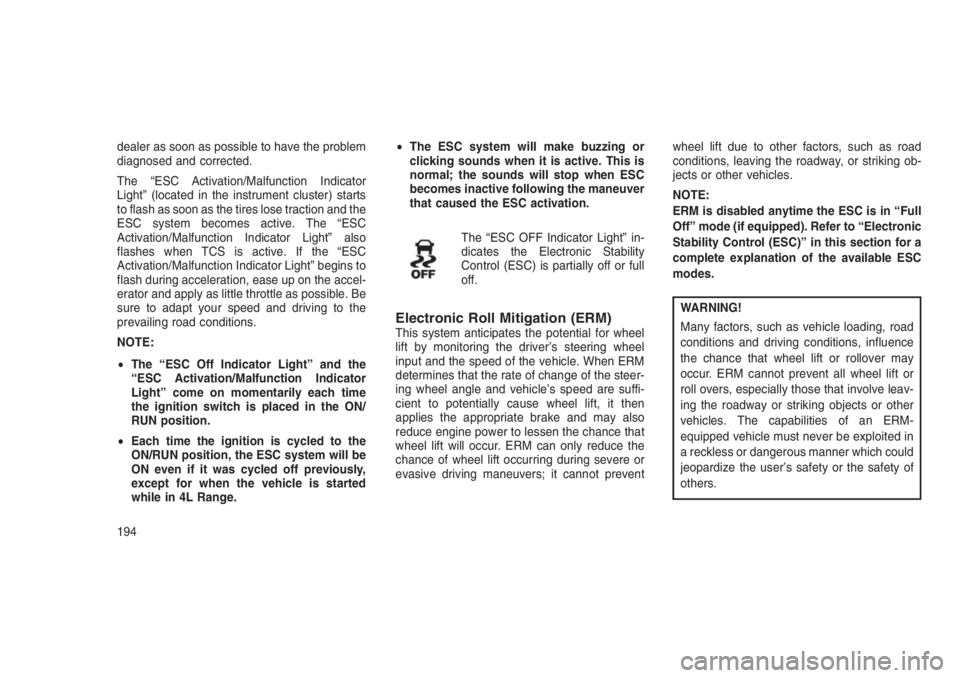
The “ESC OFF Indicator Light” in-
dicates the Electronic Stability
Control (ESC) is partially off or full
off.
Electronic Roll Mitigation (ERM)This system anticipates the potential for wheel
lift by monitoring the driver’s steering wheel
input and the speed of the vehicle. When ERM
determines that the rate of change of the steer-
ing wheel angle and vehicle’s speed are suffi-
cient to potentially cause wheel lift, it then
applies the appropriate brake and may also
reduce engine power to lessen the chance that
wheel lift will occur. ERM can only reduce the
chance of wheel lift occurring during severe or
evasive driving maneuvers; it cannot preventwheel lift due to other factors, such as road
conditions, leaving the roadway, or striking ob-
jects or other vehicles.
NOTE:
ERM is disabled anytime the ESC is in “Full
Off” mode (if equipped). Refer to “Electronic
Stability Control (ESC)” in this section for a
complete explanation of the available ESC
modes.
WARNING!
Many factors, such as vehicle loading, road
conditions and driving conditions, influence
the chance that wheel lift or rollover may
occur. ERM cannot prevent all wheel lift or
roll overs, especially those that involve leav-
ing the roadway or striking objects or other
vehicles. The capabilities of an ERM-
equipped vehicle must never be exploited in
a reckless or dangerous manner which could
jeopardize the user’s safety or the safety of
others.
194
Page 199 of 332
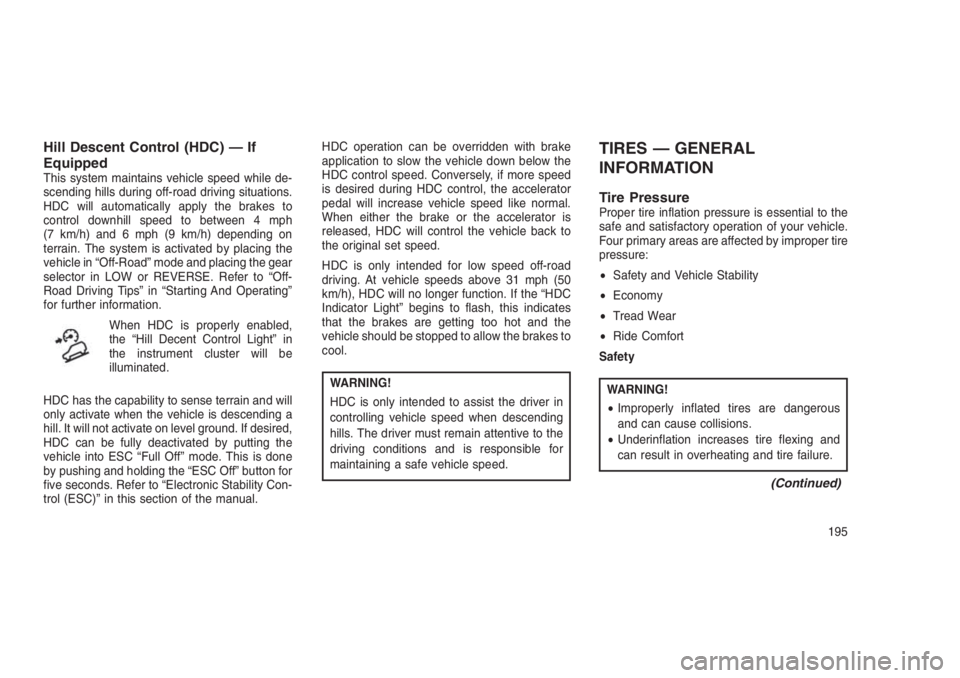
Hill Descent Control (HDC) — If
Equipped
This system maintains vehicle speed while de-
scending hills during off-road driving situations.
HDC will automatically apply the brakes to
control downhill speed to between 4 mph
(7 km/h) and 6 mph (9 km/h) depending on
terrain. The system is activated by placing the
vehicle in “Off-Road” mode and placing the gear
selector in LOW or REVERSE. Refer to “Off-
Road Driving Tips” in “Starting And Operating”
for further information.
When HDC is properly enabled,
the “Hill Decent Control Light” in
the instrument cluster will be
illuminated.
HDC has the capability to sense terrain and will
only activate when the vehicle is descending a
hill. It will not activate on level ground. If desired,
HDC can be fully deactivated by putting the
vehicle into ESC “Full Off” mode. This is done
by pushing and holding the “ESC Off” button for
five seconds. Refer to “Electronic Stability Con-
trol (ESC)” in this section of the manual.HDC operation can be overridden with brake
application to slow the vehicle down below the
HDC control speed. Conversely, if more speed
is desired during HDC control, the accelerator
pedal will increase vehicle speed like normal.
When either the brake or the accelerator is
released, HDC will control the vehicle back to
the original set speed.
HDC is only intended for low speed off-road
driving. At vehicle speeds above 31 mph (50
km/h), HDC will no longer function. If the “HDC
Indicator Light” begins to flash, this indicates
that the brakes are getting too hot and the
vehicle should be stopped to allow the brakes to
cool.
WARNING!
HDC is only intended to assist the driver in
controlling vehicle speed when descending
hills. The driver must remain attentive to the
driving conditions and is responsible for
maintaining a safe vehicle speed.
TIRES — GENERAL
INFORMATION
Tire PressureProper tire inflation pressure is essential to the
safe and satisfactory operation of your vehicle.
Four primary areas are affected by improper tire
pressure:
•Safety and Vehicle Stability
•Economy
•Tread Wear
•Ride Comfort
Safety
WARNING!
•Improperly inflated tires are dangerous
and can cause collisions.
•Underinflation increases tire flexing and
can result in overheating and tire failure.
(Continued)
195
Page 200 of 332
WARNING!(Continued)
•Overinflation reduces a tire’s ability to
cushion shock. Objects on the road and
chuckholes can cause damage that result
in tire failure.
•Overinflated or underinflated tires can af-
fect vehicle handling and can fail suddenly,
resulting in loss of vehicle control.
•Unequal tire pressures can cause steering
problems. You could lose control of your
vehicle.
•Unequal tire pressures from one side of
the vehicle to the other can cause the
vehicle to drift to the right or left.
•Always drive with each tire inflated to the
recommended cold tire inflation pressure.
Both under-inflation and over-inflation affect the
stability of the vehicle and can produce a feeling
of sluggish response or over responsiveness in
the steering.NOTE:
•Unequal tire pressures from side to side
may cause erratic and unpredictable
steering response.
•Unequal tire pressure from side to side
may cause the vehicle to drift left or right.
Fuel Economy
Underinflated tires will increase tire rolling resis-
tance resulting in higher fuel consumption.
Tread Wear
Improper cold tire inflation pressures can cause
abnormal wear patterns and reduced tread life,
resulting in the need for earlier tire replacement.
Ride Comfort And Vehicle Stability
Proper tire inflation contributes to a comfortable
ride. Over-inflation produces a jarring and un-
comfortable ride.
Tire Inflation PressuresThe proper cold tire inflation pressure is listed
on the driver’s side B-Pillar or rear edge of the
driver’s side door.At least once a month:
•Check and adjust tire pressure with a good
quality pocket-type pressure gauge. Do not
make a visual judgement when determining
proper inflation. Tires may look properly in-
flated even when they are under-inflated.
•Inspect tires for signs of tire wear or visible
damage.
CAUTION!
After inspecting or adjusting the tire pres-
sure, always reinstall the valve stem cap.
This will prevent moisture and dirt from en-
tering the valve stem, which could damage
the valve stem.
Inflation pressures specified on the placard are
always “cold tire inflation pressure”. Cold tire
inflation pressure is defined as the tire pressure
after the vehicle has not been driven for at least
three hours, or driven less than 1 mile (1.6 km)
after sitting for a minimum of three hours. The
196