service JEEP PATRIOT 2021 Owner handbook (in English)
[x] Cancel search | Manufacturer: JEEP, Model Year: 2021, Model line: PATRIOT, Model: JEEP PATRIOT 2021Pages: 332, PDF Size: 1.99 MB
Page 191 of 332
WARNING!(Continued)
your vehicle harder to control. You could
have a collision. Have the vehicle checked
immediately.
ELECTRONIC BRAKE
CONTROL SYSTEM
Your vehicle is equipped with an advanced
Electronic Brake Control system (EBC). This
system includes Electronic Brake Force Distri-
bution (EBD), Anti-Lock Brake System (ABS),
Brake Assist System (BAS), Hill Start Assist
(HSA), Traction Control System (TCS), Elec-
tronic Stability Control (ESC), and Electronic
Roll Mitigation (ERM). These systems work
together to enhance both vehicle stability and
control in various driving conditions.
Your vehicle may also be equipped with Hill
Descent Control (HDC).
Electronic Brake Force Distribution
(EBD)
This function manages the distribution of the
braking torque between the front and rear axles
by limiting braking pressure to the rear axle.
This is done to prevent overslip of the rear
wheels to avoid vehicle instability, and to pre-
vent the rear axle from entering ABS before the
front axle.
Brake System Warning LightThe red “Brake System Warning Light” will turn
on when the ignition switch is turned to the ON
position and may stay on for as long as four
seconds.
If the “Brake System Warning Light” remains on
or comes on while driving, it indicates that the
brake system is not functioning properly and
that immediate service is required. If the “Brake
System Warning Light” does not come on when
the ignition switch is turned to the ON position,
have the light repaired as soon as possible.
Anti-Lock Brake System (ABS)The Anti-Lock Brake System (ABS) provides
increased vehicle stability and brake perfor-
mance under most braking conditions. The sys-
tem automatically prevents wheel lock, and
enhances vehicle control during braking.
The ABS performs a self-check cycle to ensure
that the ABS is working properly each time the
vehicle is started and driven. During this self-
check, you may hear a slight clicking sound as
well as some related motor noises.
ABS is activated during braking when the sys-
tem detects one or more wheels begins to lock.
Road conditions such as ice, snow, gravel,
bumps, railroad tracks, loose debris, or panic
stops may increase the likelihood of ABS acti-
vation(s).
You also may experience the following when
ABS activates:
•The ABS motor noise (it may continue to run
for a short time after the stop).
•The clicking sound of solenoid valves.
•Brake pedal pulsations.
187
Page 192 of 332
•A slight drop of the brake pedal at the end of
the stop.
These are all normal characteristics of ABS.
WARNING!
•The ABS contains sophisticated electronic
equipment that may be susceptible to in-
terference caused by improperly installed
or high output radio transmitting equip-
ment. This interference can cause possible
loss of anti-lock braking capability. Instal-
lation of such equipment should be per-
formed by qualified professionals.
•Pumping of the Anti-Lock Brakes will di-
minish their effectiveness and may lead to
a collision. Pumping makes the stopping
distance longer. Just press firmly on your
brake pedal when you need to slow down
or stop.
(Continued)
WARNING!(Continued)
•The ABS cannot prevent the natural laws
of physics from acting on the vehicle, nor
can it increase braking or steering effi-
ciency beyond that afforded by the condi-
tion of the vehicle brakes and tires or the
traction afforded.
•The ABS cannot prevent collisions, includ-
ing those resulting from excessive speed
in turns, following another vehicle too
closely, or hydroplaning.
•The capabilities of an ABS equipped ve-
hicle must never be exploited in a reckless
or dangerous manner that could jeopar-
dize the user’s safety or the safety of
others.
ABS is designed to function with the OEM tires.
Modification may result in degraded ABS per-
formance.
Anti-Lock Brake Warning LightThe amber “Anti-Lock Brake Warning Light” will
turn on when the ignition switch is turned to the
ON position and may stay on for as long as four
seconds.
If the “Anti-Lock Brake Warning Light” remains
on or comes on while driving, it indicates that
the anti-lock portion of the brake system is not
functioning and that service is required. How-
ever, the conventional brake system will con-
tinue to operate normally if the “Brake System
Warning Light” is not on.
If the “Anti-Lock Brake Warning Light” is on, the
brake system should be serviced as soon as
possible to restore the benefits of anti-lock
brakes. If the “Anti-Lock Brake Warning Light”
does not come on when the ignition switch is
turned to the ON position, have the light re-
paired as soon as possible.
188
Page 202 of 332
of identical size and service description (Load
Index and Speed Symbol).
Tire Types
All Season Tires — If Equipped
All Season tires provide traction for all seasons
(Spring, Summer, Fall and Winter). Traction
levels may vary between different all season
tires. All season tires can be identified by the
M+S, M&S, M/S or MS designation on the tire
sidewall. Use all season tires only in sets of
four; failure to do so may adversely affect the
safety and handling of your vehicle.
Summer Or Three Season Tires — If
Equipped
Summer tires provide traction in both wet and
dry conditions, and are not intended to be
driven in snow or on ice. If your vehicle is
equipped with Summer tires, be aware these
tires are not designed for Winter or cold driving
conditions. Install Winter tires on your vehicle
when ambient temperatures are less than 40°F
(5°C) or if roads are covered with ice or snow.
For more information, contact an authorized
dealer.Summer tires do not contain the all season
designation or mountain/snowflake symbol on
the tire sidewall. Use Summer tires only in sets
of four; failure to do so may adversely affect the
safety and handling of your vehicle.
WARNING!
Do not use Summer tires in snow/ice condi-
tions. You could lose vehicle control, result-
ing in severe injury or death. Driving too fast
for conditions also creates the possibility of
loss of vehicle control.
Snow Tires
Some areas of the country require the use of
snow tires during the Winter. Snow tires can be
identified by a “mountain/snowflake” symbol on
the tire sidewall.If you need snow tires,
select tires equivalent in
size and type to the
original equipment tires.
Use snow tires only in
sets of four; failure to do
so may adversely affect
the safety and handling
of your vehicle.
Snow tires generally have lower speed ratings
than what was originally equipped with your
vehicle and should not be operated at sustained
speeds over 75 mph (120 km/h). For speeds
above 75 mph (120 km/h), refer to original
equipment or an authorized tire dealer for rec-
ommended safe operating speeds, loading and
cold tire inflation pressures.
While studded tires improve performance on
ice, skid and traction capability on wet or dry
surfaces may be poorer than that of non-
studded tires. Some states prohibit studded
tires; therefore, local laws should be checked
before using these tire types.
198
Page 203 of 332
Run Flat Tires — If EquippedRun Flat tires allow you the capability to drive 50
miles (80 km) at 50 mph (80 km/h) after a rapid
loss of inflation pressure. This rapid loss of
inflation is referred to as the Run Flat mode. A
Run Flat mode occurs when the tire inflation
pressure is of/or below 14 psi (96 kPa). Once a
Run Flat tire reaches the run flat mode it has
limited driving capabilities and needs to be
replaced immediately. A Run Flat tire is not
repairable.
It is not recommended driving a vehicle loaded
at full capacity or to tow a trailer while a tire is in
the run flat mode.
See the tire pressure monitoring section for
more information.
Spare Tires — If Equipped
NOTE:
For vehicles equipped with Tire Service Kit
instead of a spare tire, please refer to “Tire
Service Kit” in “What To Do In Emergencies”
for further information.
CAUTION!
Because of the reduced ground clearance,
do not take your vehicle through an auto-
matic car wash with a compact or limited-use
temporary spare installed. Damage to the
vehicle may result.
Spare Tire Matching Original Equipped Tire
And Wheel — If Equipped
Your vehicle may be equipped with a spare tire
and wheel equivalent in look and function to the
original equipment tire and wheel found on the
front or rear axle of your vehicle. This spare tire
may be used in the tire rotation for your vehicle.
If your vehicle has this option, refer to an
authorized tire dealer for the recommended tire
rotation pattern.
Compact Spare Tire — If Equipped
The compact spare is for temporary emergency
use only. You can identify if your vehicle is
equipped with a compact spare by looking at
the spare tire description on the Tire and Load-
ing Information Placard located on the driver’s
side door opening or on the sidewall of the tire.
Compact spare tire descriptions begin with theletter “T” or “S” preceding the size designation.
Example: T145/80D18 103M.
T, S = Temporary Spare Tire
Since this tire has limited tread life, the original
equipment tire should be repaired (or replaced)
and reinstalled on your vehicle at the first op-
portunity.
Do not install a wheel cover or attempt to mount
a conventional tire on the compact spare wheel,
since the wheel is designed specifically for the
compact spare tire. Do not install more than one
compact spare tire and wheel on the vehicle at
any given time.
WARNING!
Compact spares are for temporary emer-
gency use only. With these spares, do not
drive more than 50 mph (80 km/h). Tempo-
rary use spares have limited tread life. When
the tread is worn to the tread wear indicators,
the temporary use spare tire needs to be
replaced. Be sure to follow the warnings,
(Continued)
199
Page 205 of 332
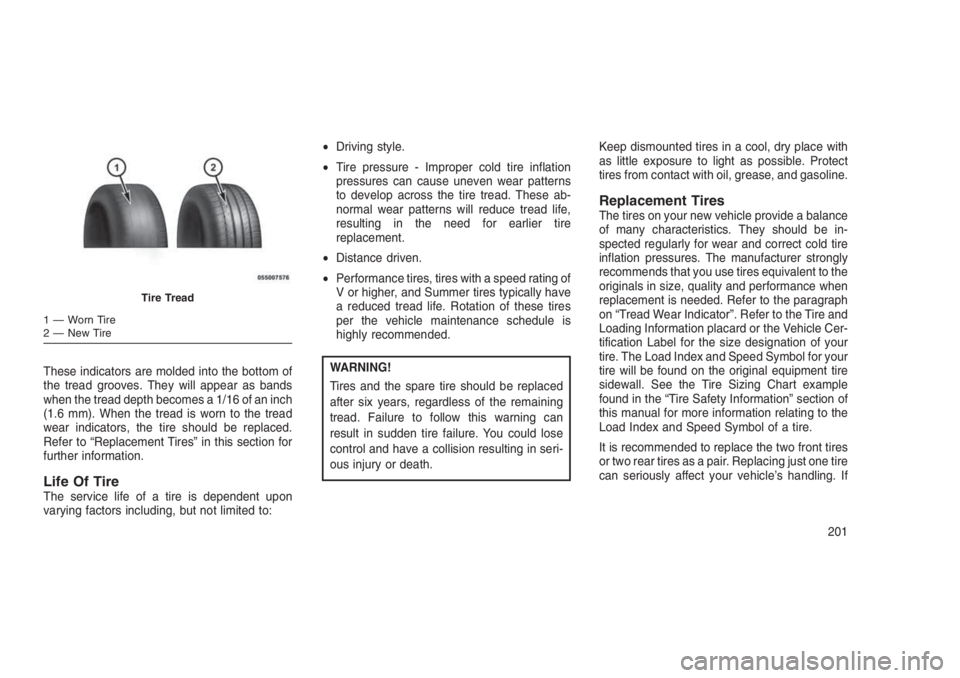
These indicators are molded into the bottom of
the tread grooves. They will appear as bands
when the tread depth becomes a 1/16 of an inch
(1.6 mm). When the tread is worn to the tread
wear indicators, the tire should be replaced.
Refer to “Replacement Tires” in this section for
further information.
Life Of TireThe service life of a tire is dependent upon
varying factors including, but not limited to:•Driving style.
•Tire pressure - Improper cold tire inflation
pressures can cause uneven wear patterns
to develop across the tire tread. These ab-
normal wear patterns will reduce tread life,
resulting in the need for earlier tire
replacement.
•Distance driven.
•Performance tires, tires with a speed rating of
V or higher, and Summer tires typically have
a reduced tread life. Rotation of these tires
per the vehicle maintenance schedule is
highly recommended.
WARNING!
Tires and the spare tire should be replaced
after six years, regardless of the remaining
tread. Failure to follow this warning can
result in sudden tire failure. You could lose
control and have a collision resulting in seri-
ous injury or death.Keep dismounted tires in a cool, dry place with
as little exposure to light as possible. Protect
tires from contact with oil, grease, and gasoline.
Replacement TiresThe tires on your new vehicle provide a balance
of many characteristics. They should be in-
spected regularly for wear and correct cold tire
inflation pressures. The manufacturer strongly
recommends that you use tires equivalent to the
originals in size, quality and performance when
replacement is needed. Refer to the paragraph
on “Tread Wear Indicator”. Refer to the Tire and
Loading Information placard or the Vehicle Cer-
tification Label for the size designation of your
tire. The Load Index and Speed Symbol for your
tire will be found on the original equipment tire
sidewall. See the Tire Sizing Chart example
found in the “Tire Safety Information” section of
this manual for more information relating to the
Load Index and Speed Symbol of a tire.
It is recommended to replace the two front tires
or two rear tires as a pair. Replacing just one tire
can seriously affect your vehicle’s handling. If
Tire Tread
1 — Worn Tire
2 — New Tire
201
Page 212 of 332
NOTE:
When filling warm tires, the tire pressure
may need to be increased up to an additional
4 psi (30 kPa) above the recommended cold
placard pressure in order to turn the Tire
Pressure Monitoring Telltale Light off.
The vehicle may need to be driven for up to 10
minutes above 15 mph (24 km/h) to receive this
information.
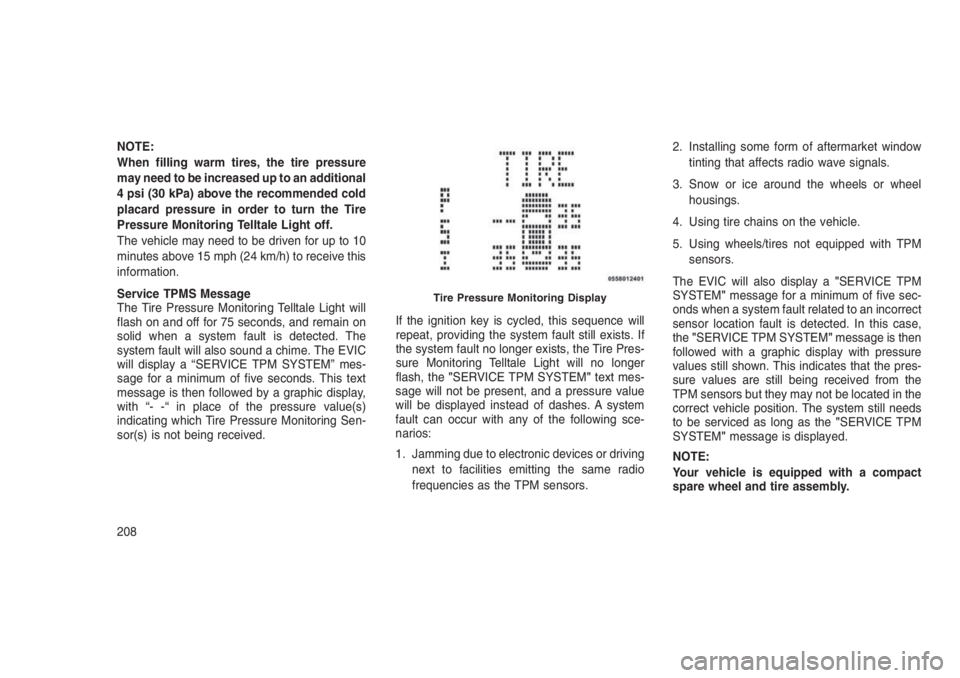
Service TPMS Message
The Tire Pressure Monitoring Telltale Light will
flash on and off for 75 seconds, and remain on
solid when a system fault is detected. The
system fault will also sound a chime. The EVIC
will display a “SERVICE TPM SYSTEM” mes-
sage for a minimum of five seconds. This text
message is then followed by a graphic display,
with “- -“ in place of the pressure value(s)
indicating which Tire Pressure Monitoring Sen-
sor(s) is not being received.If the ignition key is cycled, this sequence will
repeat, providing the system fault still exists. If
the system fault no longer exists, the Tire Pres-
sure Monitoring Telltale Light will no longer
flash, the"SERVICE TPM SYSTEM"text mes-
sage will not be present, and a pressure value
will be displayed instead of dashes. A system
fault can occur with any of the following sce-
narios:
1. Jamming due to electronic devices or driving
next to facilities emitting the same radio
frequencies as the TPM sensors.2. Installing some form of aftermarket window
tinting that affects radio wave signals.
3. Snow or ice around the wheels or wheel
housings.
4. Using tire chains on the vehicle.
5. Using wheels/tires not equipped with TPM
sensors.
The EVIC will also display a"SERVICE TPM
SYSTEM"message for a minimum of five sec-
onds when a system fault related to an incorrect
sensor location fault is detected. In this case,
the"SERVICE TPM SYSTEM"message is then
followed with a graphic display with pressure
values still shown. This indicates that the pres-
sure values are still being received from the
TPM sensors but they may not be located in the
correct vehicle position. The system still needs
to be serviced as long as the"SERVICE TPM
SYSTEM"message is displayed.
NOTE:
Your vehicle is equipped with a compact
spare wheel and tire assembly.
Tire Pressure Monitoring Display
208
Page 213 of 332
1. The compact spare tire does not have a tire
pressure monitoring sensor. Therefore, the
TPMS will not monitor the tire pressure in the
compact spare tire.
2. If you install the compact spare tire in place
of a road tire that has a pressure below the
low-pressure warning limit, upon the next
ignition key cycle, a chime will sound and the
Tire Pressure Monitoring Telltale Light will
still turn ON due to the low tire. The “LOW
TIRE” text message and the graphic with the
low tire pressure flashing will be displayed.
3. However, after driving the vehicle for up to
10 minutes above 15 mph (24 km/h), the Tire
Pressure Monitoring Telltale Light will flash
on and off for 75 seconds and then remain
on solid. In addition, the EVIC will display a
“SERVICE TPM SYSTEM” message for a
minimum of five seconds and then display
dashes (- -) in place of the pressure values.
4. For each subsequent ignition key cycle, a
chime will sound and the Tire Pressure
Monitoring Telltale Light will flash on and offfor 75 seconds and then remain on solid,
and the EVIC will display a “SERVICE TPM
SYSTEM” message for a minimum of five
seconds and then display dashes (- -) in
place of the pressure values.
5.
Once you repair or replace the original road
tire and reinstall it on the vehicle in place of the
compact spare tire, the TPMS will update
automatically and the Tire Pressure Monitoring
Telltale Light will turn OFF, as long as no tire
pressure is below the low-pressure warning
limit in any of the four active road tires. The
vehicle may need to be driven for up to 10
minutes above 15 mph (24 km/h) in order for
the TPMS to receive this information.
TPMS Deactivation — If EquippedThe TPMS can be deactivated if replacing all
four wheel and tire assemblies (road tires) with
wheel and tire assemblies that do not have
TPMS Sensors, such as when installing Winter
wheel and tire assemblies on your vehicle. To
deactivate the TPMS, first, replace all four
wheel and tire assemblies (road tires) with tires
not equipped with Tire Pressure Monitoring(TPM) Sensors. Then, drive the vehicle for 10
minutes above 15 mph (24 km/h). The TPMS
will chime, the “TPM Telltale Light” will flash on
and off for 75 seconds and then remain on and
the Electronic Vehicle Information Center
(EVIC) will display the “SERVICE TPM SYS-
TEM” message and then display dashes (--) in
place of the pressure values. Beginning with the
next ignition switch cycle, the TPMS will no
longer chime or flash the TPM telltale and
display the “SERVICE TPM SYSTEM” message
in the EVIC but dashes (--) will remain in place
of the pressure values.
To reactivate the TPMS, replace all four wheel
and tire assemblies (road tires) with tires
equipped with TPM sensors. Then, drive the
vehicle for up to 10 minutes above 15 mph
(24 km/h). The TPMS will chime, the “TPM
Telltale Light” will flash on and off for 75 sec-
onds and then turn off, and the Electronic
Vehicle Information Center (EVIC) will display
the “SERVICE TPM SYSTEM” message. The
EVIC will also display pressure values in place
of the dashes. On the next ignition switch cycle
209
Page 214 of 332
the “SERVICE TPM SYSTEM” message will no
longer be displayed as long as no system fault
exists.
To reactivate the TPMS, replace all four wheel
and tire assemblies (road tires) with tires
equipped with TPM sensors. Then, drive the
vehicle for up to 10 minutes above 15 mph
(24 km/h). The TPMS will chime, the “TPM
Telltale Light” will flash on and off for 75 sec-
onds and then turn off, and the Electronic
Vehicle Information Center (EVIC) will display
the “SERVICE TPM SYSTEM” message. The
EVIC will also display pressure values in place
of the dashes. On the next ignition switch cycle,
the “SERVICE TPM SYSTEM” message will no
longer be displayed as long as no system fault
exists.
FUEL REQUIREMENTS —
GASOLINE ENGINE
All gasoline engines are designed to meet all
emissions regulations and provide excellent
fuel economy and performance when using
high quality unleaded gasoline with a minimum
research octane rating (RON) of 91.Light spark knock at low engine speeds is not
harmful to your engine. However, continued
heavy spark knock at high speeds can cause
damage and immediate service is required.
Poor quality gasoline can cause problems such
as hard starting, stalling, and hesitations. If you
experience these symptoms, try another brand
of gasoline before considering service for the
vehicle.
Besides using unleaded gasoline with the
proper octane rating, gasolines that contain
detergents, corrosion and stability additives are
recommended. Using gasolines that have these
additives may help improve fuel economy, re-
duce emissions, and maintain vehicle perfor-
mance.
Poor quality gasoline can cause problems such
as hard starting, stalling and stumble. If you
experience these problems, try another brand
of gasoline before considering service for the
vehicle.
Methanol(Methyl) is used in a variety of concentrations
when blended with unleaded gasoline. You mayfind fuels containing 3% or more methanol
along with other alcohols called cosolvents.
Problems that result from using methanol/
gasoline blends are not the responsibility of the
manufacturer.
CAUTION!
Do not use gasolines containing Methanol.
Use of these blends may result in starting
and drivability problems and may damage
critical fuel system components.
EthanolThe manufacturer recommends that your ve-
hicle be operated on fuel containing no more
than 15% ethanol. Purchasing your fuel from a
reputable supplier may reduce the risk of ex-
ceeding this 15% limit and/or of receiving fuel
with abnormal properties. It should also be
noted that an increase in fuel consumption
should be expected when using ethanol-
blended fuels, due to the lower energy content
of ethanol. Problems that result from using
210
Page 229 of 332
6
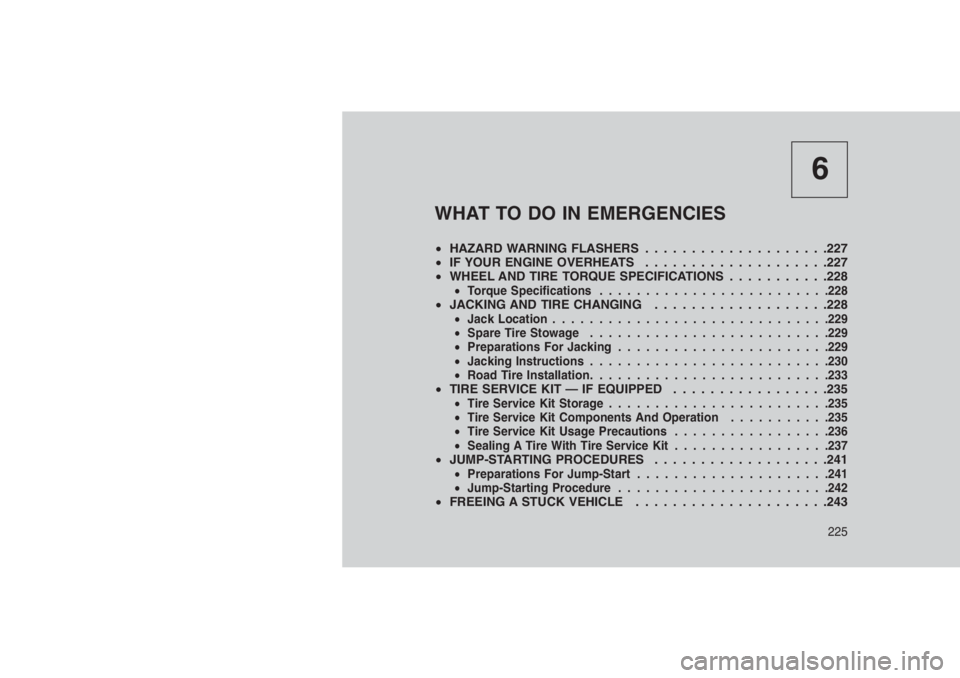
WHAT TO DO IN EMERGENCIES
•HAZARD WARNING FLASHERS . . . . . . . . ............227
•IF YOUR ENGINE OVERHEATS . . . . . . . . . . . . . . . . . . . .227
•WHEEL AND TIRE TORQUE SPECIFICATIONS . . . . . . . . . . .228
•Torque Specifications.........................228•JACKING AND TIRE CHANGING . . . . . . . . . . .........228•Jack Location..............................229
•Spare Tire Stowage..........................229
•Preparations For Jacking.......................229
•Jacking Instructions..........................230
•Road Tire Installation..........................233
•TIRE SERVICE KIT — IF EQUIPPED . . . . . . .. . . . . . . . . .235•Tire Service Kit Storage........................235
•Tire Service Kit Components And Operation...........235
•Tire Service Kit Usage Precautions.................236
•Sealing A Tire With Tire Service Kit.................237
•JUMP-STARTING PROCEDURES . . . . . . .. . . . . . . . . . . .241•Preparations For Jump-Start.....................241
•Jump-Starting Procedure.......................242
•FREEING A STUCK VEHICLE . . . . . . . ..............243
225
Page 231 of 332
HAZARD WARNING FLASHERS
The Hazard Warning flasher switch is located
on the instrument panel below the climate
controls.
Push the switch to turn on the Hazard
Warning flasher. When the switch is
activated, all directional turn signals
will flash on and off to warn oncoming traffic of
an emergency. Push the switch a second time
to turn off the Hazard Warning flashers.
This is an emergency warning system and it
should not be used when the vehicle is in
motion. Use it when your vehicle is disabled and
it is creating a safety hazard for other motorists.
When you must leave the vehicle to seek assis-
tance, the Hazard Warning flashers will con-
tinue to operate even though the ignition is
placed in the OFF position.
NOTE:
With extended use the Hazard Warning
flashers may wear down your battery.
IF YOUR ENGINE OVERHEATS
In any of the following situations, you can
reduce the potential for overheating by taking
the appropriate action.
•On the highways — slow down.
•In city traffic — while stopped, place the
transmission in NEUTRAL, but do not in-
crease engine idle speed.
NOTE:
There are steps that you can take to slow
down an impending overheat condition:
•If your air conditioner (A/C) is on, turn it
off. The A/C system adds heat to the
engine cooling system and turning the
A/C off can help remove this heat.
•You can also turn the temperature control
to maximum heat, the mode control to
floor and the blower control to high. This
allows the heater core to act as a supple-
ment to the radiator and aids in removing
heat from the engine cooling system.CAUTION!
Driving with a hot cooling system could dam-
age your vehicle. If the pointer rises to the
H(red) mark, the instrument cluster will
sound a chime. When safe, pull over and
stop the vehicle with the engine at idle. Turn
off the air conditioning and wait until the
pointer drops back into the normal range. If
the pointer remains on theH(red) mark for
more than a minute, turn the engine off
immediately and call for service.
WARNING!
You or others can be badly burned by hot
engine coolant (antifreeze) or steam from
your radiator. If you see or hear steam com-
ing from under the hood, do not open the
hood until the radiator has had time to cool.
Never try to open a cooling system pressure
cap when the radiator or coolant bottle is hot.
227