wheel JEEP PATRIOT 2021 Owner handbook (in English)
[x] Cancel search | Manufacturer: JEEP, Model Year: 2021, Model line: PATRIOT, Model: JEEP PATRIOT 2021Pages: 332, PDF Size: 1.99 MB
Page 210 of 332
Tire Pressure Monitoring Low Pressure
Warnings
The Tire Pressure Monitoring Telltale Light will
illuminate in the instrument cluster, a LOW TIRE
message will be displayed for a minimum of five
seconds, and an audible chime will be activated
when one or more of the four active road tire
pressures are low. Should this occur, you
should stop as soon as possible, check the
inflation pressure of each tire on your vehicle,
and inflate each tire to the vehicle’s recom-
mended cold placard pressure value. The sys-
tem will automatically update and the Tire Pres-
sure Monitoring Light will extinguish and the
LOW TIRE message will turn off once the
updated tire pressures have been received.
NOTE:
When filling warm tires, the tire pressure
may need to be increased up to an additional
4 psi (30 kPa) above the recommended cold
placard pressure in order to turn the Tire
Pressure Monitoring Telltale Light off.
The vehicle may need to be driven for up to 10
minutes above 15 mph (24 km/h) to receive this
information.Check TPMS Warnings
The Tire Pressure Monitoring Telltale Light will
flash on and off for 75 seconds and remain on
solid when a system fault is detected. The
system fault will also sound a chime. If the
ignition key is cycled, this sequence will repeat
providing the system fault still exists. The Tire
Pressure Monitoring Telltale Light will turn off
when the fault condition no longer exists. A
system fault can occur with any of the following
scenarios:
1. Jamming due to electronic devices or driving
next to facilities emitting the same radio
frequencies as the TPM sensors.
2. Installing some form of aftermarket window
tinting that affects radio wave signals.
3. Snow or ice around the wheels or wheel
housings.
4. Using tire chains on the vehicle.
5. Using wheels/tires not equipped with TPM
sensors.NOTE:
Your vehicle is equipped with a compact
spare wheel and tire assembly.
1. The compact spare tire does not have a tire
pressure monitoring sensor. Therefore, the
TPMS will not monitor the tire pressure in the
compact spare tire.
2. If you install the compact spare tire in place
of a road tire that has a pressure below the
low-pressure warning limit, upon the next
ignition key cycle, a chime will sound and the
Tire Pressure Monitoring Telltale Light and
LOW TIRE message will still turn ON due to
the low tire.
3. However, after driving the vehicle for up to
10 minutes above 15 mph (24 km/h), the Tire
Pressure Monitoring Telltale Light will flash
on and off for 75 seconds and then remain
on solid.
4. For each subsequent ignition key cycle, a
chime will sound and the Tire Pressure
Monitoring Telltale Light will flash on and off
for 75 seconds and then remain on solid.
206
Page 211 of 332
5. Once you repair or replace the original road
tire and reinstall it on the vehicle in place of
the compact spare tire, the TPMS will update
automatically and the Tire Pressure Monitor-
ing Telltale Light will turn OFF, as long as no
tire pressure is below the low-pressure
warning limit in any of the four active road
tires. The vehicle may need to be driven for
up to 10 minutes above 15 mph (24 km/h) in
order for the TPMS to receive this informa-
tion.
Premium System — If EquippedThe TPMS uses wireless technology with wheel
rim mounted electronic sensors to monitor tire
pressure levels. Sensors, mounted to each
wheel as part of the valve stem, transmit tire
pressure readings to the receiver module.
NOTE:
It is particularly important for you to check
the tire pressure in all of your tires regularly
and to maintain the proper pressure.
The TPMS consists of the following compo-
nents:•Receiver Module
•Four Tire Pressure Monitoring Sensors
•Three Trigger Modules (mounted in three of
the four wheel wells)
•Various Tire Pressure Monitoring System
Messages, which display in the Electronic
Vehicle Information Center (EVIC)
•Tire Pressure Monitoring Telltale Light
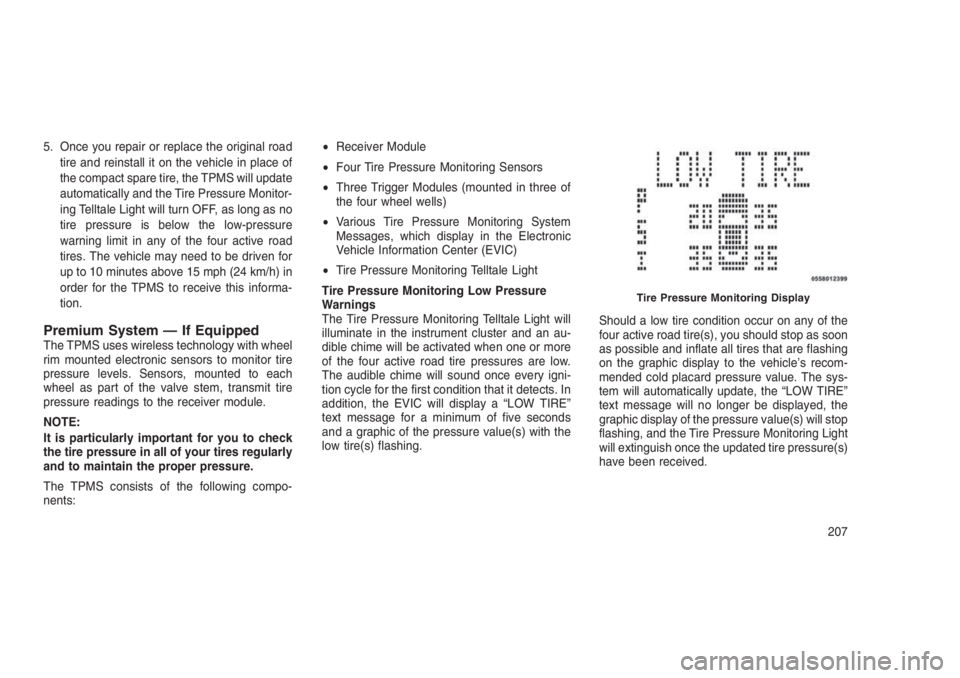
Tire Pressure Monitoring Low Pressure
Warnings
The Tire Pressure Monitoring Telltale Light will
illuminate in the instrument cluster and an au-
dible chime will be activated when one or more
of the four active road tire pressures are low.
The audible chime will sound once every igni-
tion cycle for the first condition that it detects. In
addition, the EVIC will display a “LOW TIRE”
text message for a minimum of five seconds
and a graphic of the pressure value(s) with the
low tire(s) flashing.Should a low tire condition occur on any of the
four active road tire(s), you should stop as soon
as possible and inflate all tires that are flashing
on the graphic display to the vehicle’s recom-
mended cold placard pressure value. The sys-
tem will automatically update, the “LOW TIRE”
text message will no longer be displayed, the
graphic display of the pressure value(s) will stop
flashing, and the Tire Pressure Monitoring Light
will extinguish once the updated tire pressure(s)
have been received.
Tire Pressure Monitoring Display
207
Page 212 of 332
NOTE:
When filling warm tires, the tire pressure
may need to be increased up to an additional
4 psi (30 kPa) above the recommended cold
placard pressure in order to turn the Tire
Pressure Monitoring Telltale Light off.
The vehicle may need to be driven for up to 10
minutes above 15 mph (24 km/h) to receive this
information.
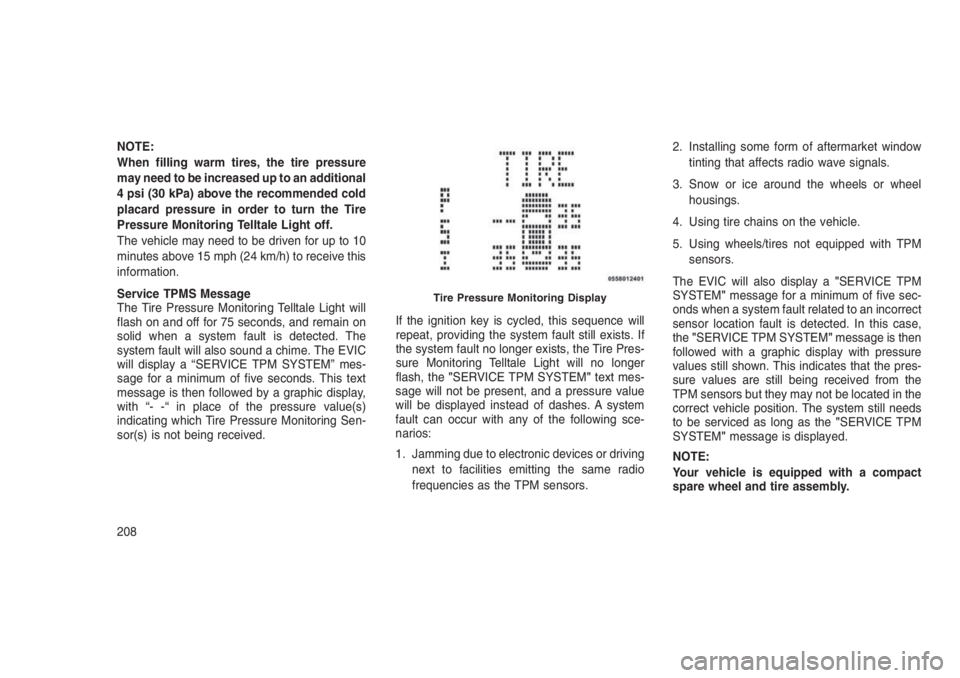
Service TPMS Message
The Tire Pressure Monitoring Telltale Light will
flash on and off for 75 seconds, and remain on
solid when a system fault is detected. The
system fault will also sound a chime. The EVIC
will display a “SERVICE TPM SYSTEM” mes-
sage for a minimum of five seconds. This text
message is then followed by a graphic display,
with “- -“ in place of the pressure value(s)
indicating which Tire Pressure Monitoring Sen-
sor(s) is not being received.If the ignition key is cycled, this sequence will
repeat, providing the system fault still exists. If
the system fault no longer exists, the Tire Pres-
sure Monitoring Telltale Light will no longer
flash, the"SERVICE TPM SYSTEM"text mes-
sage will not be present, and a pressure value
will be displayed instead of dashes. A system
fault can occur with any of the following sce-
narios:
1. Jamming due to electronic devices or driving
next to facilities emitting the same radio
frequencies as the TPM sensors.2. Installing some form of aftermarket window
tinting that affects radio wave signals.
3. Snow or ice around the wheels or wheel
housings.
4. Using tire chains on the vehicle.
5. Using wheels/tires not equipped with TPM
sensors.
The EVIC will also display a"SERVICE TPM
SYSTEM"message for a minimum of five sec-
onds when a system fault related to an incorrect
sensor location fault is detected. In this case,
the"SERVICE TPM SYSTEM"message is then
followed with a graphic display with pressure
values still shown. This indicates that the pres-
sure values are still being received from the
TPM sensors but they may not be located in the
correct vehicle position. The system still needs
to be serviced as long as the"SERVICE TPM
SYSTEM"message is displayed.
NOTE:
Your vehicle is equipped with a compact
spare wheel and tire assembly.
Tire Pressure Monitoring Display
208
Page 213 of 332
1. The compact spare tire does not have a tire
pressure monitoring sensor. Therefore, the
TPMS will not monitor the tire pressure in the
compact spare tire.
2. If you install the compact spare tire in place
of a road tire that has a pressure below the
low-pressure warning limit, upon the next
ignition key cycle, a chime will sound and the
Tire Pressure Monitoring Telltale Light will
still turn ON due to the low tire. The “LOW
TIRE” text message and the graphic with the
low tire pressure flashing will be displayed.
3. However, after driving the vehicle for up to
10 minutes above 15 mph (24 km/h), the Tire
Pressure Monitoring Telltale Light will flash
on and off for 75 seconds and then remain
on solid. In addition, the EVIC will display a
“SERVICE TPM SYSTEM” message for a
minimum of five seconds and then display
dashes (- -) in place of the pressure values.
4. For each subsequent ignition key cycle, a
chime will sound and the Tire Pressure
Monitoring Telltale Light will flash on and offfor 75 seconds and then remain on solid,
and the EVIC will display a “SERVICE TPM
SYSTEM” message for a minimum of five
seconds and then display dashes (- -) in
place of the pressure values.
5.
Once you repair or replace the original road
tire and reinstall it on the vehicle in place of the
compact spare tire, the TPMS will update
automatically and the Tire Pressure Monitoring
Telltale Light will turn OFF, as long as no tire
pressure is below the low-pressure warning
limit in any of the four active road tires. The
vehicle may need to be driven for up to 10
minutes above 15 mph (24 km/h) in order for
the TPMS to receive this information.
TPMS Deactivation — If EquippedThe TPMS can be deactivated if replacing all
four wheel and tire assemblies (road tires) with
wheel and tire assemblies that do not have
TPMS Sensors, such as when installing Winter
wheel and tire assemblies on your vehicle. To
deactivate the TPMS, first, replace all four
wheel and tire assemblies (road tires) with tires
not equipped with Tire Pressure Monitoring(TPM) Sensors. Then, drive the vehicle for 10
minutes above 15 mph (24 km/h). The TPMS
will chime, the “TPM Telltale Light” will flash on
and off for 75 seconds and then remain on and
the Electronic Vehicle Information Center
(EVIC) will display the “SERVICE TPM SYS-
TEM” message and then display dashes (--) in
place of the pressure values. Beginning with the
next ignition switch cycle, the TPMS will no
longer chime or flash the TPM telltale and
display the “SERVICE TPM SYSTEM” message
in the EVIC but dashes (--) will remain in place
of the pressure values.
To reactivate the TPMS, replace all four wheel
and tire assemblies (road tires) with tires
equipped with TPM sensors. Then, drive the
vehicle for up to 10 minutes above 15 mph
(24 km/h). The TPMS will chime, the “TPM
Telltale Light” will flash on and off for 75 sec-
onds and then turn off, and the Electronic
Vehicle Information Center (EVIC) will display
the “SERVICE TPM SYSTEM” message. The
EVIC will also display pressure values in place
of the dashes. On the next ignition switch cycle
209
Page 214 of 332
the “SERVICE TPM SYSTEM” message will no
longer be displayed as long as no system fault
exists.
To reactivate the TPMS, replace all four wheel
and tire assemblies (road tires) with tires
equipped with TPM sensors. Then, drive the
vehicle for up to 10 minutes above 15 mph
(24 km/h). The TPMS will chime, the “TPM
Telltale Light” will flash on and off for 75 sec-
onds and then turn off, and the Electronic
Vehicle Information Center (EVIC) will display
the “SERVICE TPM SYSTEM” message. The
EVIC will also display pressure values in place
of the dashes. On the next ignition switch cycle,
the “SERVICE TPM SYSTEM” message will no
longer be displayed as long as no system fault
exists.
FUEL REQUIREMENTS —
GASOLINE ENGINE
All gasoline engines are designed to meet all
emissions regulations and provide excellent
fuel economy and performance when using
high quality unleaded gasoline with a minimum
research octane rating (RON) of 91.Light spark knock at low engine speeds is not
harmful to your engine. However, continued
heavy spark knock at high speeds can cause
damage and immediate service is required.
Poor quality gasoline can cause problems such
as hard starting, stalling, and hesitations. If you
experience these symptoms, try another brand
of gasoline before considering service for the
vehicle.
Besides using unleaded gasoline with the
proper octane rating, gasolines that contain
detergents, corrosion and stability additives are
recommended. Using gasolines that have these
additives may help improve fuel economy, re-
duce emissions, and maintain vehicle perfor-
mance.
Poor quality gasoline can cause problems such
as hard starting, stalling and stumble. If you
experience these problems, try another brand
of gasoline before considering service for the
vehicle.
Methanol(Methyl) is used in a variety of concentrations
when blended with unleaded gasoline. You mayfind fuels containing 3% or more methanol
along with other alcohols called cosolvents.
Problems that result from using methanol/
gasoline blends are not the responsibility of the
manufacturer.
CAUTION!
Do not use gasolines containing Methanol.
Use of these blends may result in starting
and drivability problems and may damage
critical fuel system components.
EthanolThe manufacturer recommends that your ve-
hicle be operated on fuel containing no more
than 15% ethanol. Purchasing your fuel from a
reputable supplier may reduce the risk of ex-
ceeding this 15% limit and/or of receiving fuel
with abnormal properties. It should also be
noted that an increase in fuel consumption
should be expected when using ethanol-
blended fuels, due to the lower energy content
of ethanol. Problems that result from using
210
Page 218 of 332
Trailer Sway ControlThe trailer sway control can be a mechanical
telescoping link that can be installed between the
hitch receiver and the trailer tongue that typically
provides adjustable friction associated with the
telescoping motion to dampen any unwanted
trailer swaying motions while traveling.
If equipped, the electronic Trailer Sway Control
(TSC) recognizes a swaying trailer and auto-
matically applies individual wheel brakes and/or
reduces engine power to attempt to eliminate
the trailer sway.
Weight-Carrying Hitch
A weight-carrying hitch supports the trailer
tongue weight, just as if it were luggage located
at a hitch ball or some other connecting point of
the vehicle. These kinds of hitches are the most
popular on the market today and they are
commonly used to tow small and medium sized
trailers.
Weight-Distributing Hitch
A weight-distributing system works by applying
leverage through spring (load) bars. They are
typically used for heavier loads to distribute
trailer tongue weight to the tow vehicle’s frontaxle and the trailer axle(s). When used in ac-
cordance with the manufacturer’s directions, it
provides for a more level ride, offering more
consistent steering and brake control thereby
enhancing towing safety. The addition of a
friction/hydraulic sway control also dampens
sway caused by traffic and crosswinds and
contributes positively to tow vehicle and trailer
stability. Trailer sway control and a weight dis-
tributing (load equalizing) hitch are recom-
mended for heavier Tongue Weights (TW) and
may be required depending on vehicle and
trailer configuration/loading to comply with
Gross Axle Weight Rating (GAWR) require-
ments.
WARNING!
•An improperly adjusted Weight Distributing
Hitch system may reduce handling, stabil-
ity, braking performance, and could result
in a collision.
(Continued)
WARNING!(Continued)
•Weight Distributing Systems may not be
compatible with Surge Brake Couplers.
Consult with your hitch and trailer manu-
facturer or a reputable Recreational Ve-
hicle dealer for additional information.
Breakaway Cable AttachmentEuropean braking regulations for braked trailers
up to 7,700 lbs (3,500 kg), require trailers to be
fitted with either a secondary coupling or break-
away cable.
The recommended location for attaching the
normal trailer’s breakaway cable is in the
stamped slot located on the sidewall of the hitch
receiver.
214
Page 221 of 332
WARNING!
Improper towing can lead to an injury acci-
dent. Follow these guidelines to make your
trailer towing as safe as possible:
•Make certain that the load is secured in the
trailer and that it will not shift during travel.
When trailering cargo that is not fully se-
cured, dynamic load shifts can occur that
may be difficult for the driver to control. You
could lose control of your vehicle and have
an accident.
•All trailer hitches should be professionally
installed on your vehicle.
•When hauling cargo or towing a trailer, do
not overload your vehicle or trailer. Over-
loading can cause a loss of control, poor
performance, or damage to brakes, axle,
engine, transmission, steering, suspen-
sion, chassis structure, or tires.
(Continued)
WARNING!(Continued)
•Safety chains must always be used be-
tween your vehicle and trailer. Always con-
nect the chains to the frame or hook re-
tainers of the vehicle hitch. Cross the
chains under the trailer tongue and allow
enough slack for turning corners.
•Vehicles with trailers should not be parked
on a grade. When parking, apply the park-
ing brake on the tow vehicle. Always, block
or"chock"the trailer wheels.
•GCWR must not be exceeded.
•Total weight must be distributed be-
tween the tow vehicle and the trailer
such that the following four ratings are
not exceeded:
1. GVWR
2. GTW
3. GAWR
4. Tongue weight rating for the trailer hitch
utilized.Towing Requirements — Tires
•Do not attempt to tow a trailer while using a
compact spare tire.
•Proper tire inflation pressures are essential
for the safe and satisfactory operation of your
vehicle. Refer to “Tires – General Informa-
tion” in “Starting and Operating” for proper
tire inflation procedures.
•Check the trailer tires for proper tire inflation
pressures before trailer usage.
•Check for signs of tire wear or visible tire
damage before towing a trailer. Refer to
“Tires – General Information” in “Starting and
Operating” for the proper inspection
procedure.
•When replacing tires, refer to “Tires – Gen-
eral Information” in “Starting and Operating”
for proper tire replacement procedures. Re-
placing tires with a higher load carrying ca-
pacity will not increase the vehicle’s GVWR
and GAWR limits.
217
Page 227 of 332
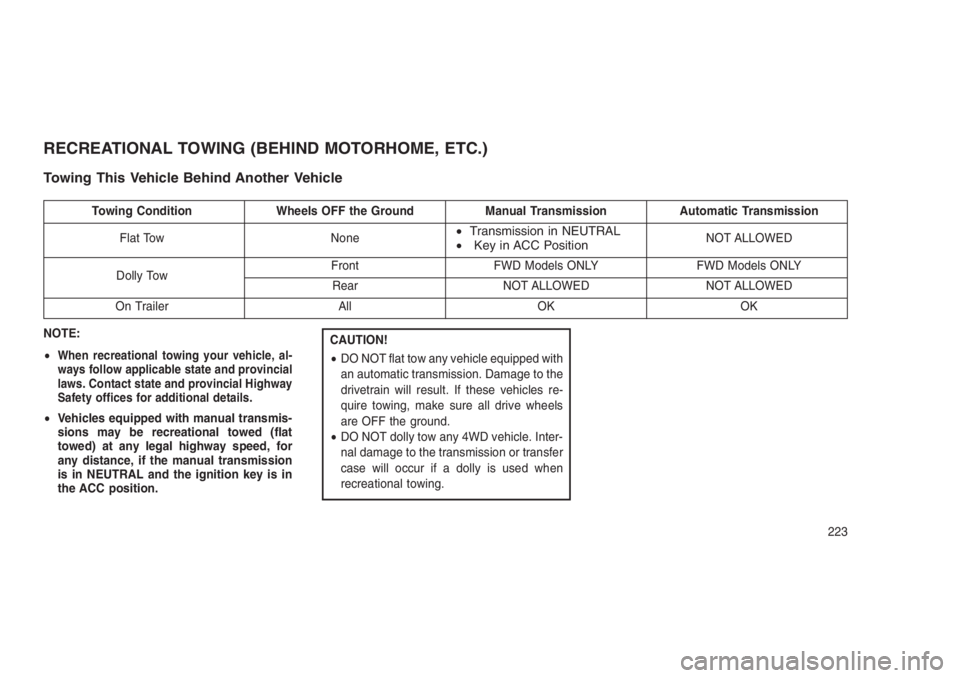
RECREATIONAL TOWING (BEHIND MOTORHOME, ETC.)
Towing This Vehicle Behind Another Vehicle
Towing Condition Wheels OFF the Ground Manual Transmission Automatic Transmission
Flat Tow None
•Transmission in NEUTRAL
•Key in ACC PositionNOT ALLOWED
Dolly TowFront FWD Models ONLY FWD Models ONLY
Rear NOT ALLOWED NOT ALLOWED
On Trailer All OK OK
NOTE:
•
When recreational towing your vehicle, al-
ways follow applicable state and provincial
laws. Contact state and provincial Highway
Safety offices for additional details.
•Vehicles equipped with manual transmis-
sions may be recreational towed (flat
towed) at any legal highway speed, for
any distance, if the manual transmission
is in NEUTRAL and the ignition key is in
the ACC position.
CAUTION!
•DO NOT flat tow any vehicle equipped with
an automatic transmission. Damage to the
drivetrain will result. If these vehicles re-
quire towing, make sure all drive wheels
are OFF the ground.
•DO NOT dolly tow any 4WD vehicle. Inter-
nal damage to the transmission or transfer
case will occur if a dolly is used when
recreational towing.
223
Page 229 of 332
6
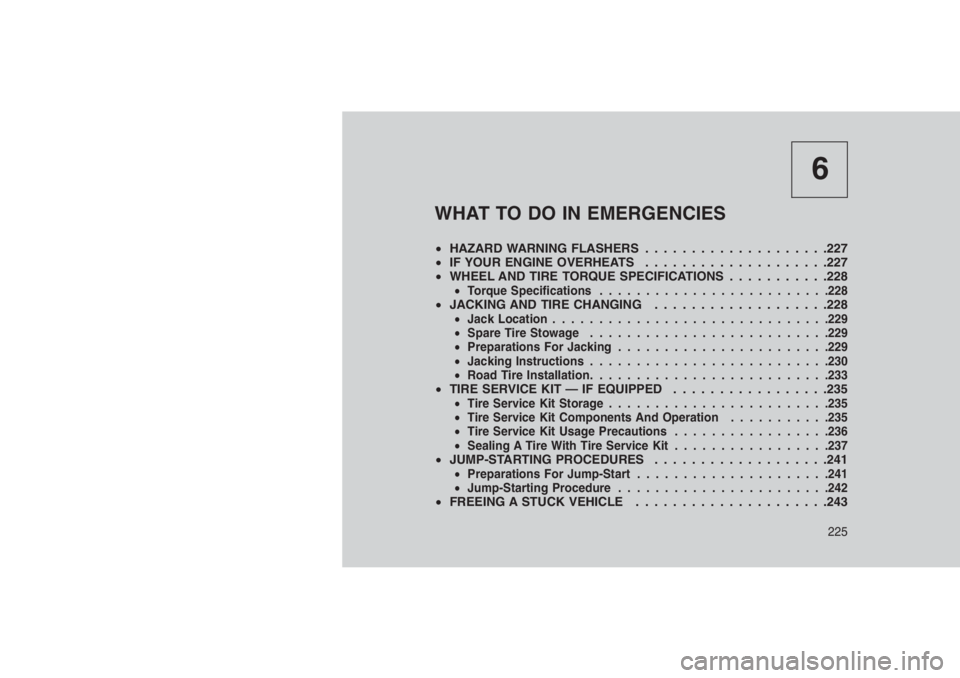
WHAT TO DO IN EMERGENCIES
•HAZARD WARNING FLASHERS . . . . . . . . ............227
•IF YOUR ENGINE OVERHEATS . . . . . . . . . . . . . . . . . . . .227
•WHEEL AND TIRE TORQUE SPECIFICATIONS . . . . . . . . . . .228
•Torque Specifications.........................228•JACKING AND TIRE CHANGING . . . . . . . . . . .........228•Jack Location..............................229
•Spare Tire Stowage..........................229
•Preparations For Jacking.......................229
•Jacking Instructions..........................230
•Road Tire Installation..........................233
•TIRE SERVICE KIT — IF EQUIPPED . . . . . . .. . . . . . . . . .235•Tire Service Kit Storage........................235
•Tire Service Kit Components And Operation...........235
•Tire Service Kit Usage Precautions.................236
•Sealing A Tire With Tire Service Kit.................237
•JUMP-STARTING PROCEDURES . . . . . . .. . . . . . . . . . . .241•Preparations For Jump-Start.....................241
•Jump-Starting Procedure.......................242
•FREEING A STUCK VEHICLE . . . . . . . ..............243
225
Page 232 of 332
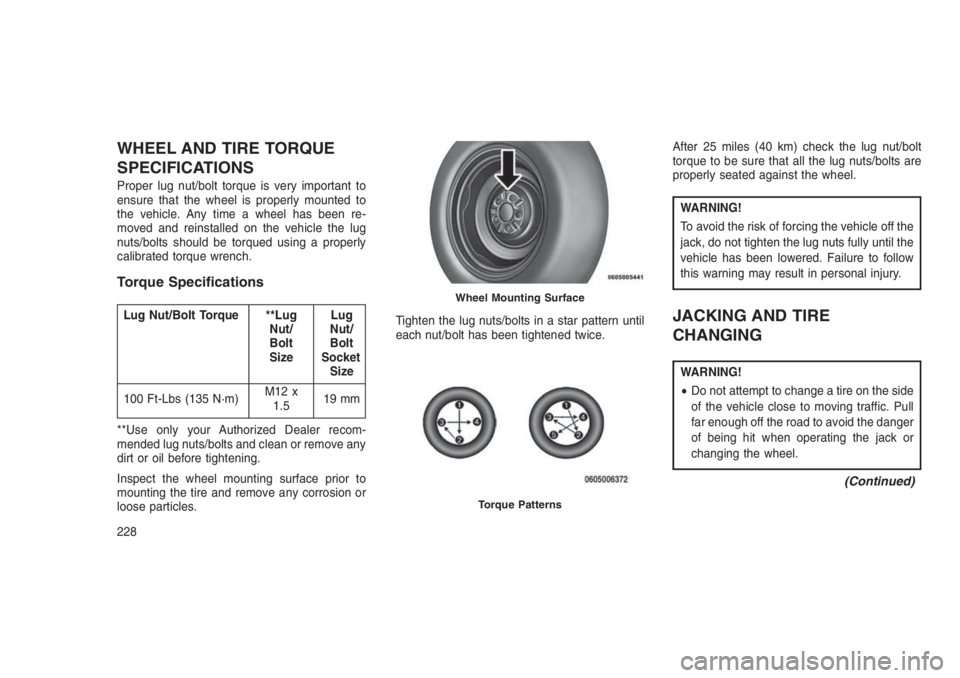
WHEEL AND TIRE TORQUE
SPECIFICATIONS
Proper lug nut/bolt torque is very important to
ensure that the wheel is properly mounted to
the vehicle. Any time a wheel has been re-
moved and reinstalled on the vehicle the lug
nuts/bolts should be torqued using a properly
calibrated torque wrench.
Torque Specifications
Lug Nut/Bolt Torque **Lug
Nut/
Bolt
SizeLug
Nut/
Bolt
Socket
Size
100 Ft-Lbs (135 N·m)M12 x
1.519 mm
**Use only your Authorized Dealer recom-
mended lug nuts/bolts and clean or remove any
dirt or oil before tightening.
Inspect the wheel mounting surface prior to
mounting the tire and remove any corrosion or
loose particles.Tighten the lug nuts/bolts in a star pattern until
each nut/bolt has been tightened twice.After 25 miles (40 km) check the lug nut/bolt
torque to be sure that all the lug nuts/bolts are
properly seated against the wheel.
WARNING!
To avoid the risk of forcing the vehicle off the
jack, do not tighten the lug nuts fully until the
vehicle has been lowered. Failure to follow
this warning may result in personal injury.
JACKING AND TIRE
CHANGING
WARNING!
•Do not attempt to change a tire on the side
of the vehicle close to moving traffic. Pull
far enough off the road to avoid the danger
of being hit when operating the jack or
changing the wheel.
(Continued)
Wheel Mounting Surface
Torque Patterns
228