window JEEP PATRIOT 2021 Owner handbook (in English)
[x] Cancel search | Manufacturer: JEEP, Model Year: 2021, Model line: PATRIOT, Model: JEEP PATRIOT 2021Pages: 332, PDF Size: 1.99 MB
Page 14 of 332
•REMOTE KEYLESS ENTRY (RKE) . . . . .................16•To Unlock The Doors And Liftgate.....................17
•RKE Key Fob Unlock, Driver Door/All First Press............17
•Illuminated Approach — If Equipped...................17
•To Lock The Doors And Liftgate......................18
•Flash Lights With Remote Key Lock/Unlock...............18
•RKE Key Fob Battery Replacement....................18
•REMOTE STARTING SYSTEM — IF EQUIPPED . . . . . . . . . . . . .19•How To Use Remote Start..........................19
•Remote Start Abort Message On Electronic Vehicle Information
Center (EVIC) — If Equipped........................19
•To Enter Remote Start............................20
•To Exit Remote Start Mode Without Driving The Vehicle........20
•To Exit Remote Start Mode And Drive The Vehicle...........20
•DOOR LOCKS . . . . ..............................21•Manual Door Locks..............................21
•Power Door Locks..............................21
•Child-Protection Door Lock System — Rear Doors..........23
•POWER WINDOWS — IF EQUIPPED . . . . . . . . . . . . . . . . . . . .24•Power Window Switches..........................24
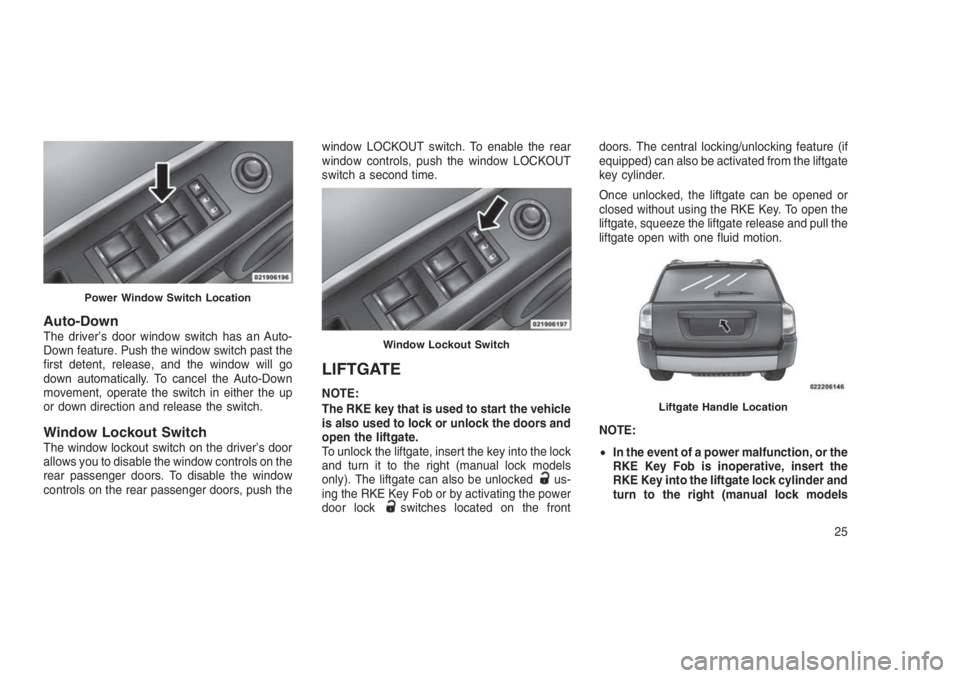
•Auto-Down...................................25
•Window Lockout Switch...........................25
•LIFTGATE . . . . . . . . . . . . ........................25
•OCCUPANT RESTRAINT SYSTEMS . . . . . . . . . . . . . . . . . . . .26
•Important Safety Precautions.......................26
•Seat Belt Systems..............................27
•Supplemental Restraint System (SRS)..................38
10
Page 23 of 332
Skin oils may cause battery deterioration. If
you touch a battery, clean it with rubbing
alcohol.
3. To assemble the RKE Key Fob case, snap
the two halves together.
NOTE:
If the RKE Key Fob is equipped with a screw,
reinstall and tighten the screw until snug.
REMOTE STARTING SYSTEM
— IF EQUIPPED
This system uses the RKE Key Fob
to start the engine conveniently
from outside the vehicle while still
maintaining security. The system
has a range of approximately 300 ft
(91 m). Obstructions between the
vehicle and RKE Key Fob may reduce this
range.NOTE:
•The vehicle must be equipped with an
automatic transmission to be equipped
with Remote Start.
•Obstructions between the vehicle and the
RKE Key Fob may reduce this range.
How To Use Remote StartAll of the following conditions must be met
before the engine will remote start:
•Gear selector in PARK
•Doors closed
•Hood closed
•Hazard switch off
•Brake switch inactive (brake pedal not
pushed)
•Ignition RKE Key removed from ignition
•Battery at an acceptable charge level
•System not disabled from previous remote
start event
•Vehicle Security Alarm not active
WARNING!
•Do not start or run an engine in a closed
garage or confined area. Exhaust gas con-
tains Carbon Monoxide (CO) which is
odorless and colorless. Carbon Monoxide
is poisonous and can cause serious injury
or death when inhaled.
•Keep RKE Key Fobs away from children.
Operation of the Remote Start System,
windows, door locks or other controls
could cause serious injury or death.
Remote Start Abort Message On
Electronic Vehicle Information
Center (EVIC) — If Equipped
The following messages will display in the EVIC
if the vehicle fails to remote start or exits remote
start prematurely:
•Remote Start Aborted — Door Open
•Remote Start Aborted — Hood Open
•Remote Start Aborted — L/Gate Open
•Remote Start Aborted — Fuel Low
19
Page 24 of 332
•Remote Start Aborted — System Fault
The EVIC message stays active until the igni-
tion is placed in the ON/RUN position.
To Enter Remote StartPush and release the REMOTE STARTbut-
ton on the RKE Key Fob twice within five
seconds. The vehicle doors will lock, the park-
ing lights will flash, and the horn will chirp twice
(if programmed). Then, the engine will start and
the vehicle will remain in the Remote Start
mode for a 15-minute cycle.
NOTE:
•The park lamps will turn on and remain on
during Remote Start mode.
•For security, power window and power
sunroof operation (if equipped) are dis-
abled when the vehicle is in the Remote
Start mode.
•If your power door locks were unlocked,
Remote Start will automatically lock the
doors.•The engine can be started two consecu-
tive times (two 15-minute cycles) with the
RKE Key Fob. However, the ignition must
be placed in the ON/RUN position before
you can repeat the start sequence for a
third cycle.
Remote Start will also cancel if any of the
following occur:
•The engine stalls or RPM exceeds 2500.
•Any engine warning lamps come on.
•Low Fuel Light turns on.
•The hood is opened.
•The hazard switch is pushed.
•The transmission is moved out of PARK.
•The brake pedal is pushed.
To Exit Remote Start Mode Without
Driving The Vehicle
Push and release the REMOTE STARTbut-
ton one time or allow the engine to run for the
entire 15-minute cycle.NOTE:
To avoid unintentional shut downs, the sys-
tem will disable the one time push of the
REMOTE START
button for two seconds
after receiving a valid Remote Start request.
To Exit Remote Start Mode And
Drive The Vehicle
Before the end of the 15-minute cycle, push and
release the UNLOCKbutton on the RKE Key
Fob to unlock the doors and disarm the Vehicle
Security Alarm (if equipped). Then, insert the
RKE Key into the ignition and place the ignition
in the ON/RUN position.
NOTE:
The ignition must be placed in the ON/RUN
position in order to drive the vehicle.
20
Page 28 of 332
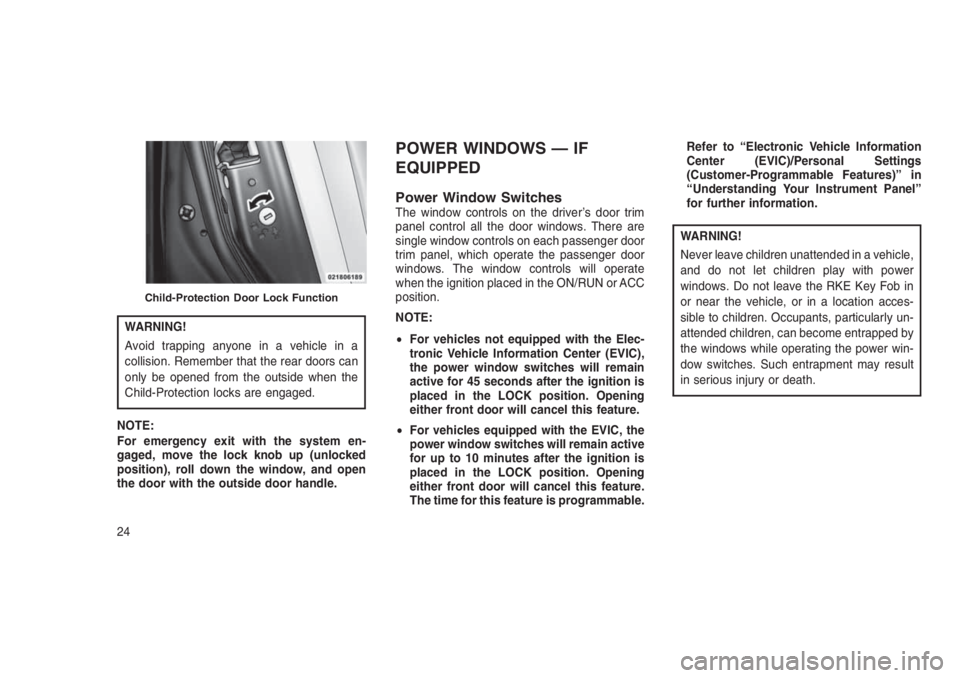
WARNING!
Avoid trapping anyone in a vehicle in a
collision. Remember that the rear doors can
only be opened from the outside when the
Child-Protection locks are engaged.
NOTE:
For emergency exit with the system en-
gaged, move the lock knob up (unlocked
position), roll down the window, and open
the door with the outside door handle.
POWER WINDOWS — IF
EQUIPPED
Power Window SwitchesThe window controls on the driver’s door trim
panel control all the door windows. There are
single window controls on each passenger door
trim panel, which operate the passenger door
windows. The window controls will operate
when the ignition placed in the ON/RUN or ACC
position.
NOTE:
•For vehicles not equipped with the Elec-
tronic Vehicle Information Center (EVIC),
the power window switches will remain
active for 45 seconds after the ignition is
placed in the LOCK position. Opening
either front door will cancel this feature.
•For vehicles equipped with the EVIC, the
power window switches will remain active
for up to 10 minutes after the ignition is
placed in the LOCK position. Opening
either front door will cancel this feature.
The time for this feature is programmable.Refer to “Electronic Vehicle Information
Center (EVIC)/Personal Settings
(Customer-Programmable Features)” in
“Understanding Your Instrument Panel”
for further information.
WARNING!
Never leave children unattended in a vehicle,
and do not let children play with power
windows. Do not leave the RKE Key Fob in
or near the vehicle, or in a location acces-
sible to children. Occupants, particularly un-
attended children, can become entrapped by
the windows while operating the power win-
dow switches. Such entrapment may result
in serious injury or death.
Child-Protection Door Lock Function
24
Page 29 of 332
Auto-DownThe driver’s door window switch has an Auto-
Down feature. Push the window switch past the
first detent, release, and the window will go
down automatically. To cancel the Auto-Down
movement, operate the switch in either the up
or down direction and release the switch.
Window Lockout SwitchThe window lockout switch on the driver’s door
allows you to disable the window controls on the
rear passenger doors. To disable the window
controls on the rear passenger doors, push thewindow LOCKOUT switch. To enable the rear
window controls, push the window LOCKOUT
switch a second time.
LIFTGATE
NOTE:
The RKE key that is used to start the vehicle
is also used to lock or unlock the doors and
open the liftgate.
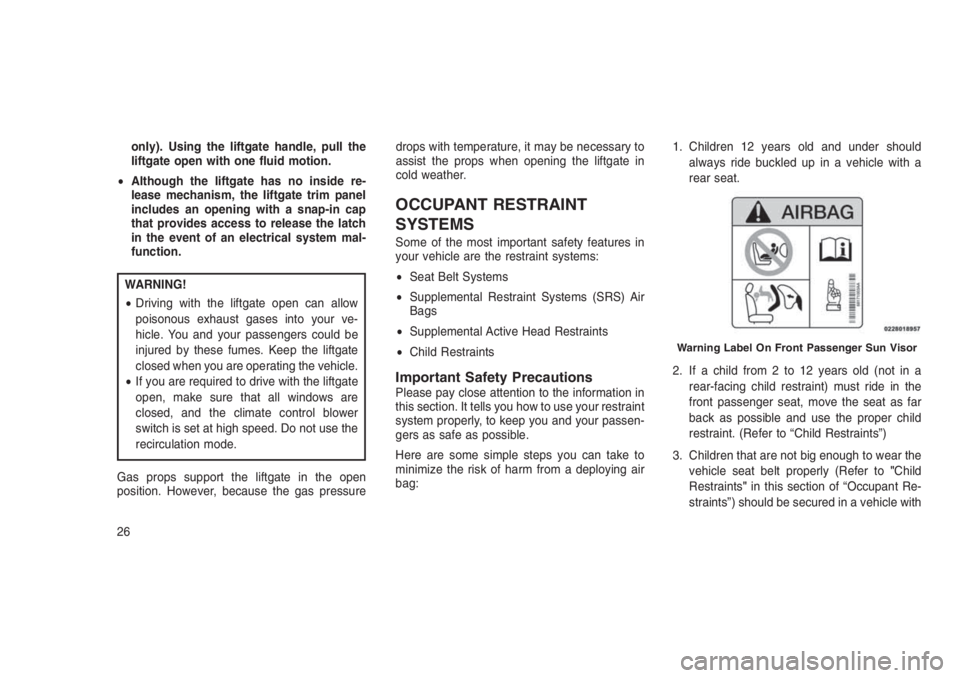
To unlock the liftgate, insert the key into the lock
and turn it to the right (manual lock models
only). The liftgate can also be unlocked
us-
ing the RKE Key Fob or by activating the power
door lock
switches located on the frontdoors. The central locking/unlocking feature (if
equipped) can also be activated from the liftgate
key cylinder.
Once unlocked, the liftgate can be opened or
closed without using the RKE Key. To open the
liftgate, squeeze the liftgate release and pull the
liftgate open with one fluid motion.
NOTE:
•In the event of a power malfunction, or the
RKE Key Fob is inoperative, insert the
RKE Key into the liftgate lock cylinder and
turn to the right (manual lock models
Power Window Switch Location
Window Lockout Switch
Liftgate Handle Location
25
Page 30 of 332
only). Using the liftgate handle, pull the
liftgate open with one fluid motion.
•Although the liftgate has no inside re-
lease mechanism, the liftgate trim panel
includes an opening with a snap-in cap
that provides access to release the latch
in the event of an electrical system mal-
function.
WARNING!
•Driving with the liftgate open can allow
poisonous exhaust gases into your ve-
hicle. You and your passengers could be
injured by these fumes. Keep the liftgate
closed when you are operating the vehicle.
•If you are required to drive with the liftgate
open, make sure that all windows are
closed, and the climate control blower
switch is set at high speed. Do not use the
recirculation mode.
Gas props support the liftgate in the open
position. However, because the gas pressuredrops with temperature, it may be necessary to
assist the props when opening the liftgate in
cold weather.
OCCUPANT RESTRAINT
SYSTEMS
Some of the most important safety features in
your vehicle are the restraint systems:
•Seat Belt Systems
•Supplemental Restraint Systems (SRS) Air
Bags
•Supplemental Active Head Restraints
•Child Restraints
Important Safety PrecautionsPlease pay close attention to the information in
this section. It tells you how to use your restraint
system properly, to keep you and your passen-
gers as safe as possible.
Here are some simple steps you can take to
minimize the risk of harm from a deploying air
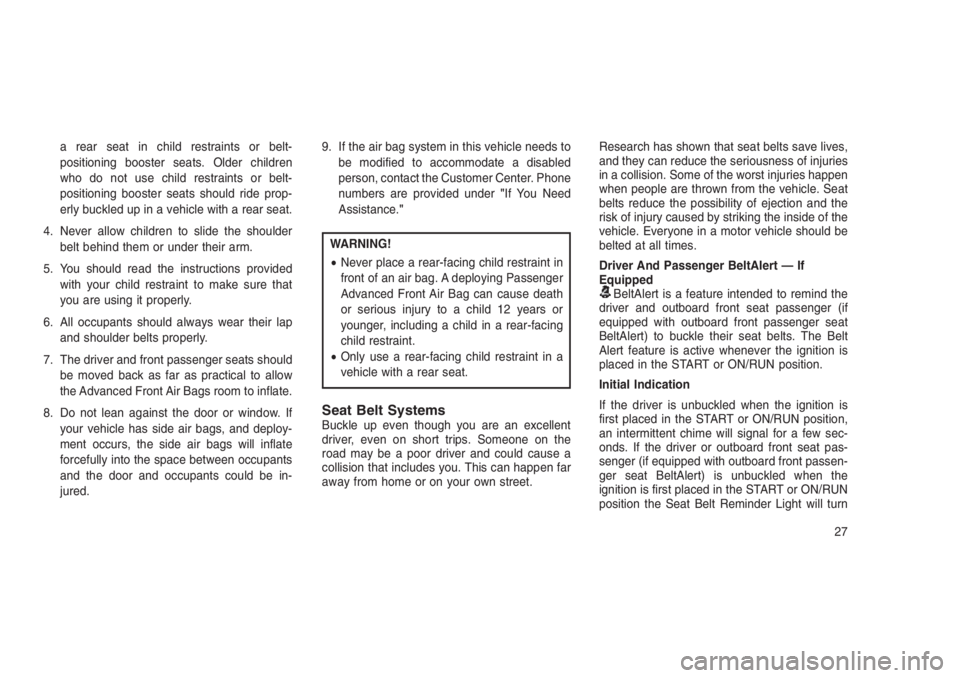
bag:1. Children 12 years old and under should
always ride buckled up in a vehicle with a
rear seat.
2. If a child from 2 to 12 years old (not in a
rear-facing child restraint) must ride in the
front passenger seat, move the seat as far
back as possible and use the proper child
restraint. (Refer to “Child Restraints”)
3. Children that are not big enough to wear the
vehicle seat belt properly (Refer to"Child
Restraints"in this section of “Occupant Re-
straints”) should be secured in a vehicle with
Warning Label On Front Passenger Sun Visor
26
Page 31 of 332
a rear seat in child restraints or belt-
positioning booster seats. Older children
who do not use child restraints or belt-
positioning booster seats should ride prop-
erly buckled up in a vehicle with a rear seat.
4. Never allow children to slide the shoulder
belt behind them or under their arm.
5. You should read the instructions provided
with your child restraint to make sure that
you are using it properly.
6. All occupants should always wear their lap
and shoulder belts properly.
7. The driver and front passenger seats should
be moved back as far as practical to allow
the Advanced Front Air Bags room to inflate.
8. Do not lean against the door or window. If
your vehicle has side air bags, and deploy-
ment occurs, the side air bags will inflate
forcefully into the space between occupants
and the door and occupants could be in-
jured.9. If the air bag system in this vehicle needs to
be modified to accommodate a disabled
person, contact the Customer Center. Phone
numbers are provided under"If You Need
Assistance."
WARNING!
•Never place a rear-facing child restraint in
front of an air bag. A deploying Passenger
Advanced Front Air Bag can cause death
or serious injury to a child 12 years or
younger, including a child in a rear-facing
child restraint.
•Only use a rear-facing child restraint in a
vehicle with a rear seat.
Seat Belt SystemsBuckle up even though you are an excellent
driver, even on short trips. Someone on the
road may be a poor driver and could cause a
collision that includes you. This can happen far
away from home or on your own street.Research has shown that seat belts save lives,
and they can reduce the seriousness of injuries
in a collision. Some of the worst injuries happen
when people are thrown from the vehicle. Seat
belts reduce the possibility of ejection and the
risk of injury caused by striking the inside of the
vehicle. Everyone in a motor vehicle should be
belted at all times.
Driver And Passenger BeltAlert — If
Equipped
BeltAlert is a feature intended to remind the
driver and outboard front seat passenger (if
equipped with outboard front passenger seat
BeltAlert) to buckle their seat belts. The Belt
Alert feature is active whenever the ignition is
placed in the START or ON/RUN position.
Initial Indication
If the driver is unbuckled when the ignition is
first placed in the START or ON/RUN position,
an intermittent chime will signal for a few sec-
onds. If the driver or outboard front seat pas-
senger (if equipped with outboard front passen-
ger seat BeltAlert) is unbuckled when the
ignition is first placed in the START or ON/RUN
position the Seat Belt Reminder Light will turn
27
Page 44 of 332
Bags fully inflate in less time than it takes to
blink your eyes. The air bags then quickly
deflate while helping to restrain the driver and
front passenger.
Knee Impact Bolsters
The Knee Impact Bolsters help protect the
knees of the driver and front passenger, and
position the front occupants for improved inter-
action with the Advanced Front Air Bags.
WARNING!
•Do not drill, cut, or tamper with the knee
impact bolsters in any way
•Do not mount any accessories to the knee
impact bolsters such as alarm lights, ste-
reos, citizen band radios, etc.
Supplemental Side Air Bags
Your vehicle is equipped with two types of side
air bags:
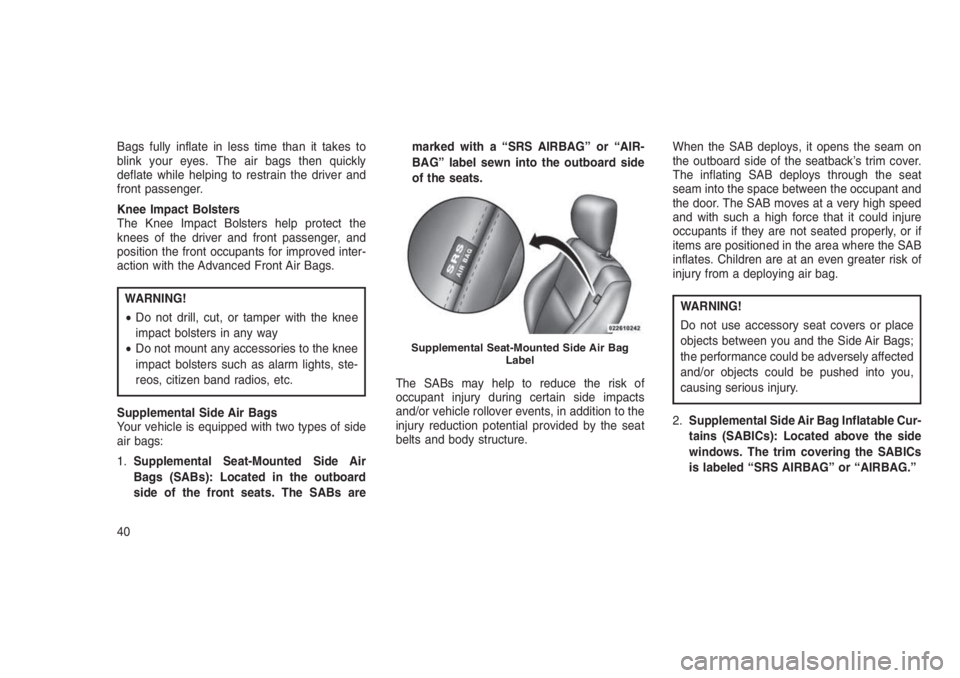
1.Supplemental Seat-Mounted Side Air
Bags (SABs): Located in the outboard
side of the front seats. The SABs aremarked with a “SRS AIRBAG” or “AIR-
BAG” label sewn into the outboard side
of the seats.
The SABs may help to reduce the risk of
occupant injury during certain side impacts
and/or vehicle rollover events, in addition to the
injury reduction potential provided by the seat
belts and body structure.When the SAB deploys, it opens the seam on
the outboard side of the seatback’s trim cover.
The inflating SAB deploys through the seat
seam into the space between the occupant and
the door. The SAB moves at a very high speed
and with such a high force that it could injure
occupants if they are not seated properly, or if
items are positioned in the area where the SAB
inflates. Children are at an even greater risk of
injury from a deploying air bag.WARNING!
Do not use accessory seat covers or place
objects between you and the Side Air Bags;
the performance could be adversely affected
and/or objects could be pushed into you,
causing serious injury.
2.Supplemental Side Air Bag Inflatable Cur-
tains (SABICs): Located above the side
windows. The trim covering the SABICs
is labeled “SRS AIRBAG” or “AIRBAG.”
Supplemental Seat-Mounted Side Air Bag
Label
40
Page 45 of 332
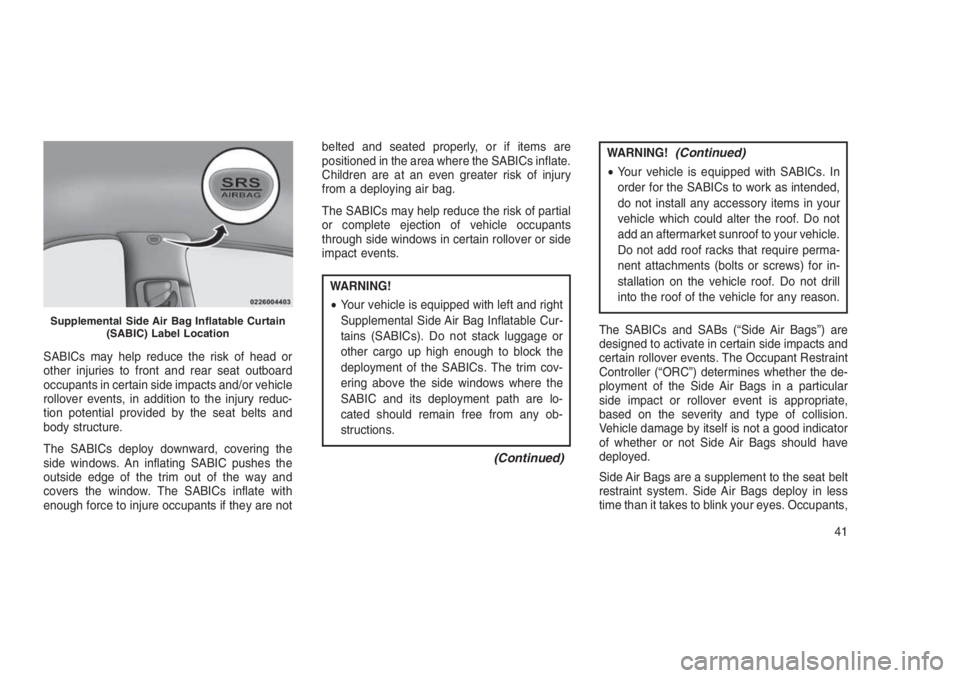
SABICs may help reduce the risk of head or
other injuries to front and rear seat outboard
occupants in certain side impacts and/or vehicle
rollover events, in addition to the injury reduc-
tion potential provided by the seat belts and
body structure.
The SABICs deploy downward, covering the
side windows. An inflating SABIC pushes the
outside edge of the trim out of the way and
covers the window. The SABICs inflate with
enough force to injure occupants if they are notbelted and seated properly, or if items are
positioned in the area where the SABICs inflate.
Children are at an even greater risk of injury
from a deploying air bag.
The SABICs may help reduce the risk of partial
or complete ejection of vehicle occupants
through side windows in certain rollover or side
impact events.
WARNING!
•Your vehicle is equipped with left and right
Supplemental Side Air Bag Inflatable Cur-
tains (SABICs). Do not stack luggage or
other cargo up high enough to block the
deployment of the SABICs. The trim cov-
ering above the side windows where the
SABIC and its deployment path are lo-
cated should remain free from any ob-
structions.
(Continued)
WARNING!(Continued)
•Your vehicle is equipped with SABICs. In
order for the SABICs to work as intended,
do not install any accessory items in your
vehicle which could alter the roof. Do not
add an aftermarket sunroof to your vehicle.
Do not add roof racks that require perma-
nent attachments (bolts or screws) for in-
stallation on the vehicle roof. Do not drill
into the roof of the vehicle for any reason.
The SABICs and SABs (“Side Air Bags”) are
designed to activate in certain side impacts and
certain rollover events. The Occupant Restraint
Controller (“ORC”) determines whether the de-
ployment of the Side Air Bags in a particular
side impact or rollover event is appropriate,
based on the severity and type of collision.
Vehicle damage by itself is not a good indicator
of whether or not Side Air Bags should have
deployed.
Side Air Bags are a supplement to the seat belt
restraint system. Side Air Bags deploy in less
time than it takes to blink your eyes. Occupants,
Supplemental Side Air Bag Inflatable Curtain
(SABIC) Label Location
41
Page 46 of 332
including children, who are up against or very
close to Side Air Bags can be seriously injured
or killed. Occupants, including children, should
never lean on or sleep against the door, side
windows, or area where the Side Air Bags
inflate, even if they are in an infant or child
restraint.
Seat belts (and child restraints where appropri-
ate) are necessary for your protection in all
collisions. They also help keep you in position,
away from inflating Side Air Bags. To get the
best protection from the Side Air Bags, occu-
pants must wear their seat belts properly and sit
upright with their backs against the seats. Chil-
dren must be properly restrained in a child
restraint or booster seat that is appropriate for
the size of the child.
WARNING!
•Side Air Bags need room to inflate. Do not
lean against the door or window. Sit up-
right in the center of the seat.
(Continued)
WARNING!(Continued)
•Being too close to the Side Air Bags during
deployment could cause you to be se-
verely injured or killed.
•Relying on the Side Air Bags alone could
lead to more severe injuries in a collision.
The Side Air Bags work with your seat belt
to restrain you properly. In some collisions,
Side Air Bags won’t deploy at all. Always
wear your seat belt even though you have
Side Air Bags.
NOTE:
Air bag covers may not be obvious in the
interior trim, but they will open during air
bag deployment.
Side Impacts
In side impacts, the side impact sensors aid the
ORC in determining the appropriate response
to impact events. The system is calibrated to
deploy the Side Air Bags on the impact side of
the vehicle during impacts that require Side Air
Bag occupant protection. In side impacts, theSide Air Bags deploy independently; a left side
impact deploys the left Side Air Bags only and a
right side impact deploys the right Side Air Bags
only.
The Side Air Bags will not deploy in all side
collisions, including some collisions at certain
angles, or some side collisions that do not
impact the area of the passenger compartment.
The Side Air Bags may deploy during angled or
offset frontal collisions where the Advanced
Front Air Bags deploy.
Rollover Events
Side Air Bags are designed to activate in certain
rollover events. The ORC determines whether
the deployment of the Side Air Bags in a par-
ticular rollover event is appropriate, based on
the severity and type of collision. Vehicle dam-
age by itself is not a good indicator of whether or
not Side Air Bags should have deployed.
The Side Air Bags will not deploy in all rollover
events. The rollover sensing-system deter-
mines if a rollover event may be in progress and
whether deployment is appropriate. A slower-
developing event may deploy the seat belt
pretensioners on both sides of the vehicle. A
42